
Podcast
Impact Journey with Julia
Hosted by Julia S · EN
Conversations with hidden heroes making big societal change.
Many of us want to make life better for others and the planet.
Few people devote their life to it.
Even fewer try to tackle the big systemic issues, like climate change and inequality.
In years working at the intersection of impact and strategy, Julia has been fascinated by these hidden heroes. Beyond what they’re doing, we explore how they got here, how they keep going, what they’re still learning.
Join the conversation, and inspire your own impact journey.
13episodes
Episodes
Newest firstAll episodes
Confronting Complicity in Capitalism - Wrap-Up (for now)
3w ago00:41:19Tap to summarizeWhat did we learn in our 3-month experiment to face privilege with care?No, we didn’t solve capitalism. We are not now doing money perfectly ethically forever. But we sure learned a lot. And phew, how our lives are already different.Some highlights for me:Our three original questions: seeing clearly (what are my resources and needs?), sitting with what's hard (is this money even mine?), and moving forward (what is mine/ours to do?). All three are still alive, not “solved.”From “is this mine?” to “what do I do with access to this?” We moved from an anxious, binary ownership question toward practical redistribution. For example, getting out of the stock market and letting resources circulate to people and community who need them now.Rejecting all-or-nothing thinking. A recurring insight: people assume confronting capitalism means either full compliance or total withdrawal / go live in the woods. Instead, we already live by multiple economic logics (capitalist, communal, hierarchical) simultaneously within our relationships. We can apply this to work and money too!“There's more than two options here, friends.”Privilege named systemically, not individually. Learning to name privilege openly (rather than downplay it as personal “bravery”) and to hold it “with care and joy rather than shame and blame.” More and more, we can see our privilege as a structural condition, not a personal trait.“This idea of me, mine, ownership, accumulation, possession... I can be a bit closer to why some of that feels problematic.”“It's not good nor bad, it just is.”Holding shame with care. Being witnessed while sitting with painful shame (rather than being judged or someone turning away) was one of the most powerful parts of the process, enabled by a small trusted container, and coaching from our mentor Miki Kashtan.Ripple effects into family relationships. The together work made it possible for Elena to approach money conversations with her parents more honestly, separating assumptions and projections from what was actually true, moving toward co-holding decisions with them.Collective/communal investing. Inspired by guest Morgan Curtis's resource library, we both want to move from individual financial decision-making toward more collective, community-based approaches to investing and resource-sharing.“Even me not making a choice – like keeping things invested in a retirement fund – is absolutely still making a choice.”What's next. Rather than a tidy conclusion, this is an ongoing spiral: next steps include our "purpose partnership," making needs more visible, and maybe even another experiment with new and different questions.And we're curious: What questions are still open for you? What feels new and illuminated?As always, follow along on…video on LinkedIn (visible if you’re connected to me or Elena)blog on Medium: https://juliash.medium.com/
Transcribe →
Confronting Complicity in Capitalism, Week 15: Processing Privilege
Jul 100:16:06Tap to summarizeIn the last episode, our mentor Miki Kashtan took us through some harsh - and needed - perspectives on privilege and how to work with it.Now, we take a moment to process it together.
Transcribe →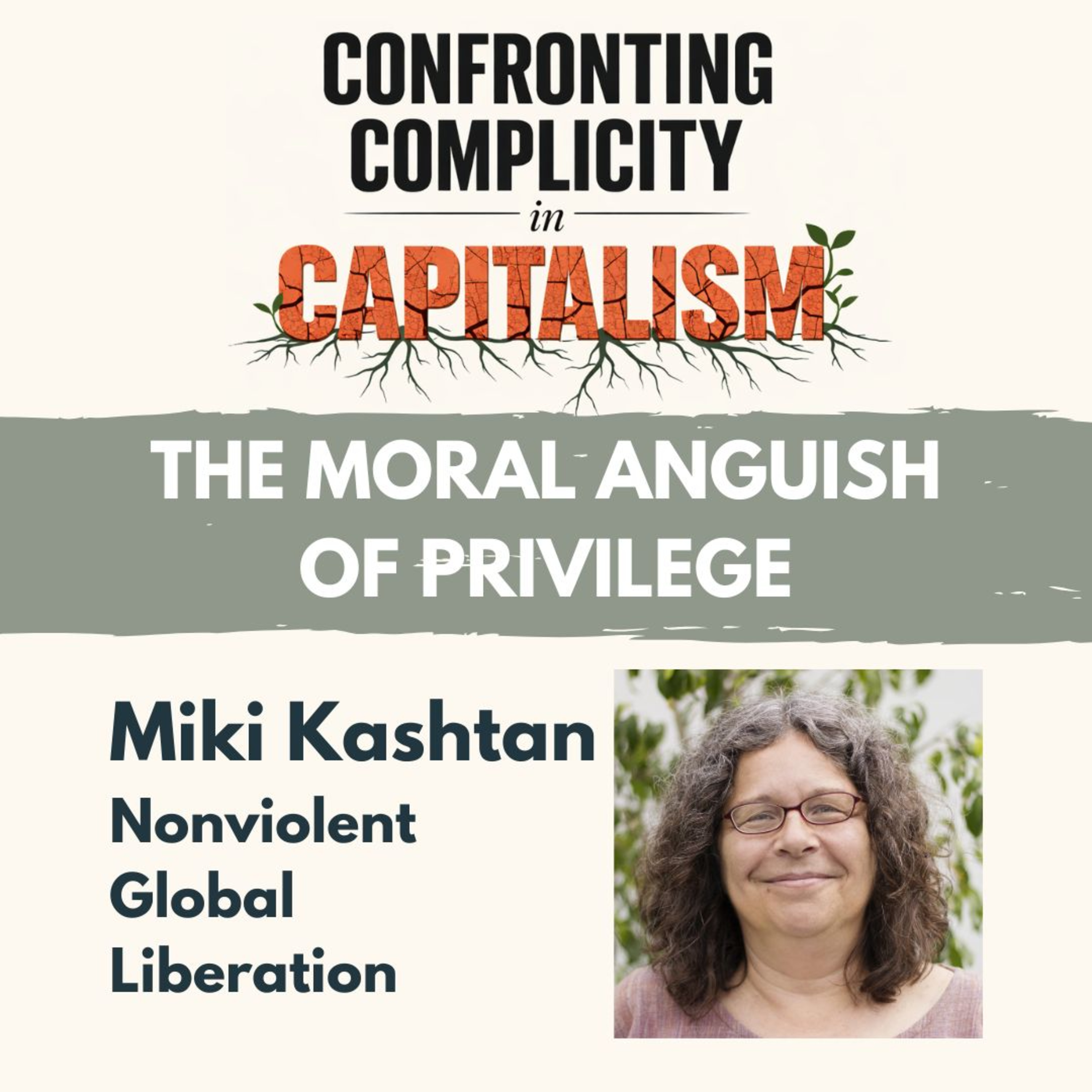
The Moral Anguish of Privilege - Miki Kashtan, NGL
Jun 1000:58:15Tap to summarizeThis podcast is part of a series called Confronting Complicity in Capitalism. As Elena and I come toward the end of this phase of confronting our complicity in capitalism, there is one loop we keep getting stuck in - shame, specifically the shame of privilege. And there is one person we wanted to speak to, a mentor of ours: Miki Kashtan. Miki is the seed founder of the Nonviolent Global Liberation (NGL) community where Elena and I met, the author of many books, and importantly she walks the talk of nonviolence - including offering her entire body of work entirely on the gift economy.And in this conversation - the longest and most vulnerable podcast I’ve ever published - she helps me and Elena make sense of what she calls the ‘moral anguish’ of privilege, and move through it in a way that’s soft, practical, transformative.THE IMPACT. Miki Kashtan:is a practical visionary pursuing a world that works for allapplies the principles and tools of Nonviolent Communication (NVC) to social transformationis the seed founder of the Nonviolent Global Liberation (NGL) Community is the author of The Highest Common Denominator and Reweaving Our Human Fabric, and The Little Book of Courageous Living. Miki also writes at The Fearless Heartholds a Ph.D. in Sociology from UC BerkeleyTHE JOURNEY. Some gems of wisdom that Miki takes us into:Judgment. We judge people relative to where we are. Anyone who is further outside the system is a radical fanatic, anyone more within the system is complicit. Anybody who recycles more is a fanatic; anybody who recycles less doesn't care about the Earth.Systemic shame. What is leading me to shame? Who is benefiting from my shame? The shame makes it look individual. So I had a good job, I am a problem. I have family intergenerational wealth, that is something wrong about me. Our place in the system. A system designed to benefit the fewer and fewer with each passing century at the larger and larger cost of the more many. I am just a cog in a system that no one knows how to stop. Understand the shame where you are positioned systemically, to see the values you hold dear that the shame is a distorted expression of. Means and ends. My deepest commitment is to aligning means with ends. If I treat myself poorly and do all these amazing things, the seed of non-love is there in what I do. The line of should, must, have to, shame, will not bring about a foundational shift to the system. Attachment. How attached people are to privilege is one of the core dilemmas of humanity, how to undo that attachment, what to replace it with that isn't done through internal or external imposition.From shame to grief. Shame is not gonna get us anywhere. Grief will. Moral anguish. This particular kind of pain, I call it moral anguish. It points to care. The more you can be with the pain, the more you're touching your care.Shit and bullshit jobs. That you have access to this money means that you don't have to do either shit or bullshit jobs. It's up to you what you do with your attention and energy. That is one angle of the privilege.Privilege and attention. No one is going to benefit from you taking on a regular full-time job. No one benefits from you suffering, from you feeling shame. From there, asking yourself : what is the most aligned pathway with where I'm situated, my sphere of influence, my skills, my strengths, my limitations?Modeling the change. You cannot change the systems. You're trying to model something. Rather than thinking about your privilege, think instead about what is yours to do given that you have the option to choose. A daily practice. Rather than looking for what is yours to do, review the day hour by hour. What felt on purpose, what was that purpose? What didn't feel on purpose, what do you wish you had done instead? Do that for a few weeks and see what you learn.Purpose. Some people have a very simple definition of what your purpose: that which you can't not do.
Transcribe →
Confronting Complicity in Capitalism, Week 11: Money (Dis)Entanglement
Jun 500:15:08Tap to summarizeIs it my job to make sure a collaborator is financially comfortable? This week, I got a verbal smackdown about my privilege. Instead of fighting (how dare you) or giving in (fine I’ll just pay for everything), I explore with Elena our responsibility to others when we’re entangled.In week 11 of confronting complicity in capitalism, we come upon the reality that changing how we do money is a relational practice, not just an individual one. What happens when money is unspoken? When needs are not met? When the reality changes and agreements aren’t working any more? This week, I face tension with a collaborator about a shared project:Responsibility. What is my responsibility to someone I collaborate with? It’s not my job to pay their rent and make sure they’re comfortable… It’s not nothing… What’s the middle ground?Agreements. This thing we agreed to isn’t working any more. One phase has ended, another is beginning. What does it mean to re-shape agreements? I’m different, you’re different, let’s review. Openness. Not jumping to conclusions, assuming that I have to fix it all. But something isn’t working. What is possible?Spoken and unspoken. With money, some things we discussed. But so much is implied. What happens when needs are unmet? Decentering humans. What’s important to both people, AND what’s important to the space and the ecosystem?And Elena tries to engage her parents about their shared privilege:Slow and tender. When we first started this project, I thought I would have regular conversations with my parents. This isn’t quick, it may not be as far along, and that’s ok. Any movement forward is all grist for the mill. If I try to move too quickly, I risk triggering people and taking steps back.Creating conditions. I want to disentangle… but that’s not where they are coming from. It’s on me to create conditions that don’t trigger shame and blame. How do I not get caught up when shame and blame does come up?Preparation and resourcing. So many of my stories are entangled with what I think they’re thinking. When I have the conversations, I want to meet them as they are. This takes a lot of prep work. Nonviolent communication. The root of how we approach our lives and work. Centering human needs. We can disagree about strategy… but what is the deeper need for each of us that we can’t disagree with?Choice. Recognizing interdependence, AND it doesn't always mean that we do everything together or need to be financially intertwined.As always, follow along on…- video on LinkedIn (visible if you’re connected to me or Elena)- blog on Medium: https://juliash.medium.com/
Transcribe →
Confronting Complicity in Capitalism, Week 10: Community Abundance
May 2800:15:47Tap to summarizeI just hosted a post-capitalist birthday party with my neighbors. Elena just returned from a local Burning Man event. In week 10 of confronting complicity in capitalism, both of us are in awe of the ABUNDANCE that emerges when we gather with dear ones… not just to have fun and celebrate… but to do life together, in interdependence rather than individualism / transaction / accumulation.So it’s no surprise that our theme this week is COMMUNITY, and all the ways in which we are living and learning about joyful alternatives to capitalism, including:Sharing resources. Sharing capacity. The challenge of complicity. Seasonality. Lightness. As always, follow along on…- video on LinkedIn (visible if you’re connected to me or Elena)- blog on Medium: https://juliash.medium.com/
Transcribe →
Spiritual Strategy for Systems Change - Erin Selover
May 2200:25:01Tap to summarizeThis podcast is part of a new series called Confronting Complicity in Capitalism. Our second special guest in the series helps us build the spiritual ground for this tricky work of confronting complicity in capitalism. Erin Selover is a ‘spiritual strategist’ who connects decades of Buddhist practice and teaching with nonviolence and collective liberation. She helps me put words to why my time in meditation retreat is not just a nice thing I do to stay sane, but a core practice for slowing down enough to see grasping and suffering, and to tap into our natural possibility for creativity and collaboration.THE IMPACT. Erin Selover:is a Dharma teacher with over 20 years of Buddhist practice and teaching, including at Spirit Rock Meditation Center in Northern California works with individuals as a spiritual strategisthas studied and experimented with Miki Kashtan and the Nonviolent Global Liberation communityas a white settler of Irish descent on indigenous lands, is in deep inquiry about the way power and privilege function within modern societies, and the complex history of her Irish ancestorsco-stewards a meditation community integrating the Celtic Wheel of the year and Buddhism within needs-based gift economics and distributive governance systemsis a Licenced Marriage and Family Therapist with training in Somatic Experiencing and Dialectical Behavioral TherapyTHE JOURNEY. In this conversation, we cover:From domination to collaboration. “ I get competitive when my needs aren't met. But when my needs are met, I'm not competitive. When my needs are met, I'm generous, and that's what I see with the thousands of people that I've worked with over the years. When our needs are met, we're generous, we're creative, we're collaborative.”Slow down, wake up. ”When we slow down, our natural awake heart, unfolds and reveals all these tendencies. It just reveals it to us. We don't have to actually effort. In a way. It's like just slowing down and being in nature and eating food slowly. It shows us, oh, I'm being urgent in this particular way, or I'm actually judging myself so hard, or some of this action is driven by my own unworthiness.”From the individual to the systemic. “What are the systems that we live in that have reinforced this judgment? What are you struggling with that isn't actually personal? But it's collective. What's the context that we live in that in part inform this? And can you direct that energy, that anger that you're feeling at yourself, can you direct that energy at the system?”Gift economics. ”I live as much in gift as I can. Drawing on a deep trust in life that if I continue to give in this way, I'll be able to bear whatever the consequences are of the choices that I make with dignity, with an open heart, with care, for myself and others.”
Transcribe →
Confronting Complicity in Capitalism, Week 8: Work Anarchy
May 1400:12:17Tap to summarizeWhat is ‘work’? Is it the thing that gives me money? Or the thing I spend time and energy on? And what if those two were … separate?In week 8 of Confronting Complicity in Capitalism, Elena and I unpack and repack ‘work.’It turns out there are MANY ways to do ‘work.’For anyone aware of ‘relationship anarchy,’ this may sound familiar. Just like there are more ways to have a relationship than “traditional marriage with house and kids and everything with one partner,” there are more ways to work than “job description with fixed hours and a salary.” In fact, it’s a whole smorgasbord of choices!And they don’t just apply to me as an individual. We are coming up with our own model of a “purpose partnership.” Not a startup or business venture, not just project collaborators, not friends helping each other out. But with new-to-me interdependence – shared risk, mutual exchange and development, co-creation, making decisions together, a deep commitment. With money and way beyond money.We are curious what comes up for you as you unpack and re-pack this idea of ‘work’:Could ‘relationship anarchy’ apply to work? Could we uncouple what is considered ‘work’?How could we put it back together in new creative ways? Resources on topics mentioned:On Miki Kashtan and NGLOn relationship anarchy: manifesto, smorgasbord, historyAs always, follow along on…video on LinkedIn (visible if you’re connected to me or Elena)blog on Medium: https://juliash.medium.com/
Transcribe →
Confronting Complicity in Capitalism, Week 6: Beyond All-or-Nothing
Apr 3000:12:58Tap to summarize“I made my bed… Do I need to lie in it? Or can I make a different bed?”In Week 6 of our inquiry to confront complicity in capitalism, we explore CHOICE, especially the places in work and money where it feels like the choice is all-or-nothing: full financial independence not relying on anyone, or complete merging of finances; everything separate or everything in common. We refuse to believe that… and try to find our way into the middle ground.This week, we dive into the choice and middle ground in:How we work. Beyond “entirely dependent employee” or “fully independent freelancer.”How we do money. Playfully choosing what ways we interlink our finances, money, resources, needs.Beyond the project. It’s easier when there’s a project and budget and start/stop. What about in between projects?Opening possibilities that weren’t there. For example, applying for one job as two people. Material limitations. Not all options are always on the table. Choice in relationship. What if others aren’t in the same relationship to choice, and see it as more fixed.We’re curious: Where do you get caught in ‘all-or-nothing’ ? How did you break out of it? What beds have you made that can be made differently?This is part of a new series called Confronting Complicity in Capitalism. This special series is a season of experiment to really look at money and privilege with care & joy rather than shame & blame.As always, follow along on…- video on LinkedIn (visible if you’re connected to me or Elena- blog on Medium: https://juliash.medium.com
Transcribe →
Confronting Complicity in Capitalism, Week 5: In the Flow
Apr 2200:09:55Tap to summarize“When I accumulate, resources don’t flow.”In Week 5 of our inquiry to confront complicity in capitalism, we reconnect to FLOW – how this inquiry flows beneath the surface even when life happens, how we are complicit in not flowing resources where we really want, how we can be choice-ful in how we live and work and spend.This week, we dive into:Life happens. This conscious inquiry in the forefront … AND seeping in the background.The point is flow … YET accumulation is the opposite of flow.Privilege in capitalism. We are still complicit … WHILE we’re trying to create something new.The full range of options. Nurturing a multiplicity of alternatives… NOT just one logic: where to be in gift economy, in conscious exchange, in mutual aid, in other ways we don’t even know yet.How to be in this system … WHILE weakening capitalism from the inside out. Is that even possible?We’re curious: How are you flowing resources in your world to subvert harmful systems?This is part of a new series called Confronting Complicity in Capitalism. This special series is a season of experiment to really look at money and privilege with care & joy rather than shame & blame.As always, follow along on:video on LinkedIn (visible if you’re connected to me or Elena)audio in the Impact Journey podcast: https://creators.spotify.com/pod/profile/impact-journeyblog on Medium: https://juliash.medium.com/
Transcribe →
Confronting Complicity in Capitalism, Week 3: Inspired by Morgan Curtis
Apr 900:12:19Tap to summarizeCould I ever give away everything I’ve earned or inherited? What leads someone to make that choice?In week 3 of Confronting Complicity in Capitalism, we take in the wisdom of someone who’s been doing this work — for herself, with her family, with others with privilege — much longer: Morgan Curtis at Solidaire Network.I interviewed Morgan on this podcast, where she shares what led her to question the origins and impact of her family’s wealth, and to ultimately to give away all of her financial inheritance (before the birth of her first child, no less!).As we listen to Morgan’s insights, Elena and I may not end up at the same conclusions, but are certainly challenged to dive into tough questions for ourselves:What does it mean to question whether ‘my’ money is ‘mine’?How have I fallen prey to capitalist conditioning to replace relationships with transactions?What would it take to ‘invest’ in a safety net that’s NOT based on accumulating money?This is part of a new series called Confronting Complicity in Capitalism. This special series is a season of experiment to really look at money and privilege with care & joy rather than shame & blame.Follow along…- video on LinkedIn (visible if you’re connected to me or Elena): https://www.linkedin.com/posts/ugcPost-7445803475755499520-zQnc- blog on Medium: https://medium.com/@juliash
Transcribe →