Loading summary
Transcript37 lines
- [00:00]
A
Rabbi I'm rabbi ami hirsch of the stephen wise free synagogue in new york. And you're listening to in these times.
- [00:12]
B
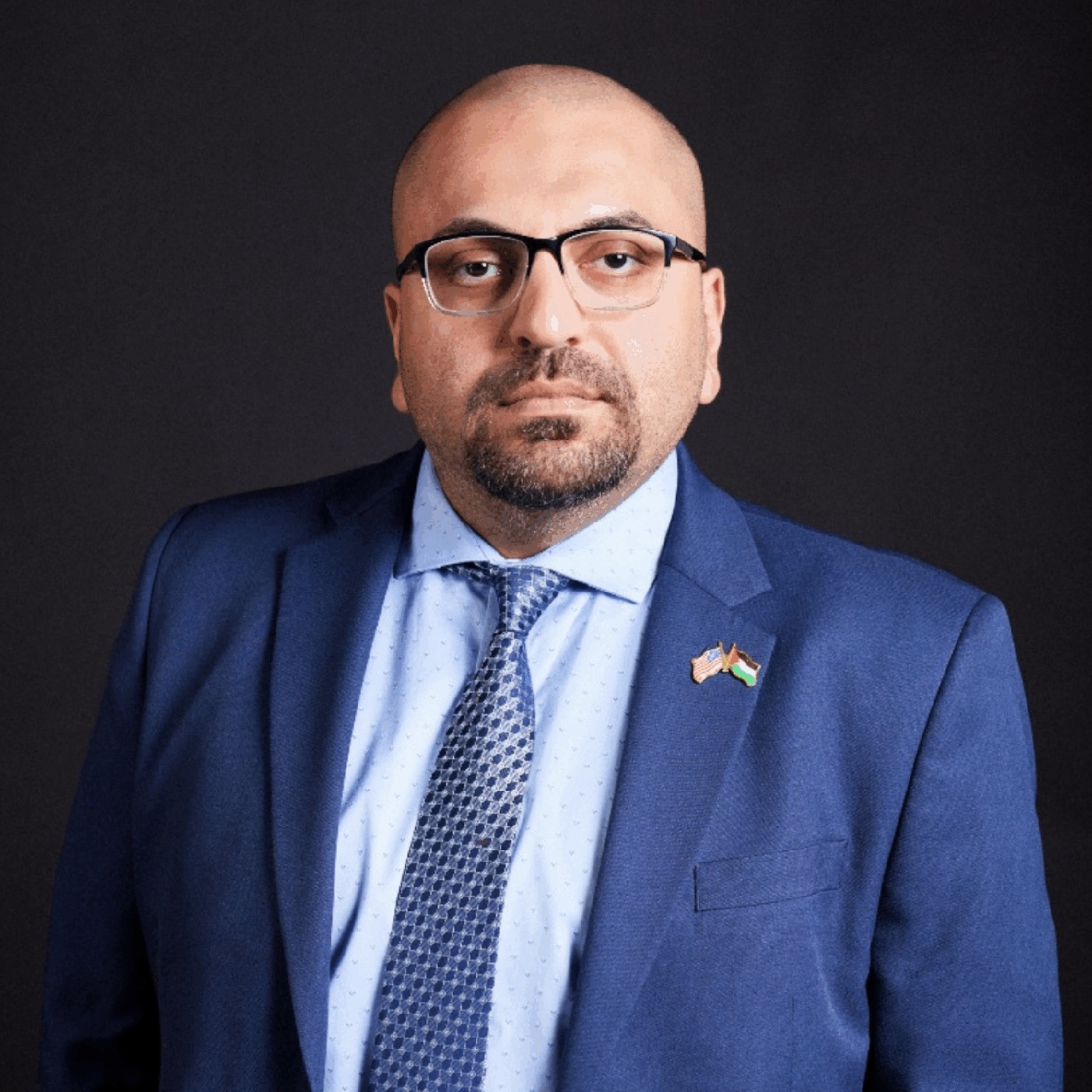
As I record this. The United States and Israel are at war with the Islamic Republic of Iran, an oppressive regime and the sponsor of countless acts of terror around the world, including the October 7th attacks. But when this is over, the century old Israeli Palestinian conflict will remain. My guest today grew up in Gaza as a youth. During the second intifada, he was injured by an Israeli airstrike and he's lost many friends and family members to war. Yet Ahmad Fouad Al Khatib refuses to succumb to the vicious cycle of hatred and violence. As a senior fellow at the Atlantic Council and the founder of of Realigned for Palestine, Ahmed is pursuing a different kind of pro Palestinian advocacy, one that recognizes Palestinian agency and is committed to nonviolence and radical pragmatism.
- [01:14]
A
Ahmad Fouad Al Khatib, welcome to in these Times.
- [01:18]
C
Thanks so much for talking to me. Appreciate it.
- [01:21]
A
And apropos. In these Times. These times are so consequential. I very much appreciate you coming on because our audience for in these Times doesn't normally hear directly from Palestinians. First of all, let me ask you, so the war in Iran as we're recording it now is in its third day. What do you make of what's going on now? And what do you make of the objectives that the Americans and the Israelis have?
- [01:51]
C
For me, I see the war in Iran, or war with Iran as the continuation, if you will, of what began on October 7th. I mean, what Sinwar and Hamas did on that day in particular. And when I say Hamas, it's actually even more narrowly the military wing of Hamas. The two psychopaths within Hamas, Sinwar and Al, they very much so estimated that Gaza will be ground zero for the end of the normalization project between Saudi Arabia and Israel. But that the Islamic Republic of Iran, through this extensive network of the proxies we've heard about in the so called axis of resistance, which included Hezbollah in Lebanon, the Houthis in in Yemen, Hamas in Gaza with other groups like Palestinian Islamic Jihad, the state of Syria that was under the control of the Assad regime, Shia militias and parts of the Iraqi state apparatus and the popular mobilization militias. And then you have the head of the snake itself, the Islamic Republic with its arsenal of drones and cruise missiles and ballistic missiles and, and other capabilities. And so there was the belief that once you trigger this cataclysmic event for which Israel was woefully unprepared and surprised that that would turn Gaza into ground zero for such a massive regional war that would usher in the beginning of the end of the State of Israel. And what we just saw over the weekend is the continuation now of arguably two and a half years of a gross miscalculation that has not only failed to produce the aforementioned results of the plan that Hamas had desired, the way that the Islamic Republic of Iran had envisioned its proxies in these different Arab and Muslim countries protecting it from direct confrontation. That was the whole point of the proxies, was to actually protect the Islamic Republic from having a direct war with Israel, with the United States. Not only did that fail, but Gaza actually ended up being ground zero for the beginning of the end of the so called axis of resistance and has actually turned Israel into, into a regional superpower. Now, of course, that came with a whole host of pain, destruction, damage. Gaza's in ruins, many parts of the Middle east are in ruins. There's a lot of risk, and I'm certainly not saying this as if I'm cheering for this outcome. I'm simply diagnosing, I'm simply speaking from an analytical point of view.
- [04:57]
A
So, so you think that actually by sunset of October 7th, in the end, all roads at the end of the day had to lead back to Tehran, that what was triggered and launched on October 7, inevitably, one way or the other, was going to conclude or at least lead to what we're seeing now
- [05:19]
C
in these very days, Precisely that, and I have long been, been very clear that there will never be peace between Palestinians and Israelis, there will never be a Palestinian state, there will never be any calm in Gaza and certainly in the west bank while the Islamic Republic of Iran continues to exist in its current shape and form. I'm not talking about the nation of Iran, I'm not talking about the people of Iran. I'm simply talking about the regime. I'm talking about the apparatus that for 47 years has been in control of this incredible nation with an immense history.
- [05:58]
A
And the reason for that was, is because when it came to Israel, their ideology was simply, it was irreversible. They wanted to destroy Israel. There was no, no negotiating with that, no compromising with that. And the ring of fire that they built around Israel through all their proxies was devoted to, specifically to that cause. And until the Republic of Iran was weakened and its proxies weakened or even eliminated, you couldn't advance the Palestinian issue at all. Is that essentially what you're saying?
- [06:38]
C
Well, it's multidimensional so that's certainly the ideological component. That's a dimension of it. But I would argue that there are other more sinister and quite frankly, just overly, like, let's just overly simplify and say that. I mean, it was a brilliant tactic to divert a lot of resources away from the Iranian people and toward the irgc, the Quds Force, the whole. The military industrial complex of Iran, which made immense successes in how they like. There was an economic component to it, there was a PR component to it. There was a religious, there was a legitimacy component to it. I mean, Iran, unfortunately, or the Islamic Republic, simply looked to what the Arab countries had done for decades before it and realized that at some point, any despot, any dictator, any failed state could just, you know, pledge to fight on behalf of the Palestinians, use the Palestinians, use the Palestinian issue to gain legitimacy and to suppress internal dissent. Because we're doing it for the, for, for, for Allah, for jihad, for Jerusalem, for the Palestinian people. They made a lot of money off of this. And they were able to. I mean, Iran was able to basically occupy multiple Arab capitals and, and Arab countries. Iraq, sy, Syria, Lebanon, Gaza, Yemen. They meddled in Saudi Arabia and eastern Saudi Arabia, where not only all the oil is, but where much of the population is Shia. They meddled in Bahrain. And this is all before the war. And I'll just close out by just saying that Hamas in Gaza would not have been what it is over the last two decades without the support of the Islamic Republic of Iran with the tunnels, with the combined arms warfare, with the missiles, with the way that it carried out the October 7 attack. Similarly, many people don't understand or appreciate that it was the Islamic Republic of Iran that in the 1990s incited Hamas and the Palestinian Islamic Jihad against the viable yet fragile Oslo peace process process, directly giving them money, asking them to carry out those terror attacks and suicide bombings, but also helping form this radical block against any effort for a negotiated settlement with the State of Israel. So that's where I think, unfortunately, the Islamic Republic of Iran was always going to meddle in the Israeli Palestinian conflict with no end in sight.
- [09:31]
A
So it really is astonishing that the people most responsible for launching October 7th are all dead. Sinwar is dead. DEF is dead. Nasrallah is dead. Assad is gone. Khamenei is. Is dead. So what they wanted to do happened exactly in reverse. And it was collapsed on them, actually. And it rendered Israel, strategically, at least, in a much stronger position than October 6th.
- [10:02]
C
Precisely. Precisely the case. I mean, I think the way. I mean. And this is what's so frustrating with some of the pro Palestine voices that have emerged after October 7th. And what they fail to appreciate in making some of those maximalist demands and pushing so hard at actually normalizing Hamas's rhetoric, normalizing October 7, celebrating the resistance narrative, is that you threw all of your eggs in a losing basket in a, in a, I mean, forget the morality component, which October 7th was a horrendous action that I think was, was despicable. And I'm part of why I speak out as someone from Gaza, as someone who has family there, who has lost family there, who has grievances with the state of Israel, but still just without any qualifications or unconditionally opposed to the taking of women and children and the elderly as hostages, in addition to the morality argument that October 7th was bad, it was such a strategic fiasco. And to not see that Gaza literally became ground zero for Israel and expanding its reach and influence across borders of multiple nations. And Israel actually being in a position now where it's indirectly aligned with many more Arab countries because they face a similar enemy. So Hamas may have foiled Saudi Israeli overt normalization, but in reality they actually ended up bringing under the table at least. And that's how a lot of things happen in the Arab and Middle Eastern Muslim world. They actually ended up creating greater synergy between the state of Israel, irrespective of how loathed Netanyahu and the far right government is the State of Israel and many Arab nations. So, so that's where I just think it's such a twist of fate and events. And now, to be clear, what is going to unfold? I mean, it remains to be seen what will unfold in the Islamic Republic of Iran and how there could be an off ramp that President Trump pursues, resulting in the maintenance of some aspects of the regime. But let there be no doubt that, that what remains of this regime, regardless of how the day after in Iran looks like, will be nothing like it was before this war.
- [12:51]
A
So moving on directly to the Palestinian Israeli dispute, can you tell us, broadly speaking, from your perspective, the dispute has now been going on for well over a century. Fundamentally, what is it about?
- [13:07]
C
So I have thoughts and observations, but I'll start with the Palestinian side. I think on the Palestinian side, you do have a sense among many that there was that the way that the Zionist project unfolded entailed inherent injustices which the Palestinians are still dealing with and facing today. Now, one of the things that I have, and I've heard this narrative from my Own grandparents who were pushed out in 1948 from my parents who grew up in refugee camps in Gaza, actual refugee camps, like tents in Gaza. In the early 1950s, I, when I lived in Gaza, I experienced elements of that. My, my family, I mean, I have within me like the battle scars, if you will, during the second intifad, I'm largely deaf from my left ear from a bombing that killed two of my friends who were teenagers and almost killed me and rendered me largely deaf in an asymmetric sense. I lost dozens of my immediate and extended family members in this war. It's like for the Palestinians, they feel that there has been a generational perpetuation of this injustice.
- [14:23]
A
What is the nature of the injustice from the Palestinian perspective?
- [14:28]
C
So there are many Palestinian perspectives. There is no singular Palestinian voice or narrative. And I actually, this is one thing that I always try to preface and highlight that no one person or one narrative really speaks for the Palestinian because Palestinians in Gaza are different than Palestinians in the west bank are different than Palestinians in East Jerusalem or different than Palestinians in Syria, Lebanon and Jordan, or those who remained in the land and became citizens of Israel. So it's very key to actually like, despite the portrayal of this universal Palestinian perspective that doesn't in my view exist. So it's two, it's two components. Number one is that it is unjust for the Jewish people to act upon an old claim of ancestry because it feels that only they, they being the Jewish people and Zionism, have that special right and privilege to return to a homeland thousands of years after their displacement when most of the world has experienced all a whole host of displacements, genocides, conquests and conquerors. So that's, that's injustice number one. And then there's the sense of injustice. Number two is that as the Declaration of Israel neared in 1948, there was the bringing of different refugees, Jewish refugees from different parts of Europe whose refuge and safety came at the expense of the Palestinian people's ability to live in their ancestral homeland. And that persists today where Palestinians, for example, in the west bank or what's known as by many as Judea and Samaria, are being pushed out by settlers. But Jews from around the world have a right to make aliyah when the Palestinians themselves are being pushed out. So those are the two core elements.
- [16:43]
A
I studied at the London School of Economics when I was a student. I was in my 20s, it was 40 some odd years ago. And I remember I had a professor, he was a world class international relations expert and he said to me he was lecturing and he said, you know, there are two insoluble problems in the world. This was in the 1980s, the Irish problem and the Israeli Palestinian problem. In the meantime, the Irish problem, it still has fits and starts, but essentially it was solved. But the Israeli Palestinian issue is not solved. And it looks to many people like, if anything, we're further away than ever. Mindful of what you just said, do you think it could be resolved? And if so, how? And what would the timetable of that be?
- [17:31]
C
Certainly so I have, between learning, speaking to Palestinians who've been involved with this issue for a long time, doing research, I mean, I have filled in multiple gaps that I do sincerely wish are more prominently understood and recognized by my folks and my people and the Palestinian people to really get us out of this perpetual cycle that unfortunately has had us entrapped for generations. Even as Israel grows stronger, bigger, more successful, and as time goes on, we lose more land, more options, more people. And many parts of the world are moving on from the Palestinian issue. Like I don't consider a bunch of the incendiary pro Hamas protesters or even like the initial wave of pro Palestine protests following October 7 or in the early days of war. That's inconsequential. Like I care about outcomes and results. So with that in mind, you look at the early history. Then you look at the pan Arabism of Abdel Nasser. We have the nationalism of the plo, we have the Marxism and communism of the PFLP and democratic fronts and the Soviet supported groups. And then now we've had the Islamism of Hamas. I think you look at the missed opportunity, for example, between 1948 to 1967, why wasn't a Palestinian state declared then? Why what? When Jordan was in charge of the west bank and Egypt was in charge of Gaza and we had East Jerusalem, why wasn't even a provisional Palestinian state declared and established? And why establish the PLO in the 60s when again we still had the territories like that, both of these territories, and you look at what happened after the 73 Yom Kippur War and how Sadat in Egypt pivoted away from war and wanted to pursue peace. And like that could have been a significant opening for the Palestinians and for the Arabs to pragmatically look, I mean, Israel demonstrated a willingness to give up territories that it conquered for peace. We could have had the 67 borders at that time. Then you do look at the 1990s, and I experienced the tail end of the 1990s. I flew into Gaza's short lived airport in 1999 and in 2000. Can you imagine, I remember that Palestinian airlines. Can you imagine just uttering those words? And yeah, an authority passport instead of the Egyptian travel document and the elements of state statehood. And yes, the Palestinian Authority was corrupt to the bone, but still like there was hope and it's a beginning and you can slowly get somewhere. And that was sabotaged by Hamas and by external interference and not to mention the 2000 Camp David and how Arafat didn't say yes but didn't say no. He danced around the corner and then he was like, well, let me then do this, you know, the second Intifada, thinking that he's going to, you know, enhance his negotiating position. But it got out of control. And I've spoken to senior PLO officials who told me point blank that the intention was not for the second intifada to get out of control, was meant to be a very small thing for Arafat to claim that he's still the revolutionary because people were calling him a traitor and to try to like gain leverage in the negotiations. And it got out of control and, and we lost the opportunity. Then you have the 2005 withdrawal of Israeli settlements in 2008. That was an opportunity to create what could have been a successful role model for Palestinian self governance and what an occupation free west bank can and should look like. So this is where I, without denying that Israel has had a significant role in my view and the injustices of the Palestinian people, I believe that within the imbalance of power dynamics between Palestinians and Israelis with Israel being up here, there very much so exists plenty of space within this imbalance for Palestinian Agency responsibility and accountability. Accountability to learn from our mistakes, to learn from history, to acknowledge that October 7th was a choice, not a necessity, to acknowledge that there were choices that made for the disasters that we're in. Even as you want to criticize Israeli actions. So I share with you the frustration that it's one thing to have a legitimate grievance towards maybe historic or even contemporary, like what's happening with the settler violence in the West Bank, I think is appalling and I think is despicable. And on the other hand, it's also another to just be perpetually caught in this state of victimhood and of paralysis and learned helplessness, thinking that somebody else is going to come from the outside and save us.
- [23:14]
A
So do you think that in the foreseeable future there's a way to reach some kind of reconciliation, say within the next generation?
- [23:25]
C
Well, I'm going to Speak specifically about Gaza. I'm a believer in a Gaza first approach because if we don't solve Gaza, there will never be anything meaningful happening in this issue. Not in the west bank, not on the broader conflict. If we don't address, for the past 20 years more foreign and international aid was invested and spent in Gaza than anywhere else in the world. And look at where Gaza is. If we don't address the fact that even left leaning Israelis who are against Netanyahu and against the far right fascist in his government are afraid of pulling out of the west bank because they don't want a repeat of the Gaza situation. If we don't address Gaza being a success story, then I think we're going to be in a perpetual state of stalemate. With that in mind, I've spoken to several senior Palestinian and US officials and Israeli officials who have said that every single day there are plots that they intercept fomented by the Islamic Republic of Iran to carry out attacks to create instability, to cause the Palestinian Authority to fully collapse, because that's what the Islamic Republic wants. Gaza's decimated. So they're like, let's see what we can do. And the goal is to elicit an overwhelming Israeli military counter strike or attack on Palestinians in the west bank and hoping that that will keep Israel busy and destabilize Israel from within. In the context of the last two and a half years after the consequences of October 7, due to the totality of the failures of the last 20 years by Hamas and their behavior during the war and their fascism and violence and the Islamism rotten ideology, I am actually hopeful that there are voices in Gaza who are ready for something else, something different. That's why I'm putting myself out there as much as short term. I'm pessimistic about many subjects related to the Israel and Palestine conflict. I am very, extremely hopeful that the people of Gaza will actually have already, even if we don't have incredible media that can capture the sentiments of the people of Gaza. My family, I have a brother there, I have an army of contacts. Ten years ago I tried to build an internationally run Israeli approved airfield in there. I've done humanitarian projects on the ground in there. It's like I have a very good sense of what a diverse segment of the population. I speak to former Hamas folks and Hamas defectors who during this war were like, this has been a terrible dream. Like what have I been a part of? And these are lawyers, teachers, doctors, nurses, engineers, NGO professionals, administrators, bureaucrats, technocrats. These are people across Segments of society. These are construction workers, these are garbage workers. These are either every, every segment of society and there are people that you and I, or most people wouldn't know their names. They're, they're as average as, as it gets. They're people that if they're given a chance to rise up and be part of a new generation and given actual safety and security so that they're not persecuted, given actual opportunity, just the biggest bare minimum of their needs and allowed access and the space to engage in a new culture, a new deradicalized education and just a space to transform themselves and their lived reality. 70% of Gazans have never left the Gaza Strip. People are a product of their environment. They will absolutely perform miracles. And, and there is enough there that I strongly believe, and this is what I keep saying, a significant chunk of Gazans are ready to move away from the so called resistance narrative to the nation building agenda. All ultimately will lead to the coexistence narrative. But you see it's sequenced and I'm very deliberate because even though they're against Hamas, there's still a lot of it doesn't mean they're ready to talk to Israelis or they're ready for peace. It's a journey, it's definitely a journey and I think they're ready to go on this journey.
- [28:27]
A
They're not Zionists and they won't be Zionists. Can I ask you, I assume that you were, remember where you were when you heard the news of October 7th. Can you share what you felt just personally and on behalf of the Palestinian people and could you relate also to you live in the west when you saw the protests? I don't even know how to characterize them. I, I, I didn't necessarily think they were pro Palestinian because I didn't think they were. The effect of them was to be pro Palestinian. I think maybe they were Hamas supporters was more accurate actually as a characterization. What did you feel personally on October 7th and when you began to see the responses immediately in the west, in the streets of the west and in the academies of study, did you feel that they were helpful to the Palestinian cause or did you feel that there was some moral hollowness at the core of those protests that these young, mostly young Westerners didn't really get, didn't really understand?
- [29:44]
C
Well, I mean that's part of why I'm here and doing what I'm doing. And I was in California and I'm in Washington D.C. that that right now is precisely like it, it began on, on 10 7. It was, it was October 6th. It, evening of October 6th here in the United States. I was in California and I just come back from a long run or walk and, and I, I, I remember after just slowly getting catching up with what, what, what was really unfolding, like screaming into the void and saying that Gaza's as we know it is going to see Stigs and exists. And I, I started just piecing together the different pieces and, and I remember distinctly thinking that I hope the Israeli casualty numbers don't keep climbing because I knew the more they kept climbing, the more horrendous this war and the counter reaction was going to be. And there were several Palestinians on social media and that, that in Arabic that I remember seeing their posts and them going like, Hamas just sold us out. Hamas just betrayed us. Hamas. Like, yes, there were Palestinians who were celebrating. Yes, there was a sense of novelty, of like, oh like people were mesmerized. It was like it was, some of, for some people it was a spectacle. Those people who went in it was, and looted, it was a spectacle. It was like, it was like a, like going to like the zoo or going to like the shopping mall. There was just the concept of a mass entry into Israel in this fashion, a mass casualty event was just, you know, it immediately did brainwash a lot of people. But what I'm saying is that there were people early on that were like, oh crap, like Hamas just sold us out. Like Hamas just like, you know, even my mother who was I consider like basically politically illiterate, said to me, they destroyed Gaza for Qasem Soleimani, the head of the irgc, that, you know, this is part of the avenging of the death of Qasem Soleimani. So it was equally shocking when there were the immediate protests and people were like calling it a genocide, like two days into it, like there wasn't even a war really then. And people were saying this is a genocide. And I remember seeing a statement from Senator Chuck Schumer, he said something like, to the effect of, I couldn't think of a more ill timed protest as Israelis are still battling to like regain control and like calculate like, you know, tabulate their dead and whatever. So it was then that I was horrified by the celebration of Hamas as a resistance organization, as the normalization of such a vile terrorist organization. The cheering on of the taking of women and children and the elderly as hostages. I mean, again, let's just play along for a second. If you just went into military bases and you took soldiers, like, don't do that because regardless, you just crossed into Israeli territories and you just broke a ceasefire. But let's just for the argument's sake, pretend that you can make a case and say, okay, these are soldiers, these are whatever, blah, blah, blah. But you took little, like literal children's, like, like, like tiny little children and the elderly and women, and you were parading dead, half naked bodies in Gaza. Like that is vile. Like, that is disgusting. Like, those are not the values of my once beautiful society that I believe Hamas has decayed from within after two decades of Islamist despicable, fascistic rule that was significantly enabled and supported by the Islamic Republic of Iran, by Qatar and others. And so then to see the hordes of the, you know, I call them the pro Palestine industrial complex. There's the pro Palestine folks. I call them the quote community. Because you can be pro Palestine. I'm pro Palestine. I've met a lot of Zionists and Jews and Israelis who are pro Palestinians.
- [34:19]
A
Listen, I consider myself pro Palestine to the extent that I would, I would be supportive of reconciliation between Palestinians and Israelis. I've worked on that my whole life. So, I mean, I don't want to diminish the term, but in a broad sense, I have nothing against the Palestinians and I'm a very strong Zionist and I would like for them to prosper precisely that. I think if the Palestinians prosper, that's good for everybody, for them include and
- [34:50]
C
the Israelis, precisely that. On the other hand, I will say that there was also an immense amount of ignorance and dehumanization of all Gazans and everybody's Hamas and every. Because a lot of folks didn't really understand Gaza very well. They understood Hamas, they understood the horrible imagery of the abuse of hostages going in, of the celebrations in Gaza. And though a few thousand had participated in that, there was then kind of this application of, well, then 2.2 or 2.3 million Gazans must therefore be like those, you know, 3 to 5,000 who may have in total celebrated, attacked and gone in after the Nokhbabais went in. And so between the dehumanization of Israeli victims of October 7, the hostages and the survivors, and just what had happened and the celebration of Hamas as resistance and the total degradation of the actual Palestinian advocacy movement and efforts and the ethos and between the dehumanization of the Palestinian people, I think incitement against the, just the wholesale killing of Palestinians and seeing them as all animals and really just horrendous incitement that I knew was going to lead to somewhere Horrible. This is where I wanted to throw myself out there and that I wanted to do something. You know, I hate this term, the cliche, something in the middle, like a third way, a third narrative of a sort that, that pulls in different, that holds multiple truths, that is radically pragmatic, that realizes the intricacies and interconnectedness of the two people's futures and pathways forward. And that's not Kumbaya. That's not just a peace and love and like, let's have dialogue and everything's going to be fine. There's actual like desperate radical pragmatism to avert disaster for both of our peoples. And that's what I've been doing, what I decided to do very quickly after 10 7. And that was put to the challenge when I lost immediate and extended family members in both of my childhood homes, were destroyed in several Israeli airstrikes. And I have immense amounts of resentment and anger and grievances over that. And I also work really hard at not harboring notions of hatred because that only leads to revenge. And I want to honor the legacy of my fallen family members by working towards healing and reconciliation and breaking away from the vicious cycle of hatred, incitement, revenge, violence and violence, and rinse and repeat that is so characteristic of this conflict. And so that's how 107 really shaped who I am today and got me started on doing narrative work to try to push for a different pro Palestine narrative and point of view that rejects the relics of the past, rejects the violent rhetoric, rejects the maximalism, and is radically pragmatic while also trying to dabble in policy, which is much more difficult because it's politically a dead end issue for several reasons. But that's why I got to Washington D.C. and I began a gig at the Atlantic Council where I'm a senior fellow. And I started a project called Realign for Palestine to create an organizational framework around this so that it's not just a one man show, but something that can hopefully be inspirational for others.
- [38:48]
A
Ahmed, you've had very, very deep context, ongoing context for the last 20 years with Gaza. Did it surprise you and do you think it surprised the population that was not Hamas? The extent of the Hamas tunnel network in Gaza?
- [39:08]
C
Well, unfortunately towards the last few years, it kind of was one of the biggest open secrets. Not that that everybody knew where the tunnels were, but it was very out in the open that Hamas was digging tunnels everywhere. Everybody knew it. Israeli intelligence knew it. So for example, I would call my mom and I'd ask her about distant neighbors because you know, I always reminisce. I haven't been in Gaza for. For quite a few years. And so I was like, oh, Mom, I wonder what happened to that neighbor up there or that person. And, you know, oh, so and so got married, so and so. Oh, so and so. It was, like, relatively common every few months to be like, so and so, oh, he's a loser. He's now digging for Hamas. Like, it was well known. So Hamas would have people in disconnected cells. They had amazing operational security where it was like, basically a team of five. Sometimes that way, if they were exposed, they only exposed the little segments, and they only had them dig little segments, and then they would rotate them and have other teams come in. So that way, if the Shin Bet or Israeli intelligence exposed you or if you were a mole, you're only telling the Shin Bet, well, here's. I don't know, like, 300 meters that we dug here. Here's. There's 300 meters we dug there. But, like, they're disconnected. And you don't know if these are tunnels, if these are standalones, if these are connecting ones. If these are like decoy tunnels. Sometimes they would actually. I've heard from several people, they would actually have people dig deliberately decoy tunnels and then see, like, monitor those people's behaviors to see the level of penetration by Israeli intelligence. But I want to be clear about something. Two things in particular. Number one is there were many cases where people were opposed. Like, people's. Like, shafts or tunnels were. Would appear under people's homes, and they would. They would speak out again. They would confront the people. And Hamas. Well, the first thing is they would threaten people with all sorts of punitive measures up to disappearance. But then in certain other cases, like underneath big markets and big sprawling community centers, because, you know, sometimes you can also hear or feel certain shakings or certain whatever. They would also bribe certain businesses and certain people and buy their silence. I would be very curious to know how much NGOs knew about Hamas's use of their. And. And of their. Of their facilities and underneath their facilities and some of the unrun. The UN facilities. And like, yes, there was Israeli propaganda that was a little bit over the top, but the truth of the matter is that there was absolutely exploitation of the humanitarian sector on numerous levels by Hamas. And I think many of these organizations knew. Some of them, they were too scared to say anything. Some of them felt that we just were operating in a difficult environment, so we got to keep our mouth shut. Some of them felt that, well, our focus is on the population and serving their interests. But I still think in retrospect it was a mistake that there wasn't a cohesive confrontation of Hamas. Even if the, like the locals find they have to live there, they're, they're, they're weak, they're, Hamas will just kill them off or whatever. But that international NGOs that used local staff that basically knew about some of Hamas's activities and chose to remain silent, I find that, I think in retrospect, I think that that's very disturbing and that should actually be not just investigated but like, like taught and like lessons. We should extract lessons learned from this for future conflicts because those organizations and the NGOs, they command billions of dollars in international aid and support across conflict regions. And so I think there needs to be a reinforcement of like what are the red lines? Like what is the ethical code of conduct? And yes, you're operating in areas that are under the control of violent terrorist organizations. They're not always jihadi Islamist groups. Sometimes in Africa or Latin America or whatever. There could be drug organizations or there could be separatist organizations, or they could be rebel groups. But what is the red line? What is the behavior? Like, like the expectation here? I think that to learn the lessons
- [44:17]
A
from Gaza, your opposition to Hamas's ideology and policies is profound and apparent and public. Are you concerned personally for your safety? Do you receive threats and how do you respond if you do?
- [44:40]
C
Well, certainly I do. I mean I've paid a heavy price for personal and otherwise for this opposition. I've had significant numbers of the pro Palestine industrial complex come after me. I've had Islamists, I've had like leftists and wokesters and white folks and university students and professors and journalists and others in the United States and Europe and elsewhere and NGO administrators and nonprofit professionals come after me for this. So yes, I've faced harassment, being ostracized, being attacked. I faced like actual threats that required involvement of the FBI and like authorities and private security and armored vehicles and all, you name it. But I don't regret that at all. I don't regret what I'm doing. I wouldn't do anything different. There's a huge number. I mean, what I'm saying in English is there aren't that many Gazans in English who are saying what I'm saying. But in Arabic there are many Palestinians who are saying what I'm saying, including some in Gaza, overtly and covertly. In other words, there are thousands of Ahmad's out there. I'm not unique in my opposition to Hamas. I am unique in the sense that I'm not just against Hamas because of the consequences. I'm against Hamas because of the principle, because of a desire for peace, because I want to end this conflict. I'm against Hamas because it's part of an ecosystem that has benefited, it's part of a grift that has benefited so many people. And then finally there are so many in the land, but certainly people here who are regularly Arabs, Palestinians, Muslims, sharing with me how grateful they are that someone else is saying this. This is a common phrase that I hear. I'm just glad someone else is saying this, or I'm just glad someone is saying what we all know and believe is true, but we can't say so publicly ourselves. And I appreciate those sentiments, even though I would prefer that more and more of these become public. But I've also had people tell me that, you know, I speak out against Hamas and my Facebook friends are crazy or my in laws are insane, or my Muslim group kicked me out, or I can't get play dates for my children or the halal market guys or the Arab market guys are acting all weird around me. And so there's a very, unfortunately, and this is where I'm, I'm very disgusted, disgusted by elements of the Palestinian and Arab diaspora and the Muslim diaspora that there has not been the ability to separate the Palestinian people's just an urgent aspirations for self determination, freedom, dignity, independence from a vile, despicable, anti Semitic, jihadi fascist organization like Hamas. And somehow speaking out against Hamas is equivalent to, oh, well, you're just, you're, you're being against Palestinians or you're supporting Netanyahu killing Gazan children. And these are the same people, by the way, that will often cry foul when, when someone, I mean, like, like there's just, without going into details, there's just inconsistencies. And so I'm, I'm very frustrated by that. I'm frustrated by how also the aforementioned communities in the diaspora have become single issue voters and activists when in fact there are many issues that are facing Arab, Muslim, Palestinian Americans or those who are living in the UK or Europe that are much more than just Gaza. But I'll just close by saying that, you know, there's a disconnect between the discourse in Gaza where people have skin in the game and are paying the price of Hamas failures and violence and horrors and criminality versus those who are in the diaspora with varying degrees of privilege and they're totally disconnected. And so I've gradually basically moved on from the diaspora based discourse. And I'm focusing on supporting and amplifying folks in Gaza and amplifying the voices, courageous voices in Gaza, because those are the ones who are actually going to forge a different future, not those in Dearborn, Michigan.
- [49:32]
A
My last question to you Ahmed, is we have many thousands of listeners and people who watch the podcast. My guess is most of them are Jewish and my guess is most of them are supporters of Israel, love Israel. And my guess is most of them, although not all of them, are liberal. Do you have a message to American Jewry?
- [49:57]
C
I register that you have faced a really difficult two and a half years from multiple directions. On the one hand you have the Kahanas and the far right elements of the pro Israel or Jewish or Israeli communities or you know, whatever self identified folks who have affinity for Israel who have really embraced an all or nothing black and white, you know, us versus them. You're either with us or you're with a terrorist. And what that has resulted in is an inability to express any empathy or compassion for the Palestinian people. On the other hand, traditionally liberal, progressive or leftist spaces have in significant numbers really abandoned many of their Jewish constituents and in an effort to be supportive of the Palestinian people have, have embraced some deeply problematic and really destructive and pathetic narratives and views. And so I reckon that many in the Jewish community are struggling to find their space within the political spectrum, if you will. So I hear you and I see you and I know that it's been difficult and I know that it feels hopeless and I know that there have been some really awful, terrible things directed at you. I will tell you that yes, I might be loud, I might be one of few who are just out there in your face. I don't care. I'll tell you what I think. But there are thousands of Ahmed out there and should there be. And they're not just in Gaza also, they're here in the United States. There are many people who are looking at what Students for Justice in Palestine or Jewish Voice for Peace or Care or you know, dsa, Democratic Socialists of America or the Squad or others are putting out and saying I'm Muslim, I'm pro Palestine, I'm pro Gaza, but this is, this is not me. So please understand that there are many out there also in the Arab, Muslim and Palestinian community who are struggling as well. And I would argue their struggle is compounded to find their space on the political spectrum without being part of the loony Democrats or the racist Republicans. And I'm not even here to speak about politics. Neither Republican nor Democrat. It doesn't matter. So you're not alone. We're in this together. And finally the people of Gaza are done with Hamas. Yes. It doesn't mean they're ready for total peace with Israel. Remember I said it's a journey, but there is hope. Otherwise I would have moved on. I have a degree in intelligence and national security. I have many opportunities for other jobs. Like I wouldn't. This is not glorious work like this is. This is horrible on my health. I would much rather move on to something else. I want to walk away from this every single day. But I see those people in Gaza and I see everybody talking over them. I see no one listening to them. I see them as being treated as inconvenient voices by the pro Israel folks who want to say all Gaza's Hamas or the pro Palestine folks who want to say all Gaza is Hamas and resistance. And that's the irony of it all. So I insist for as long as I can to stick around and say like most Gaza is truly not Hamas. Right now even Hamas dudes are jumping ship. But Al Jazeera doesn't want you to see that. Independent media doesn't want you to see that. Progressives and leftists don't want you to see that. So just look a little bit deeper and check. Check me out on on social media and realignforpalestine.org Ahmed Fouad Al Khatib, thank
- [54:17]
A
you very much for taking this time with us, for shedding light on very complicated issues, for supporting and pursuing peace and we wish you well.
- [54:29]
C
Thank you brother. God bless.
- [54:38]
B
This podcast episode is especially especially important to me. Not because I agree with everything that Ahmed said, I don't. Rather, I'm interested in platforming important voices and bringing attention to perspectives that are not given enough consideration. When the Iran war is over and
- [54:56]
A
when the guns over Lebanon and Israel
- [54:58]
B
have fallen silent, the Palestinian Israeli dispute will remain. I hope that in the aftermath of the historic takedown of the Iranian regime of terror which fed the murderous proxies of Hezbollah and Hamas, new creative approaches for progress between Israelis and Palestinians will open up. By the end of this war, Israel will have eliminated practically every leader who was responsible for planning and executing October 7, and severely weakened the murderous rejectionist forces that were arrayed against it for decades. I have no illusions. Even if progress will be made on the Israeli Palestinian conflict, it will take many years, perhaps generations. There will be no permanent settlement anytime soon. But I meant what I said to I wish for Palestinians what I wish for all people peace and well being. And if there is to be progress, it must be through the cultivation of people like Ahmed Fawad Al Khatid. Palestinian thought leaders who are not radical hate filled extremists who commit or justify the worst savageries human beings can imagine. I'd like to emphasize two points that Ahmed made especially to our younger audience. First, Ahmed insisted that Palestinians too have moral agency and to portray Palestinians as innocent victims of forces beyond their control is to infantilize and disenfranchise Palestinians themselves. They launched October 7th. It was their choice. They didn't have to. They took hostages, grandparents and babies and refused to release them. They didn't have to. They turned down every two state solution since the partition plan of 1947. It was their choice. They didn't have to. They choose struggle with Israel over accommodation. They don't have to. And as Ahmed emphasized, as a result of these choices, the Palestinians have not manifested their potential while the state of Israel gets stronger, wealthier and more developed every day. And second, especially to our younger audience, pay careful attention to Ahmed's frustration with so called pro Palestinian Western protesters. Most of them are pro Hamas, not pro Palestinian. There's nothing pro Palestinian about supporting Hamas. They brought catastrophe to Gaza. They are the tip of the spear of the Iranian inspired effort to spread
- [57:19]
A
radical Islam around the world.
- [57:22]
B
Hamas represents the same Islamist forces that destroyed the twin towers on 9 11. Hamas is a disaster for Palestinians. The entire anti Zionist struggle in the west and on campus in particular, is conducted above and beyond the actual people on the ground. It's about theories divorced from realities. There's something distastefully elitist about ignoring actual people in service of an academic proposition. Do anti Zionists think that Israel's right to exist is theoretical for Israelis and Jews? That we can introduce some resolution at the Oxford Debating Society? Does Israel deserve to exist and debate whether Western students think that's a good idea? Do not confuse moral conviction with moral preening and virtue signaling. The Israeli Palestinian conflict is not one of race or skin color or colonial oppression or apartheid or ethnic cleansing. It is not intersectional with and an extension of American social justice struggles. People and societies are much more complicated than that. You cannot simply clothe all of the world's conflicts with the same garment. And by the way, most Israeli Jews are Jews of color. They're not European and they are not white. They are refugees and descendants of refugees from the Middle east, persecuted by Muslim rulers and arriving in Israel with nothing but the clothes on their backs. And even most of the Europeans who made their way to Israel were fleeing persecution, pogroms and oppression. They were emaciated refugees, the miserable surviving remnants of the genocide of our people. We need to make anti Zionism disreputable again. We need to strip it of its venera virtue. There can be no such thing as virtuous antisemitism masquerading as virtuous anti Zionism. The fact of the matter is that half of our people lives in Israel, and most Jews of the world feel an existential bond with the Jewish state. I hope that you do too. Until next time. This is in these times.