← Insights Unlocked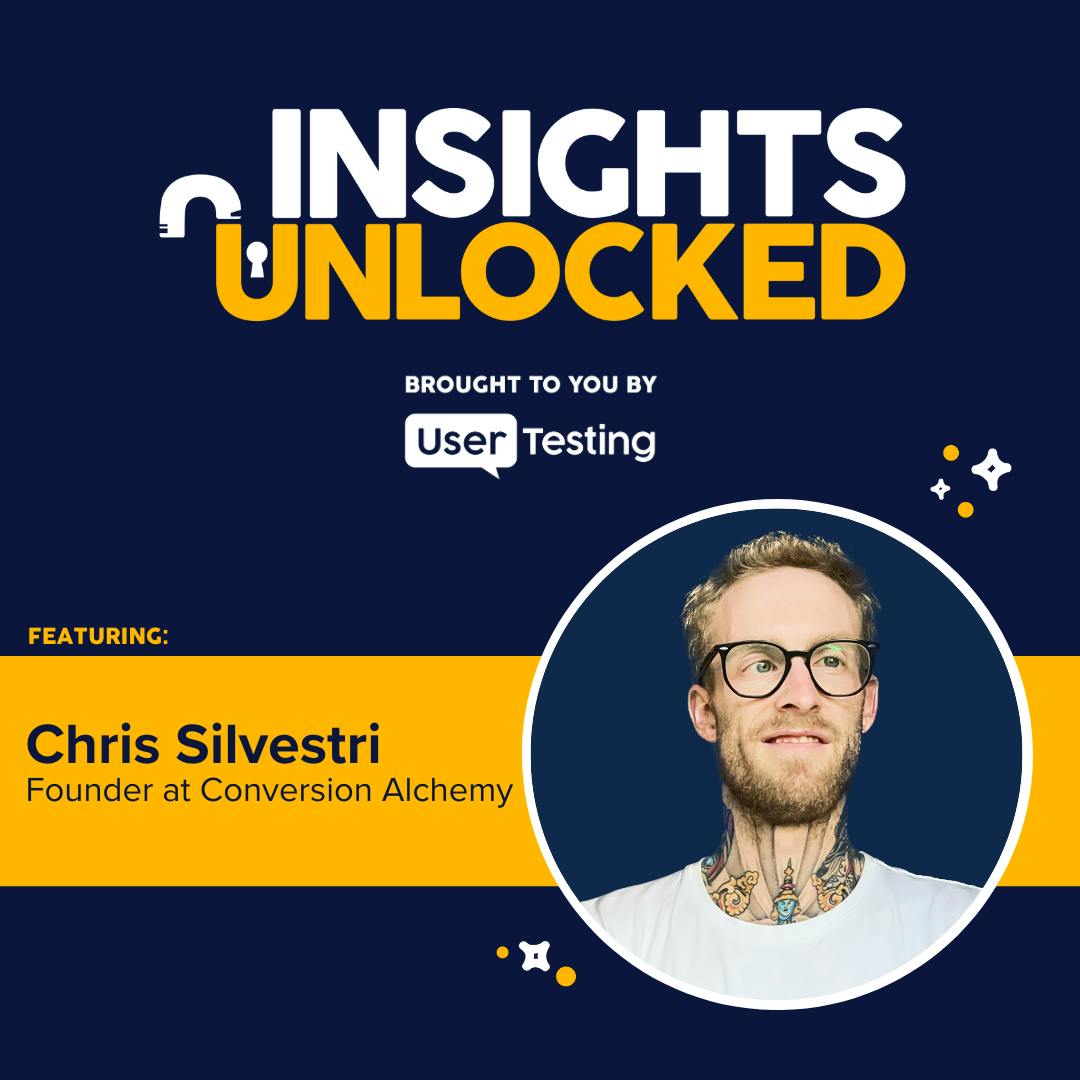
Insights Unlocked
Conversion copywriting starts with customer research
00:31:18
Learn how Chris Silvestri uses customer research and user testing to craft conversion copy that resonates. Real insights, not guesswork, drive results.
Loading summary
Transcript33 lines
- [00:02]
Nathan Isaacs
Welcome back to the Insights Unlocked podcast. In this episode I'm joined by Chris Silvestri, founder of Convergent Alchemy and a self described Conversion alchemist. We dive into why great messaging isn't about being clever, it's about doing the work and truly knowing your audience. Chris also shares how research, user testing and even AI simulated Personas shape high converting copy and smarter strategy. If you care about customer first content, you'll want to stick around. Enjoy the show.
- [00:34]
User Testing Host
Welcome to Insights Unlocked, an original podcast from User Testing where we bring you candid conversations and stories with the thinkers, doers and builders behind some of the most successful digital products and experiences in the world, from concept to execution.
- [00:53]
Nathan Isaacs
Welcome to the Insights Unlocked podcast. I'm Nathan Isaacs, Principal Content Marketing Manager at User Testing and our guest today is Chris Silvestri, founder of Conversion Alchemy and the self described Conversion Alchemist. With a background in software engineering and UX, Chris now helps B2B SaaS companies nail their message market fit through research driven copy that speaks directly to what customers are already thinking. Welcome to the show, Chris.
- [01:20]
Chris Silvestri
Hey Nathan, thank you so much for having me.
- [01:23]
Nathan Isaacs
Chris, you describe yourself as the Conversion Alchemist, which is fitting given how you blended your past as a software engineer, your passion for UX and now your work helping B2B SaaS brands with their message marketing. What was the moment or insight that made you realize conversion copy wasn't just about words but about psychology, research and experience design?
- [01:49]
Chris Silvestri
Yeah, it's a good question. I think it stemmed a lot from my background as you mentioned. So I was a software engineer in industrial automation. So very different from the typical software engineering that you hear about, web development and so on. So it was a lot of very logical systems thinking, a lot of UX as well, because I was designing the interfaces for operators and then I moved to direct response copy through various different paths and I stumbled on the actual conversion copywriting, which is what I'm kind of doing now. But I also took a detour in user experience working at an agency. So lots of different various experiences that actually taught me that the real secret to the actual good writing was actually putting yourselves in other people's shoes first and foremost. Right? And like the main insight was once you are able to do that, the actual copy doesn't really feel like writing. It's more architecting and more translating what people are thinking inside their minds and putting it on the page. And once you're able to do that, you kind of get that empathy, that intuitive feeling that copy almost writes Itself.
- [03:06]
Nathan Isaacs
Well, speaking about writing itself, you said 70% of your work is research at user testing. Likewise, we also believe customer insights drive empathy and clarity. How do you determine when you've uncovered enough insight to start writing?
- [03:23]
Chris Silvestri
Yeah, so, I mean, over the years I kind of established my own frameworks, processes. So I know from experience that typically, I don't know, between 7, 10 customer interviews could give us good insights. Or maybe running five user tests per ICP could be good. Or looking at 200 reviews, let's say. So all of those, like different numbers and frameworks, help me identify. Okay, this is a good amount of insight to get to where we want to go, but probably the more, again, intuitive feel, it's when I start seeing patterns. So it's more like a pattern recognition. Looking at research and looking at insights, that tells me at some point, okay, like, I'm seeing the same insights, the same voice of customer come up over and over. It means that we are onto something. Right? So this is a probably a good point to stop ruminating over the research and start getting into maybe the strategy or the writing. And to be honest, like, when you start, when you try writing copy and you're still not at a good point where you maybe you still need to know something else that you haven't covered, the copy feels kind of clunky, doesn't come out naturally. So you. That that's also another sign that tells you, okay, I'm not ready, I need to go deeper, or I need to cover this other aspect that I haven't covered. So, yeah, I think it's a mix of systems that I've built over time. But also there's still that intuition and kind of pattern recognition.
- [04:59]
Nathan Isaacs
For me. You know, I used to be a former newspaper reporter, and I realized when the story was hard to write, that means I hadn't done enough research and I was struggling, I'd be like, oh my gosh, what am I going to do? And then if I just made that one more phone call, then all of a sudden everything sort of flowed from there. Likewise, when I was cheating, and I shouldn't admit this on podcast, when I was cheating in college on a term paper and I bought that term paper, it was harder making it, you know, in my own voice, right? It was like, oh, this should have been so much easier if I just did the work anyway.
- [05:38]
Chris Silvestri
And I think that's a really good insight because especially now with AI, lots of people use AI to write, but they don't really dive into the whole research or process. That's before using AI and that's when they actually write stuff that they either don't understand or don't even remember having written. And that's kind of a problem. Right. Comes to actually converting customers.
- [06:02]
Nathan Isaacs
Oh yeah. And, and, and, and, and it could be we, we'll dive more into AI as the interview moves along. But I think also I people, it's not the shortcut. It's not a shortcut. And, and it's going to give you an answer. The answer will look like it's right. And if you didn't do the research, you won't know that it's not right. And that's what your, that's what your sales message is or your marketing copy on your website is or whatever it might know the research is saying, boy, this person is a dummy. I don't, I do not need to do business with them.
- [06:40]
Chris Silvestri
Yeah, it's about, it's all about the reps. Yeah, those reps in.
- [06:44]
Nathan Isaacs
Oh my gosh, I should. That's why I tell my family it's all about the reps. Yeah. What are the signs that teams are operating on assumptions rather than real user input? And, and what's the impact? I, I think we're talking about it now, but what's the impact on copy performance?
- [07:01]
Chris Silvestri
Yeah. So usually when I dive into a project, rather than just merely looking at the copy or the messaging that they have, I try to be proactive about that and do some discovery. So the first question that I ask is, how many customers have you spoken to recently? If they say none. Okay, maybe we need to dive into some research and figure out what you're actually doing or basing your copy off of. And two other questions that I ask, especially when I do team interviews. So maybe I typically interview the founder, marketing support, operations, sales, and I try to gauge how aligned they are and how much they know about their customers. So two questions that are super important are typically who do you help? Which is phrased very simply because I literally want them to tell me what be, especially what kind of Persona, whether it's the marketer or cfo, not what kind of business as they help. Right. So the other question is what problem do you solve? Or what problems do you solve? Which tells me a lot about how much they understand about the value propositions, positioning, and all that stuff. But typically, if I just want to look at their websites or their marketing materials, I typically can gauge whether or not they are aligned based on, for example, the homepage tells an entirely different story from their sales tech, which means Marketing and sales are completely misaligned or a lot of different pages start from very different starting point. They don't really have a cohesive narrative or cohesive value proposition, which again tells me that they don't really have a clear messaging framework. They use a lot of buzzwords, kind of the usual jargon, which basically means that they don't know the specifics and how customers actually speak. And, and usually there's a lot of tweaking like constantly adjusting a B testing little wars because they don't really know what they're doing. And so they again basing those changes on assumptions and kind of little ideas that they have like at the last minute typically. So yeah, I think these are the signs for me.
- [09:17]
Nathan Isaacs
Yeah, sure. You mentioned talking to your customers and in the past you've mentioned usability tests and watching videos, session videos. What are some of the overlooked insights marketers or copywriters can gain from watching users navigate their site or even just reading aloud the copy on a website or email?
- [09:39]
Chris Silvestri
Yeah, I've always said, and that's because when I was working at an agency as a UX lead, we kind of transitioned into usability testing startup. So we were kind of a competitor of user testing, but in a much, much smaller scale. But I used to watch hundreds of user test videos every month. Right. So I kind of started seeing patterns and starting seeing the value in actually observing what people did on websites and what they tell you about what they're observing in the moment and the difference between maybe like running a B testing. It's a B testing can tell you what doesn't work, but it doesn't tell you why. Right. And with user testing you gain a lot of insights into their decision making process with what, which is what you mostly typically can get through customer interviews. Right. So decision making process and the behavior during their decision making process. So that's super helpful. So like learning thing like things about where their flow on the website breaks or what kind of friction points they meet or what specific phrases or sentences they find confusing or maybe is the visual hierarchy of your message. So maybe you have a couple of headlines that are not clear, they skip them entirely, so you need to emphasize those points. So all of these little behavioral decision making and pattern based insights that typically you don't get with normal qualitative research.
- [11:14]
Nathan Isaacs
One of the things also from watching these videos is that you can see where they, if, if you just ask a question, they'll give you the answer that they think you want to hear. But when you watch them, you can also see where they've come up with their own hacks to your product or service. And you're like, oh, wait, I didn't really. They're doing something totally different or they, they're, they're not actually addressing, they're actually having a hard time. They're just trying to be kind to me or something like that. Especially if you're a friend of the f, you know, the founder who's just ask your, your mom for advice on this kind of stuff. So I also wonder, like, how do you address or how do you translate sort of the fuzzy customer feedback, like it's too corporate, it feels off, or if they just kind of say, oh, I like it or I don't like it, how do you make that into something actionable?
- [12:13]
Chris Silvestri
Yeah, I think it's a lot about understanding context. So as you said, truly observing rather than just listening. What are they doing in the moment when they said that? Fuzzy, where they give you the fuzzy feedback, what kind of expectations they had? Maybe from the previous question, you know what they were expecting. So one thing that like to do in usability testing, it's whenever I ask them to click on a call to action or to accomplish some kind of action, I typically like to first ask them, what do you think is going to happen when you click this button? Please don't do it right now. Just comment on it and then go ahead and do it and tell me like, did your, was your expectations matched after you clicked and after you accomplish this action? And so that tells me a lot about setting and matching expectation, which is super important from a messaging standpoint as well, not only from a design standpoint. And yeah, I think after you truly observe, then just it's a lot about removing your expectations as well. You kind of have to become a blank canvas in a way and just look at what they do. And after I've done that, I try to cross reference to my other research. So whether it's customer interviews, surveys or reviews, and try to see if that fuzzy feedback, if we can kind of validate it and see if other people expressed it with the right words or more vivid words that we can actually use in our copy. But even if it's fuzzy, it gives us insights on, okay, these are the points that we need to hit because it's important, maybe they didn't express it super specifically, but still it's validated because we see it in other reviews or other data. Right. So still all good. It's all about context and observation, I think.
- [14:11]
Nathan Isaacs
Yeah. And I think you know, for listeners who are paying attention to this point in the episode. Thank you. But also, I think you'll notice we've not talked about writing any fancy words or being clever with our copy. We're really talking about research and understanding your target audience so that you can write the words and meet the expectations of what they're wanting. I'm wondering, once you've captured all this and organized all this data, how do you organize it in a way that whether it's another team member or you're going to use it with an AI LLM, how can you organize in a way that they can also use it?
- [14:58]
Chris Silvestri
Yeah, that's a great question because a lot of the work that I used to do back at the beginning kind of ended up wasted when I passed it on to my clients because I didn't know how to use it or how to extend it past what we did together. So right now I kind of see research as an iceberg. So I have this kind of iceberg framework where you have the part of the iceberg that outside of the water, right? The surface layer, that's everything that customers or your audience or your ICP says. So it tells you what they, what they say, kind of the words. So this is all surface stuff for information that you probably already have available, which is reviews on public websites, it's customer support, chats, sales transcripts for conversations. So all insights that you can actually already get and collect. And we try to organize this way. Second layer is the usability layer. So the structural layer, which tells you what users do on your website. So it's all about usability, heat map, user interaction, product analytics, all of that. And the final layer is kind of the deepest layer, it's more the qualitative layer. So customer interviews, everything that tells you why customers act or why they make those decisions. So all of a decision making process. Once I have this clear structure, it also helps my teams kind of optimize for the research they need to do. Because if they want to know language, okay, maybe they can just stick to the surface layer. If they want to know specific decision making, they can dive into the final layer, right? So that helps both customers, but also AI because a very good structure to give, to feed into the AI. Once I have all of this, I create my messaging strategy documents, right? So from all the research, I typically have a single report with all the research collapsing into it. Then I have my positioning canvas messaging framework. So everything that says what you do, who you do for how you do it, and how to Say it. So all those strategy documents, I typically create a project in an AI system that uses all those documents to actually strategize or write copy. One kind of trick or optimization that I started doing lately though, Instead of using LLMs like Claude or ChatGPT, I like to use a third party platform that uses an API because at first I don't have the typical limits that you have with normal LLMs. So I can write at scale and I can also collaborate. So with my junior copywriter, for example, or my clients can collaborate inside their teams. Right. Because if all team members have access to a single project with all those strategy and research documents, they can basically write the same copy as if they were me almost or very good first draft. Right. So this is pretty much the, the system they use and it's constantly evolving because things are changing every week. So it's all about staying up to date as much as possible.
- [18:08]
Nathan Isaacs
And it's like creating that framework, you know, the old expression of teaching them how to fish rather than just giving them the fish. Right. So which is, makes them more loyal to you, your clients. Because I trust this guy, he's going to help me be successful long term. He's not just in it for a quick buck or whatever it might be. When we're talking about si, AI. When we're talking about AI, you've dabbled in some synthetic Personas and I'm just wondering if you can talk about that, maybe share an example or an approach that, you know, just what's, what's your thoughts on synthetic Personas right now and, and how can people leverage them or what should they be aware of if they're trying to leverage them?
- [19:02]
Chris Silvestri
It's a very interesting topic. So I, I also just published a deep dive report on synthetic reefs like the current state. And there's a lot of different opinions. So a lot of people don't really trust synthetic research. Other people say it's kind of like revolutionary. And it all depends obviously on the context and also on how much research you've conducted in the past and how used you are with conducting research. And I think for me so far at this point, we are in a, at a very good point where synthetic research can actually help you either complement or extend or scale your actual real human research. So I would still always conduct real human research if possible, obviously, and then use synthetic research to kind of scale it and expand it and create multiple Personas based on all of that. And I think that's a very good fast way and also cheaper than traditional Research if you have to. If you think about interviewing 100 CMOs or CFOs, obviously it's going to be quite expensive rather than using AI to kind of replicate it. But again, based on real human research and a couple of example of things that I tested that were quite surprising. So for example, for one client, we tested an entire email sequence. So it was like ABC. So three variants created their Personas, like two or three ICPs and the sequences for each ICP. And we ran it through all those Personas and we were able to get kind of like a score trust scale, really good, helpful data that like even before launching the sequence, actually helped us remove one of the three variants that wasn't really working. And then we launched the actual two other variants in like a normal a B testing sequence via email. And it was surprising to see, I would probably say the synthetic research was 80% accurate compared to what we saw in the real launch, which was really crazy. Or another thing that we tried was testing some positioning angles using value propositions. A couple ones were based on kind of the founder vision, so very kind of aspirational or grounded in what they thought the product was going to be. And the other one was very much customer focused. So based on research. Right. And we launched synthetic research. And it was pretty interesting to see that obviously the customer or the customer once won and the founder was really super happy. But it was actually a good argument for us to also launch them and make sure that we actually had real good value propositions that we knew we had confidence in. And probably more of a fun experiment that I ran was creating my client Persona. And so before sharing copy with the client, I actually created their Persona because I knew they were kind of opinionated. And so yes, we wanted the copy to be based off of real research, not on my client's opinion, but still we also wanted it to align to kind of the point of view that my client had because they were very involved in the project. Right. And so before sharing with the client, we created this Persona, we tested it with it, and it was pretty almost freaky to see how close the feedback was from when we sent it to the synthetic Persona and then to the client. But it was super helpful because we actually made a lot of changes before actually submitting the final version. And that also helps you avoid lots of rounds of revisions. Right. So yeah, synthetic research, very interesting. But I say, I would say to people, try it, dive into it, try. There are a couple of tools now that help you already, like remove some bias and different Things and already consider a lot of the work that you typically do manually if you create those Personas and they're not even really super expensive. So I would say try it and see what you think.
- [23:14]
Nathan Isaacs
Yeah. We'll share a link to your report in the show notes. And I love that third example that you were sharing about just testing it with your sort of, you know, you know, objectionable customers that you had because you could, anybody can do that. Right. You can think about delivering a report to a boss or stakeholder, create a Persona based on that stakeholder, you know, and then get an idea of what objections they're going to have to your report. Right. I spend a lot of time and effort making a report and then I get this question asked and I'm like, where did this question come from? You know, and it would be better. You don't look embarrassed, you don't get frustrated with them if you have some answers ahead of time. So that, that, that's something we can all learn regardless of what our profession is.
- [24:09]
Chris Silvestri
Yeah. It goes back, it goes back to again, putting yourself in other people's shoes. Right. Like would you rather just assume zoom or you have this tool, like, why not use it to at least try and get a different perspective? Right. To me, like, it's a no brainer.
- [24:24]
Nathan Isaacs
Yeah. And yeah. In the amount of time it takes, it's hardly anything. The. I'm just wondering too, with your thoughts, whether it's synthetic Personas or just, you know, there are you. And I can see people are using AI to generate copy left and right. I'm just wondering what your thoughts are on. How do you keep AI from sort of amplifying bias or just too generic language, especially when you're. When it's supposed to be the voice of your customer that you're trying to kind of get here.
- [24:58]
Chris Silvestri
Yeah. So very valid point because and I saw it myself at the beginning, it was when I was testing the first, like creating my first AI Personas. Obviously it was super pleasing. What they call the SECO fancy. So was trying to please me. Wasn't accurate at all. So what I tried to do, because there are some platforms that actually do everything for you. So they in their algorithms, in their systems, they have a kind of guardrails that help with all of these biases and kind of give you more fidelity and confidence in the Personas that you create with them. But I also like to create my own with like real human client research and customer data. And so what I started doing as well when I create my Personas is, for example, I create kind of my ideal Personas, like the best fit buyers. And then I might create contrast Personas, which is Personas created with maybe Personas who churned or hesitated during the buying process or never really bought, but they still fit kind of the ICPs that I, that I found in research. But maybe they have like different little facets that we weren't able to figure out. Right. So I create these kind of contrast Personas and I might test the same copy or same messaging or try to ask questions to these guys to see, like, what are we missing? What are the gaps that we need to fill in? What are the biases that we are trying to figure out or overcome. Right. And so that's, I think helps a lot, just avoiding overconfidence in your AI Personas because you get that other perspective again and different side, different point of view. That can be really helpful.
- [26:47]
Nathan Isaacs
I am going to steal that idea. I love that. Contrast Personas. Wow. I'll have to figure that one out. You've said most bad messaging stems from lack of clarity. How do you use real customer language to sharpen a value proposition so it speaks immediately to your users?
- [27:08]
Chris Silvestri
Oh, yeah. So, yeah, I think what you mean is like, how you use like voice of customer, for example, to make the copy, like, clear, rather than just blindly using words the customers have. Right. I think what I usually say is a lot of what I usually see is a lot of companies try to be simple in their messaging, but that's not always the case because especially in B2B, various technical products, sometimes when you try to be simple, you're basically removing the complexity that actually makes your prospects resonate with your message. Right. So what do you want to do is try to be clear. And to be clear, again, we go back to research. So you need to understand what is the level of awareness that these people carry with them. So what do they know about the product, the problem, the solutions? Where are they in this kind of scale? And also sophistication, how much do they know? Which tells you a lot about the different specific language and terminology that they use. And also is this specific snippet of voice of customer, if it's verbatim, does this fit the specific point in the customer journey? And so I use these three kind of meters or metrics to figure out, okay, this piece of customer or voice of customer could actually fit this headline. Maybe use it as like a quoted headline, like entirely verbatim, or could be like a problem, agitation, solution section that we divided in specific words or a call to action. So yeah, again, understanding where are they coming from, how much do they know about problem solution and product and kind of making sure that it's effective fit for that specific asset or piece of copy.
- [29:00]
Nathan Isaacs
Interesting. Chris, I've really enjoyed our conversation today and thank you so much for being on the show. How does someone learn more about you, your thought leadership and the work you're doing at Conversion Alchemy? And also we were talking before the show how you're doing some of these page teardowns and can you talk about that and if anyone's interested in that, how they could reach out to you and talk about that?
- [29:31]
Chris Silvestri
Yeah, sure. So people can find me on my website, conversionalchemy.net I have a scorecard there. I have the research report that we mentioned, a couple of other things, and I also have a podcast as well which is all about mass messaging called the Message Market Fit Podcast. And I'm piloting a new format where I'm basically looking for in house folks or whether I'm marketers, heads of growth or even founders. If you want to share or talk about a specific asset or page or piece of copy that you wrote that's been successful, I'm running these episodes on my podcast where we deconstruct and break down your messaging. So I'm going to ask, what kind of research did you did you do, what insights did you glean, what kind of results did you get? And all the stuff so super nerdy, super involved behind the scenes. And I want to make it super specific and very actionable for listeners. So if you're interested, reach out to me on LinkedIn. I'm always there, so that's another place where you can find me.
- [30:37]
Nathan Isaacs
Excellent. Hey again, thank you so much for being on the show.
- [30:41]
Chris Silvestri
Thank you so much, Nathan.
- [30:42]
User Testing Host
Want to keep the conversation going? You can find the show notes@usertesting.com podcast if you haven't already, don't forget to follow us on Apple Podcast, Spotify, Overcast or Google Play so you never miss an episode. And if you enjoyed today's show, please share it with a friend or leave us a rating and review on Apple Podcasts. And until next time, this is Insights Unlocked, an original podcast from you. User testing.