← Insights Unlocked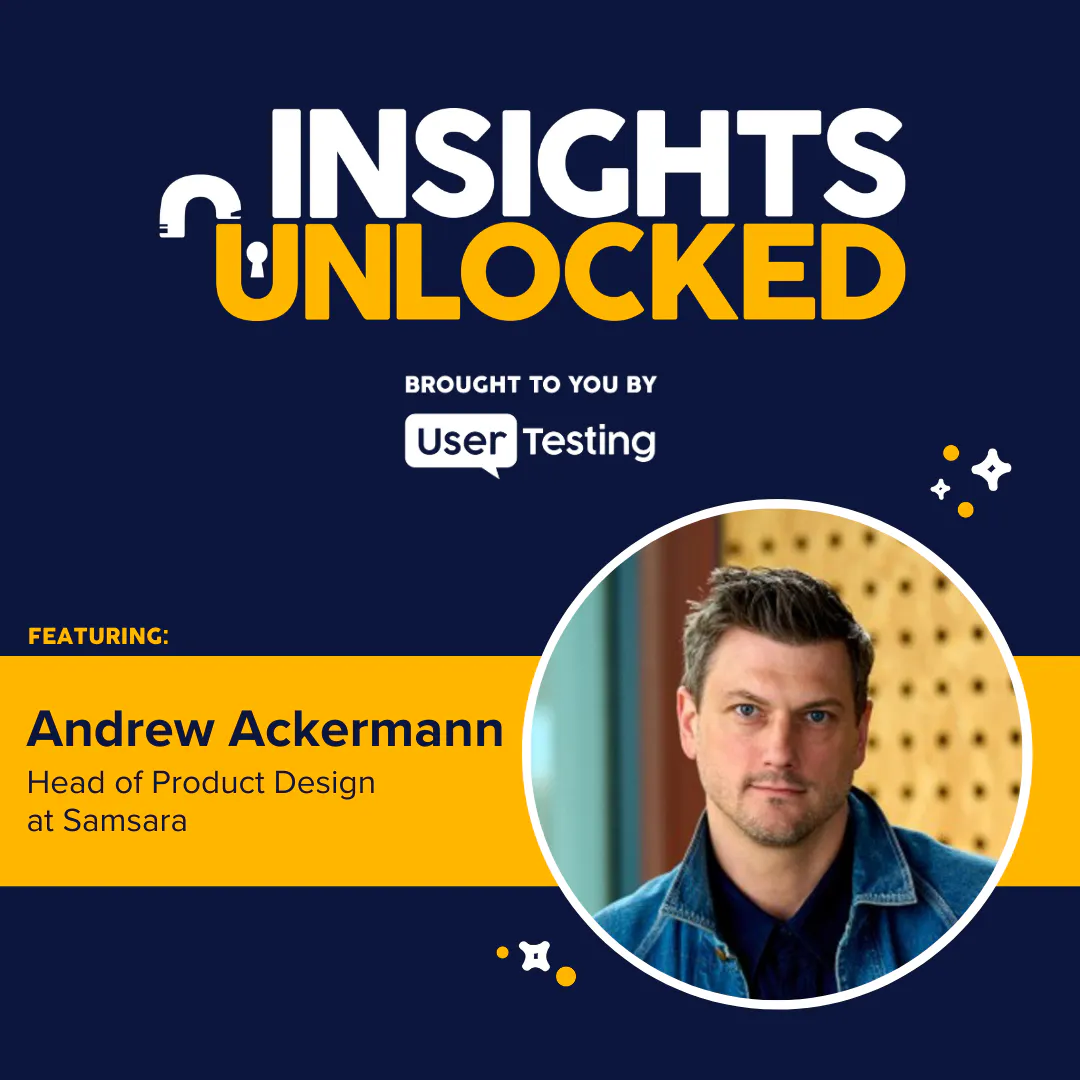
Insights Unlocked
Designing for frontline workers in a digital world with Samsara's Andrew Ackermann
00:41:14
Designing for frontline workers: Andrew Ackermann shares lessons on AI-powered tools, field research, and enterprise UX in physical operations.
Loading summary
Transcript37 lines
- [00:02]
A
Welcome back to Insights Unlocked. In this episode we're joined by Andrew Ackerman, Vice President of Product design at samsara, to explore what it takes to design AI powered tools for frontline workers. From ride alongs with truck drivers to building mission critical enterprise software, Andrew shares lessons on humility, field research and creating truly elegant experiences in complex real world environments. Enjoy the show.
- [00:30]
B
Welcome to Insights Unlocked, an original podcast from User Testing where we bring you candid conversations and stories with the thinkers, doers and builders behind some of the most successful digital products and experiences in the world, from concept to execution.
- [00:51]
A
Welcome to the Insights Unlocked podcast. I'm Nathan Isaacs, principal Content marketing manager at UserTesting, and joining us today as host is Blair Frazier, a product design manager here at User Testing and based in our Edinburgh offices. Welcome to the show, Blair.
- [01:07]
C
Hey everybody.
- [01:08]
A
And our guest today is Andrew Ackerman, Vice President of Product design at Samsara where he leads the creation of AI powered tools built for frontline workers in the real world. Before joining samsera, Andrew held product and design leadership roles at Google and other tech companies. Samsera is a pioneer in physical operations technology, helping organizations improve the safety, efficiency and sustainability of their frontline operations. Welcome to the show, Andrew.
- [01:38]
D
Thanks, Nathan. Good to meet you. Happy to be here.
- [01:42]
C
All right, so Andrew, so good to be with you here today. Maybe, you know, let's start with, you know, you've spent a big part of your career so far designing tools for people working in tough and unpredictable environments. Maybe you could start by telling me a little bit more about Samsara. I think it is, right, Samsara, who your users are, what are the kinds of problems that you're trying to solve every day? And you know, what originally drew you to this sort of design environment around designing for frontline workers?
- [02:16]
D
Yeah, absolutely. Great to be on. Thanks so much for having me, Blair. So I'm going to maybe rewind a little bit further back than, than you anticipated. So when I got started in design, I was in New York City and actually my first role wasn't even at a design company. I was working at a book publishing firm and they, they had a task for me that they would often sort of ask me to do, which is like, I need you to go over to this design studio and pick up the files and kind of bring them back over here. I had a skateboard and would kind of ferry around the city going back and forth. It was kind of introduction into the world of publishing and design. And when I got to this one design Studio. They asked me. They kind of buzzed me up. I walk up maybe, like, six flights of stairs. I get to the top, I'm like, panting. And they are. They say, okay, well, we're actually not ready for you yet. So I sit down and I watch them as they're designing. And up until that point in my life, you know, I'd never actually been exposed to design.
- [03:23]
C
And.
- [03:23]
D
And it was just amazing to see, like, oh, wow, there's different typefaces. These are how you bring files in. Here's how, like, a Word document gets turned into text on the page. Oh, you can adjust the space between all these, like, little things that I'm sure you're aware of as a designer. And I was just like, blown away. And, you know, I left. You know, after they gave me the files, I left. And I remember just walking out outside and looking around and seeing signs. I mean, like, oh, wow. Somebody actually, you know, they. They designed that. They chose that typeface or a shop window. Somebody made that logo. Somebody made those decisions. And it was kind of at that moment that my mind just sort of expanded, and I was really became in love with design and realized that it was this kind of underlying force that was shaping the way that we all experience the world. I often joke with my friends that one day we'll have, like, a designer strike and, you know, everything will be in Comic Sans on the COVID of the New York Times. And, you know, it'd just be one block of text or something. But it's like you don't realize how much this world is created and influenced by design. So that's kind of where I began my career. Cut to, you know, maybe six or seven years ago, when Samsara approached me, and was a similar moment where I had been kind of moving through this world for much of my life and never really asked myself the question, you know, how. I don't know, like, whose job it is to deliver food or, you know, like, who. Who actually. What is the. A day in the life of a person that's running a snowplow? You know, what are the big companies that sort of run this physical economy around us? And I fell in love with the space and have been doing it for multiple years now. And it is just really exciting to work with these individuals that do really hard work, often dangerous work within our economy, and are at that front line of sort of the physical world and the digital world, and they need better tools. Especially when we first started, we would go and meet with our customers, and they often had, you know, reams of paper that hadn't been digitized or they were just calling people on the phone because they didn't have messaging systems. So there's just a huge opportunity in the space and it's really fun and rewarding work to be able to design for these individuals.
- [06:01]
C
Nice. Yeah, that's amazing. It's that sort of, you know, twice you've had that sort of like the, that that veal has been lifted from your eyes off the introduction to design. And then once again you're like, oh my gosh, there's this whole world and infrastructure of stuff that goes on and doesn't have that same necessarily level of detail and attention that perhaps, you know, consumer facing products and things like that may have. So yeah, super, super interesting. And like, what are some of the design challenges that you have encountered in this type of work? You know, we think about these people in these physical settings, you know, the people who are driving those snowplows and the people that you're potentially designing or compared to more digital based products or consumer products where you've been working on things maybe for the masses or more of gen pop audiences, these sorts of things. What are those design challenges that you faced or your team has faced?
- [07:03]
D
So one of the most important things that we encourage our team to do is just get out in the field and to sit next to the person that you're designing for. And what you realize quickly is that there's a bunch of things that you can never learn over zoom that just come up and that they may not even know that they need to tell you. And they may be questions that you may not know that you need to ask them. I'll give an example. Very early on I was with a truck driver. I think his name was Big Pink or something. But I was just basically doing a ride along with him outside of Little Rock in, in Arkansas and just did a whole shift with him. And one of the things I noticed was he got this was probably like five or six years ago, but he got into the vehicle and he pulled out his personal device and he opened up Google Maps. And I was like, oh, that's really interesting. Doesn't your company have like, you know, commercial navigation software or things you're supposed to use? And he's like, yeah, but it's just not very good and I'd rather just use this because I know the map is accurate. And then when we got to the stop, he actually ignored Google Maps. And I was like, oh, but it says to take a right. And he's like, yeah, but if I know that, that's like not the truck entrance. And so it was one of those moments where you're like, oh, he's actually like the software, he's creating this for himself. He's piecing together sort of like a broken user experience and going that last, you know, 5 to 10% and creating the software in him to create this job. And so those are like little moments. And might be that or it might be the moment where you see somebody, you know, having gloves on and noticing that the tap targets are too small and that they need gloves because it's cold outside. And you know, their job requires them to do something outside, but they can't actually hit the tap target. And you have to sort of be in the real world and be in these spaces with these, with these customers and with these individuals to understand what is the interface that they actually need to get this job done. Another kind of interesting thing is often these individuals are doing the same experience over and over again and often multiple times in the same day. Like, this is their actual job. So they might need to inspect their vehicle before they start their day, and then at the end of the day, they may need to inspect their vehicle again before they return it. And there are just these little things throughout the day that you need to make sure that each kind of bump or moment of friction is kind of shaved away and then it becomes a really elegant and seamless experience for them.
- [09:50]
C
Yeah, that's super interesting. Like those sorts of, you know, you don't get taught that in design school. You don't get taught that necessarily those, those moments when you're sitting with them or being there and trying to like, take steps in their shoes every day, and you're getting those aha moments and you're, you're seeing what it feels like to go through their day. I'm sure nothing compares ultimately in terms of like those observations and how you then translate that back into, into the stuff that you're building and thinking about every day. It's interesting, very interesting. So what is interesting though is I think there's this like, general expectation, you know, users, generally speaking, and it sounds like frontline users as well are maybe even comparing and have expectations that their tools should maybe be a little bit more slick and work and behave like other tools around them in their everyday lives might work. And so how do you sort of balance those user expectations for the sort of sleek and intuitive user interfaces and experiences with more of the gritty realities of their day to day work environments? And maybe some possible constraints, even technically or environmentally around them.
- [11:12]
D
Yeah, I mean, one, it's important to remember that often we're creating tools. So one thing that I often share with, like, new members of the team is, you know, if. If we're designing tools for a mechanic and they've been using a wrench, you know, forever, you actually have to come in and say, hey, I created a better wrench for you. You know, and to begin with, maybe it's a ratchet wrench, and it has, like, you know, can get into tight spaces and, you know, allows you to sort of remove nuts and bolts easily. But you have to be better than the tool before you. And so sometimes we're creating experiences that replace things as mundane as paper and pencil. And when you talk to these customers, they'll even tell you, they'll be like, well, paper and pencil don't break down. There's no outage for paper. I can just go get another ream, print another set of forms. So you have to be doing something better than that where you have to actually kind of get in front of them and say, well, yeah, sure, you could do it that way, but is anybody actually looking at the paper? Is the paper going back into the system? Are you creating, like, is there sort of intelligence layered on top of all of that data? Do you understand what's in that paper? And you have to show that value continuously to customers and have them understand. So I don't know if that quite answered your question.
- [12:45]
C
Yeah, that's great. I mean, and how do you help? Like, there's obviously, like, a trust piece there as well, in terms of, like, I'm used to things this way, and you're introducing a different way of doing things. Like, how do you approach building trust and thinking about adoption of that iteration of that tool, for example, that you're. That you're talking about? What are some of the things you think about when. When you're. You're doing stuff like that?
- [13:10]
D
So we believe very strongly. One, we're like a very humble company, and we know, you know, maybe a little bit more about technology or a little bit more about AI or have a unique vantage point in terms of, like, looking across customers or across industries or across geographies and seeing patterns and understanding best practices that we can share kind of across our customer base. But we're also very humble, and we don't know what it's like to run one of these companies. You know, people in our organization, maybe we dabble and fix our car or something like that. On occasion. But we're not fixing big, you know, diesel machinery day over day every day of the week. We're not driving these semi trucks, you know, long stretches of highway over, you know, six or eight hour shifts. And so we have to kind of come into it with a sense of curiosity and a lot of empathy and basically talk to these individuals and just learn from them. And we believe that, you know, research is something that everybody in the organization needs to be doing. And we get a lot of feedback, you know, from the field, from folks like sales engineers, you know, our sales team itself, customer support, you know, designers are out in the field meeting with customers. Everybody is out there talking to customers and understanding sort of what they, what their needs are and how we can sort of deliver on it. And often we begin by prototyping just in words and saying, hey, if I made something like this, would this, you know, meet your needs? Or oh, I understand that our product isn't quite know there yet, that there's maybe a little bit something else you need from us. Tell us more about that. Tell us what you're looking for. And then we, you know, talk to a series of customers and begin to basically create an idea of what we need to create for them to deliver that value. And then we create little prototypes. And these might be in code, they might be in simple things like Figma make, and we basically like get an understanding of, um, what it would take to deliver that value. And then we actually build it, we scale it and we go from there and we run those feedback loops continuously throughout the process.
- [15:28]
C
Yeah. Oh, that's cool. I so like, literally when, when people say you are not your user, you're really in that space where you are not your user.
- [15:38]
D
Totally.
- [15:39]
C
I mean, put the time and the effort into really just getting under the skin and seeing how they operate and what their day is like. And just that constant feedback, constant feedback loop in your process. Side quest question for you. So you talked about prototypes. How do you take your prototypes or anything that you're sort of putting together that's not like fully shipped, anything like that. It doesn't matter the fidelity. How do you get that into their hands so that you can test it and see the response to it, not just like on a computer, but within an environment where they were going to be potentially using that? Is that something that you have to kind of like deal with and think about?
- [16:18]
D
Yeah, I mean, we have all sorts of ways of like, you know, kind of turning on features for subsets of users and allowing, you know, groups of people to use things. We do get to a point where people opt into experiences. There's also kind of unique challenges for us where, you know, these, this is the way that people are running their operations. So I know there's a little bit meta, but even within their own organizations they need ways to like beta test and roll things out. And we've created like tooling for them to do so because it's, you know, you're really touching the inner metal of the way that things operate. But we do, you know, again we spend time in the field, we do some remote sessions where we'll like, you know, watch people sort of use things. But I think honestly there is some nuance here with the space that we're operating within, which is sometimes people, especially when people are coming from years or even decades of using bad tools, they've just been sort of programmed to take it and to sort of be silent. And so sometimes you actually have to be in the room with them or in the cab with them or the field and see them and be like, hey, wait a minute, you like force quit that. Or you like, I saw you do something weird there. You stepped over that annoying hurdle. Why didn't you do that? Or even things that have nothing to do with software where it's just like there's a bunch of post its on your screen. What are those things? Or why do you have this giant whiteboard up with this handmade basically like spreadsheet or I noticed that you come in at three in the morning. Like why do you need to come in at 3 in the morning instead of 4 in the morning? And so it's just there is like this world of invisibility that you need to basically be very curious about and ask lots of questions about. And you know, we found that that doesn't always come up when it's just like on the screen and doing remote sessions.
- [18:27]
C
Yeah, yeah, that's that great curiosity which helps uncover all these little like patterns and data points that you like add up and you know, create this picture. How do you like if, if for example, like you're on the road or you're, you know, you're, you're telling me you're on the road with this guy, you spend a day with them. How do you, how do you bring that back to like a team of people who might be working on something who weren't in the car seat with you and other person, like how do you translate and bring that back? And maybe that's kind of what my next question is. Really about is like, how do you, what are the strategies, what are the ways that you turn those observations from the field that you have? And maybe it's isolated, maybe it's just you, maybe it's one or two of you, but you bring it back and you're able to take, you know, actionable, actionable design decisions, but something that's shared with yourself and others in the team so that you can all share in that learning together. Yeah, how do you translate that into the solutions you're working with?
- [19:26]
D
I mean, it is as simple as sometimes we just write trip notes and we share those notes. And trip notes are a big part of our culture. And that's not just for a thing that executives do, but it's things that, you know, teams might go out and meet with an individual customer and they share back what they've learned. Even our CEO, he'll share with us his trip notes and meetings that he's having with customers. So all of that provides a ton of value. This may be a little bit of a side narrative, but one kind of interesting thing is we, we have customers, we don't really have users, which is maybe feels like just semantics, but revenue is incredibly clarifying in terms of decision making. People come to us and design is part of their purchasing decision. And so if they like the design and we've created a better user experience than the competition, they purchase us. And we have revenue goals every quarter and we strive to hit those as a public company. And there's a lot of clarity. If we actually lose a deal, we also do closed loss analysis for deals that, you know, we might not have won. And we also talk about win stories. And so everybody's kind of doing the storytelling about, you know, how design is differentiated or what are the features and technology that we shipped that is making a real world impact and you know, driving this, our customers, we're also a subscription based business. So customers continue to renew and that's also a great test to the design that we create. Many of our customers use our product like call it 40 to 60 hours a week, like an individual, like this is really their operating system to run their business. And then they use that over like a three to five year period based on contract length. And so if they love it during that period, they're going to fight hard to renew and they're going to become internal champions. And we see that at aggregate the vast majority of our customers renew with us. And if there's any feedback in that journey, like we're also incentivized to, you know, basically right those wrongs and make sure that we're driving a higher and higher quality experience for them.
- [21:54]
C
Amazing. So, like, design, you would say, is a bit of a differentiator for you guys in terms of. Absolutely, yeah. Like, tell me more about that. Like, how do you, how do you as a team talk about that? How do you have a team of people who potentially you're maybe building tools that can be quite functional or maybe easy to say, that is a function and a capability is delivered versus something that's desirable to use and something that outperforms not just in terms of features and functions, but an experience that's helpful for others to use, that they want to keep using.
- [22:32]
D
Yeah, yeah, it's weird. We internally often use the term elegance. We talk a lot about elegance, you know, and the. Are these designs elegant? Have we created an elegant experience here? And when you think about that word, it's, you know, there's like a grace to it and it's almost, you know, a dance or something like that. Like the. Where your mind goes when you just hear the word isn't necessarily tools or software, but that's what our customers, you know, sort of expect from us. It's sort of at the right moment, the tool sort of appears and it's in your hand before you know it. And it is a bit of a dance between, you know, myself as a worker, potentially a machine, and then the software and off, and increasingly AI and intelligence within that mix. And how do all of these elements kind of come together in the right moment at the right time so that you can get your job done and keep moving? And sometimes the most elegant thing is for us to get out of the way, for us to be, to kind of participate in that world of invisibleness and to sort of disappear in the background. And I think that that's just part of what we do. And I think again, we're just humble about it. I think that there's a way to beat your chest about design and sort of come into a room and say we're the best designed or we're known for design. And that's not really what we're trying to do. We're just trying to help you get your job done. And design is the means to an end, and we recognize that. But we as a company all believe in it. You know, we really are pushing forward to create a great user experience and technology and, you know, is a huge part of delivering great design. A well engineered product is a well designed product and those things go Hand in hand. And so it really is a team sport. And you know, we, we all kind of work in unison to deliver that value.
- [24:40]
C
It's a beautiful lens to look going through, I think having that as a design principle or something that you can assess quality in something as well as, you know, what is it lacking or what are we added too much of. Yeah, I like that. And so you, you worked at Google before, I think for quite, quite a considerable time, probably on many different and wildly interesting projects. And you transitioned from Google to leading design at Samsara. I'm interested what have been some of the biggest or even most surprising sort of mindset shifts that you have had, having to move from a sort of big tech company into a more operationally focused role or focused company?
- [25:29]
D
Yeah, that's a good question. I think 1, 1 at Google we often talked about moments that matter. So as an example, you might be just typing into search like 20th anniversary date or something and it might be like a very pivotal moment in your life and you might be looking for the perfect restaurant at the perfect time to sort of align. And you know, and at Google you really need to meet people in that user journey and help them find the thing that mattered to them. And that was true not just for search, but I also worked on maps as well. And it was a lot of intent based design, but it was also a really big volume play where you were trying to create great experiences for people in very specific moments and find very common user journeys and solve a lot of, you know, you could create a very, very impactful thing that only 5% of users might use in one day. Like if 5% of users in one day were using your features, that would be considered a wild success. And you know, we did at Google, talk more about, increasingly, especially towards the end of my time, the toothbrush test of trying to find those things that people use twice a day and creating more of these utilities and kind of driving towards, you know, more and more usefulness. But it was kind of a different mission than, you know, creating software where you're like, hey, you might need to use this thing 10 times today and you might need to use it 20. And your whole job may depend on actually using this tool, you know, eight hours today to solve a wide variety of tasks. And they're just different design challenges. I think both of them are fun to work on and valid in different ways, but they're just unique.
- [27:35]
C
And for product people or UX people listening in, what advice would you give to them from your experience about designing for perhaps overlooked user bases like frontline workers, maybe you could sum up, you know, what have you learned that you think other designers and product people could benefit from thinking about more who maybe have never worked in those types of arenas as you do?
- [28:04]
D
Yeah, I would say just in general, be really curious and be really humble, as simple as that is. And you have to ship. And so as an example, you know, if I'm working with a mechanic and I know nothing about what it's like to fix this type of machinery, like, go and spend time with that mechanic, and it's not just, you know, watching them do their job, but, like, take them out for a meal, you know, buy them a cup of coffee, get them away from what they do, then watch them, but try to, like, really understand who they are as people and what motivates them. And then how do they do their job? And just, you know, people often want to share their story with you. Very often, like, if I'm talking to a mechanic, it's not every day that somebody comes in and interviews them and says, like, how do you do your job? I'm so curious. They often tell me stories like, you know what? Honestly, like, my kid doesn't even go this deep with me. Like, they don't, you know, they just. I go away and I do this hard work every day. But, like, this is a level of curiosity I haven't experienced yet. And so, like, you just. You gotta get out there and be humble and ask those questions. But I have seen some people kind of get stuck in that, you know, analysis paralysis, where they're like, this is basically the whole world, like, how the whole world operates. Like, there's so many different types of customers, different verticals. Like, I talk to one user, but I feel like I have to talk to 500 to understand what to make. It's like, nope, talk to one, maybe talk to five, start to notice some patterns. And then you have to start making. And you have to make something and get it in front of them. And even more important than that is you have to get it, like, built and deployed and for them to use it. And people will be polite and, you know, they'll try to say, like, yeah, that sounds great, but it's not until they actually are, you know, using the software day to day and have it in front of them and. And they're trying to get the thing done that they'll come back around and say, you know what? Actually, this doesn't work for me. There's something in here that, you know, we talked about it. I thought this was going to be the thing, but I don't want it like. And then you go back and you kind of. So you need those cycles to be very quick and you need to kind of be willing to kind of operate continuously and iterate. And we found, you know, I think the company has been successful by sort of leveraging those feedback loops and being very humble and sort of building that scale.
- [30:38]
C
And would it be a conversation if we didn't talk about AI these days? So, you know, thinking about the role and the opportunities of AI in your world and in design today and also looking ahead as much as we can to see what's coming, what's next, and anticipating, you know, what's happening in the world of AI. How do you think AI will play a part in shaping the future of physical operations and designing experiences for the frontline workers, the people that you're serving and building solutions for over the next couple of years?
- [31:17]
D
Yeah, I would say a couple things. One, like, for you and I as people in design, you know, we're all using AI to, to improve our design and to basically get to market faster and create higher fidelity and more realistic prototypes and run those feedback loops. We're also doing it sort of on the front end where we're using AI to like, kind of do better research, understand sort of customer bases or industries or individual users, or try to like, basically get up to speed as fast as possible. So I think because of all that, what I think we're about to enter is a world of just acceleration where especially from a product perspective, we're just able to do things quicker. I think there's going to be a little bit of a challenge to navigate and there'll be a lot of static where we can create things very quickly. But are they the right things? There'll be, you know, competitors both for us, but even just in the industry at large. I think many customers will see like, quick upstarts, like little startups that get to market very fast and might create some value, but they may not have the rigor or the culture to continue to deliver that value. And so there is something to sort of figure out for us as a society, which is how do we, I don't like what's our way to basically sift through all the noise and have high quality experiences and make sure that we're actually delivering value into the world. And that's just, you know, I think we'll figure our way through that. Markets have a way of kind of being that filtering mechanism. So we'll see if that plays out or if there's other things that need to be put in place to sort of reduce some of that static and noise. I think that's, you know, just the way that we develop products. But I think in terms of operations themselves, I think we're going to see a world where over time a lot of things become easier to do. There's acceleration in the speed at which some of these economies are moving. Hopefully there's less, you know, friction and less outages. Experiences that may have been relegated to consumer grade experiences will now be more easily built and available to enterprise spaces as well. And so a lot of these tools and user experiences will also seen quicker gains of quality. And I think we'll see ideas that kind of may have been even in entertainment spaces or sort of like different orthogonal spaces move through different types of even like enterprise B2B SaaS software because it's easy, like we can create it, we can experiment with it. You know, to your point earlier on, like you don't go into work and suddenly take off your consumer hat. You know, you're the same person and so you need. You sort of bring with you sort of expectations or ideas about what could be value to valuable to you and you want to bring that into that space.
- [34:37]
C
Yeah. So the cost of experimenting just dramatically drops in terms of time and ability and you know, even resource itself. Awesome. And speaking about resource. So like you've been hiring for roles focus on Samsara's design systems, I hear, I think and as you've grown the team at Samsara, like what, Tell me more about, like what are some of these lessons that you've been learning about scaling design in a complex hardware plus software environment? Like what does that look like from a design system and a scaling perspective where there's the hardware, there's the software and there's all these teams working together to make these things live well together. Yeah, yeah.
- [35:22]
D
I mean we are hiring for design systems but we're also hiring just across the board. And I would say, you know, we're, if you're interested, just reach out to me on LinkedIn. Always happy to kind of connect and see if there might be a mutual fit there. I was kind of alluding to this a little bit earlier, but it's kind of two different roles that designers play within the organization. We have kind of more verticalized designers that might work on a specific product or business area. You might work with like kind of a group of Personas and get to know them well. And then continue to kind of drive a product forward. And then we have these more horizontal individuals that look to create systems that most of our customers and most of our user types would use continuously. So as an example, if I am, let's say if I'm working on telematics, which is like where all the vehicles are in the world and how, how are they doing and you know, I might like have a big report that I want to run around the utilization rates. So which vehicles are used and which vehicles aren't used. Can I get rid of some of these vehicles? Sell them off or do some of them, you know, should I replace some of them? And we make that report and it's a common use case. And so that's available to almost all of our customers. Customers. But if you want to tweak that and you have something unique to your organization, like a utilization threshold that maybe warrants sort of reconsideration of ownership, then, you know, we have a whole tool set called our custom reports which allows you to tweak and adjust that. And so a tool like a custom reporting tool is very useful to most of our customers. We create sort of this broad based tool that anyone has access to. There's reports, there's things like, you know, workflows or forms, there's even simple things like a notification pane or how you do billing and all of that is available to everyone. And then we have sort of these more vertical roles that might be focused on like on the road safety, which is a huge business for us. Maintenance, commercial navigation, like more sort of niche areas. And yeah, they're all really fun challenges and like I said, if you're interested, feel free to reach out and take it from there.
- [37:53]
C
Sounds great. Yeah. Well, you know, thank you so much for opening my eyes up to this whole world of Frontline and this. Everything you've talked about today has been different, very different to my day to day design. But some of those commonalities of curiosity and shipping and spending real time and trying to get under the skin and draw and absorb empathy from other people that you're thinking about, I've been able to connect with that. So thank you. But yeah, such a fascinating area of work that you're in. I've really enjoyed our conversation. And how do people learn more about you or Samsara or some of the projects and things you're working about? You mentioned the roles and that you're hiring. That's awesome. You can reach out to Andrew on LinkedIn, but yeah, if there's anything else that you want to you want to add or how people can find out more about you? Where would they go?
- [38:49]
D
We have a great YouTube channel. If you like, are interested in roles, you can look at our Every year we do a big customer conference called beyond and you can look at last year's keynote. It's kind of similar to like Apple's www.dc but focused on the world of physical operations. So if you want to go deep, you can go deep there. We're always on all the socials so you can check us out on Instagram as well to get a feel for our culture and sort of our customers. And then like you said, if you want to connect with me, feel free to reach out to me on LinkedIn.
- [39:23]
C
Amazing. Well, thank you so much for the conversation, Andrew. Thanks for being here with us again.
- [39:28]
D
Yep, I'll talk to you soon.
- [39:30]
B
Want to keep the conversation going? You can find the show notes@usertesting.com podcast if you haven't already, don't forget to follow us on Apple Podcasts, Spotify, Overcast or Google Play so you never miss an episode. And if you enjoyed today's show, please share it with a friend or leave us a rating and review on Apple Podcasts. And until next time, this is Insights Unlocked, an original podcast from User Testing.