← Insights Unlocked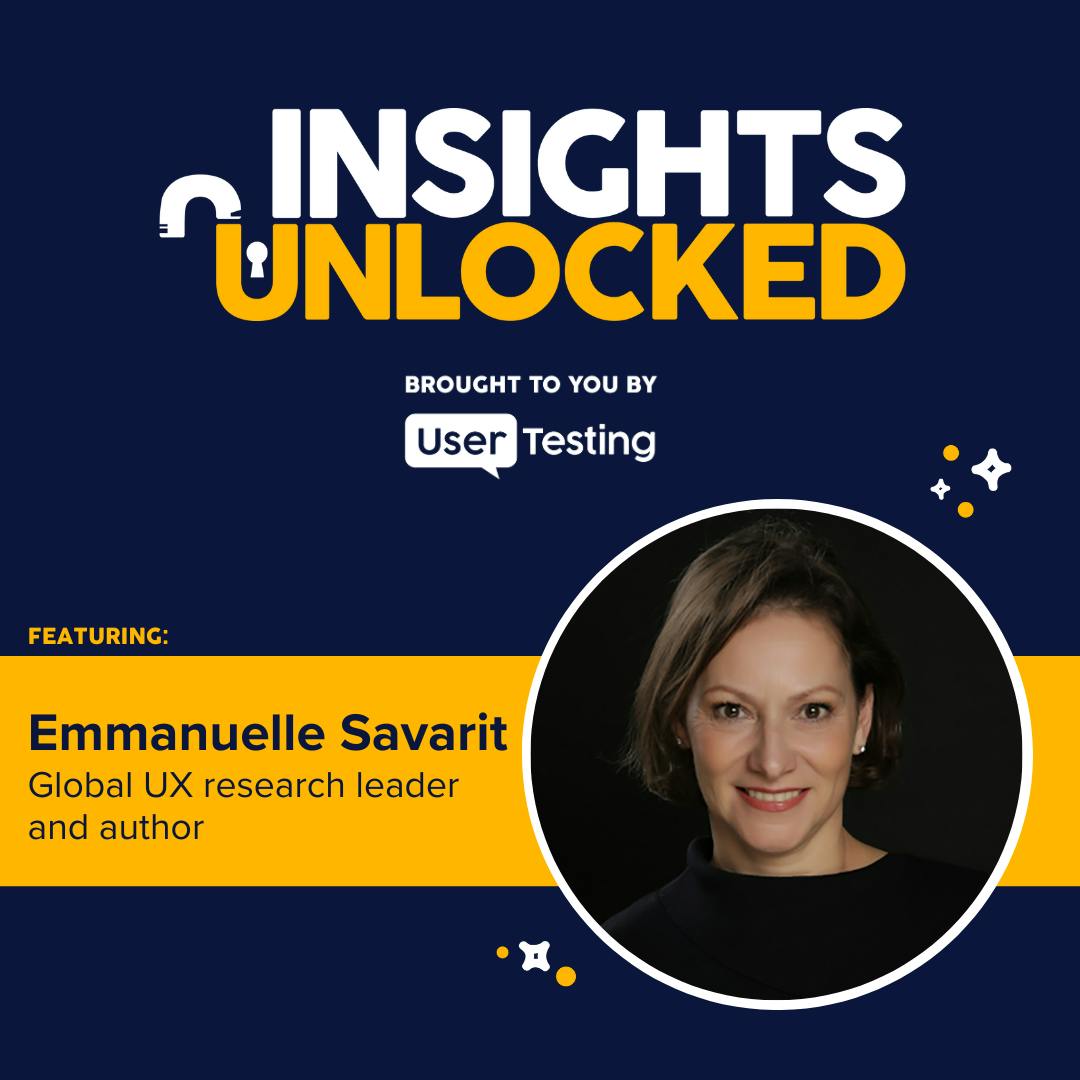
Insights Unlocked
From doing research to leading it: how UX research creates real business impact with Emmanuelle Savarit
00:24:22
Discover how to move from doing UX research to leading it, creating strategic impact and influence in AI-driven organizations.
Loading summary
Transcript44 lines
- [00:02]
A
Welcome back to Insights Unlocked. In this episode, we're talking about what it really takes to move from doing UX research to leading it. UserTesting's Amrit Batu talks with Emmanuel Savary, a global UX research leader, author of the recently published the ux Research Powerhouse Volume 1, and host of the UX Research Club podcast. They dig into research leadership, business impact and AI's growing role in UX. Enjoy the show.
- [00:32]
B
Welcome to Insights Unlocked, an original podcast from User Testing where we bring you candid conversations and stories with the thinkers, doers and builders behind some of the most successful digital products and experiences in the world, from concept to execution.
- [00:52]
A
Welcome to the Insights Unlocked podcast. I'm Nathan Isaacs, Principal Content marketing manager at UserTesting, and joining us today as host is Amrit Batu, a principal customer experience consultant here at User Testing. Welcome back to the show, Amrit.
- [01:08]
C
Hi again everyone.
- [01:11]
A
And our guest today is Emmanuel Savary. Emmanuel is a global UX research leader, author, podcast host with more than two decades of experience helping organizations turn human insight into into strategic impact. She's the author of the recently published the ux Research Powerhouse Volume 1 and the host of the UX Research Club podcast where she explores what it really takes to lead research with clarity, confidence and influence in today's complex AI driven organizations. Welcome to the show, Emmanuel.
- [01:47]
D
Thank you. And well, thank you for having me today. I'm very pleased to be here today.
- [01:52]
C
Yeah. And we're excited to speak to you today as well, Emmanuel. And so just to kick things off initially then I'd love to start by understanding a bit more of your journey. If you could share a bit more about your background through the peaks and troughs of what is UX Research and how you've got to where you are today.
- [02:13]
D
Okay, so I come from academia, so I've got a PhD in psychology, so quant and qual research method. I was an academic for a little while and then I moved to ux. Actually, we didn't even call it UX research. We used to call it usability back then. So I started to be a contractor because the role of UX research didn't really exist in the market. So I started to be a contractor in some organizations and I started building my own company because I started having more and more demand. So I was a contractor. Then I became a consultant and I start hiring people as well to support me because I had so much demand that I couldn't fulfill all the requests I had across all my clients. So I grew my company. I had up till 10 researchers, some were contractors and some were full time employees. And I did a lot of work with the government, all the digital transformation with the. Gov uk. I had also a lot of private sector, a lot of banking because they were the first one really to start implementing UX research. And then I was hit by a lot of people like with Brexit. So contracts were a bit more complicated, legislation was a bit different. And the uncertainty made me start thinking of maybe I should move permanently in an organization and help an organization. So I move and I start being a full time employee as a manager and then I became director, head of research. And that's where I am today. So it's a long journey with a.
- [03:54]
C
Lot of hiccups, a lot of ups and downs no doubt during that period of time and. And you've brought those experiences and to writing this book and the UX research powerhouse.
- [04:09]
D
Yes, I had the first book which was. This is my second book technically. My first book was Practical user User Research, how to integrate User Research, your product which I published in 2020. We came out during COVID and this one is a bit different because the UX research powerhouse is more about leadership, how to have impact, how we can really have a seat at the table and how we need to change a way of thinking and behaving in the organization.
- [04:39]
C
Okay, keen to learn more about that as well. You describe in your book as the one that you wish you'd had when you're stepping into leadership. What were some of the earliest leadership lessons that you learned the hard way and how do they show up in the book?
- [04:59]
D
Because the thing is, every time when I was working in different organization, I was always the most senior researcher in the organization. So I was an IC for many years and then they asked the IC to start managing other people as well. So management is something we. You don't know. We had to learn it on the ground. And especially research is a bit different than managing product or managing engineering or managing design. Research has its own specificity. So even if I was reading a lot, getting a lot of information, it didn't really fit really the context of research because with all the things we have to do and how we actually do the work, because researcher, we don't have a portfolio, we tend to really support everyone else in the organization. Normally we don't have the budget. We may get some budget, but originally no one think of giving us budget. So all those things as well is not only about managing people but also of course managing headcount and getting the budget to get the head counts, but. But also suppliers, incentive tools and we are using all that if it's not planned ahead because we don't have a portfolio, we had to find the money somewhere to actually support the function. So it's a lot of things, it's quite complex. Everything we have to do actually when.
- [06:30]
C
We start stepping into leadership, it's a continuous uphill climb. I found trying to continuously prove yourself, prove the value of what you're bringing, etc.
- [06:43]
D
Yeah, I think, yes. Proving yourself actually is more like showing the value and also influencing the decision making.
- [06:54]
C
Yes.
- [06:55]
D
It's a very different thing than actually just doing the research and presenting the findings is how with those research, all those insights, we really manage to influence the decision making at the top level. Because it's what we do.
- [07:09]
C
Yes. And I think that's a really interesting point that you've made there. It's one of the big challenges I hear from customers when I speak to them on a regular basis where they're doing a lot of amazing research. You mentioned academia there, that academic level of research that they're doing some fantastic findings, but a lot of the time, a lot of it doesn't fit into what the business is actually interested in at that point in time.
- [07:37]
D
Exactly. And I think this is an issue than researcher. And I was exactly the same when I started. I was doing the research, going into the depth, presenting long report because I wanted to show the value. But showing the value of the research is not the quantity. It's really to take what is important for the business. And I think this is really what I've been doing for the last few years, is really to understand the business. Because once you understand the business, you can adapt your findings accordingly to their needs. So you switch, you look at the business like a participant, your stakeholder, like participant. What do they need right now and how can I support them?
- [08:25]
C
Yes, I've got so many questions just on that point, but I know we've got a lot to get through today as well, so hopefully we can come back to that later on in this chat. One of the things that you do mention is you make a strong distinction between doing research and leading research. What are the biggest mindset shifts researchers need to make when they make the move from being excellent practitioners to strategic leaders?
- [08:56]
D
Yeah. So you could be a leader, even if you are a team of one. You don't need to manage people to be a leader and to influence the organization. And I want to be very clear to the people who are going to Listen this podcast that a lot of people are thinking I need to manage people to have influence. No, when you manage a team, you manage those people and your responsibilities to make sure they provide the right work for the business. But if you're a solo researcher, you need to understand what is the most important thing for the business right now and then you can focus and prioritize what you need to do to help them to make the best decision. So this shift is quite important because I find like to be an IC is we do the work, we are very happy about the work and very proud about the work and all the effort we put into the research and we just manage ourselves when we start to become a leader, you manage the expectation of the leadership and your stakeholders. So it's a very. It's a shift. You don't do it just to do the research. You try to understand the full spectrum, the full ecosystem and where your research can make a difference.
- [10:13]
C
How long in your as a rough timeline do you see people needing to make that shift in mindset from delivering that awesome research to communicating that within an organization in a business manner?
- [10:30]
D
It depends because you can have. If you set some specific goal of what you want to achieve, you can implement them from day one. I did a workshop a few months ago in which I was leading with impact and I was giving a lot of little tips of how we can lead with impact and how we can actually influence the senior leadership. And I gave them like the first 30 days on how to change and they could start implementing it straight away. Every little change will make a difference.
- [11:03]
C
Yes.
- [11:04]
D
And in the book in the UX Research Powerhouse, I put a whole chapter of the first 365 days of changing the whole infrastructure of your team. What you need to do when you start taking a leadership and it can be when you are the only one and want to build your team, all those things you have to do step by step. So I would say you can start seeing differences after months.
- [11:28]
C
Yes.
- [11:29]
D
But to really see the shift, I will say a year of practice and have a proper plan of what you want to achieve. You won't achieve everything at once. It's too much.
- [11:41]
C
I think that last statement that you've made there sums up the answer to that question really nicely. A lot of the customers that we speak to, when I have similar conversations with them, they come to the conclusion that they can't change everything all at once. But that idea of breaking it down in smaller steps is really important for them. And when they start having those small gains that's where success shows up for them. And then, yeah, looking at it as a year of progress is a good outlook for them.
- [12:15]
D
And also a year progress, you can fit it. Especially for people working in big organization. They've got their year, the end of year review, so they can break it down and then they can say at the end of the year, I've done this, this and this. So it's not double work, it's actually feeding the end of year self assessment and review they want to do with their manager. But little things to change. For example, I give you a very easy one that actually everyone can start straight away. Most of the researchers are doing most of their work is user testing. Usability testing is what they do. We also use tools like user testing to actually do a lot of unmoderated work. But the researcher own their session, they own the participant, the time they spend with the participant, they own it. If they see something that may be interested for the business, they can squeeze it in their session. You don't need another research. You leverage your session, the access to the participant to test some concept. You don't have to tell anyone you are doing it, you just run your session. Then you can sometimes see something emerging. When you present the result, you say, by the way, these came out on the research and it's where that's a huge impact. Much more than actually usability testing. Yes, it's understanding this power. And the researcher got this power. Sometimes they think, oh, I don't know, I've been told to do this research. And what you've got an hour session, you can take five minutes to test a concept, to try to get more information. For example, how people are feeling using AI, what do they feel of using a chatbot, simple of that. Or looking at their profile, their personalities, what is their behavior? They can put some behavioral questions, then they bring them at the end, when they wrap up their research, they can say, actually we identify different profiles and different behavior with AI, some people like it, some people dislike it, what do they need to like it, how they will trust it, what is frustrating. And they add all that at the end. So there is no limitation. And I find very often researchers, they are too much in their little bubble and try just to do what they've been asked to do.
- [14:47]
C
Yes. And often in that kind of instance, when they just do what they're asked to do, the research becomes a box ticking exercise for a delivery process rather than actually adding true value throughout.
- [15:06]
D
Actually, I totally agree with you. And the thing is now with AI. I think we've got even more pressure to start shifting quicker because what's happening, a lot of things can be done by AI. Usability testing, user testing, interviews with testing product, they're great, but it's not the part of the work which are extremely strategic. It's more like the tick the box exercise. As you say, it is a bread and butter, but shifting to be more strategic and understanding the business. New things they want to do, new products they want to launch, what is in their mind at the moment, where are they struggling, what is the issues they have? And speaking with the product is very important. Understanding the product issues, what is keeping them awake at night and then you can investigate on those matters.
- [16:00]
C
Yes, I think the AI question is really interesting one and the concept of AI within research, how do you see it impacting the role of UX research leadership? How do you see AI coming in and what can IT offer and also potentially what risks does it pose to the UX research leadership?
- [16:27]
D
So I think AI is great. I'm a very big advocate of AI actually I'm doing a lot of training at the moment on AI and ethics and governance because I think research can really see how the user are going to interact with AI features and the business. And what's happening at the moment is business wants to put AI everywhere to save money, to be more efficient, to do faster calculation, which is great. I think it's going to be game changing but we need to be very careful where we need to put AI because we can't put it everywhere. That remind me on the digital transformation and I did the whole chapter on that. It's the link between the. When we went through the digital transformation, especially when you follow the. Gov uk, when we went through the whole transformation, we had the constraint of the policy, so we were going through the policy to check everything, see where we could introduce digital features and start moving everything digital. And the research was essential and at the center of the transformation because we were identifying where we could put the digital features and how we were evaluating how we could make it usable by all the end users. So that was really the core of research to do this work. We can do exactly the same thing with AI. Where do we want to put AI? We can identify where it's going to be the more efficient way to do it because sometimes it's not going to be efficient. And there is a lot of risk as well to integrate AI because you don't know what's going to happen and you may have the risk to lose your customer if they don't trust your AI features, Research is going to be so important. Firstly to identify where we need to put it and also how the user is going to interact with it and to refine the AI model because we will have the data to actually say this is going to work, this doesn't work. That's the issue. That is fine. So it's to be really conscious of moving in the AI era is great. I'm very excited and it's even more exciting for research because research can play a fundamental part in this transformation.
- [18:54]
C
Absolutely. I think for me, AI has also got other benefits of internal ways of working as well. So beyond the implementation out to the customer, how do you see AI helping us internally?
- [19:09]
D
As a research team, we use it all the time. My team, myself, we use it all the time. We are much more efficient. We use NotebookLM to centralize all our research. So then we do some prompt and we can get the findings straight away instead of going back and forth to the research. We use AI for transcript. But I remember when I started, we were transcribing manually. We were going back through the video and spending hours transcribing.
- [19:38]
C
Yes.
- [19:38]
D
Okay. So now it's done like this. You put the video, you've got the. It's got systematic transcript, you know. You know, if you go back 20 years ago, that was like we were spending so much time transcribing with our headphones. Hours and hours of work. Also you can do so much with AI because it's very important actually how we can be much more efficient because a big criticism than research tend to get or the feedback we get is we are too slow. So we could be much faster because the world is moving so fast, we have to be fast. So leveraging AI as much as we can. Of course we need to be very careful of how we do it because AI, there is some risk and sometimes AI has some great hallucination, but you need the researcher to be conscious of it and actually try to spot where there is some risk and then interfere through the process.
- [20:41]
C
Absolutely. I'm personally really excited about getting my hands on your book and reading about your excellent. It's a really cool cover, etc. As well. I like the styling of it.
- [20:58]
D
Yes. Yeah. I'm very excited. A friend of mine actually gave me some ideas for the design. So I'm very, very pleased about the COVID So it's in hardcover, in paperback, on ebook, and I'm hoping to record an audible soon.
- [21:15]
C
Excellent. Would you like to. I think first off, thank you so much for joining us on the show today. I've really enjoyed our conversation. I wish we had longer and I'm sure we can share stories and talk for hours if we wanted to. How would someone learn more about yourself, your thought leadership and you've mentioned the book, but you want to talk a bit more about how they can purchase a book, et cetera as well.
- [21:41]
D
Yes. So they can reach out to me on LinkedIn. I respond to everybody. You can drop me a message, make a contact request. I always accept and I always take the time to answer to everybody. I've got a site which is still in process. I'm moving it, but it's emmanuelsavari.com at the moment. It's on Podia, but you can get the information through LinkedIn. The book is available on Amazon for the moment and then after it should be available shortly in library, bookstore and things like that. So it's what I'm working on at the moment. So yeah, excellent.
- [22:20]
C
And all those links will be part of the show notes as well, so the listeners can certainly click into them and get access to them through there. Thank you again, Emmanuel, and we hope to chat to you again soon.
- [22:32]
D
Thank you very much for having me. It's always a pleasure.
- [22:37]
C
Pleasure is all ours.
- [22:39]
B
Want to keep the conversation going? You can find the show notes@usertesting.com if you haven't already. Don't forget to follow us on Apple Podcasts, Spotify, Overcast or Google Play so you never miss an episode. And if you enjoyed today's show, please share it with a friend or leave us a rating and review on Apple Podcasts. And until next time, this is Insights Unlocked, an original podcast from User Testing.