← Insights Unlocked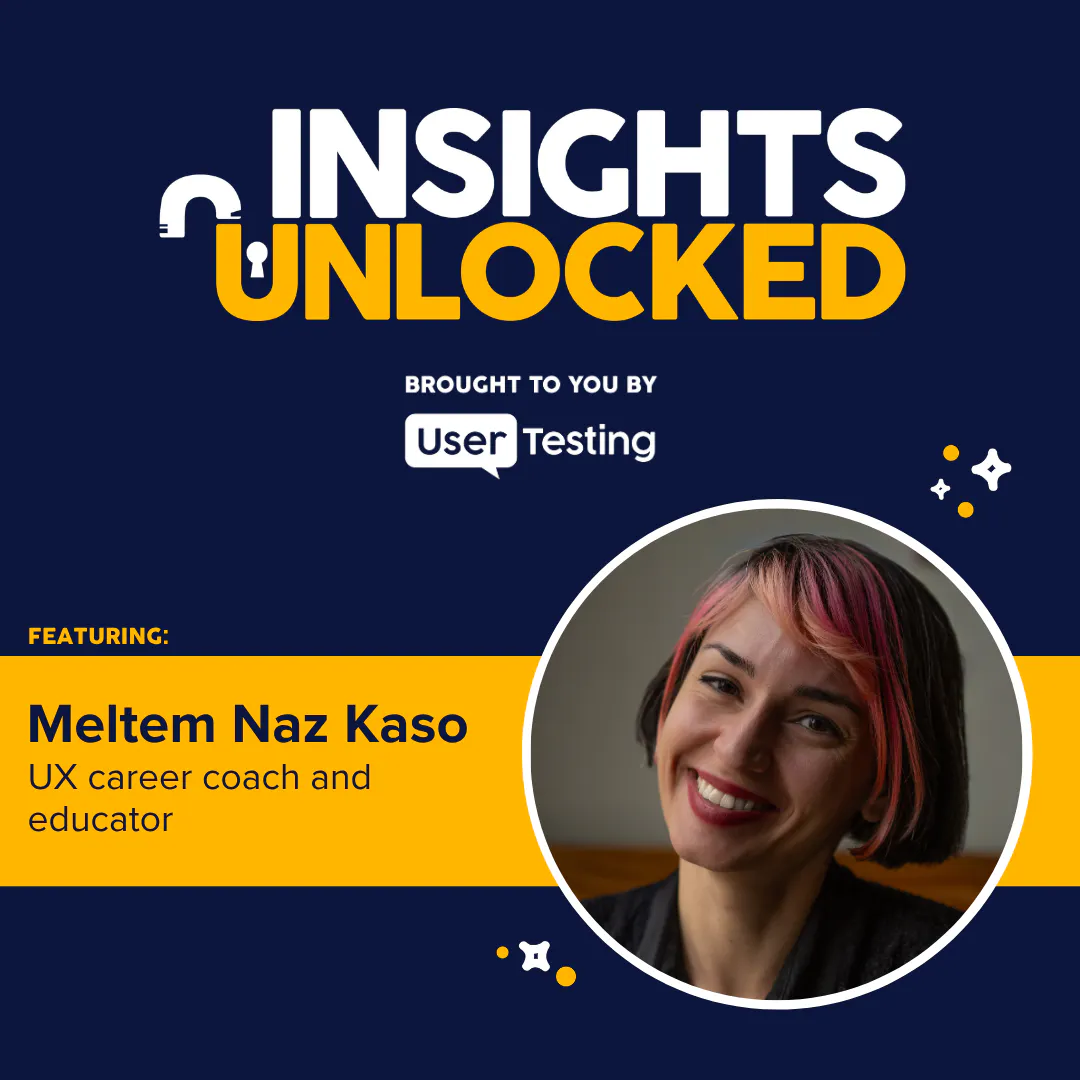
Insights Unlocked
Future-proofing your UX research career with Meltem Naz Kaso
00:42:14
Meltem Naz Kaso explores the future of UX research, building trust, driving business impact, and creating career resilience in the age of AI.
Loading summary
Transcript53 lines
- [00:02]
A
Welcome back to Insights Unlocked. In this episode, guest host Amrit Batu sits down with UX career coach and former UX research leader Meltam Naz Kasso to explore what it takes to build a resilient UX career in the age of AI. They discuss why trust, business acumen and entrepreneurial thinking matter more than ever, and how researchers can increase their influence by connecting customer insights to business outcomes. Enjoy the show.
- [00:32]
B
Welcome to Insights Unlocked, an original podcast from User Testing where we bring you candid conversations and stories with the thinkers, doers and builders behind some of the most successful digital products and experiences in the world, from concept to execution.
- [00:51]
A
Welcome to the Insights Unlocked podcast. I'm Nathan Isaacs, principal Content marketing manager at UserTesting, and joining us today as host is Amrit Batciu, a principal customer experience consultant here at UserTesting. Welcome back to the show, Amrit.
- [01:05]
C
Lovely to see you again, Nathan.
- [01:07]
A
And our guest today is Meltem Naz Kasso, better known as Mel, a UX career coach, former UX research leader and educator who helps researchers, designers and product professionals navigate uncertainty, build resilience and create a more meaningful career. Drawing from her background in UX leadership, psychology, anthropology and coaching, Mel brings a deep human perspective to the future of work, identity and innovation. Welcome to the show, Mel.
- [01:37]
D
Thank you so much for having me, Nathan. Hi, Amrit.
- [01:40]
C
Hi, Mel. I'm really looking forward to the conversation today. I've looked through your profile. Loads of cool stuff to cover off, so let's not beat around the bush, let's just jump straight into it. You've had such an interesting journey across your career when it comes to UX research, leadership education and now doing your career coaching. Can you take us back to the start and share what your experiences are of how UX has shaped your work and what you're doing today?
- [02:15]
D
I'll gladly do that. At the same time, I want to even take us a few steps back, because before ux, I was an investigative journalist, Amrit, and that greatly shaped my UX approach too. And prior to journalism, I was an academic researcher. As I was in academia, I was a graduate student doing research for NGOs and things like that. My background's in human development, so. So it has always been about curiosity towards human behavior. The applications have changed, the methods, the format, the users change, the impact too. But it was really about understanding human behavior. And so that was also what pulled me in many, many years ago, recognizing that tech startup scene, it was really about bunch of guys usually because engineering is predominantly male driven. Still to this day. And there were a lot of guys, a lot of building, you know, nice things, but there was a lot less back then work around understanding human behavior, the pain points of users, the motivations, their jobs to be done, what they wanted to take from any tools that was, you know, in their disposal. So this is why I came into ux. I came into this whole world to do research to make sure that what was being built was actually going to be relevant, both from product market fit perspective, from usability perspective, end to end really. And this is what pulled me in into into ux, but it was always about really understanding human behavior. And that is, you know, as a journalist I also knew it was not only about what people said, but also what they did and if there were any contrast, what they really meant. So it was what has pulled me in.
- [04:07]
C
Awesome. I've had a lot of conversations in my travels over the last few weeks and I always go back to one project that I did at the very start of my career in an academic setting when I start thinking about the impact that UX can have on individuals. Thinking back through all those different experiences that you've had, can you think of one project that you think that's had a massive impact on the work that I've done on drawing me into doing more around UX and more and learning about the human as such?
- [04:48]
D
I'm thinking more in particular in the UX research world, not before, not after. So for me, I'm the kind of person that anything big or small is just always very big. For me it could be a very small copy on the checkout. That really is tricky because we recognize that people aren't converting the flow entirely is not working out. So I am fascinated. I'm like thinking, you know, I mean, I was in fintech in my most recent full time job at Global, part of Delivery Hero. So it was like just the first project that comes to mind. Not because it was this mind blowing thing, but was like, wait a minute, there's someone out there with many people. They're spending minutes figuring out which restaurant to order from, what to order. They're probably hungry, they have a credit card in the system, the flow technically can go through, there's no bug, there's nothing. But somehow we're losing them. What is it? What is happening in there? So you know, you do the research, you look at the data, you collaborate across different fields and you speak with people, you really understand, okay, what is it about there are copy that is not giving them the confidence. If there Is any error message that we are sending when the first time around the payment doesn't go through, what are we sending and how are we sending it and when are we sending and what is it that is not making people willing and able to try it again. So these are smaller things, but at the end of the day it is about that makes a big difference because there is no value in having couriers, having restaurants in the system, having our app that is fully functioning with a dev team behind the scenes if people are not going to finalize the transaction. So me figuring out the most small details and helping our team find a way to unblock our users and therefore unblock all the stakeholders involved. They were always fascinating to me. But is this the most exciting example? I don't know, but I think it gives you the sense of every little thing is very important because everything sort of matters.
- [06:50]
C
Awesome. And that's a really good segue into the next question. Melissa, as you said, there essentially nothing matters if the human can complete the task that they've been set out to complete. There's no point having a restaurant, a delivery service, engineers building apps and that if the user can't actually hit that buy button at the end of it. A big topic of conversation just now is user researchers questioning their long term relevance when AI is introduced into the conversation. What conversations are you having with people? They're worried about where the profession is heading.
- [07:33]
D
That's a very relevant question indeed. A lot of people are worried. Emirates I am seeing from many coaching conversations I'm having or meetups or you know, trainings and other sort of setups I am seeing a lot of people are being worried. They're worried about, of course, layoffs and reorgs and the most obvious bit around do I have enough savings if things change drastically 180 degrees from 1 day to the next, will I have enough money to pay the mortgage, to pay my school fees? So I, I am sensing that February is not a luxury and not a sophisticated one and not for only juniors or seniors. It's really for overwhelming majority of the people are feeling that uncertainty. I am sensing that. And the job is like the question I'm hearing is also not about okay, will my job exist? It's not about only that, but it's also like okay, what am I supposed to do now? What makes me valuable? A lot of people are today compared to a year ago or two years ago, are more open to a future possibility down the line. They might not call themselves ux researchers or UXers. Maybe they're going to be using very similar talents and experience and skill set. But maybe they're going to be just like a client of mine. She is now an accessibility officer. She's a ux. She's a UX researcher. Of course she's on other things as well. She's been a trainer before but right now her main focus also back in the day when she started was accessibility. Now that's the full focus, even if she is using research as, as a strength. So I think there is going to be a growing need to redefine ourselves as, as UX researchers, which is seemingly very methods driven. Like I'm a UX researcher, this is what I do. It's like, okay, but what is the impact? What is the sectorial understanding and knowledge? What is your judgment like in what ways do, how problems get solved and whatever that is, you're going to be maybe that person and UX research is going to be one of the things you're good at, maybe amongst other things. So this is a little bit how I'm seeing the conversations evolving.
- [09:49]
C
Nice. And again, that brings us really nicely on in this flow of. In your recent LinkedIn writing explores the emotional and psychological side of working in that age of AI. What human needs do you think are becoming more important and not less important as this technology advances?
- [10:13]
D
So I will say something Amrit, maybe overwhelming to some, maybe they won't like it, but I want you to challenge me on that too because everything you're asking, I'm actually curious about your point of view as the host. So what I'm seeing is as follows. This is a capitalist system. Tech has always been very competitive. So the moment a tool succeeds an AI tool, there's 10 others doing pretty much the same thing. So there is a lot of noise and people can go ahead and say I'm certified in X and Y and Z and this is what makes me competent. But you know, the shelf life of that sort of competence is very, very, very short. So I am seeing that anytime we need to convince human beings to invest their time, energy, money, all of that, the thing that is, that really matters, the human needs that are becoming more and is ability to build and hold trust. And I'm saying that I know trust is a big concept, Amrit. I mean that's trust within your organization. If you were in an organization with your stakeholders, trust with your end users. As an organization, we know what happened at ChatGPT and the kind of deals that they signed with the American government. And the day later how People dropped out and things like that. So trust is the very currency that no matter how much I may evolve, people will pay attention to. That's the greatest asset, I believe. And this is also what I do in my coaching sessions too. How to build that asset, how to maintain that asset, how to diversify that asset as the greatest key. Because no tool is going to give the final answer. People will need to leverage their judgments to make decisions. And when those decisions are important, I don't know a single person emorett that will just go with whatever the tool decides, if it's an important decision. So all that is to say that, you know, judgment plays a big role in building trust. So is human connection, that likability, that sort of, you know, the emotional elements of what it means to be human and adaptability too. That's a, that's a big part to be able to reiterate your message, adjust to different people groups and needs to be able to once again build and maintain, grow that trust.
- [12:32]
C
Absolutely. I think it's, it's a really interesting space just now. And when we think about, as you were saying before, people feeling overwhelmed, people feeling the worry for their jobs, etc. I see it as a massive opportunity for UX research and design where these are the people that know the end user, the end customer better than anyone else within an organization. And there is a need to shift how they communicate, how they build that trust internally. But ultimately, if organizations of products, of teams want to make sure that their users and customers keep coming back to them, they need people in place that understand the end customer, the end user.
- [13:21]
D
I do not disagree with that at all. And it looks like in its origins UX was really about advocacy for us to say, sure, in this organization everybody cares about the end users, but we actually day in, day out are caring for them, are advocating for them. We know what they need and we are going for it. Even if that means we're going to challenge our stakeholders. I don't disagree with any of that. But I will also say, just thinking out loud with you today, curious to hear your thoughts. The only way UXers can have that great advantage is if they also know the business language, if they also know what shareholders need and what okrs we are pursuing and those design decisions that research insights, the real business implications that those will have. Because if you cannot do that business driven translation, people are going to be like, oh great, there is this user advocate that they believe that X, Y and Z needs to be accessible. And when we do, why the Users suffer, but if they don't really understand the implication and they cannot do the work, then we need to be those translators. So that's why it feels like the advocacy work alone. Unless you are in an NGO or in an organization that really doesn't have those business needs, maybe that's going to work. But a large portion of organizations are recognizing that they need to be sustainable financially because financial sustainability is also key for the organization to continue serve to to their users. So that's why not rejecting but also mastering that language is going to be important.
- [15:03]
C
Absolutely. I, I couldn't agree anymore. I, I speak about that as closing the communication gap internally with organizations. How do we help the product team understand what to build and when to build it? If we want that seat at the table, if we want to have that seat of that strategic table at this point in our careers, we need to be able to speak their language and you yourself as well. Within ux, within design, we spent many years try to get a seat at that table, doing it our way, just being that user advocate. And in most situations we struggle to get that seat at the table. So now more than more than ever, it's important to close that communications gap and get closer to what the organization is thinking and how they're doing things.
- [15:56]
D
Couldn't agree more. We're like continuously agreeing with each other and it's going to be a boring conversation to our audience for sure. There needs to be some challenge here.
- [16:09]
C
Let's see if we can get some infighting going here as well with that sort of path going forward. Again, what separates UX researchers right now who are thriving from those who feel stuck or even feeling the word that I've got here is invisible inside their organizations.
- [16:33]
D
Okay, let me give you a tangible case emorett from one of my top performing CL clients, the one that I actually give examples to others. The answer is not the methodology. Long gone are the days where you can be like, hey, I'm a mixed method researcher, I can do qual and quantum great, everybody can do that or they can claim that they do. So I really genuinely doubt, no harm intended, that that's going to make the greatest difference. The one I'm observing constantly as a pattern. But this example I'm going to give also in the others is the entrepreneurial mindset and the spirit, proactivity, ownership. So if you are the kind of ux, UX researcher in particular in this example where you are like, hey, I need a JIRA ticket, I need someone outside of me to recognize that we need this project, we need this research. We need X, Y and Z. And I'm going to come and I'm going to execute. Then you already lost the battle. You can have the most relevant user insights. I don't doubt any of that. That could be great work, maybe great report. And even if you're doing a relatively good job at disseminating your insights and they're acted on, you're still like a contractor. You're still like, okay, the hard job of like recognizing what the pain point is, what gap, what will create the greatest impact. Amrit, someone else has done it. So the greatest performance I'm seeing and the UX researchers I'm working with are the ones that are so proactive. They're like, hey, product cluster A, B and C, like they're working on this challenge. The senior leadership is unaware of what they're doing and why and so on. Everyone is doing some sort of strategy. But like we need this one document that puts it all together and marries all these different constraints to figure out what that means for the organization. Also for the end users. She does that, the entire organization cannot get their hands off it. You know, people are literally canceling their meetings to really review it, leave notes and everything, the CPO included. So now she's like this golden child of the organization. The most interesting initiatives to the degree that PMMs need to sort of get her buy in before they go into something. Focus on one thing here. This is why I'm so excited. You can probably sense it from my voice. Nobody told this person to draft this document. She just genuinely did it. No one else asked for it. No one else did it. She just was like, okay, I'm in the meeting X here, meeting Y. I saw this other person doing it. Like they were working in silos. They're all working hard, doing their things. But you know, we are one organization delivering one solution to our users. What is the common narrative here? Sure, there's storytelling, their qual and quant awareness, there is assistance thinking, but none of that means anything if you don't have the proactivity, if you're not the one going ahead and doing the work, not just talking about it or complaining even. So that is what we need. That's why I feel like the future of work is entrepreneurship, especially for UXers, UX researchers. I don't care if you call yourself, you know, a solopreneur, you, who pays you and how, whether you're in a big or small organization, but that entrepreneurial approach is going to Be important.
- [19:53]
C
I feel like I need to let the listeners and viewers know this. This is the first time that we've spoken proper on and I feel like we've been working together for years. Oh, I wish just listening through this conversation. I couldn't agree more. The couple of things you've said there that I've written down in front of me. Storytelling for me. We are so good at doing the storytelling from the user's perspective, but we often fail at doing that storytelling internally within our organizations, the people that we work with. So how do we take the skill sets that we have from a user perspective and treat our internal colleagues and product team and the product team and then delivery team in the same kind of way and put it into language that they understand and take ownership within that as well as the other word I've kind of double underlined here, taking ownership of what's going on there as well. So we spoke about the business value, getting close to the metrics, understanding the metrics, being on the front foot with the metrics, putting them in front of people before anyone else can put them there. That means that we've got some accountability for those metrics as well. And as we start taking that on board, we start taking that proactivity on board, we can really drive the decision making within these organizations. That's my viewpoint anyway.
- [21:25]
D
We are just hyper aligned, which is why we are risking boredom here for our users. I really will iterate. Like this is the first time Emrit and I, after exchanging some messages, are actually meeting and having this conversation. So that's it. This is as authentic as it gets. And you're spot on. Just like thinking out loud here. Many people do stakeholder mapping. Maybe they're aware of the strategic documentation or the priorities of that stakeholder and whatnot. So that is very common. What is uncommon is this narrative as a storytelling to a degree that is very holistic and 360 and maybe to make this conversation a little more abstract, a little more tangible, I'm going to give an example from myself because all of my coaching, practice, curriculum building trainings also, you know, I can humble myself with all these mistakes I made. I made ton of them. I was so annoying. I was trying to do my job advocating for the users. But you know, at the end of the day, if you're not convincing for the decision makers, if the decisions are not made based on your key needs, advocating for the users and it doesn't work out. So one thing I learned in all that is, you know, sometimes we uxers position ourselves in opposition almost to our stakeholders. You know, you have the revenue X target and we are maybe using dark patterns for that. And like users, it's not a good practice. And X, Y and Z. And I mean, I gave an extreme example here, Amrit, but the point of it all is that because we are spending so much time studying our end users, we're advocating for them. We're hired to promote their needs and their well being. It's very easy if you're not mindful to position yourself in a position to your stakeholders. It's like zero sum game sort of situation. One person is going to win. Right. But at the same time though, it's important to be able to step back and challenge yourself as a UX researcher, as a, as a, as a UXer to see to what degree you can position yourself parallel to your stakeholder. Like wait a minute, why do they want their goal X and Y and Z? What does it mean to them? What do they want to unlock by achieving them? So if you can also build empathy, which we are known for to build with our end users, there is going to be a lot more room for us to build that common narrative. Because my saying after all these years, if it's not a win win, then everybody's losing. So you need to figure out a way between your stakeholders amongst the stakeholders because it's not like they're usually aligned. Even there are situations where the product teams are in a huge fight of somehow or engineering versus product management. No, nobody needs a Turkish shop upper right now. It is within the organization. So there is that to figure out. There is the challenge and the tension between the stakeholders and the end users, many things. So you just gotta figure out, you just have to be the person that you know, starts from the foundational, what puts us together, where is the win win opportunities and go from there.
- [24:36]
C
Absolutely. It's one of the terms I have grown to dislike a lot that we use very often is we need to educate.
- [24:47]
D
Oh, I hate that. I hate that. I need to educate my children like they are 4 and 6. Right. I also like you hate me right now. You don't like that I, you know, have a curfew. This is the end of the screen time. But I need to educate you. Like I can do that. But even they are frustrated. Imagine you do that to an adult who's also trained in their field and needs to drive results and you're like, I need to educate you.
- [25:11]
C
It's a horrible term. And I had a customer once and I've used it ever since the customer said that. Sometimes we weaponize research and we, we take our findings and we try and put those in place to educate and push against other stakeholders internally. And I love how you've put it. It's more about how we can align with them and, and help them achieve what they're looking to achieve as well. And yeah, I think taking that word educate away and bringing those insights in from a different perspective will really help us as we move forward.
- [25:49]
D
I agree, and maybe we're gonna get some hate for saying this, but I do hope that we're gonna capture emorett the nuance here. A lot of the times when I'm in conversations here is super easy. Like you say, I agree, and I say, I agree that you agree. It's just continuous agreement here. Somehow we manage that. But when we talk about this approach to win trust as an asset, to drive impact and team up with the people we work with, with the end users, with the stakeholders, a lot of the times, those that educate tend to be like, okay, but rigor. What about the rigor? The rigor of research and so on and so forth. And I want to make it clear, I'm not advocating for lack of rigor here. That is very clear. What you need to also understand though, that one day or another, rigor needs to marry the very outcomes that we are seeking to accomplish. And this research that we are doing here in UX or in technology at Raj, maybe different disciplines like CX or whatnot, is not academic research in academia. It's knowledge for its own sake. While you have, once you have tenor, you just go and research what you want. You might come up with whatever outcomes. It needs to be respected. But it's not like that here. It needs to be applied. It needs to serve a function. You're hired by an organization for the goals that they need to seek. So I think applying rigor while being intentional about the dynamics that we're describing in this call, I think that's an important one.
- [27:26]
C
Absolutely. I couldn't agree anymore.
- [27:30]
D
I don't agree.
- [27:34]
C
Another customer uses to sum up and I really like it and it resonates well. We think about scrappy, not crappy. So we're not looking at that academic layer of research. We're looking to get things done in a timely manner. But that gives us the insights to make decisions as quickly as possible. And yeah, that's a term that I quite like. The scrappy, not crappy approach to getting customer insights.
- [28:03]
D
Nice.
- [28:05]
C
In your experience, what makes Someone truly influential inside a product organization even if they don't have that formal authority.
- [28:16]
D
That's right, because very few of us have that formal authority. Unless you're like this product director or the CPO or whatever. Very few people can say like because I said so, then, then go for it. So to some degree competency is key because people need to be able to trust your judgment and there comes your years of experience, your rigor, your background, your certifications, all that is that really matters. Em, but I have a, a tendency to think, and I'm curious about your thoughts too, that we are overdoing that part because you can have all the competence in the world. You, if people don't identify with you, if that trust and relationship building part is not working out, there is going to be the frustration and people might even do for egocentric reasons at the end. We are social animals. Never forget the human part of it all. The opposite of what you propose, what you seek to influence. So I think it's very important to acknowledge that there is that, you know, competency aspect together with likability. Now what makes you likable is very different across organizations based on their culture, based on their maturity. And also we don't talk enough about it, but I think we, I trust that we do openly. So it's a lot of a stigma or less of a hardship in the conversation. Not only the organizational culture, but who you are is also going to be influencing how or if people trust you or feel themselves open to influence. Gender is a big part. Research has shown that the competency and likability put together works very differently in genders. A researcher, like a UX researcher woman coming in, she can be a bossy. Whereas the same tone and same approach used by a guide could be like okay, great, he's determined, he is carrying leadership skills and things like that. So it is not a magic formula, but it is really curiosity driven, non judgmental assessment of you recognizing, okay, this is the organization, this organization has biases towards qual work or quant work or this is more engineering driven or this is more product driven or whatever it is that driven. So just figure out where you are to understand what success looks like in a place like this and then assess like who am I? Am I the intern that just started? Am I the director? Am I someone in the middle? How do I show up my accent, my looks, my gender, all of that. Once again, social animals, that's part of the picture. And then you figure out what's the best approach. It is very Political. I say that and some of my clients like, I hate it. Can't my work speak for itself? The answer is no, it just does not.
- [31:15]
C
Again, I think it's really interesting how you frame that there. The challenge that I see in that kind of space is when we do a piece of research, we know how good that research is and we try and force that into our team to try and make the changes that we want to make. And often it's not the right time to present certain findings. Sometimes decisions have already been made and ultimately people don't like their baby getting called ugly and that's that friction and that dynamic as well. A lot of the time, from our research perspective, we get frustrated when people don't listen to us. And I'm quite interested to see how you think about this or how you speak about this with some of your clients and customers. Now we want to go from 0 to 100. We want to have that instant impact rather than thinking that this is a transformational process that we're going through and try and pick up small wins along the way. And over the course of maybe six months, eight months, we've got a really embedded approach to customer research that's informing the decision making as we go forward. But we can't go from 0 to 100 straight away within that, that space. That's my feeling on it anyway.
- [32:41]
D
That resonates with my experience with my clients, my trainings, my experience as a research as well. What and I recognize as past mistakes, a lot of passion, a lot of advocacy, also filled with rigor and my notion of how good looks like. This is because we haven't talked about the other side of the coin when we talk about ownership, entrepreneurial spirit. You also have a vision of how things need to go, which can be dangerous if you do not play the long game. The long game is also about recognizing like, hey, this is not 180 degrees. I'm not imposing people a certain way of doing things. Some of my insights, some of my work could be accepted. Some of them might be ignored. So it's not going to be an all or nothing thing. This is about trust building. We need to figure out what battles are worth fighting, what are the things that are worth keeping low key, so being intentional to make sure that your research practice grows, so does the influence, but also the trust building part on an individual level, on a human level, and your business understanding is also continuing to grow. I think those are very important when they come together.
- [33:56]
C
100% absolutely agree. We're running a Bit short of time. So there's three questions here that I really want to cover off and the first one in this list for me is massive just now, especially again when we start thinking about AI, a lot of people out there are saying that AI essentially is going to make it difficult for early people in their careers to break through into any kind of practice. So if you are mentoring an early career UX researcher today, what would you tell them to focus on over the next three to five years?
- [34:36]
D
Right. By the way, for transparency. Whoever will listen to this Emory, that I don't focus on in my business career with Mel Early. So starters is, is a senior level IC or managerial or otherwise. But still though I bump into a lot of junior folks ask similar questions and I find a way to circle back to trust. Because the truth is, after you hit a certain threshold in terms of your experience, your methodological rigor, your expertise, it's not going to make much of a difference whether it is five years experience or 10 or 15 or 20. It's not like whoever has 40 plus years of experience experience running research is going to run the best research. But once again it's trust. Because when opportunities arise and they're rising less and less publicly, like there's this job opening and everyone's applying in the first hour, there's 200 plus applications. Sure, in those occasions, as a junior person in particular Emirates, you have less of a chance. But if you're seeking to build trust in very specific problem areas, where entrepreneurs are seeking to find solutions, they're competing, they're figuring out the product market fit or what have you. So it's not about your methodological rigor expertise only, but it's also your interest and your network and your unique angle, the kind of questions you're willing to ask, the perspective you're bringing as an insider, outsider to this. And these are the things that a 50 plus year old can do, but also 20 year old can do, even a 19 year old can, you know, try to figure out how does X, Y and Z, like how do they come together? What is the implication of such and such. These are the beginning of like logic and also making a very interesting sort of thinking that might not have been done before. And so we need kind of the people that focus less on the expertise and excellence, but just sort of like you are a thinker and you are curious, you're pitting up the pussies of the puzzle together, you're adaptable, you can wear different hats together. So if you look at it that way, start to build trust with people around you on a very specific topic and like have volunteering experiences too. I think this could be a very interesting approach.
- [36:51]
C
Approach again, I always sort of take notes when I'm having these types of conversations and there's key words that stick out to me and the one here is the implication. Having an understanding of the implication, whether it's from a conversion perspective or whether it's from a cost perspective. Internally, having an understanding of that for me is a big thing to go with your research and wireframing and whatever else capabilities.
- [37:22]
D
Now, couldn't agree more.
- [37:30]
C
If there is one small but meaningful action that any UX researcher or product professional could take this week to build a more resilient and intentional career, what would you recommend that they do first?
- [37:45]
D
Okay, I do it. And I will also say that on my website later we can introduce the link. There are trainings and PDFs around it so they can also have it in writing with some instructions. But. But I would ask them to look within. I say that because anytime people are seeking to grow, they are seeing, okay, what do I do? What am I not doing yet? The idea is to apply to this job and go to this event and get the certification or whatever. But very few people, according to my experience, juniors, mid levels, even seniors have this coherent narrator around. These are the areas where I drive impact. These are the actions I've taken. These are the results of those actions. And the impact of these results are such and such. In the bigger ecosystem, very few people can really see the pattern in their work. And I'm not saying it from a place of judgment, Amrit, I really don't. I say that because we've been so busy. Project after project, delivery after delivery, work and work and work. We are very externally focused. Very few people are recognizing that their careers is the big product that they're working on for the rest of their careers until they retire or even beyond. So being able to see, okay, what patterns of impact are emerging and how can I walk backwards from that to the results and to the very actions that is key. And what does it say about my values? Because I'm actively hiring people I hire, I focus on those impact stories and I try to figure out the values of this person, not just seeing what are they capable of doing, but why are they doing it. Like, why do they wake up day after day to do these things? What is the underlining value? And when you can put together the value with the impact together, the pragmatic argument is like, look, I'VE done this before. I can do this again and this is why I'm doing it. There is something personal and meaningful about it too, which makes it memorable, and this usually is the factor that distinguishes people.
- [39:54]
C
Awesome. Again, I think that sums up really, really well from my perspective as well. The key word that you said there for me is the value. And I think that that's a great summation of the conversation that we've had today. Essentially that understanding the value that you're adding, understand the value that the product's going to add within that organization, understanding the value of the customers within the organization and being able to tell those stories is so important in this day and age.
- [40:25]
D
I agree. Thank you so much, Amrit. It was really fun, full of laughter. Also a lot of learning from you and your questions.
- [40:32]
C
Absolutely. Thank you so much for coming along and joining us today. Before we do end up, how does someone learn more about you and your thought leadership pieces?
- [40:44]
D
Amazing. CareerWithMel.com is the best place to go because once you go there, you have my podcast link, LinkedIn, Substack, other articles I've written on Medium, wherever. You have my videos, you have my recordings, other assets. So that's the website. That's a starting point. Careerwithmel.com awesome.
- [41:06]
C
And we'll share that link when the podcast goes up as well.
- [41:10]
D
Amazing.
- [41:11]
C
You said it as well. Thank you so much. I really love this conversation. I wish we had a lunch or some drinks in front of us and we can carry on for another couple of hours, I'm sure. But maybe you can come back later on another show as well and we can carry this conversation on.
- [41:28]
D
I would love that. But hey, you travel a lot so why don't you just come to Barcelona and we have this in person.
- [41:36]
C
I might be able to sneak that in at some point for sure.
- [41:39]
D
I would love that. Sounds great. Thank you Amrit.
- [41:42]
C
Cheers now.
- [41:43]
D
Ciao.
- [41:45]
B
Want to keep the conversation going? You can find the show notes@usertesting.com podcast if you haven't already. Don't forget to follow us on Apple Podcasts, Spotify, Overcast or Google Play so you never miss an episode. And if you enjoyed today's show, please share it with a friend or leave us a rating and review on Apple Podcasts. And until next time, this is Insights Unlocked, an original podcast from User Testing.