← Insights Unlocked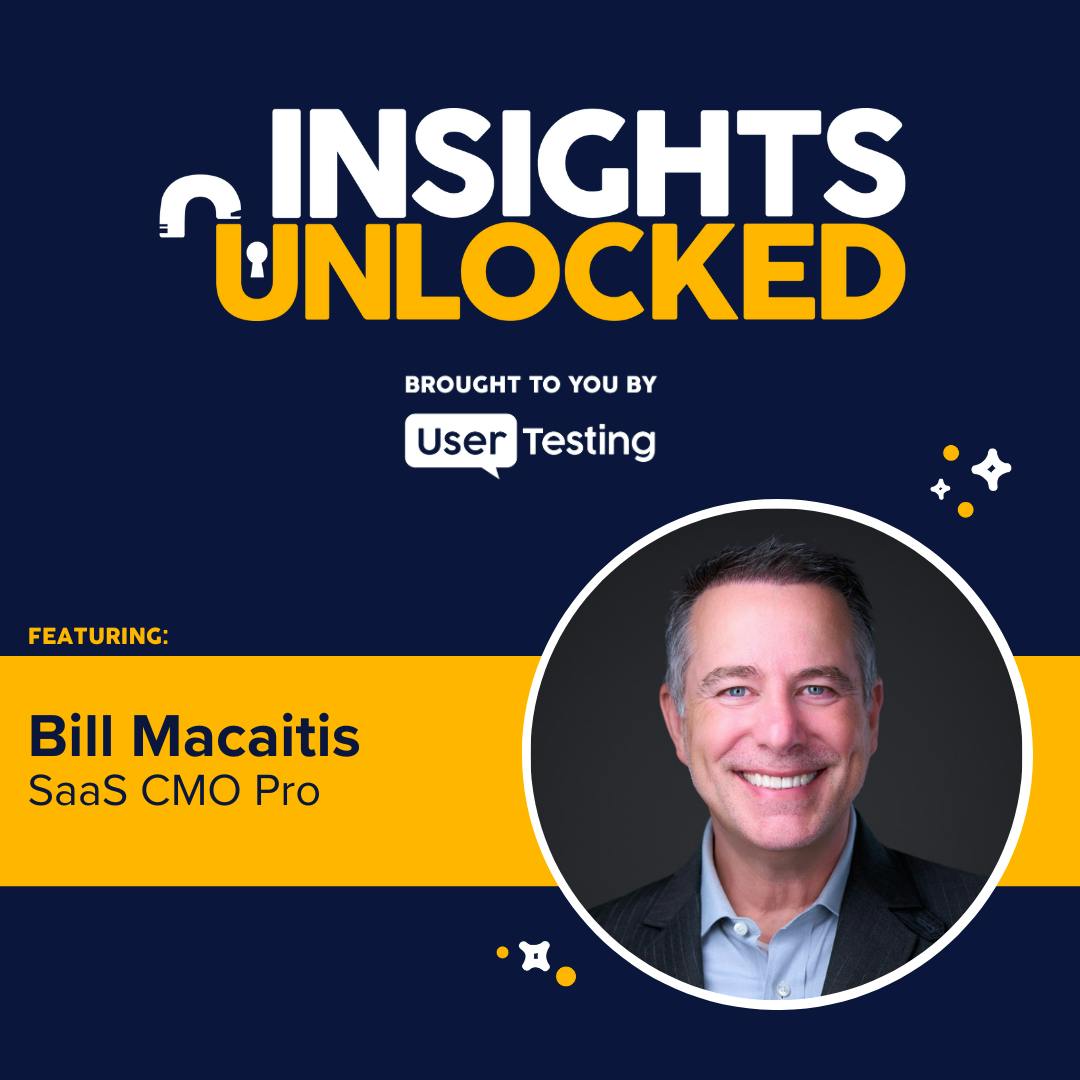
Insights Unlocked
How customer-centric marketing fuels real growth
00:39:32
Learn how Bill Macaitis scaled brands like Slack and Zendesk using customer-centric marketing, capital-efficient growth, and bold B2B brand strategy.
Loading summary
Transcript45 lines
- [00:02]
Nathan Isaacs
Welcome back to Insights Unlocked. In this episode, I'm joined by Bill Masaitis, former CMO and CRO of Slack, CMO of Zendesk and SVP of Marketing at Salesforce to talk about what it really takes to build a beloved B2B brand. We dig into customer centric growth, rethinking, attribution, and why embracing curiosity and a bit of AI can give a marketer a major edge. It's packed with real talk and practical takeaways. Enjoy the show.
- [00:33]
Podcast Host
Welcome to Insights Unlocked, an original podcast from User Testing where we bring you candid conversations and stories with the thinkers, doers and builders behind some of the most successful digital products and experiences in the world, from concept to execution.
- [00:52]
Nathan Isaacs
Welcome to the Insights Unlocked podcast. I'm Nathan Isaacs, principal Content Marketing Manager at User Testing and our guest today is Bill Masaitis. Bill is a marketing powerhouse who's led growth at some of the most iconic brands in tech, including Slack, Zendesk and Salesforce. Now an executive visor and board member, Bill brings a customer obsessed mindset and a passion for building beloved brands that scale. Welcome to the show, Bill.
- [01:17]
Bill Masaitis
Yeah, thanks for having me, Nathan.
- [01:20]
Nathan Isaacs
Bill, as I mentioned, you've had a great run in B2B marketing, but you also worked in B2C before that, and now you advise some of today's most exciting AI startups. How did your journey in marketing begin and what were some of the pivotal moments that shaped how you think about building brands and go to market strategies?
- [01:38]
Bill Masaitis
Yeah, I've been really fortunate from the standpoint that I always knew I wanted to get into business. I always knew I wanted into, like, startups and marketing. And, you know, I did my first job right out of college. We were in the Midwest, we didn't even know there are things called VCs that would give you money. So we had to build a profitable company, which was not really in vogue at the time. But we did an online gaming startup up and we had subscription tiers and models and we were profitable and we sold it. And so like, it's just something like, I've always been super fascinated by it. I think it's like super curious. And for me, like, I think I dabbed in programming really early. Like in fifth grade, I tried to like, program a game and it was horrible. I just had like syntax error, line after line after line. And I said, I'm not a good coder, but I love the business stuff. Right? And so for me, um, you know, I really spent the next part of my career on the B2C side, just really focused on the, on the marketing and the go to market side, you know, and, and the fun thing is like when you're in B2C, you are marketing, but you're also sales. Like there's no giant sales team generally in B2C. Right. Like, marketing is doing a lot of the revenue, they're doing a lot of the growth, a lot of the brand building a lot of the awareness. So, you know, I think spending about 15 years there working for some large media companies, News Corp, IGN Entertainment, going through several acquisitions, it just taught me a little bit of a different style on how you can build and grow these online properties. And then, you know, kind of coming over to B2B, it just, it equipped me with a much different skill set than I think a lot of kind of traditional B2B marketers had.
- [03:12]
Nathan Isaacs
Well, and I, I think, yeah, going back to that first experience you had where you had to build something and make it profitable, you had to learn all those hard lessons where if you're a Stanford grad and you just get some VC money for an idea, you can just throw money at the problem and somebody else will figure it out. But you've already thought about all that stuff and can apply it and really make it leverage all that experience. Go ahead.
- [03:39]
Bill Masaitis
Yeah, I was gonna say it helped me, I thought was one of the most important things that I learned in my career was like, like anyone can buy growth, but how do you get it like capital efficiently? And that first online startup, we did a ton of like viral marketing, we did a ton of like partnerships, we did a ton of content, like early SEO, you know, a lot of stuff that it wasn't just here's a $10 million check and go do a massive ad campaign and nothing. Those don't have their places. But it really taught on me really early that hey, like in startups you have to think about capital efficiency. And I know that goes in and out of vogue over the years, right? Depending on how hot the economy is and how hot the funding environment is. But I just think like, you have to have that. And even the companies that, you know, got massive rounds now, like I see them, they're, they're struggling from the standpoint, like they can't go IPO unless you have the right unit economics unless you are capital efficient with your growth. Right. Or maybe they got a huge round in 2021 and now it's like they need another round, but they're underwater. And a lot of it's just because like you Know, it was growth at all costs. And so I think it's a really important discipline for, you know, marketers and anyone building and scaling these new AI and SaaS, startups like AI is so hot and everybody can get funding now, but hey, like the average time to exit is like 12.3 years, right? Like, what is the environment going to be then? And are you still capital efficiently growing? Are you profitable? Like, I think those are really cornerstones of how you build and scale a company.
- [05:08]
Nathan Isaacs
And you're talking about in the context as a founder, but I think even as a marketer and you're working in demand gen, thinking about how you can solve these problems without having to use money will make you so that when you do have the money, you're much more effective at it. I was just watching a documentary about Spike Jones, the legendary skateboarder cinematographer, and it all started from just having a passion and figuring out how to do things on the fly. Nobody had done it at that point in time. And as we live in today's world, world with AI, start thinking about it that way. How can I solve this problem in a way that no one else has done it before? Anyway, yeah, enough, enough about Spike Jones. But you know, it led to his success. It's why he's so successful is all that experimentation.
- [05:56]
Bill Masaitis
Absolutely. Like, I remember when I was working for IGN Entertainment, I really got into SEO. And at the time SEO wasn't really mainstream, there weren't any classes on it, it wasn't that big of a thing. But like, I knew how powerful that could be for us because we were producing a ton of content. And I just remember, like every night after work, I spent four or five hours going through everything, every single forum I could find, every single article, learning about like black hat backlinks, domain authority. And I just kind of taught myself over a couple months, right? And I think like today, in a really cool way for all the new marketers coming out, like you have this entire new paradigm shift around AI tools and like, hey, and there aren't a lot of formal classes for it, right? But a lot of it's just like, are you just curious and do you want to try things out and fail and you know where to use AI and it's just like it totally opens up and it really levels the playing field too. It doesn't matter if you have, you know, 30 years of marketing experience, sometimes just a new person coming out that really knows how to use AI well can be in a great position. So I, I think that intellectual, you know, curiosity that Spike had is like, it's really important.
- [07:09]
Nathan Isaacs
And we will be talking more about AI as the interview goes along. But right now I wanted to talk about. You've. You've championed customer centricity throughout your career. And I'm just wondering, how do you operationalize that in an enterprise setting where we're so focused on short term metrics that often dominate, you know, the conversations?
- [07:30]
Bill Masaitis
Yeah, it's a, it's a great question. I think for me, I really got into customer centricity because I just think about it like, as an average person and for a while I wasn't like, so when I worked at ign, I was in charge of the subscription model. And you would do things like, hey, you know, if we make this a little bit harder to cancel, like, if we put it in smaller fonts, like, our revenues will go up in the short run, right? And it's all like, short run stuff. And then at some point it's gonna hit me like, God, we're giving like a horrible experience for people. And I started really shifting into customer centric. And then when I finally moved over to B2B, I saw the entire funnel was horrible. If you were a prospect, right, you would find out about a company, maybe go to their website, and hey, I just want to learn more. And literally, you, you can't find anything. Everything's behind the gates. You have to fill a massive form, you get harassed by salespeople, you know, you're not ready to buy yet you finally do buy, you know, all the customer success runs away. The only time they help you is you, right before your year is about to come up and you're about to renew, then they come and help you. You can't get support that's buried. It was like the worst experience possible. And I just thought that, like, hey, if you want to grow and grow efficiently again, like, you got to have word of mouth, you got to have people that are talking about it and recommending it. So I do think, like, to your original question there, enterprise companies really get caught in this trap of short term thinking, right? And not really thinking about, like, what's best for the customer, right. And I thought, like, Bezos had a great quote in his early days of Amazon, where they would always keep like a seat open and anytime they're having a meeting, at the end of the meeting be like, hey, whatever. We talked about decided, what would the average, like, customer think about this, right? Was this like a customer friendly move or was it something that just pissed people off and so I do think it's important. I think it's really hard. I think like customer centric companies really dominate and win the long run and they have massive growth. But it's so hard to build. You have to have the board aligned behind it, the C suite aligned behind it. You have to have customer centric metrics that you track. You know, like I like Net promoter score, CSAT or daily activities. There's a bunch of them, but you actually have to track them. You have to incentivize people on them. You have to like pay them based on them. There's so many things that make it like a really, really hard playbook to execute. Especially when you're at the enterprise and you've already been doing things for 10 years the same way. It's really hard to change those patterns.
- [09:55]
Nathan Isaacs
The we and I two points there I was thinking about is I wonder how much how tied to what we were talking about earlier and capital efficiency, knowing what we're, you know, having the right metrics later on, right? If, if you're efficient with your money, you don't have to be so worried about having massive growth right now to lead into your next funding round. You're like, we can afford this. We can, we can take our time building this the right way. And then you talk about, you know, what are the metrics to track to kind of know customer centricity. And maybe you can share your thoughts on this. But we had Sangram Vadre on and his metric he's really fascinated with is nrr. So that you know how many of your customers are staying your customers and can you keep that metric? That's a good sign that you are customer centric. If you can. How close to 100 or even farther than that you can get.
- [10:53]
Bill Masaitis
Yeah, certainly. Right. Like expansion too. That's a huge part of it. It's just say your existing customers, are they growing and expanding over time with nrr, I think, I think metrics drive behavior. I mean, at the end of the day, like I work for a lot of different companies and what I found is I think most people are good people, you know, they're trying to do their job well. And if you tell someone that like for instance, in marketing leads is your only metric, you're going to just try to get leads, right. And you're going to put everything behind a paywall and a gate and you're going to get people that probably even aren't good fits for your product, but you know, they still became a lead and you're going to do all this stuff to like maximize leads. Right. And I think like that's again one thing I noticed in B2B was that like how it was done 30 years ago, a lot of it is still the same playbook and go to market, I'm, I'm always amazed, like I'll see like a really cool AI company and they've done an incredible job with the product, like whoa, it's groundbreaking. And then I'll like kind of peel back the onion on the go to market and it's a really old playbook. It's like outbound sales, top down enterprise, press releases, events and that's just how they've built it. You know, classic funnel leads, MQL's pipeline opportunities. So I just think like a lot of the customer centric, it's a, it's a much different paradigm shift, right. It's thinking about hey, what are the right customer centric metrics? How do we track it? How do we incentivize people, how do we have all these teams work together that are historically siloed to drive these. I remember at Slack for us, you know we had three primary company North Star metrics, it was ARR Daus Daily Active Users and Net Promoter Score. Right. And all the teams shared in that we didn't just say like oh marketing you just do this or sales you just do this or product. You know, we all shared. So you know it was a very customer centric culture. But I think a lot of that starts with the right metrics, the board being behind it, having a little bit more of a longer term viewpoint because then once you start to get like that amazing customer centric word of mouth, K factor growth, like it just starts to grow crazy. And it's an amazing playbook if you can kind of pull it off.
- [12:58]
Nathan Isaacs
Well how do you get that, how do you adopt that playbook? How do you, you know when we're talking about being customer centric and we're measuring metrics but how do you get that customer back involved to, to know what the right metrics are, to know what the playbook should be or, or anything like especially in you're talking about with AI, you're some of the AI companies you're advising how you know, what, what's your recommendations?
- [13:23]
Bill Masaitis
Yeah, so I ended up getting that question a good amount right from AI companies. And so for anyone that is curious about this and wants me to you know, hear like an hour long explanation on a specific topic, I'd encourage you go check out SAS CMO Pro that's my website. I've done a ton of videos on this stuff. They're all free. I just did it because like literally I kept getting the same questions and I'm like, you know, I wouldn't mind like showing the founder here's like an hour long video on just like, you know, POG metrics or whatever it might be. But I will say like, you know, to kind of answer the tactical question, a lot of it is a, a culture mindset, right? The great news is a lot of the AI companies coming out are, are by definition new, right? They're not that old. There's a couple that have been doing AI for like five or 10 years, but most of them are like net new startups. And I will say from working with a bunch of companies to try to like help them accelerate their growth, shift a customer centric mindset a lot of times that has certain like PLG or product like growth initiatives in it. The earlier stage companies can really adapt very quickly to it and pivot and you know, kind of get the board behind it. I help them with here's the right metrics, here's culturally how we have to adopt it. Here's how like for instance, maybe we're going to do a model where people go in, they go straight into the product as opposed to naturally becoming a lead and then going through the sales team, right? Maybe they have a kind of a PQL product qualified lead, right? You know, maybe you're measuring time to value, which is a classic like PLG customer centric type metric. Like those things are all easier. The early, earlier stage. You are really for the later stage companies. When I work with like you know, a series D E, maybe they're public, that's where it becomes much more of a change management exercise, right? That's like just fundamentally trying to change a company. How they do work, how they're organized, the metrics they use. And I've seen a lot of them fail. And I've done videos just on that, right? Like here's why this big company tried to peel GENIE initiative and it totally failed. You know, there's sometimes like, I, I remember one, I couldn't believe this. It was a giant company and I'm walking them through, okay, they want to do POG and walk me through, like what have you done so far? And like, well, we put, you know, it's like I think a thousand people at the company. Well, we put one person on it. They're like the PG person, right? And I was like one person like that's, it's like a company transformation, right? So it's definitely difficult. You know, for anyone that's listening to this, like, like PLG or customer centric is a very different paradigm shift than a normal, or I wouldn't say normal, like an old style slg, sales like growth, like playbook. And if you're going to do it, you really have to attack it on a number of levels.
- [16:09]
Nathan Isaacs
When we think about that and think about executing your playbook and what are the metrics, you've said that most attribution models are broken. What are some of the signals or feedback loops that can help marketers truly understand how people are making buying decisions?
- [16:26]
Bill Masaitis
Yeah, attribution man. It's a rough one, right? Because one thing that I kind of implicitly always felt and when I kind of dived into the analytics was that these are journeys, right? Especially in B2B, right? You don't just see a billboard and go buy a six figure deal the next day, right? It's, it takes time to like learn about this category, learn about this company, what do they do, like what are use cases, talk to other people that are using it, you know, start trying the product out. Finally talking to sales like this is, you know, in B2 B6amonth, one year, two year, three year deal cycles are very common based on the segment you're selling to. And attribution was always kind of weird because like I, I started getting into it at Salesforce and you know, a lot of the marketing automation tools were using like first or last click to give all the credit. And I'm like, wait a minute, like this, I would look at this deal and it had like 30 touches and I'm like, why are we giving everything to the first or the last touch? Like, and again it creates kind of these like weird perverse incentives where you're getting into like tagging wars on the marketing team and everyone's trying to take credit. Credit. And not only that, like a lot of companies would have this model of like, well, either marketing gets the credit or sales gets the credit or the partner gets the credit. I'm like, well a lot of times these like, they're all working together to close this deal or to move it forward. And so I, I just, I really didn't like the, the old style attribution model. I do like the idea of attribution. Like, hey, let's like, let's understand what helps move these deals through, what helps discover them, what helps close them. And I, you know, I do recommend for companies that really want to get into the fine tooth attribution model, like use AI tools, I can do regression analysis that look at every single touch, that apply credit, that understand trends, or for other startups that are just kind of, you know, don't have the dollars to maybe like invest in that or the time, just do like control groups. Right? Control groups are where you basically say, we did this a lot of slack when we were scaling up. Or we'd say, hey, we're going to run this marketing campaign. Maybe it's an outdoor advertising campaign, whatever it is, but it's just going to be limited to a very specific region in the US and the rest of the US will be the control group that doesn't get it. Right, right. What were growth rates, what are branding rates, how do they differ? Pipe leads, all that stuff. Right? And you can do that. Or maybe you're running an ABM campaign, right? And you say, hey, we have 100 accounts in our ABM campaign. Well, as opposed to all 100 getting it, just run it to 50, right. Have the other 50, never got the ABM campaign and then measure, okay, what were the size of the deals? Like, how long did they take? You know, what was the acceleration? There's all these metrics you can look at, but I think like when you just look, get into like first or last such attribution, it really skews you. It's one of the reasons why Google SEM got so big is because, you know, one of the last things people do is do a branded search, click on it and then go, you know, buy from the organization. And you know, I think you have to challenge a lot of these things and at least in my experience, like kind of understand that these were journeys and really make the appropriate decisions from that.
- [19:36]
Nathan Isaacs
When you are having a control group or you're looking at something like that, when do you dig deeper to find out the why, you know, get into, you know, so why did 50 of these people click on this? Or. Yeah, you know, do whatever.
- [19:53]
Bill Masaitis
Yeah. Well, I remember I was a Salesforce one time and there was this big movement, like, so Marc Benioff, amazing guy, incredible philanthropist, just towering, really tall guy too, Right. Can be intimidating. And he was always ahead of his time. He was always like 10 years ahead of his time. Right? So, you know, like we're talking like 10, 15 years ago, he was all on the social enterprise, right? He kind of understood how social is going to fundamentally transform and he was building something internally. We called it chatter. But eventually, like Salesforce Bought Slack, but it was kind of like that type of like internal social type tool. And he really was all in on this, right? And so he's like, hey, I want the homepage to read. You know, Salesforce, the social enterprise, right? And in his mind, he totally got it, right? And he talked with press and analysts. They kind of got it. So we all, right, we put it up there and all of a sudden we're like, our leads are going down and we're not. As many people are converting. And so we're looking at this, you know, when we're running this test. And we, at that point we're like, well, we got to know the why, right? So we did a lot of like, at that time, I think we used like, I think it was five second test.com, it's where you basically show a homepage for five seconds, it goes black. And then you ask the people, well, what do they do? What is this company about? Right? And we're talking to these people and they're all like, oh, well, I thought you sold software to nonprofits. Right. You know, and it wasn't for me. Right? And so that was a really good example of like, where, you know, the messaging, which sometimes is great for analysts and press and even for leadership in the company, sometimes it's like, just what does the average person think of those words though, right? And like us understanding the why. And once we understood that, we were able to talk like, okay, we get it. Like, maybe we still use that messaging, but very targeted for the right groups. But for average people coming in, you know, we're going to use more language that they understand and that can help explain what Salesforce is.
- [21:46]
Nathan Isaacs
Yeah, just, you know, we just went through this exercise understanding why one particular, you know, guide or white paper was doing better than anything else. And it was like, oh, it's. It has a link to it on the, you know, the first tab on the home page. And, and people are clicking on that tab first because of the positioning. It's not because you wrote that guide any better than anything else, Nathan. And just watching people do that, you go, oh, okay, I got it now.
- [22:16]
Bill Masaitis
Totally.
- [22:17]
Nathan Isaacs
You've. And. And you Slack and Zendesk and, And Salesforce. These are all. They're B2B brands that, like, are universal. Really. I mean, they, you know, grandmothers know what they are. How do you build that? How do you create a brand that goes beyond sort of that traditional, boring B2B sort of, you know, space?
- [22:45]
Bill Masaitis
Yeah, I, I think for me, you know, my Background. And when I, I spent a lot of time B2C and when it came to B2B, what I noticed was that a lot of B2B companies played it super safe, super conservative. They all kind of looked the same, they all kind of sounded the same. And consequently, like, it was really hard for those companies to differentiate and separate from the package. And you know, my time in B2C really taught me like, hey, you have to be different, right? You have to stand out from people, you have to talk a little bit different, you have to look a little bit different, right? And I really pushed when I was at, you know, Salesforce, Zendesk, Slack owned the marketing leadership roles. Like, hey, I want to build a really unique brand. I want a brand that has a very unique editorial tone and voice, that has a very unique visual identity. Some cases we're going to leverage mascots, we're going to do a lot of consumer type playbooks, right? And that's where really the customer centric came into, right? Like, hey, you know, it's not just your brand isn't like your logo or your slogan. It's like all these little touch points that people have with you, right? And were they positive touch points, were they joyful touch points? You know, we talked about content marketing. I know that's your side of the house. Like I ran a lot of content teams and I always said, hey, I want you to build like helpful, good content. I don't want you to make slimy brochure where that just says why we're awesome in 20 different ways. Like just help them out. I remember our most popular piece of content at Zendesk was the top 10 interview questions for Hiring Customer Support Agents. Zendesk was not an ats. We did not help hire customer support agents. We just helped solve tickets. Right? But that was a really big pain point that a lot of customer support managers had. Like, there's a lot of turnover if you're in support. Like it's a hard business. Like it's stressful. You have a lot of turnover. So hiring is a really big part of their, of the role and that was really helpful for them. So I, I think like eventually like you know, kind of merge all these together. Like the brand takes all those into consideration and why it's why when you're marketing, sometimes you have to really look beyond the marketing team. You have to look at like, are we, are we polluting bad experiences as part of the sales process or part of the product onboarding experience? Or like, I'm a Big freemium guy. Like, I never liked free plans that all like were crippleware, right? That only like three features you could use and everything else was limited, right? Like no, give them a good experience, right? Because that impacts the brand and all those things matter, right? And a lot of times I would get pushback either when I help other companies or even at some of the companies I was at some point somebody like, well, I don't know, Bill, like we're, we're starting to move into the enterprise and they're not going to like, like we got to play it safe and talking acronyms and I would always hear that. But eventually like it wouldn't matter. Like people were people, right? And you know, a brand that you really love, even in B2B, right? You tend to talk about more, you tend to spend more with, you tend to, you know, you don't tend to attrit as much, right. And you tend to expand more. So these are like really important metrics, right? When we get back to the original conversation, how do you grow efficiently? How do you have the right growth metrics and capital efficiency metrics? Like that comes back, a big part of it is the brand. And so like that's just been kind of my experience. But I definitely believe like in B2B there's a massive opportunity now, especially within AI where you have 20 competitors, you know, building a unique brand, it can really separate you and put you in a great position to succeed.
- [26:15]
Nathan Isaacs
So my, the observation, I don't know if I have an observation. I'm just wondering, and we speak about AI and how everyone's just going to sound the same because they're all asking, you know, for, write a headline for this homepage and it's the same headline for everyone that everyone's product. But I'm wondering what advice do you have for these marketers or other leaders to have that courage or find that courage or be able to enact on that courage, right? Because I think what you're really getting at is having the courage to do all this stuff. Why your AI startups that you're advising are using that old playbook. Because it's, it's like they've, it's been used before, right? They, they. What's the old saying? You can't, I can't remember what it was. It was something about IBM or whatever you. Oh yeah, you can't get fired for.
- [27:11]
Bill Masaitis
Yeah, for, for recommending IBM.
- [27:13]
Nathan Isaacs
Yeah, yeah. So how do you, how do you find that courage? How do, what can they do to you? Know, channel that.
- [27:20]
Bill Masaitis
Well, the good news is, look, a lot of the AI founders I work with are implicitly trying to build something amazing and big. And the founders are always thinking about the long run, right? Like they are thinking 5, 10, 20 years out. So usually that's not a hard group to believe in. You know, most of the VCs, hey, these are 10 year funds, right? So again, they want something big too. I think a lot of times where it breaks down is when you start building out your executive staff and you know, a lot of times there's a temptation, well, I want to hire this person. They worked at Oracle, they've been there 20 years, like, and then you end up taking that playbook, whatever they brought in. And again like for 80% of companies, that's the normal playbook is SLG sales like growth. That's what they've done. Now new AI startups coming up are really leaning into more customer centric plg, freemium models, a bunch of other type of go to market innovations. But I feel like there is, you know, the courage is there. I think sometimes where it's harder is when you're an individual marketer as part of a big marketing team that's been doing things the old way and to kind of like challenge that and to maybe, you know, hey, maybe we're not using the right metrics, maybe we're not doing the right playbook, maybe we're not really being customer centric. That's hard, right? And I'll say a lot of the cycles that I personally spent at my time at Slack, Zendesk and Salesforce were all on change management. Like I would literally spend a ton of cycles just talking to people and educating them. Here's why these Playbooks can be different, here's why they can work, here's like how to implement it, here's, here's why we need to make this change. Right. Like the actual Playbook itself I actually didn't think was that hard. Like, it's all right, you do this, this, this and this, but it's like convincing everyone else that hey, this is a new model, it's a better way of doing it. Now of course, once the metrics all start going up onto the right, it gets a lot easier to get that buy in. But initially that's hard, right? And some of these by nature are a little bit more long term. Like you're not going to see everything changed in a week. It might be six months or three months or nine months. Right. So it is hard. There's A reason that everyone does it because it's very hard to change all the hearts and minds. It's very hard to pivot to a little bit more long term type goals.
- [29:28]
Nathan Isaacs
The speaking of that sort of working together and talking to those different teams, what's your advice on, on just that how what can marketing do to work better with product? What can product do to work better with marketing? What can they both do to work better with finance? You know, what are your thoughts there?
- [29:50]
Bill Masaitis
Yeah, the natural gravity that I've seen over time is that these teams are going to be siloed. And not only that, the bigger you get, the more siloed they get. Some of that is just physical proximity. So for those, you know, startups are still in offices and everything, right? Like you just as you get bigger, well, the marketing team's on one floor and the product team's on another floor. If you get really big, they're in a, a different building or a different city, right. And so, you know, the natural gravity is you are going to get more siloed as time goes on. I, I found the only antidote that I've seen from this is a try to share some metrics. Like really like try to have not, you know, like the classic was marketing and sales, right. Where they just have very different metrics and a lot of that's like you gave me crappy leads and well you never followed up on them and because they had wrong metrics, right. Like when I've seen marketing and sales team share the same metric, maybe it's just closed ARR for the quarter. Wow, they really work together much more and marketing really changes how they act and sales changes it too. But taking a more wider viewpoint, I really thought go to market is not just marketing and sales, it's marketing sales products. It's really all the teams looking at it holistically, right. So I like the idea of like hey, you know, one reevaluate, do we have the right metrics? Are they customer centric? Are they long term oriented? Like what are those? B trying to like then share those metrics across multiple of these teams and then C, you know, if you're an individual marketing leader or an, or just even an IC within marketing team, like meet with these other teams like regularly, right? Like I would always tell people on my team like hey, you should get to know these other, you know, internal stakeholders. You should know, you know, who's their significant other, you know, like what are they? Like you should get to know them like you know, more than just A total superficial level, like, you know, become a true, like, you know, partner with these folks. And that's hard, you know, because I think a lot of times, and I was guilty of this too, really early in my career where, you know, I would have a job and I'd just be like, heads down, okay, I'm the same man. I'm just going to optimize this campaign all day long, right? And part of it in marketing is like, really trying to understand, like, hey, you have to build these partnerships. We have to spend cycles, you know, doing projects that require other teams and educating folks and building momentum towards it. And that just takes a lot of cycles.
- [32:11]
Nathan Isaacs
It's. It goes back to something I've been thinking about a lot, and a lot of conversations we've been having on the podcast is like, you almost have to slow down and, and to speed up, slow down, have those, build those relationships. Don't get caught up trying to launch campaign after campaign, but understand truly what you need to kind of move forward. I am wondering, as we wrap up and we. We touch briefly on AI, what your thoughts are on AI and how marketers can be leveraging that. And also, just as. What's your advice for marketers as they think about tomorrow's playbook, stuff that we're not even thinking about today? How do you. How can they be flexible in their mindset so that they. They adopt a playbook that they need to adopt at that point in time?
- [33:03]
Bill Masaitis
Yeah, it's a great question. You know, on that last point there, I think it's really good to establish a mindset that, hey, the go to market, the marketing playbook can and should be changing every year, right? Like, it really should evolve and you have to leverage what our latest tools are, latest trends. You have to go where the eyeballs are. You know, it should be this fluid dynamic playbook. And as part of that, you know, you have to understand, like, what are the big macro trends on where people are spending time and also what are the tools that are available to me, right? And I just think, like, AI is fundamentally changing and making us all like, super marketers, to be honest, right. Like when I started my sasscmo Pro channel, like, historically, to kind of create that much content and do all this, like, you might need a pretty big team. And I just was like, well, I'm gonna use an AI tool for every place I can, right? And it really, like outside of a couple freelancers I use for editing, which we were talking about earlier, it's. It's all like, AI Tools are allowing me to do the work that historically, like a big team would take on. And so I just think like, be open minded. And I really think like, there's not a single function and marketing that can't be using AI right now, right? We talked about like, you know, the unique brand, right? And editor, tone and voice. And look, if you use now there's like with all tools, bad and good ways, right? If you just ask a really generic way, well, what should the homepage say, right? And everyone's going to have the same, same homepage, right? Or maybe you go like, hey, we're going to build a really unique editor, tone and voice. And here's what it's going to sound like. Here are the values here, the quality. And now like we've written a bunch of articles, now we're going to say, hey, AI, rewrite the 4,000 other pieces of content that we already have, but in this unique tone and voice, not just our marketing collateral, but also within the product, the onboarding, right? You know, the, the success, like all this stuff, right? And make it, whatever it is, it's unique, it's different, it just doesn't sound like everyone else here. That's a great example where AI, you can leverage and change the amount of content you have. In the past, that'd be, it's so hard. I remember when I worked at Salesforce, we did a big messaging change and we kind of, there were like 10,000 assets that all needed to be updated and we're like, oh my God, like how are. And that's why like marketing's push back when there's like the CEOs like, we gotta change how we speak. And they're like, oh my God, like everything I have to update, right? But AI makes it easier now, right? And so I don't care if you're in video, if you're an attribution, you're in programmatic buying. You know, AI can help you out and really make you a superpower, right? So I just think like, it's a, it's a cool thing. I get, it's a scary thing, you know, But I, I think like the best marketers are just going to kind of adopt it and, and really lean into it.
- [35:42]
Nathan Isaacs
I think as you're talking about that I'm wondering how many people are. They go, oh, I need to do AI, so I'll just do a Google search for chat prompts for demand gen and they use somebody else's chat prompt instead. Be curious, you know, channel your inner Spike Jones and write down all the stuff that you have to do and say, how can AI help me do this one step? And then kind of come up with your own prompt, you know, maybe do it that way. I, I don't know, but.
- [36:14]
Bill Masaitis
And I'll say for the, the marketing leaders that are maybe listening too, I think it's really good to give them cover, give your team cover. Like, it's okay, guys, some of these AIs are going to make a mistake and it's going to look a little weird or embarrassing. It's okay. We're going to make some mistakes as we lean into this. It might hallucinate at one point or it just doesn't work out, but that's all right. Like, you have to give your team cover to try these new things and to embrace them.
- [36:39]
Nathan Isaacs
Is it. How does the leaders stay authentic to that point and not sound or not be interpreted by, you know, me as being, oh, he just wants me to train my AI replacement.
- [36:52]
Bill Masaitis
Yeah, it's definitely a larger issue. Right. Is, is AI enabling us? Is it, you know, replacing us? What does it look like for marketers? But in general, like, I'll say this when I've seen companies grow fast, right. Like, if you're helping your company grow faster, that's, that's something that's going to be always in demand. And I think, like, trying to resist using it isn't a winning playbook in the long run. Right. You're just going to get replaced by someone else that does it. So I don't know, I just think, like, I'm more, I try to be an optimist on this stuff with AI. Like, I do have, you know, I've got a daughter, she'll be going into the workforce and I want to believe that, hey, AI is going to allow really anyone to do, create businesses to do things they couldn't in the past because there's going to be so many helping functions within it. But it's, it is, it is scary. You know, there's, there's some scary elements to it. It's incredibly powerful. It's going to change how marketers do their jobs, how many of us they need. And you know that. The best advice I can say is just, hey, just lean into it and get to know it because you'll, you'll be more, much better equipped than the person that doesn't lean in.
- [38:01]
Nathan Isaacs
Yeah. And truly know your audience. Like, if you can know your audience and know how to use these tools, you'll still have a job, job somewhere.
- [38:10]
Bill Masaitis
Absolutely.
- [38:11]
Nathan Isaacs
I'M trying to end on a higher note.
- [38:13]
Bill Masaitis
There we go.
- [38:16]
Nathan Isaacs
I really enjoyed our conversation. How does someone learn more about you and SaaS CMO and all that?
- [38:25]
Bill Masaitis
Yeah, so the website is Sass CMO Pro. So you can go there or you can go to YouTube. I created a lot of video content. Really. It was all the questions I used to get asked by a lot of my advisor or board member. I just started creating videos on it because I was so lazy. I'm like, just watch the video. Right? So if you want to learn about any of this stuff, customer centric, plg, freemium brand stuff like, I love that stuff. It's totally free. I just want to help out. You know, other marketers are kind of going through the similar things. And of course you can always hit me up on LinkedIn. Happy to connect there as well.
- [38:58]
Nathan Isaacs
Great, Bill. Thank you so much.
- [39:00]
Bill Masaitis
Yeah, it was such a pleasure having me, Nathan. I really enjoyed the conversation. Thanks so much.
- [39:04]
Podcast Host
Want to keep the conversation going? You can find the show notes@usertesting.com podcast if you haven't already, don't forget to follow us on Apple Podcasts, Spotify, Overcast or Google Play, so you never miss an episode. And if you enjoy today's show, please share it with a friend or leave us a rating and review on Apple Podcasts. And until next time, this is Insights Unlocked, an original podcast from User Testing.