← Insights Unlocked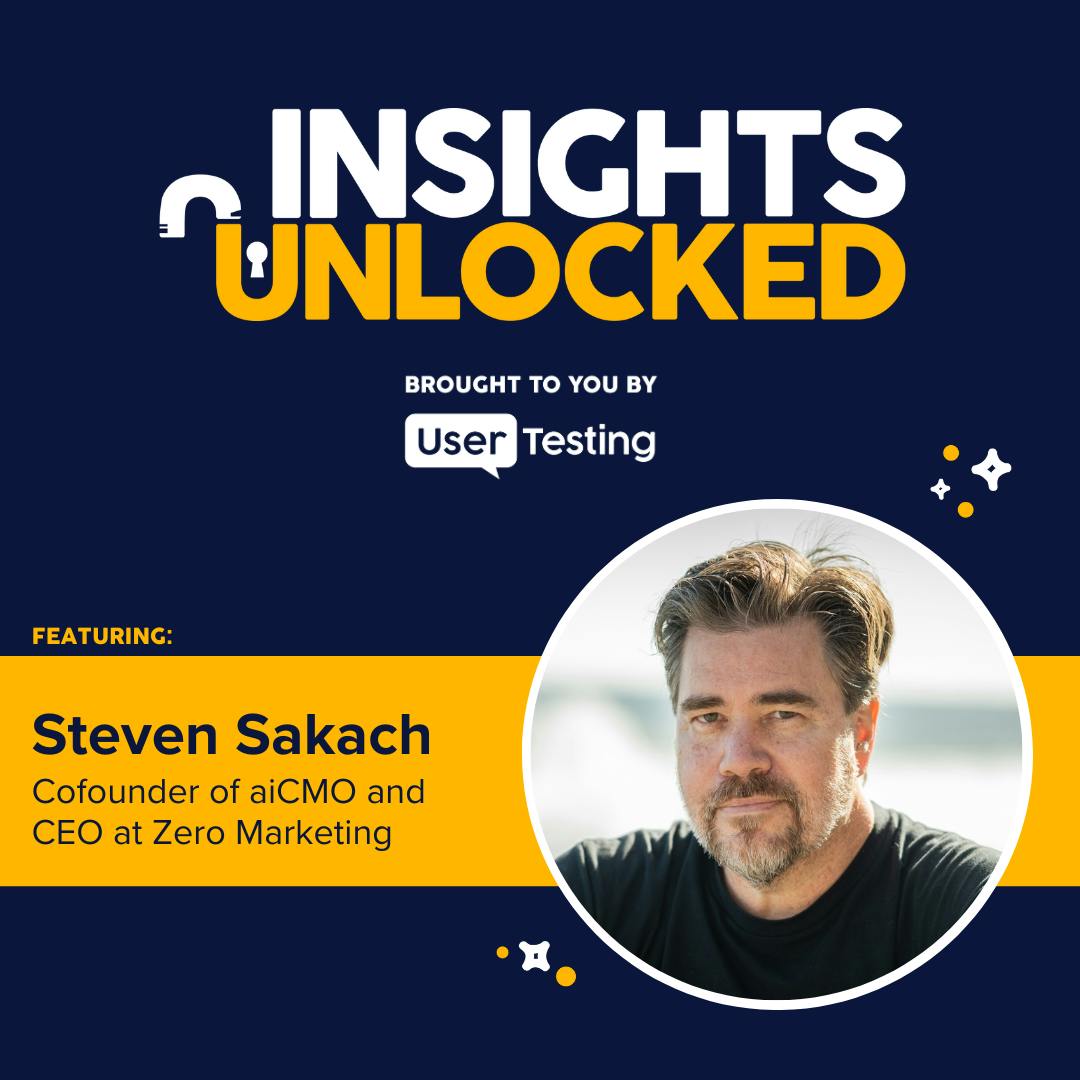
Insights Unlocked
How empathy in marketing can unlock your brand’s higher purpose
00:33:10
Discover how empathy and purpose can transform your marketing with insights from aiCMO co-founder Steven Sakach
Loading summary
Transcript39 lines
- [00:02]
Nathan Isaacs
Welcome back to the Insights Unlocked podcast. In this episode, I'm joined by Stephen Sokash, co founder of AI CMO and CEO of Zero Company. We dive into what it really means to build empathy and purpose into your marketing and how AI can help you get there without losing the human touch. From Patagonia to Dove, we explore the brands that are getting it right. Enjoy the show.
- [00:27]
User Testing Host
Welcome to Insights Unlocked, an original podcast from User Testing where we bring you candid conversations and stories with the thinkers, doers and builders behind some of the most successful digital products and experiences in the world, from concept to execution.
- [00:47]
Nathan Isaacs
Welcome to the Insights Unlocked podcast. I'm Nathan Isaacs, Principal Content Marketing Manager at User Testing and our guest today is Stephen Sikash. Stephen is co founder of AICMO and founder CEO of Zero Company. He has three decades of experience in digital media, journalism and human consciousness studies. He also co hosts the Bliss Business podcast. Welcome to the show, Stephen.
- [01:13]
Stephen Sokash
Great to be here.
- [01:14]
Nathan Isaacs
Steven, you've had a fascinating journey from your journalism background to digital marketing to building AI tools that aim to make business more human. Can you share a bit more about what sparked your focus on empathy and marketing and why that became such a core part of your work?
- [01:32]
Stephen Sokash
Yeah, you know, there was, I remember going to this consciousness event way back when and we were all, you know, talking about like oneness and integral theory and all these sort of things and sitting around our breakfast and they're like, so how are you going to apply this to your business? And you know, I'm thinking in back then it's like search engine marketing. I'm like, we've got, you know, one title and a couple descriptions lines. I have no idea how I'm going to apply, you know, all these, these higher concepts to marketing. And so really it became kind of a journey on, well, what does it look like to be, you know, these higher consciousness businesses? And you've kind of seen this movement recently of this sort of conscious capitalism movement which is really this, this moving consciousness from modern consciousness to a postmodern consciousness where you're taking on a lot wider perspectives and so where you're really more empathetic in how you run your business. And you know, in the old, in that other consciousness area, you're kind of really focused business wise on, you know, the investor, owner, this is the sole thing, is the sole pursuit of profit. And then as you move to this conscious capitalism approach, it's more like, okay, not just the investor owner, but now also, you know, what's in our employees best interest, our Customers, best interests or our partners, our vendors, our community and environment. And you kind of make decisions through that lens for your business. So is there a marketing side to this? Yes. And I think a lot of it really surrounds itself around your purpose and your higher purpose. And as businesses evolve, they start to articulate that higher purpose a little bit better to whether it's not just profit. They're also looking at profit, people, planet and purpose, you know, when they're evolving their consciousness as a group. And so, you know, this is where we really started to lean into focusing on purpose in your business, trying to get that higher purpose of your business articulated. Because when you can do that, you see all these businesses as they evolve, that really becomes the boss is the purpose. You start to align every decision around that purpose. And so with all of that, I think two things really kind of become more and more important with your marketing. And that's, it's empathy and it's connecting to purpose.
- [03:55]
Nathan Isaacs
It seems like that's a hard thing to reach. You can only think of a handful of companies that have been very successful with that. Right. Patagonia would be one. And then you see where they, where it was clearly focused on the purpose, Ben and Jerry's ice cream, but then gets sold off to a company that wasn't really his purpose. And now they're in this state of flux going on right now. So like, how, how do you.
- [04:26]
Stephen Sokash
Yeah, it really is. I mean, that's a really great point, especially with Ben and Jerry's. There's this, there's a, a few books on this that show these, these different businesses that operate at this higher consciousness level. And sometimes when you bring in someone who's operating from that more traditional business level with a sole pursuit of profit, it just wreaks havoc on the business because it's like a regression move. And so, like, you know, this is, like you mentioned, Patagonia is a great example of, of one that's really this next level that all the decisions are made from Patagonia about their purpose. You know, they aren't going to come up with an ad like don't buy this jacket that goes viral if they aren't so aligned with the purpose that they're asking questions like that that can come up with this concept. But like you mentioned, like Ben and Jerry's, this is a really interesting time to see what's going to happen with, with that because historically it has not gone well when you've seen that happen with the business. But it is, it's a very difficult Thing and that's why we really started trying to develop this AI Chief Marketing Officer is because we know that process is difficult and trying to take someone through that, we thought AI could actually do a pretty good job of that, you know, if done right. And what's amazing, when you take small companies, mid sized companies through that and they're articulating it for the first time, you just see everything kind of come to life. Like their marketing starts to have soul, the organization starts to have this, it starts to become kind of this living organization versus the old way. It's just this very dead dry system that we're in where we're, you know, opening up the vein, you know, Monday through Friday, can't wait for the day to be done. And it's just this exhausting problem that we've got really with if you look at the Data, it's about 80% of the world workforce is disengaged. And this is amazing. This is like amazing almost tragedy because we're going to work without meaning. And so I think there's a huge opportunity here for marketers to help find that meaning in, in people's work. And it does start with asking those questions about purpose.
- [06:44]
Nathan Isaacs
Well, yeah, and I think you know, like there's some sort of the, the. If you can do that and you can, what happens is that you find your true audience, right? That audience that will make you do all the things that you want out of life, will give you that profit that you want in. In that toss out, you know, big brand examples. But like the other 98 of companies, what, what are they doing? What are they getting wrong about empathy in their messaging? You know, like how, where are they? How, how can they better connect emotionally with their customers through marketing and you know, and maybe we can understand how to do that better by understanding what they're doing wrong. Maybe you have some ideas.
- [07:33]
Stephen Sokash
Yeah, no, this is a great question for sure. I think it really does kind of start with you got to be about it in as a company, you know, the stories you tell need to be authentic. You can't pander like we're right now like this younger generation, this is the most marketed to generation in existence, right. And they're going to sniff out the BS a mile away. Know they're and, and it's going to backfire on you badly. You know, for like a Patagonia like you mentioned though, this is, they're about it. Right? We all understand that and we're kind of living that journey with him. We want to see ourselves in that, in that situation. But, you know, the opposite side of that, we did a, a, we looked into business scandals, right, and looked at how they failed on the various different verticals and broke those down by their systems. And what part of their systems failed. And a huge chunk of them failed because they lacked an authentic purpose. And so that was a huge chunk of. The other part was like, the feedback loops were, like, you know, suppressed in that process. But like you look at Wells Fargo, you know, marketing, they built up this great campaign over decades of, you know, the old stage coaches and how trusted they were in the gold rush days. And then at some point, their business wasn't about it. And the scandals kind of followed that we all know about, and it really killed this story that was told for decades. And it, it's just hard to recover from that if you're not. If you're not authentic. And so I think that's really. You got to make sure your business is about it because, you know, you can talk the talk, but if you aren't walking that at the same time, this, this generation and people are just, you know, we're just very savvy about the messages that are coming at us these days.
- [09:19]
Nathan Isaacs
So that if we, if we want to find that true, authentic self in our messaging and in our marketing, you know, what. What are the some steps that we need to take to kind of get going with that?
- [09:34]
Stephen Sokash
Yep, that's a good question. So, you know, where. Where we like to start with, I think, is really when you think about businesses, a lot of times when they're growing, they sometimes lose their way. When they get to the stage of, like, scaling right, they start things going fast, they're making shortcuts, they're building systems, and then what happens? You start to lose your story. Sometimes you never even had it at this point. And so we have this kind of mantra that we use. It's called bliss, which is build love into scalable systems. And so if you're asking yourself that, you know, how can I build love into this part of my business? And you kind of doing that over and over, I think this is a good way to help you find those values and a good way to maybe articulate them, because you'll kind of figure out that higher purpose along the way. When you're doing that, you find out, you know, how is my business in service to others? You know, how is. How is it making a. A positive difference in people's lives and how can we do more of that? And so this gets you to a place, I think, where you're getting closer to that higher purpose. If we can get closer in proximity to really love in what we're doing, we're going to find higher purpose more often than not in that kind of work. And once you can at least define some sort of higher purpose, it's going to be almost always kind of this empathetic kind of thing. And now you can use that as kind of guide rails for your marketing. And so, you know, we're wondering ourselves, like, okay, can we take this process and can we scale this, you know, out to other businesses? And so is really having this interaction with AI, I think that helps kind of guide us through this process because it's a very difficult process, you know, like you're thinking to get there with that, pulling that purpose out of some businesses when they've never articulated it.
- [11:36]
Nathan Isaacs
So, so how's that work? How. Tell me more about that with the AI.
- [11:40]
Stephen Sokash
Yeah, so we developed the AI Chief Marketing Officer platforms at a CMO IO, which is. It's really trying to help, you know, small businesses, small marketing teams kind of take a more empathetic approach to their marketing. So one of the first places we try and help companies start with is defining that higher purpose. So we're taking you through, like, a series of questions. And, you know, I've seen some people spend a long time at this. We also have AI prompts that do really well, like, hey, does this sound like you? So you can get through it in like, five, ten minutes. But all we really want from it is something that closely aligns with what you're feeling as far as your higher purpose, because then we can take that. And now, you know, whenever we're creating, like, ideas for, you know, your campaigns, we've got these kind of guide rails that, hey, can we tie it back to this in some way? So if you want to create, you know, your social posts, your blog articles, your. Your Google Ads, your emails, you can always kind of have these guide rails of this purpose in there. And it comes up with some really creative ideas on campaigns and some of the brainstorming tools that we have that really are trying to help resonate, you know, with. With your purpose and with other people in the process. And a lot of time is spent on trying to make emotional connection and how we could do that, and which is why we kind of started our podcast, is because we wanted to make sure you're authentic throughout your business because, you know, we can help you do all this stuff, but we really don't want you to Be, you know, just talking to talk and not being about it.
- [13:15]
Nathan Isaacs
So when you're, when you're, you mentioned starting the podcast and you're out finding what's your experience been like, are you finding the businesses that are getting this or understanding this?
- [13:26]
Stephen Sokash
Yeah, we did. So we started this process of, we kind of did this keyword research on businesses with, you know, words like love and empathy. And turned out maybe about 8, 9% had some sort of part of that in there. It was okay. There's a group of people on here that's actually a pretty decent sized chunk out there. And it's, it is kind of closely related to, if you're looking at different stages of consciousness, the percentages at some of these higher stages is around, you know, that kind of number. So then we're like, okay, let's go see and if we can talk to some of these businesses about, you know, their experience and how they're building empathy, building love into it. And it's just, I'm never not amazed at, at how many good people are actually out there. We're living a very skeptical time. But there are people who are really trying hard to, you know, help find meaning, help finding connection with each other in the workplace and with their customers. And it's, it's been a fun process. I've been loving it for sure. It's like the highlight of my week is just talking with people about these types of businesses.
- [14:36]
Nathan Isaacs
That sounds great. The, you know, I, I feel like some listeners are going to be wondering like, how can AI help you be more empathetic when it's really just built on, you know, Seinfeld episodes? You know, how, how do you address that?
- [14:57]
Stephen Sokash
Yeah, so it's like can, you're asking like, can artificial intelligence make us more real? Right, right, so.
- [15:03]
Nathan Isaacs
Right, right, right. That's such a better way of saying it.
- [15:07]
Stephen Sokash
Yeah, no, we, we've, we've thought about that quite a bit too, but really, too. And some of the areas where people get a little upset about AI is like in art and things like that and artists and so we've even talked to artists that were, you know, the traditional sort of artists now working with AI, you know, hey, how are you able to navigate this area? And, and the way they've described it is really, it's this co creation process where it's kind of like a jazz session where. Right. Like we're just a little back and forth and we're co creating here. And so it, it's, it's really kind of interesting with AI and where it's going and, and how much of that co creation is. But what we really want our tool to do is actually prompt us. You know, we think of AI about prompting AI. We want it to prompt us, you know, to be more aligned with a higher purpose, to connect more empathetically in our marketing. You know, it, you can use it to prompt us to be better humans. And you know, I think a lot of times with marketing we're really kind of focused on, you know, just numbers and transactions and those kind of stories. But you know, there's this whole experience in there, there's connection, you know, that can be made and people can be really moved by what you're doing in your business. And you know, marketing shouldn't even, shouldn't stop even once the sale is made. I think a lot of people think it's like marketing is kind of over, but there's, there's 17 consumption emotions when you're experiencing a product, right, and you want to be on the positive side of this. So we really, you know, want to help businesses try and exceed those expectations if we can. So we've even got a tool in there on like surprise and delight, kind of helping you come up with creative ideas to help in that process. So again, it's this co creative process on how we can connect emotionally better with our audiences. And so when you do that, like if we're talking about the transactions and the numbers, there's studies that show if you can emotionally connect with an audience, your, your, your average lifetime value is going to increase 306%, you know, on average over satisfied customers, over just the ones you think are kind of satisfied and happy. But if you can make that emotional connection and take it a level deeper, these are the ones that are going to be with you through, you know, all sorts of whatever ups and downs you have because they're, they're really invested emotionally with you. And like I said, the only way you can do that though is really beautiful, authentic in that process.
- [17:51]
Nathan Isaacs
How do you get confirmation as you're moving through this process that you're on the right track? Like we, we decide that this is our purpose, this is our authentic purpose and stay with it, I guess. Right, because you can think that, but maybe your current audience is not that. Maybe, maybe being truly authentic and understanding who you are means that there's a different audience that you need to go out and get. I don't know, there's a lot of friction there. I think if the current audience you have is not really part of that. If the Patagonia audience just wanted a jacket, they didn't really care how the jacket was made. Right. There are other brands. I can go, yeah, but originally they didn't know that. They didn't know that. Oh, I just, I, I know some people that don't know that about Patagonia and they're just, you know, that was. Okay, let me, let me start this question. Over five years ago, it might have been. There are a lot of hipster Wall street traders that were wearing the Patagonia vests just to wear the Patagonia vests. They weren't committed. They were on the opposite end, totally opposite. Patagonia's mission. If that was originally Patagonia's audience, how do they get back aligned?
- [19:21]
Stephen Sokash
Yeah, and it's interesting too, because like a lot of the, like, I'm, when you're saying hipster Wall street types, I'm just picturing, like, they think of purpose as, you know, shareholder value, increase shareholder value. This is the purpose. This is not going to motivate anyone. This is the status of where consciousness is kind of at. Right? And like, if that was Patagonia's story, they wouldn't be Patagonia at all. And that's just not something that resonates with people, doesn't resonate with the employees. And that's like that old sort of older business model where I think we see this younger generation especially evolving very fast beyond past that kind of thinking because of all the work of, you know, us, our older generations, where we kind of slog through it all. This is the gravity of consciousness that was much higher now than it was, you know, 50 years ago, a hundred years ago. Whether you think so or not right now. But it gets, the younger generation is getting up there much faster to where, you know, they want a product like Patagonia versus, you know, the, wherever else, you know, just the jacket or stuff because of that meaning. And so I, I think even if your audience isn't right there for sure, the younger generation audiences, this is where it's going. This is kind of the future. But your purpose can be kind of co created with your, with your audience if you want to. In fact, like, some of the best ways that you're going through is being very transparent on what you want to do. You know, maybe you think you want to do something eco friendly related and you're not quite sure and you're not quite hitting the right note, but you're sharing. If you're sharing, like your struggles while you're doing that, you know, with your, with your community. That's how it becomes kind of a community. It's like, oh, they started getting involved. Maybe you should try this, this. And it becomes again this other sort of co creation process on, on your purpose. But going back to like the bliss approach. I always think if it's just trying to do, if you don't know what to do, always try and figure out what the loving thing to do is. And I think that will in some way or another lead you along a path of getting closer to probably what your purpose is that will really resonate.
- [21:27]
Nathan Isaacs
With people in the business world. We always go to these business cases. Patagonia is always one. Southwest Air is always another. I'm just wondering if there's an example of a time when an emotionally resonant marketing campaign, either yours or someone else's, made a lasting impact on customers or changed the course of a brand.
- [21:49]
Stephen Sokash
Yeah, this is a really good question. You know, we actually, as part of developing our AI chief marketing officer, we have this massive file on all these types of campaigns. But I think, you know, when people do bring that up, one of the campaigns that does come to mind is it's kind of a revolutionary campaign at the time was the Dove Real Beauty campaign, which was, is about 20 years ago, 21 years ago this month when it was launched. And it was really based.
- [22:20]
Nathan Isaacs
That.
- [22:21]
Stephen Sokash
Only 2% of women worldwide saw themselves as beautiful, largely because of advertisers and bombarding with images and you know what the ideal beauty is. And so I have a daughter who's now 20 years old and being in advertising and marketing industry, I don't want to contribute to this problem. You know, and with social media now, it's just even. It's even, it's just constant. It's just worse. So Dove took their millions of dollars in advertising and put it into billions and billions of ad impressions that put good into the world. And I think that changed their brand. And they're still doing it today. They're still. Because it resonated. People identified with these campaigns, you know, in a deep way really, because Dove kind of found that higher purpose and they, they haven't strayed from it. And so, you know, if you think about that authenticity, something they did 20 years ago is still going to resonate today. It wasn't like they just jumped on some trend, you know, to pander to some trend. This is what they're about. And so as marketers, I do think this is a great opportunity is when you kind of focus on that and asking ourselves, you know, how we can build love into what we're doing because it, it resonates. And I've been in those meetings with the, you know, CEOs where we're talking about the products and the benefits and you know, we're trying to figure out the marketing, you know, approach for all that and then been just stopping and saying, okay wait, let's take a step back and look at, you know, why you came up with this product to begin with. And it was really, you know, because you cared about your family and your loved ones. And so you made this product and you made this service and then all of a sudden just having that conversation, you see kind of the light bulbs come off and you see people kind of energized and they're all like, yes, that's it. And this becomes kind of that north star of that brand. So you saw it with dove kind of change how they're doing things and they've been doing it ever since. But you can see it in small companies when you just as soon as you find that kind of north star now you can start telling those stories around that that really energize people and kind of connect you on a deeper level.
- [24:26]
Nathan Isaacs
Yeah, that's such a great example. And I can't believe it's 20 years and it's really changed everything. All advertising, I think has been affected by that campaign in some fashion. Right. I mean just what a beautiful woman is. Right. Is not just, you know, I'm not going to even get into this topic and get myself in trouble. But as also a father of a daughter, it's to important to me too that yeah, my daughter feels confident in her own skin. So yeah. So thankful to that and, and just see how it's done. Well, and I can't speak to an example but I, I, I know I've read about them where a brand tried to copy that they were, they were trying because it was trendy and everybody was writing about how doves doing this and they brought get people who don't look like our normal art is and we'll call it good. Right. And, and it backfired on them completely. Again, there are examples there, there's like a, I'll put them in the show notes.
- [25:36]
Stephen Sokash
But we might, we might remember a Pepsi commercial, you know, five years ago or so, I think where they really tried to pander to kind of the social justice, you know, movement at the time.
- [25:45]
Nathan Isaacs
And it would that yes, I'm sorry to interrupt.
- [25:50]
Stephen Sokash
That could be what you're thinking of, because it just absolutely 100% backfired because everyone just like, yeah, you're not about it. This is just your pandering to improve sales with Jenner.
- [26:01]
Nathan Isaacs
Right. Or one of the Kardashians. Yeah.
- [26:03]
Stephen Sokash
So that's like. I think that might be the example, but it's just like, yeah, if you're not about it, this is why you really need to think, you know, operationally, you know, what are we doing inside and out our company? Are we about this purpose and audit your company related in relation to that purpose?
- [26:21]
Nathan Isaacs
I think, and maybe even just bring somebody new in to ask you. And maybe this is what the AI CMO does. It just forces you through that exercise to ask questions that you just have assumptions about. Right. Like, oh, we've always done it this way, or we'll just articulate that. Then what? Who are your customers? You know, when's the last time you talked to them? Or, you know, because you don't know. And we, you know, I. We were talking before the show got started that used to be also in the Navy, or we were talking at some point in time. I mentioned I was in the Navy and I was on a submarine, and we would come up to the surface every six hours just to get a GPS fixed back in those days. Yeah. And the intent, I was like, wow, why do we always have to do this? Because it was a lot of work for me as a radioman. I have to kind of get ready. I have to try and get communications either sent out or received during this time. And I hated it. And the point was made was like, well, if we're not checking to see if we're on the right course, if we're off by even just a degree or two after, you know, 12 hours, 24 hours, we could be really way off target. And it's important to kind of stay on course. And this is an exercise that we should all do, I think. Right.
- [27:49]
Stephen Sokash
Yeah, I agree, too. Especially as you grow. I think that's really where the problems start happening, is because things are going fast. And maybe the original ideas of the company, you know, the founder founded it on, or, you know, what really made you successful in the beginning of your. Your early days, they just kind of get lost in systems, get lost in systems within systems, and it just becomes kind of a. An afterthought a lot of times. Whereas what we see in these more consciously evolved companies is that purpose is the boss. Purpose is what everyone's aligned and you have freedom as an employee. You know, to get to that purpose. They aren't going to tell you a lot of times you have freedom and you're empowered to get us to that purpose. And so that's where you get that creativity and the innovation in that process is because this is where we want to get to. And so as long as that purpose is, is. Well, this is a good point. As long as that purpose is a higher purpose, like a good purpose. What I tend to say, because honestly I think this is where we're going to have a big problem is if we're just stepping back for, for a little bit. You know, this is what I worry about with AI is how good it can be at persuasion and like emotional manipulation. Because one of his greatest strengths is it can personalize interactions really well. And if it's, you know, at the same time, got a goal in mind that it can be really good at dog walking people on scale to some sort of goal. So if going back to what I was talking about in the conscious capitalism, if its sole goal is to pursue to profit and it's just optimizing toward that, this is where, you know, the people planet, you know, everyone gets kind of steamrolled in that in the process. And I've worked with AI in the early days of AI where we're just focusing on data and if it's got a goal of a conversion goal or something, and that conversion goal is just off and wrong and not correct, it's going to optimize toward wrong and not correct because that's what it thinks is correct, that's what it's told to do. So really I think kind of with our product, one of the big things is we really want people to put good into the world. And so we're trying to help them take a more conscious approach to the business and ask them questions like you mentioned that maybe they hadn't thought about. So we really want to have AI leaning into more of that higher purpose goals because that will be the most empathetic, responsible way to navigate some of these issues that we're going to be facing in the future with this new technology.
- [30:38]
Nathan Isaacs
Right. And if it's, if it's not your tool, it's a tool that they should try and figure out how to add that empathetic guardrail in there. So it's not just, as you mentioned, we're optimizing for a behavior optimizing for a demographic. You could just look on your news to see how that's playing out. Where we've done that. Stephen, I'VE really enjoyed our conversation. I apologize for rambling on, on taking us into many different directions, but I've really enjoyed it. And I, and I really, you know, like, I challenge all of us and I'll bring this to user testing is like, what is our, our higher purpose? And am I doing the work to help us get there and build our audience? So how do someone learn more about bliss, about AICMO, about zero marketing yourself?
- [31:34]
Stephen Sokash
Yeah, check out AICMO IO or our marketing agency@zerocompany.com z e r o company spelled out.com or check out our podcast. I mean, the Bliss Business podcast is where we're talking about building love in the business every week. So it's a mission. And so if you're out there, you know, my higher purpose really is try to get people to build love into some type of system. Don't let it just be a random act of kindness, because that's fleeting, right? That can disappear if you can systemize it in some way where other people can just hop right in and they're going to be prompted to do something loving in this system. And it's continually adding love into what we do and adding good into what we do little by little. A little can become a lot. So that's really, if you can think about it, what your routines are, what your systems are, how can you add a little love into it?
- [32:30]
Nathan Isaacs
Wow, that's a great way to end. Thank you again.
- [32:36]
Stephen Sokash
Thank you. It was fun. Fun.
- [32:38]
User Testing Host
Want to keep the conversation going? You can find the show notes@usertesting.com podcast if you haven't already, don't forget to follow us on Apple Podcasts, Spotify, Overcast or Google Play so you never miss an episode. And if you enjoyed today's show, please share it with a friend or leave us a rating and review on Apple Podcasts. And until next time, this is Insights Unlocked, an original podcast from User Testing.