← Insights Unlocked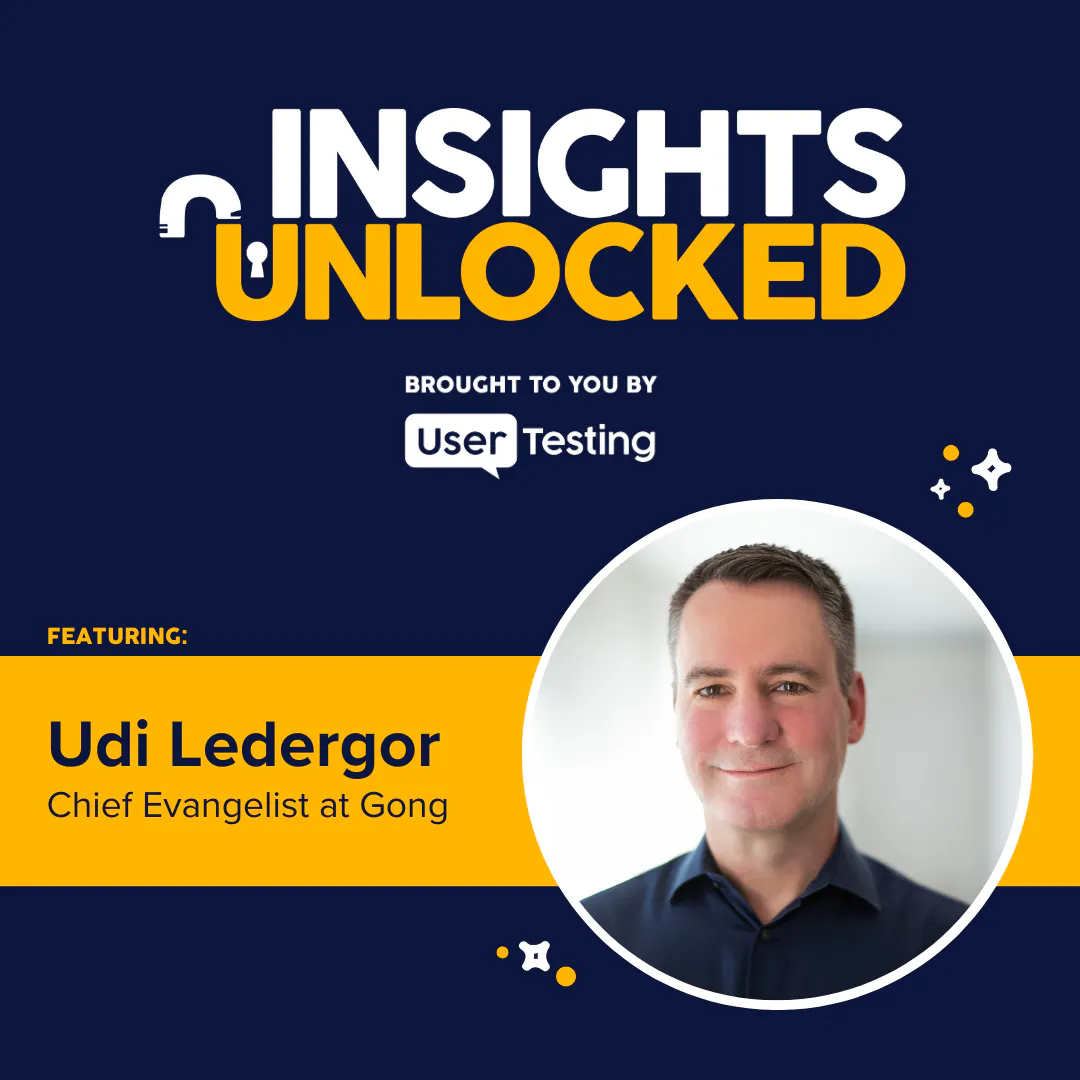
Insights Unlocked
The power of courageous marketing with Gong's Udi Ledergor
00:45:05
Learn how Udi Ledergor champions courageous marketing to help brands stand out, drive growth, and break free from best practices
Loading summary
Transcript40 lines
- [00:02]
Nathan Isaacs
Welcome back to the Insights Unlocked podcast. In this episode we're talking with Udi Ledegore, the former CMO and current Chief evangelist at gong, about why courageous marketing and not just following best practices is the key to standing out and driving real business results. Udi shares lessons from his own journey and offers practical advice for marketers at every stage of their career. Enjoy the show.
- [00:26]
Johan Reed
Welcome to Insights Unlocked, an original podcast from User Testing where we bring you candid conversations and stories with the thinkers, doers and builders behind some of the most successful digital products and experiences in the world, from concept to execution.
- [00:46]
Nathan Isaacs
Welcome to the Insights Unlocked podcast. I'm Nathan Isaacs, Principal Content marketing manager at UserTesting, and joining us today as hosts is UserTesting's CMO Johan Reed. Welcome, Johan.
- [00:59]
Udi Ledergore
Thanks, Nathan.
- [01:00]
Nathan Isaacs
And our guest today is udi Ledergore, a five time B2B marketing leader who served as CMO during Gong's rise from SaaS startup to industry dominance. Udi has advised startups, served on boards and mentored hundreds of marketers. His work reveals how courage and creativity can build iconic brands. He's also author of the recently published Courageous Marketing. Welcome to the show, Udi.
- [01:27]
Udi Ledergore
Thank you so much, Nathan. Johan, I'm excited to be here.
- [01:30]
I'll jump right in. You know, I looked at your journey and I read your book udi and it stood out to me that, you know, as a magician and a musician to get to the CMO role and now the chief evangelist role, that is anything but a typical career arc. And so what I'd love to start with is when you look back at that arc, going from this performing arts background to building one of tech's most iconic brands, what really stood out to you as being pivotal in shaping the way that you think about storytelling and brand today?
- [02:08]
I think the main point that I figured out, which is also the theme of my book, Courageous Marketing, is that most marketers, either by choice or because they feel they don't have permission to do otherwise, they tend to do best practice marketing. They tend to follow conventions by looking around them what the bigger competitors are doing, and thinking that if they do the same, they will enjoy the same status. But that's the fallacy because by doing that, you create a sea of sameness and you do anything but stand out. By the time anything becomes a best practice, everybody's doing it. And so it's really a boring practice that if you do it, you will get ordinary results. If you want extraordinary results, you need to do something different. And that's where courageous marketing comes in, that's where trying to take in what others are doing, understand the context, environment, your customer needs, their expectations, the competitive landscape, but then coming up with a crisp, unique point of view that is not like someone else is not the uber of, but actually something entirely fresh that hasn't been seen. That's, for some people, difficult. But I think the harder part is for people to feel that they have permission to do that. Because once you create that environment. We can talk about that later if you want. On how I created that environment for my team and how it was created in virtually every team at gong. Once you have that permission, a lot of people's creativity just starts flowing. And that's when you start standing out and people start paying attention. Because now you're different. You're not following the best practices. You look different, you sound different, you put out a different product, you try different marketing channels, you put out different marketing messages. You can create an entirely new category. And I can go on. But that is the theme. The transition from best practice marketing to courageous marketing.
- [04:10]
I love that. I think your point is well made. We're often surrounded by creativity, especially when you start talking to people about their hobbies.
- [04:19]
You.
- [04:19]
You discover that you have photographers and poets and all kinds of people with creative bent on your team. But often we're in this quest for a predictable result. The board wants to see predictability and the CEO wants to see predictability and guaranteed results. And there's that permission that you talked about that's often missing. What. What was your spark to say? Hey, listen, I'm willing to take this on my shoulders and give my team permission to go and take these kinds of creative chances.
- [05:02]
So I have a somewhat frustrating career hack, and it's frustrating because it's not easily copied and it is working for a great CEO. And I've done that not once, but at least three times for this specific CEO. So Amit Bendov, the CEO and co founder of gong, he and I have worked together back and forth for the last 27 years at three different companies. And while you can't copy that and just go work for Amit, There are about 1400 people who do right now. But if you can't get yourself to work for Amit, I do talk about some things to look out for when you're choosing the CEO that you're going to be working very closely with over the next five or ten years. And I talk about doing due diligence of the next company. You're going to work out some of the gotchas that I learned the hard way. I had to leave a couple of companies after less than a year because it was either not a good fit between me and the founders or because I was blinded by a cool product that turns out did not have a any substantial differentiator in the market and was actually struggling to compete and had very little product market fit. So all these things should go into any marketers due diligence of who am I going to be working with, what company this is, do they have a real chance of succeeding? And I cover four of the top reasons that marketers fail according to my experience and many other marketers I've spoken to in writing the book. I'll just give you one example that I've fallen for and wasn't even the marketer's problem or false not problem was my problem, just not my fault, which is you join a company without sufficient product market fit and then whatever you do, you are going to fail because they're expecting you to set up a pipeline and meetings and have brilliant messaging that's going to bring the customers knocking the doors down. But if the product in its essence doesn't have the right vision, isn't providing the right value, isn't focused on a specific user that is a raving fan, whatever I do as a marketer is never going to be enough. And that's how so many marketers end up being tagged as a failure, either by themselves or by companies that they work for. And you know, if you go into a room of 100 marketers, you ask them to raise their hand if they've been in that position, almost every single one will raise their hand because we've all been there. And so being able to identify that situation as you walk into it and maybe stop yourself at the door, turn around and go look for someplace else. If I can help one marketer do that, I think the book is already going to be a win.
- [07:38]
I love that and that definitely stood out to me. I think you even said this is like this is something you can't fix as a marketer. Product market fit is not a thing that you can fix and so I love that you that you talk about that. There's some other things in your book that I love that you know you're part of a two headed dragon when you talk about the relationship with sales and I love that. I think part of what I take away from your comment about picking the right CEO is you can work with people who you have trust with and if you don't find yourself in that position. You have to build trust quickly so that you can earn the right to take some creative chances and to demonstrate that. You have to demonstrate that you know what you're doing so that they will trust you and fund your ideas. And then you have to probably get that first one right to, to continue building that trust.
- [08:35]
I think it's about again, coming into a situation where the CEO, ideally the CRO and the CFO as well, understand from their past experience what great marketing can achieve. And they don't expect you to just be the arts and crafts department, which many companies. That's still the reigning expectation. Like, go put on a nice trade show booth, make some nice brochures and decks and just stay in your corner and let us grown ups handle actual messaging and pipeline and stuff like that. If, if that's what you want to be, you want to be a marcom coordinator, by all means, go do that. But if, if you want to be a bold marketing leader, if you want to be a VP or a C level, you have to be an environment that wants more than that and being able to prove that and as a headline. So because I like being practical here, I don't want people walking away saying, okay, that was, that was fluff. So here's the, the point of view and your North Star. If you can demonstrate in everything that you do that you are making sales easier, you're already ahead of 95% of marketers who operate in an isolated silo. And so when I onboarded new reps every month during my tenure almost seven years as CMO at ga, my first slide said, marketing's goal in this company is to make sales easier. And when you do that, they're already listening and they are already kind of vibing with you because, okay, that's what I need. I want you to make sales easier. Sales is really, really, really hard. And if you can be the guy or gal and team that makes it easier, you're already a hero. And then with that starting point, go ahead and show how even things that are maybe counterintuitive, like why do we need everyone to share content on LinkedIn? Well, I explained. Here's how the algorithm works and when you share it all at once, like I ask you to, you're helping me help you because the LinkedIn algorithm is going to show that to more prospects that you want back as qualified sales meetings. And that's how I can bring you back more meetings. Who wants leads? Yay. So when you explain that, when you do some off the cuff. Brand investments could be out of home or television or radio or events or podcast sponsorship. But you show and demonstrate how that increased brand awareness translates into higher conversion rates, more traffic on your website, more people showing up on meeting to meetings, and opportunities moving faster down the pipeline, then you're, you're becoming best friends and you're becoming the superhero of sales. And I've never seen a marketing leader fail when the sales leadership loved them. That that is an absolute condition for your success as a marketing leader. If sales love you and what you're doing, they're going to advocate for you to the CEO. They're going to talk the CEO and CFO out of cutting your budget when things get a little rough. And that's a very privileged position to be in. So that should be your focus in creating a relationship with sales.
- [11:28]
Yeah, that I completely agree with. I think I often think about this in the context of one go to market organization. And if we're aligned as a go to market organization just the way we want product and engineering to be aligned as one delivery organization for the business, then I think no CEO wants to have to wade into the middle of a disagreement between their marketing and sales leaders or between their product and engineering leaders. Right. They, they want those organizations effectively to solve their own problems. And, and I couldn't agree with more with you about the importance of helping, helping sales understand that everything marketing does is done with empathy for how hard sales actually is and in support of the revenue mission. And I'd love to get your take just on that about the conversation around KPIs, because my view is that marketers get themselves into a lot of trouble when we're not talking about revenue, when we're not talking about bookings or whatever industry you're in. Right. Whatever the revenue number is. Instead we're talking about other metrics which might be vanity marketing metrics or even just not metrics that sales cares about.
- [12:42]
Yeah. So before I get into the actual metrics again, kind of to give a North Star here, one of my favorite quotes in the book is from Ryan Longfield, who was Gong's longtime CRO for five years and I had the pleasure of working with him. And I've never collaborated better with a sales leader than I did with Ryan. And he had a beautiful insight where he said here's how real life works with sales and marketing alignment. When marketing or celebrating something that doesn't feel like a win to sales, that's when that relationship starts to crumble. That's when sales loses trust in marketing. And so think about that when you're presenting KPIs at a board meeting. If you're announcing something at a company, all hands, is this something that only marketing is celebrating and doesn't feel like a win to sales, then you should hold back. By all means, you can celebrate that internally if you have a good reason to do that because someone maybe just rebuilt the website infrastructure and it's an important milestone for marketing. But if sales are not hitting their numbers, this is not a celebratory day for them. And going back to your question now, where I see that break more often is marketing has a lot of metrics to follow and some of them should be kept internal and others should be external. A Common example is MQL's. MQL, as the name suggests, is a marketing qualified lead. Now here's the thing about marketing qualified lead. They're absolutely made up by marketing. Nobody outside of marketing understands them. To quote my longtime VP of sales of gong, Jameson Young, he said he used to say, oh, marketing, you brought us MQLs. That's adorable. And that tone is absolutely how salespeople feel when you bring them MQLs. We totally made this up. Now think about the discrepancy here and you'll understand why it makes so little sense to salespeople. Because who gets to decide if sales get a commission? The salespeople get to decide for themselves if they get a commission. No, the customers. When they sign on the line that is dotted, they decide when a salesperson is going to get a commission. Why should marketing get to decide when marketing gets their bonuses or commission or variable pay or whatever it is that's tied to KPIs? Why should marketing get to make up a definition of MQLs, change it as it pleases, and then show up celebrating? I just created two gazillion MQLs. Where's all my money? That doesn't make any sense. So in my book, and this is how I've been operating both at Gong and in other successful companies before that, marketing does not get to decide when we get our bonus sales, which are internal customer, they get to decide when we get that bonus. And if you understand and agree with that logic, then you can see why MQLs are almost always the wrong answer for a good currency. Between marketing and sales, a much better currency would be sales qualified opportunities. A dollar amount of pipeline that has been qualified and approved by sales and SQL and sao. There's so many names. I don't care what you call it, but it has to be something that sales understand that means business to them. And so when you say we achieved 1000 SQLs, let's celebrate. Sales agrees that you should celebrate because they can see a thousand opportunities that they want to work on.
- [15:57]
I love that and I totally agree. I think our success is when sales feels like they're getting what they need for marketing. And I think going to some of the more brand oriented activations that you've done, I think I'm curious about, you know, those carry a lot of risk with them, those investments. And you know, if you're talking with sales and with your CEO about, you know, SQLs or sales or whatever, as you said, any of the many names we give those things, you know, where do you feel like, you know, taking those big swings is appropriate and how do you assess risk in that context? Because that's not a conversation that's easy to say, hey, we're getting to the, the, the, the sqo's and draw a straight line between we did this activation, we got these leads right.
- [16:54]
So, so I'll say three things from different angles that might even seem contradictory, but, but they're not, not really. And then again, there's a lot more on this in the book. But one, one thing that's important is just like with medicine, the best type of medicine is of course preventive medicine. And when you're thinking about funding marketing experiments and brand investments, it's important to have a preemptive budget to do so. And so the way that I did this gong for many, many years and I did this in previous companies as well, I had a budget line item called Marketing Experiments. So whenever the budget cycle is, let's say, November, I get that approved. It's 5 to 10% of my program's budget. And I use two ways to explain and justify it. One, any marketing channel that I have that's working right now will stop working at some point. And that's just the nature of the business because if it's successful for me, everyone else is going to come and use it. It's not going to be so successful for me. It might be too expensive. At some point the cost per lead is going to be crazy or I'm just going to tap it out and I'm going to get the same leads over and over again if I'm in a small pool. So that's one reason why I should be experimenting with new channels so that I create and find the new ones now before I run out and go, oh shit, what do I do now. That's one reason. The second reason is there are many marketing opportunities that present themselves throughout the budget year. A classic example is an October event might be announced only in April prior to that event. But I don't know about it last November when I need to budget for it. And if I don't budget for it, I'm going to be missing out on a lot of these opportunities. Like I want to sponsor this event. Or one of my media contacts called me and he's got some leftover budget and leftover inventory because another advertiser backed out at the last minute. I want to have budget I can move quickly with and capitalize on this opportunity. Could be a 75% discount on the media. I don't want to start a whole budget approval cycle or I'm going to miss that and my media contact is going to call his next customer because time is of the essence. So when you explain these two things, even the grumpiest CFO will understand and usually say, okay, I get why you need this sort of contingency or marketing experiments. Budget. So that's the first step in getting those things done. And then it's a much easier approval because you're not looking for new money. You're just looking to allocate money you already have and allocate it to something specific. So that's one thing I'll say. The second thing I'll say is there are many cases where we can't be overly obsessive with measurement when we do something that's right for the business. First, if it works off the charts, you don't need any digital dashboard to show you that it's working off the charts. You will see all the right things breaking if you do a Super bowl commercial and that triples your demo request that week. You don't need a dashboard to show that you can. You can see that it's working. Now, not everything is going to be a sort of landslide win like that. But there are many things that you want to do because you feel they're the right thing to do and you should do them, even if it's going to be hard to measure. I'll give you an example. Every year we do special recognition for our outstanding Gongsters, which is Gong's version of Employee of the Year. And we spent some money, like putting them up on billboards, either physical B, static billboards or digital billboards. During COVID we did virtual billboards. But imagine your employees seeing their faces up in Times Square or in Piccadilly Circus in London, for real. And people get so excited about it. I cannot show you the direct roi, but I can tell you that our employees fly out on their dime if they have to. Although this year we're flying them on gong's dimensions, flying out to their nearest billboard to take a selfie they shared with their family and their network, and they become loyal employees for life. Their peers are cheering for them and wondering what they could do to be featured that way and get that sort of recognition next year. And the third audience, the candidates out there, they see that type of recognition and they go, well, I want to work for a company like that. I want to be recognized like that. So we always see an influx of inbound job applications when we do this campaign. And when we were doing in office interviews, which are less common today, I remember people coming in and saying, oh, I walked past your outstanding longstra billboards. That's amazing that you do that for your employees. And so they're already in a positive mindset of, this is a culture I want to work in. I want to be part of this. And so sometimes doing the right thing, even if the measurement is what I call on the softer side of roi, it's a little bit harder to measure. I like doing that and I like explaining that, and most people will agree with the logic. And then the third and last thing I'll say on that is that there are ways and we should try to measure the impact of our brand investment on demand gen and other important business metrics. I'll give you just a couple of ideas that go beyond the classic attribution models that I think we all agree are broken in view of a harsh award. So one way, and here's a shameless plug for gong. I use GONG to see who's talking about my billboards, who's watching my super bowl commercial, who read my Wall Street Journal ad. If you go into GONG and you search for that podcast that you sponsored or that television commercial that you aired, or that billboard that you put up, you can search for it and you will see customer conversations when they talked about it. So that won't cover 100% of your target audience who saw it, Because a, your salespeople are not asking every single person, did you see our billboard? Did you listen to the podcast? Did you do that? But you will get anecdotally directional evidence that people are being impacted by these brand investments. So that's an awesome start of doing that. If you see zero it, it might have been a dud. But I give an example in the book of Michael Lewis, the bestselling author of Moneyball and other books and, and podcasts. He has a very widely listened to podcast and he charges a bit of an arm and a leg to come on his podcast and be the sponsor. And we did that once. And most times you do that. If you even muster up the courage to do that, you know you're not going to be able to measure the impact of that. But I did measure the impact of that because I went into gong on the week that the podcast aired and two weeks later as well, and I saw 40 calls with customers unprompted who said, I heard your CEO on the Michael Lewis podcast. So I asked for a demo and here we are. And so knowing that I had those 40, even if those were the only 40 who listened to the podcast and asked for a demo, it was already clear ROI. But I'm guessing that behind every one of those 40 there's 10 to 20 that weren't asked about it. So didn't think of bringing it up, but they also came on board. So when, when you do that math, which has some assumptions in it, you actually see that doing these things that most marketers won't dare do out of the fear of the difficulty in measurement, you get a lot of great things coming out of that. So just to summarize, we talk about the three things. One is doing the right thing, even if it's hard to measure, to getting creative with how you measure it, like using revenue intelligence or we didn't talk about marketing media mix. Mmm. And other methods that are becoming more prevalent today. And the third thing was getting a preemptive budget so you can actually have an easier conversation when you want to get these things.
- [24:00]
Yeah. And I think your point is well made about, you know, in some cases, we as a marketing community may be over indexing on the quantitative measures because for so long we were under indexing on that. And so now we, we look at this and go, everything has to tie back to revenue somehow. Where to your point, I think some things are less tangible or less of a straight line, and that doesn't make them any less important to do. I do want to ask about, you know, for, for folks who are listening to this and who are like, wow, 5 to 10% of my budget's not that much money to do experiments and my whole budget is fairly resource constra. What are some of the other things they can be thinking about to avoid wasting time, avoid wasting those precious resources on things that are going to be Less successful. So how can they think about being on the right track before going all in on one of these sorts of investments?
- [25:04]
Yes, I'll say a few things on that. One thing is absolute focus. So just like entrepreneurs keep hearing from their investors, you have to focus. You can't sell something to everyone. You've got to sell to one icp, one product that solves one problem. Start with that, excel at that. That's how you have any chance of survival, and then think about expanding. And I think marketers forget that advice, but it applies equally to us. If you're on a shoestring budget of $100,000 a year trying to be active on 20 channels, there's no way you're going to succeed in any of them because a, you're stretched so thinly, you can't really learn what works and doesn't work. You don't have enough resources to put on them. And the little resources that you have are just not going to be enough to prove anything that's working or not working. And so at Gong, after very little experimentation across different channels, we decided that we're going all in on LinkedIn because we figured from our data that that is where sales leaders live and that that is our audience. For you, it might be TikTok or Snapchat or somewhere else, but find that channel where the party is at, where your audience is hanging out, and go all in on that. And that meant that we were reading the LinkedIn developers blog to understand changes in the algorithm in real time before other advertisers figured them out. So we know when surveys are hot and when video is hot and when live blogging is hot and when images are hot and how to format your text posts and how to spread them apart and how to capitalize them or not. And like the tiniest thing, I'll give you a funny story that you might have read in the book. There was a point in time where I read in the LinkedIn Developers Blog that they were testing a new dwell factor, that the longer someone stared at a post without scrolling on, the more visibility they gave that post. So I thought, well, okay, how can I, how can I hijack that? How can I get people to artificially stare at my post for a long time? And then I remembered those Where's Waldo books. Remember when we were kids, we were looking at a page for 10 minutes looking for Waldo. I said, what if we do something like that, but instead of Waldo, we'll hide Bruno, the Gong mascot, which is an English bulldog. So I had My team quickly bring up an image. This was before AI, they actually needed an artist to do this. Created a Where's Waldo style image and they hid Bruno in it. And I posted that as an experiment of like, hey, we hid Bruno here on the beach, can you find him? And that post blew up because people were dwelling on it. And I was just testing the LinkedIn algorithm and lo and behold, the darn thing worked. And so that just shows you it had little business value. But it probably did get more followers for Gong's social handles, which is always a good thing, and got people talking about the fun things we're doing. But, but the real idea here was that we're testing this minutiae of the algorithm because that's how you win a channel. And we could not have done that if we were trying to focus on 20 different channels. So that's, that's one piece of advice. Focus on one channel, make an educated best on where a bet on where your target audience is and get really, really good at that. Two, of course, which was a big, not so well kept secret of Gong success, is that we created organic content. So good the people wanted to follow us, they wanted to subscribe to our emails, they wanted to show up to our talks at events without us having to use a lot of paid advertising to give to them. And I think especially on a small early day budget, if you're trying to spread your money by creating mediocre content and then paying to get it in front of eyeballs, you're not going to see impact from that. I haven't seen that work. If someone has, I'd love a reference and a story to learn from because I'm still learning.
- [28:46]
I've never seen it either.
- [28:48]
I haven't seen that work. But that's what a lot of people do, right? The content creation is almost an afterthought. And they're like, let's just pump money into this network and that network will spend some money on paid ads. We'll get people to look at the, at the ads and then they're going to pour in as demo requests, right? No, they're not. On the other hand, I didn't spend any money on paid ads in the early days, almost any money. But I spend a lot of time and effort and creativity thinking about what content people will want to pay for. And we created the Gong Lab series where we educated and entertained salespeople on what's working and not working on sales calls. So we went from everything like, what's a good talk to listen ratio on the call. Turns out that if you talk about 46% of the time and you listen for the rest, you're going to do much better than someone who's talking 80% of the time like I am right now. Luckily, you're not trying to sell me anything or I'm not trying to sell you anything, otherwise I would be doing a very poor job. And then we got even spicier with like when you should swear and use F bomb or an S word on a call. And we showed that that can increase your win Rate by 8% if you use that strategically. And so salespeople love that. And it blew up and it got earned press and media that I never could have afford to reach those people, let alone the virality of it, because people were sharing it and tagging each other and using their most colorful vocabulary to say, that's the shit I've been talking about. And you know, this is what I'm going to be doing from today's calls and on. That's what happens when you create such amazing content that people want to organically amplify for you. So rather than spending your hard earned dollars on paid go create content people really want to consume.
- [30:28]
I love the quote under the chapter heading of would you pay for to access your content? No fucking way. I love that you put that in there because I think it's such a great litmus test on what should we be thinking about as content creators so that we're not just putting more dust into the universe, but actually creating something meaningful and having that as a level. And you mentioned focus not only on the channel, but I think you started with on the ICP as well. I get, and what I take from that is get to know your customer, research them, understand them, put the voice of the customer into your messaging and into the content that you're putting out because they want to hear their voice coming back at them with an answer, not just their question.
- [31:14]
Exactly. Here's a very simple rule of thumb. It applies to product and marketing and sales. If you can help your customers solve one of their top three problems, they are listening. They will take the call. They will read your ebook. They will take the demo call. They might buy your product. You need to address and tie into one of their top three problems. And a lot of product teams operate this way. I don't think enough marketing teams operate this way. They really need to understand and I'm reading a great book that talks about that right now called how you measure your life. And it Talks about a job to be done. What is the job to be done that your customer is trying to do today and how can you work your way into helping them get that job done? If you're trying to create an artificial agenda that is very different from what your buyer's real agenda is, it's rarely going to work. It has to be disruptive like, like a nuclear war or a tornado to get their attention. But most of the content we produce doesn't have that magnitude and impact. So why not just ride a wave if you know that our customers are struggling with something? And here's an example. During COVID and during the economic downturn last couple of years, we saw that even small companies now had to go through their CFO to approve even small deals of 10, 20K. That's not something that we saw before that. Now a lot of our SMB and mid market salespeople were never trained to get through a CFO because they're selling small deals. Right? Our enterprise folks, of course they have the business acumen and they know how to do that. But the small business guys, they never knew how to get past the cfo. As soon as our content team, Devin Reed, was running it at the time, as soon as our content team listened to a few customer calls and heard them struggle get through the CFO, they quickly, in 48 hours they turned out a cheat sheet which was titled how to get past your buyer's cfo. And as soon as they released that, it got thousands of downloads from salespeople like those that we were targeting because we were at the top of their agenda right now. We understood the job that they are trying to get done, which is get past or buyer C phone. And now there's a cheat sheet to help me do that. I'm going to stop everything I'm doing, I'm going to download and read that. That's how you get to their top of mind by really understanding what problem, what job they're trying to get done today and go attack that and help them do that. That's how you become the hero in marketing, in sales and in product.
- [33:33]
Yeah. And I like your point about it doesn't matter externally, internally, right. Figure out what is the job that your audience is trying to do. And as a market marketer, when we're thinking about sales enablement materials, it's so often this idea of well, we have to enable sales on the product messaging, we have to enable sales on the latest campaigns, we have to like it's we're telling sales about what we think is important as opposed to thinking about what. What is important to them? Where are they hung up? They may not even know to come to marketing in your example, to say, can you help me with the cfo? Right. As a, as a marketer, it's our responsibility to be ahead of that and to pay attention and.
- [34:15]
Exactly.
- [34:16]
Our audience.
- [34:17]
Here's one more example of that, Johan. For. For the last 10 years, Gong has been doing AI way before it was cool. And our grandmothers knew how to ask ChatGPT for their next trip itinerary. But up until about 18 months ago, we also understood that sales leaders couldn't give a rat's ass about AI. They cared about hitting their quota up, leveling their reps, managing their deal pipeline. And so if you went to Gong's website as recently as 18 months ago, you would be hard pressed to find any mention of AI. Even though we've been hard at work building these custom LLMs for revenue teams for the last 10 years. Because we started with what the customer cares about. And AI was not something the customer cared about until very recently. Now everyone has an AI strategy and plan and they have to be thinking about it. So of course it's in the forefront. But we've been doing this for a while and we, using a lot of discipline, held back on talking about the nuts and bolts and what's under the hood because no one outside our engineering team cared about it. What our customers cared about was how do I beat my forecast, how do I uplevel my reps, how do I coach them better? And that's what we talked about. The outcomes that they cared about and how we help them solve their problems. Not showing off our technology because nobody cares about it.
- [35:30]
Yeah, that. And, and how do you. What advice would you give to somebody who's struggling to figure out what their audience's priorities really are? Especially if maybe they're not selling to big public companies who are publishing strategies in annual reports.
- [35:47]
You have to start with a customer problem. If you don't know what that is, you probably shouldn't be writing a single line of code or building a solution for them yet. Go talk to them. When Gone got started, we use a very well connected VP of Sales to connect us to 10 others. And we use them as design partners and sat down with them and learned about their problems and found enough of common ground that we could solve for with a single, very simple product. Back then, that was recording calls and analyzing and helping them do something that they never could have done before. And that solution worked magically for, for all of them. So we really understood their needs, but that just comes from talking to them and being in their seat. Some of the best products are built by founders who experience the product, the problem themselves, and didn't find a better solution. That's the case in Gong as well. Our CEO was prior to Gong, a CEO of another company. And he had a quarter from hell, as he describes it, and he didn't know what was happening and nobody on his sales team could explain what was happening. So he thought there must be a better way than asking reps or looking in the CRM, which doesn't give you any insight. And so he went and built Gong. He found a technical partner, explained the problem, asked him to find a solution, and together they found a solution. And other sales leaders agreed that this is what they needed. So you have to start with the problem domain. I think we're still seeing a bunch of founders that fall in love with a technological idea or a solution and then they go chasing after a problem. It can work. It's much, much harder getting there and you risk losing your way there and running out of money much faster than if you start with the problem and solve for that.
- [37:21]
Yeah, and I think that also applies to marketers. Right. Even though we have a problem domain that the product solves, we often don't go out and really try to understand how people are talking about it today. And I think that's maybe part of the point you were making around AI, where the way that, that your audience started to understand the solution changed, even though the technology didn't, because you'd been doing AI for so long, but the way they understood it started to change. And so you needed to change your vocabulary in the way that you talked about the same product that had been evolving over 10 years.
- [37:58]
And to be clear, Gong's product of course, is evolving at warp speed every year, every day. But yes, our marketing has evolved as our users needs and, and their interest areas evolve. And today if you don't have a AI strategy, you're going to be out of a job by the end of this year. And so we realize that. And sales leaders as well, they have an AI strategy. But again, the strong focus there be beyond the bells and whistles of using AI is we focus on the outcomes. How are we going to help you with growth, with predictability, with productivity? Those are the outcomes that they care about right now. And your audience might have different outcomes, but if you start from there and then work back to like, why are we doing this, how we do this, that's kind of the way that we talk about it.
- [38:43]
Yeah, that's great. And I definitely didn't mean to imply that Gong wasn't innovating. It was more about, from my perspective, that the audience was coming to where Gong had been for a long time, and therefore you had to change your talk track. I know we're slowly coming up on time here. I have. I wanted to ask for our audience, given that we've got a wide range of listeners. If you're sitting down with three different people, somebody who's just starting out in marketing, somebody who's somewhere in the middle of their career trying to have a breakthrough moment, and maybe to a CMO who's navigating some big brand decisions. What are the three pieces of advice you would give?
- [39:31]
I'd say to the beginner, the marketing novice is to just be the hardest worker and to surround yourself with mentors and people who know a lot more than you. I've done this myself where I, too early on, took on a marketing leadership role, which is a very lonely role, as any leader will tell you. And if you do this too early, you don't benefit from working with really smart people who've done this before who are more experienced than you. And once I took a step back and actually took a cut in my title and went to a company where for the first or second time I worked for Amit, my current CEO, I finally enjoyed that mentorship and that up leveled my marketing skills tenfold and then I was ready for my next marketing leadership role. So I see a lot of people just chasing title and prestige and status too early before they've actually done being an apprentice and learning. So I want to be a lifelong learner. Of course, at some point you become an executive and there's fewer people to learn from. Maybe. But when you're early on, don't chase that title and slightly higher pay. If a company is hiring you, an inexperienced marketer, as their head of marketing, it might feel good for five minutes, but there's probably a reason they're hiring you because they couldn't hire someone more experienced than you, and you're going to have nobody to learn from there. So that's probably not a great choice for me. For you, you should take the time, learn from others who've done this and, and then break and make your way through the the ranks. So that's, that's for the novice. I say for, for someone who's kind of midway, it's avoid Getting stuck in a rut, avoid falling on the best practices and just copying and pasting something because it worked once, because it's might work one more time, not going to work 10 more times. So always keep your learning hat on. And the more curious you are, the more you'll find inspiration outside of your industry. Not just by what your peers and competitors are doing, but if you're in B2B, what are consumer marketers doing? When I go to an amusement park or to a show with my kids, I get inspired and I take notes like, oh, I should try that stage illusion in our next customer conference because that's going to excite people. If something worked at a Taylor Swift conference, imagine the impact it would have at a B2B conference, right? So that's the type of thing that I always want to be learning. And just that cross pollination between seemingly unrelated fields, it creates a lot of excitement where you bring that in. And it's now very new in your field. And for the, I guess advanced senior marketer, it's charting your career path on. At that point you probably know what you're passionate about, what you get joy in doing, what you can do better than others rather than focusing on your weaknesses which at that point in your career, the solution for them is to hire someone to complement your weaknesses rather than trying to work on them. I will never be an amazing product marketer. So if I were to be another cmo, my first or second hire would be a really good product marketer because I'm just not going to be a good one. But I can pull off good content and events and creative and demanding and all that stuff. And so trying to craft your next role and tailor it to your passion areas. And I've gone as far as creating most of my roles from thin air. So I talk about this in the book, but for the last 20 years I've never stepped into a role where someone else had my position before me. I've created five heads of marketing roles. I've created the chief evangelist role. Before that I was a product manager twice at companies that never had that role before. And it takes some self exploration to understand like what you get joy from, what you can bring value in, what will people pay you to do? If you find that, as the Japanese call it, the ikigai of where all those things meet, you're a very lucky person.
- [43:25]
That is excellent, excellent advice. Thank you for sharing that with us. And you know, we're basically at time, so I would, I'd love to, first of all say thank you for being on the show today and this was such a fabulous conversation. I'd love for our audience to learn more about your background and your thought leadership and about the book that we talked so much about. Where can they learn about all this stuff?
- [43:52]
Yeah, so Courageous Marketing is available on Amazon, on Barnes and Nobles, everywhere books are sold. You can even go ask for it at your local bookstore. They don't have it. They can order it in through Ingram, the world's largest book distributor. So go search for Courageous marketing. I've condensed 20 years of B2B marketing experience into 200 very easy to read pages that people have told me they can read. Flying from Atlanta to San Francisco. That's all you need. You can get through the book and I'd love to hear people's take on it, either in an Amazon review or shared on LinkedIn, privately or publicly.
- [44:24]
It's a fabulous book. I read it on Kindle.
- [44:27]
I appreciate it. Thank you. Jan.
- [44:30]
Thank you so much for your time. Look forward to talking to you again soon.
- [44:33]
Johan Reed
Want to keep the conversation going? You can find the show notes@usertesting.com podcast if you haven't already, don't forget to follow us on Apple Podcasts, Spotify, Overcast, or Google Play so you never miss an episode. And if you enjoyed today's show, please share it with a friend or leave us a rating in return. Review on Apple Podcasts and until next time, this is Insights Unlocked, an original podcast from User Testing.