← Insights Unlocked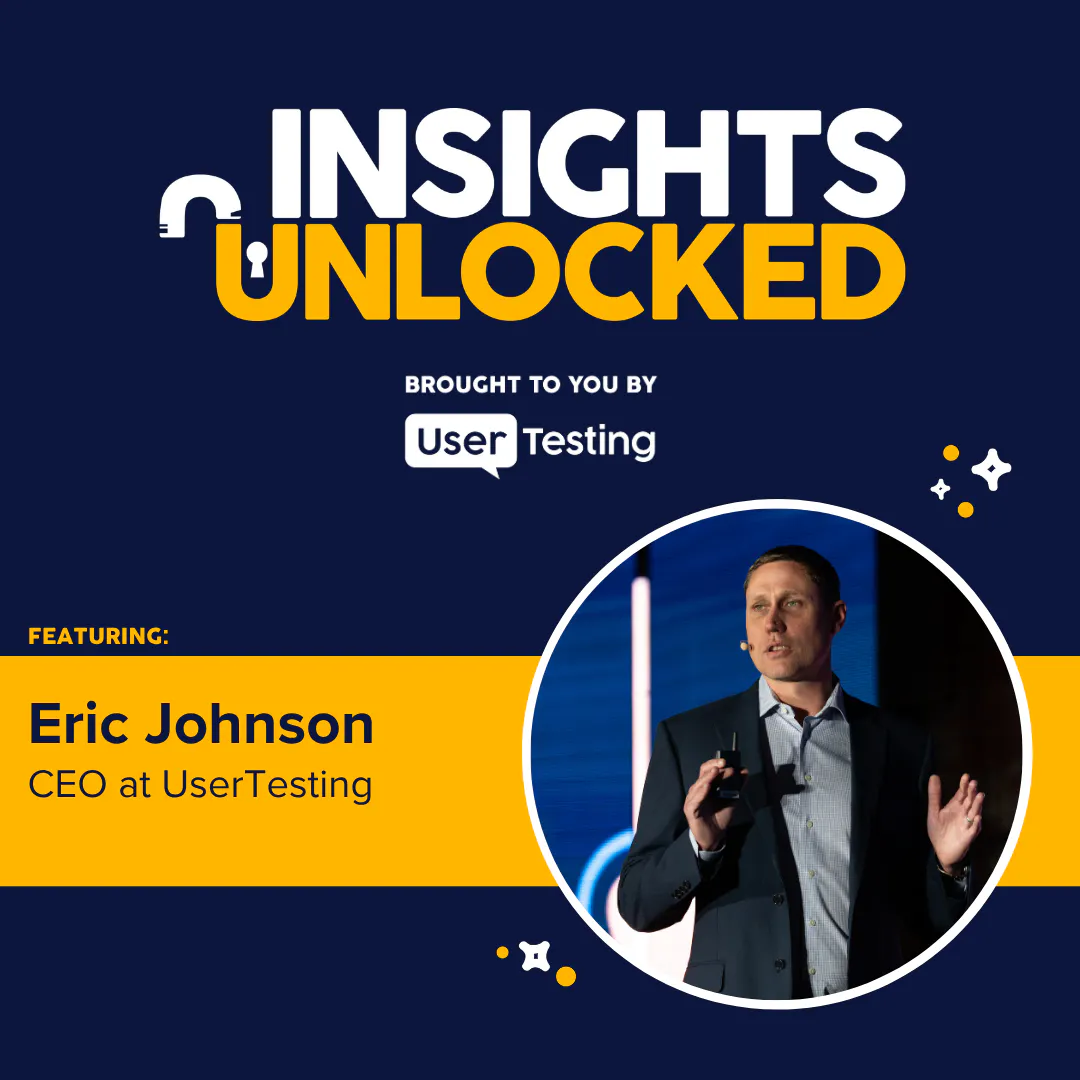
Insights Unlocked
When AI can build anything, knowing what to build is everything
00:15:47
As AI makes building easier, customer insights, human judgment, and UX research become the keys to creating products people want.
Loading summary
Transcript36 lines
- [00:02]
A
Welcome back to Insights Unlocked. In May, hundreds of product leaders, designers, UX researchers and customer experience professionals gathered in Seattle for Crafting User Testing's annual customer event. The conversations covered AI research, design, innovation, and the future of building products. But as we listened across keynotes, panels and presentations, one theme kept surfacing. When AI can build almost anything, knowing what to build will be your differentiator. And that begins by talking with your customers. In this event recap episode, we'll hear from User Testing CEO Eric Johnson, Chief Strategy Officer Baran Urkel, Cisco's Travis Isaacs, former Twitter and Netflix Insights leader Nakia Revlic, Yum Brands design executive Jessup Perrette, McDonald's research leader Brad Carrera, and many more. And you can listen to all the crafted presentations on demand by going to Insights plus on the UserTesting website. Go to UserTesting.com insightsplus Welcome to Insights
- [01:07]
B
Unlocked, an original podcast from UserTesting where we bring you candid conversations and stories with the thinkers, doers and builders behind some of the most successful digital products and experiences in the world. From concept to execution.
- [01:25]
A
Let's start with a simple idea. When building becomes easier, deciding what to build becomes much harder.
- [01:31]
C
When AI can build anything, knowing what to build is everything. Knowing what to build, knowing what your customer really needs, understanding that, understanding what they think, what they feel, why, who they are, those things have never mattered more. And right this moment in time, we can build things so incredibly fast. Over 90%, nearly all of software developers now use one or more agent coding tools. Literally one year ago, that was 14%. There are organizations that I've personally been out to where they literally do not write any code. All of it is built agency. There are tons of organizations where they're not using traditional like figma, they're doing their prototypes and lovable replit figma make cloud design. So the world we're all working is changing dramatically. The volume at which we can do what we do is massively higher. But we don't want to just produce more stuff. We want to produce the stuff that people actually want.
- [02:28]
A
That idea set the tone for the entire event. AI is dramatically increasing our ability to create software experiences, content and products. But if everyone can build faster, competitive advantage shifts somewhere else. According to Baran, that shift creates a critical decision point.
- [02:46]
D
We're at a crossroads, a fork in this journey where we can go the way things might go if we don't fight, which is full automation, which is full synthetic feedback, full synthetic research.
- [03:03]
E
Or
- [03:06]
D
we can impact the future to be more human. Centered, to be based on human understanding, to be to put humans at the center of products, experiences, and content. And I think that's the future I want to see. I think that's the future we want to see. And I actually think that's the best future for our businesses. That is the winning future as well.
- [03:28]
A
For the researchers and designers in the room, that question is one they're asking themselves. One of those voices was Cisco's Travis Isaacs.
- [03:37]
F
Part of what really helped here was actually defining what craft means in this age. When you're the human in the loop, what are you bringing to the loop? Well, you're bringing empathy, a genuine understanding of feeling and emotion. You're bringing context, situational awareness. You know your product, you know your customers, you. You know your business. You're bringing creativity. You're adding new and novel ideas, unexpected connections, and transforming outputs into surprise and delight. You bring taste. You know what style and judgment to apply to what is that you're building. You get to define what good looks like and tell the agent when it's done. But most importantly, you have the unique ability to turn your work, your output, into storytelling that inspires people, aligns, and drives change.
- [04:37]
A
Travis has spent the past year transforming his global design organization to become AI native. And one lesson surprised him. The biggest challenge wasn't the technology. It was the mindset.
- [04:49]
F
The mindset shift was the biggest gap. This moving from this mindset of maker to supervisor is not easy.
- [04:59]
A
That same idea surfaced repeatedly throughout the event. AI isn't replacing human judgment. It's changing where that judgment gets applied. No one said it more directly than Yum Brands design leader Jessa Perrett.
- [05:12]
G
Right. I have designers who are scared because for so long, the lowest value things in an industry will always be the first things that get automated. In accounting, in nursing name the industry, the lowest value thing is what will be automated first. But the lowest value aspect was always like, just throw away prototypes sometimes, right? But it took so much of our time. I'm not saying interaction design is not hard. It is. It is very hard. But what I'm saying is you can either look at that and go, oh, my God, 30%, 40% of my job just got automated. Or you can go, oh, holy crap, I just got 40% of my time back. What am I going to do to be a better designer?
- [05:50]
A
But getting that time back only matters, and if you know what to do with it. For Jessa, the answer's simple. Don't outsource your ability to make decisions.
- [05:59]
G
Okay. Because designers who are doing it well are the ones who understand where human judgment needs to be and how that doesn't necessarily slow down process, but how that asks a better question. Yes, should we be doing this? Should we be outsourcing this? The ones that I have seen that have done the best are designers and teams who have decided intentionally not to outsource their execution and their right to decision. Okay, you can outsource execution. AI just did that. Yeah, don't you dare outsource your right to decision.
- [06:37]
A
But according to User Testing's Jason Giles, AI may be creating the biggest opportunity the profession has seen in decades. Rather than shrinking back from that change, he believes this is a moment to step forward.
- [06:50]
C
We really have this opportunity. And the worst thing that I can imagine due to some of the fear mongering, is for people to shrink back, to be overwhelmed, be, ah, I should think about a different job, maybe my whole career, you know, I need to think about something different. And it breaks my heart because this is the time of like, no, no, no, no, wait. This is our moment. So we just need to step into it.
- [07:15]
A
If AI changes anything, it may be changing who gets to build. Former CVS and Charles Schwab design executive L.L. johnson described the future where individuals and small teams can create things that once required entire organizations. But even with those new capabilities, he says, human insight remains essential.
- [07:36]
E
I think a lot of people are finding their energy, their early hacker days. They're sort of rediscovering that passion for making. And these tools take a lot of the drudgery. I've talked to people who founded companies, had stopped coding, are now coding again. People who are executives who have leaned back in. And I think the composition of a team is going to look different potentially. I used to lead teams as large as 550, 400 people. I think now I can produce work, cover a similar design surface with, with a fraction of that because the agents give us superpowers. And so if I think about where the power is, it's not in the volume of work that's coming out, but it's kind of taking some of the mundane things out and accelerating them and then also allowing us to work with higher fidelity outputs to get better signals earlier. But we still need to evaluate them and we need these humans.
- [08:31]
A
As the cost of creating new products continues to fall, another challenge emerges. How do you make sure you're solving a real problem? LL pointed to a lesson from legendary product creator Tony Fadell that feels especially relevant in the age of AI.
- [08:47]
E
But when you actually start talking about what do people actually want? What story is important for our company? How is our brand represented in the experience? How do we show up every day and every touch point as the brand we want to be? And this is what people think of us. This is what people talk about at cocktail parties, about us, tell their friends about us. This is what frustrates them. And then this is how it can be a better future. Tony Fadell, the product genius, talks about making painkillers, not vitamins. And the concept is you really need to solve a real problem for people. And if as a product team, you can understand that through insights and then show what it can be, that can bring a lot of alignment in companies. And I think alignment is the chief job. The bigger the company, it's not about velocity, it's about alignment. But in every company, getting that alignment through showing, I think that's when you know you're kind of jamming like a bait.
- [09:42]
A
That brings us to one of the strongest themes from crafted the future of research. As AI accelerates product development, several speakers argued that customer understanding becomes even more important. Brad Carrera leads design research at McDonald's. His message was unforgettable.
- [10:00]
H
But the main thing I'm here to talk about today and to tell you all is that you might not know it yet, but you all, you're glue. You are glue, and you can be the best glue version of yourself that you can imagine. And if you do, embrace your glueness, which we're allowed to invent words here, right? We understand what I'm talking about. The this is how you scale your influence as a researcher is by bringing people in, by creating shared understanding, by not working in a vacuum. And it's a key piece that, again, you can't plug into Gemini to fix.
- [10:36]
A
Brad described researchers as the connective tissue between teams, not simply producers of reports, but builders of shared understanding.
- [10:46]
H
So if you take away one thing today, it's that getting a report does not equal, is not the same as experiencing your customers. Okay? You might learn facts about how things perform. You might learn about what's findable and what's not. But the real value, where you really start to scale your influence is by helping people experience their customers, their users, the crew members that are using these tools.
- [11:12]
A
That distinction became increasingly important throughout the day, because if AI can summarize information, then the real value moves upstream toward asking better questions, toward uncovering what people actually need, toward influencing decisions. Former Twitter and Netflix executive Nakia Revlich challenged the audience to think differently about influence.
- [11:35]
I
The teams and you could take a picture of this. One with the most influence are never the ones with the most data. They're simply the ones who learn to ask better questions earlier. And they stayed in the room long enough to shape what happens next.
- [11:49]
A
For Nakia, influence comes from understanding people. Not just customers, but colleagues, executives, stakeholders, the humans behind every decision. As AI becomes more capable, she believes human insight becomes more, not less, valuable.
- [12:06]
I
It's just a thought that I have continued to carry through every leadership position that I've ever had, every organization that I had the benefit of trying to transform and bring a little bit more of a focus on people over profits. And that is that insight, I believe, will continue to be human. And humanity reveals itself inside of the questions that we ask, inside of the patterns we observe, inside of the dots we connect and breakthrough we receive in return.
- [12:41]
A
That sentiment carried directly to the event's closing keynote from Stanford professor Jennifer Acher. Jennifer studies meaning, purpose, storytelling and human behavior, and her message expanded the conversation beyond products and technology. She challenged attendees to think about what kind of experiences we create and why.
- [13:01]
J
How do we design systems that deepen our sense of purpose? And the last panel said it I think really beautifully. How do we use AI and human creativity and ingenuity and judgment and taste and open ourselves up in ways that are working with high performing teams and agents in ways that are actually fulfilling and creative, not just productive? How do we do it in a way that strengthens our authenticity and our sense of boldness, with humor and even love. People want to be valued members of the of a winning team on an inspired mission. And if you get every one of these words right in your team, love exists. I feel like I'm a team. I feel like I know what we're winning or where we're going. And if we're not winning, why are we not winning and how are we going to get to winning? We know what sort of is our inspired mission. We know exactly how others feel valued
- [13:59]
A
as AI reshapes how we work. Jennifer argued that authenticity, connection, humor, empathy and purpose become even more important. And she closed with a reflection that felt like the perfect ending for the event.
- [14:13]
J
I think at this time, AI can't replace that sense of human connection, but we can take this moment of time and understand what is truly important for us. And when do we feel most alive. And these regrets of the dying, they're not warning, but they're instructions for all of us to live with more authenticity and boldness and humor and love. And what I hope you think about is this opportunity right here, right now to use technology as you go out and live and use it in ways that are more human.
- [14:44]
A
At Crafted, we heard plenty about AI, new tools, new workflows, new ways of building. But the strongest takeaway is wasn't about technology, it was about people. The future may be built faster than ever, but understanding what matters to humans and making better decisions because of it remains the work. Thanks for listening to Insights Unlocked again. You can listen to all the Crafted presentations on demand by going to insights plus on the UserTesting website. Go to usertesting.com insights plus want to
- [15:19]
B
keep the conversation going? You can find the show notes@usertesting.com if you haven't already. Don't forget to follow us on Apple Podcasts, Spotify, Overcast or Google Play so you never miss an episode. And if you enjoyed today's show, please share it with a friend or leave us a rating and review on Apple Podcast. And until next time, this is Insights Unlocked, an original podcast from User Testing.