← Insights Unlocked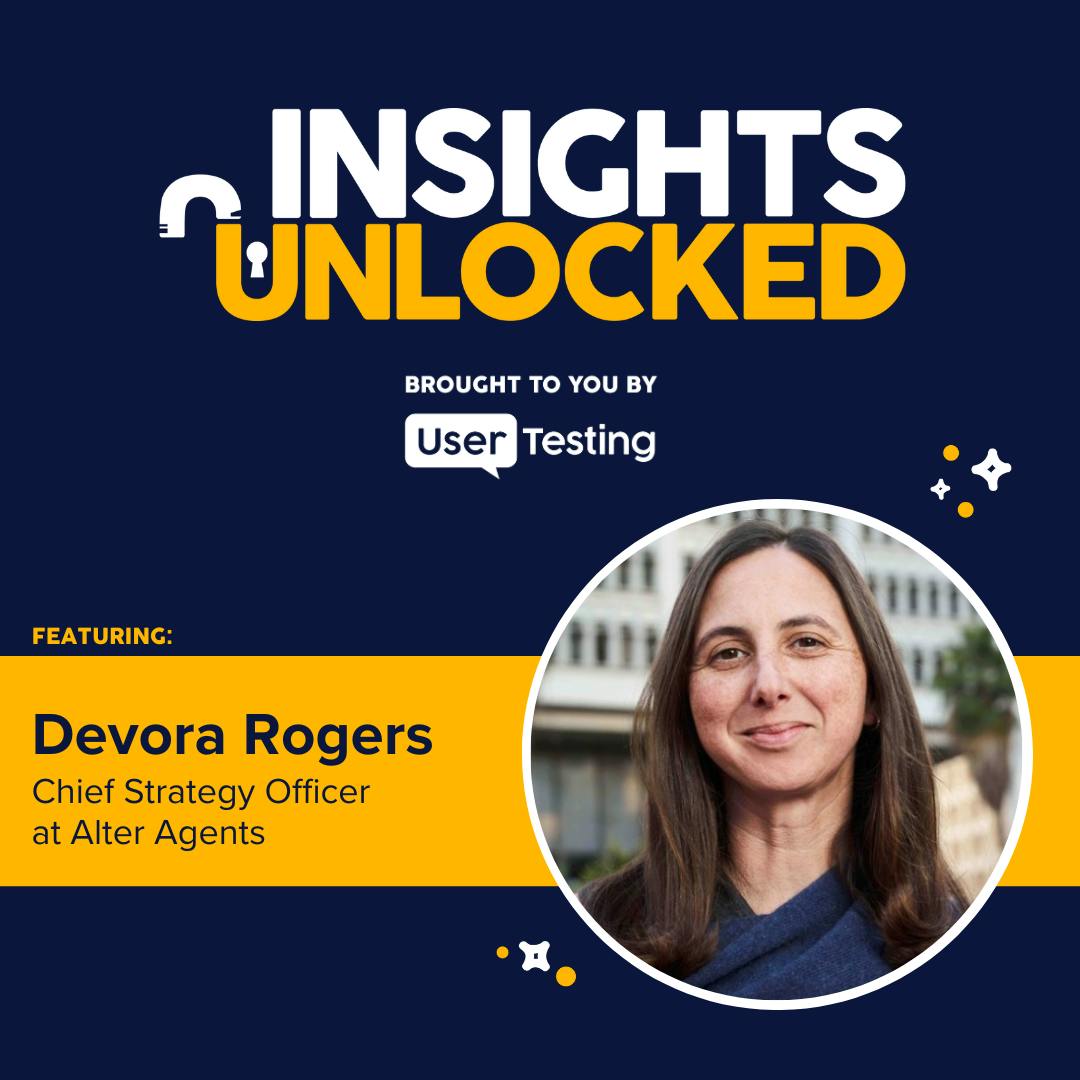
Insights Unlocked
Why shopper behavior is changing and what brands can do with Devora Rogers
00:19:44
Explore why shoppers rarely stay loyal and how brands can adapt using real human insights, with Devora Rogers of Alter Agents on Insights Unlocked.
Loading summary
Transcript29 lines
- [00:02]
Nathan Isaacs
Welcome back to the Insights Unlocked podcast. In this episode, we're joined by Devorah Rogers, chief Strategy Officer at Alter Agents and co author of Influencing Shopper Decisions. Devorah shares how shoppers really make decisions today and why brands can't rely on loyalty alone. From behavioral segments to brand research pitfalls, we're diving into what it really takes to connect with modern consumers. Enjoy the show.
- [00:29]
Bobby Meixner
Welcome to Insights Unlocked, an original, original podcast from User Testing, where we bring you candid conversations and stories with the thinkers, doers and builders behind some of the most successful digital products and experiences in the world, from concept to execution.
- [00:49]
Nathan Isaacs
Welcome to the Insights Unlocked podcast. I'm Nathan Isaacs, principal Content marketing manager at User Testing, and joining us today as host is UserTesting's Bobby Meixner, Vice President of Solution marketing. Welcome, Bobby.
- [01:02]
Devorah Rogers
Hi, everyone.
- [01:03]
Nathan Isaacs
And our guest today is Devorah Rogers. Devorah is the Chief Strategy Officer at Alter Agents, where she helps brands like Google, Snapchat, and Nespresso understand how people actually make buying decisions. She co authored the book Influencing Shopper Decisions and played a key role in Google's landmark Zero Moment of Truth research. A TEDx speaker and frequent industry voice, Devorah is known for blending behavioral science, agile neuroscience, and real human insights to challenge outdated marketing models and rethink how brands connect with modern shoppers. Welcome to the show, Devorah.
- [01:40]
Devorah Rogers
Thank you. Thanks for having me.
- [01:42]
Devorah, you've spent your career helping brands understand why people buy, right? Challenging the way traditional marketing thinks about consumer behavior. Can you take us back a bit and share how you got into this work and what drew you to that intersection of research, strategy, and storytelling?
- [02:02]
Yeah, it's a great question. I love this story because. Well, one, it got me where I am, but it really started where I thought I was going to be in storytelling. I worked in radio and television. I met my husband on the Apprentice, of all things. I worked for HGTV shows. And so I learned about storytelling in the first part of my career. And when I accidentally was converted into a researcher, very, very much accidentally, I was working at Inner Public Groups Media Lab, and we were telling stories about new media and what was happening in gaming and social media, which at the time we were advising brands was just like you'd put up a shingle on Facebook and call it. That was your new media strategy. And we decided that we needed to start doing research. And all of a sudden, literally kind of overnight, I became a researcher. And because I didn't know anything, I brought my storytelling to Research. And fortunately, there were people that guided me along the way so that I could learn what I was doing.
- [03:06]
Nice. So you've essentially said shoppers start fresh every time they buy. If that's the case, thinking about loyalty programs and brand consistency, what role do they play in that? And what's the best way to uncover what makes people switch?
- [03:24]
Yeah, great question. And by the way, you know, there are certainly times in our lives where we're busy and so we, we're not completely starting fresh, but there are many times where something shifts in our lives. The example that comes to mind for me is, is the milk category. You know, so for decades, milk was what, you know, a repeat sort of purchase that nobody thought much about. And then there started to be more awareness about, you know, people's sensitivities to lactose. And suddenly the market exploded to the point where you have all kinds of different milks on the market. And now it's going the other way where some of those alternatives are actually not considered as healthy or safe. And so some people are swimming back to milk. And so that, to me is a, is a perfect example of where you can never, as a brand, become complacent. And the brand that comes to mind right now, just, just a very minor example, is Horizon. I have a 10 year old child, so I have to buy a lot of milk. It's a lot of milk comes through this house. And I stopped buying Horizon because there was other cat, there was other brands I liked better. And then Horizon came out with a new product that had these little prebiotic, good for young bellies messaging. And suddenly that's all I buy and I spend $2 more on it than I would, you know, another product. And so that's what I mean, that brands have to really be aware. Consumers have so many choices and they are so aware and they're so well versed in all the things, whether it's, you know, what new thing is on the packaging or new information that comes through a blog, that brands have to operate as if each time they're earning it anew.
- [05:15]
That makes a lot of sense. I mean, there's certainly, like you said, there's lots of different factors that play into it. And you've introduced a model that categorizes consumers into loyalists, defectors, ambivalence and impulse shoppers. With that level of behavioral variety, how can brands tailor experiences and that stay relevant and how important is it to capture feedback in the moment in order to do that effectively?
- [05:46]
Yeah, so it's hard. Okay, so the first thing I just want to say, and I want to acknowledge brands is that their work is not easy. Consumers and shoppers change really fast. But the first thing you have to know is how much of your audience is a loyalist versus a potential explorer versus a potential defector. Like, you know, do you have an unusually large audience that is very loyal? It's more and more unusual, but still possible. You know, for example, in soda categories, people remain extremely loyal. In ice cream, they tend to be a lot more exploratory. And there are some brands that are inherently. That they sort of inherently attract people that try things for the first time and are kind of looking for new experiences. But brands have to remember that that doesn't last. And so you have to know, okay, I might have all of these, you know, kind of new folks that are excited and engaged in my brand, but. But I have to begin converting some of them to loyalists. I have to begin looking for other ways to continually refresh that audience, because those explorers are really likely to go away.
- [07:02]
So that explains why my favorite ice cream shop rotates their flavors every season.
- [07:09]
Yeah, absolutely. Absolutely. And I mean, and if you think about it, I mean, ice cream is a big deal here in Los Angeles, I feel like. And I have a lot of, you know, peculiarities with my ice cream because I can't have dairy and whatever. And so if a place doesn't have the dairy ice, the non dairy ice cream that I want, then I'm gonna change and I'm gonna look for another. And so that's the world that we're living in now is how can I find what works for me? And how can brands then expect that they're operating in that type of, well, what we would call a promiscuous environment.
- [07:45]
Yeah, yeah. Well, we could circle back and have a whole other conversation on Los Angeles ice cream.
- [07:51]
I would like that.
- [07:54]
And so you've written about what's called brand narcissism. Research that asks people what they think of a brand before understanding what really matters to them. What's a better alternative for measuring relevance, trust and clarity in today's environment?
- [08:11]
Look, brands have to have a mechanism to ask what people think about them. And so I understand that research has developed to answer those questions. But it's the dirty secret of research that most people are unhappy with their brand trackers. Most researchers who work on brand trackers become unhappy with it because it's inherently narcissistic. Things that are collected in a classic brand tracking study, which is what many brands do who don't do much other research. They might at the very least do brand tracking. Right? Because it gives the marketing team a way to say, hey, we're doing. We're doing this well, or we've increased our awareness this amount. So I understand why everybody likes it and why it's necessary. But our suggestion is, are you really getting to know the category? Are you really getting to know what people are dealing with in their lives? And inevitably, it's always different than we expected. You know, the example that I'll give is in the beauty category. There is so much research, there's so much passion. But when you really spend time with people who are buying frequently in the beauty category, and by the way, men also buy in the beauty category, something that not everybody knows. What you find is that people really lack confidence. And so here you have brands. Take 10% off. Try my sample. And what people really need is, I just don't know what the hell I'm doing as it relates to makeup. Can you help me feel a little more confident? And brands are completely missing that in many cases. That's just one example of a category where if you didn't do the research, you wouldn't know that the main issue is not price or even quality, frankly, although that's important. But it's, you know, getting it right and the risk of getting it wrong. The good news is there's so many tools, tools like user testing that give us instantaneous access. We can go into people's homes in a way that was super expensive in the past. You know, you. I mean, to go and do ethnographic interviews in home ethnographic interviews was so costly, most people could not do it. And today you can do it for a fraction of the cost. And people can take videos and photos, and you can do it asynchronously, and you can add on an ad hoc idi. And so there's just so many ways for people to access insights about their audience at, you know, a fraction of the price and a lot more easy to do the actual research than in the past.
- [10:57]
So, yeah, I mean, certainly meeting a shopper's needs in their micro moment of need is somewhat of a challenge. And you've argued that fewer than 5% of shoppers follow a linear journey. If traditional purchase funnels, then no longer reflect how people buy, what should retailers replace them with? And how should they test and measure performance in a more dynamic journey?
- [11:25]
Yeah, so this is a question I get frequently. And here's the thing, is that the purchase funnel still does matter, and Our research does show that people, less than 5% of people, do the exact same thing in the exact same order. So we have to, I think, temper our expectations that people are going to do this and then do this and do this in this perfectly neat way. But it doesn't mean that there aren't patterns, it doesn't mean that there aren't things that you can learn, especially if you allow all the different places that people may be going. So one big problem that retailers and brands have is they only see the biggest things that are line items on their budget. Right. Like if they're investing in television or in the past catalogs or you know, print or radio. Right. Those were some of those traditional things. That's all you would see. And today you have the inverse problem where there's such fragmentation and so there's so many different things. The opportunity really is to say, are there things that we're not seeing that aren't on our budget list or you know, do we don't have visibility into that are making a difference? Are there podcasts, are there influencers, are there creators who we, if we don't do the research, if we don't do the looking, we won't know are actually driving influence in our category. So it's less about the exact order that things happen in. I would say, like, I, I wouldn't put a lot of credence in exactly what order and I wouldn't put a lot of credence in feeling like you have to get it all perfect. But to try to understand all the different parts and pieces that might be coming together and then to look at your audience and say, well, it looks like our audience is really listening to podcasts, even though that's not going to attract, you know, I don't know, millions of people, like a TV ad might, it might actually reach the right people. So it's, it's a little bit more of a nuanced conversation. Which is why I, I don't typically produce, you know, funnel charts for clients because it's inherently kind of not true. But it doesn't mean that we can't learn from that funnel or that that funnel doesn't exist in some form.
- [13:45]
Sure, that makes sense. I mean, certainly you mentioned patterns. Obviously patterns occur over the course of time. But many teams still treat research like a one time step and you advocate for something different, which is really more obsessive customer listening. With the work that you do at Alter Agents, what advice do you have for organizations trying to really bake human insight into the entire process, baking human insight into product, brand, customer experience, decisions that they make every day.
- [14:22]
Well, it starts with a cultural shift, right? And saying that if we don't do the listening, we won't know what to do. And to be really humble in the face of consumer and shopper needs and viewpoints. I think humility is the biggest thing that brands need. You know, brands can, you know, earn and grow without. They can, they can get lucky. And that does happen. And sometimes brands that get lucky early on neglect to include consumer insights into their core competencies. And then that's sometimes when they come calling is because in not having had that baked in from the start, they miss it at a later point and the luck runs out. And the only way to keep the luck going is to stay close to consumers because they change constantly. We are in a very dynamic world that is just constantly evolving. And so the way to stay close to it is to partner with research firms and vendors who can connect you to your audience.
- [15:34]
So you've said that research is only useful if it tells a story people can act on. How do you help teams move from insights into decision making faster, especially when they're juggling short timelines and stakeholder pressure?
- [15:50]
Sure, it is hard even for dyed in the wool researchers to know how to tell a story and how to level up insights and synthesize. The cool thing is there are a lot of tools, including an AI, which is a use case that I permit AI to help with, is there's a lot of ways now to get insights faster through mobile types of interviews, through connecting sort of continuously. There's a lot of tools out there and I think that then the step becomes really learning. Okay, we got these insights. What's the big idea? What's the problem we're trying to solve? What I always work with my team and my clients on is, okay, let's never lose sight of the objective. Why did we start the research? What problem are we trying to solve? What in this research gives us new insights that we didn't know before? Another thing that a longtime mentor who kind of converted me into a researcher taught me is it's easy to look at a number like 40% and be like, well, it's lower than 60%, so less than half of people think X, Y and Z. On the other hand, if 40% of your audience thinks a certain way and that's impacting your brand, that's massive. So I try to turn the data on its head, turn things so that, and kind of look up, look at it. Upside down and go, what new thing here is being said that we want to pay attention to? And that can be done also through, you know, workshops with teams bringing across selection of stakeholders in that kind of thing.
- [17:36]
Certainly. So you mentioned AI. There's lots of excitement and anxiety around AI in the retail space. From personalization to automation. Where do you see AI making the biggest difference for brands? And in a world increasingly driven by algorithms, where do you think real human feedback still needs to lead?
- [18:00]
Our line in the sand at Alter Agents is that we don't want to interview computers, robots, large language models. We want to interview people and we want people to interview people. That's for us, the line in the sand. After that, I think there's a real opportunity for AI and let's just say large language models for, for now to help sort through the data. I mean, one of the big challenges of qualitative research in particular is that you just get so much feedback and sorting the wheat from the chaff has always taken teams a lot of time. And so AI can, I think, really assist in finding high level themes and that kind of thing. But for us, we're going to stay centered in humans being the ones that we talk to and talk with.
- [18:50]
Devorah, thank you so much for being on the show. Really enjoyed the conversation. How does someone learn more about you, your thought leadership, or about alter agents?
- [18:59]
Yeah, we can be found@alteragents.com on LinkedIn. I'm quite active so people can follow me there. And you can also find our book anywhere books are sold, influencing shopper decisions.
- [19:12]
Bobby Meixner
Want to keep the conversation going? You can find the show notes@usertesting.com podcast if you haven't already, don't forget to follow us on Apple Podcast, Spotify, Overcast or Google Play so you never miss an episode. And if you enjoyed today's show, please share it with a friend or leave us a rating and review on Apple Podcasts. And until next time, this is Insights Unlocked, an original podcast from User Testing.