← Insights Unlocked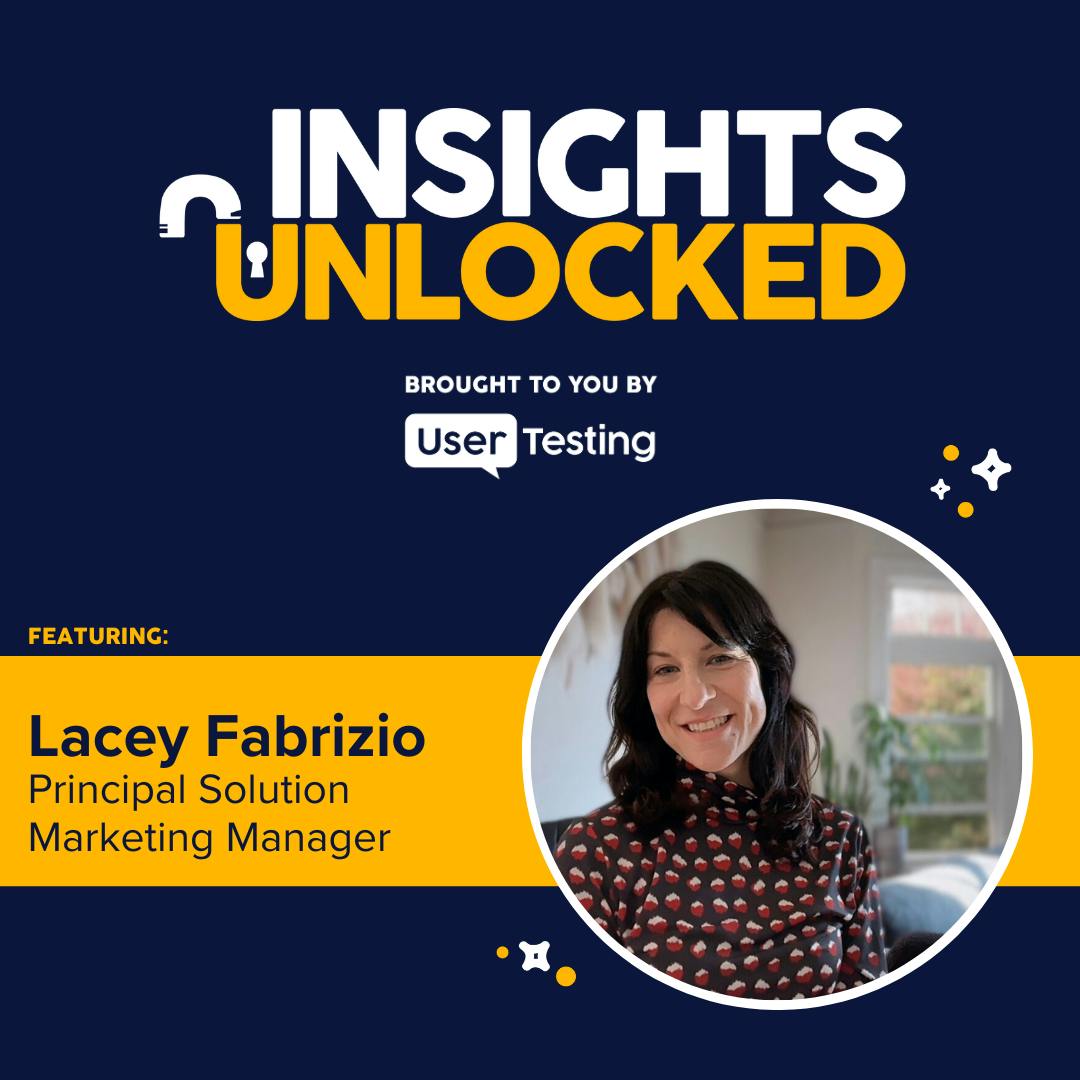
Insights Unlocked
Why the evolving role of designers changes everything with Lacey Fabrizio
00:13:06
Discover how designers are shaping strategy, using AI creatively, and staying close to users to build better products in 2026 and beyond.
Loading summary
Transcript27 lines
- [00:02]
A
Welcome back to Insights Unlocked. In this episode, I'm joined by Lacey Fabrizio, Principal Solution Marketing Manager here at User Testing to talk about how the role of designers is evolving and fast. We dive into how teams are bringing designers into strategic conversations earlier, how AI is becoming a true creative partner, and why staying close to customers is more important than ever. Enjoy the show.
- [00:29]
B
Welcome to Insights Unlocked, an original podcast from User Testing where we bring you candid conversations and stories with the thinkers, doers and builders behind some of the most successful digital products and experiences in the world, from concept to execution.
- [00:49]
A
Welcome to the Insights Unlocked podcast. I'm Nathan Isaacs, Principal Content marketing manager at UserTesting, and our guest today is Lacy Fabrizio, a Principal Solution Marketing Manager at User Testing. Welcome, Lacy.
- [01:04]
C
Hey, Nathan. Thanks for having me.
- [01:06]
A
Lacy. So I shared your title, but can you share with listeners what you actually do at User Testing?
- [01:12]
C
Yeah, I'd love to share a little bit about my perspective and why I'm equipped to talk about what we're going to be discussing today. So before we jump in my perspective, I spend a lot of time partnering with design teams in leading our design focused efforts here at User Testing. So I get a pretty close look at how designers are working, what they're focused on, and how their roles are evolving. And as I'm sure we'll get into, a lot has changed in the past year. You can really start to see where things are heading as we move into 2026.
- [01:48]
A
So more or less, you're the industry expert on this topic here?
- [01:54]
C
I am. They call us the subject matter experts. Yep.
- [01:58]
A
The. As we head into 2026, what are some of the trends you're seeing in the design and product space?
- [02:04]
C
Yeah, I'm happy to chat about that. So I think when I look ahead, there's really three trends that are rising to the top for me. So designers are being pulled into strategic work earlier is great. AI, you know, kind of has been around for a bit now, but it's starting to become a true creative partner. And then there's a much bigger emphasis on staying really connected to customers throughout the design process. And I'm, I'm happy to kind of dig more into those trends too, if you want to.
- [02:37]
A
Oh, absolutely. Yeah. Can. Let's start with the first one. You know, designers moving upstream. Can you tell us more about that?
- [02:43]
C
Yeah, of course. So when you think of design or traditionally, design is usually brought in towards the end of a process, almost like, okay, we've made all of the decisions already, now make it look Good. And that's been shifting pretty dramatically. And so more teams really want designers involved before those final decisions get made. So they want designers helping define the problem and not just polish the solution, which is great news for the design community. So they're being asked to bring more clarity, to connect customer needs with real business priorities and then really help shape the direction. We're actually seeing this in small but pretty meaningful ways. So, for example, I've seen more teams pull designers in before a feature is even scoped. So instead of saying, here, here's what we're building, what they're now saying, or what it's becoming is, here's the problem we think we need to solve. Does this actually matter to users? And so designers are helping really reframe that conversation instead of just reacting to it. And it's a really big jump in influence. And honestly, it's leading to better outcomes. And so when design is really part of those early conversations, teams are able to align faster, so and build whatever it is that they're building more intentionally. All of that ends up reducing any additional cycles or iterations, and it really just increases confidence in that final result.
- [04:19]
A
Okay, how does AI fit in to some of that, as well as to just being a creative partner in general?
- [04:29]
C
Yeah, I love talking about this subject. So AI as a creative partner is really the second trend that I've been noticing a lot of. And a lot of the early conversations that were happening in this space around AI was about speed. So how quickly could AI generate variations or take care of some of the repetitive work that designers were working on? And that's really still helpful. But the real shift that's happening now is how designers are using AI much earlier in the process. And so, so when I say it's a creative partner, I'm really saying that AI is becoming a brainstorming partner. Right. So designers are using AI to explore more directions, to spark new ideas, to push themselves out of their typical patterns and even challenge assumptions. And so I had a dinner recently where I was talking to a designer who said that she uses AI almost like a brainstorming buddy. So she'll throw like a half form, half formed idea into a prompt just to see what unexpected directions come back. And so the way to think about that is, you know, it's not replacing her, but it helps her break out of her usual patterns and explore concepts that really might have not. She might have not even considered them on her own. Right. And that really feels like where things are going. Right. And I think when designers embrace that mindset, instead of being kind of scared of what it is and what's to come when they start thinking about AI as a collaborator rather than a replacement, those are the designers that are going to get the most out of it. Right. So it opens up those creative possibilities. Designers are still providing the judgment in the meaning behind the work. But using AI as a collaborator is this.
- [06:27]
A
Designers can use AI. I mean, is this through specific platforms or. And you may not know this answer, I don't know if anyone knows this answer, but is it like, how are they using AI in like, is it text based? Are they uploading, you know, wireframes of a product or an app? You know, is it, is it platform based, like Figma's new AI tool or, you know, like any of the come to mind or what can you share?
- [07:02]
C
Yeah, that's a really great question. And I think it's honestly changing like every week. Yeah, I just played with a new tool yesterday that creates a website for you from scratch. You don't even need to put code in. Some of the AI solutions now will write code for you. This actually just produces the entire website. You can host it through there and then you can start charging people for your website that you're hosting for them. It's just been unreal. But to answer your question, a lot of designers, like I had mentioned, are using AI as a thought partner. So I think a lot of that really happens in something like a chatgpt where they're just kind of like going back and forth, like putting an initial idea in and then asking, you know, what do you think about this? Or where are there potential holes in this idea? There are a lot of prototyping AI assisted tools out there, but what I've noticed is the design community is not quite ready to move in that direction yet. And the folks that I've talked to really want to keep that like craft. But I think they're absolutely using AI to help with workflow optimization, to help make processes a little bit easier to take care of. The stuff that was maybe keeping them away from like working on their craft, which actually is design.
- [08:26]
A
And as we talk about that and we talk about speeding up and moving up in the process, let's talk about like that deeper emphasis on customer understanding, like how does bring that all together for us?
- [08:41]
C
Yeah, yeah. Are you kind of hinting at the trend three that.
- [08:45]
A
Yes.
- [08:45]
C
Yeah, yeah, yeah. I think it's important. Right. Because we kind of sandwiched like AI in between the two trends, maybe. So to just wrap it up there Is that renewed focus on understanding humans. Right. So. Or real customer understanding and real customer feedback. And so for me, this one feels especially important. And so experiences overall are getting more personalized, they're getting more complex, they're becoming spread across more channels. And really, because of that, designers need tighter connections with customers. Right. So it's really not adequate or enough to do one big research study and then call it a day. Right. Because expectations are shifting very quickly. Like we just talked about, there's these new tools almost every week. It's very hard to keep up with. And so as these expectations from your customer base are shifting, teams are then trying to validate the direction that they're going in even sooner. Right. And so what designers that I've been talking to are asking for is like something super lightweight, something that's continuous, so they're not really designing in the dark. They want to lean into design. Is this really meeting a need? And I need a human to answer that. And so what we're seeing is designers are doing really quick pulse checks on super early concepts. So even something like a sketch or a rough flow, instead of waiting until something is super polished to test it. And so this means that they're getting those reactions right away, and it gives them the clarity even sooner. So. So what that whole thing does is prevents them from going too far down a path that really doesn't resonate. And so even a five minute reaction from a real person can save them, you know, hours or days of revisions. And so that kind of continuous insight really lets designers move faster, lets them move with more confidence, because those decisions are grounded in those real human reactions, not just an assumption.
- [10:56]
A
Awesome. Lacy, is there anything I haven't really asked about that you want to share?
- [11:03]
C
I think all of these shifts, strategy, AI, customer insight, all of it's really giving designers a bigger voice at the table or bigger seat at the table. It's really something that the design community has been advocating for for a long time, and now it's really happening. And so these three trends really point to the same theme, and that's the role of the designers expanding. So they're becoming more strategic. They're getting new creative superpowers through AI, and they're working on ways that are more connected to real people. I would say just for designers, it's a huge opportunity to step forward to influence more decisions and design with more intention. And Overall, I think 2026 is going to be a really exciting year for the field.
- [11:52]
A
Excellent. Lacy, I appreciate you being on the show, and I enjoyed our conversation. How does someone learn more about some of these topics?
- [12:01]
C
Yeah, great question. We've got a ton of resources. If you head over to usertesting.com, we have blog posts, we have guides, podcasts, webinars, and we actually just came out with a new guide that I helped author that is related to the trials and tribulations that a design leader will face in their day to day. And it's all listed usertesting.com right under resources.
- [12:27]
A
Perfect. And we'll include some of those links in the show notes. Lacey, again, thank you so much for your time today.
- [12:33]
C
Yeah, of course. Thank you for having me. It was fun.
- [12:35]
B
All right, want to keep the conversation going? You can find the show notes@usertesting.com podcast if you haven't already, don't forget to follow us on Apple Podcast Podcast, Spotify, Overcast or Google Play so you never miss an episode. And if you enjoyed today's show, please share it with a friend or leave us a rating and review on Apple Podcasts. And until next time, this is Insights Unlocked, an original podcast from User Testing.