Loading summary
Transcript84 lines
- [00:00]
A
Mary, could I offer you a flamingo tongue?
- [00:04]
B
Very nice, Charlotte, thank you. But with a bit of peacock brain perhaps.
- [00:09]
A
I would like to offer you some rotten fish sauce to go with that.
- [00:12]
B
That would be nice. And perhaps some liver of pike.
- [00:16]
A
I was thinking of some lamprey semen actually.
- [00:21]
B
Oh, you tempt me. You tempt me. Butter. There's also, don't forget the stuffed dormice.
- [00:27]
A
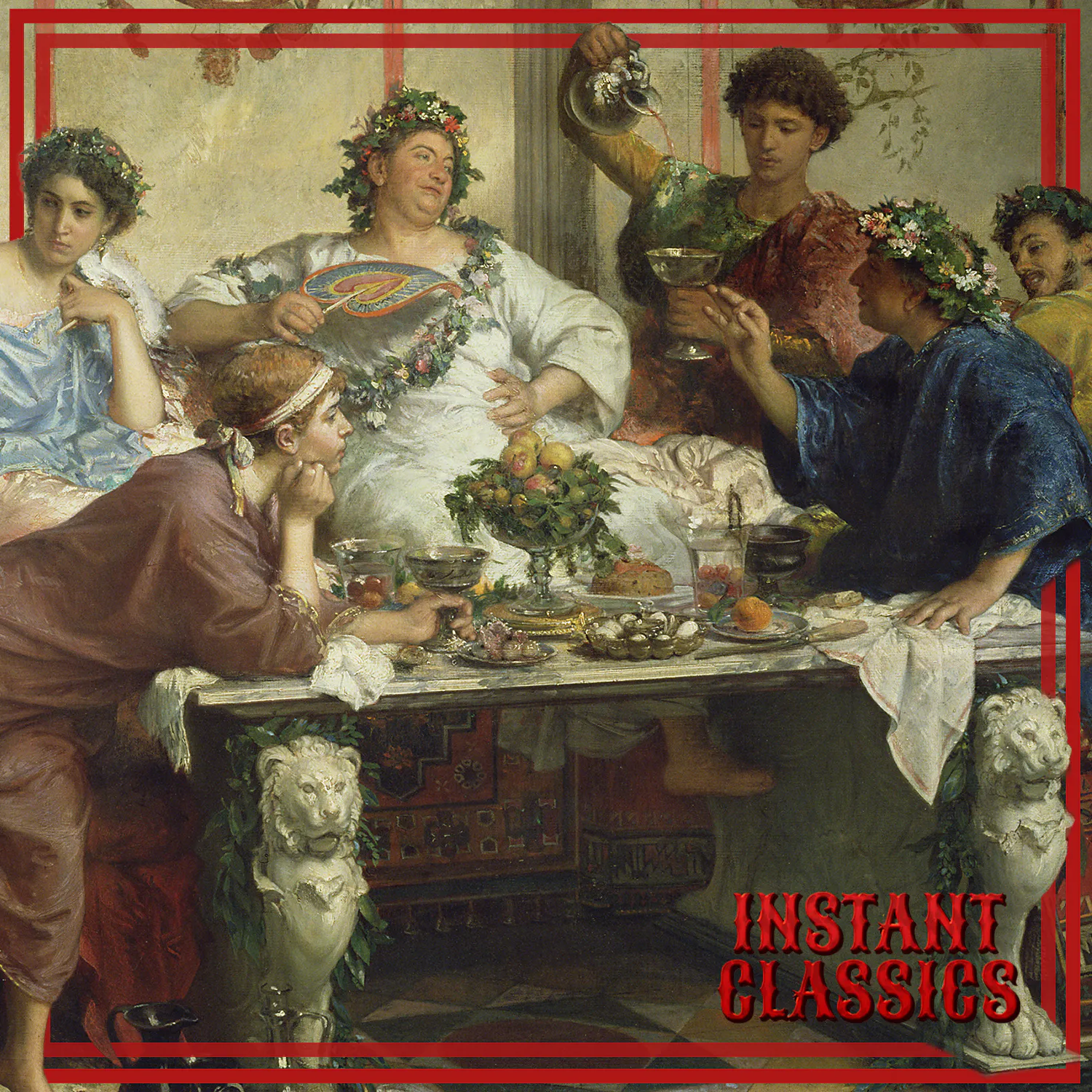
Absolutely delicious. Well, Roman food has got a reputation for being extravagant, rich, and depending on the way you look at it, totally disgusting. No wonder it gave rise to that popular but completely deluded urban myth that the vomitorium was where the Romans made themselves throw up halfway through a meal so that they could keep eating.
- [00:51]
B
Needless to say though, your average Roman Joe blogs was not sitting down every evening with the missus to a wonderful roast flamingo tongue. Right. And probably the wealthy elite weren't doing that always either. So what did the Romans really eat? In this two part special, we're going to be starting with the diet of the great and the good, the elite food. Then we'll be looking next time at the street food, what the average Roman consumed. And we're going to be doing this armed with one of the very earliest cookbooks to have survived in the world. We've got some wonderful eyewitness accounts of Roman eating. And we're also going to be having a bit of a look at some of the stuff that has got left in Roman lavatories once it's gone through the Roman digestive tract.
- [02:02]
A
Great as ever, we'll be asking what Roman eating habits tell us about Roman society. We'll be busting a few myths, possibly confirming some others, and discovering a mind boggling array of dishes that can be made from cabbage.
- [02:18]
B
And we'll be asking what everyone always wants to know, which is would the ancient Romans recognize anything that we find on the menu of an Italian restaurant in our local high street? Because this is Instant Classics, the podcast that uncovers the ancient stories that are still shaping the world today. And I'm Mary Beard.
- [02:45]
A
And I'm Charlotte Higgins. Each week we dive into the myths, the dramas and the characters of the classical world to discover what they still mean to us. Now, this episode prompted by a suggestion from our listener, Mike. What the Romans ate. Posh food.
- [03:14]
B
Morning decisions. How about a creamy mocha frappuccino drink?
- [03:18]
A
Or sweet vanilla smooth caramel maybe?
- [03:21]
B
Or white chocolate mocha? Whichever you choose, delicious coffee awaits. Find Starbucks frappuccino drinks wherever you buy your groceries. If we are posh, Charlotte, I think we're going to start in the Roman imperial palace. Go straight to the top, go straight to the top. And that's partly because Roman writers, Roman historians, observers of these guys were absolutely fascinated by their diet. So you know we go to Suetonius's set of biographies of the first 12 Roman emperors and, and most of them have got a good chunky bit on what they liked to eat. Now I think we ought to be clear to start with that they don't all like the same stuff. And there are some of these rulers, like the first emperor Augustus for example, who doesn't do anything of the likes of the stuff. Flamingo brains. He is supposed to be very keen on a plain, simple, ordinary Roman's diet. You know, straightforward hand pressed cheese, figs, a few fish and some ordinary bread. Right.
- [04:45]
A
And it's fascinating because he, because Suetonius actually digs out letters, documentary evidence, because Suetonius the biographer, 1st or 2nd century CE biographer was actually the archivist in the palace. So he had access to actual stuff and he digs up letters that Augustus wrote to his adoptive son Tiberius who was the next emperor. And Augustus is almost making a virtue of I ate nothing all day except for a few pieces of dry bread and a handful of figs or something. And it feels like he's constantly snacking or not actually not constantly. He takes the occasion, he's a snacker but he barely eats anything. But he's also very keen to tell us and to make a virtue of it which I think is worth storing away for. What for? Seems to be part of his self
- [05:39]
B
branding and some of that clearly did if we believe Suetonius, rub off on Tiberius himself because Tiberius actually got into a bit of trouble with the Roman elite for being quite careful on food expenditure. So he would serve leftovers, right. So you know, great banquet one night, plenty of stuff left, you go to the palace the next night and it's been reheated. The idea. And he has some very sort of moral and homely plant hobbies. I mean he's dead keen on growing cucumbers. Is our Tiberius up in the palace you got some Tiberius cucumber frames where he's cultivating.
- [06:27]
A
Fantastic.
- [06:27]
B
Yeah. But the truth is that most Roman writers are not as interested in that kind of ordinary, non fussy diet. What they really get off on the biographies of these guys is the absolute extraordinary complicated luxury of the Emperor's menu really. And some of them rise even above the sort of the pack. So you get emperors who in some ways become known for their extravagant Diet and one is a very short lived emperor in the middle of the first century ce a dye called Vitellius. Vitellius is supposed to be rather portly, not to say gluttonous Roman emperor. But what he's eating is very, very carefully crafted. His recipes and his favorite dishes get special names. I mean there's a wonderful one we' which is Vitellius signature dish. You know, no doubt that for the few months he was emperor the palace staff were very good at whipping up. It was called the Shield of Minerva. The goddess Minerva. And Suetonius describes this in quite a lurid for me way. In this dish he mingled the livers of pikes, the brains of fish, pheasants and peacocks, the tongues of flamingos, the milt of lampreys brought by his captains and triremes from the whole empire from Parthia to the Spanish Strait.
- [08:26]
A
What's milt of lampreys? Mary, come on.
- [08:28]
B
Yeah, I know you were going to ask that. We had to look up milt actually.
- [08:34]
A
We've got a bit of a nasty shock.
- [08:36]
B
I'd say we did because it's lamprey semen basically. Lampreys are fish, right? Kind of eel fish, I don't know. But this is semen of lampreys, you know. Wow, that's. You can't get more refined than tucking into lamprey semen. And it's another one who gets really kind of the whole sort of extravagant menu treatment is the third century emperor Elagabalus. You know, the one who's. We're always digging out Elagabalus because he's more extreme in almost everything than anybody else but including in his diet. And he. There's a wonderful bit in a later biography of him. For 10 successive days he served wild sows, udders with the wombs, the wombs at the rate of 30 a day. Serving besides peas with gold pieces scattered in them, lentils with onyx in them, beans with amber and rice. And he also sprinkled pearls on fish and truffles instead of sprinkling them with pepper. This guy is so rich that he is that his dishes, the dishes he's serving at the palace kind of imagine that you're eating gold, pearls, gems along with the food.
- [10:05]
A
So interesting. Like obviously rice does in some senses look particularly the arborio, particularly risotto rice, sort of short grain rice does, does look like tiny pearls actually when you're making a risotto out of it. Are you supposed to like hunt for the. I mean we, we can't Know the answer to this I guess. Like are you supposed to hunt for the precious bits in your dinner and kind of put them in your pocket and take them home? No, you just meant to eat.
- [10:38]
B
You eat them, you eat them. I bet, you know, you say lovely, you can't sit there with the rice trying to pick the pearls out. But what you do is you make sure that you are very careful about what you do with your stools when they emerge the other end. Because that is when you get the pearls, don't you think? Been to dinner with Elagabalus and you know, you sit on the potty for days after getting the slaves to go through it to pick the pearls out. How about, how about that?
- [11:13]
A
Well I, I, yes, it's an interesting theory, Mary. I'm not sure that I wouldn't be sort of just poking through it with my fingers and just, you know, popping it into the little pocket in my, in my toga. But anyway it's, it's, it's a remarkable picture that may or may not accurately reflect reality because there's a sort of sense of over the topness of kind of fantasy here, isn't there?
- [11:42]
B
You see that also actually in real Roman fiction. And we'll come back to this in a bit I think. But there is a wonderful Roman novel written in, in the reign of Nero by Petronius the Satyricon. But the most famous bit of this novel is an over the top dinner given not by an emperor but by a very, very rich ex slave. And that fictional account mirrors in quite a lot of ways the, the biographical accounts we get of Roman eating. So you know, you can see this is in the zeitgeist, this kind of what do people with more money than sense do when it comes to constructing a menu for themselves? I mean you can see it doesn't take much going through these. And you know, once you get over, you know, all your little queries about how you, with where you got the pearls at and how it all worked, you know, the kind of higher level, higher. There's, you know, there's a sense that, you know, what are we seeing here? We're seeing expensive food obviously food that is incredibly difficult to harvest. I mean I don't know how you collect the semen of lampreys, but it clearly is going to require quite a lot of, of skill. And then there's the fact that the ingredients are coming from everywhere, you know, so that is actually brought out in Vitellius signature dish when it actually says that these are being brought from the whole empire, from Parthia in the east to the Spanish Strait in the west. And there is a sense that this is about the power to extract resources to eat, you know, not from your own back garden, but from everywhere in the Roman Empire and probably, certainly, I think, beyond.
- [14:03]
A
Yeah. Exotic foods, exotic far flung foods. Showing your power as the center of the empire to bring it all to you.
- [14:13]
B
Yeah. And kind of that's not entirely different from our own very posh foods. Why do these mushrooms come from that? Oh, they were dew picked in the, you know, in the hillocks of southern France this morning and brought to England. You know, that kind of. That sense that, you know, being able to command things to eat from everywhere. The other thing about it, and this really matches with, again, some of our senses of oak cuisine, is that the food is kind of mushed up in a way that it ends up not looking like what it really is. There's a kind of wonderful deception about it. And there's a marvelous anecdote in the middle of Petronius's dinner party of. Of trimalchio, where a whole little joke depends on things not being quite what they seem. Because one of the courses, they're already well into the dinner, a great pig is brought in, apparently stuffed Trimalchio looks at it and says, look, I don't think this pig's been gutted. No, it really hasn't. Bring me the cook.
- [15:27]
A
Right.
- [15:28]
B
And the cook comes in and the cooks actually, as we discover in on the joke, and Tramalika gets really cross with him, says, thrash him. He has, you know, he has forgotten to. To kind of take the innards out of the pig somehow. They kind of, they. They pass over the thrashing, I think, and the. The cook does actually say, no, look, let's demonstrate. Let me cut the. The pig open. And what, what tumbles out of this pig that's been brought in is actually a load of sausages. Now, you might think so it's a
- [16:01]
A
kind of a sort of food joke. It's like the sausages are in fact a kind of joke on the guts of the pig.
- [16:09]
B
They were made with the guts.
- [16:10]
A
It's like they're made with the guts of the pig. So it's an illusion. It's a kind of sort of weird form of illusion where it's the thing itself, but, you know, and it's been made to look as if the guts are still intact, but in fact, the guts have been made into sausages. It's a kind of foodie joke. And I can totally Imagine, you know, chefs, famous chefs like the British chef Heston Blumenthal in his heyday. I mean, we're going back 20 years or so really, but he used to, and this is in modern oak cuisine, as you say, like, make a joke about expectations about what the food that you eat might be. So he had a sort of signature dish that looks exactly like an orange with its sort of orange dimpled skin, but you cut into the orange and it was a sort of perfect chicken liver parfait or sort of liver parfait anyway. And yeah, almost like a psychological game playing with what you think the food's going to be. And that seems to be a sort of continuum in, in this very high flown, very high flown cuisines.
- [17:20]
B
Yeah, that's certainly what's going on with Trimalchio. And I think it's quite nice that the writer Petronius kind of builds it up. It is all fictional. Remember, Petronius builds it up into a kind of a stage joke about how he's going to thrash the cook and all the other guests say, oh no, don't hurt him, et cetera, et cetera. And yet the kind of punchline is in the sausages, the sausages which were the innards of the pig and have been put back. So you don't quite, you know, it's playing with the boundary of the prepared and unprepared, the raw and the cooked and all that kind of stuff.
- [18:00]
A
There's a kind of, for me with all this that we've just been discussing, Mary, that the boundary between what people are actually fantasizing about what the super rich are eating and what the rich are actually eating is quite hard to judge. No, I mean, I'm not sure that we could, with hand on heart, prove that anyone was eating this menu, these kind of menus with really putting the pearls into the rice. I mean, I wouldn't put it past them, but we don't. Everything that we've got is a kind of wonderfully strange mix of fantasy and aspiration and myth. And I mean, there must be some reality in the mix. And I suppose it kind of almost, it almost reminds me about the way we think about our own contemporary royal family, almost, you know, that kind of idea that, yes, we have a sort of double idea about them. I think in a way this is partly to do with what they themselves tell us or what we ourselves can see. You know, there is feasting, there are state dinners with very elaborate dishes. And then you get things like Prince Harry in his biography, which I have Read his autobiography, which I have read. Not out of choice particularly, but I have read it still. Team Harry. Anyway, Harry describes his childhood meals while the adults were all having something very elaborate downstairs. He and William would get just sort of ordinary fish fingers and stuff for supper, but brought in by butler and served under a. Under a silver dome.
- [19:45]
B
Yeah, that's right, yes. And there's quite a lot similar there, isn't it? Because the late Queen Elizabeth ii, she in kind of our stories is very much an Emperor Augustus character. You know, she's eating simple food and I remember reading all this stuff about how she had her breakfast cereal in ordinary Tupperware on the breakfast table.
- [20:13]
A
That's it, yes, yes.
- [20:14]
B
So you're always, when you're thinking about what is it that they, you know, they with a capital T, what is it that they eat, whether it's Roman emperors or the British royal family and how do I begin to imagine it? And it's always caught between actually they're very ordinary really, like Augustus and they don't like a farce to on the other end. It is just unimaginable. Both it's brought in, in this ridiculous silver dishes and then it's. You could never, you, you could never in a million years imagine that you could eat like that. You know, it's a great sense of, you know, sit down, close our eyes and think, how do the very, very rich eat? And those are the answers that we get, I think.
- [21:05]
A
Is there a way of getting a little bit closer to reality, do you think, Mary? Can we edge our way beyond the myth into something a bit more concrete for this super rich cuisine?
- [21:17]
B
I think we can get a little bit closer and we'll have a look after the break.
- [21:28]
C
Membership means more with American Express Business Gold. Earn four times Membership Rewards points in your top two eligible spending categories every month, including eligible U.S. advertising purchases in select media and U.S. purchases at restaurants, including takeout and delivery. What are you waiting for? Get the card that flexes with your spending every month. Terms and points cap apply. Learn more at American American Express.com Business Gold AmEx Business Gold Card built for business by American Express.
- [21:58]
B
Hello, lovely listeners. If you're not yet part of our Instant Classics Book Club, well, now is the perfect time to join because we are making our way through one of the most exciting works of literature ever. That's Homer's Odyssey.
- [22:18]
A
We would love you to join our book club, which we absolutely adore. So please do join now to give you all the access to our previous episodes and loads of other Perks like being able to join our online community and getting early booking access to our live events.
- [22:37]
B
All details are on our website, instantclassicspod.com
- [22:44]
A
Mary one of the things that I think people do associate broadly with Roman food. Two things. One, this rotten fish sauce called garum and two, roasted door mice. What's your take on. What's your take on. On garum?
- [23:05]
B
Right now I'm going to have to confess here that I've become slightly less skeptical about some of these recipes and these staples of Roman diet than I used to be. Now in the case of garum, and it's sometimes also called liquame, I suppose just means liquid. In the case of garum, we tend to think of it when we see that there was something that the Romans kind of poured over everything made of rotten fish. We kind of tend to think of a kind of horrible paste. And when students do Roman banquets to go with their Roman toga parties, they have terrible trouble finding out what the garum might be here. And what they usually do is they do get anchovy paste and put some water in. It's absolutely disgusting. Now I think actually we've not been seeing the wood for the trees here. I think that, you know, I love to consume fermented Thai fish sauce. It's not messy at all. It's clear, it's nice, spicy, it's peppy and I love it. Now I suspect we ought to get out of our minds this kind of mush that we think of as garum or liquament and think of it a bit like nice clear Thai fish sauce, right?
- [24:38]
A
So it's not kind of mushed up old fish gone rotten. But Thai fish sauce I think is little fish sort of dissolved in salt and you end up with this actually rather delicious condiment. So maybe, yeah, Garum's more like that.
- [24:55]
B
I think, you know, there's a vicious circle here. We misunderstand what the thing is and then we say, oh, they couldn't possibly have eaten that. Whereas actually maybe we ought to go back to the beginning. I think garum would probably be quite nice. And it was certainly a huge money making business in the Roman world producing this fish sauce. But I think I was more caught up probably on the dormice line, right. I used to say, and you know, I can hear myself saying this and teaching students that, look, this was just the idea that Romans ate dormice. You know, this is just a kind of, you know, a fantasy that they had of what you kind of should and shouldn't eat. And I've had to climb down on that a bit. Now, there's two reasons. I think that the, the word doormouse is. Is misleading here because I think what we call the dormouse and what the Latin means for the little animal, the gliss or whatever it is, they're not quite the same species. And I think that one of the reasons that we thought Romans could never eat dormice was because, you know, we had the Mad Hatter's tea party and Lewis Carroll and the cuteness of the dormice was always in our minds.
- [26:19]
A
So tiny.
- [26:21]
B
Yeah, but they, you know, and tiny. A little furry and sweet. And we thought, no, and that's just impossible there. I have to say, I did later discover that there were references to pottery vessels called Glyraria, which were dormouse fattening vessels. The idea was that you put these little creatures into this jar, you filled them, you kind of gave them loads and loads to eat. They got fat, you then took them out and killed them. Now there are vessels that have survived at Pompeii which can only be Glyraria. They must be these vessels. They're big vessels, they've got little breathing holes, they've got racks inside for the food and you can put a top on. Fits exactly what Roman writers talk about. So this is not actually that far down. This is not actually real rich stuff. This is comfortably off stuff. But it does look as if whatever the Roman dormouse was, it's hard to get away from the idea that it was something quite a delicacy that you go to some trouble to eat. Now, we are still a very long way from lamprey semen, but I can see.
- [27:58]
A
I'm just thinking aloud here, but I can kind of see how raising mice as a foodstuff. Let's just pretend it's not a totally alien idea to eat mice for a minute. It's actually very convenient because you can raise this foodstuff domestically without a lot of space. You can have that thing in your house. You have then got kind of fresh mice, you've got fresh meat on tap. Presumably they then reproduce very rapidly. That is one of the features of mice. I don't know, it just feels like, you know, if you can't keep your own livestock, this is a small. You can keep, you can, you know, it's a domestically available foodstuff that self reproduces and can be eaten fresh.
- [28:47]
B
And, you know, I bet it's, you know, it's going right up to a pretty elite dining. And so I've had to kind of bash down my normal skepticism here and to say that some of this
- [29:06]
A
is
- [29:06]
B
probably much closer to reality than I'd ever given it credit for. That said, however, I mean, one of the things that's always been puzzling about the vast spread of food that we're supposed to get in Roman imperial banqueting is that the apparent absence of big kitchens in the Roman palaces. Many Roman palaces have been quite well excavated. A few have produced some very small kind of food prep areas. But, you know, if you start to look at, you know, Vitellius's Shield of Minerva dish, you are imagining that is a, you know, that's an industrial culinary operation. And there is no sign certainly in the big palace in the center of Rome, there's no sign of that now. I mean, one thing is it's getting cooked a bit away. It's kind of a half takeaway. And Romans, like, I think many other modern cultures, are not so hooked as the Brits are with food being hot. You know, you want. Your Brits want their food, sir, piping hot. Well, actually, lots of cultures don't mind about that. So, you know, kitchens are a fire risk. So maybe all this stuff was prepared, but a bit off, a bit off site, I think.
- [30:49]
A
I mean, it can't, you know, unless there's something we haven't yet discovered of the, you know, Imperial palace of Nero in Rome. It must have been. There's simply nothing on the scale of those big medieval kitchens that you get in castles where absolutely very elaborate, very elaborate things were cooked on site. So there's always a bit confused, where did they make it?
- [31:15]
B
Where did they make it? I mean, I think that the other option is that the using parts of the house that we don't recognize as kitchens as places where the food is prepped. I mean, I think it's interesting that in the story of Trimalchio in Petronius, he has a slave boy acting as a kind of doorkeeper on his outside step, but at the same time he's shelling peas into a colander. So food prep is kind of diversified around the house. And some of this is going to be, basically, it's going to be a barbecue. And in those open spaces, you are erecting temporary ovens, spits, et cetera. So it could be that, that more of this can be prepared than we think. But you're absolutely right. You know, when you go to a castle or you go to Topkapi palace in Istanbul, it is, you know, the kitchens, you can tell that food is crucial because you know, the kitchens are so vast. You don't get that in Rome. So it's. And I think that some of my. Some of my skepticism, I have to say, you know, I do. Like, I allow it back in just occasionally. And also. Yeah. I mean, the other thing is that they really hadn't. The Romans hadn't invented a fork. Right. So I think you've also got to think. I mean, these enormous dishes, you know how actually without a fork, did you eat them?
- [33:09]
A
Right.
- [33:09]
B
You ask where you've got a spoon or you have them cut up. But you can see that this comes over very clearly in Trimalchia with the pig, there's great ceremony of bringing in the centerpiece dish, you know, the shield of Minerva for Vitellius or whatever. And then you could actually eat this stuff with rather inappropriate implements, I think.
- [33:36]
A
So I find hands very useful in these situations.
- [33:39]
B
Yes.
- [33:40]
A
I mean, it must.
- [33:41]
B
You also got a glass of wine. I mean, you know, there is. There is a kind of sticky.
- [33:45]
A
I'm getting it sticky. But I assume there's some enslaved person with a towel and so. Yeah. Keeping it going.
- [33:52]
B
Yeah. We do know that in the imperial palace, we've got inscriptions which preserve evidence of napkin keepers. Special. A special cadre of the imperial service, which is keepers of the napkins. So maybe you're actually getting your hands into this stuff. Yeah.
- [34:13]
A
Yes. Hygiene, that's a whole other issue, not for today. But we do, Mary, we actually do have. Our secret weapon is this amazing Roman cookery book, which is called Apicius.
- [34:28]
B
That's the author. That's supposedly the author on the art of cookery.
- [34:32]
A
It's both called that. And that's the author, isn't it? And the author was kind of a real. Probably. Well, clearly was a real person. Around the time of the emperor Tiberius, he was. It sort of became a kind of mythical gourmet, someone who was a byword for extravagant eating and extravagant food. But he almost becomes a kind of brand name. So that we don't think that every recipe in this book that we know of as Apicius was written by Apicius, or possibly any of them, but rather he gives his name to this kind of volume of cookery books. And it seems. It's quite. What we call Apicius, seems to be quite a hodgepodge of different recipes from different sources. It's a kind of amalgam. Although I love one of the myths about Apicius was that he was one of these. When you talk about just the status attached to getting food from exotic places elsewhere, he was once said to have sent the emperor oysters all the way to Parthia. Now, Parthia, you know, kind of modern Iran around there, quite far, quite far from the sea, quite far from the source of the oysters. So that's already, you know, sending oysters anywhere is, you know, I would say a kind of problematic and interesting project. And he also wants, he sets, supposedly set sail for Libya to find the best prawns. So he's a foodie. Apicis is a foodie rather than a cook. He's a. He's a rich gourmet, a foodie and a saucer of things and a holder of banquets and feasts.
- [36:24]
B
In some respects, I think Apicius is a bit like the British 19th century Mrs. Beaton Book of Cookery and Household Management, one of the most famous traditional cookbooks in Britain. And it's still available. You can still buy Mrs. Beaton's cookery book, but actually since the death of Mrs. Beaton, it's gone on and on being added to and changed so that what you now buy in the shops as Mrs. Beaton probably doesn't have very much relationship to what Mrs. Beaton actually wrote. There's a sense of that with Apicius, that he's kind of giving his name to a set of works that we eventually have in a kind of 4th century CE version, but where they're very different is that Mrs. Beaton is very precise. You know, she's a real household manager, whereas Apicius is not the household manager, he is the. Let it all come on, because we're going to have the most fantastic banquet.
- [37:37]
A
Thanks to me, I've got my copy in front of me and I find it totally fascinating. I have to say, say it's really worth a flip. And by the way, don't expect to be able to cook from it in any sort of meaningful way. Like, as you just said, Mary, people have made modern versions of Apicius that are kind of vaguely cookable from. Well, no, not even vaguely, like actually adapted Apicius into the form of a modern cookery book, which I'll dig out and put in the notes. So that if you want, if you really want to do some Roman cookery, you can, you can look at these adapted recipes, but probably, you know, they're very imprecise guides to, to these recipes. There's no measurements or anything. Oh, Cooking Times. Goodness help us.
- [38:26]
B
You know, one thing you expect from a modern recipe book, and it's probably is quite modern actually, this is. It probably is one of the inventions of Mrs. Beaton really that, you know, really kind of getting things spelled out for you. You go to Aberkes's recipes and he'll, you know, he'll. He won't give you the exact quantities and he won't give you the cooking time, you know, so he'll say, you know, take some eggs and make a roux and add the sea nettles, and when it's cooked, you'll find it delicious. And so it's, it's, it's hard to imagine what you actually do with that, what the preparation involved was. Of course, the other problem is that. And this is where you come back to the question we raised at the beginning about, is this anything like the Italian cookery that we get in Italian restaurants now? Because if you're looking in arpicius for the kind of ingredients that we now associate with Italian food, like particularly tomatoes, but. But also aubergines and potatoes, et cetera, because you don't find those.
- [39:36]
A
Those are all foodstuffs that came to Europe after Europeans made it to America. In fact, those like peppers, tomatoes, potatoes, they're all from. They're all from the Americas. And also, similarly, we think of oranges, quite possibly. Oranges don't reach sort of Sicily and Italy until the Arabs get there in, you know, the Medieval age. So this is a cuisine that's got a lot of offal in it, which actually, I do think is quite. Actually modern Roman food has got quite a lot of offal in it. It's got a lot of greens, a lot of green vegetables, leeks and, oh, you know, things like lovage. I'm just flipping in celery seed and mint. I mean, actually quite nice things in some ways. Lots of papa, which must have come from the east. And for me, amazingly surprising amounts of cumin, which presumably also came from India, which we. I certainly associate now with Indian and Middle Eastern food. The idea that it was absolutely everywhere in this apicious as a very ordinary. Well, we say ordinary for Apicius. It's very ordinary flavouring, you know, Seems remarkable to me. Here's a recipe for a whole page, actually, of recipes for womb. Doesn't say wombs of what? You know, it could be wombs of, I guess, pork or lamb or beef. And these are not very precise recipients. Right. This is to make roast womb, should you wish to try it, roll the womb in bran after you have put it in brine and then cook it. That's the entire recipe. And some of them are a little bit more elaborate, just a little bit. So here we go sauce for sterile womb, pepper, celery, salt, dry mint, honey, vinegar and liquor men, which is the sort of fish sauce. And there are dormice recipes. Stuff the dormice with pork force meat and also with the flesh from all parts of the dormouse, pounded with pepper, pine nuts and this liquamen, this fish sauce. Sew them up and arrange them on a tile and put them in the oven or cook them. There you go, Mary. Yeah, that's your supper for dinner for tonight.
- [42:09]
B
Yeah.
- [42:11]
A
And you bother to stuff dormice with dormice.
- [42:13]
B
It, it overlaps a little bit with these very over the top recipes that you get talked about in the context of the imperial banquet. I mean some of them are. Some in epic is a much more, much simpler. But there are, you know, you just read one, you know, about cooking sterile wombs, so you're presumably finding an animal that has not had little animals, not given birth. And the sterile womb then becomes a particular delicacy, I guess. And so again, it isn't undermining, I think, our rightful skepticism about these over the top fantasy recipes, but it is showing them a little bit more rooted in real cookery. If Apicius is real cookery, I mean, because, you know, I have very many cookery books on my shelves which I never actually used to cook out of. I mean, their function is actually also partly fantasy. But I think the thing that struck me when I was reading Epicyclies and we talk a bit about the idea of food as deception, as when you get to this very upmarket food, nothing's quite like what it is seems to be. Now this is not a major theme in Apicius, but there's one wonderful recipe which is called pate of anchovy without anchovy. And the last line of this recipe is at table, no one will know what they're eating. And I think that sense of that Apicius writing that into a recipe, this is a recipe which is a deception and a fake, et cetera, et cetera. Now that also it fits, it overlaps with what you see in Trimalchius fiction or whatever.
- [44:22]
A
I think what I find fascinating about Apicius, another thing that I find fascinating about Apicius, as with so much to do with Rome and the ancient world, it's. Some of it feels kind of very familiar to me. Like there's, there's no pizza or pasta, by the way, in this, you know, this is all, that's all much later Italian cookery. But there are things that, that feel some of the vegetable. There's a whole book There's a whole section on vegetable dishes. I'm vegetarian. I felt quite at home with these vegetable dishes with kind of, you know, celery and kind of lovage and nice sounding cumin spicing and stuff like this is all sound perfectly reasonable to me, but right at the beginning of the book, there are also recipes for flamingos and if I'm not wrong, there might be a crane, a recipe for birds that we certainly don't eat in our culture. In other words, there's a kind of. There's a mixture of things that seem totally alien. I mean, all the awful recipes. I mean, I know I'm not a meat eater, so it's hard for me to judge, but, you know, I think even some fairly hearty meat eaters might find some of the offal, a little of the concentration on offal, a little bit off putting. Some of it seems familiar, some of it seems desperately, desperately alien. But of course, that alienness asks us, I think, is an invitation to examine the weird things that we eat. I mean, we eat weird things. The Romans would probably think that some of the things that we did to food, if not a vast majority of the things that we did to food, was extremely, extremely odd because we've been
- [46:13]
B
talking a bit as if this was about fantasy. And some of it certainly is. I think that the imperial recipe is a kind of apicious scene through a magnifying lens. It is fantasy in part, but there's also a really strong thread of morality here about what our own identities. You know, it is the old, you know, you are what you eat tag that there is something about what it is proper or improper to consume. And that's partly the idea that one of the things we started from the how extravagant can you be in your diet? I mean, when Elagabalus puts bits of gold and pearls in with the food, he is being accused in part of waste. I mean, that is waste. You know, eating, eating the precious in that way is really off limits. And, you know, when Augustus is, you know, pottering around the palace having a quick snack, he's partly trying to reassert his sense of not being a pamperito. You know, a little bit of bread and cheese is fine for me. And we, of course, live in that world and we don't always, I think, notice how very rigid our food rules are about what we think is over the top, what we think is just inedible. You know, I think, as far as I understand it, there is absolutely no reason, if you are a meat eater, not to eat dog, right. But we have put that off limits. You know, dogs have become domestic part of the home. You know, cutting up your, your dog would be, you know, the next worst thing to cutting up your kids to eat your children. I mean, they are one of us. And the world is divided into animals that somehow belong with us and those on the other side of the line which you can eat. And in, in Rome, what, partly what you're seeing is a different set of divisions.
- [48:42]
A
And I think the thing that you, the, the thing that you identified there about the, the, the precious, the precious jewels that are hidden within the food, to me that, that's a clincher because there's so much of rough and it's not just Roman thought, it just comes out, it comes out in all kinds of Roman writing about, you know, what is about this sort of sense that we, the Romans are decadent or luxurious. You know, it's the Romans writing about themselves that gives them this reputation. And this is morally, this is morally corrupt in some ways. If only we could go back to this old fashioned sense of Romans as stern, upright chaps who had farms and ate very simple food before we conquered the empire. That brought us cumin and peacocks, gizzards and whatever. This extraordinary sense of doublethink, you know, a complicated sense of what it means to have become rich. And to me, another sort of clincher in the whole thing is Augustus, who was both, you know, super powerful global leader and man of extraordinary, unthinkable wealth, making such a big deal of. I just had a tiny crust of bread between appointments. And that goes along with everything else about him, which is about reinstituting traditional Roman festivals and trying to make Romans more moral just like they used to be. Food is one ingredient, pun intended, in this whole sort of realm of the Romans thinking about themselves. So when you get that sort of, that sort of semi fantasy about what the super rich are eating, that's also a kind of weird fantasy about what we, the Romans have become. And it's a sort of reflection of all that.
- [50:53]
B
I think for me too, it kind of turns the spotlight back onto us though. I mean, thinking about how the Romans are talking morals or talking what it is to be Roman, what it is to be foreign through food, I think helps us to spot the way we do that too and don't so often notice it. I mean, one of the totally obvious examples of that is the way that slightly now old fashioned nicknames for foreign cultures are so often food related. There's the Kratz, there's the frogs for the French. And then the French call us Les Roast Beef, you know. And we're seeing something which is on the kind of spectrum between morality and self definition in diet. And I think that's one of the things that makes it quite hard to get to the bottom of exactly which bits of these recipes are kind of real life truth because it's also presented unintentionally in some ways or at least unconsciously acting out a moral position. And you know, we do that too. I mean, Charlotte said she's a vegetarian and we talk about that as if it's, well, she's a vegetarian. We could do a very strong moral divide between you and me, you know, me the you know, who loves nothing more than a nice bit of awful and you who will only eat veggies. And but we, we've sort of taught ourselves not to see our own morality invested in this and just kind of take it for granted as sort of a bit of difference. So I think it's as often with the ancient world, it makes you look again at yourself.
- [52:52]
A
Well, Mary, let's leave it there for today. But next, next time we are going to look at slightly the opposite end of the spectrum. Not at what the very posh people ate, but at what the plebs like us ate.
- [53:06]
B
No flamingo tennis.
- [53:09]
A
As ever, we want to know your thoughts and comments, ideas, questions. And so if you have them, please do send them to us@instantclassicspodmail.com or on our site Social media at Instant Classics Pod.
- [53:25]
B
Bye bye.
- [53:33]
C
Ryan Reynolds here from Mint Mobile with a message for everyone paying big wireless way too much. Please, for the love of everything good in this world, stop with Mint. You can get premium wireless for just 15amonth. Of course, if you enjoy overpaying. No judgments. But that's weird. Okay, one judgment anyway. Give it a try at mintmobile.
- [53:53]
B
Com, switch upfront payment of $45 for 3 month plan equivalent to $15 per month required intro rate first 3 months only, then full price plan options available, taxes and fees extra. See full terms at mintmobile. Com.