← Intelligence Squared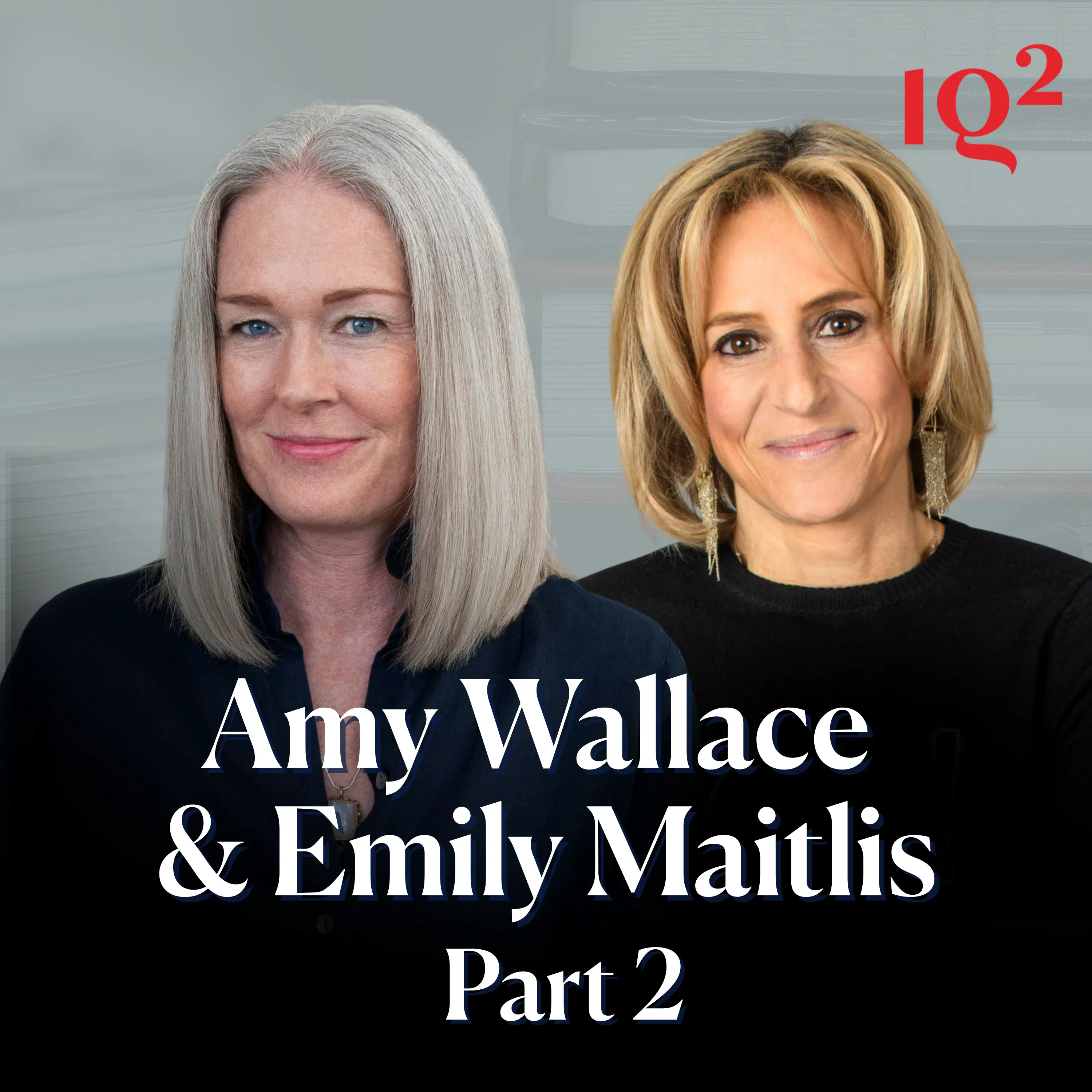
Intelligence Squared
Uncovering the Epstein Story, with Emily Maitlis and Amy Wallace (Part Two)
00:34:47
Loading summary
Transcript69 lines
- [00:00]
Amy Wallace
Hey, I just Venmo'd you for rent.
- [00:02]
Venmo Advertiser
Nice. Now I can instantly spend it whether I'm checking out online with Venmo or using a Venmo debit card.
- [00:08]
Amy Wallace
Say more.
- [00:09]
Mia Sorrenti
More.
- [00:09]
Venmo Advertiser
Exactly. Because the more you do with Venmo, the more you get. Like earning up to 5% cash. Back with Venmo Stash on a bundle of brands.
- [00:17]
Amy Wallace
So order more pizza.
- [00:18]
Venmo Advertiser
The math demands it.
- [00:20]
Amy Wallace
Get the Venmo debit card.
- [00:21]
Venmo Advertiser
Venmo stash bundle terms and exclusions apply. See terms at Venmo Me Stashterm. Venmo checkout not available at all merchants. Venmo MasterCard is issued by the Bancorp Bank. Na.
- [00:31]
Amy Wallace
I see you.
- [00:33]
Venmo Advertiser
Fire and Ash is now streaming on Disney. It's the film critics are calling the best avatar yet. A true epic and completely jaw dropping.
- [00:43]
Amy Wallace
This is the only pure thing in this world.
- [00:46]
Venmo Advertiser
Return to Pandora on Disney. It will be an adventure for the whole family. And watch the Oscar winning phenomenon at home.
- [00:52]
Amy Wallace
This is sick.
- [00:57]
Venmo Advertiser
Fire and Ash now streaming on Disney. Rated pd.
- [01:01]
Mia Sorrenti
Welcome to Intelligence Squared, where great minds meet. I'm senior producer Mia Sorrenti. In this episode, we return for part two of our live event with journalists Amy Wallace and Emily Maitlis. Wallace and Maitlis joined us recently at Conway hall to discuss the Jeffrey Epstein case, the life of Virginia Giuffre, and the ongoing fight for accountability. The conversation was hosted by journalist and broadcaster Emily Maitlis. If you haven't heard part one, we recommend jumping back an episode to catch up. A brief content warning. This episode contains discussions of sexual assault, suicide and trauma throughout. Now let's return to the conversation live at Conway Hall.
- [01:42]
Emily Maitlis
I was with another Epstein survivor this afternoon and it's quite interesting to put in context just what the 90s 2000s felt like, because we feel very connected now. You know, wherever you are in the world, you can probably, you know, check online or call an Uber or contact somebody. You've got your. Your emergency button in the palm of your hand the whole time. And she was explaining to me that when she was taken to West Palm beach, the ticket was booked, the car arrived, she didn't really see her passport. She had no idea where she'd ended up. She didn't even know what the calling code was to call out of America. And it strikes me, of course, that Virginia would have been in a very similar situation. The loneliness of those moments where you don't even know who the other people are that are going through this. You probably know that there are other victims, but you're not even able to reach out. Well.
- [02:52]
Amy Wallace
And they were really discouraged from talking to each other. They were very much discouraged from connecting if they were on the island together. They were very much discouraged from forming any friendships. And to your point, I mean, Ghislaine buys Virginia her first phone that she never had a phone, because Virginia takes a walk one day around New York. She's exploring New York City for the first time and loses track of time. And when she comes back to the mansion, they're really outraged at her. They're angry that she has been gone so long. And so Ghislaine gets her a phone so that they can keep her on the leash. Yeah, yeah.
- [03:38]
Emily Maitlis
And did they ever talk to each other? I mean, did they now, as you said, the term they use is survivor sisters. So trauma buddies, they understand each other's pain hugely. But at the time, they will have crossed over, whether it was in the mansion, whether it was on the island.
- [03:54]
Amy Wallace
No. I mean, there's like a really moving story in the book. Marika Chartuni is another victim survivor. And what happens after Epstein dies in however he dies, is that the judge. They could have just vacated the prosecution, the person they were going to prosecute is dead. But the judge, who is a former therapist, I think he was hip to how much the women had lost. So he says, we're going to have a hearing and let every survivor have their say about this, which they didn't have to do. And so many women flew in and were flown in, actually, by the federal government. I think that the DOJ paid for it. Different DOJ than we have now. And women met.
- [04:45]
Emily Maitlis
They'd be deporting them now.
- [04:47]
Amy Wallace
Yeah. So Mareika and Virginia meet, and everybody's. Mareike says, I'm trying to figure out who my. The woman who recruited me is. And she knew her first name and. And she remembered what she looked like. And Virginia said, I know who that is, and she gave her the last name. And so there was this constant piecing together of what was your experience? When were you there? Oh, I was there, but I wasn't there. You know, girls were coming in and out at different times. Even if you were abused around the same time as another person, you didn't necessarily know them. So there was this coming together that partly that hearing enabled, which is really moving and that I think that's really the beginning of the survivor sisters. Text chains, chat chain. They all communicate still on a single text string. Yeah.
- [05:50]
Emily Maitlis
So let's go back to the moment where Virginia realizes that as unbearable as her Life is. It's about to get even worse because Ghislaine and Jeffrey are planning for Virginia to have their baby. She's going to carry their baby but never hold it.
- [06:11]
Amy Wallace
Essentially, she's going to take care of it, but she's never going to. If they ever have a falling out, the baby will stay with them. They want her to be a nanny. They don't want to raise a baby. It's too much work. But it will not be her baby.
- [06:26]
Emily Maitlis
And so she. She runs. She finds a very clever way to just leave America.
- [06:36]
Amy Wallace
Well, what happens is she's not sure what to do. I mean, I find this very moving, that. And she says this in the book. She had an easier time. Her worry was, what if I have a girl and I'll be having a girl who will grow up to be abused by these people? And so she had an easier time sticking up for this hypothetical child than she had had sticking up for herself, which is very Virginia. Very Virginia. So what she says to them is, you know that first day when you procured me and you said you would help me learn how to be a massage therapist so that I could have a profession before I have this baby for you? Which she didn't want to do, but she knew she couldn't tell them no, before I do this, could I get that training like we discussed two years ago? And they say, okay, and she's expecting to be sent to, like, Long Island School of Massage or something. And Ghislaine says, we're sending you to Thailand. Now. Why are they doing that? Because there's a girl in Thailand they want her to procure. I don't know how they know about this girl, but they want her to procure her and bring her back for Jeffrey. But so she flees to Chiang Mai, Thailand, and at that point, she's far away from them and she's starting to feel like, oh, I don't have to wait by the phone. I can miss the call. And what are they going to do? They're not here to punish me. And she's starting to kind of develop some agency, but she still doesn't have any idea how she's going to. She doesn't really have any money. She doesn't have any visas to go anywhere. She's not sure what she's going to do. And she meets this man, six, seven years older than her, who's there from Australia, studying mixed martial arts, Muay Thai in Thailand, and they connect. And she pretty quickly tells him, which she was not easy for her but tells him what's going on and that she's working for this wealthy man who's trafficking her to his friends. And Robbie is like, well, you don't have to live like that. Come home with me.
- [08:55]
Emily Maitlis
So, I mean, was that. That marriage? Was that just an eject button? Do you think she fell in love with him, or do you think she just.
- [09:04]
Amy Wallace
I think she did fall in love with him, but I also think. I mean, clearly she was completely desperate. They get married while they're in Thailand. They get married, like a week after they decide that she's going to stay with him. And, you know, the book describes they had several really happy years. Because what happens is she flees. She calls Jeffrey and says, I'm getting married. I'm not coming back. And Jeffrey basically hangs up on her, says, have a good life, and hangs up on her. But then she flees. She has a different last name. She's in a whole different continent, and she doesn't think she's going to be able to have kids because of various problems that she'd had growing up, potentially related to all the abuse she'd suffered. But she gets pregnant and they have their first baby, and then they have their second baby, and they have absolutely no money, but they. She's learning how to be an adult, which she describes. You know, she really kind of was stuck as a young teen, even though at that point she's 19 years old and there she's not in the Epstein orbit, and she's not fighting Epstein either. She's not doing what she would later go on to do. And so she's kind of scooped out this liminal space. You know, that's just them making a family. And I think during those years, they were really happy.
- [10:31]
Emily Maitlis
And you say during those years because there are allegations, there's a lot of controversy about what happened later in her married life and whether he was an abuser, too.
- [10:45]
Amy Wallace
Yeah, I mean, in the preface I write about, she had told me about one incident in 2015 when they were living in Colorado near her family. Robby was really not happy for a lot of reasons. He's Australian. He didn't. He had trouble finding work in the United States. But also, she had already begun her campaign to try to take these guys down, which he supported. But it meant that they were hounded by paparazzi and, you know, they were getting death threats. They had three little kids at that point, and it was tense. And she told me that he had really hurt her one night, but that she didn't want to put it in because her kids, she didn't want. Her kids had been small and they didn't know about it, or at least she didn't think they did. And so we didn't put it in the book. And then in the months leading up to her death, she went public with that incident in People magazine. And she, at that point is in a custody battle with Robbie. They're splitting up. And in those months, right before she died, she called me, it was in January, and she was sobbing and she said, he just did it again. And so I write about that in the preface. There have been other allegations from other facets of her life that have been, have alleged that he was abusive. Much more than that. Virginia never told me that. I've talked to Robby about the 2015 incident, and he completely owned it and said it was horrible. And I vowed, you know, we've worked hard to get past it. So I don't know the truth of how extensive the abuse, how frequent it was. It happened definitely two times too many. But, you know, the statistics, and we put this in the preface, are if you've been sexually abused as a child or as a young person, your chances of being in a domestically violent relationship go way, way up. And that doesn't mean, that doesn't prove anything. But it just, you accept a lot more than perhaps someone who has a stronger sense of self worth would accept.
- [13:17]
Emily Maitlis
We've got a few minutes more before questions. I just want to bring us to the question of, I mean, this sounds so obvious, really, but justice and lawsuits and how America works, because we all know Epstein's crimes and we all know now the names of many of the other perpetrators. And yet it seems that the victims, the survivors, really couldn't use the criminal system at all. If they wanted anything done, they had to go through civil courts and litigation and basically settlements. I mean, that just seems so broken, Amy.
- [14:04]
Amy Wallace
I mean, it shouldn't have been that way. I mean, you know, Maria Farmer makes her first claim in 1996. It was just ignored. It was never followed up on. And this isn't just the Trump administration, obviously, it's 1996. So there are many administrations that didn't take this seriously.
- [14:25]
Emily Maitlis
So 1996 was a full decade before he's finally arrested in Palm Beach. And there is this whole mass of evidence from 36, nearly 40 girls and their families who come forward and they think they've got this watertight case, and then that just evaporates and it comes prosecute on one. So what do you think happened There, total corruption.
- [14:53]
Amy Wallace
A deal was made. I mean, he had a dream team of lawyers, including Alan Dershowitz, who kind of made a career of representing reprehensible people and winning. There was a lot of the stuff we've talked about already of damning the victims, saying they're drug addicts, they're prostitutes, all these. All these girls were prostitutes, and Jeffrey didn't know how old they were. They were prostitutes, which was not the case. So there was a lot of victim shaming.
- [15:29]
Emily Maitlis
I mean, they checked their abortion records and stuff like that, didn't they? Medical histories.
- [15:33]
Amy Wallace
Yes. And drug use. And, you know, the classic thing we know, just women who are raped and who come forward. It's a ghastly, often a ghastly experience to raise your hand and say, I was hurt, and then be put through the mill by the justice system.
- [15:51]
Emily Maitlis
But what you're saying is it was corruption because it was the powerful versus the powerless. You're not suggesting, which, I mean, there are so many theories now around Epstein that he was a useful asset, that he was connected to the government, that he had connections with foreign governments. Do you think there was a bigger top to that whole cobweb?
- [16:15]
Amy Wallace
I'm reading all of those things just as you are. I mean, it doesn't feel. I don't know is the honest answer, but it doesn't feel like it would be enough to just be a wealthy guy who paid off some of the Palm beach police, which I think there is evidence that he did that wasn't going to get you off. There's something else afoot. And was he. He was deemed. I mean, I think there is a document that says he was deemed a valuable asset. We just don't know what that meant for the US Government
- [16:53]
Emily Maitlis
because there were lawyers that were trying to get him prosecuted. They were trying to pull in his
- [16:59]
Amy Wallace
valiantly trying and pulling, hitting a wall,
- [17:02]
Emily Maitlis
the flight logs and all the rest of it.
- [17:03]
Amy Wallace
And then, you know, who among us has ever heard of a prison sentence where you serve it? First of all, it was short, way too short, but you serve it. But you get to leave every day. You get to go to your office where you're having young girls brought to that office. While he was serving his sentence for raping young girls, he was raping young girls. I mean, what is that? It kind of boggles the mind. And then what he does after he comes out is he tells everybody, you know, it was a trumped up charge and it was, these girls were prostitutes. And I didn't know how old they were. And see, I only got 18 months, I only served 13. And it's in my past. And he very successfully re entered New York society and had dinner parties.
- [17:54]
Emily Maitlis
British society.
- [17:55]
Amy Wallace
Yeah, you know, had dinner parties where famous people would come. And you know, he whitewashed that because. And again, when you were Talking about the 90s, I think we have to think back to before the MeToo movement. You know, we all know that the MeToo movement happened and then there was a backlash. But before the Me Too movement, there was a lot of disbelieving of women. There still is, of course, but it was not even. No one hesitated to just say, well, I don't. You know, these women, they just always make stuff up. And that was the milieu. And again, I think class plays a part. He's very rich. He was targeted. I see you.
- [18:45]
Venmo Advertiser
Fire and Ash is now streaming on Disney. It's the film critics are calling the best avatar yet. A true epic and completely jaw dropping.
- [18:56]
Amy Wallace
The only pure thing in this world.
- [18:58]
Venmo Advertiser
Return to Pandora on Disney. It will be an adventure for the whole family. And watch the Oscar winning phenomenon at home.
- [19:05]
Emily Maitlis
This is sick.
- [19:09]
Venmo Advertiser
Fire and Ash now streaming on Disney. Rated PG 13.
- [19:19]
Emily Maitlis
I mean, we've now seen who kind of came to his rescue, who re embraced him after that very short stint in prison, including, you know, recently released emails from Peter Mandelson saying, dear Jeffrey, it's a travesty. You know, I don't know how Sarah Ferguson and others, I mean, do you understand why he was rehabilitated given that the sentence was so pathetic? Quite frankly, if you'd looked in on that and said, well, it was only a year and it was an open prison and it was one count that they kind of deemed prostitution or soliciting.
- [20:01]
Amy Wallace
Right.
- [20:01]
Emily Maitlis
Do you understand why it was so easy for him to reintegrate? Or do you look at all the people who said they're actually refriending a man who is in prison?
- [20:15]
Amy Wallace
I mean, I think he could use the shortness of the sentences, say, see, it was nothing and it was unfair anyway. It wasn't deserved. So I think he used that for sure. But he was also an incredibly manipulative connector of people and he was very good. I heard somebody say this and I think it's really smart. If it was the president of Harvard, Larry Summers, who he could look at him and see that while he's super successful, he once served in commerce secretary of one of the administrations. But he had insecurities about his boring social life or he could size you
- [21:00]
Emily Maitlis
up about what he Knew your weakness.
- [21:02]
Amy Wallace
Yeah. What your vulnerabilities, what your yearnings. Just as he could do for a 14 year old girl who was damaged and had been told she was worthless. So he would say, I see something in you. He was just as good at all levels, whether it was Nobel Prize winning scientists you would think would be smart and wouldn't fall for it. But he had a way of just insinuating himself. And that's not to give an excuse for the people who took him back. But I do think he was a remarkably persuasive and manipulative person in terms of playing on your vulnerabilities.
- [21:44]
Emily Maitlis
And here we are in 2026, literally, what, 20 years after that original arrest. The names are now all in the files. Some places they're redacted, but many places they're not. Why has so little. You knew I was going to end on this. Why has so little happened? And do you think if you were a survivor now, you would have hope that there were going to be more prosecutions?
- [22:20]
Amy Wallace
Well, I mean, we have a little bit of a window into this from of all places, the Republican former congresswoman Marjorie Taylor Greene, who said that when she was trying to get the Epstein files released, she talked directly to President Trump and said, this is important. Why aren't you behind this? And he said, it will hurt my friends. So I was not on that call, so I can't vouch for it independently, but I think that's what's going on. These men are well known. They are very, very wealthy, most of them, not all. And from what the survivor sisters are telling me, they just are not even being interviewed. I mean, as far as they know, let alone prosecuted. I mean, you can't just prosecute somebody from a file. You have to, you have to investigate, you have to find out is there any corroborating information, can we prove this? I get that, but it seems that that is not happening. And in fact, Todd Blanche, the acting Attorney general, who's going to be confirmed or not confirmed on the 15th, I believe it is, of July, you know, he's basically said, nothing to see here. We're done. These Epstein files have taken up enough of the public discourse. We released half of them, even though we're supposed to release all of them. We're not going to. It's over. So. But is there any hope? The survivor sisters are hopeful about state prosecutions. You know, the DOJ is federal, is, and generally in the history of America has done some very valiant things around the civil rights movement. You know, DOJ was what came in. When the states wouldn't deal with the racism in their own backyard, the federal government came in and did it. So they were like the superheroes. Now, ironically, it's a flip side we have the federal government has no teeth, seems to be not doing a single thing to look into these crimes. But the states are starting to talk about it. In New Mexico, where Jeffrey had a huge ranch and he abused Annie Farmer there and many, many other girls, they've started a truth commission and they are subpoenaing people. And the hope is that you would have similar action in New York and Florida. I think hoping for it in Florida, given the leadership of Florida, is probably unlikely, but that's the hope, is that there are. There are possible state prosecutions that could bring some of these guys to justice. But we'll see.
- [24:58]
Emily Maitlis
Yeah, let's open it up to questions. I know it's boiling in here, but now we've got the lights up. Get the lady there in black top.
- [25:08]
Mia Sorrenti
So, Amy, I've heard. I'm not sure if it's true, but I've heard that. That Virginia had said that she was
- [25:16]
Amy Wallace
not suicidal before her suicide.
- [25:20]
Mia Sorrenti
And I heard that she was also hit by a bus a couple months back. Do you. Do you believe that she committed suicide
- [25:28]
Emily Maitlis
and do you fear for your life?
- [25:32]
Amy Wallace
I do believe that she committed suicide because sky, her brother, was there. He wasn't there at the moment she did it, but he was in Australia with her and he found her and he had to break the door down. So I do believe she committed suicide. And also, you know, she had talked to me a lot about wanting to be dead. That the voice, and she describes it in the book, the voice that comes up and says, the world would be a better place without you in it. So, yes, I believe that she committed suicide tragically. I mean, she'd always been so resilient, and it was heartbreaking in terms of fearing for my own physical safety. I've been careful. I was most worried, really, in the gap between when they announced the book and published the book. It was about six to eight weeks, I think. And that was the time I felt most vulnerable because I thought if I were a guy that had. You didn't know, I would want to know if I had raped Virginia. I would want to know if my name was in the book. And those guys know who they are. And she's accused some of them very publicly in the past. And so I'd want to know if she dared to defy us, because one of them had actually said to her, take my name out of your mouth, or I will keep you in court for the rest of your life. And he had enough money to make good on that threat. So I was worried they were going to break into our house and try to get my laptop or my notes or my tapes of Virginia talking. So I did a whole cleanse of my computer systems. I took everything off. I put them on hard drives, I put them in safe places, and then I went. When we started publicizing the book, I would say to the camera, or I'd say to Piers Morgan, don't break into my house. Like, I just kept saying, the files are not there. Piers Morgan and others were obsessed that I had tapes of Virginia naming these guys, and they wanted them. And I was like, well, you're not getting them, and you can't find them. I don't think there's anything to be gained at this point by hurting me. You know, the cow is out of the barn, the book is out, and it's doing what it's doing. And the movement now is the people who are still alive and can push it down, push the ball down the field. But I'm careful. I know how. There's one particular person, the former prime minister in the book, who almost kills her. And I did a podcast at one point, and at the end, they turned the mic off, and they said. The guy said, I know who the prime minister is. And I said, well, I'm not going to confirm or deny. And he named the person, and he said, that guy could have you killed for $1,000. So these are who she was dealing with. And so I'm aware. I'm aware of that.
- [28:44]
Emily Maitlis
You've got the mic. Yeah.
- [28:46]
Amy Wallace
So I think my question is slightly to the both of you, but I'm just wondering, both as a journalist and as a writer, what is it like sitting on such a big story before the public knows? Yeah. What kind of societal things do you think about? Do you have, like, a very dark outlook on society, or what is it like sitting on something this big before it comes out? You know, it's funny, I didn't ever really. We were working in secret, and, you know, people didn't know until, as I just said, six to eight weeks before the book came out. But in a way, a lot of what she said, not all had come out in news stories. In some ways, I think part of the power of the book is the entire chronology put in order and also thus being able to understand what happened, what caused what. So Much of it was breaking news stories which is I used to be a newspaper reporter and that's what you do, you write news items. But this is the whole continuum. And then you get to see oh me too happens and then that changes the way the New York Daily News treats her because they used to call her a whore. In print you can see kind of the societal forces working and that helps you understand the whole story. But I never felt like I was sitting on like something that could have changed the world but we were not publishing it yet. I didn't have any idea how much of an impact that book was going to have.
- [30:19]
Emily Maitlis
I guess briefly I'm working on an Epstein documentary at the moment and if I'm honest it makes you quite obsessive. So you just want to talk to everyone about it the whole time and you meet people randomly and you start asking them if they can feel fill in the gaps for you even though they're nothing to do with the story. So I've actually stopped being invited to things now because people just really scared that I'll turn up and start interrogating their guests. And I can sort of see it on the hosts faces where they're just like can I take you over here? Because they sort of want to shut down the conversation. So that's a little bit of it. I think as a journalist you are really aware, I mean I said that I was talking to one survivor this evening and Amy and I have talked about this before. We made a pact in our team that we didn't want to make women re traumatized every time you are trying to explain the circumstance of their story. And so actually I think my documentary will have very few details of the abuse in it because we've got to a place where I don't feel I need to ask the women to go through what they've been through. Again for me and an audience I'm going to say we believe you. We've taken that as read. We want to give you agency and we want your role in this film and in this series to be something that is helpful to you to the next stage to the retelling and and rebuilding of your life and other survivors lives. I don't need to make people go through it and feel shit all over again. So that's sort of become a weirdly a sort of mantra for me. Doesn't always work because actually sometimes even when you're talking about the emotional side of it, the emotional side of abuse is actually just as powerful and just as painful as trying to describe anything physical. So, you know, hasn't always worked. But that has been sort of in my head a little bit as I cover it. Well, we're just going to say thank you. A huge thank you.
- [32:30]
Amy Wallace
Yes, thank you for being here.
- [32:32]
Emily Maitlis
Huge thank you to you all for coming. And the book is available on sale and Amy will be staying to sign. Thanks all very much indeed. Thank you. Thanks, Amy.
- [32:42]
Mia Sorrenti
Thanks for listening to Intelligence Squared. This episode was produced by Ginny Hooker and it was edited by Mark Roberts. For ad free episodes and full length recordings, you can become a member@intelligencesquared.com membership. And if you'd like to join us at future live events, you can find our full program and buy tickets over@intelligencesquared.com attend. You've been listening to Intelligence Squared. Thanks for joining us.