← Intelligence Squared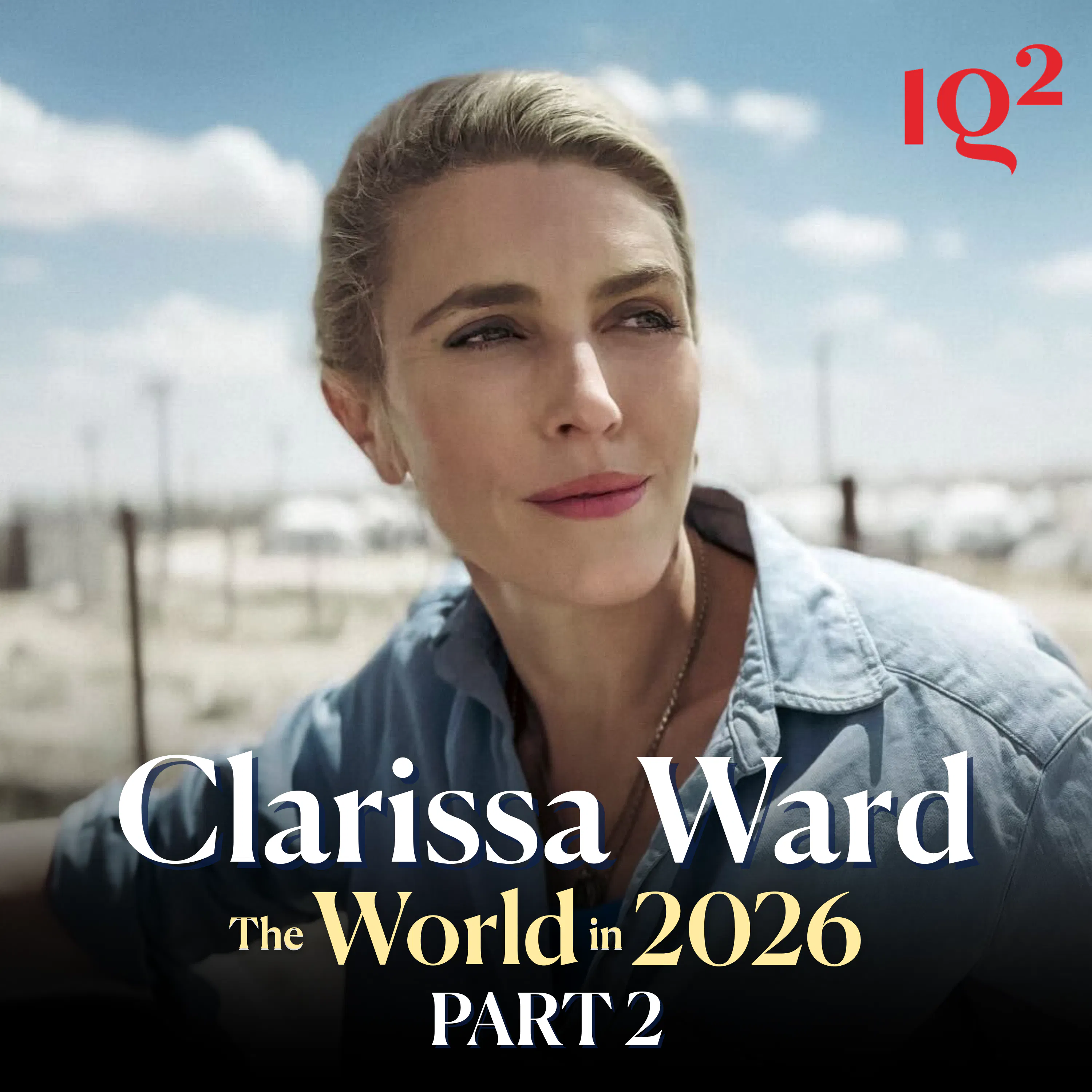
Intelligence Squared
What Everyone Gets Wrong About Iran, with Clarissa Ward and Lyse Doucet (Part Two)
00:41:24
Loading summary
Transcript123 lines
- [00:01]
Commercial Announcer
This episode is brought to you by Google Chrome. You think you know a browser, but Gemini and Chrome, that's new. It can help you with practically anything on the web, like restoring a vintage motorcycle from a 50 page restoration block. Or finally break down that long article you've had open for weeks. Gemini and Chrome is here for it, ready to make anything online make sense. There's no place like Chrome. Check responses set up, required compatibility and availability. Various 18.
- [00:27]
Clarissa Ward
This episode is brought to you by Facebook. So you were scrolling on Marketplace and there it was, the bike you'd been searching for. You sent a message and it turned out the seller was super chatty, kind of funny and an avid cyclist. The next thing you know, you're in a cycling crew. Well, a community cycling group. The thing about Facebook, you might find more than what you're looking for, from a browse to a bike ride this summer. Find more on Facebook.
- [00:56]
Mia Sorrenti
Welcome to Intelligence Square, where great minds meet. I'm senior producer Mia Sorrenti. In this episode we return for part two of our recent live event with CNN's chief international correspondent, Clarissa Ward. Ward joined us recently at Conway hall to discuss the human cost of war and a rapidly changing world order. She was in conversation with BBC Chief international correspondent Lee Soussette. If you haven't heard part one, we recommend jumping back an episode to catch up. But now let's return the conversation live at Conway Hall.
- [01:27]
Lee Soussette
If we just rise up a bit above, above the specifics of this war. One of the last times we worked together was in Afghanistan, which was another war that was a debacle for the United States. How many people in the audience are American passport holders? Just so we don't. We want to. Yeah. Okay. Number of you people are now looking at this Clarissa on a broader thing to be, to be blunt about. They say another war that the great American military has lost. They lost this war. They didn't win it, but they won it tactically, but not strategically. They lost the war in Afghanistan. Mistakes were made across. Then they're going back to Vietnam. You're working for a global channel, but it's also known as an American channel.
- [02:15]
Clarissa Ward
Yes.
- [02:15]
Lee Soussette
Does this cause you to reflect about America's place in the world now? Like when you travel, what people say, I know you're American, British and many others.
- [02:26]
Audience Member
No, no, no, no.
- [02:27]
Clarissa Ward
Look, I became a journalist literally at almost one week before the US Invasion of Iraq. So if ever there was a time for 2003. In the 2003. Yeah. So if ever there was a time for soul searching as an American and trying to understand better our actions in the world, the way we saw our own actions in the world, the way the world saw our own actions. And this was coming after 9, 11, which was the very reason I became a journalist. So I feel like we have been through a pretty brutal and intense cycle of pretty much back to back wars with a few little interludes there. And at the same time, I'm also old enough to remember the Obama presidency, which while there were a huge number of drone strikes, there was less military intervention. And that brought its own issues with it as well, which is not to be like an apologist for America at all, but rather to say that I think the idea that this Goldilocks sweet spot of how much force to use versus not to use is a really difficult spot to find. And it is interesting to me that President Trump, after again running on this platform of wanting to end these wars and not have any more of these wars, has somehow felt himself pulled back in. And perhaps it was because of something that we haven't mentioned yet, which was Venezuela, which is how this insane year began, 2026. Thank you very much. I think there was something intoxicating because I think he thought he'd found the Goldilocks sweet spot, right?
- [04:37]
Lee Soussette
The Delsey Rodriguez, Del C. Rodriguez.
- [04:40]
Clarissa Ward
Like, you send in your special ops guys, you get rid of Maduro and his wife, you co opt, you know, the Chavistas like Delsey Rodriguez, and you basically have yourself a client state and everyone's a winner in his mind. And I think honestly he thought that they were going to be able to pull off something similar with Iran, which belies a staggering lack of humility because as you know better than I do, if you spend some time in Iran and understand a little bit about the way the power structures work there, particularly with the irgc, particularly after the lessons learned because they had a dress rehearsal last year and I think they were able to decentralize like remarkably effectively.
- [05:32]
Lee Soussette
And it's a sort of, it's a measure in the United States of how the State Department has been hollowed out. And when you do diplomacy without diplomats, remember when President Trump started his second term, he says, oh, the State Department, they have these diplomat, you know, the rivers and the mountains and. But I have, I have my envoys and they know how to do a deal and I'm going to. And in Iran, they used to talk about Steve Witkoff, his golf buddy and property dealer. And they'd say he didn't even take notes. He'd show up at the meetings, whether in Geneva or Muscat, he'd sit down there on his own. Often never with. Only once with the nuclear expert. He wouldn't take any notes. He'd go back to Washington and then he'd come again and they'd have to start from completely from zero again because nobody took any notes in Washington. So it is a measure. It is a measure of this moment. And of course, don't you love the way she says, I'm old enough to remember. People use that when they're talking about the Second World War. And Clarissa's talking about, like, what happened with the 2022 full scale invasion of Ukraine. But anyway, hashtag, just, just teasing. But let's go back to. We'd be remiss not to discuss Ukraine, which is sadly the other major war of our time. And I'll remember. Let's go back to the beginning that evening where Russian forces had just, they just done this. Major warplanes were in the sky. There was explosions all around Kyiv. A huge serpentine column of armor was heading toward the capital. And everyone thought, it'll be over in three days. And I remember you called me, it was about 2 in the morning, you called me. Lindsay Addario called me and we said, and this would show you a measure, even though on paper our editors would say, don't work together, your competitors. We did talk to each other and it was mainly women. We said, what are you going to do? Do you think it's safe enough to stay? And we did the other night. And I said to my colleagues, I'm talking to Clarissa of cnn, I'm talking to Lindsey Addario. I did talk to Mark Austin of Sky and they said, oh, Lise, that's just because they want to make sure if you're staying, you know they're gonna stay too. And I said, no, I think it is. I think there's a camaraderie, especially when comes to security.
- [07:48]
Clarissa Ward
We have to stick together 100%. 100.
- [07:52]
Lee Soussette
And also you want to make an assessment of, Assessment of the risks.
- [07:55]
Clarissa Ward
Yeah, yeah.
- [07:56]
Lee Soussette
And that was such a. I mean, the decision to stay was, in retrospect, for both of us. It was, it was, we're glad we stayed. It was really important to be there on the ground.
- [08:07]
Clarissa Ward
It's also, it's so hard because now everyone's like, oh, yeah, of course you stayed. But like, it was really scary. Like it wasn't a given that anyone was going to stay. And there was actually quite a bit of pressure to pull out or at least to pull a little bit out, which some did. Which a lot of people did. Most people did. We went down to two teams, basically, and no one had any idea what the Russians were going to do and what they were going to hit. And people running around talking about thermobaric weapons and Danish security sources. And again, there's a lot of panic and misinformation that spreads. So it's incredibly helpful to have a network of people who you've been working alongside in the field for 20 years who, you know, have a really good read on any given situation. And also, I mean, maybe it's, like, sort of naive, but I'm always like, if Lise is there and Lindsey is there, then we're not gonna die.
- [09:08]
Audience Member
Yes, yes.
- [09:08]
Lee Soussette
We can't all die. I once had a producer and we used to take these dodgy aircraft in Afghanistan. And she. She said, well, Lise, I know you're not going to die, so I'm okay. But you're going to go. Yeah. But it's interesting because this is a question, I think whenever foreign correspondents go out on these assignments, one of the questions which always comes up is, are you scared? And why did you decide to stay? And I always say, and I'll be interested to hear what you say is that it's not a reckless decision. So I went to our security advisor when it's really, really dangerous, and you do have a security advisor, and that was the case is you go and you say, okay, how much water do we have? We have enough for three weeks. How much food do we have? How much store stocks do we have? We have enough for three weeks. How far are the Russians? Well, we think they're 10 days away. So we can wait to make our decision? Yes. Do we have a road out? Yes, we have a road out. So it's based on an assessment of the risk. It's not as simply of, oh, I'm going to be looking so brave on tv. No, but it's. Yes, you have to decide you want to stay there because it's important history and it matters, but you also want to survive.
- [10:14]
Clarissa Ward
You absolutely want to survive. And you're. Again, this is why I always loved television. And I felt like print would be so isolated because I love that we'll have a team and we're there like,
- [10:26]
Lee Soussette
okay, and your team, you're with a lot?
- [10:27]
Clarissa Ward
Yeah, we're with, like, three people, maybe four if there's a security consultant. And we're, like, filling up the bathtub with water so that we know if there's not going to be any water for a few days that we can get by. And buying lots of tuna fish and sleeping bags and talking to the hotel about generators. And there's a huge amount of thought and preparation that goes into any kind of a high risk assignment, but let alone preparing for a Russian invasion. And I just, I still can't believe that that was now more than four years ago and that we're still in a situation. Just two days ago, beautiful monastery in Kyiv got hit, or right next to it hit by a missile. And there's no let up. There's no real sense of progress. There's no real sense of anyone having won anything from this. And, you know, I found it really interesting when I was there in March and because everyone talks, rightly so, about like the extraordinary resilience of the Ukrainian people, but I decided this trip that I really wanted to focus on spending a lot of time with women and understanding their perspectives. Because these women, many of them are alone. Their husbands are either fighting or they have been killed. And they are. They're trying to raise a family and work a job. And I found people who were quite matter of fact about how broken they are and how exhausted they are and how they never want to hear the word resilient again. They're so over being told how amazing they are. They're like, stop telling us how amazing we are and maybe start helping us. And on my way out of Ukraine, I bumped into this very brilliant French war correspondent who I won't mention, who's very talented but very French. And a man.
- [12:27]
Lee Soussette
Male or female? And man, yes.
- [12:30]
Clarissa Ward
And I'm like checking into the hotel and I'm literally. I look like Methuselah. I haven't washed in two days because it's a very long drive to get out of Ukraine. So I was feeling a little cranky. And he was like, oh, no, the Ukraine, I just got back. They're totally resilient, they're totally fine. I was like, oh, really? I was like, I actually felt this time there's a big shift and. No, no, no, they're fine, they're fine, they're fine. And I was like, I'm just curious, like, did you spend a lot of time with women while you were in Ukraine? Because you kind of sound like a dude right now, talking from a very dude centric perspective. And he did actually get flummoxed. He's like, well, I try to, but, you know, blah, blah, blah. And I'm like, yeah, thank you, thank you. That's enough.
- [13:19]
Lee Soussette
Do you think there's another question that especially female journalists get asked to cover war? Just building on that comment, do you think women in war cover war differently? Women and men cover war differently? Yeah, because I don't have a gendered view of it. But do you?
- [13:34]
Clarissa Ward
I definitely think we cover it differently. First of all, I think, you know, it's like that quote about, like, Fred and Ginger where, like, she had to do everything. I'm talking about Fred Astaire and Ginger Rogers. She had to do everything that Fred did, but with, like, backwards and in heels, right? So it's like, if you're going to be a female war correspondent, I mean, maybe it's a little different now, but certainly when you started out, and even when I started out, like, you had to be able to do all the stuff that men could do, right? All the, you know, having a decent understanding of, like, military strategy and history and all, and like, all the good, important stuff. But then it was like. I mean, it started out, I think, partly because places like Afghanistan, as you well know, like my male colleagues can't talk to women there for the most part, whereas I spend a lot of time with women there because there's enforced gender segregation. And that absolutely affects how you cover a war. If you're sitting with women and children, it doesn't mean that men aren't great at covering war. Of course they are. And I don't think one needs to be overly gendered about it. But there is no question that if you're a woman and you're sitting with the women and children all day and talking to them, like, you're going to be absorbing their perspectives, their perceptions, and it's going to give a different flavor to your reporting. I'm sure
- [15:01]
Lee Soussette
it is interesting, though, that you remember the great Martha Gellhorn, who was one of the women who were covering the Second World War where it was illegal for women to go to the front, and she had that great scoop where she, her ex husband Hemingway, tried to took her permit for the magazine that they were both working for, and she got to the front by hiding in a toilet and got to the beaches before. Smug, right? Yeah, Revenge. Revenge is. But she did have to say, war happens to people one by one. And in that day, the women were always told to cover the human stories, to do the hospital, to do the volunteers. But I would wager that now, I think in our time, we've understood that what we really do need to focus on in war is not just the bombs and the bullets, but it is the human cost of war. And that is not just a side story. That is the main story.
- [15:51]
Clarissa Ward
Yeah, I could not agree more. And I'm very like, that is my primary compulsion to cover war. I want to. I end up in dangerous places because I want to get to the civilians who are living through these extraordinary and horrific experiences. And so that's how I end up in those places. It's not because I want to feel the excitement of being under heavy bombardment or in a gunfight or anything like that. Like that for me is the most important part of it. And it's, you know, it's still to this day, I'll go to a conference then afterwards, after covering a conflict with like masters of the universe types and you start talking about like people and what you've seen. And it makes people uncomfortable because from a policy perspective, they just want to deal with who are these guys and who are those guys and what sector they part of or who are they loyal to and how will that shake out and what happens. And I understand, like when you're talking about policy there, you know, you do need to be a little dispassionate sometimes. And there is obviously this, you know, rail politic that comes into it, but I am always flummoxed by how difficult people find it. It's like considered to be like mawkish or twee or like emotional to sort of to talk about that stuff. And I think that's unfortunate. I just keep making people feel really uncomfortable and continuing to talk about it.
- [17:30]
Lee Soussette
I think the best of leaders are cognizant, you know, that's in the end what it's all about. Before I turn over to your excellent questions, just I want to ask you that you really distinguish yourself, Clarissa, because not only are you very good at television, but you're also now very good at social media and Instagram. And this is the kind of getting away in which, you know, our journalism is changing. Some of you may know there's been big announcements at the BBC today about, we have done, we're having to make a lot of cuts. But it's also a measure of not just what cost cutting, it's also because, you know, digital first people are going to social media. So we're being asked to do so small, you know, 67, 90 second posts for Instagram, for Facebook, whatever. And you do it in a particular way, Clarissa. You get there, no makeup, your hair tousled. What do you sense about your audiences, that you're doing it as a journalist and what is your Thinking, because it's all about. You have to go to where your audiences are. So what is your thinking and how you approach it?
- [18:38]
Clarissa Ward
I mean, I think that one of the more exciting things about social media is like we can be ourselves and be journalists at the same time, but
- [18:46]
Lee Soussette
not everyone is doing it that way.
- [18:48]
Clarissa Ward
No. And that's. I mean, I would be the last person to tell people that they need to be doing X, Y or Z. But for me, I actually find it really refreshing after so many years of working in an industry where you kind of need to look a certain way and talk a certain way and be a certain way and dress a certain way and to be in my pajamas and just being me and still being a journalist and talking about things that are usually pertaining to something journalism related, although not always, but usually. And I feel like people are kind of craving that from institutions like cnn, like BBC, where we have really tried to keep that at arm's length because there's something about it that makes us feel uncomfortable because it can't be controlled in quite the same way. It's not sanitized, it's a bit more transparent, it's a bit more authentic. And so for me, I find that tremendously, kind of liberating actually. And just to be able to talk to audiences directly and to be able to talk about a story that is probably not gonna be even maybe on the news that day. And that's fine. I'm not gonna go and try and badger my editors and to putting it on. But now I know that I can just go and talk about it online and you know, hopefully a few people will watch. At least my mother.
- [20:28]
Lee Soussette
Make a note. Go out and buy new pajamas tomorrow. Yeah,
- [20:38]
Clarissa Ward
Hey, it's Ryan Reynolds here for Mint Mobile. Now I was looking for fun ways to tell you that Mint's offer of unlimited Premium Wireless for $15 a month back. So I thought it would be fun if we made $15 bills, but it turns out that's very illegal. So there goes my big idea for the commercial. Give it a try@mintmobile.com Switch upfront payment
- [20:59]
Lee Soussette
of $45 for three months, $90 for six months or $180 for a 12 month plan. Required $15 per month equivalent taxes and fees. Extra initial plan term only greater than 50 gigabytes. Me slow when network is busy.
- [21:07]
Clarissa Ward
See terms Traditional home security only alerts you after a break in. And that's too late.
- [21:13]
Lee Soussette
Simplisafe is changing that.
- [21:15]
Audience Member
Stop.
- [21:15]
Clarissa Ward
This is Simplisafe.
- [21:16]
Lee Soussette
Police are on the way.
- [21:18]
Clarissa Ward
We don't just alert, we stop crime before it starts. SimpliSafe plans starting around a dollar a day, save 50% on your new system
- [21:25]
Lee Soussette
with professional monitoring at SimpliSafe.com Spotify or with promo code Spotify Outdoor Deterrence requires a SimpliSafe Active Guard Outdoor Protection Plan
- [21:33]
Clarissa Ward
starting at $49.99 a month. Visit SimpliSafe.com licenses for alarm license information.
- [21:36]
Commercial Announcer
Tennessee, 2012 IBM a name synonymous with innovation for over 100 years. From typewriters to Barco ATMs to PCs, we helped reach the moon. And we were in the AI game before it was cool. IBM has continually reinvented itself to do what it does best, solving the biggest challenges of the day through technology. Right now, we're putting hybrid, cloud and AI at the core of everything we do. We are champions of openness, infusing the greatest innovations from the community. We are pioneering responsible AI, leading governance, and partnering with other institutions to advocate AI ethics. We're helping solve some of the biggest problems facing humanity, from climate change and sustainability to development and human rights in the future. Our global network of research scientists continues to be at the cutting edge of innovation. Whether it's in semiconductors or quantum computer computing, we're shaping the future one breakthrough at a time.
- [22:48]
Lee Soussette
I think we can put the lights up if people want to put up their hands. And unless they're hiding from their partner, you can say your name and who you are. There's two in the front.
- [22:57]
Clarissa Ward
Kamal Qureshi, my name. And I have a question for both of you. Just wanted to say it's a real pleasure to see Las Dusay in person for the first time. India seen over decades in BBC. So with all that you both have seen representing such fine institutions, the question is. My question is, do you wish that the UN was more powerful than it
- [23:19]
Lee Soussette
is, that the United Nations.
- [23:22]
Clarissa Ward
Oh, the United nations was more powerful. Oh, no. But I also don't wish for the UN to be abolished at all. I see that the UN does an extraordinary amount of vital work and gets very little credit for it. And it's become increasingly in vogue to trash the UN and berate them. But at the same time, I can also see quite clearly cases where the bureaucracy of it and the inefficiency of it often and sometimes just the impossibility of it, is such that even with more power, I mean, there are so many inherent complexities that I don't think make it the magic bullet. I don't know if you feel that way.
- [24:22]
Lee Soussette
I do think the shape of the world has changed. The political map of the world has changed dramatically since post1945. And I think everyone talks about reform. And if we had a reformed UN Security Council which represented the shape of the world, represented all regions of the world, that would be in a better place. And I think we do need a top table somewhere that on some issues the world should be able to come together, particularly when it comes to saving lives. And yes, I agree that there's a lot of bureaucracy, they need to cost cut, they need to even get rid of whole agencies within the UN but if they were leaner, you get some really inspiring UN chiefs, Tom Fletcher, Dr. Tedros, and they should be allowed to do their job, to lead the international community in vital life saving work. So we need the un but we need a UN which is fit for purpose.
- [25:18]
Audience Member
Right.
- [25:19]
Lee Soussette
Thank you.
- [25:19]
Clarissa Ward
Thank you.
- [25:20]
Lee Soussette
Thank you.
- [25:23]
Audience Member
Good evening. Thank you so much. Sarah Scott. I was living in the U.S. between 2018 and 2020.
- [25:31]
Lee Soussette
Where were you living?
- [25:32]
Audience Member
U.S. houston. And was very interested to see the way Donald Trump became incredibly powerful. And at that point he was batting around the term fake news. And it appeared that he used it when really to bat away inconvenient truths. And so he didn't have to learn so much or know so much because when he was questioned about anything, he just batted it away as fake news rather than give a serious answer. In recent years, it's become obvious that he's using it to cover all sorts of things. Questions about his share dealing questions about potential war crimes. It's fake news and it's really impacted the way you divided the US and the way they see and believe things. And what I'd like to know is if you think that truth telling can be maintained in the face of being accused of being fake news. And whether the mainstream or lamestream media, as he likes to call it, mainstream, he calls them mainstream media. Whether you will ever retain that pinnacle of respect that you used to have,
- [26:48]
Clarissa Ward
I think on that one, probably not. In terms of like, can we go back to the glory days where 100 million Americans would tune into one of the three network broadcasts every night at 6:30 and be told by a middle aged white man everything that was happening in The World in 21 Minutes with two beefy commercial breaks like that's over. That ship has sailed. We're never going back to that. And I don't think we can actually lay that entirely at the feet of some of the rhetoric from President Trump and the fake news. I mean, there's a lot going On, I think that's social media has completely changed the way people consume information. I think that AI is only exacerbating that. And so I just think we are entering into a completely different information era. And I do think that institutions will survive, and I do think that people will have an increasingly strong sense of the desperate need for those institutions, and particularly in the face of just like so much AI slop and so much misinformation. And you have to have organizations that can still be out on the ground doing the reporting, bearing witness, holding people accountable. I also think that we need to have a reckoning within ourselves about where we have not met the moment, where we have not stepped up to the plate, where we have been victims of our own groupthink, and particularly where it comes to understanding the election of President Trump or even the invasion of Ukraine, these seismic moments that most journalists really did not see coming, because we are also living in bubbles to a certain extent. So the long and the short of it is it's a very different age that is upon us now. I still fundamentally, deeply believe in the mission of journalism, and I believe that it's a fundamental pillar of any thriving democracy.
- [29:24]
Lee Soussette
So, yeah, we can't give up the fight. If we give up the fight for independent journalists, we give up the fight for the kind of democratic society and the values that all of us here, I think, hold here and want to live in.
- [29:36]
Clarissa Ward
By the way, every single president has hated the press, okay? Every single president. We're a pain in their asses, okay? All we do is bitch and look for the worst, dirtiest, darkest, stupidest thing they've done every single day and dig, dig, dig, dig, dig. Until we. No president of the United States has
- [29:56]
Lee Soussette
ever liked the press but Trump. Is Trump digging.
- [30:00]
Clarissa Ward
But most, at least, yes.
- [30:03]
Lee Soussette
Okay, let's take two questions.
- [30:04]
Audience Member
Just as I've got the microphone here.
- [30:06]
Clarissa Ward
Yeah.
- [30:07]
Lee Soussette
Who's. Oh, my goodness. We can't have people dominating from one side of the room.
- [30:10]
Audience Member
I just say we mustn't dominate this corner.
- [30:12]
Lee Soussette
Yes, yes, but you just did.
- [30:15]
Audience Member
Okay, Martin, Luan, I'd just like to say that we all are damn privileged that we've got two of the finest and most.
- [30:22]
Lee Soussette
Oh, you're so kind.
- [30:24]
Audience Member
And there's hardly a week that I don't see either of them on the screen, television screen. And to see Clarissa in her equipment in DRC recently was fantastic. But if you haven't read either of their books, do so reads both of them.
- [30:42]
Clarissa Ward
It's my PR age.
- [30:43]
Audience Member
Two questions.
- [30:43]
Clarissa Ward
Thank you.
- [30:44]
Audience Member
One, this is the World in 2006 up there. We're only halfway through it. There's two. One is on the present war in Iran and the other one's on Ukraine. We're all reading a lot about the potential. And I use that because it's in the MOU300 million reconstruction and economic Development Fund that might be forthcoming with Trump very clearly saying, I'm not putting any money in it. Could one of you possibly comment on that? How focused is it going to be? Let's pray it's not going to be this fake peace plan fund that came out in Gaza. But it's a totally different question. Will corporates, will there be barter trades to it or whatever. But that is the next phase of 2026 that we need to know more about it. And then on the Ukraine front, with the attention hopefully being taken away from the Middle east situation, is Trump going to come to the table and enhance the sanctions situation for the Ukraine and try to get away from this deadlock area?
- [31:57]
Lee Soussette
Okay, so just hold that question. I'm just going to take one more from the other side of the room lest we be accused of being biased or tilting to the right or the left.
- [32:05]
Audience Member
Hi, good evening. Smyena Lotmani, thank you so much for your analysis today. It has been a dramatic year, as you mentioned, from Venezuela to Epsteinfile to the war to everything that you mentioned. Who you know, Trump's Trump. And you know who? I like you. I don't like you. I like your wife. I don't like your wife. You know, we've had that with Macron. What else up to. Well, the gcc, the Gulf countries and Albania recently. With your analysis, what is the actual end game?
- [32:50]
Lee Soussette
You know, which one for on the Iran front or on. On the world?
- [32:55]
Audience Member
On the overall, really.
- [32:57]
Clarissa Ward
Is there something.
- [32:58]
Lee Soussette
The end will all be dead. But. But other than that. Okay, we'll have a think about that one. Okay.
- [33:03]
Audience Member
It feels like there's something bigger that is brewing while we're being kept busy with all those.
- [33:09]
Clarissa Ward
Those events.
- [33:10]
Lee Soussette
Okay. Okay. Okay. Microphone to the person next. You will get two from that side, too.
- [33:15]
Clarissa Ward
Okay.
- [33:15]
Lee Soussette
Okay. Are you keeping track of the right there in the same row? Yep.
- [33:19]
Clarissa Ward
I feel like I had gummy now. I'm like, wait, okay.
- [33:22]
Lee Soussette
And then we're gonna come to the center. We're gonna get the center ground.
- [33:24]
Mia Sorrenti
Okay. Hi. I will keep this short and sweet, but I saw Amy Goodman from Democracy now speaking last week about Steal this Story Please, her new documentary, and she spoke about wanting people to steal her
- [33:37]
Lee Soussette
stories and when you spoke, wanting to steal.
- [33:39]
Clarissa Ward
Wanting people to steal your stories as a journalist.
- [33:42]
Mia Sorrenti
Yep. And so as you talk about editors not wanting to collaborate, but ultimately seeking that out, especially amongst women, I just wondered if you could speak to how you think collaboration amongst journalists is going to become more or less prevalent as we continue in this sort of state of omnicrisis.
- [34:01]
Clarissa Ward
I feel like. Okay, so we've got four questions here. The 300 million I'm hearing the Gulf states are being asked to pony up for that.
- [34:09]
Lee Soussette
It's about half funded. Trump calls it the Gulf Coast. He's kind of. He means that. I mean, some of the Persian Gulf neighbors are reluctant because obviously, understandably, attacked by Iran during this pretty big ask. The stability of the region and the stability of reconstruction of Iran is in. Is in there, is in their interest. And also President Trump and certainly the hawks around him say no money, no cash from the US and that is. That is empirically true. It is Iran's money. It's frozen. It's frozen.
- [34:39]
Clarissa Ward
But this was like the same game that they. Obama administration as well.
- [34:44]
Lee Soussette
So the Iranians are getting quite a lot, actually. More than.
- [34:46]
Clarissa Ward
It's a good deal.
- [34:47]
Lee Soussette
Yeah, it's a very good deal for them.
- [34:49]
Clarissa Ward
On Ukraine,
- [34:52]
Lee Soussette
the frozen assets from oil
- [34:54]
Clarissa Ward
sales and yeah, on Ukraine, I don't see any indication that President Trump is going to be overly involving himself in. I mean, didn't he just said yesterday on the plane, he's like, we sell them weapons. That's it.
- [35:12]
Lee Soussette
He's kind of given up because he's realized how hard it is to do peace and peace.
- [35:15]
Clarissa Ward
I think he just realized. And also, like, he sent his guys to Moscow a few times and it like, you cannot send a neophyte to deal with President Putin. Like, you need to, like, bring back Bill Burns for that conversation. So I just think it's. Yeah.
- [35:33]
Lee Soussette
Former head of the CIA. Yeah, yeah.
- [35:34]
Clarissa Ward
And before that, Russian speaker. Yeah, yeah. I'm gonna let you answer the one, but on the journalism and collaboration thing, I think, Yeah, I think the future you're gonna see a lot of what I would call, like, storytelling collectives. That's my instinct as to the direction of travel. People now tend to trust individuals more than they do organizations. There will be obviously some organizations like the BBC, like the New York Times, hopefully like cnn, that will remain. But I think you'll also see lots of, like, ad hoc, what I would call storytelling collectives.
- [36:15]
Lee Soussette
Yeah, I mean, some journalists cooperate and some journalists don't. Journalists come in all shapes and sizes. Some journalists feel their Editors and their readers or audiences want them to get the scoop. I have to say, it irritates me that when people are dying, journalists put this in capital letters scoop. And I think, for God's sake.
- [36:36]
Clarissa Ward
Exclusive.
- [36:37]
Lee Soussette
Yeah, exclusive.
- [36:37]
Clarissa Ward
Can we call it an exclusive?
- [36:38]
Lee Soussette
World exclusive. Please stop it is journalism. That's what journalism is about. It's about getting the story. It's the thrill of the chase. But I. No, but I think that we're better together, that it will always. If you help someone in the field, they're gonna help you in the field. I'm not gonna take a gendered approach on it. I think men also do cooperate, whether they do it less than women, but there is a kind of solidarity I'd like. And it's not perfect. We have to do our jobs. But.
- [37:04]
Clarissa Ward
But I also think you've hit on something which is this idea of, like, you know, one of the more insidious impacts of social media has been like, we're just desperately chasing people's attention now. And it used to be that you would sit down and read the newspaper, and it wasn't that long ago, and, like, you would read an article about, like, Guatemala, even if you had no interest in Guatemala, and you'd be like, hey, Guatemala. Who knew? That's super interesting. You're never going to read another article about Guatemala unless you fall in love with a Guatemalan, because you go online and you just choose the things that you think you're interested in, or you choose the headline that's so alluring or so clickbaity for whatever reason. And so then we're just going deeper and deeper into our silos, and we have much less sort of general sense of what's going on, because we just need to constantly be ginning up, like, how can we get attention? How can we get attention? How can we get people to read? How can we get you to stay? We can't have you swipe right unless
- [38:01]
Lee Soussette
you're going to your favorite supermarket and ordering different kinds of guacamole and your iPhone hears you saying Guatemala. And so then we'll suddenly start sending you articles about, you've given this guacamole and Guatemala. Sadly, that's the story that we're. Wow, that's such a big. I'm almost going to say that there are times when the questions are more interesting than the answers, that you somehow think that there's some big. But there are people who believe, you know, we all live in the world as it is. But then you realize that there's this Dark underworld of forces, criminal networks, the dark arts, people using malign actors, using artificial intelligence, social media, cross border transnational crime. And they're the ones who are really pulling the strings. And obviously we live in a time where we talk about strong men, you know, the world, you know, President Trump, President Xi, President Putin. So maybe they have some, maybe they have some grand plan for domination.
- [39:04]
Clarissa Ward
President Trump, oh, 2026, you're actually still trying to answer that question. So, yeah, I was like, where are you going with this?
- [39:11]
Lee Soussette
Now I understand. Yeah, yeah. But I don't know, I think we'd like to see the light, light in the dark and not see it as a completely dark and dangerous world. That's right, isn't it? I think we have to get up in the morning and sort of hide under the duvet. Well, I'm going to bring this back to first, back to where we started this evening and I mentioned how trust in our institutions are declining, trust in traditional journalism is declining. I think Clarissa and I have tried to convey that we too know we have to do a better job. We have to be better at telling stories and telling them well. We also have to go where our audiences are. And if you're going to social media, then I'm sorry, but we will follow you there.
- [39:57]
Clarissa Ward
But I think I'll send you a pair of PJs.
- [40:00]
Lee Soussette
But I think if I can speak for both of us that, you know, we also need you and we hope that you will also, even though you could, you know, you might like the influencers, you might like TikTok. I think we hope that you will continue to believe in the power of the kind of journalism that we have representative that we still, that we still fight for. Because we do believe that we do have a mandate, some would even say a mission to try to get as close as possible to the truth. We're not perfect, as I say in the Middle east on the only God is perfect. But I hope that between journalists and between those who consume journalism, that somehow we can get through this together. So please join me in thanking one of the best journalists of our generation, Clarissa Ward and Liz De Zak.
- [40:49]
Mia Sorrenti
Thanks for listening to Intelligence Squared. This episode was produced by Conor Boyle and it was edited by Mark Roberts. For ad free episodes and full length recordings, you can become a member@intelligencesquared.com membership and if you'd like to join us at future live events, you can find our full program and buy tickets over@intelligencesquared.com attend. You've been listening to Intelligence Squared. Thanks for joining us.
- [41:27]
Clarissa Ward
I see you.
- [41:27]
Commercial Announcer
Avatar Fire and Ash is now streaming on Disney plus. It's the film critics are calling the best avatar yet. A true epic and completely jaw dropping.
- [41:38]
Lee Soussette
This is the only pure thing in this world.
- [41:41]
Commercial Announcer
Return to Pandora on Disney plus.
- [41:43]
Lee Soussette
It will be an adventure for the
- [41:45]
Commercial Announcer
whole fam and watch the Oscar win phenomenon at home.
- [41:48]
Clarissa Ward
This is sick.
- [41:52]
Commercial Announcer
Avatar Fire and Ash now streaming on Disney. Rated PG13 IBM a name synonymous with innovation for over 100 years, from typewriters to barcodes ATMs to PCs, we helped reach the moon. And we were in the AI game before it was cool. IBM has continually reinvented itself to do what it does best, solving the biggest challenges of the day through technology. Right now, we're putting hybrid, cloud and AI at the core of everything we do. We are champions of openness, infusing the greatest innovations from the community. We are pioneering responsible AI, leading governance, and partnering with other institutions to advocate AI ethics. We're helping solve some of the biggest problems facing humanity, from climate change and sustainability to development and human rights in the future. Our global network of research scientists continues to be at the cutting edge of innovation. Whether it's in semiconductors or quantum computing, we're shaping the future one breakthrough at a time.