Loading summary
Transcript71 lines
- [00:00]
Evan
Jokerman podcast is brought to you by Distrokid and their new direct to fan tool. Allowing any artist to sell merch. Distrokid Direct allows artists to create a merch store in minutes without any upfront costs or any technical skills or know how they'll take care of all the logistics and the nitty gritty. And as with distribution through Distrokid, they never take a cut of the proceeds. You, the artist, keep 100% of your earnings. Once again, that's Distrokid Direct. Open a store today@distrokid.com direct.
- [00:49]
Gary Stewart (singing)
I've seen man look at her before they think I don't see I'd like to think it makes me proud but I'm only fooling I know she'll be looking back the minute I'm not there While she pours herself on some stranger I pour myself a drain Somewhere trees I can sing oh, I'm drinking double I hide my pain I drown my
- [01:39]
Evan
troubles
- [01:42]
Gary Stewart (singing)
My heart is breaking like the tiny bubbles she's acting single.
- [01:58]
Evan
Hi, Jimmy. It's great to meet you and welcome to Jokerman Podcast.
- [02:03]
Jimmy McDonough
Well, thanks, Evan. Glad to be here.
- [02:05]
Evan
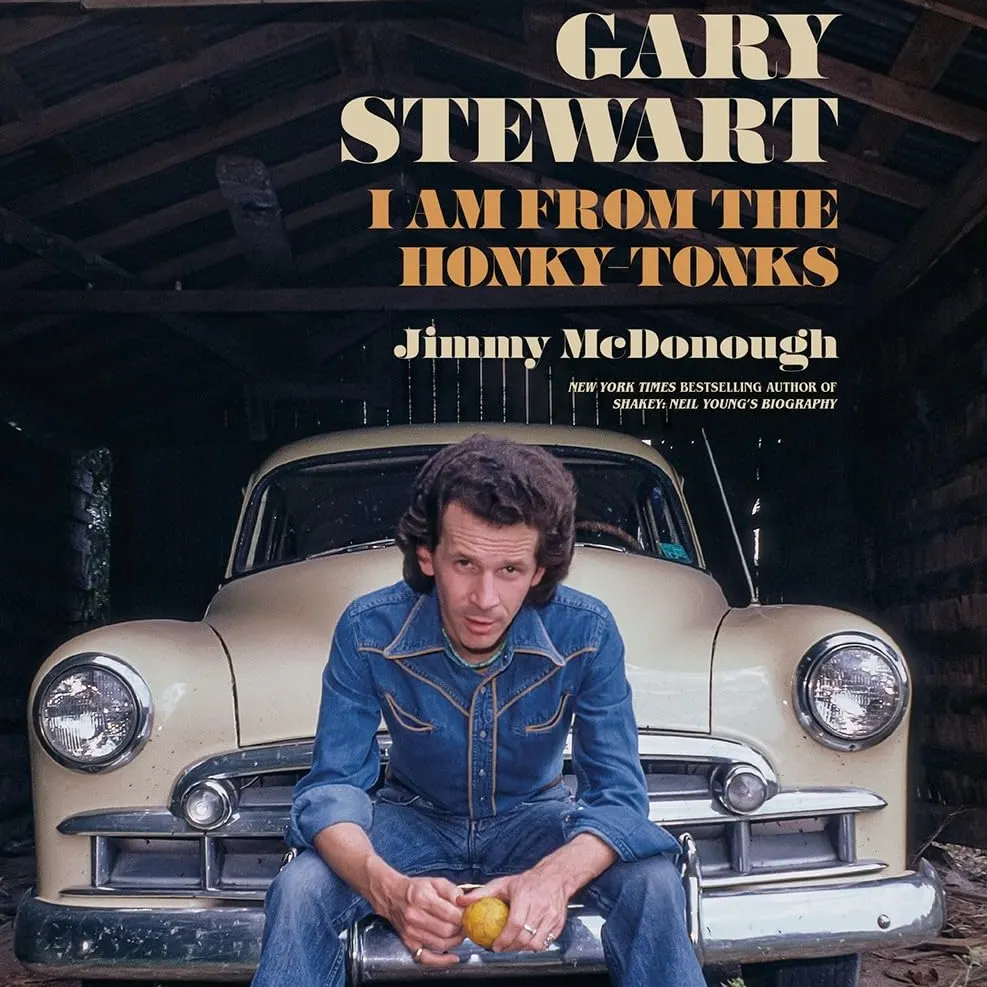
The book, of course, is Gary Stewart. I am from the Honky Tonks. Why is it called that for the people at home? What is a honky tonk? What is honky tonk music versus country music?
- [02:21]
Jimmy McDonough
Well, honky tonks are fueled by alcohol. They're bars and with prominent jukeboxes and they play music that's country music, but maybe not very nice music. It's all about drinking and cheating and extreme behavior. A lot of which, Evan, happens right in these little bars and they tend to have the real honky tonks, tend to have low stages, and they're Gary, like the worst crappy joints. He did not want a place that had urban cowboy mechanical bulls and, you know, polished spittoons. That was not Gary's style. He wanted a sweaty joint where he could reach out and touch the people he was playing to. Those are what honky Tonks are. And the reason the book is called that is because the great Texas writer Joe Nick Petoskey, who's going to interview me in Austin in a few weeks about this book, interviewed Gary. He reviewed a show Gary opened for this guy, Charley Pride, a great country singer, but he was a family show. He was the first Afro American country singer. And incredible. That's a whole story unto itself. But it was a family show and they weren't ready for Gary. And Gary as a sideman in somebody's Band was going to come to a combustible end, which is, does. It's all in the book. But he saw Gary. Joe Nick was reviewing the show and Gary came out and almost threateningly to these blue haired ladies in the audience and guys with the pants with the sansa belt and your typical country crowd of them to death. But he said, I am from the honky tonks. And I just thought, yeah, that's right, that's the title of my book. So thanks, Joe Nick, how did this
- [04:23]
Evan
come to be that you were friends with Gary? Were you based out there? Like I'm just trying to figure out how that all shook out.
- [04:33]
Jimmy McDonough
Yeah, I was living in Hoboken, New Jersey at the time and working in the film business. And also I had started. Well, I was writing about 42nd street with this character, Bill Landis. That's a whole nother tale. But I got out of that situation and I thought, I want to write about people I admire. And the first name on the list was Gary Stewart. And I talked somebody in the Village Voice into running a feature on him. And simultaneously to that, whenever I do a book or story, it ends up with me picking up the phone and seeing if I can find whoever, whoever I'm looking for. And everybody told me, you don't want to find Gary. He's living in a trailer like Dracula. He doesn't care about the outside world. Trust me, buddy, you don't want to know. Well, that was like throwing a big piece of bloody meat to me. I was determined to find him, find him I did. But he couldn't have given a shit that I found him. He didn't care about. He's unique in all the people I've written about. He really could care less about celebrity. But anyway, I said, so Gary, let me interview you. I'm a fanatic. I love everything you've done. And we talked and became a parent that I, I was a bonafide fan of his work. And he said, well, buddy, if you find me this one record by Wild Bill Emerson, Harlan County Highway, I'll give you an interview, pal. And this was an obscure record on an obscure label. I thought he probably thought, I don't have to be bothered by this guy again. But I found it in a matter of days. And I said, guess what, Gary, I got your record and I'm delivering it to your, your trailer myself. And I don't think he quite knew what to say to that. And at that point I was en route to Fort Pierce. At the time I had a terrible Fear of flying, which was cured by Shaky because all the interviews with Neil basically were on a plane. But I was in a. In a Greyhound bus and I went down there and there Gary and his wife Mary Lou were standing out in front of the bus looking exactly like Dracula and his wife. And that begat this whole crazy thing. And that was almost 40 years ago.
- [07:12]
Evan
For those who don't know Gary Stewart. Yeah, because we don't typically. I think this is our first proper capital C country artist that we've really talked about on our show. People who listen probably know you from Shaky and from being interested in Neil. There's maybe a small sliver who know you from your Russ Meyer book, which also is fascinating to me. But just what's the pitch to the world at large? Why Gary Stewart?
- [07:45]
Jimmy McDonough
I am a big fan of emotional singers. I hung out with Jimmy Scott, AKA Little Jimmy Scott. Wrote a book about Al Green, Tammy Winnett. And so I like my singers to come from the. The deepest, darkest places, I guess you could say. And Gary's. Gary had a number of hits in the, in the mid-70s. She's acting single, I'm Drinking Double. Probably the one that most people know out of hand drinking thing. These were Nashville perfection. Great, great honky tonk records. And he sang them with wild abandon. Many compare him to Jerry Lee. I think he's a more nuanced. Jerry Lee's great, don't get me wrong. But Gary's a whole nother bag besides that. And when I got into that trailer, I discovered there were all these outtakes that pointed to a much larger almost singer songwriter talent, if you will use that term that is labeled with stink, if you ask me. But anyway, he had a lot more talent than met the eye. And I just knew it was a story that needed to immortalize. He's a guy who certainly should be in the Country Music hall of Fame. And all these people out there that like Graham Parsons, you know, or figures of that ilk who are really rock but tinged with country. This is like the real deal. Straight, no chaser. And I think once you even listen to the hits, he's just, I, you know, the book's what, 540some pages? I think he's worthy of that kind of book because he's a talent of that magnitude that just never got his due and kind of self destructed his career.
- [09:47]
Evan
One thing that comes out very clearly right at the top of the book is you make a point to note that he. And he puts it this way himself, that he Was kind of omnivorous when it came to music. And part of the fascination I had, I already just loved him for those country songs and honky tonk numbers. But then to hear him talk about, like eating sheets of acid and being like, I'm into psychedelic rock, I'm into whatever, like there's seems to be so much more to the story. Kind of comparison I can make is like, you know, the Bob Dylan mold, if such a thing exists, of someone who kind of just can do it all. And in his case, it seems like there's only this tip of the iceberg when it comes to his recorded material.
- [10:39]
Jimmy McDonough
That is correct. And you mentioned Dylan. Dylan was obsessed with a record that gary made called 10 years of this. And told Gary he played it over and over because there was nothing to top it. And if you listen to 10 years of this, it'll put your hair in curlers. It's just one of the A plus Gary performances.
- [11:02]
Gary Stewart (singing)
You never know by looking. We were ever more than strangers. But we're celebrating 10 years of wedding bliss. She made the rounds as usual while I set heads down as usual. Lord, I can't believe we sat about 10 years of this. 10 years together, a million nights along.
- [11:42]
Jimmy McDonough
And yeah, he operated on many levels. And my whole point of this book is, you know, to shine a light on the complete guy and hopefully get some of that unreleased music out there.
- [11:55]
Evan
Yeah, I'm wondering if that's on the horizon in any official way at this point.
- [12:00]
Jimmy McDonough
Oh, yeah, some people are working at it. Some of the early stuff is going to come out imminently. And yeah, you know, I'm just hoping, as you well know, all these companies now are owned by conglomerates, and it's hard to convince them of the value of unearthing the vaults when it comes to figures they might perceive as marginal to some degree in terms of sales. But I do think this book is. It's getting a lot of attention and I hope it will change the landscape as far as future Gary Stewart releases.
- [12:38]
Evan
Yeah, that's one thing about the book is that I think even if you're not interested in him at all, there's so much color, to put it mildly, in just the story and the people around him, the characters that he came up around. Some of these anecdotes I have so much just underlined in red. Just moments where I was just like, pardon me, like the big guy who only ever wore just overalls and would go out on a little island and eat the endangered green sea turtles and manatees. Yeah, the Family scene around him. His mom sold Avon products as well as cocaine. And this is just kind of an open secret. I just find the whole milieu around him to be incredibly compelling. It seems like you just start pulling on that thread with him and everything attached to him is worthy of its own novel.
- [13:41]
Jimmy McDonough
Yeah, and that's what entranced me. You know, I did a lot of research on this in the late 80s, and then sporadically since then. And when I returned to Fort Pierce a handful of years ago, I thought, well, what else can I learn? There was plenty, Plenty more to learn. The stewards are a bottomless pit. I'm sure there's plenty more. I don't know. I love the family. I love the people in it. And I thought their story was as worthy as Gary's. And I think it just fills in where Gary's coming from. I was very lucky because no one wanted this book, Evan. I mean, no publisher. We looked under rocks, we climbed bridges, mountains, valleys. Nobody wanted. Hey, Jimmy, we think this might be your best book. We couldn't make a dime off it. That's what I was told. And this guy, Chris the Champion Campion, an Englishman, a writer, a fellow writer, just said, you know, I want to do this book, and we're going to do it all the way. And, you know, I'm just grateful for that opportunity because, yeah, I get into it all. I get into his family, I get into the scene of Nashville when he made these records. I get into his cohorts. I just felt that this is probably going to be my last biography. I'm going to write other types of books. But I felt like Gary was the one guy and all the people I've written about, I just had to go all the way. And that's what I tried to do.
- [15:17]
Evan
What was your first experience with his music? How did you discover him for yourself?
- [15:21]
Jimmy McDonough
Okay. I was living in Hoboken, and a friend of mine, Dale Lawrence, who went on to be in a band called the Vulgar Boatman, and he was also in the Gizmo, the later edition of the Gizmos, Indiana's answer to punk rock. He knew a lot about music, and I was just a young screwball who didn't know anything. I mean, you know, I liked. Anyway, he. He was educating me. He played me a record by Gary called I Had to Get Drunk Last Night. Now, this record was written by Rodney Crowell, a very fancy songwriter. And to be honest, it was a little too fancy for me, in a sense. And the production was sort of that uber 70s Nashville sound that sounded like, you know, somebody's paneled rumpus room. I couldn't quite wrap my ears around it, but something in that voice. Evan, I don't know if this has happened to you, but there are moments in your life where you encounter something and you just say, I don't exactly know what this is. I don't exactly understand it, but I want to know everything there is to know about it right now. That's how all my stories have happened. That's how this book happened. And there was something in the abandon and the passion and the voice that just told me, I gotta meet this guy.
- [16:50]
Gary Stewart (singing)
I had to get drunk.
- [16:55]
Jimmy McDonough
Smile.
- [16:58]
Gary Stewart (singing)
I could lay down without a fight. I had to get drunk last night when I should have been sleeping with the. Oh, well, I should have been sleeping with you.
- [17:35]
Jimmy McDonough
Dale and I, with some friends, saw him at the Lone Star Cafe in New York in 1981, I believe, and it was electrifying. It was more Crazy Horse than it was. I mean, he had this ragged band behind him, and it was just raw and. And still to this day, I've seen a lot of performances. It's the singularly most intense show I ever saw, and. And that even hooked me more. And I just thought, okay, I. I have to pursue this and pursue what I did.
- [18:12]
Evan
I had a similar experience with him. I think that I don't know exactly how I first. Well, I didn't see him, I wish, but I think I discovered him just by chance on the Internet or something. But the. The timeline worked out in such a way that I had just been broken up with. And all of his songs. Not all of them, but I would say, like, three quarters, maybe are. Some might even say, like, repetitively. I would just say, like, it thoroughly about being in that state in this kind of, like, cosmically down, bad way.
- [18:55]
Jimmy McDonough
Yeah.
- [18:56]
Evan
There's something in his voice that is so unique that. That quaver.
- [19:00]
Jimmy McDonough
Yeah.
- [19:01]
Evan
That really fine vibrato. This, like, breathy quality that is so vulnerable, like just a bloody nerve.
- [19:12]
Jimmy McDonough
Yeah.
- [19:13]
Evan
And. And knowing it, it's very cathartic in a way that even. It seems unique to me. There's plenty of country music that mines that territory, but his presence feels transcendent of the genre trappings.
- [19:30]
Jimmy McDonough
I couldn't agree with you more. I am a connoisseur of sad songs, and there was something in his music that just spoke to me deeply. I was just a young screwball there in his double wide trailer, and he just picked up a guitar and any song we talked about or a song That I admire. He just leapt into it, and he'd be standing over me, and he's an intense little dude, okay. And he'd just have that guitar and be, like, sometimes inches away from my face singing a song. And, you know, I mean, the cliche is Eye of the Hurricane, but that's what it was like with Gary. I mean, it just. He did not hold back, and there was nothing in it for him. I mean, we weren't recording for Hee Haw, certainly, but he was giving us all in the trailer for me, a total stranger from Hoboken, New Jersey. It took my breath away so much, so many times with this guy. And you say vulnerability. Yeah, yeah. Bloody nerve, all that. He was a weird combination of I don't care and I care so deeply, I can't care. He always seemed to be in a state, one state or another, and he wore it on a sleeve. I just love the guy, you know, I still. I stay up nights wondering, did I do him justice? Did I? Did I? Most books, they let go of me when I finish the book. But this one, I think will. It'll never be finished.
- [21:08]
Evan
Also, part of the book is the great love story within it.
- [21:14]
Jimmy McDonough
Yes.
- [21:14]
Evan
His wife, Mary Lou. And that I found so touching. The nature of their relationship, that dynamic between them. It seems like what he was 16, 17 when they met, 17 when they got married, which was a whole caper.
- [21:37]
Jimmy McDonough
She was the older woman. Yeah.
- [21:39]
Evan
How much did he speak to you about that aspect of his life?
- [21:46]
Jimmy McDonough
Well, that's funny, because Gary was not an interior individual. For all of his feeling and expression of feeling, it wasn't something he was gonna really put into words, in my experience, at least. Mary Lou, however, was the exact opposite. And she helped me a lot with this book. Even though she's no longer with us, God rest her soul. She was sort of like the director on the set without me even knowing. She just made sure I got what I needed. And, you know, Mary Lou was just as tough stuff as Gary was. They were quite the combo. It's a running thread through the book. And, of course, the story ends how it does. They were just. She gave as good as she got and there was no greater protector. Or she was just there for Gary, and he was not an easy guy to be there for. Sometimes she drops her names into songs left and right. That's where he expresses his feeling for her. I mean, he was very outward about, she's my dame, I love her. That's it. But he wasn't going to express it more than that you have to kind of look in the music for the nooks and crannies. A fascinating relationship. They could be lethal together, too, don't get me wrong. But yeah, definitely one of the main focuses of this book.
- [23:22]
Evan
What would you say were some of the surprises or revelations for you throughout the process? Oh, man, it seems like there's one on every page almost.
- [23:33]
Jimmy McDonough
Yeah, yeah, it's hard. I'll tell you the biggest revelation for me, looking back on all of it, was how kind Gary was in spite of his many irks and quirks. At the time I met him, I was just flaming youth, to put it one way, and not a lot of subtlety. And he saw in me that my love for music and my love for his music was authentic. So I think he forgave me a lot of my peccadillos. But looking back, I wish he was here so I could thank him more in depth for all the window he provided into his life, the experiences he gave me. He really gave me my career without my first profile on him. That led to Shaky and all my other books. So there's that and then, you know, the family. There's just so many layers to the family, family. And it took a very long time, decades, to learn what I did about them. Here's the deal. You know, I wanted that to be part of the book, yet I didn't want to come off as some holier than thou muckety muck judging these people. And so I used a device I also used in Shakey that a lot of people use, and that's oral history. And I just let members of his family tell that part of the tale. And I don't want to. Yeah, I don't. I want the reader to make up their own mind how they feel about these things. Some of which are rather jaw dropping, some of which are absolutely hilarious, some of which are rather terrifying. And that's it. I just. I wanted them to tell the story and I wanted to stay out of their way.
- [25:33]
Evan
You say hilarious. I mean, there's. He's very funny. One of my favorite bits is this anecdote. He's in a high rise elevator with a lot of stuffy east coast types. You're right. And then in the deepest Southern drawl he could muster, he mutters, man, this fucking building would hold a lot of corn.
- [25:57]
Jimmy McDonough
Yeah, I know. I mean, where. Where does that come from? That was Gary. You know, he'd send me mysterious tapes. Maybe had been a year or two since I hear from him, and there'd be a tape from him and he'd label it Mike Love.
- [26:13]
Evan
Are you kidding me?
- [26:14]
Jimmy McDonough
Now, I don't know where the Mike Love connection came from, but it was some sort of joke with each other in 1987. And here it was like, 1997, and I'm getting a tape and it's labeled Mike Love or Howard Hughes. He was a very slyly amusing individual, which you will also find in his lyrics. It was never dull being around Mr. Stewart.
- [26:42]
Evan
Let me tell you what was sort of, if you don't mind, like, kind of.
- [26:46]
Jimmy McDonough
Yeah.
- [26:46]
Evan
Can we give a kind of loose timeline of his career? Because things didn't go, as you've said, in the direction of real breakout stardom. But there was a moment in the 70s, what exactly were, like, the broad strokes and how. How his journey went as a. As a recording artist. Sure.
- [27:13]
Jimmy McDonough
Okay. So in the 60s, he was. He worked in Nashville as a songwriter with a Florida pal of his by the name of Bill Eldridge. They wrote a number of very popular country hits for other artists. And Gary started to record great records like merry go round, you're not the woman you used to be, but they didn't really do much of anything. And then in 73, a great producer by the name of Roy Day, who produced all of the great stuff on Gary for rca. He had heard Gary do some Motown demos. They were trying to get these Motown songs done and make them appealing to the country market. They hired Gary for 15 bucks to sing these songs. He heard the sessions, couldn't get it out of his head, tracked the guy down and started making records for him for RCA. And. And then that sweet spot from 75 to about 78 is when he had a run of hits. She's acting single, I'm drinking double out of hand drinking thing in some room above the street. Ten years of this, and then things just went haywire. He started getting more and more into drugs. Drink was never his vice, despite what people thought. It was always chemical. I mean, he'd. He didn't buy Bambooze if it was around, but, you know, he. He had more esoteric pursuits. And then, you know, they tried. You know, all RCA wanted was another drinking song. Another drinking song, Another drinking song. And once you top a genre, it's hard to recreate it. But Nashville, at least one part of it, was all about recreating what had already been successful. Gary wasn't good at that. Gary didn't want to do that. Gary didn't give a shit about any of it. He didn't care about being a star. That combined with his drug use and general out thereness and lack of hits got him dropped from rca. And then he just. He was on a put out singles on a small label in the 90s. He had a bit of a comeback on High Tone Records, but really he was just roaming the south and the southwest playing honky tonks to make a living because he had this reputation as being an electrifying live act. Now there were times when he wasn't in the best spirit or shape and he could be a terrible live act. But for the most part through even that period, he commanded a great audience in the south just because he was Gary Stewart. He had this thing, this indefinable thing and people still wanted to see it. No matter that he had no records, no hits, no presence in Nashville.
- [30:18]
Evan
Did he stop playing toward the end of his life?
- [30:21]
Jimmy McDonough
No, he played right up until the end. There was a period right before I met him where he sort of had a breakdown on the road and he retreated for a little while, but that's how he paid the bills. He had to go out on the road. And even at the very end of his life he was selling out the honky tonks in Texas. And we're talking just. I guess it must have been a month or two before he passed. So that was viable. And he had all these things that he wanted to do when he died. It's a shame. Crazy ideas. He wanted to cut Ozzy Osbourne's changes. Where that came into his cranium. I don't know, I'd love to hear it frankly. But. So, yeah, it was just when he went, it was a tragedy. He was still happening, he was still viable and he still could have made great records
- [31:21]
Evan
the end of his life just to get a little into it. Yeah, the circumstances surrounding it are. They cast a shadow over his whole story in a way.
- [31:32]
Jimmy McDonough
Yeah.
- [31:33]
Evan
All I knew as a casual fan was that he took his own life. But it wasn't till I read more that I understood why.
- [31:44]
Jimmy McDonough
You know, it's hard. You know, the book gets way into it in detail and it's hard to just offer cliffnotes version. But let's just say, you know, he got more and more into drugs and certain drugs that people have a very hard time coming back from. And he wasn't, he was unrepentant, he didn't want to go to rehab, you know, he didn't, he wasn't interested in, in reforming as far as I can tell you. And to that, to that, you know, Mary Louise passed, and without her, it was. It was a done deal. I mean, everybody told me. We knew it was only a matter of time. Once Mary Lou went, Gary was gonna go. And, you know, he had loved people around him that were looking out for him, but Gary had made up his mind. I mean, the end of the book, that's one reason it took me so long to come back to it. I knew. I knew where the darkness lay, and it was much grimmer than I even thought. And I wasn't anxious to go in there. But, you know, the story is what it is. And, you know, the beautiful thing is Gary's gone, His son's gone, his wife's gone. That only leaves Shannon, his daughter. And the last chapter, the epilogue of the book is about her. And that's the hope in the story. Without her, there wouldn't have been a book. She's helped me even now. I mean, you know, I texted her this morning. There's a bond between us over a love of her parents and her mission to make sure they get the respect maybe they didn't get full stop in life. And that, of course, is utterly moving to me. So I try to end on that note of hope, because she really carries a torch for her parents, and she wants her dad to get in the hall of fame. And being a steward, there's not a phony bone in her body. You know, she gave her all to me, and you don't always get that doing a book like this. And I can't say enough good things about Shannon and the experience she gave me writing this book.
- [34:21]
Evan
You mentioned that Gary never chased fame, and I also found that to be a really interesting aspect of this, is the kind of spontaneous nature of everything he did and every decision he made, whether it was calculated or just completely spur of the moment. Even his stardom was based on his sheer enthusiasm. He seemed destined to make music, and other people just couldn't help but notice. As sad as it is, there's something about it, to me, that reading about him, it's a silver lining, I guess, of just recognizing that he. He did go so far. For someone who never was a careerist, he just was what he was and managed to get so much done for for someone who wasn't after it in that way.
- [35:23]
Jimmy McDonough
Yeah, I mean, this was a guy, you know, many times it was hard to even get him off the couch. He'd rather watch, you know, the White Buffalo with Charles Bronson for the 11,000th time, then go outside or make music. And yet, I'll tell you, Evan, even now I'm finding things I didn't know he recorded. He told a reporter once, you know, you ought to look around. I can't remember the place. I think it was Pikeville, Kentucky. He said, yeah, you ought to look around there. I left some things in a studio there, and wouldn't you know it, I've never found whatever he's talking about. But even as I was finishing this book, stuff that he recorded just appears out of the ether. It's almost like, you know, with a Cheshire Cat grin, he's telling me, yeah, Jimmy, you don't quite know all the story, do you, buddy? And you never will, pal. I can hear him saying that to me.
- [36:25]
Evan
You said that things are coming out. I'm just wondering how much of it is not country music, or is it mostly. Or what. What have you. Is there stuff that he's recorded that's just like rock music?
- [36:38]
Jimmy McDonough
Oh, yeah, yeah, yeah, yeah, yeah. In this early stuff that's coming out, there's this version of a song on his first album, Williamson County. Now, on that album, it's. It's a murder ballad, but it's done very, almost jauntily in that Nashville style. It's great. He sings his ass off on it. But one day in the trailer, I was sitting there and he was zonked in the bedroom. He. He. He was out of it for like five days. And, Evan, I. I didn't have any experience dealing with celebrities or interviewing people, and I just thought, wow, maybe this is just what they do. I don't know. But I was getting antsy. Evan, where is this guy? And I noticed he had these boxes in his room of all these tapes, and they were all outtakes. And I just thought, fuck it. I'm going through the tapes. I got to know what's on these tapes. And there was a version of this song, Williamson County. The quarter inch box was mislabeled. It didn't say Gary's name on it. I threaded it up. It was 5am in the trailer, deathly still. And this thing came out that was like the 13th floor elevators. I mean, it's like this distorted guitar, and he's screaming the lyrics. And I would say, it's in the Gary Top five, this recording. And it's. It's. I don't know what you call it. You could call it. You could kind of maybe call it. You definitely could call it rock. You could call it psychedelic. Yeah. You could call it country a bit. You could call it bluesy a bit. But it's just Gary Stewart music. And that's when he ambled out from the bedroom and he listened to it. He had no memory of cutting it. And he said to me, I'll never forget this. It's in the book. He said, yeah, Jimmy, I just thought that's what we were going to do. Just round up some pickers and play. And it was like an arrow in my heart. I mean, here I'm listening. Excuse me, Here I'm listening to one of the greatest things this guy has ever put on tape. And the world, you know, they don't even know it exists. There are things like that and some early attempts at pop even, which, you know, has. They even have their fans. And there's more bluesy things. And there's more. There's a great session from. I think it's 79 with his band, then Rockfish Railroad, and. And it's like seven songs and it's white hot Gary at his best. There's bluegrass in there. There's a filthy blues called Bedtime Stories. Nothing that would ever get played on the radio ever. Yeah, so one only hopes that all this stuff. When I was right, I was editing this site for this guy Nicholas Refn by NWR.com I did, I, I. We did a whole thing on Gary Stewart and I threw hours of my stuff. It's on the site. You can listen to it there. So there's, there's, there's an idea. You can hear some of this stuff there. But there's so much more. So much more. I hope it all comes out.
- [40:08]
Evan
I don't want to take up too much more of your time, but is there anything we haven't gotten to that you want to just make sure people know about?
- [40:17]
Jimmy McDonough
No, I mean, I'm out on the road. I'm out on the road in early April to the end of April. So if I hit your neck in the woods, come see us. All sorts of musical people are joining us. My friend Tammy Faye Starlight is going to perform some Gary. Some music inspired by the book. Margaret Dollarod of the great Demolition Doll Rods is going to show up in LA and do a mini Gary set. And this is all part of my evil master plan to get Gary over to the general populace. So come out and see us. And if, if you like a good music biography about somebody you might not have even thought about, it's a whale of a tail and dive in.
- [41:05]
Evan
When is the LA show?
- [41:08]
Jimmy McDonough
The LA show is. Let's see. I think it's April 23rd at Stories Books. There's another LA date before that, which is just as interesting, but I can't announce it yet. So. Yeah, it's a bookstore in LA called Stories Books. And I'll be there with the great Bill Bentley, who's an industry legend. Without him, I wouldn't have a career. So he'll be grilling me. Marge will be turning up the electric guitar and it'll be a real hee
- [41:44]
Evan
Haw event April 23. So everyone in Los Angeles, please come out to that. Well, thank you so much, Jimmy. Again, it's Jimmy McDonough, author of Gary Stewart. I am from the Honky Tonks. Buy it and read it. And thank you so much for coming on Jokerman.
- [42:03]
Jimmy McDonough
Oh, my pleasure, Evan. Thanks a million. I'm so glad. You know, talking about Gary Stewart, I could do it. I could do it for 440 pages. And I did.
- [42:13]
Evan
Favorite Gary Stewart song right off the top of the dome. At this moment.
- [42:17]
Jimmy McDonough
At this moment, I would say Harlan County Highway. It's a song about Gary's life. And go to YouTube. Put it in. Don't listen to the somewhat slick recorded version. That's great. But there's. There's a. A thing of him performing it on. On Kentucky public tv. It's just him and a guitar and boy. It's often been a soundtrack in my life. It's never far from me and if that doesn't move you, I don't know what will. It's the real deal.
- [42:59]
Gary Stewart (singing)
I was born one stormy night Then a heart rain started falling. Daddy died inside of mine. Mama cried but she kept going. I quit school for a job Mama begged me not to take. A running Kentucky shine Down the Harlan county highway Then I married lo rain she gave our baby my name. And Lord that woman tried more with each passing day. What started out is heaven got lost along the way. So I took off down the Harlem County highway down the Louisville. Where the palm is run. Or a man can turn a dollar into a hundred On a hunch. He can buy his dream I have them for a small mouth Temptation calls from every corner Seven corners of m shackle to a highway call my bones a to keep roll. And I'm standing in the cold with all my cards are showing
- [46:05]
Evan
what you
- [46:06]
Gary Stewart (singing)
start running ain't nothing but right and left to do look for me cuz I'll be a coming or a go in one of the two.