Loading summary
Transcript37 lines
- [00:11]
A
Welcome to the Journal of Special Operations Medicine. I'm your co host, Jessica Rodriguez.
- [00:16]
B
I'm Sydney Duke.
- [00:18]
C
And I'm Matthew Farinella.
- [00:20]
A
And this is where evidence based medicine meets unconventional warfare. This is Sophia Leishman, Director of Marketing and Social Media Communications for the Journal of Special Operations Medicine. You can find us on Instagram, Facebook, X LinkedIn, and ThreadsaseOnline. Subscribe to our biweekly newsletter@jsomonline.org and don't forget to subscribe, review and rate this podcast on Spotify.
- [00:47]
D
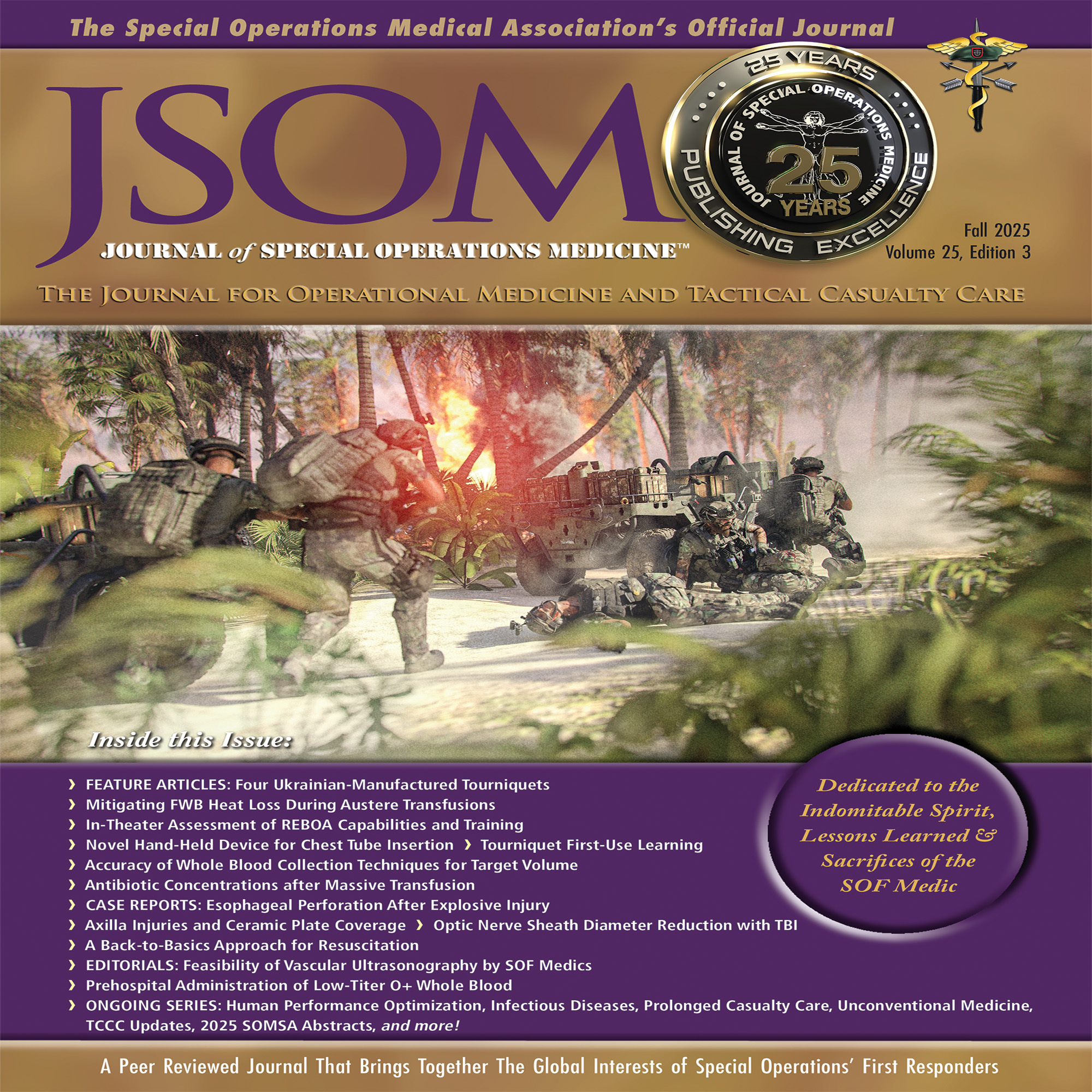
Hello again. This is Dan Godby, Medical Editor of the Journal of Special Operations Medicine. Thank you for joining us for the fall edition of the JSON Podcast. For this introduction I will point out two other articles worth reading. In addition to the three articles being highlighted in the podcast, the EMS Medical Director in me is coming out in this introduction with the choice of the two articles I'm going to highlight. Pre hospital use of blood is a very hot topic and both of these two articles are pertinent to that issue. The first article I'd like to recommend is Storage and Transport of Whole Blood and Chest Harnesses. This is a very good and timely topic. It has broad applicability to both law enforcement and military operations. It expands the vision on the viability of blood products while not burdening teams with more equipment. Second is advocating for the pre hospital administration of low titer o positive whole blood. Dispelling myths and misinformation. This is a well written and balanced review. It presents data to address the concerns of those that may not be opposed to an out of hospital blood program but are definitely not in favor of it. The offers did not disparage one side or the other, but presented logical explanations. The paper provided insight into the challenges of pre hospital blood administration and how some agencies have overcome those logistical and financial challenges. The data provided shows where the successes are and what the deficiencies with warming and negative interactions are. As always, we in the JSOM do really want to hear from our readership, particularly those of you in the front level positions. I will always take this opportunity to reiterate our mentoring program specifically created to help medics get through the publishing process. A select group of editors are dedicated to concentrate on articles submitted by medics and and aid in getting them published. Now here's our team with the podcast.
- [02:53]
A
Good afternoon everyone. Welcome back to the fall edition of the JSON Podcast series. We are so excited to be back with you all and we have three great articles that we hope you will enjoy before we jump in Sydney and Matthew, how are rotations going for you both?
- [03:08]
C
They're going well, Jessica. So just finished up outpatient internal medicine last week and start first. First rotation with surgery starting tomorrow morning. So looking forward to it.
- [03:21]
A
Oh, yeah, I'm sure you have an early morning going soon.
- [03:25]
C
Absolutely.
- [03:28]
B
Yeah. Mine are going really well. I'm in my last two weeks of internal medicine with a pulmonologist and critical care doc. And then after those two weeks are up, I'll be doing hospital medicine at Brooke Army Medical Center. So I'm really excited for that one.
- [03:44]
A
Super cool. Yeah, I think last time we spoke, I was getting ready to go to Wright Patterson for an audition rotation. So I finished that one up, I finished bamcy up, and now I'm getting ready to start a new one. But it's kind of like a weird break in between. So I'm glad we got to get together this weekend, get this going for everybody. Matthew, if you want to go ahead and start just by giving us a little bit about your article and just with the title and kind of take it from there.
- [04:11]
C
All right, so this article is going to be looking at is titled Penetrating Axilla Injuries and Ceramic Plate Coverage, A Special Operations Case Series. The authors are Duncan Carlton, MD, Alexander Gwynn, MD, Nicholas Warner. Ryan Knight, MD, Christopher Myers. Jonathan Outen Dio. So basically the gist of this article is reviewing whether or not side plates make a difference in axillary injury coverage. They looked at a series of injuries reported from 2001 to 2018, went through a pretty rigorous screening process to try to determine which article or which casualties fit the billet and criteria that they had set forth of, you know, kind of injuring that axilla area which they labeled as like the fourth or fifth intercostal space and up and, and kind of bordered medially and laterally by the the front and side plate. So overall, they ended up selecting 11 case studies and that which occurred from a single unit over the course of GWAT. Of the 11, seven had four plates in, and of the seven, there were three of the individuals that were killed in action. So the bottom line up front was that they determined that having a four plate system was substantially better in providing coverage of vital organs. Now that did come with some costs and they kind of touched this in the section titled Superior of the four plate system and appropriate Armor coverage. I think they do a good job of bringing up really the point of like, you know, what guys are actually feeling with the four plate system versus, you know, just wearing two plates and that's the weight burden of it and really the mobility aspect of it that really can kind of play into, you know, restricting your movement and not allowing you to be able to be as comfortable on the battlefield, but, you know, at the same time sacrificing some of your safety by not wearing four plates. So they do a good job. They talk about it from the perspective of a Marine Corps study that kind of dives further into whether or not their Marines were wearing the four plate system or the two plate system and how it affected them on the battlefield. They also looked at this in a sense of modern conflict, looking at the Ukrainian Russian war and the tasks required to those individuals in that war and how taxing it is and looking forward for us as we enter a time where we're preparing for these large scale combat operations, what it's going to look like for us as far as movement and terrain and environment that we're going to be fighting in. So I think they do a really good job of bringing up really good points as to what commanders are going to have to make decisions over, you know, whether or not we look at, you know, decreasing the plate burden and weight burden on soldiers so that we can increase the mobility, the longevity. You know, we talk about all the time about how we're not going to have the ability to have air. So how are we moving troops? You know, is it by foot? Is it by vehicle? Because if it's by foot, you know, the weight's going to be a really big problem.
- [07:43]
A
Do you think in your experience that this is something that we can train to be better at? Like if we trained with the different plate systems, that this is something that we could overcome? Or do you think that this is something that's like, no matter what, like this is just a lot of weight on the backs of our men and women and we maybe we need to figure out whether we would rather have mobility or rather have a lighter, I don't know, a lighter load?
- [08:07]
C
Yeah, I think that, you know, ultimately we have to make a decision that of either, you know, increasing our security and our protection by wearing the four plate system more or increasing our mobility by going to the two plate. I don't know if it's something that we can trained perhaps, but just making a conscious decision and, you know, having, having the, the option would be really nice. I think from a, from a, from a, from a enlisted perspective and from a perspective of someone who is going outside the wire, so to speak, or on the front lines at least having the option to, to, you know, choose what would make it better for you to be able to move and to be able to basically enhance your fighting capabilities.
- [09:05]
B
Yeah, and, and Matthew, why don't you go ahead and remind our, our listeners of a little bit about your background and kind of how this article, you know, applies to your experience. And then, you know, furthermore, what did you see in your experience? Were people wearing the full, you know, full plate system? You know, were soldiers more concerned with mobility? What. What in your personal experience have you seen?
- [09:35]
C
Yeah, so I spent a few years down at 3rd Ranger Battalion before I moved over to the Special Troops Battalion and worked in both capacities as a line medic, as a platoon medic, and as a SEAT Company senior medic. And, you know, I really, I chose this article because one of my mentors, Colonel Ryan Knight, was the regimental surgeon at the time when I was a junior enlisted. So when I saw his name pop up on here, I was like, absolutely. Gonna see what kind of studies he's getting into these days. And then, you know, from my experience, you know, a lot of guys, you know, wore the Fort Way system. I think it's just lended itself to the nature of how we were maneuvering in Afghanistan and Syria, which is the, the two areas that I operated in. You know, both of them we were primarily using vehicles for infill and exfil. And so I think it was very easy to just have all your plates in. But I do know that in certain circumstances, you know, especially earlier in the G wat and really in a lot of the movements in Afghanistan that required, you know, long movements and remain over days and stuff like that, the guys would occasionally, you know, drop the two side plates to try to help ease the weight burden. And, you know, for me, I mean, I can remember as a junior enlisted, you know, going to one of our training events, we were getting ready to load up on an aircraft. And part of, you know, before you leave to get on an aircraft, everyone has to weigh in so that the aircraft can determine its, you know, weight capabilities and if it can carry everyone and as a platoon medic carrying supplies for, for a two day operation where we were going to move, you know, five, six miles and then remain over day and then continue to move the rest of the movement the next night. When I was getting ready to step onto the aircraft, I weighed around 325 pounds. So a huge weight burden that, you know, was going to have to be moved for a lot. You know, a decent amount of movement in a terrain that wasn't even as severe as what we've seen. In Afghanistan and other parts of the world,
- [12:10]
A
I don't think I ever actually realized like the actual weight burden until you said £325. Like that is a lot of weight to be carrying around on your back for miles at a time. So I can understand trying to drop a plate here or there to just try to lighten the load after you've been on your feet and walking for so long.
- [12:29]
C
Yeah, absolutely. You know, I would say even at my size at the time I was weighing about 215, so you're looking at about 110 pounds of equipment. And I would say, you know, even as a medic, I was probably on the lighter end of that with, you know, some of the guys carrying, you know, the seven, six, two rounds for, for some of the larger guns and some of the guys having to carry the Carl Gustav and some of the guys having to carry 320s and 320 rounds. And really just, you know, it's pretty dispersed across the board that everyone's going to be carrying a substantial amount of weight.
- [13:11]
A
And I know you were talking about options and like having the option would be nice for people who want to wear the four plate system versus the two plate system. Is this something that soldiers can choose to do or is this something that when leaders implement it's kind of across the board standardized?
- [13:29]
C
That's a good question, Jessica. You know, it is, from my understanding, it's command directed. And I think that again going back to the article they do they bring up this point of having it be mission specific. So one of the casualties was a gunner of an aircraft. So they were on the rear gun of a Chinook or 47. And you know, them in their role could be provided more safety and more armor in that position because they know that they're not going to have to get off the aircraft, they're not going to have to move versus someone who's having to move. So I think it comes from a command directive ultimately whether or not, you know, you can change the plates you're carrying and stuff like that. But you know, looking at what the mission is is going to be vital to decisions that these commanders are going to have to make.
- [14:29]
A
Yeah, that makes complete sense. Well, thank you so much for sharing this article with us. This was really interesting and I think your perspective brought a lot to us today. Sydney, if you want to go ahead and get started on recording yours for us.
- [14:43]
B
Yeah, awesome. Yeah, thanks again, Matt. That was really great. So my article is mitigating heat loss in IV tubing during austere blood transfusions by Amin Faust, Ph.D. and Drew Homan. I believe they are from West Point and sort of the background and importance of this article is that hemorrhagic shock is the number one preventable cause of battlefield deaths. And in 2014 the Tactical Combat Casualty Care guidelines recommended that we use fresh whole blood over component therapy. And they did this because they saw a 95% versus 82% survival rate in trauma patients when using fresh whole blood over those component therapies. So essentially with that fresh whole blood we have a problem, and that is in cold environments, blood cools as it travels through IV tubing. And if we have cold transfusions, that can lead to hypothermia and, and hypothermia can lead to impaired clotting and then we have increased mortality and we can't control the environment. Right, but we can control how we react to the environment. So the study's objective was they wanted to quantify how much heat blood loses in IV tubing under certain conditions and they wanted to identify practical ways to prevent hypothermia during field transfusions. They hypothesized that heat loss would increase as, as environmental temperature decreases and, and that insulation and shorter tubing can reduce heat loss. So kind of their methods of how they did this was in a controlled environmental chamber that ranged from 20 degrees Celsius, which is I believe is about room temperature, to negative 39 degrees Celsius. They used fresh whole blood transfusion kits and then they simulated blood with 22% glycerol solution, which matches the viscosity of blood. And they measured the inlet temperature, which is the starting temperature before the simulated blood travels through the tube, and then the outlet temperature, which is the blood leaving the tube right before it enters the body. They also measured flow rate and then they calculated heat loss in watts. And through this they tested different insulation thicknesses and tubing lengths. And while conducting this experiment, they found that even at room temperature, which is at 20 degrees Celsius, they still had about 41 watts of heat loss. And then at negative 39 degrees Celsius, they had about 168 watts of heat loss. They also saw that the outlet temperatures dropped from 39 degrees Celsius to 9 degrees Celsius at 39 degrees. I'm sorry, at negative 39 degrees Celsius, meaning that the temperatures dropped rapidly during, in that super cold environment and, and that none of the outlet temperatures stayed above 37 degrees Celsius, which is what we want blood typically the temperature we'd like it to be at. They also noticed that lower flow meant that there was more heat loss because there was a longer amount of time that the blood had to cool. So if you think about it like if we're moving slower, then there's more time to be affected by the elements. And you know, all of these are problematic because we have seen and it's know that there's severe risk of infusing dangerously cold blood. Um, so further go. Furthermore, when looking at specifically the insulation in the tubing sizes, insulation really only helped mildly when the outside temperature was above 0 degrees Celsius. Even at negative 39 degrees Celsius, 25 millimeter insulation couldn't maintain that goal of 37 degrees Celsius. And then thick insulation was bulky and impractical. In the field. They did find that shorter tubing had major improvement in outlet temperature because, you know, less distance to travel, less heat loss. And so they kind of concluded that combining shorter tubing with insulation was the best balance to maintain that temperature of blood. And again, like this has significant clinical implications because cold transfusions equals hypothermia, that gives coagulation issues. And then we have increased in mortality. And again, we really want blood to be at that 37 degree range for safety. And so they, you know, we're saying that maybe we should redesign our field kits to have shorter tubing, better insulation materials, and kind of even the potential to integrate portable warming devices to help keep that blood warm. And throughout this whole study, they really just concluded that heat loss through IV tubing is significant, especially in, you know, Arctic conditions and even colder environments. And that insulation alone really isn't enough. And we need to include shorter tubings and potentially warming devices. And so hopefully we can have future research in testing different insulation materials. Maybe we can validate this research in real world feel environments. And also all of this contributes to kind of what Matt was saying beforehand, of ensuring mobility, speed and safety in the battlefield, battlefield and how we can really, you know, execute the mission of whatever theater, whatever plan that we have. So basically the take home messages are even mild cold environment drastically cools transfused blood, that cold blood worsens trauma out club outcomes, and that short tubing and installation is the most effective fix we have. And that field testing needs to be done before we do implementation of this idea of shorter tubing and insulation.
- [20:40]
A
You know, the premise of this actually makes a lot of sense to think about, like even comparing like, like IV tubing to like house pipes. You Know, we have to insulate our pipes. It gets cold, we need to go do extra work with them. And so why would we not be doing that for our IV tubing when we're going to transfuse blood? So it actually makes a lot of sense to be doing this. But I think that there are easy fixes, like possibly redesigning the blood kits like you spoke about, or even carrying little insulation packets in this. Like, that's very light material. And I know at the end of the day, we want to keep what we carry light, but if you are in an arctic condition, this could make the difference in someone's life or death. So this is a really cool article. Thank you, Sydney.
- [21:22]
B
Yeah, and I had the same thought. Like, I didn't really realize how big of a deal the temperature of those blood transfusions were. So knowing that there's things we can do to, like, prevent these injuries and mitigate it, and maybe we can all do this while still maintaining. Right. Our mobility, our speed, you know, safety, and just kind of helping everyone in these, you know, in this. These combat fronts, I think is interesting and valuable.
- [21:52]
C
Sydney, in that article, did it talk about the use of, you know, external warming devices and their role in heating blood as it, you know, was transfused, or. And then also did it talk about the, you know, is it talking about direct transfusion, so the, you know, walking blood bank, so to speak, concept, or is it speaking more on, like, packed red blood cells, frozen products that we carry?
- [22:22]
B
Yeah, I believe they were talking about more of packed red blood cells and, again, fresh whole blood products rather than other therapies, as well as this was a study that they did, I believe, at West Point. So they. I don't think they used heating devices, but it was something that they brought up as maybe, you know, with further research, maybe we could integrate portable warming devices.
- [22:50]
C
Yeah, I know that from, you know, past experiences back when I was active duty that, you know, heating devices were kind of our standard of care back then. And so I'm curious to see what they're using now, if they found a better tool. At the time, we were using a device they called the Buddy Light that had a cartridge that kind of did the opposite of what you were saying in slowing the flow. But it had a heating element and coil system to it so that it tried to heat as you transfused. And then they also had one called the quantum that they were using that involved a heat, a coil in the actual tubing itself to try to heat the blood as it was transfused. But I'm sure that by now they're using something new and great technology to try to help, you know, mitigate that, you know, transfusion of cold blood products and blood. And, you know, I'm just curious if they brought up any of those products.
- [23:53]
A
I was actually kind of wondering that too, because I know I was not prior service, but I was prior ems and we used to carry on the box, the. These like blood warming coil. They're like boxes. And I wondered if maybe they didn't bring it up in the article because maybe that's difficult to carry if you're trying to be really select about what you're taking in the field with you. But like, I know that that's what we would use on the trucks to warm the blood up before we would transfuse it into a patient. And so I kind of wondered why they didn't use it in this specific instance or if they maybe didn't want to look into that and to try to mitigate how much, how much each person's carrying.
- [24:30]
B
Yeah, so I think they were really just wanting to identify, you know, certain properties when transfusing blood in cold weather. Not necessarily about the devices, but what that looks like. Just, you know, if the minimal you had was just the tubing, you know, how can we, we fix that if we don't have the devices? And again, in these cold and austere environments.
- [24:55]
A
Fantastic. Well, thank you so much for reporting on that, Sydney. Next, we're going to go into our last article, which is named Lab Evaluation of four Ukrainian Manufactured Tourniquets. It's by Piper Wall, Charisse Buzing and Mary Jonas. So the purpose of this article was to look at four different Ukrainian manufactured tourniquets and they looked at four properties of them. Specifically, they looked at the achievement and maintenance of arterial occlusion with tourniquet secured on an arm and a thigh. They looked at the pressures involved in usage. They looked at the amount of visible wear that you could see with reuses, and then they looked at the general design and considerations. And then they actually took this study and they compared it with the concurrent study that they were already doing with a tourniquet called the X8T T2G. And so the four Ukrainian tourniquets that were mentioned in this article were the strengthened individual combat hybrid tourniquet, which is going to be called the SICH when we're reporting out today. The second one was a TQ dnipro generation two. So we're just going to call that the DNIPRO and then there was a pulse tourniquet and then there was a yellow and blue tourniquet which we'll call the Y and B. So as far as methods go, they took each tourniquet and they applied it to the mid arm and the mid thigh of 30 different recipients. And then they waited 100 seconds for first completion to release. So they wanted to see if blood flow would return after 100 seconds. There were four of each tourniquet used. So one was for practice, one was for right limbs, one was for left limbs, and then one was just actually used as a visual representation to inspect the tourniquets and it was never actually applied to note. They also placed a little white mark on one end of each windlass rod just to kind of aid in being able to count the turns better. The next thing that they looked at, as far as methods go, the appliers. There were eight different researchers who were chosen to be the appliers of the tourniquets based on the ability to frequently achieve pre tightening since system uses use pressures above 100 millimeters of mercury with the X8T. So that was the previous study that they were already doing. So there were only eight people and based on their availability, that's were the only eight people who were allowed to actually apply the tourniquet. The recipients were volunteers, 18 and older. They didn't have any known bleeding or clotting abnormalities, no circulation problems, pain syndromes, peripheral neuropathies, anything like that. No connective tissue disorders. The pressure was measured by using a neonatal BP cuff and then a couple different pressure sensoring systems. And then arterial occlusion was defined as loss of an audible Doppler pulse. And so kind of how they did it was the rod rotation was paused at the first arterial occlusion and then the rod was secured as soon thereafter. And then they took their hands off and that was considered completion as soon as the, the Doppler said no audible pulse. And then any return of arterial flow before 100 seconds from the first completion resulted in an additional 180 degree rod rotation turn. Pressure thresholds for early application release were set at rod secured pressures of 800 millimeters of mercury for the arms and 1500 millimeters of mercury for the thighs, which we're going to talk about a little bit later in the summary. A little bit about why those, those exact pressures were chosen as threshold for like, let's just release the application as a whole. And then something cool that I thought that they did is they, they took videos of these Ukrainian manufactured tourniquet applications. And they reviewed these videos to help confirm times, help confirm pressures and rod rotation. So it wasn't just one person who was reviewing this for all these different applications. So some of the results, the pressures decreased after each completion, defined as like hands off after securing the tightening system and completing any additional tourniquet securing steps, which is what they had expected in their hypothesis. And they had one Y and B thigh application that never actually reached completion for physical inability to achieve the needed like six windless rod rotation, secure the rod. So that was the one that was not able to do that. One of the tourniquets, the SICH arm application, was never completed because the application would have surpassed the 800 millimeters of mercury threshold on the arm pressure. So it was just released from position. Among the 238 other Ukrainian manufactured tourniquet applications, 26 army and 43 thigh applications had early pulse return requiring an additional tightening. Which is interesting when you compare it to the 80x8t applications from the concurrent study that they were already completed, which all reached completion. And 5 arm and 28 thigh applications had early pulse return requiring additional tightening. So the Ukrainian ones were showing to require extra tightening when the arterial occlusion had already been successfully completed as anticipated. Because of the X8T's finer resolution tightening system increments the ranges for the Ukrainian manufactured tourniquets for the arms and the legs, the completion pressures were wider and most were higher than the X8TS. A little bit about the signs of wear with the 30 arm and 30 thigh uses for each of the Ukrainian tourniquets, none became unusable. But some did have different fraying issues that occurred which we're going to talk a little bit about. The SICH developed a small amount of fraying, so nothing too crazy. They also developed fraying on the base area strap under the opening, which was like where the inner strap passed upward through the slot of the windlass rod. And then the DNI pros and the poles did not develop any visible evidence of wear at all. And the Y and B actually had quite a bit of issues. The Y and B applied to the left arms and thighs left specifically developed stitching failures with increasing separation of the plates. The plate adjacent layers of fabric strap that was holding together I guess is being held together by the broken and pulling apart threads. And then it also had some separation of the loop of strap sewn around the windlass rod. There were also some instances of plate bending. There were also some instances of like, I think one instance of like a great plate deformation and which they go on to talk about. When it went above a five and a half turn there was a loud popping sound. There was a very bent plate, but to note it did not worsen with continuous turns. So they kept it was still able to produce effect and still work, but there were some visible flaw issues. So in conclusion, the SICH and the DNI Pro and the Poles all reached completable arterial occlusion. The Y and B did not and had design concerns. None became non functional though. And then the windless rod tightening system Tourniquets routinely have higher than desirable completion pressures, which matters with long tourniquet times. So for a key a key finding is the sich, the DNI Pro and the Poles always achieved completable occlusion, but the Y and B did not. Additionally, the Y and B had a slider redirect buckle that when unthreaded readily separated into two pieces for easy loss of the slider. Also offered multiple incorrect rethreading options and a windlass rod that could be removed from the the strap and inadequate mobility of the rod securing triangle preventing always being able to secure the windlass rod so that one kind of came apart into pieces that would be difficult for someone to put back together if they needed to really quickly. The raw turn data from the United States military combat related applications of the CAT tourniquets shows that 79% of applications involved three rod turns despite the 37% of applications using the relatively low friction simple redirect buckle strap routing. Therefore, we expect the Y and B failure incidence on the thighs would actually increase in non ideal austere environments or settings like that. However, the study shows once again that tourniquets using tightening systems involving the 180 degree windless rod rotations frequently have completion pressure completion pressures hundreds of millimeters of mercury higher than necessary and much higher than the 500 milligrams for mercury even when they are restricted to only as tight as necessary for completion with occlusion. What we were talking about earlier where those thresholds were made, this is the data that tells us where we talk a little bit about why this data was set. While non arterial occlusive tourniquets are life and limb thread pressure related nerve injuries are also undesirable and relate to both the duration and the magnitude of pressure. The classic study to reference for the 500 millimeters of mercury and higher being undesirable involved a max duration of three hours. And we know in austere environments that can be way more and combat related. Tourniquet times in the Russian Ukrainian war often exceeded the three hours. And the last suggestion that the article did talk about was that the need for longer straps for these tourniquets is necessary. So the US military thigh circumference used for length requirements is 71.46cm as the 99th percentile for males in 1988 and the 99th percentile increased to 77cm in 2012. And the TCCC length requirements requires only a sufficient length for application of 71.46 circumference. So they're still really using the 1988 circumference or a 95.25 centimeter tourniquet total length which is insufficient to allow the free end of the strap to reach the base area on thighs larger than approximately 56 cm circumference, which was actually 50% of thighs in this study. So while that was not something that they were directly looking at, it is reinforced again that this is something that we should probably take into consideration when we're manufacturing more tourniquets is the actual circumference of the thigh legs that we're trying to occlude. The last suggestion is that tourniquet tightening should begin as soon as the tightening system is engaged and not be delayed until the 90 degree of rod rotation has occurred. So in the DNI Pro. The DNI Pro and the pulls inner strap just like that of the CAT is sub optimal because it does have this slack in it before that you have to take out before you can actually start winding and getting the proper pressure that's needed. And it causes delays in increasing tourniquet pressure and delays in stopping bleeding.
- [36:22]
B
So Jessica, that was a really interesting article. A thought that I was having was kind of like the, the thresholds for the tying of the tourniquet. How, you know, if we're tying these tourniquets to too tight, are we going to have any neurological implications later down the line? And, and, and that's the question, right. Is, and you were discussing is is it life over over limb? And so just kind of curious to see if they talked about that or if not like where do we go from here, you know, going forward with this information on tourniquets?
- [37:00]
A
Yeah, I wish we would have gotten a little bit more information about average times that tourniquets are left on and a little bit about what type of neurovascular damage we're talking about that they, that they're currently seeing from tourniquets left on too long. And just so we could kind of have a greater discussion about like the life over limb, that it is worth tightening it too tight and it gets hard if you're in an austere environment, like we're not going to have a pressure system, we're not going to have a Doppler, we're just going to put it on. But kind of thinking about down the line like the recovery aspect and the rehabilitation aspect of it too, we don't want to cause them to not be able to feel their leg ever again as well. So kind of being able to find the happy medium would have been nice to kind of think about if we would have had a little bit more data.
- [37:43]
C
Yeah, I definitely think it's something to look at moving forward with wisco. And what we're looking at is, you know, are we accepting the risk of, you know, keeping the tourniquet on for an extended period of time if that means that they, the casualty lives or you know, are we more worried about, you know, the loss and use of that limb? You know, but with evacuation times changing and you know, warfare changing, I think that we're gonna have to make, you know, there's gonna have to be some gray areas in, in our casualty, casualty planning and, and what we're willing to accept as a standard of care and how we're, you know, going to be moving forward. And on that note, did they say so did they give a purpose for this study? Was it based off of the fact that they weren't seeing, seeing good efficacy with the cat tourniquets or was it that limited access to cat tourniquets, you know, in Ukraine or what was their reasoning for looking at different kind of tourniquets really?
- [38:52]
A
I think that they were contracted, I think they gave the year 2023 to help research, I guess, regarding possible help evaluating emergency use limb tourniquets of Ukrainian manufacture specifically. So it wasn't really about the cat tourniquets. We were just evaluating, here's what's being manufactured, here's four different really popular ones in Ukraine. Let's look at the efficacy of them and let's compare them to a study that's already ongoing with American ones. And so I think that was really the purpose of it, to see just kind of the efficacy of the Ukrainian ones and just to see kind of how they hold up in environments like austere environments and like their, their wear and tear and like how much they're actually able to secure the arm and the thigh and arterial occlusions and like pressures involved.
- [39:43]
C
Thank you. And you know, one other thing too that I thought of that you had said earlier was talking about the, you know, the circumference of the service members thighs changing and stuff like that and how, you know, some of the tourniquets now are too short, things like that. You know, if you really think about too, you know, you know, in care under fire, the only intervention that is able to be performed is a rapid high and tight tourniquet. And with some of these service members, one being large individuals that are strong and have strong lower bodies due to their ability to move a lot of weight for a long period of time, you know, placing some of the tourniquets now can, has become increasingly difficult for that reason as well as, you know, you try to carry as much as you can that you use. And so I think a lot of guys put things in pockets and there's things that get in the way of the tourniquets and can kind of create some bulk in those areas that can create a problem with the length of the tourniquet. So that's a, you know, was a good, you know, an interesting observation. I thought that, that they made talking about the size of the individual's legs.
- [40:59]
A
I agree. And if you think about how the study had eight people who consistently were able to get a tourniquet on above a certain threshold pressure, we have to remember that not all of our armed forces men and women who are out in the field are going to be able to do this exact mechanism that they're talking about. They picked eight people to do it. But, but we want all of our service members to be able to do it on whoever's leg or whoever's arm. And so it's important to think about leg circumference and making sure they're the right size, but also thinking about like as you were saying, it's becoming more difficult each time to turn these tourniquets on a larger leg. So we have to think about who's turning it as well. And that about wraps up our fall addition to the JSON podcast. We hope you have enjoyed listening as much as we have had hosting. As always, please reach out and give us feedback. We are always eager to find out how we can make a better product to assist your practice out in the operational environment. Thanks and we will see you next time.
- [42:05]
C
As a reminder, the views and opinions are the speaker's own and nothing contained herein is to be considered the official opinion of the Journal of Special Operations Medicine. Or the US Government, including the Defense Health Agency, Department of Defense, Department of the Army, Navy or Air Force.