Loading summary
Transcript27 lines
- [00:11]
A
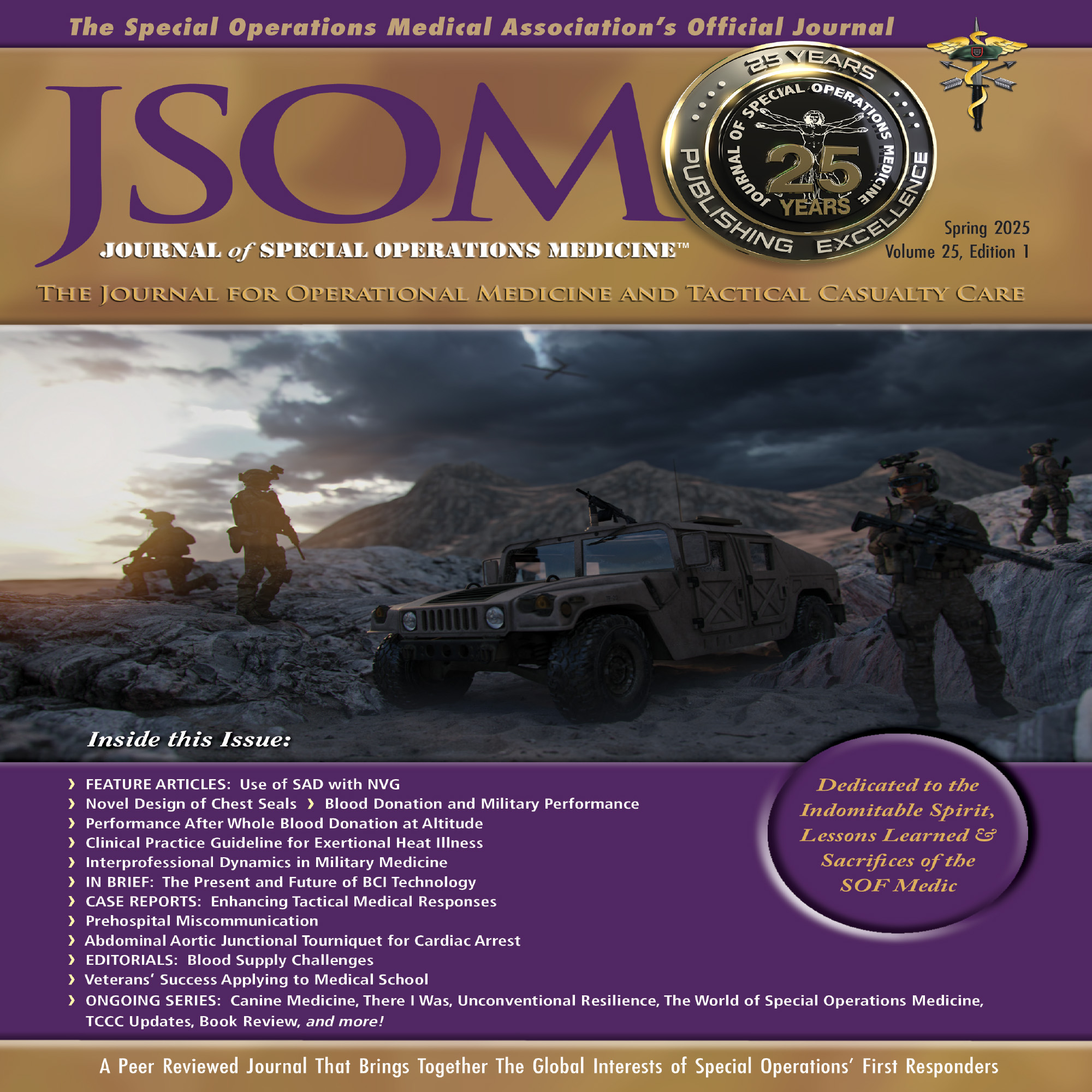
Welcome to the Journal of Special Operations Medicine. I'm your co host, Jessica Rodriguez.
- [00:16]
B
I'm Sydney Duke.
- [00:18]
C
And I'm Matthew Farinella.
- [00:20]
A
And this is where evidence based medicine meets unconventional warfare.
- [00:25]
D
This is Sophia Leishman, Director of Marketing and Social Media Communications for the Journal of Special Operations Medicine. You can find us on Instagram, Facebook, X LinkedIn and threadsaseMonline. Subscribe to our biweekly newsletter@jsomonline.org and don't forget to subscribe, review and rate this podcast on Spotify.
- [00:47]
E
Hello again. This is Dan Godby, Medical Editor of the Journal of Special Operations Medicine. Thank you for joining us for the spring edition of the JSOM Podcast. For this introduction I will point out other articles worth reading. In addition to the three articles being highlighted in this podcast, the EMS Director in me is coming out again in this introduction with the choice of two articles I'm going to highlight. First article I'd like to recommend is An Update on Best Practices for the Pre Hospital Management of Exertional Heat Illness. It's a succinct and well written review of the key points of managing Exertional Heat illness. The strength of this paper is in the author's experience as a Sports Medicine Fellow. This article doesn't need to be soft specific. It is a powerful enough speaking to the best practices for all pre hospital providers. Next is Enhancing Tactical Paramedicine Response Efficiency and Lessons from the batclan Concert Hall Incident. This article gives some great insight into tactical emergency medical practice and is relevant to all levels of providers. Finally, optimal pre hospital practices for airway emergencies of military working dog combat casualties. The premise for this study in comparison surgical cricothyroidotomy and tube tracheostomy as a primary treatment for upper airway obstruction is a needed conversation with I think the findings are interesting and applicable when talking about the upcoming changes to the current clinical practice guidelines. This article also has a good roll up of the study's limitations. As always, we at the JSOM really do want to hear from our readership, particularly those of you in the front level positions. I will always take this opportunity to reiterate our mentoring program specifically created to help medics get through the publishing process. A select group of editors are dedicated to concentrate on articles submitted by medics and aid in getting them published. Now here's our new team with the podcast.
- [02:52]
A
Hello everyone, My name is Jessica Rodriguez. I am a second lieutenant in the US Air Force and I'm also a third year medical student. Myself along with Sydney and Matthew are so excited to be hosting the podcast this year and hope to build off of the amazing groundwork set before us. We're very excited to bring a unique set of backgrounds to this podcast as we are all three different branches of the military. Let's go ahead and start with a quick intro and a little bit about our backgrounds. Sydney, if you want to go first.
- [03:17]
B
Hello everyone, my name is Sydney Duke. I am a second year medical student as well as an ensign in the United States Navy. Before medical school, I'm a proud graduate of Baylor University and worked a lot in hospice care and I am hoping to move forward in internal medicine as a potential specialty.
- [03:39]
A
Perfect. Matt, do you want to go ahead
- [03:40]
C
and go hey guys, My name is Matthew Farinella. I am a second lieutenant in the US Army. I go to VCOM Auburn and prior to starting medical school I served as a medic with the 75th Ranger Regiment, serving at 375p at Fort Moore and then at RSTB.
- [04:01]
A
And once again I'm Jessica Rodriguez. I am in the US Air Force. Prior to medical school I went to UT Austin and I was also serving as an EMT Basic and I'm hoping to apply gensurg this coming year. Thank you all for the intros. I know we are different voices to our listeners and I wanted to give them a chance to get to know a little bit about us. This spring edition of jsom, we're featuring three great articles that range from military medical officers and NCO relationships, an AAJTS case series, and a study of supraglottic airway devices with nighttime vision goggles. There's a lot to be covered that will hopefully be applicable to you, our listeners, in your practice. So let's go ahead and get started and get into it. Sydney, what do you have for us this edition?
- [04:50]
B
All right, so my article is Beyond Command, which is exploring the dynamics of the military medical officer and non commissioned officer relationships within military medicine. This article was written by several students and faculty members of the uniformed Services University Kia Crawford, McKenna Farrell, Arianna Doxvarilla, Amy Hildreth and Rebecca Cole. So within this article I thought it was an excellent article that I think anybody in medicine and healthcare should read because it was identifying the three major themes and the dynamics that foster these positive working relationships between military medical officers and non commissioned officers. For those of you who don't know, our non commissioned officers are enlisted members who have had extensive leadership responsibilities and they hold the ranks from E4 and above. And then military medical officers would be like military physicians Nurses, as well as HPSP students, HSCP students, and as well as the students of the Uniformed Services University. So within this study, how they kind of organize this is they decided to interview eight prior NCOs with a mix of specialties, a mix of services, and kind of just from all different backgrounds. And so they interviewed all eight of them individually as well as had a focus group with them as well. And what they identified were three main independent themes which were open communication, trust and training, and mutual mentorship. And all of those themes really helped contributed to positive health outcomes as well as just a positive environment in the workplace between MMOs and NCOs. So starting with open communication, many of the NCOs highlighted the importance of an open door policy from their provider. So just being able to go in and ask them whatever they need and have no barriers to communication. All of the NCOs identified that as something that was super helpful and super important. And that open door policy also allowed for feedback to be given and received. They noted that feedback both, you know, giving feedback to the NCO as well as the NCO being able to give feedback to the MMO was super important. And, you know, that fostered a relationship of comfort and kind of getting to know each other as well as being able to take feedback and criticism, you know, in order to be adaptable and kind of improve, have improvement of care, you know, and further contribute to the mission success. Something else within the lines of communication that they identified as being super critical was the NCOs highlighted the importance of knowing your people. You know, it's super important to know you know your team and know what makes them tick, know their limitations, know your limitations. And the further information you have about your people, the more success and the more comfortable they're going to be to come to you and tell you your limitations and tell them, you know, things are comfortable with, things they're not comfortable with. And this overall fosters a really cohesive unit. So they identified that as being something crucial as well. Furthermore, as their second theme they identify was trust in training. And the reason they kind of highlighted this trust in training was they. In the article, they cited various different studies within the civilian world examining the professional relationships between paramedics and physicians and several studies that outlined that there were significant dynamics that had a lot of concern between the lack of respect between physicians and paramedics and how that lack of respect came from kind of a misunderstanding and a lack of understanding of the training each of them had and that negatively impacted patient outcomes. So when comparing this in the military setting, you know, they really wanted to identify if there was that lack and trust in training between the NCOs and the MOs, and they identify that there wasn't. And that within this trust and training that there were clear expectations set for everyone. And they identified that as being super helpful. So when MMOs were briefed on what the scope of practice was of the NCOs, that kind of gave everybody clear guidelines of what was happening and what was to be expected of them. And same goes, you know, vice versa for the MMOs, being able to explain their scope of practice and their clear guidelines, that really aided, they said, in balancing trust with accountability, you know, and making sure everybody is doing what they're supposed to be doing. And so that one was a big thing, is they had an inherent trust because of, you know, everybody within this military setting. We all know the training that we all went through. And so being able to, you know, be comfortable and relying on the training, you know, your teammates have had was super critical for them. And the last theme they kind of identified was this mutual mentorship. And kind of something that they're looking for is the physician. They really like it when the physician is willing to teach the NCO, you know, because the NCOs are super willing to learn, is what they all across the board that they were willing to learn. They, you know, want somebody to instill the knowledge in them. And so when a physician is wanting to mentor them and kind of help them grow and to coach them, and they really appreciated that one NCO's, he specifically stated that in his mind, a teacher is always a leader. And that he, you know, really said that those two things go together. And that is what they expect from a medical officer, as a medical officer to be a good teacher, you know, and a medical officer, as much as they are a physician, they are an officer first and foremost. And part of being an officer is developing your subordinates. And so understanding that and kind of move forward really fostered that good, that dynamic. So overall, all of these themes is open communication, trust and training, and mutual mentorship really highlighted the importance of humility as well as being comfortable with being uncomfortable. And all those things that they identified, you know, were crucial in this relationship as well as many NCOs work with Junior officers. And, you know, a lot of junior officers like myself have very little to no experience versus NCOs, you know, can be in their specific branch for, you know, decades if that much. So being able to have those Relationships where you can, you know, you really are a team and you're bouncing ideas and figuring out what works and what doesn't work together is that dynamic really contributes to mission success. So overall I thought this was a great article. I really enjoyed how it was one, how it was written. But two, their themes that they identified, I know that those were themes that were clearly communicated, communicated to me in my officer training. Some things I also really liked about it was in the study, before they even published the study. They reached back out to all their NCOs and showed them all the data that they received from them to make sure that their, to make sure that their thoughts were being appropriately representative, which I thought was a great idea to do Things that I think they could do to improve would be. They mentioned in their limitations how they didn't interview NCOs from all of the branches, didn't have every branch representative. So I think that would have been wonderful to have all the branches representative as well as interview some of the MMOs to see what, you know, what their side of the coin kind of what they think works well for them as well. But for that. Yeah, that's pretty much my article.
- [12:39]
A
Yeah, that was great, Sydney. That sounds like it was a really deep dive into the NCO perspective. I really do appreciate how they also double checked with all the data that they had collected that that was truly representative of what the NCOs were trying to portray throughout the study. Matt is actually a prior NCO turned officer. So anything that resonates with you in there, Matt?
- [13:05]
C
Yeah, I think so much of the relationships between NCOs and officers comes from a mutual respect between the two and just understanding, you know, a lot of times the NCOs are the ones out in front doing, doing the things and especially in a medical capacity, you have your NCOs or your primary primarily performing, you know, the medicine on the ground, so to speak. And so those medics and corpsmen are going out and actually performing their duties under your medical direction as an officer. And so one understanding as an officer, a medical officer, what conditions they're working in, what they have to work with as far as supplies and equipment and then understanding how they're going to have to transport these casualties or take care of these casualties is super critical and vital to the relationship and the respect that each one can have. So I think that's it touched on that and I think that's super important. You know, part of an officer's duties, especially, you know, as you are in an MTF or in that, you know, role as a leader is to go out and see what your medics are doing and see how they're training and see what protocols they're working under and see if, you know, you need to make adjustments to those protocols to one, better suit their needs, or two, you know, refine what they're doing. So all of that, you know, kind of plays into their third point of that mutual mentorship and just, you know, being able to receive that feedback from. From the NCOs, and then as a medical officer, being humble enough and respecting their views enough to say, okay, hey, we need to go this direction with that.
- [14:58]
A
Yeah, absolutely. I was just at a military medical conference, and a lot of the talks were from these generals giving us a lot of advice on leadership. And they really stressed the mutual mentorship as well. And they said something that really was cool and really resonated with how I think that military medical officers should be training the NCOs, because they said something. They said, teach the NCOs, like they're going to treat you because you don't know when one day all the knowledge that you've passed down and everything that you have as a team, collectively trained together for might be used on you. And I thought that was a really powerful statement and it might resonate with other military medical officers or NCOs out there listening. Thank you, Sydney, for such a great breakdown. Matt, can we go ahead and move into your article?
- [15:52]
C
Yeah. All right, so the next article that we're looking at is the Successful Management of Battlefield Trauma. Battlefield Traumatic Cardiac Arrest using the abdominal aortic and junctional tourniquet, the aajt. His article is by Dimitro Andrew Schuck and Andri Verba. This article is out a case series out of Ukraine and kind of covers the use of the AJT in that current conflict over the past couple years. So what they did was they looked at two locations, Bakhmut and Slovenians, Ukraine, and over the course of a couple of years, they accrued six separate casualties that they were able to successfully use the AJT on and kind of went over each one's wound set and then how, you know, their traumatic cardiac arrest was basically resuscitated by using the AJT or it was an adjunct in that resuscitation. So we'll kind of go into the first patient. So the first patient sustained a gunshot wound to the upper abdomen, damage to the liver, body of pancreas and duodenum, with marginal damage to the Vena cava and left renal vein. The medic arrived on scene 10 minutes after wounding. And then as soon as the casualty went into traumatic cardiac arrest, the AJT was placed. In all of these cases, the AJT was placed approximately 2 centimeters above the umbilicus. So, you know, first getting into this casualty, I find it really interesting on the location of the wound set and the decision to go with the tourniquet. You know, it is significantly below the location of the wound. So you think about it and it's not actually compressing the area below it, but also, but kind of keeping the blood circulating above it. So I thought that that was super interesting. And then that casualty was successfully resuscitated on one cycle of CPR. They were then transported to a Rule 3 facility and then unfortunately for this first casualty, they were pronounced deceased 10 days later at the Rule 3 due to multi system organ failure. Patient 2 sustained gunshot wounds to the lower back, pelvis, left shoulder and hip. This patient received at the roll 290 minutes after injury. It does not specify how long between the time of injury and the medic was able to start performing their duties, but the AGT was placed upon cardiac arrest and this patient had successful ROSC en route to the Rule 2 patient ultimately received a thoracotomy and it did say that he received two units of free charge plasma transfused during the course of the resuscitation. So they were then placed, had the AJT in place for over 100 minutes and then, you know, stabilized at the roll two, sent to a roll three where they were able to be stabilized completely and that casualty was in stable condition and neurologically intact without any neurological sequelae pat. Patient three sustained a gunshot wound with shrapnel to the pelvis and both thighs, ultimately receiving damage to the left iliac artery. Thirty minutes after wounding, the medic applied a SAM junctional tourniquet that was not effective. If you've ever worked with those, those are incredibly difficult and finicky. And it shifted while they were moving the casualty and unfortunately lost that hemorrhage control. So that patient went into cardiac arrest and CPR was started and the AAJTS was applied. This patient received two units of freeze dried plasma during the resuscitation and then was transferred to a role 2B where they were able to have the left iliac artery repair and then, you know, Transferred to a role three for this casualty, the AJT was in place for approximately 120 minutes. Patient four sustained gunshot wounds to the left, sustained gunshot wounds and shrapnel fragmentation wounds to the abdomen, pelvis, right groin, iliac region, right thigh with damage to the bladder and intestines. He arrived at the roll 23 hours after injury and was hemodynamically unstable. He rapidly declined and the AJTS was applied and CPR had begun. This patient was given life fly plasma. After two minutes of cpr, the patient had rosc and in total, this patient had the AJTS on for approximately 90 minutes. Patient 5 sustained gunshot wounds and penetrating shrapnel wounds to the right upper abdomen with damage to the intestines, liver and diaphragm. Combat medic on scene started treating the patient within 20 minutes of wounding and during the transport to the roll two, cardiac arrest recurred where the AAGT was applied. CPR began and then Rossi was achieved prior to. Once at the roll two, the riboa was initiated and then this patient was then moved on to a roll three where they were stabilized. Last patient stepped on a landmine, incurred traumatic above the knee, amputation of the left leg at the level of the lower third of the thigh, multiple wounds of the right thigh and lower leg, and damage to the deep femoral artery of the right thigh. He also sustained gunshot wounds to the pelvis and extensive destruction of the pelvic bones, as well as damage to the intestines and bladder. Combat medic reached this casualty at 30 minutes after wounding and applied tourniquets and then on the way to the roll two, the patient was unstable, obviously experiencing a significant amount of blood loss. The AJTS was applied once the casualty went into cardiac arrest and this patient received 4 units of plasma and 2 liters of lactated ringers before ROSC occurred. This patient, once at the roll two, he did they the role two ended up getting shelled from enemy forces and he died of his wounds three hours and ten minutes after arriving. So ultimately, what you can see from this case series is that for the most part, the AJTS was successful in achieving rosc. I think the big thing to note was that a majority of these casualties did receive blood or blood products at some time during the resuscitation. So, you know, kind of looking at it is, what are we attributing the Ross to? Is it the, the AJT placement and its success, or is it something like the, the blood products which we ultimately know is the, the best thing for these casualties that have loss are going into hypovolemic shock. So we have six out of the six were successfully resuscitated. 83% Ross after three minutes following the hemorrhagic shock. And the other thing that I wanted to note is that researchers at the medical at the Institute of Surgical research and the US Air Force's 59th Medical Wing have demonstrated equivalency between the AJTS and the zone 3 riboa and animal models. I think it's important to note, I know riboa's kind of come on the scene last few years. So in doing some digging. So the riboa can be placed at the level that the AJTS was placed at. So it falls into the Zone 3 area which is above the bifurcation of the renal arteries and it can be placed there for 30 minutes, but not exceeding 60 minutes. I find that incredibly interesting based off of the time that most of these casualties had that AJTS on was for a significantly longer duration. And then, you know, another thing to note is the, the AHAT has been around for some time now. In my time serving I, we, we had it circulating amongst us. It was something that we utilize as a resource in truck bags or in the walk kits. And you know, one of the things that we saw significantly in training with this is the difficulty in conscious casualties in placing the, the ahts. So I'm not sure how, you know, obviously these casualties are sustained cardiac arrest, so they're all pretty obtundant and it's able to successfully be applied. But I don't know how much use there would be being able to use it on a conscious casualty that maybe would guard their abdomen in a way that wouldn't allow for it to be success. Apply successful compression of the aorta in that area, if that makes sense.
- [25:23]
A
Yes, that's a super good point. I was thinking that too when I was going through the article. I did find it really interesting that the article spoke about how although riboa is coming into place and over recently, the last couple years, it's becoming more popular and it's a great tool. It also requires a specialist to perform it. You would need ultrasound, you need catheters in the central vessels. So that level by medical specialists might not be attainable out in a pre hospital setting. So being able to apply a AHA TS is vital to keep the patient alive until they can receive a riboa. So I thought that was really interesting.
- [26:04]
C
And you know, it's, you're right in that riboa is a significantly laboring skill that takes a lot of training to be able to do. The other aspect that you have to think of is do we want medics being able to have this skill out in the field and risk of contamination because you're directly going into the aorta. And if you're not keeping sterility intact, are you just introducing a significant amount of pathogens into the bloodstream that could potentially cause further decline of this catastrophe? You know, maybe they live in the immediate, but down the road, they. They end up, you know, dying of infection. So just, you know, a good point there, Jessica, with that, Sydney, I think you had something as well.
- [26:51]
B
Yeah, I mean, I thought this article was super interesting. I just attended the military medical conference with, with Jessica as well. And I distinctly remember the surgeon General of the army really harpering on the fact that, you know, our goal for military medicine is to get soldiers back to the fight, you know, back in, you know, within, like the first or second World War, like when soldiers were injured, like they were going home and they weren't coming back to, you know, in the theater to fight. So I really think this, this does have utility, especially with, I know the Navy is working on up in Norway. They're actually working on these little islands and saying, well, if we were in a position to where we couldn't get all these equipment, like you guys were talking about the riboa, like, if we couldn't bring all that equipment, like, what are things that we can do, you know, to increase, you know, to improve patient outcomes, but as well as bring as little as equipment possible into these places where we can't. So I thought this article was super interesting considering all the stuff that military medicine is kind of working towards at this moment.
- [27:59]
A
Yeah, greatly said, Sydney. Greatly said. Thank you, Matthew, for going over that article with us. The next article that we're going to be going over is the use of different types of supraglottic airway devices by medics on a mannequin with night vision goggles. This is by Christophe Zhang et al. So this article primarily looked at different supraglottic airway devices with nighttime vision goggles on mannequins. They looked at three different types of them. And the aim of the study was to perform airway management procedures in a dark environment with night vision goggles without any extra light sources to achieve maximal concealment. The primary hypothesis was to see whether there was a difference in time placement between ambient light and using night vision goggles and darkness for the three different SADs, adjusted for the experience of the participants. So they took 53 medically trained soldiers, paramedics, EMTs, combat first responders, and they were given a brief demonstration on how to place these three sads in a mannequin's airway in ambient light and this was adjusted for the experience level by having a study team member measure their baseline first in ambient light and then measure again in the dark. This was also randomized in the order of the supraglottic airway devices for each participant. So to account for practice being the reason why one SAD would be quicker than another each participant. So all 53 had to place each supraglottic airway device in both light conditions. So this resulted in a total of 318 tests. The placement was confirmed by delivery of 500ml tidal volume with the bag valve to the mannequin, which was checked by another study team member. The placement time, which was measured from the first picking up of the device to to successful ventilation and usage problems were also noted as secondary target variables by a standardized study form later. So the results of this test ended up yielding a greater than 91% success rate for all supraglottic airway devices in both ambient light and night vision goggles on the first try. So this study actually has a table that highlights each of the three superaglottic airway devices and the time that it took in the ambient light versus the night vision goggle. And so the one that was actually the quickest was the eye gel. The eye gel and ambient light took 7.2 seconds and with night vision goggles it took 15.1 seconds. Following that was the LMA. Like the standard laryngeal mask airway that took 15.4 seconds in ambient light and then it took 21.5 seconds seconds in with night vision goggles. So roughly similar time difference there between the eye gel and the LMA. And then the laryngeal tube took 13.4 seconds with the ambient light and then 24.3 seconds with the night vision goggles. So in the direct comparison of the various SADs, the eye gel was significantly faster. But it does not ultimately prolong placement to a clear clinically significant extent on a mannequin. So it kind of proved that either three could be used. The time requirements that were specified by the trauma guidelines were met with the night vision goggles worn. And so it just shows that they're safe to use with patients and it should be possible whichever one you carry. Furthermore, all the participants were able to read the size information on the various SADs when they were wearing their night vision goggles. So they were able to make make a proper size selection. But they did note that it would have been easier had there been an additional size Marking added to that previous studies had shown when they were investigating airway management procedures under low light conditions with night vision goggles, they showed that endotracheal intubation times were more than twice as long under ambient light conditions. So it does show that a supraglottic airway device would be quicker and more efficient than doing an endotracheal with night vision goggles. Goggles. An interesting point is that they were saying the study largely focused on the German armed force. So the German armed force did use the laryngeal tube as their primary sad. So they were familiar with it beforehand. And the night vision goggles that were used were Lucy night vision goggles. And those are common in the German air force as well. So I'm curious to hear, I have a couple more remarks after, but I'm curious from Matt, since Matt was in the field, if these are commonly used in the United States forces.
- [32:42]
C
Yeah. So the IJLMA and lts we call the lts the King lt. It's, it's basically synonymous on almost the same exact thing in the United States. We're familiarized with all of them. The LTS was the, the primary one carried. I actually reached out to a couple of medics after reading this article to see if any of them were carrying the IGEL or the LMA at this point. And one of the considerations that one of them brought up that I really hadn't thought of was temperature conditions. So they stated that, you know, in the previous deployment setting that the LMA and the Igel, that plastic kind of would break down in the heat and was difficult to use in the heat and wouldn't provide adequate seal during placement. So they preferred the King lt. So most of the guys that myself would carry the King LT in either a supplemental role to other airway devices, but using it under night vision, these super glottic airways just provide you the ability to be able to basically have an insertion that, you know, is going to hopefully provide, you know, ventilation properties to this, to these casualties without the need for an invasive procedure such as a surgical crike. But you know, and doing it under nods provides added level of difficulty, but something that just needs to be trained, you know, in repetitive and lifelike situations. Scenarios.
- [34:21]
A
Yeah. Thank you. The article also noted that it kind of talked about temperature as well with some of the SADs that need inflation. And so based on if you're moving patients in different temperatures, like the inflation properties might cause issues. The Igel does not require additional inflation, which is one why that was just an additional point that they brought up. Something that I did like that this article did is that they kept track of the demographics of participants and they noted that this was like representative of the normal current proportions and structure of the German military. So they did try to keep it really relevant to the people that are actually using it. I also something else that I noticed on a different note is that in my prior experience in ems, we used to carry eye gels and they were color coded by size for ease of locating. Just you could grab a color real quick and you knew what size you were grabbing. But that would not hold up in non ambient light conditions if you're trying to be concealed with night vision goggles. So maybe in a spirit of preparedness, it would be best if we figured out how to mark the different SADs before deploying out to make sure, to make sure it's easiest to see the sizes that are going to be required and be used out in the field, which are likely all going to be similar sizes. It's probably going to be the average size. But just in case you didn't, you would at least have access to being able to read it quickly and accessibly and use it quickly. Some limitations of the studies did say that the mannequin was not a living person. They have no reason to believe that this wouldn't work on a living person. But they were mannequins. And then one other thing that we wanted to bring up for limitation purposes is that all participants had the opportunity to use it, each sad under ambient light conditions before they use the night vision goggles. So they think that that potentially could have influenced the outcome of the low light conditions just because they had had practice with each of them prior. But I do think the practice before was necessary. Does anyone else have anything to add?
- [36:32]
C
Yeah, I was going to touch on, you know, I think that your idea of like having a way to be able to, you know, differentiate size size under low light conditions. You know, what if you did something so simple as like a tactile sensation on the packaging or somewhere on the Igel to determine the size so that you would choose the appropriate size and fit for your casualties.
- [36:57]
B
Yeah, I thought that was a great idea, Matt. I was actually thinking the same thing. And also I was thinking is, I mean, I feel like this could have just incredible implications for the civilian world. I mean, if we're talking about, you know, disaster responses or remote healthcare, you know, these, these SADs can definitely extend beyond the military application to various parts of the civilian medical world.
- [37:30]
A
Yeah, absolutely, Sydney. This could definitely be applicable to civilian world as well as the military world. Well, that about wraps up the spring edition to the JSON Podcast. We hope you've enjoyed listening as we talked about these articles. As always, please reach out and give us feedback. We're always eager to find out how we can make a better product to assist your practice out in the operational environment. Thanks again and we will see you next time.
- [37:57]
F
As a reminder, the views and opinions are the Speaker's own, and nothing contained herein is to be considered the official opinion of the Journal of Special Operations Medicine or the US Government, including the Defense Health Agency, Department of Defense, Department of the Army, Navy, or Air Force.
- [38:15]
C
Sam.