Loading summary
Transcript53 lines
- [00:01]
A
I'm glad nobody else hears the raw version of these things.
- [00:14]
B
Welcome to the Journal of Special Operations Medicine. I'm your co host Alex Merkle.
- [00:19]
A
And I'm Josh Randles. And this is where evidence based medicine meets unconventional warfare.
- [00:28]
C
The views and opinions you are about
- [00:29]
D
to hear are the Speaker's own and nothing contained here is to be considered
- [00:33]
C
the official opinion of the Journal of
- [00:35]
D
Special Operations Medicine or the US Government,
- [00:38]
C
including the Defense Health Agency, Department of
- [00:40]
B
Defense, Department of the Army, Navy or Air Force.
- [00:45]
E
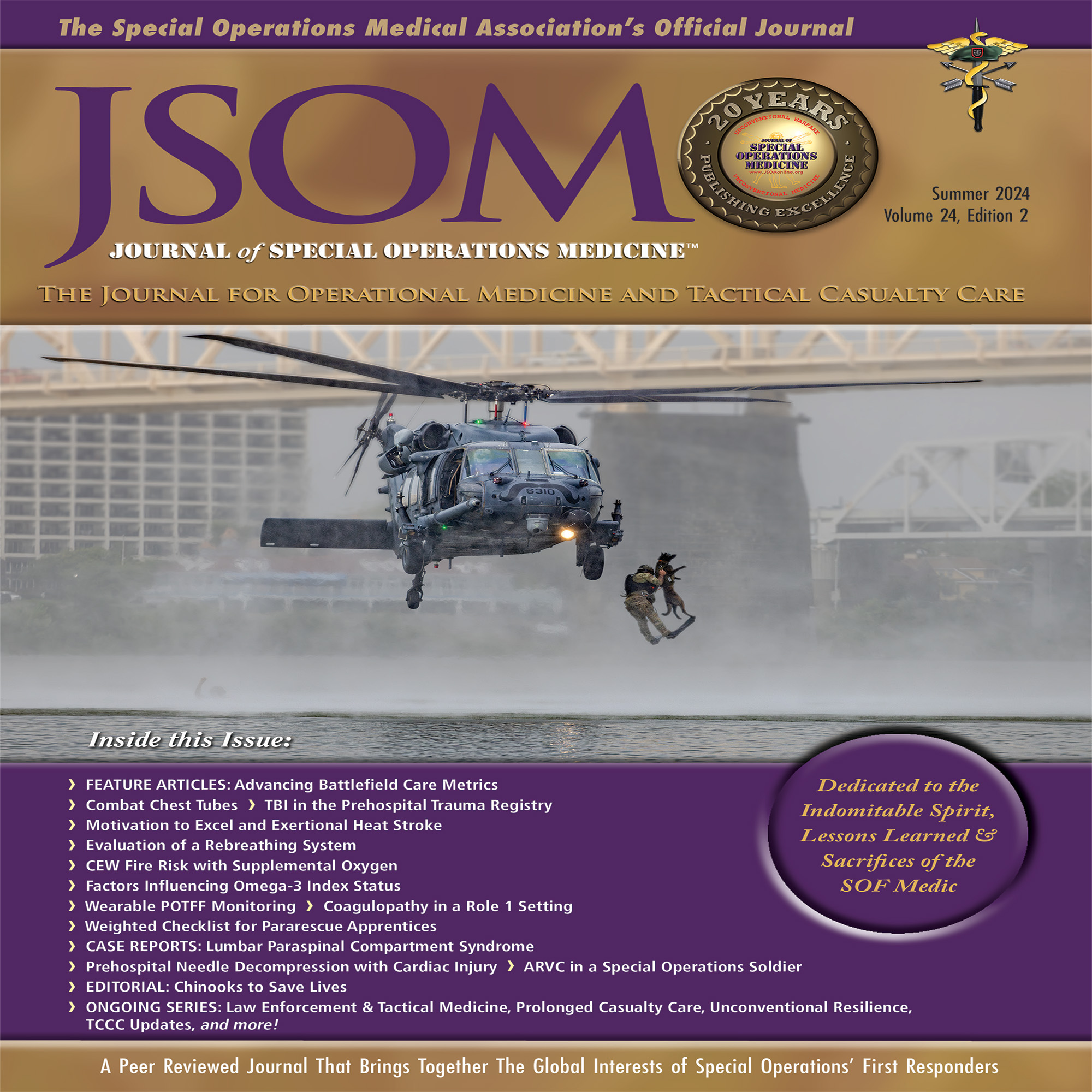
Hello again. This is Dan Godby, Medical Editor of the Journal of Special Operations Medicine. Thank you for joining us for the summer edition of the JSOM podcast. For this introduction I will point out a couple of other articles worth reading. In addition to the three articles being highlighted in this podcast, the EMS director in me is coming out more in this introduction than ever in the past with the choice of the two articles I'd like to highlight. First is the case study conducted electrical Weapon Fire risk in the presence of Supplemental Oxygen. This experimental study takes a look at ignition from conducted energy weapons in an oxygen rich environment. It has specific relevance to law enforcement and ems, particularly tactical medicine support. Second is needle decompression, complicated by cardiac injury in a pre hospital environment. This case emphasizes the importance of understanding the landmarks of performing needle decompression and will aid in increasing the procedure's efficacy and reduce iatrogenic complications. Finally, please be certain to note that the TCCC updates and statements appear in this edition. As always, we at the JSOM really do want to hear from our readership, particularly those of you in the front level positions. I will always take this opportunity to reiterate our mentoring program specifically created to help medics get through the publishing process. A select group of editors are dedicated to concentrate on articles submitted by medics and aid in getting them published. Now here's Alex and Josh with the podcast.
- [02:18]
B
Well Josh, people usually annoy the heck out of their listenership by opening all of these podcasts with weather. So let's just say it's hot and move on to something more interesting. What do you think?
- [02:27]
A
I hear it's rainy some places too and there might not be power. I don't know if that joke's going to land anymore when we publish this thing. Goodness knows this will come out six months later. So for real.
- [02:38]
B
Well, moving on. So I had a really interesting experience lately at work with one of the surgeons who has been very dogmatic in black and white about some of the specific tasks that surgeons shall only perform and have been very dogmatic about what PAs in surgery shall not perform. And that particular surgeon really toed that line for the last several years until of course, they were encumbered because they had to leave on a Friday to go on vacation, in which case they said it was totally okay for me to do this thing. And as terrifying as it was, you know, we accomplished the mission. And it really got me thinking about a lot of the conversations that are going on now, especially in related to prolonged casualty care and that sort of thing where you've got a lot of folks within the echo chamber that are screaming about medics or PAs or whatever the case may be either never doing something or should always do it and should practice it on a routine basis. Here Kona Stateside I think the more nuanced conversation that we should probably be having together is there are higher risk scenarios in which probably we should extend the scope of practice of some of our additional personnel because otherwise it just won't happen. But that doesn't necessarily mean that those same tasks or qualifications need to be recognized on a routine basis because certainly here when we're home stationed, there are more appropriately trained, qualified and resourced personnel to do high risk medical interventions or whatever the interventions may be. But I think it's certainly a much more nuanced conversation than I'm certainly hearing in the echo chamber. What do you think?
- [04:21]
A
Yeah, I love this conversation because remember my time as a medic when they said to me I could only do so much and then I was like, well, I'm going to go be a flight medic. And then that only opened it up so much and then all this other stuff. But you always heard those instructors during that time talk about if you're alone and afraid on the top of a mountain, are you going to try to do it or not do it? But that opens up the gulf. They say, well, you can do it in these certain circumstances, but I'm not actually going to teach you or train you or sustain you to do it here under some simulation or other method of teaching and training. I really think you make a great point. We need to stop talking in absolutes. We need to start talking in continuums. We even label conflict in a continuum of various phases. It's not we're in a shooting war or we're in peace. There are multiple gradations between that. And I think we really need to focus, as you've said, on the gradations. And if we're going to say that you can do it in certain circumstances, we need to build the structures policies and procedures to train and sustain that here in the States.
- [05:33]
B
Yep. Well, we of course are always interested in the feedback, opinions and insights of the listeners here out there. So tell us what we got wrong about that. Remember, it's podcastsomonline.org or I'm sure somebody out there is monitoring some of our social media feeds and could let us know if there are any out there. I'm not sure. Well, moving on. Which article have you got for us this edition?
- [05:58]
A
Well Alex, the first article we're going to review today is the Effect of Critical Task Auto Failure Criteria on Medical Evaluation Methods in the Pararescue Schoolhouse from the authors Ian Richardson, Dr. Stephen Rush, et al. The authors of this article wanted to test an alternative with weighted checklist evaluation method versus the traditional checklist method of testing in the environment of Air Force pararescue training. A traditional checklist allows for only one error on the checklist, with a second error causing a failing event regardless of the relative importance of the subtask and is unable to trend student improvement over time. The authors say that the alternative weighted checklist is instead had a passing score of 70 over 100 points and was better able to trend students progress over time. It also allowed certain auto fail tasks that were weighted more heavily than other what they would call unimportant tasks. The authors hypothesized that the alternative weighted checklist would more appropriately emphasize critical tasks, but they were concerned that auto failure points would increase rates of failure. So the authors developed a study that was a post test only, no control design. The testing was done on pararescue day single poly trauma scenarios and approximately 168 individual medical scenarios were evaluated. They discovered that there was no significant difference between the traditional checklist and the alternative weighted checklist pass rates during their practice scenarios. So the investigators concluded that the alternative weighted checklist did not increase rates of failure versus a traditional checklist. But it's unclear if the alternative weighted checklist actually emphasized those critical tasks of which the authors were so concerned about. At least it wasn't demonstrated in their data. You have any thoughts Alex? Give me what you got.
- [07:59]
B
You know, this is just another reminder about what a great approach our Air Force colleagues have from almost a business mindset about this continual quality improvement for their educational pathway. And I really applaud the fact that they shared this data. And despite it being a negative study, I think it still adds value to the body of literature. And the rest of us should really consider both the specific approach that they looked at of this traditional checklist versus the new modified. And also just the fact that they're continuing to tweak their schoolhouse I think is definitely worth commendation.
- [08:32]
A
Yeah, they wrote a lot more in the article about methods of evaluating students and interesting tables and figures, so you should go read the whole article. So Alex, this article we're going to review today is evaluating of a rebreathing system for use with portable mechanical ventilators by Thomas Blakeman, Maya Smith and Richard Branson, all out of the University of Cincinnati. In austere settings, supplemental oxygen is difficult to come by. However, anesthesia providers have been using CO2 scrubbers for decades. These scrubbers, through a chemical reaction, remove CO2 from the circulated exhaled gases. The authors wanted to test a closed circuit system that allowed the rebreathing of gases while scrubbing CO2 in conjunction with mechanical ventilation. In a bench model. Investigators used 731 and Save Tube ventilators and tested them with two test lungs, one with normal compliance and one with poor compliance simulating ARDs. They tested the ventilators with several settings and under multiple elevations. They also simulated the consumption of oxygen in the lungs by adding nitrogen in the simulated lung. And they further tested the impact of suctioning the system and change in FiO2. Lastly, they introduced oxygen flows of 1 and 3.3liters per minute into a 3 liter reservoir bag attached to the ventilator inlet and made the following peak inspired oxygen concentration within 30 minutes peak CO2 absorbent life which was determined by the rise of CO2 greater than 1%, peak delivered gas, temperature and humidity and other items which you can review in your reading of the article. So for results, the FiO2 of both the 731 and the Save 2 were not significantly impacted by ventilator settings. Meantime of CO2 elevation was noted to be longer in those with scrubbers than without, but across all the scrubbers there was no significant difference between them. Lastly, in relation to suctioning and disconnect, the FIO2 was noted to be it took me a long time to understand this Alex, and I think you and I talked about this offline is that if you disconnect the circuit for a long period of time and don't supplement it with oxygen, it takes longer for that oxygen concentration to come back up. The longer you have it disconnected or if you give it a lot of pre oxygenation, then the circuit either maintains its FIO2 grit for longer or it comes back to baseline quicker. That is essentially what happens with that.
- [11:13]
B
Yeah, which makes sense from a physics perspective.
- [11:17]
A
I would say so. So the authors conclude that in this bench top study that they can use low flows of oxygen, 1 to 3 liters, a CO2 scrubber, and they can use these two items to maintain high levels of delivered oxygen greater than 90% to a test lung. And while that's all well and good, this is still just a benchtop study. It's not even an animal model and so a lot of further testing is going to be needed, but it's a promising first start. What do you think?
- [11:48]
B
Yeah, I really applaud the authors for trying to be rather creative and ingenious with their existing equipment in a resource constrained environment. And I think if I remember from the manuscript they even were using like some 3D printed parts to again just accomplish the mission. I sure as heck would not be excited about using this in the hospital. But boy, I think if this was, you know, the contingency or emergency part of your pace planning and you ended up needing it, I'd be pretty excited to have something like this. And again, I just really applaud the authors for their efforts to try and fill a niche with some creativity and at low cost. And to wrap up the podcast with our Deep Dive, we have got the article that should be hitting the press here soon. It's called Adventure Advancing Combat Casualty Care Statistics and Other Battlefield Care Metrics. And the author list. We don't normally read out the entire author list, but I think you'll appreciate why we're going to today. So it's Dr. Judd Janik, Dr. Russ Kotwell, Dr. Jeffrey Howard, Dr. Jennifer Gurney, Dr. Brian Eastridge, Dr. John Holcomb, Dr. Stacy Shackelford, Dr. Robert Lorenzo, Dr. Ian Stewart, and Dr. Edward Mazachowski, who, as you all know, are the legends within military trauma surgery. And they also happen to be the same individuals who for the last 20 years or so have really been driving our data requirements, recommendations and analysis and so forth. From their abstract, what they write is that aggregate statistics can provide intra conflict and interconflict mortality comparisons and trends within and between US Combat operations. However, capturing individual level data to evaluate medical and non medical factors that influence combat casualty care mortality has historically proven difficult. The Department of Defense Trauma Registry, developed as an integral component of the Joint Trauma System during recent conflicts in Afghanistan and Iraq, has amassed individual level data that has afforded greater opportunity for a variety of analysis and comparisons. Although aggregate statistics are easily calculated and commonly used across the DoD, other issues that require consideration include the impact of individual medical interventions, non medical factors, non battle injury casualties and incomplete or missing medical data, especially for the pre hospital and forward surgical care needed, are novel methods to address these issues in order to provide a clearer interpretation of aggregate statistics and highlight solutions that will ultimately increase survival and eliminate preventable death on the battlefield. Although many US Military combat fatalities sustain injuries deemed non survivable, survival among these casualties might be improved using primary and secondary prevention strategies that prevent injury or reduce injury severity. The current commentary proposes adjustments to traditional aggregate combat casualty care statistics by integrating statistics from the Department of Defense military trauma mortality review process as conducted by the Joint Trauma System and the Armed Forces Medical examiner System. So Josh, not really any prospective or retrospective research here, but more of a thought from the true leaders within our community about what some of the gaps have been when they try to improve survival on the battlefield. What did you think about this manuscript?
- [15:45]
A
You know, I really appreciated the thought that the authors put laced in trying to remind us that gathering data and analyzing data well is what will actually make a huge difference on the battlefield. And while our civilian counterparts are able to capture this data because of EMRs and bright lights and power and all the things that make civilian medicine able to capture it in, in the heat of battle, it's, it's almost impossible to, to capture it. So I really appreciate them trying to look at what we've done in the past and try figure out new ways to do it.
- [16:23]
B
Yeah. And because this is such a critical component for all of us to be able to accurately understand what our soldiers, sailors and airmen are dying of, we've actually gone through this article with a fine tooth comb and we're really excited to have a number of the authors to ask some further questions of. Well, very excited to have two of the hard hitting authors from a very prestigious list of authors for this article to give us some more insight into this very interesting opinion piece. Welcome so much to the show. Dr. Yannick.
- [17:06]
C
Hi, thanks for having me.
- [17:08]
B
Oh, pleasure as always. And Dr. Mazachowski, so nice to finally meet you on the show. Thanks so much for joining us today.
- [17:15]
D
Greetings and thanks for having me as well.
- [17:18]
B
So maybe you guys could each just give us a quick summary on kind of what your background or area of expertise is and how you came to be involved with this very interesting project.
- [17:28]
C
Sure, I'll start. I'm an epidemiologist by training. I've spent a fair amount of time doing research regarding traumatic injuries, including traumatic brain injuries, genitourinary injuries, and got involved with the Joint Trauma System heading their epidemiology and biostatistics team. And that's where I met Dr. Mazachowski at AFME's. And we were both working on the initiative at the time, which was part of the NASIM Report for Milsiv Partnership on reducing preventable death from traumatic Injuries. And we were tasked with coming up with a methodology to identify potentially survivable, potentially preventable deaths from traumatic injuries sustained in the military. So that's my background, and that's sort of what led us together and part of the story of the paper we'll be discussing today.
- [18:24]
D
Yes, in my background, going back just a little bit, I went to University of Notre Dame, where I was a mechanical engineer through rotc, took an educational delay, went on to obtain a master's and PhD in biomechanics, and then following that went to the Uniformed Services University of the Health Sciences for medical school. After graduating from medical school, I did an internal medicine internship, followed by anatomical clinical pathology, followed by a forensic pathology fellowship. And since 2006 to 2021, I was associated with the Armed Forces Medical examiner System, looking at how individuals had died, looking at ways to prevent those deaths through multiple individuals, working with Dr. Cotwell for a long time. And then in 2017, my last assignment in the military to 2021, I was assigned as the Armed Forces Medical examiner Systems liaison to the Joint Trauma System and had the great opportunity to work with Dr. Jannik, who had come on board late, Dr. Joel Stockinger, who had put together a lot of work, what we had gone forward, and then other individuals that have been there, you know, Dr. Kotwell, Dr. Gurney, Shackelford, Holcomb, Eastridge, and multiple of the other individuals. So that's really where all of this comes in. And then the individuals also from the Armed Forces Medical examiner System over the years, where it started with Dr. Holcomb and Dr. Caruso in one of the first papers, where they were looking at case fatality rates and how you can use information from autopsies to delineate what injuries are which may or may not be survivable, and then how do you prevent death?
- [20:01]
B
Yeah. And Dr. Mazachowski, those of us in the community have certainly enjoyed what were your annual updates at the Special Operations Medical Association Conference on mortality reports based on your data and how they apply to the special operations community to improve outcomes for our tip of the spear warfighters. Before we started recording, you mentioned that there is finally, after many, many years of hard work from a number of great people, a really interest publication that members of the community may be interested in reading That I believe came out in the Journal of Trauma. Would you care to share with us some insights into why that's important to the community?
- [20:40]
D
Yes. Just recently there is an article that was published by the journal Trauma and acute care surgery. Dr. Gurney, Colonel Gurney was the lead author on it. And then Dr. Colonel Andy Rohrer, who is now the Armed Forces Medical examiner, was the last author on it. And then multiple individuals that I had already stated were on it. And what it was was a trauma expert consensus looking at capabilities required to improve survivability of the individuals. So as we have given those updates on the survivability or how individuals are dying, especially in the SOCOM community, this took it a step further and looked at those specific injuries that that individual had and what capabilities would have been necessary to have that individual have the potential to survive or to make a different outcome. So it was one of the first studies where we've taken all the way of seeing what that individual was, what the circumstances were, defining what the definitive injury was that led to that individual's death, and then now incorporating what capabilities were at hand at the time. And then what capabilities may have been able to be given to that individual, and then if there are, what future capabilities may have allowed that individual to live.
- [21:52]
B
Holy smokes. That seems incredibly important. For those of us all who care dearly about bringing our brothers and sisters home alive with a high quality of life, I would encourage everybody to work through your chain of command, because I'm sure that your battalion surgeon or PA has access to a digital copy of the Journal of Trauma through their mtf, and they can get that for you. But what a great segue to your particular article that was published in this edition of the Journal of Special Operations Medicine. And we were hoping maybe the two of you could give us a little bit more insight about what the gap in the current literature was that you and your colleagues identified as needing to be filled by your current opinion piece. And you may have already touched on that a little bit.
- [22:40]
C
Yeah. So I think just briefly in terms of background, as we mentioned, under the leadership of Captain Zolt Stockinger at the time, who was the director of the jts, we were initially tasked with coming up with the most robust methodology possible to make determinations on survivability, potential survivability, and potential preventability of death specific to military trauma. So we went through a whole exercise of systematic review of the literature, qualitative studies, interviewing pre hospitalists, trauma surgeons, emergency medicine physicians, to kind of come up with factors that would need to be a forensic pathologist, you know, identify different factors that would ideally be captured so that you could make the best determinations possible. And those determinations would be used to inform future research to improve survivability and inform policy as well. And so as we went through that and began, came up with the methodology, began to implement that methodology, we began to implement those, come up with determinations for the SOCOM fatalities. And one thing that kept coming up was the use of the case fatality rate traditionally to try and inform military medicine. Case fatality rate is a great measure, aggregate statistic of overall lethality on the battlefield. It is specific to battle injuries, so it doesn't inform anything on disease, non battle injuries. And it also we identified, didn't take into account differences in whether the injury was survivable or not. And so we felt to try and better inform military medicine, it would be helpful to incorporate the determinations from the mortality reviews, which are measures of potential survivability of the injuries and potential preventability of the death. Because you know, again, with the CFR just being an overall measure of lethality, the question always is if the CFR goes down, how much of that is attributed to military medicine versus other non medical factors. And the metrics of potential survivability and preventability help get at those understandings because potential survivability doesn't take into account the non medical factors, it just assumes, assumes that all of the available medical care, including where the injuries are located and optimal care throughout the continuum would be provided and just focuses on the injuries themselves, can they be survived? And the preventability component takes into account some of the non medical factors themselves. So maybe optimal medical care was delayed or prevented for non medical reason, osteoenvironment, where the injury occurred, lack of certain resources, et cetera. And so by incorporating those metrics within the CFR you can start to get a better understanding of oh, this is an opportunity where there weren't non medical factors intervening the injuries were survivable. So there's some opportunity through a CPG and intervention training leadership to specifically medical capacity to make an improvement or no, we would need some sort of non medical improvement in order for the injury to be either deemed survivable or to prevent the death.
- [26:02]
D
So one of the biggest, you know, as we had in the beginning, one of the biggest gaps are when you first look at an individual that's either killed in action or died of wounds and you don't look specifically at what the mechanism of injury, so what caused that injury and Then what the specific injuries are is then when you have difficulty comparing from event to event or from conflict to conflict. So as the state, for example, if the individuals that die all have what we were calling catastrophic tissue destruction from either a blast or a aircraft incident, those individuals never have the chance to survive. Which is very different from if an individual has a gunshot wound, because that gunshot wound can be a gunshot wound to the head where there's catastrophic damage, or a gunshot wound to the lung where given medical care, that individual should live. So that is really the difference when you look down at the granular level for injuries. And that's why we say injuries are either survivable or non survivable. So in those two categories, you have that catastrophic tissue destruction, that's a non survival injury. But that gunshot wound to the chest hits the lung, yes, you may die, but depending on where and what structures it's hit, depending on where you are next to medical care, you may have the survival injuries. And so that was one of the big gaps of delineating out to this individuals that lived, individuals that died, and then putting down the very specifics which came down to does that individual have injuries that are either survivable or potentially survivable?
- [27:42]
B
Yeah. Fantastic. That makes a lot of sense about why there was a gap in the literature. And Dr. Mazahowski, how does your proposal for higher fidelity data fit within the forecasted LISCO environment? It sure seems from the outside that a high op tempo theater would have challenges providing robust granular data for you.
- [28:06]
D
Correct. The highest tempo can have issues for the most granular data. And so when we're going forward with this granular data, part of it's going to be relying on technology as much as we can to get as much from that individual of what their injury is, what injury type they have. And the other aspect of it is there may just be a part for depending on what type of mission is, depending on where there are, there may be representation of those individuals. So in a LISCO environment, all the individuals will be identified, but they may not have a complete autopsy, or they may not have this delineation due to the op tempo of every single injury, as we were able to do in this case. So that really makes it so that we have to rely on maybe future technology to be able to have a ability to capture that data, but then also the methodology to be able to look at that data for once everything comes back. So it is not dissimilar to the Bellamy paper, which I think most people are aware of. Which was made on an aggregate as well. So when you had those original numbers for the percents of individuals that died of a pneumothorax, those were all extrapolated. They weren't on every single individual. So there was some extrapolation of the data. Again, to make decisions, you want to have the most granular data as possible, but in a listical environment it may be that you cannot have that for each case, however, there may be some very directed ones. If either something may be changing or there's a question that's being asked you, you may be having very direct and granular data on certain instances or certain areas or situations.
- [29:44]
B
That's a good point. Well, how about looking at conflict from a different approach? So if we continue to see what in my opinion is more likely, which is the ongoing conflicts of the near future, which are more proxy warfare and gray zone conflict, how could we help facilitate getting you and your cohorts these important data sets, given that OPSEC and the operational environment often precludes this level of data visibility to hire.
- [30:17]
D
Yeah, I think that data visibility for all individuals may be a little bit precluded, however. And whereas you're saying for proxy that data is still able to be captured, still able to be captured by the armed forces medical examiner and the joint trauma system. Sometimes that may be at a different classification level, but you are still able to identify that data. You are able to identify, if necessary, de identify but still identify as was done, what the exact injuries are and then what capabilities or capability gaps exist. And that can at least get back to that operational commander, to that unit on the ground. And then when you are able to, or if you either have enough information so it can be de identified or you're able to bring it back to a lower classification, is to get that information back forward. But the important part is to still collect the data of those individuals, both how they're if the individual is wounded or if they are killed or deceased, to be able to still have that granular data. There are everything is in place now and it was currently and even in the prior conflicts to be able to capture that data, even if it's necessary in a higher classification level.
- [31:28]
B
Well, thanks, that's really helpful. I'm sure I'm not the only one who wasn't aware of that. Speaking of decedents, which are a terrible, terrible cost of conflict, but also give rise to the data set to help us improve the future warfighter survivability, if we find ourselves in a LISCO environment, what would you propose as a pace plan for medical examiners to have access given to decedents. Given that we would expect probably lift capability for return to CONUS is going to be maximized for injured service members and we wouldn't have the capability to return Eagles to conus, where I think most of those facilities are.
- [32:10]
D
Yes. So currently right now, everything does come. You know, any individual that is deceased will come back to conus. Most, you know, most of the time it'll come back through the DOD's port mortuary, which is in Dover Air Force Base, which is the same place where the Armed Forces Medical examiner system is. If you look at prior conflicts, the preparation of that individual, some of it was done in the theater of operations. And there was another port mortuary that's no longer in existence, that was in California and then some also did come through Hawaii at that point. So this question is a question that I know that the current Armed Forces Medical examiner and the Armed Forces Medical examiner system is looking at. And how do you interact with both the 1 and the 4 from both the logistics standpoint and the personnel standpoint of one correctly identifying who that individual is so that we have a complete accounting of all individuals and then for what that individual's, what we call the cause and manner of death of that individual to have enough information to be able to determine the cause and manner of death or what the individuals are charged with. As we look forward to try to get more granular data, we're looking beyond that, looking at what the mechanism of injury is and then what those possible injuries are. Again, as you stated, you may not have an individual that is far forward, but there may be some techniques, as I said, maybe technology, a computer tomography. There can be some possible 3D mapping, 3D scanning of the individual, again depending on the environment, that may in the future be able to get you more information for how that individual died. And it still goes back to everything we had talked about over the past two decades when we talk about, you know, for that individual, that first responder, that medic on the ground is improving or making further solutions to be able to identify exactly what injuries that individual has. So I know it's, it's not out there yet, but it's almost, you know, something like a scan, if you go back to Star Trek, like a tricorder, a scan that you can look at the individual and say this is exactly where their injury is. This is the artery or vein or the vessel or the organ system that's injured. And as that technology moves forward that will be able to be used for individuals that are looking at and individuals that's deceased as well.
- [34:31]
B
That's a really insightful and obviously well thought out response. Thanks. And I guess we'll ask our last question with you guys, which is you keep foot stomping just how incredibly important this particular data is in improving future survivability for our war fighters. So given that it comes as a surprise to no one listening that the current data collection systems across the military enterprise are inconsistent and involve far too many silos that are incompatible and don't communicate, have you considered how we could improve the needed data collection to improve your proposed data sets?
- [35:11]
C
Yeah, I mean I think for me more on the analytics side of things, it's to Maz's point, the opset consideration is very real, but in real time and as appropriate at the appropriate security level, the needed information just needs to get into the appropriate hands. And if that's not for public consumption in the current time or potentially ever, that's fine as long as that information as expeditiously as possible makes it into decision makers hands. And what we tried to do over the last several years is identify all of those factors including considerations for things that could be aggregated to a higher level, certain non medical factors so that they would be potentially less sensitive and more rapidly disseminated as needed to the appropriate stakeholders at an aggregate level. So I think whatever system they need to be in, we have a general idea of what those those data points are. What we were missing largely is because most of the deaths occur in the pre hospital setting is the most granular information in the pre hospital setting. For obviously the number of complexities that happen in the pre hospital setting that's very difficult. But there's been leaders in the field through the TCCC committee, Russ Kotwal, Frank Butler, large listen of people who have made that a priority to improve the collection of those data elements. And we saw those improvements in real time which allowed us to do many of the analyses to make informed recommendations over the last several decades. The last thing is there's still obviously areas for improvement and data collection in the hospital setting because specifically what interventions were done at what, what times by which specific individuals the capabilities at any given facility at any given time as those change over time, obviously differences between the theaters and operations and being able to capture that the system level as well as individual level factors are very important for making those decisions. The service members that have injuries that are severe enough to be potentially fatal, that make it alive to a Level one trauma center capability, surgical capability. Luckily over the last two years were relatively small in comparison obviously to the pre hospital fatalities. And so even though there are several hundred, the complexity of those means that there are often many cases that are relatively unique into themselves and require a deep dive to find fully understand them. So you have to have the mechanisms in place to capture all of the various nuance throughout the continuum of care. Because whether it's prehospital or hospital, sort of the continued theme that we hear is that time is so important. Time to getting blood, time to identifying the injuries, time to a surgical capability. We have to decrease that time as much as possible if we want to improve survivability and preventability of death.
- [38:17]
D
I would add to that, as we know as you go forward, this in just things that were done from both Dr. Butler going with TCCC and Dr. Cotwell going with the Ranger Regiment is it needs to be placed in policy. So this ability to collect data needs to be placed in policy. It needs to have that language and it needs to be funded so that it continues to be a program of record. And as Dr. Mabry has always said, it has to be down to the commander's responsibility so that commanders understand that this data is very useful for them for multiple reasons to say the effectiveness of what's happening on the battlefield to their tactics, techniques and procedures, but then also to be able to capture this back for the medical side for those individuals. So I think that last part, as it's been for multiple ones, is making sure that it's written in policy so it can be funded and it can be an enduring capability as it has been as the, you know, the joint Trauma System had stood up, the Armed Forces Medical examiner. But having specifically written that this mortality review and looking at this, has that policy written for it.
- [39:25]
B
Well, gentlemen, thank you so much, first and foremost for all of your tremendous efforts to the community to again improve the data so we can improve soldier survivability. And then also taking the time, along with your esteemed colleagues, to put pen to paper and share your opinions in a really well organized paper that I think lays out a great case and also has some excellent proposals. I hope everybody takes the opportunity to read your particular article and of course, always give us feedback. Dr. Yannick, Dr. Mazachowski, thank you again so much for your time and insight. We appreciate your efforts here.
- [39:59]
D
All right, thank you very much. Have a good day.
- [40:01]
C
Thanks for having us.
- [40:08]
A
Well, Alex, I think that wraps it up for the 2024 Summer JSON podcast I just wanted to say it was really nice to see everyone at SOMSA this year. I got to meet some old friends and make some new ones and hear from some really powerful speakers. Really helped me crystallize why I do this, who I'm doing it for, and new and better ways of doing things. So thank you all for coming out there. It was really good to see you all and I can't wait to see you next year.
- [40:39]
B
Yeah, SOMA is just a phenomenal opportunity to remind ourselves about the community that we all serve alongside. And for folks like you and I, Josh, that are getting older and fatter and losing our hair, it's a really great opportunity that there's the next generation yet to come as you and I transition out. And so I'd like to end with a quote from the book Guerrilla Surgeon when he said, but the good old days when offensive action and guerrilla warfare were the whole of the struggle seemed to be dead, more and more equipment was coming into the country and less and less fighting was going on, which I think may be where you and I are are in our career. And just a plug that the Special Operations Medical association did get Gorilla Surgeon reprinted and it should be available in the store soon. And if you have not yet read it, please correct that because it is just a phenomenal tome about a different time and place in combat which we all may see again in the near future.
- [41:46]
C
This is Sophia Rodriguez, Director of Marketing and Social Media Communications for the jsom. I want to encourage our listeners to
- [41:53]
B
follow us on Facebook, Instagram, Twitter and
- [41:56]
C
linkedinline and to sign up to receive
- [41:58]
B
our free e. Newsletter on our website@jsamonline.org
- [42:03]
C
we love hearing from our subscribers and followers and welcome your feedback and suggestions.