Loading summary
Transcript31 lines
- [00:11]
A
Welcome to the Journal of Special Operations Medicine. I'm your co host, Jessica Rodriguez.
- [00:16]
B
I'm Sydney Duke.
- [00:18]
C
And I'm Matthew Farinella.
- [00:20]
A
And this is where evidence based medicine meets unconventional warfare. This is Sophia Leishman, Director of Marketing and Social Media Communications for the Journal of Special Operations Medicine. You can find us on Instagram, Facebook, X LinkedIn, and ThreadsaseOnline. Subscribe to our biweekly newsletter@jsomonline.org and don't forget to subscribe, review and rate this podcast on Spotify.
- [00:49]
D
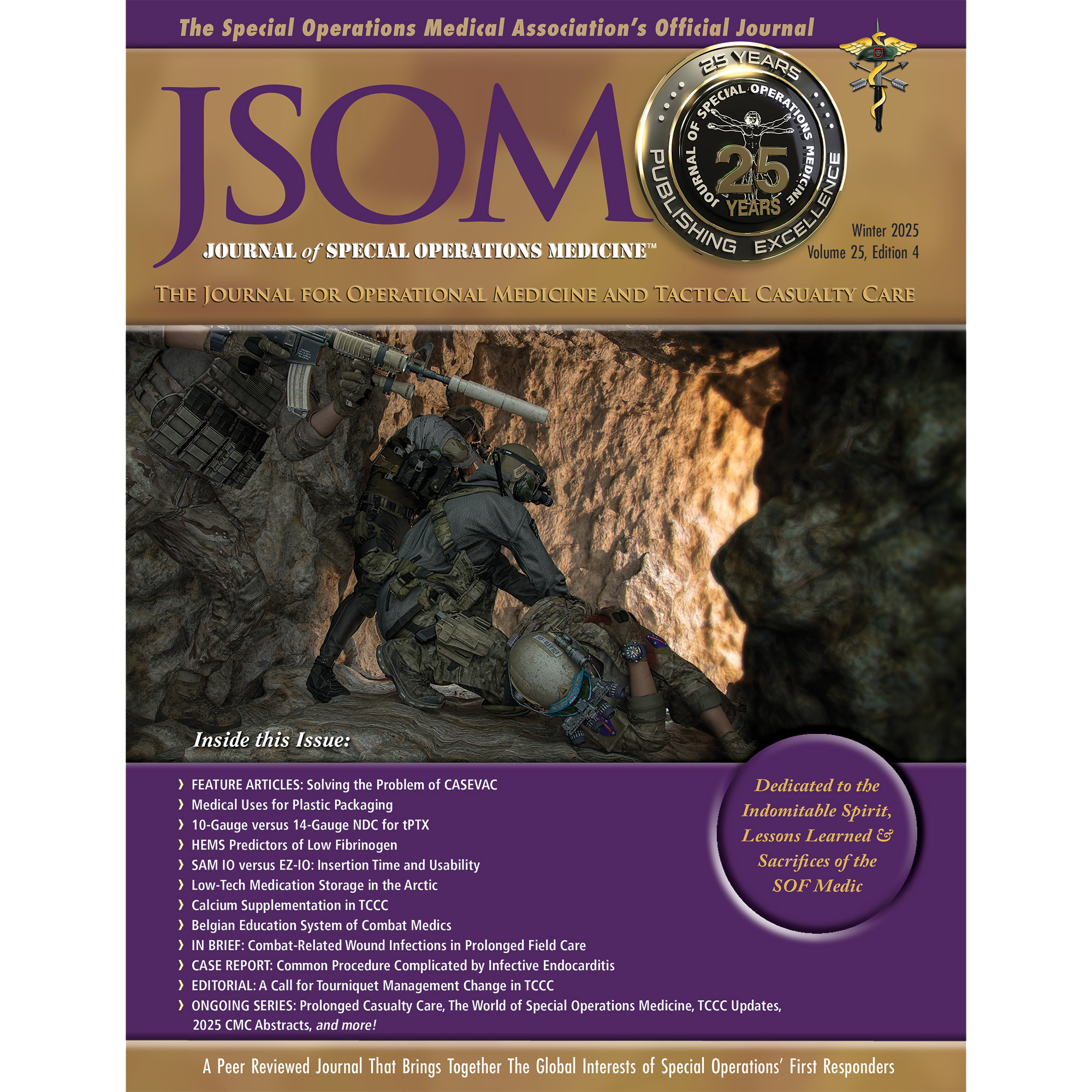
Hello again as usual, this is Dan Godby, Medical Editor of the Journal of Special Operations Medicine. Thank you for joining us for the winter edition of the JSOM Podcast. For this introduction, I will be highlighting another article worth reading. In addition to the three articles being highlighted in the podcast, the article titled Ruck Truck House Plan Application for the Management of Combat Related Wound Infections and Prevention of Multidrug Resistant Organism Spread in Prolonged Field Care Scenarios is the model that will continue to influence the future of combat medicine, especially in the context of prolonged field care. This article offers a relevant perspective on these concepts through the lens of infection. We need to pay more attention and highlight the wound care side of this and the associated microbial considerations. This is a timely paper given the small wars currently in the world with the associated mass contamination and the need to start care as soon as possible. We need to talk more about multidrug resistant organisms since prolonged field care is growing in prominence along with its associated difficulties in planning secured logistics and evacuation. This article also bears relevance to the TCCC Antibiotic Update that is included on page 40 of this winter edition of the JSOM. As always, we at the JSOM really do want to hear from our readership, particularly those of you in the front level positions. I will always take this opportunity to reiterate our mentoring program specifically created to help medics get through the publishing process. A select group of editors are dedicated to concentrate on articles submitted by medics and aid in getting them published. Now here's our team with a podcast.
- [02:53]
A
Hello everybody, welcome back to the JSON Podcast and Happy New Year. We are coming at you with the Winter 2026 podcast. We have three great articles for you today and we are so excited to share with you a little bit about what we're all doing. Matt's just happened so I will be at BAMSEA next year doing an intern year in General surgery and I know a couple of us are all spread out. So Matt, if you want to just tell us where you're at and what rotation you're doing right now. That would be awesome.
- [03:23]
C
Yeah. Jessica, Happy New Year. I'm currently on my pediatric rotation still here in Auburn, Alabama, at eamc. Just kind of looking forward to getting the audition process started here in the next few months and getting ready for the next round of what's to come.
- [03:43]
B
Yeah, same over here. I'm in San Antonio, Texas, currently doing a rotation in inpatient psychiatry. And same as Matt, just kind of applying and getting ready for these audition rotations that we'll be doing this summer. And, you know, we're just a year behind Jessica, and I'm looking forward to see what's ahead. And I'm well rested from the break, so that's exciting.
- [04:10]
A
Yes. That's so great to hear. I'm in my emergency medicine rotation right now, and it is my first rotation back from surgery, but I only have, like, two more months left of school. So y' all will be in this boat next year. It is, like, smooth sailing after. But, yeah, for those of y' all who are unfamiliar with, like, the military match process, we send out a bunch of emails in December, and we kind of shoot emails to all the different programs that we can go to once we've decided what we. What we want to apply, and then we hear back and schedule it for the next year, for fourth year. So fourth year is really fun. You get. You're doing a lot of what you love and just finishing up all the prereqs or not prereqs, but the requirements for medical school. Do y' all want to talk a little bit about what y' all are thinking about applying?
- [04:52]
B
I know that I will be applying obstetrics and gynecology, but in the military, we kind of refer to it as gynecology surgery and obstetrics. So I'm excited.
- [05:05]
C
Yeah. Just kind. I'll be attempting to apply for orthopedic surgery this next cycle. So I'm super excited and looking forward to it. And it's just. It's awesome to think about how quickly the last two and a half years has come and how quickly that next December is coming and Sydney and I's match is coming.
- [05:24]
A
Yeah, absolutely. It flies, and I feel like fourth year just, like, flies by and you blink and you're about to graduate. So really soak it in and enjoy it. I know third year is a hard year, but y' all are doing great, and y' all are really on top of it, so it's going to be really exciting for y'. All. We have three great articles for you. We're going to go ahead and start off with one a little bit tailored to leadership. And if Sydney wants to go ahead and start us off and take it away, yeah, awesome.
- [05:48]
B
So our article that I'm going to start out with is Implementing Operational Skills in the Education of Combat Medics and Integrative Model. And this was by the Belgian Defense. The author is Warochire. I do apologize if I mispronounce that, but essentially I thought this article was really good to just apply to like life in general. I mean, it is about combat medics, but there's a ton of life lessons that could be learned from this. So essentially combat medics require broad medical, tactical and like leadership skill set. So there was this ongoing debate on whether or not prior clinical experience improves combat medic performance. So the Belgian Defense tried to implement a hyper realistic immersive training model in 2021 to identify if combat medics who had previously been EMTs would outperform combat medics who were not EMTs or did not have a clinical background in medicine. So, and they, they kind of looked at three different ideologies which was, you know, situational awareness, tactical decision making and intrinsic motivation. And the study kind of wanted to evaluate their. Well, their hypothesis was that the EMTs should outperform the non EMTs as a role of a combat medic. And so the study, they just wanted to see if that hypothesis was true. So essentially they did a longitudinal cohort study and they took 137 advanced combat medic candidates and about 62% were non EMT. And so they had, you know, throughout their experiment they had an entrance exam, they had teaching. So three weeks of theory, three weeks of practical simulation, and then a 72 hour immersive final exam. They were scored on their technical medical skills, clinical decision making, leadership, and then situational awareness and tactical safety. So in their overall performance, there was no statistically significant difference between EMTs and non EMT candidates in any theoretical or practical score in any of kind of those domains that I was talking about. And actually what I thought was the Most interesting was eight out of the nine top performers were non EMTs. And they, and all eight of these top performers scored especially high in the tactical leader function, meaning that they had, you know, strong situational awareness and tactical skills safety. So basically what this article showed us that, you know, your age, your EMT status and your military seniority was not predictive of success. What had the strongest correlation with success was tactical leadership and situational awarenesses. And so I thought this was really I thought this was really interesting. Just in my. I've never been a combat medic. I've never been an EMT either. But I'm a medical student, and I have several classmates. I mean, I have classmates who have been nurses prior to medical school, have been PAs. And I remember walking into medical school being a little intimidated and kind of afraid, like, how am I supposed to compete with, you know, people who have had decades or years of clinical experience? And really, it doesn't matter. I mean, you can. You can teach. You can teach anybody medicine as. As blunt as that sounds, but, you know, as long as you have a willingness to learn a coachability about yourself, you could teach people the medicine that they need to know. But what's harder to teach, I think, is that inherent ability of, you know, to be situationally aware, that inherent leadership skills, some of that stuff that people just have. And so I thought it was super interesting. And then I know Matt is. Is previously a combat medic for the Army Rangers, and I just was kind of wondering what his take was on this and kind of what. What he thought about this article.
- [10:01]
C
Yeah, I mean, I really enjoyed the article. I thought it hit a lot of good points and hit the realistic aspect of it and kind of you hit the nail on the head, Sydney, with, you know, in that intrinsic tactical awareness and situational awareness is vital to being successful in these roles. And I think that, you know, even from before doing any of the special operations medical training and stuff like that, going back to. To. To the combat medic school out at Fort Sam, you know, going through there, we had plenty of guys who were EMTs in their previous life, and. And, you know, they had a good knowledge base for the medicine, but they were still learning it at the same capacity at them. And it was not a predictor of their success in a tactical sense. You know, some of them were better tactically, but I think, you know, is that because of their previous experience or is that just because they have that inherent situational awareness? You know, I don't know. And then go moving forward, you know, going up to the schoolhouse at SWIC and doing, you know, medical course up there, you know, it's kind of the same thing. You know, you have people that have this prior experience, and ultimately it came down to just a willingness to learn in the environment that you were in. So, you know, taking the time to learn the medicine, like you said, and then having that intrinsic, you know, situational awareness and understanding of what's going on and understanding of the moving parts, because that is such a big part of, you know, casualty, you know, problem sets and eventually casualty evacuation, which will is kind of preceding into what I'll be talking about later. But like, it is just so important to have a, you know, sometimes have that 10,000 foot view of what's going on on the battlefield. And if you get that tunnel vision and are only focusing on the medicine, it can be detrimental to not only that casualty, but yourself and those around you.
- [12:05]
B
Awesome. Thank you, Matt. Like, I really think your perspective is quite unique and we're very fortunate to hear your perspective on this as well as, I mean, I think when we say we've said a lot here, situational awareness, like, people can be like, what does that mean? I have a really a clear example and maybe this will be helpful to any medical students that are out there. I once had a physician who I was with on a rotation, we were in a surgery and she told me, she goes, you're very observant because, you know, not to stick your head in the light like where the light is coming down on the patient. She was like, you know, not to put your head in the light so I can't see. So situational awareness, this doesn't necessarily mean you need to know, you know, the ins and out of, you know, of every small minute detail, but just being able to have the wherewithal to be like, you know, I, maybe I shouldn't be standing right here. This is, maybe I shouldn't be in the way. So I thought this article was, is almost inspiring to know that you don't have to be the smartest, you don't have to have the most experience. But you know, if you can be good at your job in other ways, you and, you know, be that leader and work hard at that, that you can still be success in these areas.
- [13:19]
A
When I first initially read the article, I was thinking that the outcome that people who have prior medical experience would end up thriving a little bit more. Just like you said for your example for medical school and for medical students as well, students coming in, I used to feel like I'm like, oh man, we have all these PAs in our school and stuff. There's so much more of an advantage, which I think that to an extent they are likely because they're good leaders. But a lot of the attributes of a good leader, like integrity and accountability and humility and communication, all that stuff is also just learned as life skills as well. And I think it's really cool because when you were speaking about it, it made me think about like officer training school in the Air Force and how the military really does try to foster environments to help you become a better leader. They give you opportunities to lead teams, to lead challenges, obstacles, and stuff like that. So not only like inherent leaders, but like you can build leaders as well. And I think the military does a really good job of building leaders in officer training school and just trying to reinforce all these great qualities. And with that we can move to the next article. I'm gonna jump in. I know I normally go last, but mine is rather quick and Matt does have the lead article for this edition, so we'll save his for last because it'll be pretty long and it's pretty cool. Mine I am going to be reviewing a prospective comparison of SAM IO versus Easy IO insertion time and usability during simulated vascular access. It is by Rachel Stiglitz, an AEMT Roberto Portella, an MD Steven Taylor, PhD and Juan March, MD. So for this study it was a prospective randomized EMS study. They took 106 EMS clinicians, paramedics and AEMTs and they simulated IO placement into porcine humeral bones. And they measured insertion time only, not including like any of the prep or any of the stabilization, anything like that. And they did post procedure, usability and confidence surveys. For those of you who do not know, a SAM IO is an IO that is manually powered driver and then Easy IO is a battery powered intraosseous electric driver. So the main result is that the Easy IO was faster, it had faster insertion times, it took around 1.1 second and seconds and then the SAM IO took around 2.8 seconds. So there was a statistically significant difference, but the time difference was less than 2 seconds. So ultimately, clinically, there's no real clinical difference. And then both of them had 100% success rates. They even compared people who had used easy iOS before and who had never used MIOS and it still came out that people were saying that both were easy to use. They both felt confident. Easy IO they preferred because of the familiarity of it, but ultimately it still had 100%, 100% insertion rates. So just kind of thinking about other factors that they were looking at. While the Easy IO is faster and it was preferred, it is non rechargeable. It has a set, it has a battery, so it has a set lifespan. And so once you've used it, you've used it. Whereas the SAM IO it's lighter, it was cheaper, you don't have to charge it. And a little bit about the price differences. The SAM IO is $179 versus $659 for the Easy IO. And then the actual IO needles was actually significantly cheaper as well for the SAM versus the Easy. So when you think about using these in austere environments, it makes actually a lot of sense to use the SAMs and to carry the SAMs. Just because of. You don't know how long you're gonna be out there, you don't want this battery to die when you need it the most. Even though an Easy is very commonly used. I know in ems, I have. I've never used a sim. I've always used an Easy. I thought they were very, very simple to use. And I know that they can be used for other different circumstances too. I think I read an article a while back of like, a case study of like a rule emergency department that needed to do burholes, but didn't have any neurosurgeons, like anywhere nearby. I don't remember the exact way that happened, but I know that it wasn't easy to. To actually create burholes. So I know, like, that's really cool. Advantages of having a tool that's like that and it's really small and like compact that you can carry. But it makes more sense to have a sam, I think. And so I was kind of curious what Matt, your perspective and like, what y' all used to carry and what in your experience with y', all, what y' all have.
- [18:20]
C
Yeah, Jessica. So, you know, we had a couple options. There definitely was a handful of people that had a liking to the Easy IO. There may have been a few of the SAM iOS floating around that guys would use, but I really didn't see that a whole, whole lot. I definitely agree that it is lighter and, you know, the. The lack of having to deal with a battery or an electric source running out at some point. Not that you can recharge this, the Easy IO, but just the fact that you never knew when it was going to be, you know, the last drill for it. You know, that that definitely increases the liking of a SAM IO. That being said, there are also the easy IO makes the hand crank iOS. I see a lot of guys carrying that. I know that they didn't. They were just speaking on the, you know, both of the guns in this, this article. But that was another option that that guys used. And I think, you know, where this article and they kind of talk about it on the practical considerations where this article, to me, you know, seeing the practical use of it is the SAM IO is great and everything the Easy IO is great and everything, but which one are you going to want to moving forward, looking at LISCO carry over an extended period of time, I think the SAM IO in cost and weight wise is really going to be ahead of the game compared to the Easy IO because I mean, when you, when it comes down to it, you know, ounces make pounds and pounds make a difference. When you're walking, you know, tens of miles on an offset infill or you know, to move to an objective, it's just, it can, can get cumbersome quick and you know, having the option of the SAM IO with multiple different needles, you know, maybe something that works better in the future, it just is going to take ultimately take time and medics using it and getting comfortable with it. I think guys are just comfortable with the Easy IO from what I saw. And so that was the, you know, propensity was to use those.
- [20:33]
A
I think that bringing that up, that the comfortability aspect of it, I think that they even, they mentioned somewhere in people who had never used Sam's iOS before compared to people who had used it before still performed at similar time time frames. So like it's fairly easy to pick up like one or the other. Doesn't really matter. So I think like you're right going forward, like kind of moving away and moving into things that would make it easier to carry would be like the SAM IO just for, just to take away some of the pounds you're carrying over time. And they also looked at the needle differences too and they found like no differences in needles after like randomization. So like really overall, like if, if it's easy to carry and it's easy to learn and we don't have to worry about a charger, like definitely I would say for a military combat perspective, like a samo, just a SAM IO just takes the win.
- [21:33]
C
Yeah, I definitely agree. I mean, it's just like you said, you know, it can be taught and learned. You know, so taking the time to learn it and spending a few training sessions with it and getting, doing some casualty situations where that's what you're using versus your traditional Easy IO kind of assimilates it into the aid bag and then you can go from there. I think that having the Easy IO around is still a nice benefit. I definitely think like putting it in a truck bag, if you do have vehicles, the ability to offload some of your med equipment into vehicles or even your walk kits for your, for your light infantry units and stuff like that, they can carry that kind of stuff or have it on the helicopters, you know, that, that I don't think that, you know, you're not, you're not moving over a long distance. So it's nice to have, if you aren't at risk for, for increasing your weight too much. So using it in those settings I think is still definitely feasible. But the SAM IO for those combat medics on the ground, boots on the ground I think is a great alternative.
- [22:42]
A
Alrighty. And that wraps up this article. And last but not least, we have a case evac article which is our lead article if Matt wants to just go ahead and take it away.
- [22:53]
C
Yeah, thanks Jessica. So this article is titled the Chicken Fox and the Grain Solving the Problem of Cassavac by George Barbee, dsc, EMPAC and Joshua Causey, mpsa. The gist of this article I think is looking at what, what near peer threats and, and medevac and casavac. It hits really the, the most vital parts of it and it's how we're going to handle that in a near peer threat. And looking at lisco, you know, how do we move forward from what we know as medical companies, as you know, strategic leaders moving forward, how do we revise what we thought and what we used and got comfortable with in Afghanistan, Iraq, Syria, our various theaters that we've been in for the last 20 plus years and look at how we're going to use it in fighting some of these near peer threats. So you know, they started off I think in a really good order of going back and looking at, you know, what we did do which was in Afghanistan, Iraq, Syria was the golden hour. So that's what most medics, myself included got accustomed to is having airframes available within the hour to medevac these casualties out and get them to a higher level of care. Because ultimately that's what everyone needs. As good as combat medics are, having surgical capabilities on hand is better. So you know, this article continues to kind of go through. It looks at not only Afghanistan but, and Iraq, but also looks at, you know, those past wars that we've had mass casualties where we've had large scale troop movements, dealt with large scale casualties. Now they didn't have the technology that we have today. So it was looking at it in a different capacity. So they went through and looked at, you know, World War II and how Cassavac and Medevac was done then you know, went from, from ground evac to ship and then ship overseas and, and back home and so on. So obviously was a different level of care, you know, going Back and,
- [25:14]
A
you
- [25:14]
C
know, was a definitely a longer level, you know, time frame of care that you would have to hold on to those casualties to be able to get them evac'd. But it was ultimately mass movements of casualties from in theater to out of theater. So next I kind of touched on it, you know, that Cassavac needs to be the primary, you know, thought process behind moving casualties. So moving away from just the. The single medevac and isolated sole platforms for moving injured casualties to castlevac vehicles. So if you don't know medevac is just strictly medically assigned vehicles or modes of transportation to move casualties, they usually have the Red Cross on them. They're technically protected under the Geneva Convention, whereas CASAVAC is any vehicle that can hold any amount of casualties. That vehicle can house weapons. It is not protected by the Geneva Convention. So I think that that's important to understand that. They kind of talk about shifting from that mindset of like, hey, this is going to be a medevac vehicle only to we're going to need to repurpose, you know, vehicles that are operationally in use at that time for casavac, which a lot of units, you know, prior to me starting school were using and training with and making. Implementing that within their training. So I think a lot of that has been going on. It's just figuring out how to do that at a large scale. So they, you know, the. The big overarching thought is, is who's going to control that and, and how do we implement that? How do we change doctrine to. To better fit that? And, and kind of where they talked about it was making CASAVAC under the Army Maneuver center of Excellence, that, that being the logical choice, they control all of the maneuver elements and understanding where moving parts are on the battlefield. And so giving them control of casavac and making that kind of their baby, as well as their other duties to kind of grow up and implement how they see fit and kind of alter doctrine in that way, they next move into talking about scaling Cassavac training. So now that, you know, they talked about having the Maneuver center of Excellence, you know, handle that is going to be how do we implement the training. So I think that that would be oversight from EMCO to, you know, these training grounds, ntc, jrtc, and how we implement, you know, moving casualties, you know, in a large scale off of those training fields into MTFs and to various locations, what casualty flow looks like from those places and what it would look like. And also really comes down to, you know, how available are we. And as A military to get people out there. I think that's going to be the biggest bottleneck that I could see would be, you know, how do we get that amount of troop out to NTC or JRTC to be able to train that piece? Because, you know, you look back at World War II, it's not just, you know, a brigade or, you know, division, it's. It's like the whole army is out there. That, that is the whole moving piece is just such an expansive amount of people. So figuring out how to train that and implement that is extremely difficult. And something that they touch on that needs to be, you know, looked forward to and look, see how we can do that.
- [29:21]
A
That is so true. To think about like a mass scale training like that, you'd have to figure out where to put people, like, where the location would be. Like, the organization of it would have to be like super planned and well thought out prior. But the other thing to think about is is it safe to perform something like that? Like, to have all of our, like a good majority of our people in one place to train at one time, like, doesn't seem like the safest option either. So I don't know what y' all think about that, but that's like, what kind of came to mind for me is like, yeah, we need to train and we need to make sure that we can execute at a large scale. But how can we do that without necessarily, like, logistically having a mass amount of people go to this training? Like, is it possible to do it all at one time, but in different locations? You know, everybody gets on at a certain time and we go through this training process. But some people are in California, some people are in New York, you know, everywhere. Just spread out just to keep it safer for everyone, actually like more logistically feasible. Because I can't really think of a way to like get everybody in one place and practice per se at that large of a scale.
- [30:31]
C
I agree. I think you definitely, you know, I had the same thoughts that I did. It was like, how, if, if that's what needs to be done, how do we do that? How do we coordinate with, you know, that many units? And really, I mean, and we're not even just talking about, you know, an arm, you know, the army doing something. This takes every single, you know, branch of the military. How do we coordinate, you know, at a large scale between the army, the Navy, the Air Force. And they even touched on some, some of the aspects of the, of occupying space in a sense of using the satellites to be able to monitor real world battlefield movement. And I know that we have a lot of technology to be able to do that. Now, that's way over my head and my ability to understand what's going on with that stuff and how it, how it functions. But, you know, using all of these assets in a coordinated way to best, you know, move casualties in an. In an efficient manner is just going to be, I think, very theoretical until it happens and we're having to do it and we see what we actually have. And, you know, in light of recent, you know, events, obviously we saw, you know, what happened this past week in Venezuela. So, you know, something just a consideration is they're relatively, you know, equipped and they're able. Yet we were still able to strategically strike specific air defenses in order to perform a coordinated attack with minimal casualties. And I think that's important in today's geosphere of military. And what's going on that we're still able to perform like that in a country that is relatively modernized from a technological standpoint.
- [32:38]
B
I was, you know, when Matt brought up, you know, the recent events we just had, I remember watching on the news them explaining the timeline of which it occurred and how we basically carried off this operation in a matter of a few hours or a couple hours. And, you know, the actual. The nitty gritty of the operation was carried out in minutes. And I just thought that was so impressive. And that kind of just spoke to just, you know, how important this training is and the standardization of the training as well. And I think that's something we can do in medicine. Like we have, like, ACLS protocols, right? Like we have protocols in medicine that are standardized, that, you know, you could go to any physician in the United States and they know what the, you know, ACLS protocols are. So I'm. I'm sure, you know, our military has already demonstrated that they can do extraordinary things and execute it extraordinarily well. So I think we just kind of have to move forward. And, you know, I think. I think we'll get there. I mean, you know, I'm hopeful that something like this can be a real possibility.
- [33:44]
C
Yeah, for sure, Sydney. I definitely agree and, you know, it's just going to take time and continued efforts in trying to train it up and figure out what's going to work best moving forward. Moving forward. In the article, they kind of talked about what they called opportunities. So three went through three concepts and three recommendations. So their concepts were create asymmetric outcomes, you know, meaning find. Find alternatives to swing the battlefield in your manner One of the ones that I think are, I found interesting that they spoke about was they talked about using AI, you know, unmanned autonomous systems to increase capability and capacity. I think that that's what we're working towards. I think we have a bunch of research and development that is moving towards that and definitely think that they're right in that being an area of focus. Concept two is think differently so find ways to apply and solve problems. So in this sense, you know, finding diverse ways to move casualties from, you know, deep within enemy territory to an area where they're able to, to be evac'd and be cared for by the next level of care. And then, and then concept three is bias for action. Again, kind of similar with the creating asymmetric outcomes, but you know, finding ways
- [35:22]
A
to
- [35:24]
C
put a step forward and be a step ahead on the battlefield. One of the things that they talked about was using drones to transport blood. They've done it and the Israeli Defense Force has been doing it. Saved over 380 lives, able to push whole blood and that's been rapidly developed over the last two years. Lastly, we move into their recommendation, so revise the current CASAVAC doctrine. You know, shore to ship, ship to shore, tail to tail, multi mode platforms. You know, I think that it's a great idea. I think it is very, very environmentally dependent on what resources we have, where we're fighting. Because I think looking at some of the near peer, we're in very different environments and what it looks like, you know, could be drastically different. It could very well be boat to aircraft carrier, aircraft carrier, next level of care, you know, never even having to get in the air or something like that, depending on where we're at. And then developing a joint med cop or medical concept, medical, common operating picture. Just having the same idea of what the, the battle space is going to look like and what, what assets we have. And then the last recommendation was expand integration of kazavac and training. I think that goes without saying, like we need to train how we fight and implementing this kind of stuff, as difficult it is, we need to refine doctrine to be able to handle what we're looking forward to. And I think that strategic leaders, you know, throughout the army are doing that currently. I think they are looking at every opportunity and avenue to try to enhance our ability and fighting capabilities moving forward. I think we as a, as a country and armed forces are at the forefront of what kind of capabilities we're going to be looking at in near peer threats and in future conflicts.
- [37:42]
A
Thank you so much, Matt. For going ahead and debriefing that article. That was such an interesting article and added so much to this podcast. We really appreciate it and thank you all so much for joining our winter 2026 podcast. We hope you have enjoyed it as much as we have enjoyed hosting, and we hope to see you back next time for our Spring 2026 podcast. As always, please reach out and give us feedback. We are always eager to find out how we can make a better product to assist your practice out in the operational environment. Thanks and we hope to see you next time.
- [38:14]
C
As a reminder, the views and opinions are the Speaker's own, and nothing contained herein is to be considered the official opinion of the Journal of Special Operations Medicine or the US Government, including the Defense Health Agency, Department of Defense, Department of the Army, Navy, or Air Force Force.