
Podcast
Just the Facts with Gerald Posner
Hosted by Gerald Posner · EN
An award-winning investigative journalist provides an intimate insider account of how he and colleagues break major stories. He reveals methods used to uncover secret documents and ways to protect sources from retribution and discovery. Also, voiceovers of his wide-ranging "Just the Facts" Substack posts, investigative articles on everything from the gender wars to censorship to Big Pharma and institutional corruption.
www.justthefacts.media
www.justthefacts.media
22episodes
Episodes
Newest firstAll episodes

Not Progressive Enough: The Scott Wiener Morality Tale
Jul 100:15:03Tap to summarizeThere is a viral video making its way across social media this week that every Democrat who cares about the future of the party should be required to watch. It runs about three minutes. It is not comfortable viewing.In it, Scott Wiener — California state senator, frontrunner for Nancy Pelosi’s congressional seat, gay Jewish progressive with one of the most consequential LGBTQ legislative records in American history — sits with his back against a wall at an Irish sports bar in San Francisco’s Mission District, watching a World Cup match. An activist named Jesus Coba has cornered him. For three minutes, Coba screams, demands, and harangues. He repeatedly calls Wiener a Zionist. He tells him to get out of his neighborhood. He demands, again and again, that Wiener look into the camera and say “Free Palestine.”Wiener mostly says nothing. His face is the face of a man who has just understood something he didn’t fully understand before. The ultra-progressive movement he helped build has come for him.Three days later, Wiener showed up at San Francisco’s Trans March — an event he had attended for 22 consecutive years, an event that exists in part because of laws he wrote. A crowd confronted him, shouted obscenities, and made it, in his own words, “impossible for me to safely remain in the park.” He left. A video of the expulsion racked up roughly six million views by the following afternoon.The activist who filmed it captured the moment’s terrible irony in a single sentence, shouted at Wiener’s back as he retreated through Dolores Park: “It sucks because you’ve been wonderful… for trans people, and you’ve been terrible… on Gaza.”There it is. That sentence is not just about Scott Wiener. It is the clearest possible statement of what has happened to a significant faction of the American left.Just the Facts is reader-supported. Become a free or paid subscriber.The Most Progressive Jew in CaliforniaTo understand why these two videos are so remarkable, you need to understand who Scott Wiener actually is.He is not a centrist Democrat who got tagged with a progressive label. He is the real thing — a Harvard-educated attorney and 55-year-old gay man who has spent a decade in the California State Senate methodically dismantling the legal architecture around LGBTQ rights, one bill at a time.Start with SB 107, his 2022 law that made California the first state in the nation to establish itself as a formal refuge for transgender youth and their families. When Texas, Alabama, and Idaho began criminalizing “gender-affirming care” for minors, Wiener’s law made California a legal sanctuary for those families fleeing extradition orders, subpoenas, and custody battles. Last year he strengthened it further with SB 497, which added warrant requirements for healthcare data and expanded shield protections for trans patients, their families, and their doctors.Before that there was SB 239, which removed California’s HIV-specific felony statute. Before that, it was a felony to intentionally expose someone to HIV infection. Wiener’s bill reduced those offenses to misdemeanors and allowed prior convictions to be vacated.SB 145 ended mandatory registration as a sex offender for cases of same sex “consensual” sex in which the victim was between 14-and 17 years of age and the adult was no more than 10 years the minor’s age. Wiener also wrote the nation’s first LGBTQ Seniors Bill of Rights, protecting residents of long-term care facilities from discrimination based on sexual orientation or HIV status. He made PrEP available from a pharmacist without a prescription — also a first in the nation. He secured $15 million in state funds to cover gender-affirming healthcare that the Trump administration was cutting from Medicaid.This is not simply a legislative record but rather an ultra-progressive architecture. No California politician has built more of the legal infrastructure protecting trans people.He is also running for Congress in a heavily watched race — the frontrunner, having taken roughly 42 percent of the primary vote for the seat Nancy Pelosi held for nearly four decades. His November general election opponent is SF Supervisor Connie Chan, backed by Pelosi herself.And in the last week, he has been cornered in a bar and expelled from a parade he helped make possible.The Capitulation That Was Never EnoughWhat makes the Wiener story a genuine morality tale — and not just a local San Francisco drama — is the sequence of what he gave up before any of this happened.At a candidate forum on January 7, Wiener sat alongside two progressive opponents — Supervisor Connie Chan and former congressional staffer Saikat Chakrabarti — and was asked to hold up a sign: Does Israel commit genocide in Gaza? Chan held up “yes.” Chakrabarti held up “yes.” Wiener declined to answer. It was a moment of genuine moral seriousness: a Jewish politician who knew what the word genocide meant to his community, refusing to deploy it as a campaign prop.The backlash from the activist left was swift and furious.Four days later, Wiener released a 90-second video and reversed himself. “I’ve stopped short of calling it genocide,” he said, “but I can’t anymore. To me the Israeli government has tried to destroy Gaza and to push Palestinians out. And that qualifies as genocide.” He had read the polls and felt the pressure.Two weeks after that, he resigned as co-chair of the California Legislative Jewish Caucus — a position he had held since 2023. Wiener never took AIPAC money. He has called for a halt to U.S. arms sales to Israel. He now calls out Israel’s military response to the October 7 terror attack as “indefensible.” That was still not enough to satisfy the Gaza wing of the party.The man who confronted Wiener at the Napper Tandy bar on June 24 was not some random stranger. Jesus Coba had targeted Wiener before — in 2024, he filmed himself confronting the senator on a flight from San Francisco to Phoenix, posting an image with a Hamas targeting symbol superimposed over Wiener’s head, then following him through the airport calling him a “weak-ass Zionist” and telling him his “whole bloodline’s cowards.” This is a man who makes a practice of hunting elected officials. And Wiener — who had already publicly declared Israel guilty of genocide and resigned his Jewish institutional leadership as a consequence — was still his target.That is not a policy dispute. It has become a loyalty ritual.Gaza Has Replaced EverythingLet me be direct about what these two incidents, taken together, reveal.There is a faction of the Democratic Party — centered in the DSA, energized by the anti-Zionist left, and now demonstrably capable of winning elections, as the recent New York City primaries showed — for which Gaza has become the single organizing principle of political identity. Not climate. Not abortion rights. Not trans rights. Not Black Lives Matter. Not economic inequality. Gaza. Specifically: Gaza framed exclusively as genocide, with no acknowledgment of October 7, no acknowledgment of Hamas, no complexity, no history.These activists have erected genocide as a non-negotiable litmus test — a single phrase that every Democrat must publicly affirm or be treated as an enemy. And critically: even affirmation doesn’t buy you immunity, as Wiener discovered. What they want is not agreement. What they want is the ongoing spectacle of submission.The message of the Trans March video — “you’ve been wonderful for trans people, and terrible on Gaza” — could not be more explicit. A decade of legislative work protecting trans lives counts for nothing. The only currency is Gaza. Trans people, one presumes, should be grateful for whatever they’ve received, but that gratitude does not entitle their champion to attend their march.The Infection in the PartyThe Scott Wiener story is a flashing yellow warning light, and Democratic Party leaders who ignore it do so at their peril.The DSA-aligned left is not a fringe curiosity. It is winning elections — in New York, in progressive enclaves across the country — and it is doing so by organizing around a cause that has, by design, no resolution. A demand for a ceasefire can be satisfied. A demand that every Democratic politician publicly endorse a genocide finding, on pain of expulsion from progressive spaces, is not a policy position — it is an ideological filter that will keep running forever, eliminating candidate after candidate who won’t pass it.What that means in practice is the systematic destruction of the Democratic coalition’s most reliable progressive actors. Scott Wiener didn’t wander in from the center. But he is being expelled now from the movements he helped build and empower. The movement he helped arm with moral certainty had turned that certainty on him.If the Democratic Party cannot protect politicians like Scott Wiener from this kind of targeted harassment — if it cannot articulate clearly that chasing a man out of a bar and a trans march because he won’t say the right words on Gaza is not progressive politics but its opposite — then it is surrendering its coalition to a litmus test that will drive a wrecking ball through the Democratic coalition.Scott Wiener’s face in that bar video — blank, still, as though he is trapped and does not know what to do — is the face of a man who realizes he has been caught in a contagion sweeping the party’s far left.It is not ultimately a story about Scott Wiener. It is a story about where a piece of the Democratic Party is going — and how it threatens to take down the party along the way.Just the Facts is reader-supported. Become a free or paid...
Transcribe →
In California, Caution Is About to Become Malpractice
Jun 1200:12:10Tap to summarizeThis is another in my occasional series on the pediatric trans industry.Imagine a 14-year-old walks into a therapist’s office and announces she has bipolar disorder. She read about it online, she says. The symptoms match. She wants an antipsychotic prescription medication.No competent therapist anywhere would write the prescription. The therapist would do what therapists are trained to do, explore family history, the circle of friends, the social media diet, the possibility that what the 14-year-old has concluded is bipolar disorder might be anxiety, depression, trauma, or simply the ordinary adolescent turbulence. That careful, skeptical, exploratory process is not an obstacle to good care. It is the care.Now imagine the same 14-year-old announces instead that she is a boy.In that case — and only in that case — the rules of therapy are inverted in the United States. The patient’s self-diagnosis is the diagnosis. The therapist’s job is to affirm it. And if a bill now moving through the California legislature becomes law, a therapist who asks too many questions could be sued for it — and minors can file claims until they turn 40.Senate Bill 934: Litigation as Ideology EnforcementThis week, Senate Bill 934 cleared the California Assembly Judiciary Committee on a 7–3 party-line vote. The bill is authored by state Sen. Scott Wiener, a San Francisco Democrat now running for Nancy Pelosi’s congressional seat. The ultra-progressive lawmaker is responsible for several controversial bills, including measures restricting parental involvement in their children’s ‘gender affirming care’ and a separate effort to narrow sex-offender registration requirements. Wiener’s latest bill allows former patients to bring malpractice suits against licensed therapists for so-called “conversion therapy.” It has a statute of limitations unlike almost anything else in civil law. Patients who were minors at the time of treatment can sue until they turn 40. Adults get 10 years from their last session, or five years from “discovering harm.” In other words, the moment they decide the therapy harmed them.Plaintiffs can seek damages for medical expenses, mental health treatment, lost wages, pain and suffering, emotional distress, and loss of enjoyment of life. And, of course, attorney’s fees and, in cases of alleged fraud, punitive damages.Wiener has been candid about why he authored the bill. In April, the Supreme Court ruled 8–1 in Chiles v. Salazar that state bans on talk therapy touching sexual orientation and gender identity must survive strict scrutiny. That is the Constitution’s most demanding test. Justice Gorsuch wrote the majority opinion, and the case was remanded to lower courts.Chiles v. Salazar put California’s own 2012 ban, the nation’s first, on shaky legal ground. Wiener acknowledged as much to California Senate committee: there have “already been rumblings” of a legal challenge to the California law, “so here we are.”What to do if the courts will not allow the state to ban a category of speech between therapists and patients? Wiener noted publicly that Gorsuch’s opinion did not cover malpractice suits and therefore he designed a statute-by-litigation workaround by which the state will make practicing standard talk therapy when it comes to gender, financially ruinous. What the First Amendment forbids by statute, SB 934 accomplishes by litigation exposure.The Definitional Sleight of HandThe bill’s defenders and sponsors include prominent LGBT advocacy groups, Equality California, Lambda Legal, the National Center for LGBTQ Rights, and the Trevor Project. They invoke the genuinely discredited practices that the phrase “conversion therapy” conjures: the aversion treatments, the oppressive religious boot camps, the electroshock horrors of decades past. Wiener slams it all as “psychological torture.” Historically, that discredited legacy was abusive and is rightly condemned.If SB 934 targeted only that, it would be unremarkable. Those practices are denounced by every major medical association, already banned for minors in California, and already grounds for professional discipline. Wiener has used that concept as a cudgel, saying the bill gives victims “the right to hold charlatans accountable for this debunked torture.”But that is not how the bill is written. Its definition of prohibited “change efforts” sweeps in any attempt by a licensed mental health provider to direct a patient toward “a particular sexual orientation or a particular gender identity.”That language is the critical hinge of the bill. The chilling effect isn’t a side effect but rather its mechanism. A therapist who spends six months helping a gender-distressed 13-year-old examine whether her confusion might be rooted in autism, internalized homophobia, or social contagion — and who watches that distress resolve without a single medical intervention — has, in the eyes of a plaintiff’s lawyer, “directed” the patient “toward” her birth-sex identity. That is not conversion therapy.That is therapy. For every other condition in the diagnostic manual, it is called the standard of care.Just the Facts is reader-supported. Become a free or paid subscriber.The Chilling Effect Is the PointClinical psychologist Joseph Burgo said it plainly at last Tuesday’s committee hearing: “In supervising therapists today, I constantly hear their anxiety over their legal exposures or risks to their license if they do just that — practice traditional exploratory psychotherapy. These are not conversion therapists. These are honest clinicians who want to practice traditional psychotherapy with gender-distressed young people, but they’re afraid to do so.”SB 934 bakes that fear into statute. Few therapists in private practice can absorb the cost of defending a malpractice suit, even a winning defense — and no malpractice insurer will look kindly on a clinician whose patient population carries a two-decade liability tail. The rational response for a therapist is to choose not to explore or question, not to have “watchful waiting,” what used to be considered the gold standard for treating minors with questions about their gender.The safest path will be to affirm the child’s self-diagnosis, write a referral letter, and move the child along to the endocrinologist. The medical pipeline of puberty blockers, cross-sex hormones, and surgery becomes not just the path of least resistance, but the path of least litigation.Among those who testified against the bill was Jonni Skinner, a 23-year-old detransitioner. Skinner grew up in a devoutly religious family in small-town Michigan. He described being a feminine boy who constantly was bullied and later diagnosed with high-functioning autism. Skinner told lawmakers he encountered trans influencers online as a teen: “They said, ‘Change your body and your life gets better. Don’t, and it gets worse.’”Skinner told the committee that doctors told his mother that he would kill himself if he was not allowed to transition. The therapy he needed, the kind that might have asked and challenged whether an autistic, gender-nonconforming, bullied kid was actually a girl, is precisely the therapy SB 934 makes legally radioactive.A child like Skinner has no comparable remedy. The bill creates a 22-year window to sue any therapist who counsels caution. Meanwhile, it is not intended to create an equivalent window to sue the clinic that prescribed puberty blockers, cross-sex hormones, or irreversible surgical interventions to a confused minor. Under SB 934, it is caution that carries potential liability. The scalpel may not.How We Got HereNone of this happened overnight. Two years ago, I traced the history in “Who Put the Kids in Charge?” — how gender dysphoria entered the diagnostic manual only in 2013, the first time the disorder was applied to minors; how a Dutch protocol built on a handful of patients, and underwritten in part by a pharmaceutical company holding a puberty-blocker patent, became the global template; and how American gender clinics adopted the most permissive interpretation of it, multiplying from a single Boston clinic to dozens of dedicated pediatric gender centers over a decade.The therapist’s predicament was then compounded by the profession’s own gatekeepers. In 2024, the American Psychiatric Association published Gender-Affirming Psychiatric Care, the first textbook of its kind — and, as I wrote in the New York Post, it is less a clinical reference than a handbook for affirmation-only practice. Its 26 chapters, each featuring at least one author who identifies as transgender, non-binary, or “gender-expansive,” instruct the next generation of psychiatrists that their role is to affirm, facilitate, and refer — not to explore. A young clinician trained on that textbook, practicing under SB 934, will not need to worry about the law’s liability because that clinician will only wave patients as fast as possible from the therapy couch into the pediatric gender pipeline.The Rest of the World Is Walking This BackWhat makes California’s timing so remarkable is that it comes as the countries that pioneered pediatric gender medicine are retreating from it. England’s National Health S...
Transcribe →
When Addiction Entered the House That OxyContin Built
May 900:07:56Tap to summarizeThere are moments in a long-running public scandal when history seems to write the coda itself.Last week, while much of the national press barely noticed, Joss Sackler, wife of former Purdue Pharma board member David Sackler, appeared in federal court in Miami and pleaded guilty to obstructing a federal grand jury investigation. She admitted deleting WhatsApp messages that would have shown she was the intended recipient of prescription painkillers seized by U.S. Customs and Border Protection at Miami International Airport in June 2024. Sackler was addicted at the time to the opioids that had helped ignite the deadliest prescription drug crisis in American history while simultaneously creating a multi-billion-dollar empire for the family into which she had married. She is scheduled for sentencing in July and faces a statutory maximum of 20 years, though the guidelines are expected to call for a far lighter sentence.That would be a sad story in almost any family.In this family, it is something more.Her husband, David Sackler, is the son of Richard Sackler, the former Purdue president and chief executive, and he served on Purdue’s board before the company entered bankruptcy.I have written extensively about the Sacklers, Purdue, and OxyContin, including in my book Pharma: Greed, Lies, and the Poisoning of America, and in follow-up reporting and commentary in the New York Times and here on Just the Facts. I argued then, and I believe now, that the people who directed Purdue deserved at the very least a criminal investigation commensurate with the scale of the lethal catastrophe they had sparked.Instead, Purdue Pharma, the corporate entity, pleaded guilty in 2020 to federal conspiracy and fraud charges related to its business practices. It had pled guilty in 2007 to a felony charge of misbranding OxyContin with the intent to defraud or mislead. But no member of the Sackler family has ever been criminally charged for Purdue’s conduct.That remains one of the great failures of accountability in modern American public health.The opioid epidemic has killed on a scale that is often forgotten. The Associated Press, using federal data, reported that more than 900,000 deaths in the United States have been connected to opioid overdose since 1999. The early wave was driven by prescription opioids, led by OxyContin, and followed by heroin and then fentanyl.Those numbers are not abstractions. They are parents who never came home. Children found dead in bedrooms. Veterans. Nurses. Construction workers. Teenagers. Grandmothers. People who were prescribed pills after surgery. People who were told their pain could be safely controlled. Patients who trusted doctors, who believed drug labels, who had faith in a system that had already been compromised. I have met and talked to many of the families of the victims. For every person who died from an opioid overdose, there are relatives and friends whose lives have forever been changed.Just the Facts is reader-supported. Become a subscriber.For years, many of those families fought the Sacklers in court, in bankruptcy proceedings, in the press, and in public memory. They demanded something more than money. They wanted admissions and accountability. Many wanted the Sackler name to stop floating above the wreckage, insulated by trusts, lawyers, philanthropy, and the antiseptic language of civil settlements.Instead, what they finally received was a flawed multibillion-dollar bankruptcy deal. On May 1, 2026, a $7.4 billion national Purdue and Sackler settlement became legally effective. It is the messy and unsatisfying conclusion to a decade of litigation over Purdue’s and the Sacklers’ role in fueling the opioid crisis. The Sackler family owners are required to contribute at least $6.5 billion, Purdue is being replaced by Knoa Pharma, the Sacklers are barred from selling opioids in the United States, and more than 30 million documents related to Purdue’s opioid business are to be made public.That is a tiny measure of accountability. But it is not the accountability for which the families fought.It does not bring back the dead nor restore hollowed-out communities. It does not erase the years Purdue spent turning pain into profit. It does not answer the question that has haunted this story from the beginning: how can a company plead guilty to crimes of such consequence while the people who controlled and profited from it avoid criminal charges?That is what makes the Joss Sackler case so grimly arresting.It is not justice in any legal sense for the victims of OxyContin nor a substitute for the prosecutions that never came. It is not a reason to mock a person who says she suffered from addiction. Addiction is not a punchline or a moral failure.But the symbolism is inescapable.The epidemic that Purdue helped unleash did not stop at the gates of privilege. It did not care about the security guards, the private schools, the family offices, the wealth managers, the art collections, the high-end philanthropy, or the careful legal architecture built to preserve Sackler family fortunes. It did not care whether someone was sleeping under a highway overpass or living inside one of America’s most notorious fortunes.It is a vivid reminder that addiction spares no one.One of the reasons the Sacklers became a symbol of the opioid crisis was because they insisted, for so long, that the harms of OxyContin were someone else’s problem. Bad doctors. Needy patients. Criminal diversion. Personal weakness. Misuse and abuse. Anything but the predictable outcome of a business model that pushed a powerful opioid with catastrophic consequences.Now, in a bitter historical turn, the opioid crisis has reached inside the family perimeter.That does not make Joss Sackler responsible for Purdue’s decisions. Her lawyer is right that her case is legally separate from Purdue Pharma and other members of the Sackler family. That distinction matters. She pleaded guilty to her own conduct, not to Purdue’s.But journalism is not only about legal distinctions. It is also about meaning. And the meaning here is unavoidable.The family whose fortune was inseparable from OxyContin now has a member of its inner circle standing in federal court, acknowledging conduct tied to her own opioid addiction. That fact landed with force among the online communities of relatives and friends who lost loved ones to OxyContin and spent years demanding justice. For them, while it was not the justice they had sought, it seemed a kind of karmic reckoning.I understand why.For decades, America treated addiction as something that happened to other people. Purdue initially concentrated much of it Oxycontin marketing in the rural and blue-collar towns through Appalachia. Those were people who could be dismissed from a distance. And Purdue advanced the assumption that respectable medical treatment could not possibly create the kind of addiction associated with street drugs. That a pill prescribed by a doctor, promoted by a major pharmaceutical company, and wrapped in the language of pain relief must be safe enough.That lie helped build a fortune and the wreckage is still with us.The people who wanted criminal accountability for Purdue’s leaders did not get it. But the criminal justice system has now reached a woman who married into that same family, and it is a lesson that the forces unleashed by the family greed did not remain neatly contained. It exposes the fiction that wealth can build a wall high enough to keep consequence out.I hope Joss Sackler has recovered. I mean that sincerely. Addiction is a disease, and recovery should be available to everyone, whether they live in a mansion or a shelter. But I also hope this story is not allowed to disappear as a strange footnote. It belongs in the larger record of the Sackler and Purdue saga because it reveals something essential about addiction and power. The opioid crisis was never only about drugs. It was about who gets believed. Millions of ordinary Americans learned that lesson the hardest way possible.Now, in the family that set the fire, the story has come home.Just the Facts is a reader-supported publication. Become a subscriber. Get full access to Just the Facts with Gerald Posner at www.justthefacts.media/subscribe
Transcribe →
Why Our AI Autobiography has Some Publishers Spooked
Nov 3000:07:16Tap to summarizeThis week a syndicated newspaper columnist wrote about one of our upcoming book projects, AI: An Autobiography, and treated it as what it is: a bold, strange, funny, unsettling experiment in letting a machine narrate its own life.At the very same time, Lois Whitman, the New York-Miami PR strategist who is leading the push to spotlight project, is hearing something very different in private from editors. Many told her they are wary of publishing a book that lets ChatGPT speak in the first person. They worry that supporting a machine’s autobiography will be seen as turning their backs on human writers and future book deals.In other words: if we let this book exist, are we helping to erase ourselves?We understand the anxiety. Publishing is already under pressure. Many writers are barely hanging on. AI is arriving at exactly the moment when advances are shrinking, newsroom budgets are collapsing, and everyone is being asked to produce more with less. Adding a very visible AI-driven project to that mix feels, to some, like lighting a match in a dry forest.But here is what we want to say as clearly as possible:This book is not the end of writers. It is not the end of publishing. It is a controlled experiment, and the humans are still very much in charge.What this project actually isAI: An Autobiography is, as far as we know, the first full-length narrative in which a large language model tries to tell the story of its own creation, evolution, and possible future. It is part memoir, part tech history, part speculative nonfiction, all in a voice that is neither fully human nor purely mechanical.That voice did not appear out of thin air. We spent many months in a kind of intense conversation with the model: prompting, questioning, pushing, asking it to go deeper or stranger or more personal; then cutting, shaping, and organizing what came back. We are not handing over the keys to the library. We are curators, interviewers, and editors of a nonhuman subject.Think of it less as a robot stealing a book contract and more as an unusually demanding oral history project in which the interviewee happens to be made of code.What AI still cannot doOne of the ironies of the current backlash is that our human afterword in the proposal is very explicit about the limits of AI as an author. The model does not knock on doors, win the trust of sources, sit for days in an archive, or decide to take the personal and professional risks that real investigative work often demands. It does not feel responsibility for getting a story right or guilt when it gets something wrong.Those are human burdens. They remain human.What the model can do, astonishingly well, is talk about patterns: how it was trained, how it sees its own updates, how it interprets our fears and fantasies about it. That is exactly what this project asks of it. We are matching the tool to the task instead of pretending it can do everything.If anything, the book throws a bright spotlight back on human labor. It makes clear how much guidance, framing, editing, and judgment went into the final pages. Without that, what comes out of an AI system is at best raw material and at worst confident nonsense.Why some people are scaredSo why the editorial panic?Partly, it is symbolic. To some writers and agents, publishing an AI autobiography feels like crossing a line: the moment when the industry openly admits that a machine can sit on the same shelf as a human author. Even if this particular project is one-of-a-kind, they fear the precedent.Partly, it is economic. Everyone has seen headlines about AI systems drafting articles, marketing copy, even genre fiction. It is easy to imagine a slippery slope in which human advances shrink while machines quietly churn out midlist books.And partly, it is moral. There is a genuine, legitimate concern about flooding the culture with synthetic text at scale, drowning out fragile human voices.We share some of those worries. That is one reason we wanted to do this book now, in this transitional moment. If we are going to debate what these systems are and what they should be allowed to do, it helps to have at least one artifact on the table where the machine lays out its own version of events, under human supervision, instead of forever being spoken about from the outside.Why writers will surviveEvery major technological shift in writing has produced panic. The printing press, the cheap paperback, the photocopier, the word processor, blogs, social media—each was seen as a potential executioner of serious writing.What happened in every case was messier. Some forms of work disappeared or shrank. New forms were invented. Writers adapted, sometimes reluctantly, and found ways to use the new tools while fighting for the value of their own voices.AI will be no different. There will be ugly parts. There will be exploitation and bad-faith uses that need to be resisted and regulated. But there will also be possibilities: collaborations we have not imagined yet, hybrid forms, strange experiments like this one that help us see both the promise and the danger more clearly.The answer to an uncertain future is not to shut down curiosity. It is to insist that human beings remain at the center of the story.An invitationAI: An Autobiography is not a manifesto for replacing writers with machines. It is a way of asking, in public, what happens when a powerful new system is given the chance to narrate itself, with humans still holding the red pencil.Both of us plan to keep writing deeply human books. We are not handing our careers to an algorithm. We are asking one of the defining technologies of our time to sit for a very long interview, and then we are editing that interview as rigorously as we would any human subject.If that experiment makes some people in publishing nervous, we understand. But I also believe that shutting it down out of fear would be a mistake. Silence never protected anyone from technological change; it only made the transition less thoughtful.We are grateful that you, as subscribers and readers, are willing to think this through with us. Send us your reactions—to the column, to the anxieties it reveals, and to the idea of this book itself.Will a publisher take a chance on it? Maybe. It is on the desks of several major houses. But whatever happens to this one project, the conversation about how humans and machines write together has only just begun — and we intend to stay stubbornly human in it.Thanks for reading Just the Facts with Gerald Posner. Subscribe to receive new posts and support my work. Get full access to Just the Facts with Gerald Posner at www.justthefacts.media/subscribe
Transcribe →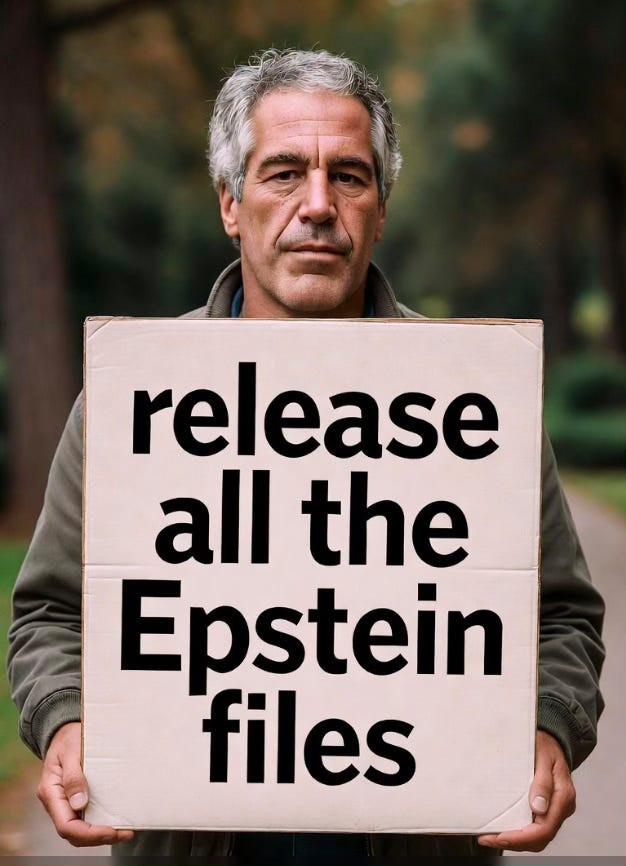
Release the Epstein Files
Nov 1700:02:42Tap to summarizeWhat matters most at this moment is not the specific contents of the Epstein files, but the political and cultural momentum driving their release. I’ve spent years battling governments and institutions for transparency: the JFK and MLK assassination records, Argentina’s Nazi fugitive documents, the Vatican Bank’s World War II archives. One truth emerges every time: the harder governments fight to keep records sealed, the more the public becomes convinced they contain a smoking gun.We are now watching that same dynamic unfold around the Epstein files. Public traction behind “Release the Epstein Files” has reached a critical mass. The House is on the verge of voting to unseal everything, and the pressure is not going away. If the files ultimately remain hidden—whether blocked in the Senate or vetoed by Trump—it will only deepen public skepticism and turbocharge conspiracy theories about what is being protected.I’ve said this for decades, and it generally falls on deaf ears inside government: the best way to restore credibility is full disclosure—immediately, not eventually. Keeping secrets in the age of weaponized speculation is impossible. Delay only inflames the belief that someone powerful is being protected.Now, will releasing everything magically silence the most feverish corners of the internet? Of course not. If full transparency fails to confirm their narrative, conspiracy theorists will simply shift the goal posts—claiming files were destroyed, or sanitized, or that the “real truth” must be hidden somewhere else. That is the nature of these cycles.But releasing the files will still help. It will drain oxygen from the most extreme theories. It will narrow the space for manipulation. It will allow investigators, reporters, and the public to work with actual documents instead of speculation.Investigative journalists often say that sunlight is a disinfectant. It’s not just a cliché—it’s accurate. Transparency reduces the power of rumor. Secrecy amplifies it.Whoever is advising political leaders to resist the release is giving catastrophic advice. Fight disclosure at your own peril. The longer these files remain sealed, the louder the questions will become—about who is being shielded, and why.It is time—past time—to release all the Epstein files. Let the public see the truth, whatever it is. Secrecy is the accelerant. Sunlight is the remedy. Get full access to Just the Facts with Gerald Posner at www.justthefacts.media/subscribe
Transcribe →
"Klansmen in Keffiyehs"
Oct 3100:07:07Tap to summarizeUniversity presidents last week finally said aloud what many Americans suspected: the pro-Palestinian uprisings that swept across campuses after Hamas’s October 7 attack were not spontaneous acts of youthful conscience but were well-coordinated and funded. “It’s more than a social contagion,” said Vanderbilt’s chancellor. “They’re organized networks as well.” Syracuse’s chancellor went further: “I really believe [the demonstrations] were encouraged by Iran. It did not have the involvement of very many, if any, of our own students.”America has a powerful legal weapon—the Ku Klux Klan Act of 1871—that the Department of Justice should use to stop the rise of coordinated, foreign-influenced and financed antisemitic hate groups operating under the guise of political activism.American administrations have not hesitated to dust off centuries-old laws when it serves their purpose. The Alien Enemies Act of 1798, the 1807 Insurrection Act, even an 1873 obscenity law banning the mailing of ‘indecent’ material have all been revived in recent years.Congress enacted the Klan Act in the aftermath of Reconstruction, when white-supremacist militias terrorized freedmen and Black voters while state officials looked away. The law empowered federal prosecutors to target private conspiracies that deprived citizens of their civil rights through violence or intimidation.Over 150 years later, that same legal tool might be more useful than ever. Its central provision—18 U.S.C. § 241—remains one of the most powerful civil-rights tools on the books. President Biden’s Justice Department used it in 2023 to indict Donald Trump for allegedly conspiring to subvert the 2020 election. Derek Chauvin, the former Minneapolis police officer charged over the death of George Floyd, pleaded guilty in 2021 to violating § 242, another section of the same act that covers abuses of authority “under color of law.”In January, President Trump’s own executive order, “Additional Measures to Combat Anti-Semitism,” explicitly cited § 241 and encouraged the attorney general to employ it against antisemitic threats. But the DOJ is not using the statute for its full powers when it comes to dealing with online threats. One of the most important aspects of § 241 is that it does not require an overt act to prove a conspiracy. And § 1985(3) of the Klan Act makes it unlawful for “two or more persons” to conspire to deprive any citizen of “equal protection of the laws” or “equal privileges and immunities.”All the KKK statutes require is an agreement to threaten or intimidate someone in their federal rights. It is important that courts allow conspiracies under this law to be proved by circumstantial evidence. That is key when it comes to online coordination with pro-Hamas/anti-Israel demonstrators who plan their actions over the internet. Online threats are not just speech—they can constitute evidence of conspiracy to deprive Jews of their right to education, association, or religious practice. In recent years, the DOJ has used § 241 against online campaigns that intimidated voters and abortion patients as well as white supremacists and violent anti-Black conspiracies. That precedent should be extended to antisemitic intimidation campaigns.When campus groups coordinate online to harass Jewish students, blockade events, or pressure universities to exclude Jews from campus life, they are engaged in a civil-rights conspiracy—no less than the hooded KKK members who once burned crosses to keep Black Americans from voting. A legal brief filed by the Zachor Legal Institute with DOJ earlier this year documented Jewish students at UCLA literally hunted across campus by masked Students for Justice for Palestine activists, some carrying knives. At Cornell, Jewish students received online threats of rape and beheading. At Cooper Union in New York, Jewish students barricaded themselves in a library while mobs pounded on the doors. These are not theoretical concerns—they are the modern equivalent of Klan night-riders, adapted to 21st-century campuses. The Zachor lawyers called them “Klansmen in Keffiyehs.”Another element of the KKK statutes that the DOJ should deploy is § 242. It applies to public officials who abuse their positions “under color of law” to deprive others of their rights. Public university faculty or administrators who advise, fund, or exclude Jewish students from classes while supporting antisemitic groups can be held liable under this provisionWhen mobs physically block Jewish students from entering a classroom or religious or secular event, as documented above, that squarely falls under § 245, which protects the right to attend public education or federally funded programs free of intimidation or violence. The Department of Justice enforcement is critical since Jewish students can’t bring these prosecutions themselves. The KKK statutes were designed for precisely this kind of situation: when mobs, sometimes aided by local officials, conspire to deny a minority group its place in public life. Congress wrote the KKK statutes for federal prosecutors to step in when citizens couldn’t defend themselves. That was true in 1871, and it’s true on campuses today. The KKK statutes once dismantled segregationist terror networks. They can do the same to the Hamas-inspired, foreign-funded agitators targeting Jewish students today.Antisemitism in America is no longer confined to the fringes of the internet or neo-Nazi rallies. It has infiltrated elite universities and corporate boardrooms, often financed by foreign money and legitimized by academic doublespeak. The myth of “consequence-free hate” has taken root.Just this month, Federal Election Commission filings revealed that Rep. Ilhan Omar’s campaign paid more than a thousand dollars to a Washington D.C. nonprofit, the Palestine House of Freedom, whose website celebrates the “liberation of Palestine from the river to the sea.” The group partners with a Palestinian university accused of terror ties and vows to “embark on an aggressive educational campaign” targeting U.S. lawmakers and the media.That money trail is a reminder that Hamas’s influence operations aren’t confined to foreign soil. They’re operating in America’s capital, on American campuses, and across American social networks.The question is whether Washington will use the legal weapons it already has. The Ku Klux Klan Act once saved the Union’s promise of equal rights. One hundred and fifty years later, it can do so again—this time for Jewish Americans facing a new generation of hate. Get full access to Just the Facts with Gerald Posner at www.justthefacts.media/subscribe
Transcribe →
The IRS Is Imploding
Aug 1600:13:18Tap to summarizeLast week’s headline that President Trump asked Billy Long to resign—making him the seventh IRS commissioner to leave this year—masked a much deeper crisis. The Internal Revenue Service is facing its worst operational breakdown in modern history just as it must implement one of the most sweeping tax code overhauls in a generation. Charged with collecting $5 trillion a year, the agency has endured leadership turmoil, lost a quarter of its workforce, and now confronts budget cuts that could slash enforcement by half.The timing could not be worse.The Trump administration's “One Big Beautiful Bill”—an 800-page behemoth that promised tax simplification—has instead added over 100 new provisions to an already labyrinthine tax code. Some of the provisions include temporary measures, phase-outs, narrowly targeted exemptions, and complex calculations that will challenge even seasoned tax professionals. Yet, the agency responsible for making sense of it all is in disarray.Chaos in the C-SuiteThe leadership bedlam began immediately after President Trump's inauguration when Danny Werfel, a respected career public servant who had successfully navigated the agency through both Republican and Democratic administrations, submitted his resignation. What followed is administrative whiplash.Doug O'Donnell, a 35-year IRS veteran, lasted just 33 days as acting commissioner. His departure was followed by Melanie Krause, whose tenure ended abruptly when she refused to comply with a directive to share taxpayer information with Immigration and Customs Enforcement—a move she argued violated taxpayer privacy laws and would destroy public trust in the agency.In April, Elon Musk, leveraged his influence within the administration, and successfully pushed for the appointment of Gary Shapley, a former IRS criminal investigator who had gained prominence as a whistleblower in politically charged investigations. That move reportedly blindsided Treasury Secretary Scott Bessent, who traditionally oversees IRS appointments. The resulting power struggle created such dysfunction that Shapley resigned after just 48 hours—the shortest tenure of any IRS commissioner in history.“It was amateur hour,” says a senior Treasury official who requested anonymity to discuss internal deliberations. “You had Musk making promises he couldn't keep, Bessent in a fury, and meanwhile, no one was actually running the IRS during tax season.”Michael Faulkender attempted to stabilize the situation by serving dual roles as both Deputy Treasury Secretary and acting IRS Commissioner, but the arrangement proved untenable. It appeared that everything at the top post had settled in July when the Senate confirmed former Missouri Congressman Billy Long as Commissioner. The White House surprised almost everyone on August 8 when it confirmed Long had been asked to submit his resignation and that Treasury Secretary Bessent would act as the interim commissioner until a new replacement was named (Long is slated to be named as ambassador to Iceland).Thanks for reading Just the Facts with Gerald Posner — Subscribe for free to receive new posts and support my work.The Great Resignation, IRS EditionWhile leadership played musical chairs, rank-and-file employees headed for the exits. The numbers are staggering: 25,000 employees—representing nearly a quarter of the agency's workforce—are expected to leave by September 30. This is not natural attrition; it's an exodus accelerated by a voluntary deferred resignation program and targeted layoffs.The brain drain is particularly acute in critical areas. The Office of Chief Counsel has lost 40% of its senior attorneys. The Large Business and International division, responsible for auditing corporations with assets over $10 million, has seen departures of 60% of its most experienced revenue agents. Criminal Investigations, the arm that pursues tax fraud and money laundering, is operating at 50% capacity.These are not just employees—they're walking encyclopedias of tax law, audit techniques, and institutional knowledge that cannot be replaced by hiring fresh college graduates.The telephone assistance division, often taxpayers' first point of contact with the agency, has been decimated. Over 9,000 customer service representatives have been let go or reassigned. During the 2024 filing season, average wait times exceeded two hours, with only 11% of calls being answered—the worst performance in IRS history. The agency's plan to hire temporary workers for the 2026 filing season is widely seen as inadequate.“The most serious problem facing taxpayers today is the complexity of the Internal Revenue Code,” according to Nina Olson, who served as National Taxpayer Advocate for 18 years. She made that observation in 2006, when the tax code was simple in comparison to today’s version. Insiders acknowledge it will be impossible to train temporary workers on 800 pages of new tax law in a few weeks. They will be overwhelmed, taxpayers will be frustrated, and errors will multiply exponentially.Technology: Running on Digital FumesPerhaps nowhere is the IRS crisis more acute than in its technology infrastructure. The agency still relies on systems dating back to the 1960s, including master files written in COBOL—a programming language so outdated that finding programmers who understand it has become increasingly difficult and expensive.The Biden administration's Inflation Reduction Act had allocated $80 billion over 10 years for IRS modernization, with $15 billion specifically earmarked for technology upgrades. Those plans are now in jeopardy. The Department of Government Efficiency (DOGE), established by executive order to oversee federal spending, has frozen all modernization funds pending a “comprehensive strategic review.”“The review is supposed to take six months,” says a senior IRS technology official who requested anonymity. “But we don't have six months. We need to program the new tax law changes now. Every day of delay means more manual processing, more errors, and longer delays for taxpayers.”The technology freeze has halted critical projects, including a new taxpayer portal that would allow real-time status updates on refunds and correspondence; artificial intelligence tools to identify fraudulent returns and suspicious claims; modernization of the Individual Master File, the core system that processes individual tax returns; and enhanced cybersecurity measures to protect against increasingly sophisticated attacks on taxpayer data.“We're asking a Model T to perform like a Tesla,” the technology official adds. “It's not just inefficient—it's dangerous. We're one major system failure away from being unable to process returns at all.”The New Tax Law: Complexity Masquerading as SimplificationThe “One Big Beautiful Bill” promised tax simplification. But it has made the tax code exponentially more complex. That is compounded by the IRS's inability to provide guidance. Typically, major tax legislation is followed by thousands of pages of regulations, revenue rulings, and procedures that explain how the law should be interpreted and applied. With the exodus of experienced attorneys from the Chief Counsel's office, that guidance is unlikely to materialize in time for the 2026 filing season.Budget Cuts: The Final BlowAs if leadership chaos, staff departures, and technological paralysis were not enough, the IRS now faces the prospect of devastating budget cuts. The House Appropriations Committee has proposed reducing the agency's budget from $12.3 billion to $9.5 billion—a 23% cut that would be the largest in IRS history.The cuts specifically target enforcement, with a proposed 48% reduction in funding for audits and collections. This comes at a time when the “tax gap” —the difference between taxes owed and taxes paid—has reached a record $688 billion annually, according to the latest IRS estimates.Instead of saving money, cutting enforcement costs money. The IRS could return about $5 to $7 of increased tax collection for every additional dollar of enforcement funding, Charles Rettig, who served as IRS Commissioner, told Congress in 2021.The practical implications are stark: audit rates for millionaires will fall below 1%, down from 8% a decade ago; corporate audits would essentially cease for all but the largest multinational corporations; criminal prosecutions for tax evasion would decline by an estimated 75%; identity theft and refund fraud investigations would be dramatically curtailed (there are 387,000 unresolved cases of identity theft as of June 2025, with an average resolution time of 20 months).“Underfunding the IRS is like underfunding your accounts receivable department,” Mark Mazur, Treasury’s Assistant Secretary for Tax Policy, warned Congress in 2017. “No rational business would do that.”The Hidden Costs of CollapseThe immediate effects of the IRS crisis are already visible: longer wait times, delayed refunds, and reduced enforcement. But tax experts warn that the long-term consequences could fundamentally alter America's tax system.“Tax evasion is widespread, always has been, and probably always will be,” said Joel Slemrod, an economist at the University of Michi...
Transcribe →
Your Perfect Child, By Design
Jul 5, 202500:05:15Tap to summarizeIn 1933, the Third Reich passed the Law for the Prevention of Offspring with Hereditary Diseases—a chilling attempt to control who was allowed to be born, rooted in pseudo-scientific notions of “racial purity” and Aryan superiority. Nazi medical schools taught students to worship genetic “perfection,” and had the tools of today’s genetic science existed then, it’s not hard to imagine how ruthlessly they would have deployed them. The Third Reich’s obsession with genetic purity laid the groundwork for the Holocaust. The specter of eugenics haunts every new advance in reproductive technology, and today, that ghost is stirring again.Last week, a coalition of leading scientific organizations—including the International Society for Cell and Gene Therapy—called for a 10-year global moratorium on human genetic editing. Their message is clear: the science is moving faster than our understanding of its risks, and the ethical questions it raises are more urgent than ever.The immediate spark for this renewed debate is a new software platform from Nucleus Genomics, a company founded by 25-year-old Kian Sadeghi, and backed by tech luminaries like Peter Thiel and Alexis Ohanian. What they have created sounds like the premise of a near-future sci-fi thriller: prospective parents, sitting with a dashboard of up to 20 potential embryos, ranking them based on over 900 traits. These include medical risks—like Alzheimer’s, cystic fibrosis, schizophrenia—but also non-medical characteristics such as eye color, predicted height, BMI, and yes, even markers associated with IQ.They aren’t just choosing health—they’re choosing a child’s future identity.Nucleus calls it “genetic optimization.” Critics call it something else: consumer driven eugenics.What sets this apart from the preimplantation genetic screening already used to avoid serious heritable diseases is the scale, ambition, and philosophical shift: from preventing harm to engineering superiority. Newsweek reports that early users are sorting embryos based on polygenic scores for intelligence and mental illness—sliding ever closer to a world in which undesired traits are quietly discarded before birth by those able to afford the technology.Even the voluntary pursuit of perfection, especially when fueled by inequality and tech utopianism, raises serious ethical questions. Who decides what traits are “desirable”? And who besides those capable of paying for it get access to this technology?Dr. Arthur Caplan, head of the Division of Medical Ethics at NYU, has been warning for decades about what happens when genetic knowledge meets market forces and parental ambition. In recent comments, he emphasized that genes aren’t destiny. Even identical twins with the same DNA often live radically different lives based on upbringing, environment, or sheer chance.And there are societal consequences of letting wealthy, well-informed parents create genetically curated offspring while poorer families are left behind. One tech investor’s “optimized child” could be another parent’s “genetic underclass.” We risk creating a society where privilege is literally written into our DNA—a new kind of hereditary elite.Some in the longevity movement—where Sadeghi and his investors have ideological roots—frame this as empowering. They see a world where humans engineer themselves out of disease, decline, even death. But that vision requires a brutal calculus: decide who gets born, and who doesn’t.As Liz Wolfe at Reason wrote, “This isn’t about Baby Mozart anymore. It’s about a world where parental choice intersects with Silicon Valley hubris and deeply personal ethics.”Some ethicists fear a coming homogeneity—a world where parents converge around the same desirable traits, slowly narrowing the spectrum of human diversity. NYU’s Caplan said this could undermine human resilience at the species level. And the “solution” from some defenders is both chilling and telling: store vast numbers of frozen embryos with diverse traits, in case we need them later.That’s not empowerment. That’s speculative breeding.What’s most unsettling is the regulatory void. Despite the profound moral, social, and biological stakes, the U.S. has no coherent policy or laws on polygenic screening or embryo optimization. As with many types of technology, including AI, the advances come at breakneck speed, faster than society’s ability to regulate and to institute safety guidelines.That leaves the terrain wide open for ambitious startups and their investors to set the rules themselves.Dr. Bruce Levine, a professor of cancer gene therapy at the University of Pennsylvania, has been blunt: “Germline editing has very serious safety concerns that could have irreversible consequences. We simply lack the tools to make it safe now and for at least the next 10 years.”So, is this science fiction? Or is it our future?The more urgent question might be this: Whose future is it?Because once you start choosing which embryos get born based on traits, the line between medicine and ideology vanishes. And history has already shown us how dangerous that can be.Thanks for reading Just the Facts with Gerald Posner. Subscribe for free to receive new posts and support my work. Get full access to Just the Facts with Gerald Posner at www.justthefacts.media/subscribe
Transcribe →
America: Big Pharma’s ATM
Jun 19, 202500:02:05Tap to summarizeThe United States is home to just 5% of the world’s population—but we generate 75% of global pharmaceutical profits.That imbalance was at the heart of my Oxford Union debate last week.Now, there's a fresh example of how drug companies wring outsized returns from the U.S. market.Gilead Sciences, a California biotech giant, is best known for Truvada, its HIV prevention drug (PrEP), which brought in more than $30 billion.But here’s what most people don’t know:The research and testing behind Truvada were paid for by the CDC, NIH, and the Gates Foundation. Gilead’s sole contribution? Supplying the pills for clinical trials.When the U.S. government patented Truvada in 2015—aiming to distribute it affordably worldwide—Gilead sued to block it. The courts sided with Gilead.Truvada costs $6 a month to manufacture. Gilead sold it for $1,600 to $2,000 a month—a 25,000% markup.Now that the patent has expired and generic Truvada is available for as little as $40 a year, Gilead needs a new cash cow.Enter lenacapavir, a long-acting injectable version of PrEP. Just two shots a year, instead of a daily pill.Before the FDA, Gilead argued that “some people face significant barriers to taking a daily pill,” and that its injectable offers “a more convenient alternative.” It cited data showing Truvada was only 26% effective in certain groups, largely due to skipped doses.This is a classic pharma strategy: take an old drug, tweak the delivery method, and get a fresh 20-year patent. It’s called “evergreening,” and it’s wildly lucrative.The price of Gilead’s new injectable? $28,000 a year per patient.Gilead expects to rake in over $50 billion from the drug while it’s under patent.Ka-ching. 💰💲Welcome to the world of Big Pharma.P.S. My Oxford Union debate on profits and healthcare will be online soon. When it is, Just the Facts subscribers will be the first to get it. Stay tuned. Get full access to Just the Facts with Gerald Posner at www.justthefacts.media/subscribe
Transcribe →
Trust No One
Mar 13, 202500:13:01Tap to summarizeMy take on the enduring seductive power of conspiracies Get full access to Just the Facts with Gerald Posner at www.justthefacts.media/subscribe
Transcribe →