← Kermode on Film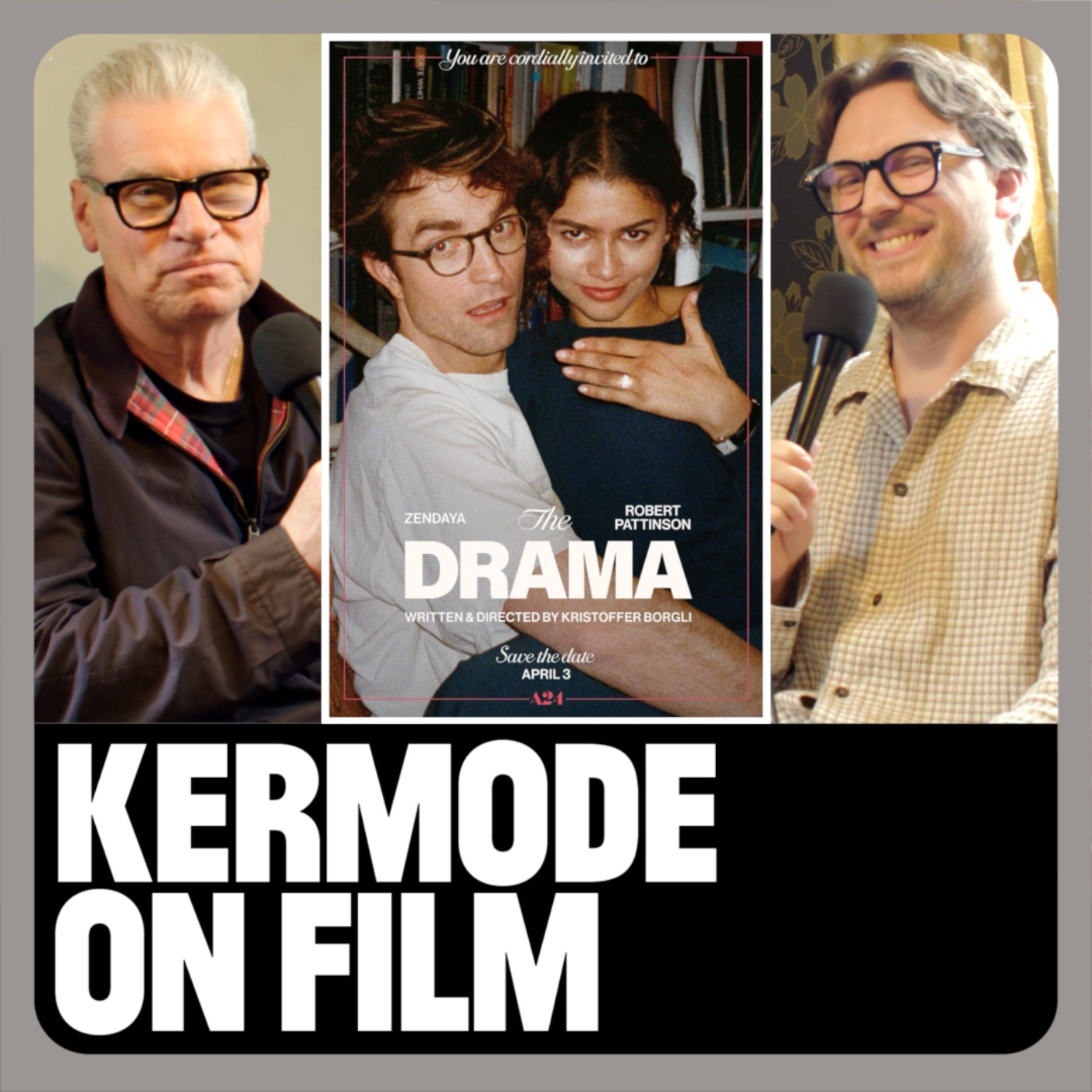
Kermode on Film
This shouldn't be funny... but it is
00:34:04
Mark Kermode & Jack Howard on the Pattinson & Zendaya Drama: Dark, Funny, and Deeply Uncomfortable (spoilers!)
Loading summary
Transcript227 lines
- [00:00]
A
Hi, this is Mark Kermode. Thanks for downloading this Kermode on Film podcast, or indeed watching it on YouTube. I am joined at the Sun Pub in London's bustling Soho once again by Jack Howard.
- [00:10]
B
Hello, Jack. Hello. Hello, everyone. Before we get started, I just want to do a few housekeeping things, please, like this video. If you're watching us on YouTube or subscribe, if you're new or if you're listening to the podcast, leave us a review. They really, really help. Today we're going to be talking about the drama, the new film starring Robert Pattinson and Zendaya Last Bit of Housekeeping. We're doing spoilers. Yes, we're doing full spoilers.
- [00:31]
A
Full spoilers. And if you heard me reviewing the film on Carmelo Mayo's take, you'll know that I avoided spoilers. This is the conversation that we couldn't have. So if you haven't seen the drama yet, well, firstly, it's one of the best films of the year. Go and see it. But see that before listening to this.
- [00:48]
B
And please keep your arms and legs inside the podcast at all times and
- [00:51]
A
put your mask on before anyone else's. What's the worst thing you've ever done?
- [01:00]
B
I think. Wow, the worst thing I've ever done, probably. It's probably making a podcast with you about Eyes Wide Shut where we expressed opinions and then putting it on the Internet.
- [01:13]
A
Did you go below the line? Did you never go below the line?
- [01:17]
B
I couldn't help but have a little scroll.
- [01:18]
A
Did you?
- [01:19]
B
And there were. There were some people that were very upset about the opinions that we expressed. Oh, yeah, the Kubrick fans found it.
- [01:25]
A
Was it because it wasn't their opinions?
- [01:26]
B
Yeah, it wasn't their opinions. I think that was where we went wrong.
- [01:28]
A
Oh, damn, we're stupid. That's a rookie error.
- [01:33]
B
We don't understand it the way they understand it. What I got from it, when the. The negative response came into our opinions is that if I was doing this podcast for any other reason other than I like sitting here and talking to you and we just happen to have microphones in our hands, I would stop immediately. If I was doing it for attention or if I was doing it to be liked, I'd look at those comments and be like, oh, my God, I'm never putting myself out there ever again. But luckily, the only reason I do it is because I love doing this with you. And that's the conclusion I've come to.
- [02:05]
A
There is a really weird thing about. I mean, I. Funnily enough, I Wrote about this in. I wrote a book a while ago called Hatchet Job, which was like 2013. And one of the things that I talked about in it was the way in which user reviews were basically, you know, gamerball on sites like Amazon. Amazon, you know, were very, very slow to respond to the fact that all their user reviews were absolutely being gamed. Systems are terrible. You know, what a surprise. Jeff Bezos turns out not to be a responsible human being. Damn. And it was at the period in which everyone was talking about, you know. Yeah, well, all these things are great. They're democratized. And my take on it was two things. Firstly, any comment published anonymously on the Internet is not worth the paper it's not written on. And the second thing is that thing about anonymity is, is it means you can say anything. It doesn't mean that what you say is true. It means that what you say is toxic. I think that anonymity is a really, really dangerous thing. And I think that if anyone is offering a criticism of anything, they have to be accountable. Like, who are you? Tell me who you are. Where do you come from? What's your, you know. So my whole thing is, I think any of that, that kind of just Jeffrey bunch of numbers says, I think Jack Howard is this. You go, yeah, but you're not. Why would I even listen to you? It's like, it's like you're, you're just, you're not even being yourself.
- [03:29]
B
I've learned that the very hard, slow way, which is being on the Internet since I was a teenager.
- [03:33]
A
Yeah. And I actually, I, and I, I say this sounds patronizing. I don't mean it to. I do think that your generation and the generation slightly behind you, the one
- [03:42]
B
behind me has got it even worse.
- [03:44]
A
Yeah. Well, literally, just like there's a five lane, you know, motorway walk across it. Oh, some of them didn't make it. We better start looking at safeguarding. I mean, I do think there was that kind of generation, which was, where's the Internet? Go play with it and see what happens.
- [03:57]
B
A metaphor you could use is it's a little bit like sort of someone coming in with a gun and seeing what happens.
- [04:03]
A
So you want to explain what it is that we're going to do. And, and, and we should say we've
- [04:06]
B
already, we've already said it at the top that we are spoiling this, but just it's also in the title. So I, I expect that people who've clicked on this are smart enough to know that, like spoilers there's going to be spoilers in this. Yeah, we're talking about the drama starring Zendaya and Robert Pattinson.
- [04:21]
A
Yes.
- [04:21]
B
Would you like to do a little summary of what the plot of the film is?
- [04:25]
A
Yeah. So the story is that we meet R. Pats, his character. He is about to. He's about to get married. He's trying to write his speech that he's going to do. And as he's writing his speech, it's kind of nice little device. We're basically seeing the relationship as he remembers it that he is having with Zendaya's character, Emma. And he remembers the meet cute that she was in a coffee shop and he saw and he was immediately drawn to her. And she's reading a book. She goes to the counter, he sees what the book is and then he pretends that he's read it. And he comes up and he starts talking to her, but she doesn't hear him because she's deaf in the ear that he's talking to, and she has an earpod in the other ear. So this is like a very cute story that during this thing, he falls in love with everything about her. Everything about her he absolutely loves.
- [05:14]
B
Her response is wonderful as well, because when she realizes that he's there, she turns around and she offers him a. A chance to do it again.
- [05:21]
A
That's right, yes, that's right, yes. And then.
- [05:23]
B
Should we start again? It's a very funny moment where he wanders over, sits back down, and literally does it from there again.
- [05:29]
A
So it's a really kind of lovely. There's a bit of a kind of Harry Met Sally thing, you know, which I. Which I really like. And then as they're prepping for the wedding, one of the things they have to do is go and do the, you know, taste the food, taste the wine. So we're introduced to a scene in which they've clearly outstayed their welcome. You know the venue, we're trying to shop. No, we'll just. We just want to try that one. Can we just try that wine again? So they've all been having drinks and there's four of them. And one of them says, yeah, you know, before we got married, we did this thing about, what's the worst thing you've ever done? Really? Yeah, yeah, yeah, yeah, yeah. So what, you tell them the thing that you did. The thing that you did was the worst thing you've ever done was a thing involving a dog. Right. And so he says, well, okay, well, I'll only tell the story if everyone else plays it. And at this point, I was literally going to stop, stop, stop, stop. Everybody leave. Everybody.
- [06:21]
B
We've all had too much to drink for this kind of conversation.
- [06:23]
A
Don't ever do it. Don't ever do it. Really, really stupid. So then he tells this story about a dog, which is far less bad than it sounds like it's going to be.
- [06:31]
B
He uses his girlfriend, his ex girlfriend, as a human shield when her dog was attacking.
- [06:36]
A
That's right. Yes, exactly. When you say it like that, it sounds worse than when, but. Yeah, but yes, no, that is exactly what happens. Then. His partner, played rather brilliantly, I think, by Lana Khaim, who's fantastic, tells us the story of the worst thing she ever did. And that was that she locked some kid who may have had some learning difficulties.
- [07:00]
B
She describes him as slow.
- [07:01]
A
Slow in a cupboard in a remote
- [07:04]
B
house, overnight in an RV in the woods.
- [07:07]
A
Yeah. Yep.
- [07:10]
B
And they're like, did you let him out? She's like, well, I ran off. And then, yeah, they got him up the next day. I think they got him out the next.
- [07:15]
A
Yeah, yeah, it was fine. You're all thinking, wow. And then R. Pats.
- [07:21]
B
His thing is he fumbles over it, and then he. He says, I cyber bullied somebody.
- [07:25]
A
Yes.
- [07:26]
B
And then they moved. I think they moved, but maybe that was a coincidence that they moved because I cyber bullied him.
- [07:30]
A
Okay, so there are three stories that these people tell that are, you know, they. And they kept saying, we were kids. You were kids. You were kids. Look, she did it. But she was a kid. He did it. He was a kid, he did it. He was a kid. You were 14.
- [07:41]
B
It doesn't count.
- [07:41]
A
It doesn't count. Fine. And then they get to Zendaya's character and they say, okay, what about you? And she says, I don't really want to do this. And she said, no, no, no, come on, come on, you gotta do it. You gotta do it. Gotta do it. What's the worst thing? And she says that the worst thing she ever did was she nearly did a school shooting. But she didn't. And the room goes absolutely silent.
- [08:00]
B
Icy cold.
- [08:02]
A
And Alana Kaim's character says, what the fuck? What are you. She said, I didn't do it. I didn't do it. I just, you know, I didn't do it.
- [08:11]
B
She's like, you know, my cousin was in a school. She's in a wheelchair now because she was in a school shooting. She's like, I don't think I knew that. She. I did I told you about that.
- [08:18]
A
And literally the whole table turns against that character. Emma. And the rest of the movie is the lead up to the wedding, in which the revelation of this thing that she has admitted to not doing. They've all admitted to something that they did. She's admitting to something that she didn't do. And the wolves descend. And as you'll find with movies, there's a lot of movies that use the kind of the Days before the Wedding as a dramatic. Everything is cranked up. The relatives are coming in. You've all got those performance stuff.
- [08:51]
B
It's a good ticking clock.
- [08:52]
A
It's a very good ticking clock. And R. Pats character basically unwinds because he can't get his head around the fact that this thing. When were you gonna tell me? Well, I don't know.
- [09:04]
B
Probably never.
- [09:05]
A
Probably never. Because you know what? It didn't happen. Now, we haven't discussed the film at all. I reviewed it and I. When I reviewed it, I was very careful to not say the thing because in the trailer, they don't say it.
- [09:20]
B
I'm so glad they didn't say it in the trailer.
- [09:22]
A
Which is remarkable because usually it's like, you know, every single thing.
- [09:26]
B
And I think actually the perfect marketing, because we're all wondering, what is the thing? How bad could it possibly be?
- [09:32]
A
Yeah.
- [09:32]
B
And I don't think anybody would have predicted that that's where movie was gonna go.
- [09:36]
A
But I. So I. What I did was I said, she says this thing that no one can get beyond. And. And. But then the one thing I did say was that. That, you know, without wanting to give anything away about it, there is a point at which they're all going, how? And, you know, and they talk about the thing in context and somebody goes, oh, so America is to blame. Yeah.
- [09:58]
B
Alana Heim again, perfectly. When Robert Pattinson is trying to say she didn't do it. And he also starts making excuses like fake. He gives his own fake analysis of her mental health and says, well, a friend of hers died in a car crash. Which is true. But at one point in the film earlier, Zendaya's character Emma says, I don't think that's relevant. And then he tells it as if that is the big deal as to why she might have been so traumatized to do it. And then says, well, it's a. And to be clear, Robert Pattinson in this plays English.
- [10:27]
A
Yes, he does.
- [10:28]
B
Which he doesn't usually do.
- [10:29]
A
Does it very well.
- [10:29]
B
And so he's. Yeah, he's. He's An Englishman in America commentating on the fact that it's a bit of a thing here. And then Alana Heim brilliantly again playing the perfect bitch that we all, collectively, everyone has decided we all hate her. Which is also interesting, given the judgmental questioning of the film itself. Says also, America is to blame.
- [10:51]
A
And. And again, at that point, I went internally, yeah, yeah, of course it is. The point that he's making is if you grow up in a culture in which this is on the news all the time and you are bullied and weird, horrible, of course that idea is in your head. There is not a school child in America that doesn't know about school shooting.
- [11:09]
B
They train for it.
- [11:10]
A
They train for it. They literally train for it. Because it has become so regular. If you look at the world statistics on school shootings, every country, it's literally like this. And then America, I mean, it's an epidemic. It is out of control. America's relationship with gun culture is lethal. It is a terrible, terrible thing that is happening with the coronavirus.
- [11:32]
B
It is the leading killer of children.
- [11:36]
A
Okay, that actually doesn't surprise me.
- [11:39]
B
Above any disease, above cancer, above anything, it is the leading killer.
- [11:42]
A
It is just a terrifying thing. And I. And I think that what the film. And I really loved the movie.
- [11:48]
B
I think it's my favorite film of the year so far, by a way.
- [11:52]
A
Yeah, well, you haven't seen Rosa Nevada yet.
- [11:54]
B
That's true.
- [11:55]
A
But I'm kind of on. I mean, I. You know, I love Rosa Nevada above all things, but actually, I. Technically, I saw that last year, but I loved this. And the thing I loved about it was how painful it was and how awkward it was. But how much as they're all struggling to just, you know, to kind of. To be angry with her. The more they do it, the more it's like, no, of all of the. She's the most honest character of all of them. Now, the thing that's really interesting is. So it turns out she didn't just think about it, she planned it. Her father had a rifle. She got the rifle. She recorded her.
- [12:33]
B
She tried to make videos about it, but they couldn't. This is, I think something we need to point out right now, actually, is that this is clearly very dark subject matter.
- [12:41]
A
Very dark.
- [12:42]
B
And the film is awkward and it's squirmy and cringy, and the. The social interactions are difficult to watch. The second time I watched it, I went with my good friend Stephen Bridges, who was sat next to me with his hands next to his eyes, like he was like, he had to watch it through a tunnel. Like he was finding it so cringy to watch. But it's also a laugh out loud. Like every scene is a laugh out loud, funny scene. And I can't believe it's a magic trick how it has done that, use such dark subject matter and made it such a. Like, I think the funniest film I've seen in a long time.
- [13:17]
A
Yeah, it is.
- [13:18]
B
What a magic trick.
- [13:19]
A
It is remarkable. And there was one line that I. I literally laughed so loud that I was embarrassed.
- [13:24]
B
I wonder if it'd be the same.
- [13:25]
A
Just when the, the other, the other guy said she. Alana Holmes character says, you know, growing. He grew up around guns. And he goes, no, I didn't.
- [13:34]
B
Why would you say that? Why would you say that?
- [13:36]
A
Because he's black.
- [13:39]
B
Because he's black. And this is. Yeah, there's like a complete underlying thing in that as well where, like, it's a complete.
- [13:45]
A
It's brilliant. It's an absolutely racist comment. He grew up a brain goes, no, I didn't.
- [13:52]
B
My. My favorite bit in it, the funniest bit that made me laugh every time. And it's to do with the editing as well, which also is sublime in this film. It's the moment when they are discussing it the morning after the secret has been revealed. And they just keep talking about it and you keep seeing little splinters of their conversation. It keeps cutting around where they're sitting in the room and then all of a sudden the phone alarm goes off and they have an appointment with the photographer that they have to get to. And it smash cuts to her going, okay, first I'm going to shoot you, then I'm going to shoot your mom, and then I'm going to shoot you. Grandma. Actually. Don't know. My grandma can come, actually. Okay, so tbd, shooting grandma like that. Like the crowd howls at that moment. It's so funny. And I can't actually believe how they've tonally walked that line in terms of making. Yeah, it's. It's. It's kind of remarkable that I think it's what you said. It's remark, boy.
- [14:47]
A
And I. I mean, one of the things that, that really, really impressed me was I never. I never relaxed all the way through it. I mean, I was laughing, but laughing, sort of crying, screaming. And I never felt it let me off the. I was. I have a slight hesitancy about the end because. Because there is a sort of redemptive resolution at the very, very end. And there's part of me that didn't quite buy that. Because if you want to express.
- [15:18]
B
Do you want to explain, like, the dynamic of it and what it was about, that dynamic you weren't sure buying.
- [15:23]
A
So basically, there's a. There's a. There's a repeated gag that you mentioned at the beginning when she says, you want to try this again? And they arranged that after the wedding, you know, let's just go to that diner that we used to go to, because this is a thing, you know, people, they get their Oscars and they go to the. You know, that's what they do. And so the very end of the movie plays out with after the wedding has gone spectacularly bad.
- [15:49]
B
Yes, it has.
- [15:50]
A
And everything has been. I mean, you know, everything that could possibly have gone wrong has gone wrong. And they meet again in the diner, at which point, if I was her, which clearly I'm not, it would just be like, I don't ever want to see you ever again. Ever. You let me. You are an appalling person. And. And what this is actually revealed isn't that what I said was bad, but that you are a total shithead. But she doesn't. What she does is she basically gives him a chance to. You want to try that again? So there is a. There is a lovely comedic logic to it, and I think this kind of fits into exactly what you were saying. It is a comedy, but there's a. The tragedy underneath it. I thought that was the one point at which it kind of parked a bigger. I mean, listen, I'm. I'm perfectly happy to forgive it for it.
- [16:45]
B
Sure.
- [16:45]
A
It's like. It's like the end of When Harry Met Sally that apparently in the original end of the script, they're not meant to end up together. But during the course of making it, Rob Reiner falls in love with them as a couple. So. Hey, and I love that. I. You know, I love the fact that he says, and when you fall in love with somebody, you want the time to start now. And I go, you know, that's fine.
- [17:00]
B
I think that I understand. I completely understand what you're saying. I understand it completely, and I see what you're saying, but I think I just feel differently about it because I think they. They do a very, very careful thing in the screenwriting and in the way it's been directed and the way the story has been told, that she almost did a school shooting and he almost cheated on her. That, like, they both almost did the thing.
- [17:29]
A
I think he. He more almost cheated on her than she almost did a school shooting.
- [17:34]
B
That's true. But I think there is that, that moment where he does, he goes for it in the way that she was gonna go for it and then pulls away and it's awkward and it's weird. And nothing made the cinema gasp more than when Robert Pattinson kissed his co worker. Nothing else in the, in the movie about the school shooting, about her revealing any of that. I mean it's amazing that a film like this, about a subject like this gets you on side with her most of all. Again, amazing magic trick. And then when R. Pats kisses his co worker, the entire cinema went, it's amazing. And then he pulls away in this very funny way and he leaves and says, I can't believe you ripped my shirt.
- [18:11]
A
Yeah, that's right. So he doesn't immediately pull away, he kisses his co worker and then there is this kind of brief interlude of fumbly unpleasantness.
- [18:20]
B
Yep.
- [18:21]
A
From which he then walks away. Although it's the kind of thing from which you don't, you know, you walk away. I mean it's shameful. It is absolutely shameful.
- [18:30]
B
But he almost gets there and you're worried he's gonna. And then he doesn't. And so yes, I think he does go a bit further and he's a grown up. This is another conversation about it. Like he's an adult and she was a teenager. So is there a difference there? But I think they very carefully make sure that he doesn't go all the way.
- [18:46]
A
Yeah, no, you're right, you're right.
- [18:47]
B
And so, and I think it also speaks to Zendaya, Zendaya's character, Emma's character, like she, she's a very open, forgiving, empathetic. Double empathy, double empathy. A bit in the Photogr when she's like, what's your favorite bit about her? And he says empathy twice. But yeah, I think that she's. I think it says more about them and her and she's like that the whole way through.
- [19:10]
A
Yeah, you're probably right. I've only seen it the once and I should probably see it again the second time. It was just that, honestly, after the carnage of the wedding, I just thought, you know, I. And I. And then when it's her in the diner on her own with all this oppobrium having been heaped upon her by these completely unjust characters who are also throwing around blame and whilst all behaving appallingly, I mean, to go back to the Ilana home character, you said, you know, we all hate. I think the clever thing is I don't hate her at all.
- [19:40]
B
I find her infuriating.
- [19:42]
A
In that film.
- [19:43]
B
Yes. Yeah.
- [19:45]
A
No, but that character. But the thing is that she becomes infuriating but at the beginning she isn't.
- [19:52]
B
No, she is the first thing you see her do.
- [19:55]
A
What's the first thing you see do?
- [19:56]
B
There is. So it's doing this very clever thing at the beginning where it's shifting perspectives on the opening of their relationship that you, you said reminds you of When Harry Met Sally. I think it reminded me of 500 days of summer. It's kind of invoking the rom com.
- [20:06]
A
Yeah.
- [20:06]
B
And it cuts to Robert Pattinson talking to his friend who about his speech. And then it cuts to Zendaya talking to her friend who's played by Alana Heim, about what she's going to say in her speech and the story she can and cannot tell. And she starts crying because Zendaya starts crying because the story makes her feel so, so emotional. And Alana Heim's first line is, you shouldn't cry, it makes you look ugly.
- [20:28]
A
Is that the first thing she says?
- [20:29]
B
And then she goes, no, I don't mean you. I mean one. It makes women.
- [20:32]
A
Okay.
- [20:33]
B
Makes women look ugly.
- [20:34]
A
Okay.
- [20:34]
B
That's the first thing she says. So they're setting her up to be awful.
- [20:37]
A
No. Okay, fine. Okay, all right, she sucks. But. But when this, when they're all around the dinner table and they're just being funny, it's like that thing of, I
- [20:45]
B
mean, look, she's immediately quite judgmental. Oh, no, she's snippy.
- [20:48]
A
Yes. And actually some of the best work that she does is the long shots of her in the wedding when she's
- [20:56]
B
just doing all that pouty little judgmental
- [20:58]
A
faces that she's doing when the father says the thing. Because there's the whole thing that the father in his speech unknowingly brings this up because he's describing what an amazing daughter he has. And he says, and you know, there was, there was that time that she became like his militant anti gun activist. And a lot of times kind of goes, yeah.
- [21:18]
B
And what's brilliant is that from his perspective, he thinks because he was in the military, it was her like rebelling against him. Rebelling against him.
- [21:25]
A
Says, yeah, and we all wondered what happened to dad's rifle. Yeah, what happened to dad's rifle is she took it, but then she ends up throwing it in the pond due
- [21:34]
B
to her own change in character because.
- [21:37]
A
And then she quite rightly becomes an Anti gun activist. Because. Because that, again, that's a. It's a brilliant piece of plot logic that is exactly the kind. The realization that, you know, that if you live around firearms, this, this kind of thing is possible. I mean, imagine if you are that character. Imagine for a moment that you are the character in the film. You are Emma. And you have this memory that at one point you were so traumatized and we, you know, we all know what it was like to be young. You were so traumatized that what did you do? You reached for the weapon and, you know, and then you revolted. And then it's a. I mean, I have always said. I mean, I think American gun culture is obscene. I think it's genuinely obscene. And I am really, really glad that I live in a country in which firearms are not legal, because if they were, they would be used.
- [22:28]
B
Of course.
- [22:29]
A
I mean, it's just statistically true. You are more likely to get killed by firearms in America than almost anywhere else.
- [22:36]
B
I think it's insane that everyone's looking at a bit of paper that was written God knows how many years ago and saying that. I love the Family Guy joke. Do you know the Family Guy joke? No. It's when Founder Guy was good. They do, like, back to the Constitution being written and they're like, do we think we need to make this clearer? And like, I don't know, man. I think it's very clear that everyone has a right to hang a pair of bear arms on their wall.
- [23:00]
A
It's the Robin Williams show, wasn't it? The right. The right to bear arms and the right to arm bears, I don't care. But, but I do, I do think that that. The very fact that I was watching a comedy film that had me thinking, what if. What if you had that memory? What if you were the person that remembered doing that? And that thing that. When she then becomes this militant anti gun activist. Which is exactly what. That's not a joke, that's an actual thing. It's like you lived in a world in which you were surrounded by this culture. Your father was in the military, there was firearms around the house. You're watching the television every day. There's stories of all this stuff.
- [23:33]
B
And even she says about the aesthetics of it as well. Like, she's talking about a time in the early 2000, late 2000s, early 2000s, when there was an esthetic. She quotes that there's an aesthetic of it and she's trying to make videos for the Internet about it. And that really existed. And probably still does in places I don't look, but at the time, it was very much a big thing. And it's interesting that they were, like, really leaning into that felt very well researched to me. That felt like very. Of that time on. On the Internet.
- [24:04]
A
The other. The other thing that is really great is the wedding dj.
- [24:09]
B
So funny. Do you. I mean, both of them.
- [24:10]
A
Both of them.
- [24:11]
B
Both of them are amazing.
- [24:12]
A
So you want to pick up the first one and I'll pick up the second one.
- [24:15]
B
But the second one's my favorite.
- [24:16]
A
Okay, all right, fine. I'll do the first one.
- [24:18]
B
So it's also thematically relevant. It's so thematically relevant. Go on.
- [24:22]
A
So at the beginning, there's somebody who's going to be involved in the wedding who they think they see across the street buying drugs.
- [24:29]
B
No, no. Doing heroin. Yeah, from foil. In the moment, she's doing heroin, but,
- [24:35]
A
you know, fine, okay. And they go, isn't that so? And so he goes, yeah, well, you know, we can't. In that case, we can't use it. Why? Well, because she's doing drugs in the street. And then there's a whole thing about leading up to whether or not they confront her with the fact that she's. Because this is terrible moral crime that she's committed, which is, you know, as you just said, but not assaulting somebody, not, you know, doing drugs.
- [25:02]
B
It's also a fantastic bit of screenwriting. It's kind of how they get onto the conversation about what's the worst thing you've ever done. It's so brilliantly written, the dialogue that takes you to that. It starts out them talking about that and gets to the actual premise of the film that way.
- [25:14]
A
And I think that, again, there is that whole thing about the woman. We're morally obliged to tell her that she can't do it. Are we?
- [25:21]
B
Yeah.
- [25:21]
A
Are we. Is that she's a dj? Yeah. Is that. That she can't do it because we saw her taking drugs. I mean, whether it was smoking heroin or whatever, it would. What it. In a way. None of that. I know it's kind of. It's the shot, but it doesn't matter. Okay, so she can't do it. So then we get to the second dj, which is.
- [25:37]
B
Yes. I mean, they. They fire the first one, and they say, like, we saw you doing heroin. And then she calls her the C word. And then Zendaya's like, well, you're fired now. And she's like, well, I'm set up. You just called it the C Word. I don't know if I want to say the C word on the podcast, which is why I've said, well done. Damn it. Now I really want to say it. Okay. Then they hire the second DJ who comes in, and first thing is hilarious. He's like, you know what's funny is I've. I've worked with one of your servers before. Were you telling me? Incredible. And then he's like, are you a gearhead? I've got one of these things here today. And then what happens is that during the. The wedding, the father is doing his speech, and then a loud bang goes off, and it makes everybody in the cinema jolt. And then it turns out that it's the new DJ putting in the right. He's like, these aren't the wires I asked for. So funny. It's so brilliant. And. And like you say, it's like. It's the tension of it that there's constantly this, like, squirmy, cringy social tension that's in everything. And then they always pick the perfect time to go bang.
- [26:36]
A
Yeah. Yeah.
- [26:37]
B
It's so good. And I also, just before we wrap up, just want to quickly shout out Daniel Pemberton's brilliant score.
- [26:42]
A
Yes.
- [26:42]
B
You know the fun fact about that?
- [26:43]
A
Go ahead.
- [26:44]
B
Four flutes. Oh, that's the entire score.
- [26:47]
A
Good for it.
- [26:48]
B
Four flutes. So cool. So cool. And also the perfect editing of the film. I think that the beginning, especially, all the way through, completely. But, like, the. The opening moments of the film, the. The drifting between different perspectives on whether it's Charlie telling the story, whether it's Emma telling the story of how they met or how they had their first kiss. The way it's blending between those. Those moments, that patchwork kind of editing, but also how abrupt some of the moments are, and then how that prepares you for the little moments of fantasy that happen where you see the younger version of Emma with Robert Pattinson, or it cuts all of a sudden. And Zendaya's character, Emma, is like holding a gun for the photographs now. And it blends into a moment where they think, what is. I mean, one of the funniest moments where the morning after Robert Pattinson is not there, when Zendaya wakes up and she's wondering where he might be. And there's just this fantasy moment that you don't know at the time is a fantasy of him talking to his mate, who was also there night before, and him being like, you need to get out the country. You need to leave now. Go to London. Don't even Go back to the apartment and I'll do. Do you want me to beat her up? And then it cuts back to Zendaya being like having a little moment of note. Of course that's not happening. But then he comes in with a coffee and it's just this, this weird blend of fantasy and reality that constantly happens the whole time. That feels like a dream when you're watching it.
- [28:01]
A
So the film is written and directed by Chris. Is it Borgly?
- [28:04]
B
I think it's Christopher Borgley.
- [28:05]
A
Borgli or Borgli. He's from Oslo, right?
- [28:08]
B
Yeah, he's from Norway.
- [28:09]
A
So outside his perspective on America for a start. He made a film before called Dream Scenario which is a. Again, a really brilliant dark comedy in which Nick Cage's character starts turning up. He's a total sort of nobody and nobody notices him and then he starts turning up in everyone's dreams and then he sort of becomes really, really famous and then he's really excited about it. But then he starts doing really, really terrible things in everyone's dreams and then he becomes completely demonized. I thought it was a really kind of good meditation upon fame, kind of King of comedy, kind of like film. But I think that it's significant in that whole America is to blame. That is that that is written and directed by a non American.
- [28:53]
B
Which is why I think it's significant that Robin Pattinson is playing it as an English person. Yeah, because I don't think he likes doing that. I think he prefers to have a different voice. He clearly likes. I think he prefers to have like a different accent and everything.
- [29:04]
A
Can I say I think he's a brilliant actor.
- [29:06]
B
Oh, he's fantastic.
- [29:07]
A
He's just Twilight. I'm sorry, I'm sorry.
- [29:12]
B
Oh, no, we're back.
- [29:12]
A
No, no.
- [29:13]
B
But we're not back on Twilight.
- [29:14]
A
Look at the careers that Robert Pattinson and Kristen Stewart have had since Twilight. What they both did was they both took the success or the profile that Twilight gave them and parlayed it into careers as really. I mean, she just recently directed Chronology of Water, which is one of the most kind of full on experimental experiential movies are really, really hard film to watch, but really so excitingly done. He's worked with Cronenberg, he's done, you know, he's.
- [29:42]
B
They're both Nolan.
- [29:44]
A
Nolan twice. It's like good for them.
- [29:47]
B
Yeah. I also think that this year is Robert Pattinson and Zendaya's year.
- [29:51]
A
Yeah.
- [29:52]
B
Like they are. They're working together three times. They've got this. They've got the Odyssey and they've got June Part three.
- [30:00]
A
Are they calling it Dune Part three or june third? June Part three, Part three, Chapter three, Part three. Okay.
- [30:06]
B
Yeah. So it's their year.
- [30:08]
A
And is that the final chapter?
- [30:10]
B
Denis Villeneuve's final one.
- [30:12]
A
Okay.
- [30:12]
B
Whether or not they will continue and make more Dune films remains to be seen, but it will definitely be.
- [30:17]
A
So it's the message, the messianic one. It's the one in which.
- [30:20]
B
It's the one that's about.
- [30:20]
A
The wheels are going to come off.
- [30:22]
B
Yes, it's the. It's an adaptation, I think of Messiah and probably a bit more.
- [30:25]
A
Okay.
- [30:25]
B
But I think I'm really looking forward to that. Me too. There was apparently some footage released at Cinemacon, was shown to people at Cinemacon and the opening was described like a sci fi Saving Private Ryan.
- [30:38]
A
Okay. All right.
- [30:39]
B
Well, I can't wait for that. But just want to mention as well that you mentioned Robert Pattinson. I think he is fantastic and everything he does, he always goes above and beyond and changes so much about how he's presenting himself, even in this where he is much more like a normal guy. Yeah, definitely feels like a unique character, but I think Zendaya is just brilliant. She is a movie star. She's a movie star and going from challenges to this to then having things like Spider man and you know, euphoria, which I have my issues with. But her, her performance and that is amazing. I think for somebody as famous as she is. I think she is a really, really great one of the collection of the new movie stars. I think she is. Is a real special talent.
- [31:20]
A
Forgive me for not knowing this. Generally regarded as nice.
- [31:23]
B
She's apparently lovely and every time you see like a little video of her, like, you know, being met with fans on the street, she's always just so kind and sweet and that just helps, doesn't it? Yeah, it does just help.
- [31:35]
A
And the same is true of Robert Pattinson. Never heard a bad word about it.
- [31:38]
B
Have you met him?
- [31:38]
A
Yeah, I've met him a couple times. I've interviewed him a couple of times. He was really nice. I interviewed him when he was working with Cronenberg and. And he was just really nice, you know, I mean, he said, well, of course he was nice, he was being interviewed. But no, there is, you know, there are people who can, there's.
- [31:51]
B
You can tell, you can tell they
- [31:52]
A
can be nice during the inter. But it's in the two minutes before the interview and the two minutes after the.
- [31:56]
B
Where they don't look at You.
- [31:57]
A
No, you know. You know, I was working with one of your servers. You know, it's like.
- [32:01]
B
It's just.
- [32:05]
A
Anyway, this. Yeah, it's one of the films of the year. One of the films of the year.
- [32:09]
B
My favorite from the year so far. I think by the end of the year, we'll see. I think it'll definitely still be in my top five because like you say, the Odyssey and June Part three are coming out, so. But for now, it's definitely far and away my favorite film of the year.
- [32:21]
A
May I finish this by saying it raises so many really complex, thorny philosophical questions that Eyes Wide Shut could only dream of raising.
- [32:32]
B
And you know what? The setup is not dissimilar that he learned something about his wife to be.
- [32:37]
A
And it sends him off a spiral. Okay.
- [32:40]
B
So much better than Eyes Wide Shut.
- [32:42]
A
So just to recap, and I hope the below the line commentators are watching
- [32:47]
B
this because we've got to the end now.
- [32:49]
A
Yeah. This film is the film that Stanley Kubrick could have made had he been any good.
- [32:55]
B
Come on. That's too far. You know, that's too far.
- [33:00]
A
Well, there we are. I hope you enjoyed listening to or indeed watching this Coming on film podcast. Jack, I have to say that I'm really pleased that we are in April and we have stumbled upon what we think is one of the best films of the year. We're in complete agreement about. I think that's the most agreeing that we've done on a podcast for quite a long time.
- [33:17]
B
In a positive way.
- [33:18]
A
In a positive way. Yeah, yeah, yeah.
- [33:20]
B
Last time we really disliked something. This time we really like something. It's nice to have a bit of hot and cold.
- [33:24]
A
Yes. And what does anybody need to do if they. They. They need to like.
- [33:28]
B
Well, no, you don't need to do anything, but if you would like to do.
- [33:32]
A
Need to really like it, want us to carry on doing it, you could
- [33:35]
B
like this video and you could subscribe to the channel and if you would like more Mark Kermode things.
- [33:40]
A
Oh, yes, that was. Was what I needed to do, wasn't it?
- [33:42]
B
You do need to do this.
- [33:43]
A
You need to do this. If you would like more movie talk with me and Simon Mayo. Kermit and Mayo's take, which actually did flag up at the beginning, so I technically did that already is available wherever you get your podcasts.
- [33:52]
B
So you don't need to. We'd like you to.
- [33:55]
A
We. We. It'll be nice. Hello, this is Simon Mayo. And this is Mark kermode. He's the UK's best and most trusted film critic. He's a best selling writer, broadcast and national treasure. Far too kind. Kermode. Mayo's take has all the reviews you need and star guests such as Sir Ian McKellen.
- [34:21]
B
Nice to be with you.
- [34:21]
A
Emma Stone. That sounds like something I would love to be a part of. Ewan McGregor. I'm very good. How are you doing? Kate Planchette. What was that word you used?
- [34:29]
B
Cattywampus.
- [34:30]
A
Kerma de Mayo's take All the film you need. Available wherever you get your podcasts.