Podcast
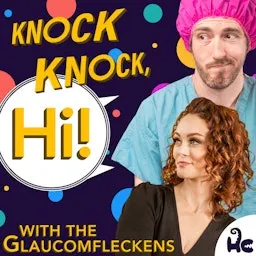
Knock Knock, Hi! with the Glaucomfleckens
Hosted by Human Content · EN
"Knock Knock, Hi! with the Glaucomfleckens" dives into the highs, lows, and WTFs of healthcare. Whether you're in the medical field, live with a healthcare worker, or broke your arm once and are still paying off your medical bills, this is a must-listen. Join Will and Kristin Flanary (aka the Glaucomfleckens) for candid chats with leading healthcare voices like Dr. Mike and Surgeon General Dr. Vivek Murthy. Discover fun facts about eyeballs, hear relatable stories from medical training, and sneak a peek into the U.S. health insurance industry (spoiler alert: it's not great!). We'll share our own perspectives of being a patient or family member experiencing the healthcare system. And, of course, we explore the question on everyone's minds: "Why has Dr. Glaucomflecken never had his eyes dilated?" Combining science with humor and a dash of snark, we unpack the human side of healthcare.
59episodes
Episodes
Newest firstAll episodes
What Healing Actually Looks Like After Near-Death with Dr. Rana Awdish
2d ago01:06:17Tap to summarizeDr. Rana Awdish is one of those rare humans who can speak from both sides of the hospital bed with complete authority, and somehow make you feel understood in the process. She's a critical care physician whose first book, In Shock, is a landmark medical memoir about becoming critically ill on the last day of her fellowship in her own ICU and it was one of the books that helped Kristin make sense of her own co-survivor experience after my cardiac arrest. Rana's new book is Aftershock: Learning to Reinhabit My Body After Illness, and it picks up where In Shock left off: not the dramatic part, but the harder part, the years of PTSD, the process of learning to trust her own body again, and the realization that medicine doesn't own healing. We talk about her experience of being repeatedly hospitalized in her own ICU, the embodiment work she had to do to unlearn what medical training takes from you, and the specific, extraordinary moment when she was sitting at her window watching snow that looked like dividing cells and understood, with total certainty, that she had cancer, before any test confirmed it. She then tried to schedule her own surgery before the pathology came back. The biopsy came back positive. Her body was right. Kristin asks us both the question I've been avoiding: is humor a deflection? I can't fully say it isn't. There's a pretty direct line between making a wearable defibrillator comedy video the moment I got home from the hospital and not having fully processed what happened. Rana's concept of "externalizing", putting difficult things outside yourself so they live somewhere other than inside your body, maps uncomfortably well onto what I do. We also get into interoception (a new word for me, as Kristin noted with zero surprise), moral injury, and what Rana would tell healthcare professionals who reflexively dismiss patients who say they know something is wrong. She's a professor at two medical schools, and the line I keep thinking about is this: "There's so much in our training that causes us to believe we have to have the answer or we have no value." This is one you'll want to sit with for a bit. I'm still sitting with it. Takeaways: Medicine doesn't own healing. Humor and creativity can be externalizations as much as they are healing Interoception, the nervous system's awareness of internal body states, is real, measurable science, not woo Living with a foreshortened sense of the future is a predictable and poorly-addressed consequence of surviving critical illness Physicians are trained to function without physical or emotional needs, and the deprogramming required to reconnect with their own bodies is real and difficult — To Get Tickets to Wife & Death: You can visit Glaucomflecken.com/live We want to hear YOUR stories (and medical puns)! Shoot us an email and say hi! knockknockhi@human-content.com Can’t get enough of us? Shucks. You can support the show on Patreon for early episode access, exclusive bonus shows, livestream hangouts, and much more! – http://www.patreon.com/glaucomflecken Also, be sure to check out the newsletter: https://glaucomflecken.com/glauc-to-me/ If you are interested in buying a book from one of our guests, check them all out here: https://www.amazon.com/shop/dr.glaucomflecken If you want more information on models I use: Anatomy Warehouse provides for the best, crafting custom anatomical products, medical simulation kits and presentation models that create a lasting educational impact. For more information go to Anatomy Warehouse DOT com. Link: https://anatomywarehouse.com/?aff=14 Plus for 15% off use code: Glaucomflecken15 -- A friendly reminder from the G’s and Tarsus: If you want to learn more about Demodex Blepharitis, making an appointment with your eye doctor for an eyelid exam can help you know for sure. Visit http://www.EyelidCheck.com for more information. Produced by Human Content Learn more about your ad choices. Visit megaphone.fm/adchoices
Transcribe →Knock Knock Eye: Physicians and Unionization: Why We're Behind
1w ago00:31:17Tap to summarizeTwo topics today. First, unionization, which is having a real moment in healthcare. Banner Health's hospitalists just formed the largest physician union in Arizona. The Brigham and Women's nurses recently held the largest one-day strike in Massachusetts history. I get into why physicians are so far behind on this, historically we've been independent, and you can't unionize as a practice owner or contractor, and why we're catching up now that companies like Apollo MD, Sound Physicians, SCP Health, and even Optum are employing us. After the break, another eye drop recall. This one is a big one. 2.5 million bottles of prednisolone from Lupin Pharmaceuticals recalled after a foreign substance was found. Prednisolone is one of the most commonly prescribed drops in ophthalmology and standard after cataract surgery, so this one is going to be felt. Takeaways: Physician unionization is accelerating: Banner Health's hospitalists just formed Arizona's largest physician union, and the Brigham and Women's nurses recently held the largest one-day strike in Massachusetts history Physicians have lagged nurses on unionization because they were historically independent, practice owners and contractors can't unionize, but as more doctors become W2 employees of health systems, private equity groups, and corporations like UnitedHealthcare (the country's largest employer of physicians), unions become both viable and appealing SCP Health's move to hire displaced Valley Health emergency physicians as 1099 contractors has multiple downstream effects, no benefits obligations for the company, and no legal path to unionization for those doctors Lupin Pharmaceuticals is recalling 2.5 million bottles of generic prednisolone eye drops after a foreign substance was found; prednisolone is one of the most commonly prescribed post-cataract drops in ophthalmology, so a shortage could disrupt post-op inflammation control Instead of intra-healthcare-worker infighting, Will's ask is radical transparency from hospitals, actual prices, actual reimbursement rates, actual margins, actual payer contracts, so everyone can see where the money is really going before accepting the argument that one group's raise costs another its own To Get Tickets to Wife & Death: You can visit Glaucomflecken.com/live We want to hear YOUR stories (and medical puns)! Shoot us an email and say hi! knockknockhi@human-content.com Can’t get enough of us? Shucks. You can support the show on Patreon for early episode access, exclusive bonus shows, livestream hangouts, and much more! – http://www.patreon.com/glaucomflecken Also, be sure to check out the newsletter: https://glaucomflecken.com/glauc-to-me/ If you are interested in buying a book from one of our guests, check them all out here: https://www.amazon.com/shop/dr.glaucomflecken If you want more information on models I use: Anatomy Warehouse provides for the best, crafting custom anatomical products, medical simulation kits and presentation models that create a lasting educational impact. For more information go to Anatomy Warehouse DOT com. Link: https://anatomywarehouse.com/?aff=14 Plus for 15% off use code: Glaucomflecken15 -- A friendly reminder from the G’s and Tarsus: If you want to learn more about Demodex Blepharitis, making an appointment with your eye doctor for an eyelid exam can help you know for sure. Visit http://www.EyelidCheck.com for more information. Head to http://www.cozyearth.com and use my code KNOCKKNOCK for an exclusive 20% off. Produced by Human Content Learn more about your ad choices. Visit megaphone.fm/adchoices
Transcribe →Sharon McMahon on How Physicians Can Make Real Change in the Healthcare System
1w ago01:09:36Tap to summarizeSharon McMahon, America's government teacher, author of the number one New York Times bestseller The Small and the Mighty, and one of the most effective science communicators working right now, just on the government side joins us today. She makes the case for what types of people should run for office. The bulk of our conversation is about something I see constantly in healthcare comments: learned helplessness, the feeling that the system is too broken and too big and too entrenched to ever get better. Sharon's reframe is the one I needed to hear, this is not a volcano, it's a human-constructed system, and the abolitionists and the suffragists and the civil rights organizers all felt exactly as hopeless as we do, and they kept working anyway. We get into the Overton window, the range of what's currently politically possible, and why universal healthcare isn't in it federally right now, but state-by-state Medicaid expansion absolutely is, and why states function as "democracy laboratories" that can shift the national window over time. Sharon walks me through how to actually get a meeting with your representative, why joining your state medical society or specialty organization matters more than being one annoyed person on the internet, and how Emily Calandrelli got a federal law passed protecting nursing mothers at airport security just by having a big platform and a specific senator. We also cover the filibuster, the Electoral College (winner-take-all was never in the Constitution), the National Popular Vote Interstate Compact, gerrymandering's embarrassing etymological origin, and Great Lakes shipping facts that Sharon would absolutely use to fill 24 hours on the Senate floor. My government teacher was a football coach. I am now remediated. Takeaways: Learned helplessness is the biggest obstacle to healthcare reform. The Overton window explains why federal universal healthcare feels impossible right now, but state-level progress doesn't . The most effective way to get a meeting with your representative is to call their district office, not their DC office. Joining a professional advocacy organization multiplies your impact dramatically. The filibuster is a Senate-only procedural rule that started as an accident. — Want more Sharon McMahon? @sharonsaysso http://www.thepreamble.com http://www.sharonmcmahon.com To Get Tickets to Wife & Death: You can visit Glaucomflecken.com/live We want to hear YOUR stories (and medical puns)! Shoot us an email and say hi! knockknockhi@human-content.com Can’t get enough of us? Shucks. You can support the show on Patreon for early episode access, exclusive bonus shows, livestream hangouts, and much more! – http://www.patreon.com/glaucomflecken Also, be sure to check out the newsletter: https://glaucomflecken.com/glauc-to-me/ If you are interested in buying a book from one of our guests, check them all out here: https://www.amazon.com/shop/dr.glaucomflecken If you want more information on models I use: Anatomy Warehouse provides for the best, crafting custom anatomical products, medical simulation kits and presentation models that create a lasting educational impact. For more information go to Anatomy Warehouse DOT com. Link: https://anatomywarehouse.com/?aff=14 Plus for 15% off use code: Glaucomflecken15 -- A friendly reminder from the G’s and Tarsus: If you want to learn more about Demodex Blepharitis, making an appointment with your eye doctor for an eyelid exam can help you know for sure. Visit http://www.EyelidCheck.com for more information. Head to http://www.cozyearth.com and use my code KNOCKKNOCK for an exclusive 20% off. Produced by Human Content Learn more about your ad choices. Visit megaphone.fm/adchoices
Transcribe →Knock Knock Eye: My July 4th On-Call Recap
2w ago00:38:05Tap to summarizeI almost finished my July 4th call week. Good news! Portland did not blow its face off this year. No open globes, no eyelid lacerations, no thermal injuries, no sclopetaria. Bad news: a Friday holiday means every unanswered call from every patient at every one of our offices lands on the on-call doctor, and I earned every one of them. I walk through three cases. First, a cataract surgery my partner had to abort mid-procedure because the patient had six clock hours of zonule laxity. I explain what zonules actually do, why pseudoexfoliation ruins your day, and how a viscoelastic-driven pressure spike at 1 AM sent me to clinic to "burp the wound" instead of shipping the patient to the ED. Second, an inpatient consult for suspected optic disc swelling, and why nobody outside ophthalmology reliably examines an optic nerve. Third, the classic infectious disease vs. ophthalmology debate: does every asymptomatic patient with candidemia need a dilated eye exam? IDSA 2016 says yes. The American Academy of Ophthalmology says no. I'll tell you where I actually land and why I still show up anyway. Also: my full case for licensing fireworks rather than banning them, and a little pushback on the once-a-year concern for veterans and dogs. Live shows coming up in Boston and at the Lebanon Opera House in September. Takeaways: Zonule laxity, loose or broken suspensory fibers that hold the natural lens in place, can force a cataract surgeon to abort mid-procedure and refer to a retina specialist for a safer staged approach; pseudoexfoliation is one of the most common causes The viscoelastic gels used during cataract surgery can plug the eye's drainage system and cause an IOP spike that lasts up to 72 hours; oral Diamox is standard, but if the patient can't keep it down, options are IV Diamox in the ED or manually burping the wound in clinic Ophthalmologists are effectively the only clinicians reliably trained and equipped to examine the optic nerve, which is why hospitalist consults for suspected disc swelling should be treated as a normal part of the job, not an imposition The IDSA (2016) recommends dilated exams for all non-neutropenic candidemia patients within one week of diagnosis; the American Academy of Ophthalmology recommends against routine screening in asymptomatic patients. Practical approach for 2026: consult ophthalmology for any candidemia patient with visual symptoms (floaters, blurriness, pain, flashes) or who can't reliably report symptoms (intubated, delirious); asymptomatic reliable patients likely don't need routine screening To Get Tickets to Wife & Death: You can visit Glaucomflecken.com/live We want to hear YOUR stories (and medical puns)! Shoot us an email and say hi! knockknockhi@human-content.com Can’t get enough of us? Shucks. You can support the show on Patreon for early episode access, exclusive bonus shows, livestream hangouts, and much more! – http://www.patreon.com/glaucomflecken Also, be sure to check out the newsletter: https://glaucomflecken.com/glauc-to-me/ If you are interested in buying a book from one of our guests, check them all out here: https://www.amazon.com/shop/dr.glaucomflecken If you want more information on models I use: Anatomy Warehouse provides for the best, crafting custom anatomical products, medical simulation kits and presentation models that create a lasting educational impact. For more information go to Anatomy Warehouse DOT com. Link: https://anatomywarehouse.com/?aff=14 Plus for 15% off use code: Glaucomflecken15 -- A friendly reminder from the G’s and Tarsus: If you want to learn more about Demodex Blepharitis, making an appointment with your eye doctor for an eyelid exam can help you know for sure. Visit http://www.EyelidCheck.com for more information. Produced by Human Content Learn more about your ad choices. Visit megaphone.fm/adchoices
Transcribe →Glauc Talk: Can Free Medical School Fix the Primary Care Crisis?
2w ago00:41:22Tap to summarizeIt's just the two of us this week, which means we bounce between Star Wars, ageism in medicine, Mark Cuban's healthcare policy ideas, and the spleen. Kristin sent me a video about the Bajau people of Southeast Asia, a group of divers from Indonesia and the Philippines who have genetically evolved spleens that are 50% larger than average, which they use as an oxygen reservoir to dive 70 meters and hold their breath for up to 13 minutes, and look, I'm not saying I was wrong about the spleen, but I'm being forced to acknowledge it might have one useful function. We also talk about the 72-year-old medical school graduate who is now heading into a family medicine residency and the baffling ageist backlash she received from people who apparently think someone "stole a spot", in family medicine, where programs regularly can't fill their positions. She earned it, full stop. We get into Mark Cuban's argument that free medical school tied to service requirements could help fix the primary care shortage, I think he's closer to right than I initially gave him credit for, but the downstream problems are thornier than they look, and the direct primary care model, which makes a lot of happy doctors but probably has a selection bias problem. We also go deep on spleen physiology because Kristin is my heckler and this is the bit now: splenic lacerations, splenules, Howell-Jolly bodies in the blood post-splenectomy, and why losing your spleen means you really, genuinely need to be vaccinated against pneumococcus, meningococcus, and Haemophilus influenzae type b. Also, I had mono in college, did not follow the no-contact-sports instructions, and I only survived because Kristin wasn't around yet to enforce anything. She has since made up for lost time. Takeaways: The Bajau people of Southeast Asia have genetically evolved larger spleens. A 72-year-old woman earning her medical degree and entering family medicine isn't taking anyone's spot Free medical school tied to service requirements is a more interesting idea than pure loan forgiveness Losing your spleen significantly raises your infection risk from encapsulated bacteria Direct primary care attracts genuinely enthusiastic physicians, but that may partly reflect selection bias — To Get Tickets to Wife & Death: You can visit Glaucomflecken.com/live We want to hear YOUR stories (and medical puns)! Shoot us an email and say hi! knockknockhi@human-content.com Can’t get enough of us? Shucks. You can support the show on Patreon for early episode access, exclusive bonus shows, livestream hangouts, and much more! – http://www.patreon.com/glaucomflecken Also, be sure to check out the newsletter: https://glaucomflecken.com/glauc-to-me/ If you are interested in buying a book from one of our guests, check them all out here: https://www.amazon.com/shop/dr.glaucomflecken If you want more information on models I use: Anatomy Warehouse provides for the best, crafting custom anatomical products, medical simulation kits and presentation models that create a lasting educational impact. For more information go to Anatomy Warehouse DOT com. Link: https://anatomywarehouse.com/?aff=14 Plus for 15% off use code: Glaucomflecken15 -- A friendly reminder from the G’s and Tarsus: If you want to learn more about Demodex Blepharitis, making an appointment with your eye doctor for an eyelid exam can help you know for sure. Visit http://www.EyelidCheck.com for more information. Produced by Human Content Learn more about your ad choices. Visit megaphone.fm/adchoices
Transcribe →Knock Knock Eye: Life Advice for Residents Starting Their First Month
3w ago00:35:32Tap to summarizeToday's main event: how a physician-owned practice negotiates with UnitedHealthcare. UHC is notorious for raising premiums 20 to 30% while offering physician reimbursement bumps of about 1%. I walk through exactly how we push back at Eye Health Northwest, phone messages that spell out the math, letters to patients, and yes, taking the contract to the brink when we have to. This works because we're large and physician-owned, which is why I make the case for other independents to consider joining forces locally instead of selling to private equity or chasing the Sound Physicians model. After the break, a quick "don't do that" tip, and some actual advice for the residents and interns who just started on July 1. Takeaways: UnitedHealthcare consistently reimburses below other commercial payers, often raising premiums 20 to 30% while offering physician reimbursement increases as low as 1%, the ability to push back depends heavily on practice size and market share Eye Health Northwest formed 40 years ago when three independent practices merged, creating the scale needed to stay physician-owned, avoid private equity, and negotiate meaningfully with big insurers, a model Will recommends for other independents willing to stay local The most effective renegotiation tactic is patient transparency: phone messages, letters, and clear math about premium hikes versus reimbursement stagnation motivate patients to pressure the payer directly, which is what ultimately gets big insurers to blink Covering an entire long-weekend call solo across all practice sites is a very different animal than typical private-practice call, Will openly acknowledges that private-practice ophthalmologists have lost perspective compared to residency call at a level one trauma center Advice for new residents: check vision before consulting ophthalmology, stay humble, listen to patients before the system beats it out of you, protect a few minutes a week for something completely outside medicine, and invest heavily in your co-residents — no one else will fully understand what you're going through To Get Tickets to Wife & Death: You can visit Glaucomflecken.com/live We want to hear YOUR stories (and medical puns)! Shoot us an email and say hi! knockknockhi@human-content.com Can’t get enough of us? Shucks. You can support the show on Patreon for early episode access, exclusive bonus shows, livestream hangouts, and much more! – http://www.patreon.com/glaucomflecken Also, be sure to check out the newsletter: https://glaucomflecken.com/glauc-to-me/ If you are interested in buying a book from one of our guests, check them all out here: https://www.amazon.com/shop/dr.glaucomflecken If you want more information on models I use: Anatomy Warehouse provides for the best, crafting custom anatomical products, medical simulation kits and presentation models that create a lasting educational impact. For more information go to Anatomy Warehouse DOT com. Link: https://anatomywarehouse.com/?aff=14 Plus for 15% off use code: Glaucomflecken15 -- A friendly reminder from the G’s and Tarsus: If you want to learn more about Demodex Blepharitis, making an appointment with your eye doctor for an eyelid exam can help you know for sure. Visit http://www.EyelidCheck.com for more information. Head to http://www.cozyearth.com and use my code KNOCKKNOCK for an exclusive 20% off. Produced by Human Content Learn more about your ad choices. Visit megaphone.fm/adchoices
Transcribe →Two Sisters, Two Cardiac Arrests, Zero Explanations with Kendra Cunningham and Kayla Messana
3w ago01:02:08Tap to summarizeThis week we're joined by Kendra Cunningham and Kayla Messana, sisters and co-hosts of the podcast Flatlined and Fine, and their stories are almost impossible to believe. Kayla was 31, healthy, three kids, husband just back from deployment, when she woke him up with agonal breathing in the middle of the night. He dragged her to the floor, did CPR for 10 minutes, and she was shocked twice by an AED before going on to have cardiac arrest approximately eight more times in the next 24 hours. Four years later, she's been shocked by her ICD three additional times and still has no clear diagnosis. Then, a few years after Kayla's event, Kendra had her own cardiac arrest while awake and feeding her newborn twins, told her husband she was about to faint, and was gone within seconds, saved by a man whose only CPR training was a few American Heart Association videos he'd watched before their first child was born. Kristin and I swap notes with them on everything: what it's like to wake up in an ICU with no memory of what happened, how you explain cardiac arrest to kids who are five, six, and eight years old, the psychological weight of an idiopathic diagnosis that gives you no answers and no closure, and the very real experience of being a 31-year-old in a cardiology waiting room surrounded by people forty years older than you. We also get into the insurance disaster of a $15,000 whole exome sequencing test that Blue Cross Anthem denied, why Kendra couldn't pick up her newborn twins for months after her ICD surgery, and why I was cleared to perform eye surgery but not allowed to drive for six months. I also get publicly shamed for not having plugged in my ICD data transmitter in two years. It's earned. Takeaways: Cardiac arrest in young, healthy adults often has no identifiable cause. CPR saves lives even when the person doing it is terrified and untrained. The co-survivor experience is its own separate, underserved story. Young cardiac arrest survivors often get inadequate guidance from the healthcare system. Being shocked by an ICD is traumatic and disruptive in ways that don't get talked about enough. — Want more Kendra Cunningham and Kayla Messana? @flatlined.and.fine on Instagram Flatlined and Fine on Spotify: https://open.spotify.com/show/2nRXIK5OvgAv2CXKvCwrQu?si=eHV4s_CZTQyLAXLvf7A14A&nd=1&dlsi=359ec698e7c64c90 To Get Tickets to Wife & Death: You can visit Glaucomflecken.com/live We want to hear YOUR stories (and medical puns)! Shoot us an email and say hi! knockknockhi@human-content.com Can’t get enough of us? Shucks. You can support the show on Patreon for early episode access, exclusive bonus shows, livestream hangouts, and much more! – http://www.patreon.com/glaucomflecken Also, be sure to check out the newsletter: https://glaucomflecken.com/glauc-to-me/ If you are interested in buying a book from one of our guests, check them all out here: https://www.amazon.com/shop/dr.glaucomflecken If you want more information on models I use: Anatomy Warehouse provides for the best, crafting custom anatomical products, medical simulation kits and presentation models that create a lasting educational impact. For more information go to Anatomy Warehouse DOT com. Link: https://anatomywarehouse.com/?aff=14 Plus for 15% off use code: Glaucomflecken15 -- A friendly reminder from the G’s and Tarsus: If you want to learn more about Demodex Blepharitis, making an appointment with your eye doctor for an eyelid exam can help you know for sure. Visit http://www.EyelidCheck.com for more information. Head to http://www.cozyearth.com and use my code KNOCKKNOCK for an exclusive 20% off. Produced by Human Content Learn more about your ad choices. Visit megaphone.fm/adchoices
Transcribe →Knock Knock Eye: World Cup Eye Injuries: An Ophthalmologist's Field Guide
4w ago00:31:58Tap to summarizeI'm on call July 4th for the first time in what feels like forever, and I have fully lost perspective on what call should feel like. 2018 me, fresh out of an Iowa trauma center, would be horrified at how nervous private practice me has gotten about it. I'll report back after the holiday. Today's main event is World Cup eye injuries. Every professional sport needs an ophthalmologist on the sideline, soccer included, and I walk through three I'd be ready for. First, a 50 MPH ball off Erling Haaland the Viking's foot straight to the face, hyphema, open globe risk at the equator and limbus, retinal dialysis in young patients. Second, a player smashing their face on a goalpost, orbital floor fractures, the workup for extra-ocular muscle entrapment, and a full breakdown of eyelid laceration repair: above brow, below brow, eyelid margin, and canalicular. Third, the soccer flop, where grass exposure can deliver a corneal abrasion or an allergic reaction, and the drops I reach for. I've got more on deck if the tournament keeps giving me material. Takeaways: A high-velocity soccer ball to the face can cause hyphema (sheared vessels in the anterior chamber), an open globe at one of the eye's two weak points (the equator behind the extra-ocular muscles and the limbus at the edge of the cornea), or a retinal dialysis, especially in younger patients Hyphema management is driven by eye pressure: normal pressure means strict couch-potato rest until the blood clears, because a second bleed is always worse than the first; very high pressure may require surgical evacuation A face-into-goalpost impact most commonly causes an orbital floor fracture; suspected extraocular muscle entrapment is a PANTS patient, the ophthalmologist comes in, the orbit gets scanned, and forced duction testing rules entrapment in or out Eyelid laceration repair depends on location: above the brow is straightforward, below the brow uses skin-only sutures because there's an eyeball underneath, eyelid margin lacerations require specialized technique, and canalicular lacerations need temporary tube placement Even a soccer flop can cause real eye injury, grass exposure can lead to corneal abrasion or an allergic reaction in the fornix, treated first-line with antihistamine drops like Patanol, Pataday, or Zaditor, with short-course topical steroids for severe cases To Get Tickets to Wife & Death: You can visit Glaucomflecken.com/live We want to hear YOUR stories (and medical puns)! Shoot us an email and say hi! knockknockhi@human-content.com Can’t get enough of us? Shucks. You can support the show on Patreon for early episode access, exclusive bonus shows, livestream hangouts, and much more! – http://www.patreon.com/glaucomflecken Also, be sure to check out the newsletter: https://glaucomflecken.com/glauc-to-me/ If you are interested in buying a book from one of our guests, check them all out here: https://www.amazon.com/shop/dr.glaucomflecken If you want more information on models I use: Anatomy Warehouse provides for the best, crafting custom anatomical products, medical simulation kits and presentation models that create a lasting educational impact. For more information go to Anatomy Warehouse DOT com. Link: https://anatomywarehouse.com/?aff=14 Plus for 15% off use code: Glaucomflecken15 -- A friendly reminder from the G’s and Tarsus: If you want to learn more about Demodex Blepharitis, making an appointment with your eye doctor for an eyelid exam can help you know for sure. Visit http://www.EyelidCheck.com for more information. Produced by Human Content Learn more about your ad choices. Visit megaphone.fm/adchoices
Transcribe →Is the Match Broken? A Deep Dive into Medical Education with Dr. Bryan Carmody
Jun 3001:05:30Tap to summarizeI've been watching the Sheriff of Sodium break down medical education data on social media for years, so I'm thrilled to finally have Dr. Bryan Carmody on the show to help me understand what's actually happening to the system that turns medical students into doctors. We start with the basics What the Match is, why it was created in the 1950s to solve a headhunting problem that was stressing everyone out, and how the algorithm actually works. We quickly get into what's gone sideways since then: the residency selection arms race, where every year applicants have more publications, higher board scores, and more research experiences than the year before, and yet the match rate hasn't moved, meaning they've all just collectively agreed to suffer more for the same outcome. Bryan also breaks down what happened when Step 1 went pass/fail and the uncomfortable fact that about 25% of medical student publications have never been cited by anyone, ever. We also go through the 2026 Match data, who's thriving, who's struggling, and what it actually means when programs can't fill their spots. Bryan puts the "physician shortage" debate in real context: it's not that we don't have enough doctors, it's that we've created terrible incentives for where doctors practice and what they do. We get into international medical graduates, the growth of new medical schools, and the signaling system, a newer mechanism that tries to fix the problem of people applying to 200 programs just to hedge their bets. I also reveal that stand-up comedy is what got me my residency interviews, which honestly tracks. Takeaways: The residency selection arms race is real but largely self-defeating, match rates for US medical students haven't meaningfully changed, meaning all the extra publications, research experiences, and board prep have just raised the floor without helping anyone actually get ahead. The "physician shortage" is mostly a distribution and incentives problem, not a numbers problem, there are about 1.3 residency positions for every graduating US MD/DO, and the real issue is that doctors rationally choose to practice in places with better pay, better amenities, and better working conditions. We probably don't need more medical schools, the constraint isn't classrooms, it's clinical training sites, and adding more schools without more high-quality hospital rotations just dilutes an already strained system. Family medicine, pediatrics, and emergency medicine are the specialties with the most unfilled residency spots and it's a combination of too many new programs being created and not enough applicants choosing those fields, driven by the same incentive mismatches that cause geographic maldistribution. Signaling is a genuine improvement to a broken application process, it gives programs a way to identify applicants who actually want to be there, rather than sifting through hundreds of applications from people who clicked every available program just to maximize their odds. — Want more Dr. Bryan Carmody: @jbcarmody on X/Instagram/Threads/Bluesky and Sheriff of Sodium on YouTube. To Get Tickets to Wife & Death: You can visit Glaucomflecken.com/live We want to hear YOUR stories (and medical puns)! Shoot us an email and say hi! knockknockhi@human-content.com Can’t get enough of us? Shucks. You can support the show on Patreon for early episode access, exclusive bonus shows, livestream hangouts, and much more! – http://www.patreon.com/glaucomflecken Also, be sure to check out the newsletter: https://glaucomflecken.com/glauc-to-me/ If you are interested in buying a book from one of our guests, check them all out here: https://www.amazon.com/shop/dr.glaucomflecken If you want more information on models I use: Anatomy Warehouse provides for the best, crafting custom anatomical products, medical simulation kits and presentation models that create a lasting educational impact. For more information go to Anatomy Warehouse DOT com. Link: https://anatomywarehouse.com/?aff=14 Plus for 15% off use code: Glaucomflecken15 -- A friendly reminder from the G’s and Tarsus: If you want to learn more about Demodex Blepharitis, making an appointment with your eye doctor for an eyelid exam can help you know for sure. Visit http://www.EyelidCheck.com for more information. Produced by Human Content Learn more about your ad choices. Visit megaphone.fm/adchoices
Transcribe →Knock Knock Eye: Mark Cuban's Case for Medicare for All and Total Financial Transparency
Jun 2500:25:07Tap to summarizeA few things on the agenda today. First, RFK Jr. and the MAHA crew want medical schools to dedicate around 40 hours, roughly 20% of preclinical training, to nutrition education. I have some thoughts. We already have dietitians, med school is already a fire hydrant, and the Krebs cycle had it coming, but this isn't the way. Then a Mark Cuban appreciation segment, because he's out there on X dragging the entire healthcare system toward transparency. His latest pitch: someone buy a hospital, charge Medicare rates for every single thing, expose every dollar in and out, and prove whether Medicare for All can actually work. In theory, I'm in. In practice, you can't slash physician pay without first addressing the $500,000 in debt that gets people into the door. The Australian model, a real public safety net coexisting with a private system, makes more sense to me, but only if we fix the training pipeline first. After the break, ophthalmology. A young man got a bamboo shoot to the eye six months ago. Healed up fine. Now he's waking up at 2 AM in excruciating pain, no trauma involved. That's a recurrent corneal erosion. I walk through why it happens, why CPAP can make it worse, and the whole treatment ladder, ointment, bandage contact lenses, superficial keratectomy, corneal micropuncture. Also: don't let your cornea melt. That's the headline. Takeaways: RFK Jr. and MAHA are pushing medical schools to dedicate around 40 hours, or 20%, of preclinical training to nutrition, a shift that ignores the existence of dietitians and would crowd out essential physiology and disease education Mark Cuban has floated a real-world test case for Medicare for All: buy a hospital, charge only Medicare rates, and operate with complete financial transparency to show whether the model is sustainable Any serious move toward Medicare for All or an Australian-style public-private hybrid will require addressing the roughly $500K in training debt physicians carry; otherwise the math doesn't work and recruitment collapses Recurrent corneal erosion happens when an old abrasion never fully reattaches to the underlying stroma, patients typically wake up in severe pain because the eyelid scrapes loose epithelium across a dry cornea overnight, and CPAP without a good seal makes it worse Treatment escalates from aggressive nighttime lubrication (erythromycin ointment, Genteal gel) to a bandage contact lens, and in stubborn cases to a superficial keratectomy or corneal micropuncture to create a smoother, more firmly attached corneal surface To Get Tickets to Wife & Death: You can visit Glaucomflecken.com/live We want to hear YOUR stories (and medical puns)! Shoot us an email and say hi! knockknockhi@human-content.com Can’t get enough of us? Shucks. You can support the show on Patreon for early episode access, exclusive bonus shows, livestream hangouts, and much more! – http://www.patreon.com/glaucomflecken Also, be sure to check out the newsletter: https://glaucomflecken.com/glauc-to-me/ If you are interested in buying a book from one of our guests, check them all out here: https://www.amazon.com/shop/dr.glaucomflecken If you want more information on models I use: Anatomy Warehouse provides for the best, crafting custom anatomical products, medical simulation kits and presentation models that create a lasting educational impact. For more information go to Anatomy Warehouse DOT com. Link: https://anatomywarehouse.com/?aff=14 Plus for 15% off use code: Glaucomflecken15 -- A friendly reminder from the G’s and Tarsus: If you want to learn more about Demodex Blepharitis, making an appointment with your eye doctor for an eyelid exam can help you know for sure. Visit http://www.EyelidCheck.com for more information. Produced by Human Content Learn more about your ad choices. Visit megaphone.fm/adchoices
Transcribe →