← Know What You Believe with Michael Horton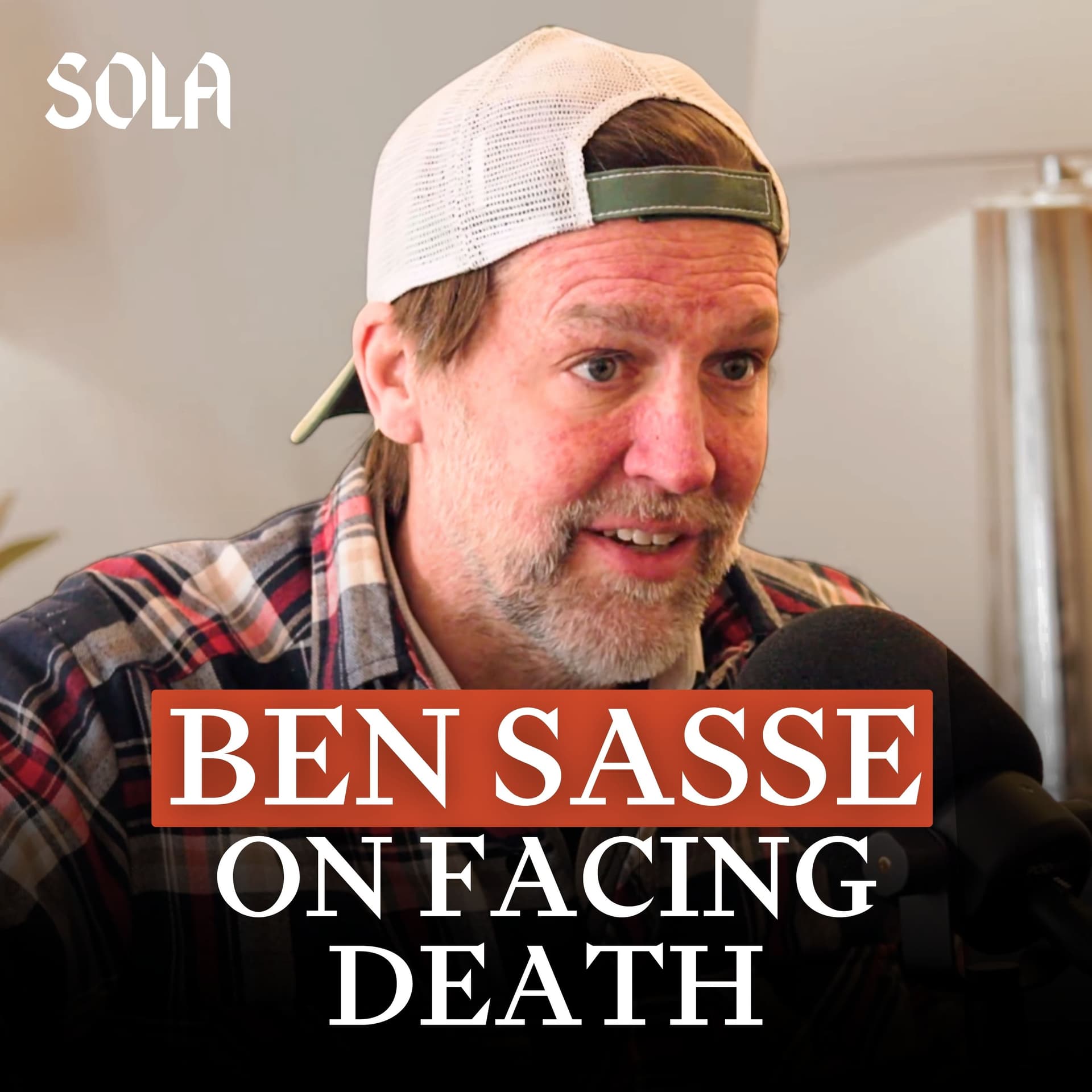
Loading summary
Transcript77 lines
- [00:00]
A
On December 23, 2025, former US Senator Ben Sasse publicly announced that he had received a diagnosis of stage 4 pancreatic cancer. On February 7, 2026, Ben Sasse, Michael Horton and Dan Bryant sat down to discuss Ben's cancer diagnosis, his rich history with sola media, and 33 years of friendship that traced back to their days at Oxford.
- [00:25]
B
Hello, I'm Dan Bryant and we want to welcome you to this conversation on I have had the very good fortune for 33 years now to call Mike Horton and Ben Sass very close friends. And it is a delight to be able to have this conversation. I am ostensibly the moderator of this conversation, so it could go downhill really quickly. So we have Mike involved and Ben involved. So the idea of me moderating is a little bit suspect. But we're going to tried to enjoy our conversation and you're going to try to be well behaved. Thank you, Dr. Michael Scott Horton.
- [01:06]
A
33 years. That sounds long and it feels like it's been way longer. Wow.
- [01:12]
C
I don't know how to interpret that, but it's over half of our life, lifetime.
- [01:17]
B
Did you have to put such a fine point on our.
- [01:22]
C
That's a milestone.
- [01:23]
B
So we are delighted to have this conversation and I'm privileged to moderate. So Ben, we will return to the topic of your cancer over the course of this conversation just to bore the listeners. Well, at the outset there are a.
- [01:37]
C
Lot of people who want to hear.
- [01:39]
B
Yeah. Would you give us the update? Obviously, in December you were diagnosed with stage four pancreatic cancer. You let friends and those who care about, you know, just before Christmas. You've been involved in a treatment program since then. How are you doing? How goes the treatment?
- [01:59]
C
Thanks.
- [02:01]
A
Yeah, cancer's nasty, but everybody knows it has experience with it. I think 40% of Americans will be diagnosed with cancer at some point. Seven weeks ago we were diagnosed, end up having 5ish kinds of cancer now but it started as pancreatic, which is kind of the worst death rates of any cancer because our pancreas isn't very important. So it becomes a place where that stealthy disease can hide and start to metastasize. And usually the reason pancreatic cancer has less than a 3% survival rate is because people don't know they have it until it's already metastasized because the fat, you don't become symptomatic in your pancreas usually cause it's not very important. So for about seven weeks I've been going through some weird abdominal stuff and we couldn't figure out what was wrong. I'm an idiot. And I do triathlons and I often train in stupid ways. So I wear a 45 pound weight vest a lot, which is fine for slow ruck races and quasi jogs, but it turns out you shouldn't wear your rucksack on a bike. And I'd been doing that for a while, which makes no sense now when you say in public, I don't know what I was thinking, but it meant that when I had all this weird stuff happening in my back and in my abdomen, I thought I just pulled a bunch of muscles. So it took a few weeks to get diagnosed. But anyway, once we got diagnosed, we knew that the probability of a relatively near term death is pretty high. And so a to live as Christ, to die as gain. We felt amazingly blessed that Melissa, my wife, and I immediately were at peace about all this. But because one of our three kids is still at home, our girls are 24 and 22, my son's 14. You felt like you had an obligation to try to fight a little bit. It's weird because we all know we're on the clock and we have a death sentence. And once you know you're going to die sooner, it feels kind of weird to spend tons of energy to go through different kinds of treatment stuff. But when you got a kid living at the house, you feel like you gotta fight to try to give him some extra dad slaps upside the head and hugs. So we're way post surgical because when I pushed my docs, they were trying to tiptoe around stuff. And I said, I'm tough. I'm not the toughest guy on earth, but sort of farm kid tough. I can take a little bit of pain and I can take blunt talk. I said, please, just be blunt. Tell me what we know. And they tiptoed again. And I said, please tell me some fact. And they go, I'll give you a fact. Ben Sasse's torso is chock full of tumors. I said, well, that was a fact. That was blunt. So we're way post surgical, which in a weird way is kind of a blessing as opposed to having a 10% chance that surgery could be of any use. I mean, I have so many tumors, there's no point in going through surgeries to try to remove one here or there because it won't add up to enough of a difference. So it kind of focused us on what we could try to do. And so the two best places on earth, and I'll stop with this for pancreatic cancer are Memorial Sloan Kettering in Manhattan and MD Anderson in Houston. And so in the first week as we were diagnosed, we went to both places for 48 hours and just stood in hallways and banged on doors and were fortunate, blessed, fortunate in a Calvinistic sense, to know people who knew people and got to know some docs. And we said at each place, give us the story of what you would do to have a shot at living 12 months instead of 3 months. What do we do? And at both places, they gave us treatment plans if we could get in a clinical trial. And so I want to thank a lot of Sola and Whitehorse friends for prayers, because I told a lot of people around Christmas that our number one prayer request was that I would be a good dad and husband during these waning days. Number two, that we would be tough and be able to honor and serve the staff that we'd be around at the hospitals. But number three was have a shot to get into one of these clinical trials. And so we got accepted on December 29th, had a clinical trial in Houston. And so MD Anderson is my hospital of choice. I'm hospitalized for a few days every week there. And we're in a super aggressive clinical trial where I'm taking, you know, chemotherapy, which is a societally polite term for poison yourself. What's the maximum dose of poison you can try to put into the tumors without killing yourself? And so we're trying to shrink these tumors for a while, and it seems to be going pretty great, except my liver and kidneys are having a little trouble keeping up with all the poison for me, so I have trouble maintaining skin on my face. So I bleed a lot out of my face and I puke a lot, like everybody on chemo. But overall, very, very blessed with the team that we have and what we're working through.
- [06:47]
B
Thanks for that. Ben, a lot of people know you as the former senator from Nebraska. Many might not know how far back you and Mike go. And you.
- [06:57]
C
You're the one who got that ball rolling.
- [07:00]
B
I might have been a little involved, yes, but you actually were one of the first team members as White Horse Inn was finding its way. And you were involved with the magazine Modern Reformation, with the radio show White Horse, Innovation. How did you and Mike kick off this collaboration?
- [07:19]
A
There's the pop culture game Six Degrees of Kevin Bacon. I think there's Two Degrees of Dan Bryant. There are about a dozen guys in my life that I still keep up with from the mid-90s, and I think two thirds of Them are people you've introduced. Summer of 92. I was in Czechoslovakia before the breakup for the summer and then studied at Oxford that fall and then lived on a train for a few months after. And in that 9ish month run, being out of the US the time in Oxford created a lot of friendships that last. And you. And it lasted. And you and I never met there, but I knew of you there and was bummed that we didn't meet. And when I got back, I ended up getting engaged the next year. And I realized, holy smokes, I have no sufficient catechol foundation in my life to lead a household. And I asked Dan's advice and Dan said, I have an idea. You need some theology and Mike needs some worldly wisdom. Why don't you go to Anaheim and see if Mike's folks will let you live with them for a while and you can try to clean up Mike's books at Cure Christians United Reformation, one of the predecessor organizations to the alliance of Confessing Evangelicals and SOLA Media. You know, I asked for some casual, you know, give me a little bit of a structure of how the flow of scripture works. And Mike's like, yeah, how about three nights a week we'll get together for maybe five hours. And how about when you get there, you'll have done 2,000 pages of Calvin reading a couple books of the Bible, three catechisms, one can be in English, and then we'll get together for a few hours. And so we started doing that Monday, Wednesday, Friday night for pizza and really cheap beer. That's how it started.
- [09:01]
C
Yeah. And then he became executive director of the whole enchilada and the editor in chief of Modern Reformation and trusted his theological judgment ever since, to this day. The practical, worldly wisdom advice too. It's been like, little brother.
- [09:21]
B
Take just a moment, though. When this, this young buck first arrived out in Orange County, California, what did you make of him?
- [09:29]
C
Oh, not much, just really, it was.
- [09:32]
A
When he mostly liked me from my voice. He asked me to sing Methodist hymns to him in the evening.
- [09:37]
C
There you go. That was part of the whole thesis. But, but it was when he married Melissa and brought her into the circle that showed me his judgment was superior. They're both. I mean, Melissa is an amazing human being and the stuff that she's done and did at the beginning, when, you know, we were starting that church, Christ Reformed in Anaheim, and just down through the years, wonderful friendship with all of our families.
- [10:16]
B
Yeah. Here, here.
- [10:17]
C
Which I don't think you see much anymore. I think it's really hard for people to remain this close over 33 years and be a part of your. We're here for your daughter's wedding. Ben, you've been to every funeral. I've had a lot of funerals in my family. You've been to Mom, Dad, Gary. My brother gave a eulogy there. I feel like we're there at crucial times in each other's lives because life is short. This life is short, but we have eternity to hang on to. And that's what anchors us so that this life is actually more precious than it would have been otherwise.
- [11:00]
A
Amen. Come a day earlier and stay a daylight at those funerals too. Right.
- [11:05]
B
I've had young friends approach me and ask about our friendships and the small community of initially guys and now guys and their wives and their children and ask the question clearly wanting more of that in their own life. And it leads to the next question. I wanted to ask you too, before you do.
- [11:30]
C
My kids too, yeah, they wanted to go to Oxford, but why do you. Plenty of good schools here. We want to have friends like you have. Yeah, that's pretty cool.
- [11:41]
B
Part of the answer, I think, when people ask, is that we all were becoming enamored with theology, with church history, with thinking about questions of deepest purpose and the Christian response to those questions. We were growing up theologically together. And at the core of that for the two of you all along has been this idea, this truth of the gospel. You have both lived through a period of time where the church has routinely confused or trivialized the meaning of the gospel. And yet for you two, the gospel is central to how you think, how you live. Mike, Ben, the gospel, what is it and why is it this anchor for how you engage life and pursue your callings?
- [12:39]
C
God for us in Jesus Christ, I mean, that's the simplest definition, I think, of the gospel. And I have watched both of you over so many years live lives consistent with that gospel and the people you've touched with that gospel. The people who say, I don't know what it is about you, but there's seems to be something authentic, something real. I'm so honored to have you guys as brothers.
- [13:14]
A
We'll definitely get back to how we're all on the clock. But knowing that your death is impending sooner gives you an even greater ability to deny any of our righteous acts as righteous. The foolishness of our works are pretty apparent to you when you try to really look at the accounting of a life. We'll get back to that. But your God for us, in Christ is great shorthand. We'll go at it to medium lengths as well. One is imputation and justification and sanctification, which will be completed and perfected at glorification. It's fun to talk to your kids and your nephews and nieces about how Jesus did everything on the cross to fulfill the whole law. I fulfilled none of it. He fulfilled all of it. And he took away all of my sins. And I'm not just justified, I'm actually being made intrinsically righteous, though you can't see it like so little fruit and bud. But it will be accomplished. And so the gospel is all of those ordos ludus stuff, and we get to talk about what Jesus did for us positively and took away negatively and what he's going to we were saved on a cross tree outside Jerusalem, and we are being saved, and we will be saved completely. But Genesis 3 and Romans 5, like I am in Adam, a member of this rebellious race, imago dei. We were created glorious in God's image and meant for fellowship with him. And yet we're a part of this rebel clan of everybody. And that's not the end of the story. The end of the story is the new Adam came from heaven, laid down all of his prerogatives, and came and swept us up.
- [15:11]
C
Raised us and seated us in heavenly places. The weight of glory Paul talks about is so great, it's not even worth comparing the sufferings of this age and of our lives right now to that weight of glory that will appear in us. You think this is not a guy sitting in an ivory tower, sitting in a townhouse in Manhattan. This is a guy being run out routinely from city to city, stoned, shipwrecked, deprived, thrown into prison. And yet he can say, not that this is unimportant, this is insignificant at all, but glory is so great that this suffering right now seems like in retrospect, it will seem like a light and momentary affliction that can be said in the wrong way, where you're kind of, well, they're there now. This is just a light, momentary affliction. Or it can be seen as, no, no, no, it's horrible. It's horrible. There are other passages that talk about suffering as horrible. The last enemy is death. But then what it's really talking about is how inexhaustible the glory is.
- [16:35]
A
When we've been there 10,000 years, still won't even have gotten started. And the Paul who said that, who was being pursued and stoned, also had been the pursuer and the Stoner. And that's the depth of our line.
- [16:51]
C
With Adams while he was stoning, you know. Yeah.
- [16:56]
B
So, Ben, maybe you've started answering this question already, but you were editor of this wonderful journal, Modern Reformation. You were director of the radio show White Horse Inn. These roles are clearly obvious springboards to the U.S. senate.
- [17:13]
C
Yeah, well, he took a. It was a downward move, really. Downward facility. Right.
- [17:21]
B
We just admire the way you mapped that career and can give that advice to others seriously. So you brought that kind of theological grounding into your various callings. Private husband, father, public, the academy, politics, policy, public service. How would you say that grounding that investment of you becoming thoughtful, theologically informed, your approach made a difference.
- [17:56]
A
I don't mean to use the term moderate about policy questions here. We don't care to talk on this radio show about anybody's policy preferences. But it's useful to be moderate in terms of how we think about this worldly callings to try to preserve institutions. God created the world and called it good. And we are embodied creatures. And the culture mandate to be fruitful and multiply obviously means make babies and build families, but it also means to set up a really nice dinner, as you did last night, for your daughter's wedding, and to have people be able to come together and celebrate and to. To do good work in snow removal. And I remember one time when Mike was doing a kind of speed read and a sermon through a bunch of Old Testament texts, as he went, he just dropped in there that some of the lines of, of Cain and, and Esau were speedboat manufacturers, which I always thought was very funny. But there's all sorts of things we need to do to live a human embodied life and to love our neighbor that are important, but they're obviously not ultimate. And it's super useful to think a framework for ordered liberty is a duty to do to love your neighbor or to try to maintain it and to recognize the glories of the American constitutional system and the inheritance are really special. And yet we're not going to need those kinds of laws for coercion and restraint of evil in heaven. So these are not eternal things, they're temporal things. And it's really nice to believe that you can live a life of gratitude to God by trying to love your neighbor and do stuff and serve in a public office, but not want it to be an idol. And right now we have a weird, weird, I don't want to use the word gnostic, but a weird kind of split where most people are just completely disengaged from public life. And the people who are engaged in public life pretend that whatever they're doing in the institutions and the sectors they're working in are ultimate and transcendent. And it's a bunch of hooey. Like, the United States Senate is a really important deliberative body. It doesn't deliver very much right now, but in theory it's a really important deliberative body, but it's not gonna be there in heaven. And that's a pretty great way to be able to serve in the Senate is to say, let's do this with two cheers.
- [20:26]
C
Yeah, yeah, yeah.
- [20:27]
B
When you announced that you had cancer, Ben, you observed that confronting those kinds of brutal realities in the here and now require an ability to deal with reality truly. And to have stiffer stuff to undergird the way you go through life. And moments like that, like this crystallize the need for that. Mike, you've faced headwinds, you've been through challenges. What do you mean by stiffer stuff? What is that better undergirding that you mentioned in your comment?
- [21:12]
A
Well, let's go to Mike on it. But I think acknowledging mortality is just fundamental wisdom. You can go through a lot of wisdom literature, you can read a lot of this altar, but Ecclesiastes and Job are right there telling us that these bodies are decaying. It not supposed to be this way and we will have glorified bodies. But telling the truth about death is really important. And I don't want to go to my hobby horse about our culture being too always online, because in a weird way, it's not really about the digital revolution. It's just an intensification via the digital revolution of generational segregation. But we're unbelievably blessed to live at a time in human history with some of the most interesting technology ever. But we're also just incredibly stupid people in that most kids are not raised around great grandparents and they don't see death and they don't have to change diapers. The course of life is dependency and then a period of independence and then head back to dependency. And if you delude yourself and think at 23 years old, the glories of your skin and your biceps are going to last. And it's a real shame for you that you don't have the opportunity to be around 90 year olds, maybe 70 year olds who can explain it, but 90 year olds who can model a little bit of dignity as they decline. And the stiffer stuff in my mind is not hallmark sentimentality. But honesty about the fact that I'm needy.
- [22:51]
C
Yeah, yeah. It's not only not sentimentality. I think stiffer stuff is also not stoic. It's also not stiff upper lip. You know, keep calm and carry on. It's being able to fall knowing that you're going to fall into the arms of a God who chose you before the foundation of the world and sent his only begotten son to redeem you and has justified you as sanctifying you and will glorify you. The God who loves you that much, that he's going to see to it it to the end. If we are faithless, he remains faithful, for he cannot deny himself. With that kind of ultimate security, we can face death. I think that the reason we come up with all kinds of ways of avoiding death, most people don't even want to talk about it, is because we kind of know in our gut that the sting of death is sin and the power of sin is the law. We kind of know intuitively that what Paul says there in 1 Corinthians 15, we're judged, we're condemned. And a believer knows that, that death is actually one of the links in the chain of salvation, that it's actually this body must die because a seed has to go into the ground in order for stalk to come up. And that's the way it is with us. Until the whole of ourselves is buried in the ground, it can't be raised in that new condition. It has to die. It's like rebooting your. Your laptop, not just reboot it, but in order to change it in the twinkling of an eye and to raise it incorruptible. Christians die with a narrative of death that makes it not happy, not fun, not whatever, but also. And not stoic, but makes it the last enemy. I mean, it's an enemy, a real enemy. Jesus wailed at the tomb of Lazarus, his friend, even though he knew five minutes later he was going to raise him from the dead. It's an enemy, no question about it. Death is not the portal to happy Disneyland and so forth. Death is hard and painful, as we're seeing with our buddy here. But the good news is that that doesn't have the last word because it's the last enemy we will ever have.
- [25:44]
A
Let's just underscore that enemy to be sure. But last is pretty great in that all the other stuff on this pilgrimage that we've had to contend with, there are none left.
- [26:00]
B
Let me ask both of you, you've touched on this, but I want to go deeper for a moment. Ben, you're facing death. Mike, you have known suffering, physical challenges, loss of family members. Many listening might well be thinking, how can I make that which ought to be primary in my life primary sooner and rightly have that which should be peripheral. Be peripheral earlier in my life. I don't want to have to wait until I'm confronting death or disabling suffering. How do you think about embracing the challenge of having a life shaped primarily by that which ought to be primary?
- [27:02]
A
I'm only seven weeks into this since my kind of dated death sentence. But I knew Tim Keller relatively well and talked with him a handful of times as he was dying, ironically of pancreatic cancer as well. And one of the weird lines Tim would use is he said, I, I hate this, but I would never want to go back to the prayer life I had before pancreatic cancer, which I thought sounded pretty weird. And then I went through some pretty heavy stuff in the couple of weeks right before I was diagnosed where I was. We don't need to get into these details, but I was in a lot of pain because I have a bunch of tumors that have grown in and around my spinal column. And so I had some, some tough pain that was hard to make sense of. And it definitely shattered idols really fast. Lots of dumb stuff that I cared too much about and I was too self reliant about seemed really pointless. This is before I had a terminal diagnosis. I just didn't like anything, nothing. I was having to shower five or six times a night for at least 15 or 20 minutes as hot as I could get the water going to spray in the center of my spinal cord to kind of release this cramping that would shoot out of my spine into the front of my abdomen. Didn't know I had pancreatic cancer, but I heard Tim's words in my head a bunch of times that he wouldn't want to go back to his prayer life before that. And I felt then what a blessing that I'm saying, Lord, come quickly. Maranatha, thank you for all of the different things that I used to cling to that right now seem really, really trivial because they're actually really trivial and they could be important ways to love your neighbor. But if you make them an idol, it's not a mixed good. It was an unadulterated bad. And so I think in my handful of weeks before diagnosis and seven weeks since, one of the things that's come clear to me that I tell my kids a lot is Man, I wish I'd taken the Lord's day more seriously more of my life. Because it's a real. A really good antidote to all those idolatries that God smashing idols for us is a blessing. And having a death sentence is a really good way. It's the old gallows humor. Nothing focuses the mind like an impending hanging. Knowing that you're not going to live very long, it's tough because things are weird. Like, I want to coach my kids on things, but some of them are advice I want to give them about something I want them to do 18 months from now. And I'm not going to really be around to give advice during that moment. 18 months. This is not the way it's supposed to be. But there's a real side benefit to not being deluded into thinking, boy, I'm going to build a really dang good building. Like, I'm an architect and I'm going to build some structure. In 36 months from now, we're going to look at this tower that I built. That's not going to happen. That's a pretty healthy thing. And I realize, wow, every Lord's Day should have done that for me in the past.
- [30:13]
C
Yeah.
- [30:14]
A
Know.
- [30:16]
B
Yeah.
- [30:16]
C
For.
- [30:16]
A
For.
- [30:17]
C
I mean, not even to be compared to what our buddy's going through. I. For me, open heart surgery was a time when I was told to say goodbye to my family and probably wouldn't come out of it.
- [30:36]
B
There's a.
- [30:36]
C
There's a good chance I wouldn't come out of it. So I was ready to see the face of Jesus instead.
- [30:43]
B
I remember the phone call with you in that. In that time.
- [30:46]
A
Yeah.
- [30:47]
C
And I. Instead, I saw a nurse standing over me and I said, you're not Jesus.
- [30:55]
A
Yeah, Jesus.
- [30:57]
C
And that would have been, you know, changed my theological. And it has theological ramifications. But I felt like this is this. I now know how I'm going to die. I have always been afraid, not of death, but of the process of dying. And I thought, if I can have this again, where I just go under and I come out on the other side. But I realize that, for instance, what you're going through, it feels like you're being dragged. Feels like to us, to me, like you're being dragged behind the horse.
- [31:38]
A
Just a career advice for you. I think greeting cards are not in your future. Like writing a sympathy card. Hey, thanks for trusting Jesus as you're being drugged by the horse.
- [31:52]
C
They've never asked me.
- [31:56]
B
So. 1 Corinthians 15 is a passage that many make use of. As it relates to the idea of apologetics, how the faith, the Christian faith, is defended and explained. The passage reads, if Christ has not been raised, your faith is futile and you are still in your sins. That text is obviously enormously useful for apologetics, but it's clearly useful and important as it relates to a theology of life, a theology of death and dying. Say a little more if you would, Ben, then you as well.
- [32:38]
C
Yeah, I mean, I think there are two parts to it. One is the apologetic for the resurrection of the body. And if Christ is not raised, then we won't be raised because he was the first fruits. So we're the harvest. If he. If he turned out to be rotting in some shallow grave in Palestine, then so will we, and we're still in our sins. But the second part of 1 Corinthians 15 is explaining to somebody he basically calls an idiot why we have to die. And it's really interesting because. So for Platonists, people who follow the philosophy of Plato, death is salvation because your soul is finally liberated from your body. Why would you want to possibly have a body forever that would be hell, to live forever with your body? No, it's escape from your body that's salvation. And so Philo was a Jewish philosopher who was very influenced by Platonism. And he argued on that basis that first God created the spiritual body, the archetype, the sort of archetypal human Adam, and then he created the individual man, Adam, who was embodied. And what Paul does there is say, undiscerning person, to put it a little bit more mildly. Don't you know that the bodily comes first and then the spiritual? So he flips it, and he's not saying that we're not going to have our. He's saying just the opposite of Philo, the Jewish Platonist. He's saying, actually our bodies will be raised spiritual. In other words, they will be raised incorruptible. And he says this mortal body must put on immortality. It's not as if we're getting rid of this body. This body will be changed, not cast away. And so I think really there he's going up pretty explicitly against Philo, who explicitly said the opposite.
- [35:09]
A
It. This is such a small footnote, but you and I both lived together in New Haven for a time, and there's a glorious old cemetery up on Grove street that has this. These stone columns that are, I don't know, 1850s or something. So in the height of industrial pride about all the big stuff that's going to be built so it looks like Gearing, but it's this old stoneworks and there's this big crossbar over the entrance to the cemetery and it just says in all capital letters, and the dead shall be raised. And we ought to go to cemeteries.
- [35:47]
C
Yeah.
- [35:48]
A
And we ought to linger around the horror and the terrible brokenness of the consequences of Adam and our sins in Adam that corrupted this glorious creation. That was good. And then we ought to also back up and look at the sign and hear the singing at those grave sites that say, and the dead shall be raised.
- [36:11]
B
Yeah.
- [36:12]
C
And you think those old churches, your old family church, is one in Nebraska where your grandfather built the pulpit or built the altar and graveyard outside. And once upon a time that was normal. People would walk through the graveyard to get into church, which reminded you why you got dressed that morning and reminds.
- [36:38]
A
The preacher what to preach about and what is trivial.
- [36:41]
C
Right. You're preparing people for death. That'll sound to a lot of people watching this like, what a morbid religion. Well, actually, when you are dying and we all are. We all are all dying. When you are dying and you realize that and you come to grips with that, that hope is what you absolutely need and to be reminded visually by that, contrast that with never talking to your kids about death, trying to bubble wrap and preserve people from having to discuss it. Movie stars who are aging poorly and yet saying, I don't talk about death. That's not in my vocabulary. Well, get it in your vocabulary.
- [37:32]
A
We know where we're going because we know Jesus is the first fruits, has already risen and he's preparing a place for us. And it's going to be great for us. But even more, it'll be great to be able to free from sin, be around the adoration feast of the Lamb, praising Christ, the one who speaks and saves. But it's also been a blessing for me going through this time to know where I'm going in terms of the actual cemetery. We bought plots long ago and on St. Paul's Road, four miles north of Highway 30 in Washington County, Arlington, Nebraska, on the hillside at St. Paul's Lutheran Cemetery. We've owned grave plots for a long time, and I got lots of generations of family there. But my wife, who has a big brain injury, we had a vertebral dissection that caused a bunch of strokes. And then we've managed struggled through seizures for a lot of years. She almost died one time on a January 25th. And so we named that death day as in a reprieve from death, a gift that God gave us that we've had so much more family life with Melissa. But on every January 25th when we're in Nebraska, she and I go up to the cemetery and it's always ugly, cold in January on this big hillside in Nebraska. So it's iced over and everything. But we walk around all these plots and it's a really good way to focus the mind. And frankly, to get back to a moderate view of how you do this worldly calling, callings you say the aging Hollywood actress. Let's just linger at skin for a minute. How stupid to be 22 or 32 and think the height of all that matters in life is perfect skin care. I also don't want to be dismissive of the work of docs who've done skin work because I was bleeding out my face for a couple of weeks, a couple of weeks ago because of the really aggressive chemo I'm on. The poison that tries to keep the tumors from growing has also made it really hard for me to grow any skin. And so my face was falling off and I was bleeding all the time. And it was pretty nasty because I'm a stomach sleeper. I couldn't sleep on my stomach anymore because my face would clot against the pillow. So for a couple of weeks I had to sleep sitting up and on my back and it was super uncomfortable because I was just bleeding out my face all the time. And I got to know the head of dermatology oncology at MD Anderson Houston and Dr. Chon. She's pretty amazing and I'm incredibly grateful for her gifts. But I want my 24 and 22 year old daughters and 14 year old son or somebody else, somebody who's listening. 14 year old daughter struggling with acne and thinking it's the end of the world. No, it's not the end of the world. But it's pretty amazing that doctors work in all of these specialties and that at the end of time, Jesus, the great physician is going to heal up every part of our body that are decaying and declining.
- [40:37]
B
Another way of thinking about the moderation, Ben, that you speak of is this wonderful reality that the Christian life is one that is neither prone to or has this triumphalistic notion. Neither is it one of despairing, even in the midst of. Of extraordinary suffering. So how do you all think about living with real hope, grounded hope, real gratitude because of the reason we get to be such a hopeful people and yet doing it, Ben, to quote you through gravelly voices, through tears, say more.
- [41:23]
C
Tom Oden when we had Tom, remember we had Tom Odin on Methodist theologian on White horse sin.
- [41:31]
A
And.
- [41:33]
C
We were just laughing through the whole thing. He and Rod and Kim and I were just laughing. And he said, you know, only people who really understand grace can go back and look sin in the face. And he says, do you notice that we've been laughing so much through this whole interview? Really, only people who understand grace can really laugh. He said, I've been around and the more you understand the gospel, the more you can laugh. There's been a lot of gallows humor in your family. Don't you think that ultimately it gives Satan a headache when he hears people laughing at death?
- [42:27]
A
Let's, let's speak to that and have a destination through it. To Dan's question, which might take us back to some definitions of home and of pilgrimage. And one of the reasons why I think you're right about that, Mike, is that to laugh about things like this is to say I'm too small to save, but I've got an ABBA father who's not too small to save. And the end of this story is already known and we're going to go through a veil of tears, but my 14 year old son needs to simultaneously believe in our heavenly Father and what he's going to accomplish. And he needs a little bit of wisdom because in God's providence, he's still got a dad around. He needs a little bit of wisdom from his dad during this time, and yet he still needs to spend 168 hours a week doing something. And I'm not very interesting right now. And as a former recovering workaholic who's done a lot of stupid, idolatrous stuff in my life, it's really humbling to not have much to do every day. I have 16 hours a day of sleep. I have tumors in my spine that the doctors insist I gotta treat with a certain amount of morphine for a bunch of secondary and tertiary reasons for this treatment plan. And so I'm on so much morphine, then I just fall asleep all the time. I'm not useful, I'm not interesting. I don't want to talk about cancer anymore. I don't want people to constantly ask how I'm doing. It's like the seventh doctor and fifth resident, fourth nurse today to ask me how my bowels are doing. Frankly, I don't really want to talk about it. I don't care very much. But my 14 year old has to love his dad and he has to be around me a bit. And so Gallo's humor is actually a.
- [44:18]
C
Little bit of work that we get.
- [44:20]
A
To do in common to say, this isn't the end and yet we still have time to pass here together. And he's going to have to get his homework done and talk to me a little bit and then do some more homework. And I think it's the distinction between pilgrimage and home. Home. It's not wrong to yearn for home. It's right to yearn for home. We're eventually going to go home. What's stupid is to think that the bridge that we're living on any given day is actually our home. What a dumb, trivial palace this is. It reminds me of the Lewis passage about how you thought you were going to do a little small addition on this house, and all of a sudden the lord of the manor comes and starts tearing off wings and throwing up towers. And this hurts a lot. And it turns out our vision for what home, and for what the dinner table feast was going to look like, it was way too small.
- [45:11]
C
That's great.
- [45:12]
B
That's great. You two introduced me wonderfully some 30ish years ago to the Heidelberg Catechism. And the extraordinary framing of Heidelberg, of course, is unpacking the reality of guilt, man's guilt, and then unpacking the wonder, the reality of grace, of God's grace toward guilty man. And then thirdly, those who have been guilty, who have known such extraordinary grace and favor to be enabled to be turned into a people of gratitude, who live with growing gratitude as we reckon with the unbelievable reality of God's goodness and favor and kindness to us, his grace in the context of what we deserve because of our guilt. Guilt, grace, gratitude. It does seem to me that gratitude is the stuff of laughter. Gratitude is the stuff of being freed up to not be owned by our suffering, but to see through it and to have a confidence in the God who has taken us from what our guilt, what our sins deserve through such unmerited favor, so that as his children, we get to be these pilgrims, these pilgrims heading home. There's a freedom, there's a joy, there's an invitation to humor, even in the midst of real struggle.
- [46:47]
A
That's so good. Pilgrims en route, heading home. I think both kinds of meals are appropriate here. We get to have in our three congregations the Lord's Supper every Sunday. So I get like three super crystallized versions of the Gospel every Sunday. You get it, confess your sins and hear it announce that I'm absolved, I'm forgiven. It's like injection of the Gospel you get to hear the scripture explained in the sermon unfolding, what's going on in the text, and you get to come to a table with empty hands. I don't bring anything except the sin to the table. I get the body and the blood. I get the bread and the wine. It's not a full meal. It's just a little embreaking for a second. That hits all five senses. Normally at church we only get the organ of the ear, but all of a sudden, for a minute, you also get to smell it, see it, touch it and taste it. The gospel hits all five organs for just that minute, just that second. But it's a foretaste to heaven. That's also true of this worldly meals. I think even about how great last night's dinner was for Caroline and Ethan's friends celebrating them, or how great it is when our families have been together on vacation or my family now during this hard time a night ago or a week from now when we have a meal together. It's not going to be a sinless meal. We're going to be rude and we're going to interrupt each other and we're going to be self absorbed and we're going to ask a question that seems like we're concerned about the other person, but we're really asking the question so somebody will flip the question back to me because I'm ready to talk now. I'm the important one here. Enough about you, more about me. And even the best meals that we have are still so tainted and broken and all of that dross will be gone. We are going to be around the table with our Lord and he's going to be the center and we're going to be sinless and we're not going to be trying to put ourselves on the throne because there'll be so much more joy for us in him being on the throne and us who would have been willing to be servants or slaves at that feast. We're going to be sons and daughters, and that'll be a perfection of both of those meals. Sam.