← Knowing Faith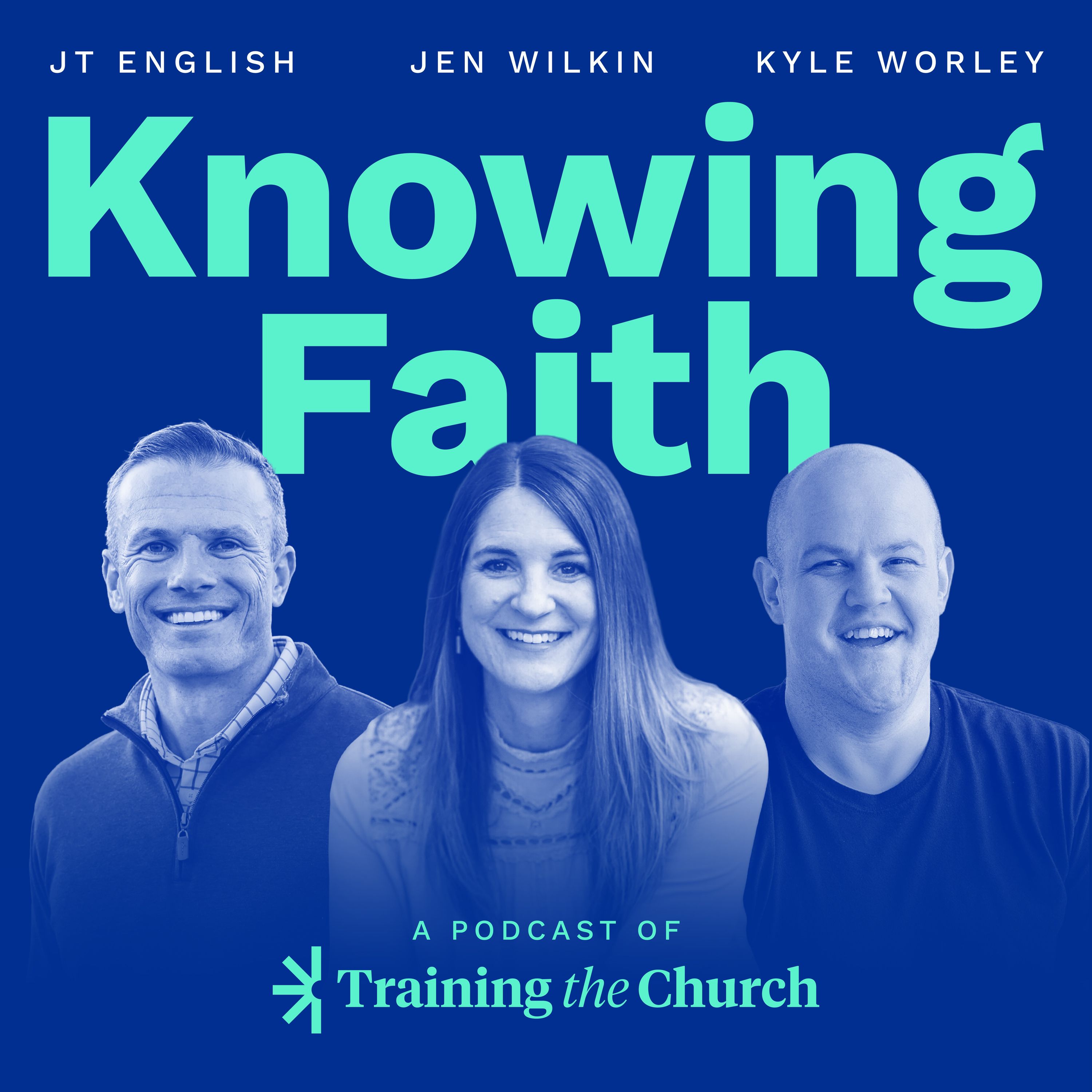
Knowing Faith
Season 15 Patreon Q&A
01:02:16
Jen Wilkin, JT English, and Kyle Worley to answer questions submitted by their Patreon supporters!
Loading summary
Transcript224 lines
- [00:02]
A
This episode of Knowing Faith is brought to you by Crossway, publisher of Stand in All How Reverence Transforms Our Worship and Our Lives Laura's story seeks to lead Christians in scriptural reverential worship all seven days of the week. Sharing her 20 years of experience as a worship leader and award winning recording artist, she clarifies what worship is and what it isn't and what's at stake without it. Pick up a copy of Stand in all wherever books are sold or visit Crossway.orginall to learn how to get 30% off with a free Crossway plus account. The One Year Bible for Men and the One Year Bible for Women help you engage with Scripture 365 days a year. Each day's reading includes one portion each from the Old Testament, the New Testament, Psalms and Proverbs, along with short devotionals that connect Scripture to real life challenges. The devotionals in each edition are unique, focusing on the questions and concerns either men or women may encounter. Individually, these Bibles help you grow deeper in your walk with God and together they can create a powerful shared experience for couples reading side by side, encouraging each other and discovering how God's Word speaks into our lives. Find your One Year Bible at the One Year Bible.com. Do you ever feel like you're just going through the motions? Busy, responsible, but not really grounded? The truth is, every man is being formed by something. So what's shaping you right now? That's why I want to tell you about the Men's Retreat at Camp of the Woods. It's a weekend away to step away from the noise, reset your direction and reconnect with God alongside other men who are asking the same questions. It's in beautiful upstate New York and we have a great time. And this year for the men's retreat in 2026, I, Kyle Worley, will be the camp speake this last year and we had a wonderful time with hundreds of men throughout the country who made the trek up to get away in the beautiful, beautiful upstate New York. And so if this sounds of interest to you or to men that you lead in your church or men in your life, I want to encourage you to go to campofthewoods.org mensretreat and find out more information about how you can come and join us up in upstate New York this fall for a men's retreat. So go check that out@campofthewoods.org I hope you'll make time to come join us and just reconnect or with the Lord and other men in your church and in your community. So come hang out with us@campofthewoods.org for the men's retreat this fall. Hey, everyone, this is Kyle and what you're about to hear is a Patreon Q and A episode that we did for season 15. So this is, gosh, it's like six months ago, seven months ago, when we did this Patreon Q and A with our Patreon community. That community helps to make this show free for everyone. If you're interested in getting involved in getting access to these episodes early, if you want ad free episodes, if you want to be a part of some of the special live episodes that we do that are only for that community, you can go to trainingthechurch.com support. It's a really just like wonderful community of knowing faith listeners. They talk about the episodes together. They engage with one another. They also get some, again, some special access. They get the episodes early. They get a mad free. The. The full video of the episodes, which turns out is something that people really want to watch, is video of our podcast, which is great. You know, you can see me making really interesting faces at JT when he's going for just a little too long. And so if you want to help make the show possible, if you want to support the show, the best way you can do it is go to trainingthechurch.com support. The episode you're about to hear is a Patreon Q and A where we took all of their questions and we did another Q and A episode on top of the one we normally do for the season that happens every season of the show. And so we answ all the questions that get submitted for the Patreon Q and A. And I hope you enjoy the discussion as you listen to it. Grace and peace. This is Kyle Worley and I am joined by. Well, you know them already. I'll let them introduce themselves on this episode. We've never done this in hundreds of episodes. This is Kyle Worley and I'm joined
- [04:14]
B
by Jed Wilkin and J.T. english.
- [04:19]
A
Wow. So good.
- [04:20]
C
I was like, hoping J.T. was gonna go first.
- [04:22]
B
He never says me first. I have to go last.
- [04:24]
A
That's true.
- [04:25]
C
I didn't think about that.
- [04:27]
A
Yes. Well, here we are. We are here for the Patreon Q and A. You guys are wonderful. You ask wonderful questions. We are going to get to all of them. No question left behind here. There's a lot of them and some of you asked more than one. But, you know, I'm gonna just. I love the gusto of that, the chutzpah, whatever other things you could throw in. No, honestly, thank you, guys. Y' all know you hear me say it every time I record one of these episodes. You're such a great audience. You make doing the podcast so fun. It is like knowing faith is made possible in large part because of your support. I don't know that the wider audience understands that. And if you're listening to this, if we've released this episode sometime in the far future, you could have got access to the episode much earlier. If you go over to train the church.com support, you can also just make the podcast possible. I don't want to get into the weeds of how much work it takes to produce a podcast, but it's a considerable amount and there's a lot of people involved in this, this work to make it happen, and you make it possible for that to happen. So thank you for your support and we want to honor that by address these questions. Let's start. Tabitha. I need book recommendations and general direction. I've begun reading what We Should Think About Israel by J. Randall Price. I need to explore and try to resolve in my heart the issue of whether the New Testament church replaces Old Testament Israel. Before I can understand current events better, I feel I need to settle this issue. Any books you'd recommend? JT, you have any recommendations for books?
- [06:07]
B
Romans 9 to 11?
- [06:09]
C
Oh, man.
- [06:16]
A
Nice.
- [06:16]
B
Wow.
- [06:18]
A
Coming in hot for the.
- [06:20]
C
Okay. All right.
- [06:23]
A
Well, those. It would be good to look at those passages. JT's not wrong. Honestly, Tabitha, I really do love this question. I am getting this question at my church a lot right now. And we, we've been in Exodus, and I think that's why people, like, have some real questions about, like, wait, hold on. Does, like, the land belonged to Israel by divine right? I will tell you one volume that I have found to be helpful on here, and this is not an endorsement of every book in this series. I think this volume can be helpful is the Perspective series. There is a Perspective series out there and they have a ton of these books, perspectives on everything. They have a volume called Perspectives on Israel and the Church that I think is. It's worthwhile. Like, it's worth picking up. And if you want to explore, like, the range of faithful Christian options on Israel and the church, this will be that. Hear you asking us for our opinion on Israel and the church. You're asking us for resources on exploring it. Those passages that JT mentioned would be really helpful. I will say that I think it could be very helpful to look at the four views book. I will also say Michael Byrd and N.T. wright have done really good work on this in their New Testament survey. This is another thing where I want to say I am not endorsing everything that Michael Byrd or N.T. wright has published. I will say their New Testament survey covers this issue in a helpful way.
- [07:50]
B
So those I've actually got a real recommendation though. Of course people should read Romans 9:11. But another book written by a friend of the podcast and an aggie Jen is Orin Martin's Bound for the Promised Land in the New Studies on Biblical Theology. Oren and I did our dissertations at the same time together at Southern, and this was his dissertation that he then made into a kind of more of a lay level. Not late. It's not lay level, but it's also not academic. It's kind of right in the middle. New Studies in Biblical Theology is one of my favorite series. It's where we got a lot of the ideas of the original deep discipleship curriculum Dwelling Dominion and Dynasty. Stephen Dempster's book Dominion Dynasty. So this would be a good book on Israel and the land promised specifically as it relates to Christ's fulfilling work. He argues that Christ as Jen made a point in our last episode that will come out later. I know this is the Patreon one that Christ is the fulfillment of these promises.
- [08:42]
A
Nice.
- [08:43]
C
That's good.
- [08:44]
A
What have you been studying recently, Jan? What have you been studying recently?
- [08:48]
C
I've been studying about aging. I have been studying about the book of Joshua because that's my next study to release and I am kicking around some study around the Gospel of Mark because I'm probably going to write a study on the Gospel of Mark.
- [09:05]
A
We just. We're doing. We're doing Mark for our men and women's Bible study this fall in the spring.
- [09:09]
B
You should wait till the city's out.
- [09:11]
C
Maybe I should just take theirs. Do you guys write it?
- [09:16]
A
Yeah, we write all of our studies. Nice. Yeah. Shout out to my great staff.
- [09:22]
C
Yeah.
- [09:23]
A
Okay. Jen, have you been particularly encouraged by anything as you've looked at aging or Joshua just like books? No, no no. Just know like you purse. Have you personally been encouraged as you've looked at aging or Joshua for and why.
- [09:37]
C
I think I've been encouraged looking at the Joshua narrative because I finally have connected it to Revelation, which is belated. I should have figured that out sooner. But like the fact that Jesus comes as the warrior in Revelation paints him as the the true and better Joshua very clearly and the the crossing over into the promised land, corresponding to us entering the new Jerusalem. And it's helped me think better about like, what is my current place in the story and that's in the space in between. And that's just been really helpful to me. And then with regard to aging. Yeah. I just, I feel like things are reaching peak ridiculousness with the aging conversation. And, and anytime I post anything about it, people say no one is talking about this. So I'm just, I'm ready to talk about it.
- [10:29]
A
I'm really excited to read this book.
- [10:31]
C
Yeah.
- [10:31]
A
From the first moment you mentioned it.
- [10:33]
C
Don't get your hopes too high. I mean, I hope it will be a conversation starter. I do not think it will answer everybody's questions or solve everybody's problems.
- [10:41]
A
Okay, then I'm not gonna read it.
- [10:42]
C
Yeah, great.
- [10:44]
A
I'm out. I. I needed to be completely exhaustive. Okay. Jt, what have you been studying recently and what have you been encouraged by? I think I know how you're going to answer this, but go, go for it.
- [10:57]
C
Really? Okay.
- [10:57]
B
I'm studying the book of John.
- [10:59]
A
I knew that you want to say this. Yeah, yeah.
- [11:01]
B
The Bible is amazing. I'm not sure if you guys knew this. The Bible's amazing. Like, I'm having so much fun.
- [11:08]
A
You know, you've been texting us this while you've been going through Gospel of John. You've had a real so cool moment.
- [11:15]
C
Yeah.
- [11:15]
B
I've had some conversations with Johannine scholars and you know, feel substantiated in some of the things I'm learning. I'm not just fine. Typically I read a commentary or two and take some of those ideas. I'm honestly just spending a lot of time in the text and then reading commentaries like way later. And I just feel like I'm seeing stuff that I feel like the Holy Spirit's illuminating for me that, that I think John meant, like, I don't think it's unique revelation to me or anything, but like just, just today. So like, let me kind of just give you guys a few things that I just think are amazing. So like John 2, he's. He goes to the wedding feast and, and this is the first sign. He doesn't just turn water to wine for like a parlor trick. It's like Isaiah 25, the king who's come to bring the well aged feast of choice, me aged wine is here. And then he goes and says, and I'm going to rebuild the temple. Like that's what the king does. Then John, chapter three, he has a conversation with Nicodemus and he's saying, I'm the God who's going to pour out my holy spirit by wind and fire from heaven. Which is exactly what the king does in First Kings, chapter eight. And it's exactly. And then you're like that. That's crazy. That can happen. Who. Who can receive that? Just Jews? Nope. John chapter four. Even Samaritan women who are deeply wounded by the brokenness of the world. John chapter six. Like, I've seen so many Exodus patterns in this, right? You think about. He walks on water. Exodus narrative. He says, I'm bred from heaven. Exodus narrative.
- [12:32]
C
Yeah.
- [12:32]
B
John 7. I'm the in John 8. Light of the world. I have led you by a pillar, by fire by day and cloud by night. And he says I'm the light of the world. John chapter nine. He shows that he's the light of the world because he takes a blind man and gives him sight. Yesterday I was in John chapter 10. He's the good shepherd and he's the one who calls his sheep by name. John chapter 11. Who does he call by name out of death? Lazarus. Because he's the anointed king who's come to bring about the kingdom at Bethany. Like, it's just stunning, the Bible.
- [13:02]
C
Somebody should write a little, little commentary.
- [13:05]
B
I don't know about that, but like I'm just having a lot of fun. I just want to encourage you guys. Like I've been studying the Bible for almost 20 years now and I'm reading.
- [13:11]
C
Just starting. I feel like it's just starting to happen.
- [13:14]
B
Like it's.
- [13:14]
C
That's how I feel.
- [13:15]
B
Fun. So don't stop, keep reading, keep praying, keep meditating on it. Keep having conversations like this. So John. And then I'm you. I thought you were going to make fun of me, Kyle. I'm also working on a new thing for trinitarian. So I'm back in some of my old days of doing a lot of trinitarian stuff. Just of course, it's Herman Bovink. Herman Bovink and Trinitarianism. I could read Bovink on the Trinity all day long.
- [13:37]
A
I love it.
- [13:38]
C
Kyle.
- [13:40]
A
Yeah. Ecclesiastes for two reasons. One, I'm preaching on it next fall and I do long range prep and I have a kid's picture book that I'm finishing on Ecclesiastes called the Unhappy King who had Everything. So I've been spending a ton of time in Ecclesiastes. There is a lot to that I'm challenged by in the message of Ecclesiastes. But I am encouraged at the end of the day that the giver of all good gifts is truly better than the gifts themselves. And I am really, really encouraged by that. I think that it's very easy for me to look towards the gifts. I think it's easy for all of us to look towards the gifts over the giver. And I find myself being drawn, my attention being drawn more to the kindness and the generosity of God in his just abundant love. That's what I've been meditating on. Would you guys know any resources on the theology of life or how Christians think of life or Christology of life? Like a doctrine of life, like what we believe life is versus what the world thinks? I'm not looking for Christian living books, which are the only resources I can find. I hear you, Esther. She's looking for something more than devotional content. You got a good audience here for that. You know what I love? I love if you're looking. If you want something that's. It sounds like you're asking for something. That's heavy lift. I would tell you there are. The doctrine of the Christian life that's in the Lordship series by John Frame is really good. It is not light work, Esther. It is heavy lifting, but it is fantastic. So if you are looking for something that is really serious theological work on the Christian life, doctrine of the Christian life in John Frame's Lordship series is fantastic. Anything you ought to add to that?
- [15:34]
C
Yeah. Divine Conspiracy.
- [15:38]
A
Dallas.
- [15:38]
C
Dallas Willard.
- [15:40]
A
There we go. Great classic work. I'm thinking Thomas a Kempis, the Imitation of Christ. You read that. You must have read that.
- [15:52]
B
I read it a long time ago.
- [15:53]
C
How are we distinguishing. I'm going to learn something. How are we distinguishing the doctrine of life from sanctification?
- [15:59]
A
Maybe we shouldn't. I don't know if she's. It sounds like she's asking it pretty generally. Like Frame's work is really. It covers sanctification extensively. So included as a part of. Like I'm reading your question is like a. A theology of. Of the Christian experience or living life as a Christian.
- [16:16]
C
Okay.
- [16:16]
A
And I think Willard's Divine Conspiracy is a great example of that.
- [16:20]
C
Yeah.
- [16:21]
A
For JT with thinking of Old Testament Christophanies. We knew you knew we were gonna get one. I'm blown away we didn't get one in the general Q and A. That just staggered me.
- [16:29]
C
Also grateful for JT with thinking of
- [16:33]
A
Old Testament Christophanies as an appearance of the post incarnate risen Christ who's outside of time and eternal A possibility rather than pre incarnate, in which case he wouldn't have had a body yet. Or am I teasing heresy here? So could the Christophany not smart enough for this question? Could the Christophanies in the Old Testament be a post resurrection ascended Christ who is outside of time and space, who is basically intruding back in?
- [17:05]
B
Yeah, I guess it could. I mean, I certainly wouldn't say it can't be that sure. I don't know that we need to say that in order for it to be a Christophany. Because it's not like God becomes Trinity after the resurrection of Christ.
- [17:21]
A
Yes, right.
- [17:22]
B
It's not like the Son isn't doing something. It's not like the sun couldn't manifest himself in some way that well.
- [17:28]
A
That is my big question.
- [17:30]
B
We've talked about. It's not. So who. Who is the pillar of fire?
- [17:35]
A
Kyle? I know. I'm with you on. I don't disagree that these are clearly theophanous and we don't have to rehash,
- [17:42]
B
but Jesus says it's him.
- [17:45]
A
Does it? Was it him or is it him? And I think those are two different questions because it's like, was it him in real space and time or is it him in perfect fulfillment?
- [17:54]
B
He seems to say both.
- [17:56]
A
You might be right. The more you talk about this, the more I feel like may. Maybe I'm the crazy one. That's what I keep thinking about. And then people. People will come up to me and they'll be like, I'm on your. People come up to me at the Gospel Coalition this last year, like, hey, I'm on your side with the Old Testament theophanies or christophanies. And I was like, well, actually, I don't know that I' still on my side with the crystal. So don't, please, like, please don't pit me here because I'm still figuring this out.
- [18:23]
B
But I mean, in all seriousness, I'm not trying to be a punk. I'm really not.
- [18:26]
A
I know you're not. Yeah, I got you. I'm with you.
- [18:30]
B
Who. Who or what is the rock in the wilderness?
- [18:33]
A
At the very least, that's sanctification. At the very least, it's. It's. It's theophany. At the. At the very most, it's a Christophany. And I don't. But I pause. I'm not prepared.
- [18:43]
B
It's a christophany.
- [18:45]
A
I don't know. I'm with you on the fact that's what Paul says. I'm curious on whether this is one
- [18:50]
B
of those, like the Bible says it to Christophany.
- [18:53]
A
I'm wondering if this is looking back from the post resurrection witness. If they're going it was figural, a crystal.
- [19:01]
B
That's not what he says. He says the rock was Christ.
- [19:04]
A
Well, Jesus says this is my body, but we don't hold to a literal transubstantiation of that.
- [19:11]
B
Yeah, but that's not the same thing. He says I'm the gate. I'm not. We need to read the Bible. Literally.
- [19:19]
C
You said that just then. I wanted balloons to go off all around.
- [19:22]
A
They never do that.
- [19:23]
C
They never show up when we most want them to.
- [19:26]
B
Yeah, but when. When Jesus says this is my body, he's not saying it's not at all my body.
- [19:32]
A
Sure. Right.
- [19:32]
B
Which is your on the theophanies?
- [19:35]
A
No, I'm. I'm definitely prepared to say that it is. Is certainly a theophany.
- [19:41]
B
And of who?
- [19:41]
A
Quite possibly.
- [19:43]
B
So if it's a. If it's a theophany, do you grant that there are theophanies?
- [19:48]
A
100%.
- [19:49]
B
Okay. Is it the Father, the unbegotten one?
- [19:54]
A
I don't think that's likely candidate.
- [19:57]
B
It can't be.
- [19:58]
A
But I struggle with it being a
- [19:59]
B
Christophany as the eternally unsent.
- [20:03]
A
And I'm with you on this. I'm not disagreeing. What I'm trying to figure out, how is he sent? I don't know what a pre incarnate figural representation of Christ is that doesn't jeopardize the uniqueness of the incarnation event. That's my struggle. We've talked.
- [20:16]
B
He's not in flesh with a human nature. That's what makes it unique.
- [20:20]
A
But he's. He is showing up in very figural ways that. That seems to me.
- [20:28]
C
I thought you said we had a lot of questions.
- [20:30]
A
We do. We do. It's a great question.
- [20:33]
B
You're getting closer. I can tell.
- [20:36]
A
What would you guys say is the definition of fellowship? My church often sees it as a time to hang out and share feelings, and it just doesn't seem quite right. I'd say we need more education spaces. But then another complaint is our church is too in its head and needs to fellowship more. Have you ever found a balance with these two? Boy, oh boy, do we hear this all the time. First off, the Bible's word for fellowship is koinonia, and it doesn't mean just hanging out. Okay. We actually just did. If you missed it, I did an after the fact episode this season with Don Whitney who is writing a book on fellowship, and he gave a six Minute answer on Koinonia. What it is and what it isn't. That's fantastic. So just go listen to that. If you missed it, it's really good. Now the distinction between like head and heart and people were too brainy and we need more time to just be together. Jen, you have heard this for as long as you've been advocating for active learning spaces. What's just one, not, not your full pitch, but what's one response when you hear people say, you know, we're too in our head and we need to fellowship more?
- [21:40]
C
I would say give a little pop quiz to the people in your small group on basic Bible facts. And I think you will find that like just about every church, your people are not too heady. Now sometimes people say our church is too heady because what they mean is we're not actually taking what, you know, what we are learning and having real conversations about it. But I do not think that we are dealing with a critical mass of over educated Christians. And I think that we see that all of the time. I say that without rancor. I mean, it just is what it is. But we are in an illiterate culture and the Bible is a subset. I'm sorry, the church is a subset of that culture. We should not think that we are more biblically literate than past generations or even than the church next door. And so I'd say take an honest look at where your, where your people are. And, and also if we're doing it right, learning should translate into these good conversations that do build community.
- [22:45]
A
Yeah, that's right. Great. What are your thoughts about paying singers who may not even be believers to be in the church choir? Don't do that.
- [22:55]
C
I hate it.
- [22:56]
A
Yeah, don't do that. I think the. Yeah, don't do it. My thoughts are don't do that. How would you respectfully communicate a concern about the difference between performance and worship to a music minister? That's a more technical question. I'm not at your church. I think the way you'd want to do it is to really think through what the Bible talks about, when it talks about singing, what the role of singing in the church is, what is, what it actually is worship. What is a church supposed to be? So you want to talk about the mission of the church, responsibilities of the church, what the Bible has to say about singing. You'd want to know all that and then you'd want to raise the question in a way that's humble and curious and convictional with your worship minister and say, hey, here's some things I just have some questions about, and I'd lead with questions, not concerns. Make sure you really understand what the practice is and not what you've heard it to be. And then follow up with some meaningful questions about how does that make sense and how does that fit with the Bible. Anything to add to that? You said you hate it, Jen, or you're not in favor of it?
- [23:55]
C
Yeah, well, I mean, I think it also depends a lot. It may be that your worship pastor is responding to the overall culture in your church, and it may not be that that person has, you know, is in. Is in control of the messaging that drives a decision like that. So it might be that you're picking up on a bigger conversation about what is the gathering. And so it can be hard to just attack one piece of it at a time. Because my guess would be if this is an issue, there are probably other issues as well related to your service being more about performance than participation.
- [24:32]
A
There you go. One silly question, one serious question. Kyle has an El Classico scarf hanging on his wall. I do. It's right back there. Tell us more about how you got the scarf and are you a fan of either team? I always wanted to go see El Classico. My brother and I, big soccer fans, we played soccer in high school and didn't think I'd ever get a chance to travel to go see it. And they did a tour throughout America like a couple summers ago and my brother and I went and saw him. I'm not a particular fan of either team. I'm just a fan of good rivalries, and that's about as good a soccer rivalry as you can have, I had a blast. And Barcelona absolutely demolished that game. So it was great. Other than the deep discipleship program, which a future which a few of us are planning to go through as a pilot project to know how to best roll out in our student ministry. That's super exciting. Yeah, that's awesome. What short 8 to 12 week Bible studies would you recommend for a student small group? We're seeing God do amazing work in our town and students are hungry to study scripture and I want to lead them. Well, can I think of somebody who has published studies in between 8 and 12 weeks that are Bible study? JT, do you know anybody who's done 8 to 12 week Bible studies?
- [25:38]
B
I feel like it's like ringing a distant bell. I used to know somebody who did that. I think. Is it Jan Watkins?
- [25:48]
A
Yeah.
- [25:49]
B
I want to take a moment and speak to this because we're Doing this at our church right now. And again, I would. This is not, I'm not saying this because Jen is here. I'm saying this because I believe in Bible literacy for my church and helping them grow. We have around 20 students any given time either doing our deep discipleship program or jumping into one of our men's and women's Bible studies. And guys, I just want to encourage you. One of the things this is a we make a statement that isn't something we're doing well at storyline. But I'm trying to think about how do we do it more, how do we get the next generation not just involved in ministries of the church, but around the older generations of the church as much as possible. Sociological studies are coming out over and over and over again that yes, we want to give them great content. We have a youth ministry, we have a student ministry, we have a kids ministry and we want to have good curriculum, good catechism for the next generation. But sociological and theological studies are coming out suggesting that one of the most important things you can do for the next generation isn't just give them their own spaces, but to invite them into your spaces. And so we've got a lot of young women in our women's Bible study. Why? Because they're young women who want to study the Word. And one of the coolest things is seeing a 15, 16, 17 year old young lady, young woman involved with a 70 year old woman studying Exodus. You want to develop and you want to set somebody on a trajectory of maturity. Put them in a Bible study that teaches them how to study God's Word with somebody who's lived in God's world for 70 years. And you're going to develop some mature Christians who love the Lord Jesus Christ. So do not think that we have to over niche sell all of our content into specific age groups like a legacy group or a student group. I know that that exists and there's age appropriate content. But the Bible is age appropriate for everybody and studying it is age appropriate for everybody.
- [27:29]
A
Nailed it.
- [27:30]
B
I'm very passionate about that one.
- [27:31]
A
Sarah asked ask Jen, as a female leader, how do you persevere through comments from naysayers who see female leaders as either a threat or stepping outside of their biblical role as a woman, a
- [27:42]
C
friend once told me, they are upset with you not because you're doing it wrong, but because you're doing it right. Now obviously you could take that and be doing something wrong and take it to justify your behaviors. And so I take very seriously keeping my motives in the right place. And I have not always. Sometimes I. If I feel my anger rising around something, it's usually because I'm trying to defend me instead of keeping in view the bigger picture. And the bigger picture is women in the church. It's. And it's not just women in the church. We've talked about this a lot. It's the health of the church as a whole because men and women are serving shoulder to shoulder. And for those trolls who are listening, I didn't just say that men and women are interchangeable. I have never said that. I do think that is true. I think that because we are not interchangeable, we need to all be serving in the priesthood of all believers in a way where the gifts of both men and women are combining the way that I think they are intended to. So I don't care if someone who does not know me, doesn't know my family, doesn't know where I serve in my local church, gets upset about something that I believe convictionally is important to do or to say. People are going to yap. They just are. And it's really okay. The people who know me the longest and the best are going to hold me accountable and they're also going to keep challenging me and they're going to keep spurring me on. And that's all I need. I don't need someone with 25 followers who doesn't even have their actual picture on their profile to validate me. That's all I got.
- [29:37]
A
Love it. Okay. Audrey asks, is there a resource you can share that will help me understand how you all came to the conclusion that the gathering of believers is so intimately and intricately connected to communion so as to differentiate that a setting without communion is not the gathering. Scripture references or things for me to look up and follow would be excellent. And a book where someone has fleshed this out would be fantastic. Okay. There has been. Okay, I want to say a couple things here because I got this question in a lot of different ways in the general Q and A, and I didn't respond to it there because we're going to do it. I have been very loud about this. I don't want to represent Jen and JT Here. I think we would all say that receiving the Lord's Supper is a crucial part of corporate worship. I am prepared to say I think it's a defining mark and one of the things that sets corporate worship apart from other gatherings of Christians that might happen in the life of a local church. I don't know that Jenna, JT would say that maybe they would, maybe they wouldn't. That being said, I would not go so far as to say that a church that is not receiving the Lord's Supper every week is not a faithful gathering of the local church. That's the church I grew up in, the church that my father still pastors. They don't receive the Lord's Supper every week. I think they're wrong for not. Not doing it. I think it is. It's right for them biblical for them to do it. The reason I see a very close connection between the corporate worship of God's people, the gathering of God's people, and the Lord's Supper is because of First Corinthians on what fellowship means and what it means to remove somebody from fellowship and how the Lord's Supper seems to be a central piece of the corporate worship, regular corporate worship of the Christians, not just in the New Testament church, but in the history of the church. So I don't want to represent JT and Jen. You can jump in here and say what you would say differently or distinctively. But I want to be clear. If your church doesn't receive the Lord's Supper every week, I think they should. I would not go so far as to say that your church is heterodox or heretical or not a true church. I would just say I really grapple with what the Bible says about the Lord's Supper Supper and with the way that the early church was receiving the Lord's Supper, the continuity of it and their corporate worship service. That's my only thoughts on that. And to do that from a biblical perspective, I would look at First Corinthians. I would look at Acts 2 at the foundation of the church. Then I would go to First Corinthians, where it begins to kind of get codified, institutionalized. And then for a great book on the Lord's Supper from a reformed Baptist perspective, I would look at Tom Shriner's wonderful book on the Lord's Supper. It's fantastic. Check it out. Anything you want to add to that?
- [32:23]
B
The one. This is not like a huge addition, Kyle. Just give me 30 seconds on this. I mean, I think the thing I would encourage evangelicals to think about is how all of the pieces of their ecclesiology fit together. You can't think about elders and preaching and the gathering and baptism and the Lord's Supper and mission, like all the things that a church is meant to do. Spiritual authority, deacons. You can't think of those as. As separate categories. You have to have an ecclesial vision of the world that is threaded together. And so you have to ask the question, not just where can I receive this? But who has the authority to give it? Who has the authority to take it away? Which is happening in First Corinthians, chapter 5. It's not just where can I take it, but if somebody can take it away, if I go do it, my home group and nobody can take it away from me. Is this the Lord's Supper? Right. Right. Does that make sense?
- [33:14]
A
Yeah.
- [33:16]
B
Your vision of this can't just be, well, I want to participate in fellowship with believers and I want to have the Lord's Supper. You have to consider this in light of an overarching ecclesial vision.
- [33:26]
D
Are you tired of shallow discipleship in your life, the life of your church or small group? God is inviting you into deeper places. Real participation in his story, real understanding of who he is and what he he has done, and a more meaningful practice of following in his ways. For the last 10 years, JT, Jen and Kyle have been teaching a program called Deep Discipleship in their local churches, and they have now worked with Lifeway to make this available to everyone everywhere. Whether you're an individual looking to go deeper, a church leader looking for an accessible way to invite your small groups, classes and student ministry, or a homeschool family looking for curriculum for your high school students, go check out the Deep Discipleship program at lifeway.com deepdiscipleship.
- [34:19]
C
Have you ever wondered if God delights in women? Do you struggle to untangle the mixed messages you receive about what the Bible says about women? Then check out Very Good, a new seven session Bible study by Jen Oshman to discover the freedom, security and joy of living as a woman made in God's image. As you study passages about women from Genesis to Revelation, you'll see that God's Word tells a beautiful story about women full of dignity, purpose and delight. Come discover how very good it is to be a woman. Learn more@lifeway.com Very good.
- [35:00]
A
Prayer can often feel mysterious or like a formulaic transaction. But in the Lord's Prayer, Jesus offers something deeper, a framework that reshapes how we think about God, ourselves, and the world around us at in the Word with Jen Wilkin, you'll explore the Lord's Prayer with fresh eyes and renewed purpose. Through teaching, worship with Sandra McCracken and Reflection, you'll walk away with a deeper theology of prayer and practical tools to transform not just how you pray, but why you pray. Bring a friend. Bring your Bible and join Jen Wilkin in the Word. Nate asks, you mentioned the foundation of the twelve apostles in Revelation, but what does that mean for the, Those the Bible calls apostle but aren't part of the 12? I'm thinking especially of Paul. He's saying that like, like there was the foundation. We talked about the foundation of the apostles in Revelation, but one of the apostles is disqualified Judas and then they
- [35:54]
C
replace them and then we get Paul.
- [35:56]
A
Then we get Paul. So how does that square?
- [35:59]
C
I think that's an over literal reading. Okay, would you say that.
- [36:04]
A
I would say that it's.
- [36:05]
C
I say that. Not judgy. I don't, no, no, that's not a kind of judgy. I don't mean it like that, but
- [36:08]
A
no, no, no, no. I think that when Revelation is, when Revelation is in view, they are talking about the, the, the apostolic witness. And certainly the 12 is a great continuity thing with looking at the 12 tribes of Israel. So I don't think that's easily surrendered, you know.
- [36:27]
C
Well, but even the 12 tribes are presented in a particular way, right? Because I mean you get the half tribes and then so it's all not precise number work if you start looking at it that way. But the point still stands. It's being made symbolically, I think is what I would say. Okay, There you go.
- [36:46]
A
J.T. how transparent should a church be with its members, with how they steward their finances, context? Not looking to know a pastor's salary, but would love to know how close we are getting to having a building. What do you guys do when you get questions about church finances?
- [36:58]
B
Wondering, this is from somebody in my church.
- [37:01]
A
I don't think it is for reference.
- [37:05]
B
Yeah, I, I think, I don't, I don't think that there is a way that this must be done in all situations and settings. For example, a smaller church with a, a bi vocational pastor and a very small budget. And by small, I don't mean less significant. Don't hear me say that. I mean less complex. Like there's just less places for the money to go. Then perhaps there's an opportunity for more transparency because there's fewer people that are involved in the budget. The larger an organization gets. It doesn't mean their budget's more significant or more important. It means it's more complex. More people are speaking into it from an internal perspective, whether that's elders and staff or deacons. 40, 50, 60 staff members might be speaking into their specific ministries if that gets made known to the overarching church. Like, wait a second, why are we spending so much money on goldfish back in our kids ministry. That can be an unhelpful level of transparency that actually prevents mission from going forward. And so you want to find the balance of transparency also efficiency of mission going forward. If your church has elders, it has a board or a finance committee that's overseeing those things. I don't think you need to have transparency all the way down, but you should always at every single church, know what the budget is broadly like, what are the numbers we're spending? Are we over under that over from this past year? What are receipts at, what are actuals at, what debt load are we carrying? What are we expecting to come in over the course of the next year? How much money is going to Missions? I think you can like we. We show specifically how much money is going to like a general ministry budget, how much is going to facilities and operations, and how much is going out the door to missions specifically going through
- [38:37]
A
the Deep Discipleship curriculum this year in our church, and we love it. Wondering if you could discuss the presence of God and what that looked like in Genesis 3:11 after Adam and Eve were driven out of the presence of God and before the covenant with Abraham. Was the presence of God different during this time? And if so, how was it different? One of the things I did not get to develop as much because I covered at least two of these sessions in the Deep Discipleship program is the difference between God's omnipresence, or what we might call his general presence, and his particular presence, or what we might call his beatific presence or his blessed presence. There's never a time in which God is not omnipresent. He has eternally been and will eternally be omnipresent. It is who he is, and it's not something he possesses. It is who he is. So God was present between Genesis 3:11 when Adam and Eve are exiled from the garden.
- [39:26]
B
Like as a theophany, okay,
- [39:30]
A
he was. He was. He was omnipresent, as he has always been and will always be. Now, what was the manner of his beatific presence or his blessed presence? I would say that there is a period of wandering that exists, and we do get some provisional instantiations of that with Noah in particular in the Flood account. And then you get it. It. The. The restoration of it is uniquely restored with Abraham back in Genesis 12. I will say this. It's my view that I do not think you have anything close to a deic restoration of the beatific presence or the blessed presence until Moses encounter at the burning bush followed by the construction of the tabernacle or the the presence of God at Mount Sinai followed by the tabernacle in the midst of God's people. So once the tabernacle is built in the midst of God's people, that I think is as close to a restoration as you're going to get. The identic presence or the blessed presence. That's my.
- [40:27]
C
Is beatific or blessed presence interchangeable with manifest presence?
- [40:31]
A
Yeah, I, I prefer not using manifest language because manifest in some circles makes it seem like in charismatic circles it can carry with the different connotations. So I typically avoid saying manifest presence.
- [40:45]
C
Good to know.
- [40:47]
B
Would you say like a beatific vision is seeing God face to face? Face.
- [40:50]
A
Okay, we're going to move on.
- [40:51]
C
Okay, next question. Oh man, I hope everyone can hear that maniacal giggle.
- [41:01]
A
Robbie, Robbie asks, does train the church have other. Robbie asked a number of questions, but we are running out of time, so I'm just going to get one of them. Does training the church have other podcasts they plan to unveil in the near future? Midas suggest something specific to ministry leadership. Well, Robbie, I'll tell you this. We launched a lot of podcasts fast and we have been in the process of rolling.
- [41:22]
C
And by we, he means Kyle.
- [41:24]
A
Well, you know, I'm so proud of what we built. I'm so proud that all those podcasts.
- [41:30]
B
Really great podcast. Oh yeah, I'm so proud of them.
- [41:33]
A
They really are. And they have done well. Even after we like let them fly the nest. It feels like for a little while we were like angel investors to a whole group of podcasts that we just wanted to exist in the world. And we were really glad that we were able to use the success of Knowing Faith to do that. That and we still believe those podcasts. So go check out Starting Place with Elizabeth Woodson and Confronting Christianity with Rebecca and Tiny Theologians with Amy Kate Gannett and Family Discipleship with Adam Griffin. We love them. It's probably, it's not on our radar right now to launch more podcasts. We actually have our own little version of a summit meeting in February where we'll talk about the next three or four years. We did this a handful of years ago. We basically laid out a ten year plan and then we did everything in that ten year plan in three years. I mean, for real crazy thinking back
- [42:22]
B
on it, what if it by 2030 we had all this stuff. It was like 2024 and we were like, oh no.
- [42:28]
C
But the answer to this question is no.
- [42:30]
A
No.
- [42:34]
B
I will say, I don't mean this as a plug, though. We get this question all the time. How do we do deep discipleship in our church? You should think about doing the ministry cohort.
- [42:42]
C
Yeah.
- [42:43]
B
Because once you do the deep discipleship ministry cohort, which you can find on trainingthechurch.com we invite you into what I think is going to be better than a ministry podcast. And it's a community of practitioners who are quarterly gathering together to talk about these questions. And so it's not going to be us recording a podcast. It's you getting on a call with us talking about ministry. The reason we want you to do the cohort first is because there's too many times where ministry practitioners aren't using terms the same way. They don't have the same frame of reference or basic philosophy of ministry. We want people on that call call to have adopted, by and large, the deep discipleship philosophy of ministry. Then jump on that call with us and we'll. We'll get to have a podcast with you.
- [43:22]
C
I'll just put in a little plug for another podcast too, if you guys don't mind. If. If people are looking for something more specific to the Bible study space, we did three seasons of a podcast called Women of the Word that talks about that. And it's not just helpful if you're thinking about women's Bible study. If you're wondering how to do men's Bible study as well. It's all the philosophical and the practical behind that.
- [43:49]
A
Nice. Celeste asked, is it necessary for a pastor to address cultural events during a Sunday gathering recently, we had a small number of church members express frustration and even had one or two people leave the church because the pastor did not address recent events surrounding the assassination of Charlie Kirk. It did not have a moment of prayer, silence. What words of wisdom would you give to pastors when it comes to discussing these events on a Sunday? There's no way to address every single day event that takes place. So how do you know when to mention it, when not to? I'd love to hear how you guys.
- [44:13]
C
I'm just can't wait to hear. I cannot wait to hear your answer here.
- [44:18]
B
Here are my words for pastors. Good luck out there.
- [44:21]
C
Out there.
- [44:22]
B
It's impossible. I'll go. I'll jump in first because this is an imperfect answer. I'd love to hear push back on this or thoughts. This is impossible to get right for all people because it's subjective, man. For some people, there are issues that are front and center that if you don't address it, it's an issue of Christian faithfulness, infidelity to the gospel, that they're going to be upset for other people. It might be the exact opposite. So pastors, ministry leaders, you cannot, you cannot be living at the whims week to week of what people online or people in your church say, what you must say. If it's not the gospel of Jesus Christ, your job is to get up and preach the word. It's living and active. It's faithful to do the work through Christ by the power of the Spirit. So get up and preach the gospel. That being said, there are moments where you need to address cultural issues, and those aren't just national ones. Sometimes they're national ones, but more often than not, they're local ones. Like, yes, if we had a police officer killed in our community who was tangentially connected to our church, we needed to address that because it was here. I wouldn't get up and say, there is a cultural issue that happened, you know, in Arvada. Therefore every pastor must address this thing or something that's happening internationally. So part I remember one of my professors at DTS said this. He said, every time I get up to preach, now he's making a point. This is more symbolic than real. He says, I have my Bible, I have the creeds, and I have a copy of the Financial Times and Time magazine. This is 20 years ago when he said this. And he said, I'm always trying to find the relationship between what God's infallible word says to the church that's been once handed down to the saints. That is also going to relate to the moment we're living in. Because what I wouldn't say you can do is just get up and say, well, I'm just going to preach the Bible forever and always and never apply it to current events or your community. That might be cowardice or even just apathy, you not applying it to the current moment that we're living in. But does that make sense? So, like Bible church, you have to address things culturally. But more often than not, those cultural things are probably going to be more local to you. And I just would encourage you guys, if you're listening to this, have a ton of grace for your pastor. This is so hard, guys. This is just so hard. It could be a Friday night and you have your sermon in the hopper and you're ready to go and you've already worked 20 hours on it, it and something happens and you're like, you're going to be at the soccer field all day tomorrow, trying to love your kids and be in their game. And your whole church is going to come with a brand new litmus test that you've never even thought of until Saturday morning. And they're going to judge your faithfulness to God based upon a brand new event. That's not what the church does. That's not who the church is supposed to be. So let's be really careful not to put new litmus tests on pastors that have existed for 24 hours.
- [46:58]
A
I think that's really good, really, really valuable. And just to piggyback on what JT is saying there, I think your pastors should be more concerned with what's happening among their people and in their community than they are with what's being talked about online. That's not it doesn't mean it's nothing. You know what I'm saying? I can remember growing up as a kid when the planes flew into the Towers on September 11th. You better believe my father addressed it it on Sunday morning. I think it was important that he did that. The information age now and the digital age has made every global event instantly accessible. And it has created a false sense that every major cultural event can be addressed. We know now more faster than we ever have. And there it's just an unhealthy expectation to think that your pastor will be able to address. They should be preaching the full council of God's word, which means they will hit every culturally relevant issue if they preach it faithfully over time. Not over 24 hours, but over 24 years, they should. And so I think if you're measuring the faithfulness of your pastor over 24 hours of the preaching ministry, I do think you're, you're missing it, especially when
- [48:13]
B
you still a little side note too. We often don't hold pastors to the litmus test standards that we should.
- [48:20]
A
That's right.
- [48:20]
B
Biblical faithfulness, Nicaea, Chalcedon, the Apostles Creed. We'll sing worship songs that make make light of the trinitarian nature of God and then make sure our pastor addresses the latest news cycle that we saw. I'm okay with litmus tests. We do need to make sure we're passing down the faith once delivered to the saints. It just doesn't move with the news cycle. But I'm interested, Jen. That's, that's the perspective of two pastors. As our friend, would you push back on any of that? Encourage us in any of it? What would you say?
- [48:47]
C
I just, I, I, I pray for every time there's something big in the news. I pray for both of you. I pray for my pastor because I am not good with hot takes. I'm way better with hindsight and no one wants to give any time for hindsight to develop for anybody. They want, they want you to weigh in immediately. I mean, honestly, a lot of people want me to weigh in immediately. And I, I'm, I'm nobody's pastor and, and I don't trust my initial responses. Not only that, but I, I don't think there's a lot to be gained often by, by saying, by shouting into what is already a room full of clamor. And so, you know, like I, I'm again, I'm not a pastor, so the question is not what am I going to say on Sunday morning? But I have so often regretted saying something quickly and I have rarely regret and thinking about something. So I feel for you guys. I think it's a really tough because the other assumption is that we're all listening to the same news, that we all have the same access or time to access information and process it, or we all have the same aptitude to do so. I feel so ill equipped to try to assess in a short time period the impact of any given news story. And yet you have people who will demand it of you on a Sunday morning. So I if you don't do it,
- [50:12]
B
tell your they're leaving on Monday.
- [50:13]
C
That's right. That's right. And so that's a whole other form of thick skin than the kind that I mentioned even earlier in this Q and A. So I would say to the people who are listening to this, who are congregants, oh, just be so kind. Please strive to be kind and to be patient and to assume the best about someone, not the worst. Everyone around you wants you to assume the worst and we've been trained into it. And I think the church will look very different from the world if we become people who instead assume the best and and are slow to to be angry.
- [50:52]
A
Bri asked I wanted to ask what you think about the church's position on the Israel Palestine conflict.
- [50:59]
B
The church's position.
- [51:01]
A
Some of my Christian friends have been quite vocal with their anti Israel views. I'm interested to hear how you respond to that. How as important is it to understand where you stand theologically, for example, whether your beliefs align more with dispensational theology, covenant theology, New Covenant theology, or another framework on the heels of that last question, Bri it just was, it was just funny.
- [51:17]
C
It's a good Question. It's a great question. We're not laughing at you. We're laughing at the nature of the timing of it.
- [51:23]
A
Yeah, Bri, it's a great question. Let me just make one observation that I think is really important because there's a lot of different ways to. To address this, and it would take. We've done full episodes on this in the past, so we can't do it in three minutes. And we have, like, five more questions to get to, and we're going to be close to an hour. Bree, let me say this. One of the things I think is important to remember is you see throughout the whole of the Old Testament, even if we just look there, that God is a holy God who will judge both the wickedness of the nations and the wicked practices of his people. He'll do both of those things. Like when God throws down Egypt, he does throw down Egypt. And part of that is because of their wickedness. When Israel builds the golden calf, God correctly judges them for doing that because it's wrong to build a golden calf and give it worship. So let's just imagine for a moment that Israel has a divine right to the land. That's what some would suggest, that the land belongs to them by divine right. It's not my position, but there's a big school of thought that believes that that land belongs to Israel by divine right. Let's grant that that's true. That would not mean that everything that Israel could potentially do to keep, protect, or guard that land would be morally sanctioned or acquitted by God. If they did unrighteously righteous things, they would be liable to the same judgment that the nations are liable to for doing those unrighteous things. So I would just say one of the things I feel like is missing from this conversation is that when God's people behave unrighteously, God judges them with a corrective judgment. And I think that regardless of where you stand on Israel and Palestine in terms of what belongs to whom, I think it's important to remember that God judges both the wicked among his people and the wicked among the nations. Those are my thoughts. You want to add anything to that? Not. Certainly not a football at all. We've talked about this a lot.
- [53:21]
C
Yeah, I thought that was a good answer.
- [53:23]
A
In Delighting in the Trinity. Okay, coming to you, JT in the. In Delighting in the Trinity, Michael Reeves talks about how we shouldn't think first of God as creator, but God as Father, because Creator implies that he's in need of creation for his being, considering the first things the Bible tell us in Genesis 1 is that God created us. Do you agree. Agree with this? Connected with this. What do you think of the New City Catechism stating God is creator as its first statement about God? So it's basically just saying, okay, if we've recommended the book a lot and they know that Austin knows that, so he's going to. If Reeves say, hey, it's important. Yeah, it's important to. Well, then talk about it.
- [53:56]
B
Yeah. So, like, again, this is a. It's a distinction without much of a difference. I think one of the points that Reeves is trying to make when he makes this point is, is he's not trying to diminish the creator creature distinction and that we ought to see God as creator. It's where the Bible says starts, but it isn't where God starts. And that's the point that Reeves is trying to make, is God starts before creat. Better. Better said, God doesn't start and always is Father, Son, and Spirit. And so God the Father has always been a father to the Son. God the Son has always been the Son to the Father. And God the Spirit has always been the loving bond between the Father and the Son. As the third person of the Trinity, God wasn't always the creator. He always was going to be the Creator because of his trinitarian nature. Nature. But there was a time when his creation didn't exist. And so what he's trying to say here is that God doesn't learn fatherhood. And one of the pastoral implications of that is that he knows and always has been a perfect father to the Son. Therefore, as his sons and daughters, we can look not to our earthly fathers for perfection. But actually, they're just windows into and hopefully good windows into the perfect fatherhood of God.
- [55:00]
A
Excellent. We've got four questions left.
- [55:02]
C
Left.
- [55:03]
A
All right, you guys ready? We're gonna do them fast. Jt, based on your current and past ministry and church attending experience, when a church is growing like Storyline, like Mosaic, do you have a preference trying to hold one large service with everyone versus multiple smaller services? How do you keep a spirit of unity of adding separate services? You've actually lived this. That's why I want to ask.
- [55:25]
B
Oh, gosh. There's not a good option here, guys. There's just not a good. Yeah, we had our largest Sunday ever yesterday. 2,700 adults, almost 600 kids. I mean, it just went going boom, which is so fun.
- [55:39]
C
But is that after you started those other two campuses?
- [55:42]
B
Yeah, yeah. That does not include those numbers well, the second campus launches in December, hasn't gone yet. This is just the first one. We sent about 100 people to Littleton. Yeah. And again, everyone who told us who we talked to before, they said as soon as you send us people out, it's gonna backfill in more immediately. And that's what we've experienced so far. There's not a great option here. I mean, I want to give a lot of grace to pastors that are experiencing growth moments. That isn't always going to be the case. There's spring and summer, and then there's winter and fall. And we're aware of that. So we're trying to. We're actually in the middle of a building campaign where we're going to expand our worship center from 900 seats to about 1500 seats. But that isn't going to get us to one service. It's not even going to get us, I don't think, to two services. I think it's going to stay at three services for the time being. So that's the case. I would say get as many people as you can in an intimate way, whatever that kind of means for your community, where they can experience you as their pastor, the other, the rest of the pastoral team or ministerial team. So I don't know. I feel like I'm rambling. There's not a perfect way to do this. It's painful. It's painful. And church growth is hard. As seen in Acts, chapter six, when the church grows. Even the original apostles are struggling with ministry of the Word and ministry towards the saints. So I feel that.
- [56:51]
A
Jen from Hannah, how do you navigate or balance serving while also being spiritually fed yourselves by other church or communal means? I'm married to a youth minister. We feel a lack of growth in personal discipleship, community with other adults, because the majority of our church activity revolves around where we serve. I want to ask you, because you. For years you served on a staff team. You're no longer serving on a church staff team right now. So you've lived the transition. There was a time in which you didn't serve on a church staff team. Then you jumped on one, then you rolled off, and now you're back, too. I want to hear from your perspective.
- [57:25]
C
I think we gravitate toward community with people who dig in. And so whether that means it's other, you know, people who are on staff or people who have volunteered at a significant level, those are the people we usually land in community with because we think about church the same way. And so I don't know if that answers her question or not, but I think I'm never going to be the average church member. Like, even though I'm not on staff anymore, I'm never going to be the person who just shows up, up and on Sunday and then goes home. And so it helps me to be in regular relationship with other people who think about church the same way.
- [58:06]
A
Okay, I'll take this one and then we have one last one that was a three parter and I'm going to give one part to each of us. That's how we'll end. James asked, what is a biblical balance of a local church being primarily a go and tell church? That is outreach focus versus being a church of come and see focus. That emphasizing rich community, displaying a John 13 love for each other that attracts the outside world. I've seen issues where one side gets elevated at the expense of the other. And I'm curious to hear your thoughts on how to find balance. I don't think there is balance, but there are seasons. You do see two kind of movements in the the Bible's missiology or doctrine of mission. And you do see a come and see. Like, look. Think about Old Testament. Like, if you had to build an Old Testament missiology, there would not be much go and tell involved. There is very much a common sea Israel occupy a place in the land where the presence of God dwells in their midst and be a light to the nations. That's very common. Se see, the New Testament's motif is very much go and tell. There are come and see dynamics to it. But the overwhelming emphasis of the New Testament missiology is go and tell. You need both. You need both. And so your church might not have perfect balance, you know, week to week, but both motifs should be present over the life of your church. There should be a life in community, there should be a life together and a life on mission. And there should be go and tell and come and see. Some seasons of the year lend themselves to more effective uses of one over the other. You know, I was talking with a church that is in a part of the country where it is like below freezing for like five to six months at a time. And they were saying, we're having a very hard time doing evangelism when it's below freezing. And I said, I bet you are. I bet you are having a hard time doing neighborhood outreach and evangelism when it's below freezing. Freezing. What if you didn't? And they said, what? I said, what if you didn't do neighborhood evangelism when it was below freezing? And they said, well, what do you mean? I said, what if you did Bible study when it was below freezing and did some other things together to strengthen leadership development? And they said, well, you can do that. I said, of course you can. They said, well, we're not being evangelistic. I said, well, what about those other seven months out of the year?
- [60:18]
B
That's also an assumption that Bible study isn't evangelistic.
- [60:21]
A
Right. But I was dealing with the issue that was in front of me here, but I think the focus of it is you. Over the course of your ministry calendar, you should have both. You should have both. They may not be present every week in the same way, but over the course of the year, they should both be present in some way. Okay, last one was a three parter. Hey, guys, I have three questions, two serious that I've been thinking about for a long time, and then one seems like it needs to happen and would be awesome. I'm going to give you the two serious ones and I'm going to take the silly one. Okay, jt, is it biblical? The. And you. You're going to offer your response with no response from generai. This is you. We're giving you the floor. No. Is it biblically or theologically appropriate for someone who isn't a pastor to officiate a Christian wedding? What is JJ. What are JT's thoughts on this?
- [61:10]
B
How much time do I have? Is this like one of those quick answers?
- [61:12]
A
Give us 60 seconds.
- [61:13]
B
Give me like 30 seconds. Okay, I'll take 30.
- [61:15]
C
60.
- [61:15]
B
Oh, uh, I'm okay. Well. Oh, gosh, I don't know. I almost said something I think I disagree with.
- [61:23]
A
Always great. On the podcast, when your first answer, you find you object.
- [61:26]
B
This is theology live. Um, man, I think, gosh, this is actually a harder question than I anticipated it when you read it because I think I actually might be like changing my mind right now. I've. I'm okay. I've been okay in the past with non pastors officiating weddings. I've been at those before where we'll have somebody who's kind of ordained, you know, do this. I really want my dad to do this. He used to be in ministry, but he's not a pastor anymore. That kind of stuff. I think I'm broadly okay with that, but I certainly would think they need to be ordained, hold the statement of confession and faith, have some kind of spiritual authority in your life. But I would say it's not ideal. I think I'M maybe saying that even more strongly now than I would have a few years ago. And even part of that goes back to the. What we said earlier is an ecclesial vision is lacking in evangelicalism of how all of these things relate. Marriage, the ordinances, preaching, gathering together with God's people. And I think one of the most important things we can do is view marriage in view of our covenantal commitment to a church which has a pastor or pastors who should and are going to be charged with helping you follow Christ in your marriage.
- [62:34]
A
We should do a whole episode on marriage based questions.
- [62:37]
C
That is a good one.
- [62:38]
B
That would be a good one because I, I would. Do you guys broadly agree with, with me?
- [62:42]
A
Yeah, I do.
- [62:43]
C
I don't.
- [62:44]
B
Jen, don't. You don't tell. I mean, just give me, give me your 15 second rebuttal.
- [62:47]
C
No, I'm not allowed to. I think we need to do an episode on tough questions.
- [62:50]
A
I'm going to do that.
- [62:51]
C
Be one of them.
- [62:52]
A
I'm going to do it. Jen, this is not.
- [62:56]
B
Have communion.
- [62:57]
C
Let me put it this way. Let me put it this way. I think that was a. You gave a really good answer given the time constraint. But I think we. Yeah, I think it's worth talking about more.
- [63:07]
A
Well, just. Jen. Jen is. It's good that Jen was just gracious with you because we will both need to be gracious with her now. Jen, our church offers private communion, but also teaches strongly against individualism in the Christian life. How should I reconcile those two practices?
- [63:24]
C
What is private communion? I don't even know what that means.
- [63:26]
A
Meaning like. Well, there's a lot of different ways of practicing private communion. Let's just imagine that private communion might be, be like this married couple in our church is about to have communion and none of us are going to have communion. Or that I go to a hospital room and I give communion to the people in that hospital room.
- [63:46]
C
Yes. Okay. I think, I think you guys are going to hate this answer. I think your why matters. I think your why matters. And I think there are a lot of times that communion is used as sort of like a bell and a whistle to sort of like amp up the significance of, of a, of a, of a gathering or something that might have otherwise not felt as zippy if you hadn't added it. And then I think that it is. But, but you look at something like hospital visits and I think that's, that's a mercy. I think it's, I think it's incredibly kind. And so I'm willing to set aside some, you know, whatever the concerns might be, because I think the concerns are less valid in that space than they would be in other spaces. And I do think so much of it goes to the motive of the person receiving and the circumstance of the person receiving the elements. So also, just while we're on it, we did have communion at our wedding and nobody else did.
- [64:49]
A
Same for us.
- [64:50]
C
And I didn't have convictions about it at the time and I don't know how I'd feel about it now. That's why we need to do an episode on it. But I would say that our motives were pure, even if our method was not perfect.
- [65:05]
A
Last one. When is the Knowing Faith Patreon Member Exclusive Israel trip? Funny you should ask. This summer 2026. We are doing, and I'm kidding, going to the land.
- [65:15]
B
Promised land.
- [65:17]
A
No, I mean seriously, JT and I, we did a joint trip together with our two churches to go again and we do.
- [65:24]
C
Source of bitterness there has been.
- [65:27]
A
J.T. i mean, just to remind the guy
- [65:28]
C
who has a lot of bitter root
- [65:30]
A
to grow, we've had, we've. There's. Israel's had a lot going on that has prohibited any sort of casual trips. But maybe it's possible. Maybe at our planning meeting, our joint meeting of the minds in the spring, we'll come up with the perfect plan for a Knowing Faith Holy Land trip. I think it's unlikely, but you can pray towards that end. Hey, listen, you guys asked wonderful questions. Thank you so much. I think we got at least, least one question from everybody who asked. I know some of you asked like five, six, seven questions and I am grateful for all of your questions. I will use some of them as fodder for episodes for next season. Thank you so much for being the best audience in podcasting. Thank you for supporting the show. You I truly. You make it possible. Without the supporters in our Patreon community, knowing Faith would not be viable in its current iteration. So thank you. You were not just, hopefully you're not just enjoying what you get, but you are enjoying the fact that you make it possible for thousands and thousands and thousands of other people to listen to this. And we're really, really grateful for it. We are going to continue to do those Patreon specific live recordings. We just had one in December. We'll have another one in the first quarter of next year. And so pay attention to those. If you ever have question ideas for those, please feel free to let Ashley, our Patreon community manager, know and she'll let me know. I'm really grateful. Thank you so much. We hope you enjoyed the discussion. Grace and peace.