← Latent Space: The AI Engineer Podcast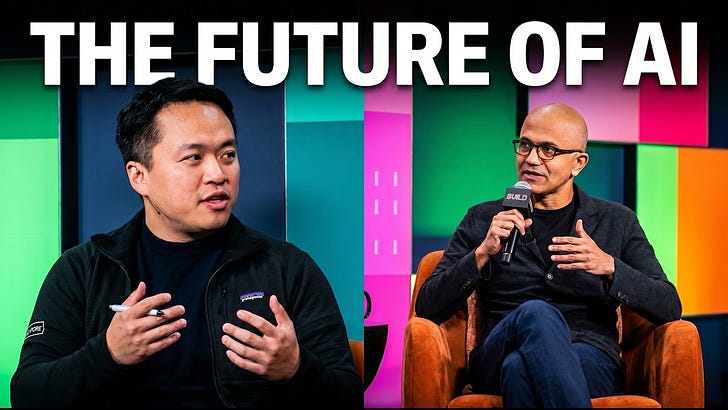
Latent Space: The AI Engineer Podcast
⚡️Satya Nadella: No Priors x Latent Space Crossover Special at Microsoft Build
00:38:58
Loading summary
Transcript70 lines
- [00:24]
Host 1
Please welcome swix saragoa al allah gill
- [00:28]
Host 2
and chairman and chief executive officer of Microsoft, satya nadella.
- [00:42]
Host 1
Hello.
- [00:42]
Host 2
So I'm so excited to be here. Welcome to a crossover episode of no Priors in lanespace with Satya Nadella. Congratulations on an amazing build.
- [00:52]
Satya Nadella
No, thank you so much. And it's great to be with both of you. I listened to both of you on both the podcasts all the time. It's great to be on it.
- [00:59]
Host 1
Thank you so much.
- [01:00]
Host 2
So you're just talking about these amazing announcements from across the Microsoft estate all morning for I think three hours. What is the, what's the most important reflection or takeaway you have?
- [01:10]
Satya Nadella
I'd say there are, perhaps the biggest one for me is let's conceptualize this more as an ecosystem play as opposed to a single model or even a single platform. Right, Whatever. At least for me, having grown up at Microsoft, having seen whatever forum major platform shifts fall into that camp where a platform is defined by fundamentally its ability to create more value about the platform versus what's captured in the platform. And so if you view what's happening right now, I think this morning's keynote was how can any company, whether it's an AI native company or a traditional enterprise company, participate as a first class participant where they can point to AI they create. Right. It's not that they don't use other people's AI, of course they will. But to me, what's the path, what's the recipe? How do I do it? What does the stack look like, what does the tooling look like? What is valuable? How do you do that? That's it. That's our job to do.
- [02:16]
Host 1
Yeah.
- [02:17]
Host 2
Ecosystem strategy is very complicated. Right. Because you end up building certain components, partnering for certain components, supporting them. You just announced this big suite of models. Tell us a little bit about the training strategy for Microsoft.
- [02:31]
Satya Nadella
Yeah. So the thing that we wanted to do with the MAI models was to build and as Mustafa talked about, first of all, a great lineage. Right. Starting with pre training, with very good data quality, doing all the ablations, making sure. Because in some sense it's become even harder to build a clean lineage model. Yes. Because there's so much stuff out there that you truly need to ablate out to be able to have a fantastic pre trained model. In fact, that's one of the challenges of a lot of the open weight models is they look great on one benchmark or two, but they're not great on practice. So that's why, in fact, even in our FDEs are pretty gone. Really excited about these Mai models because how the heck can a small 5B model hill climb? And it goes back a little bit to what I think is ultimately the key thing to do, which is try to pursue finding that cognitive core. So to me, starting with a clean lineage, then creating that ability for companies to be able to use this, right, not just as a generalist, but to create their own specialist by building this hill climbing scaffold around it, right? So it's not just the model, but you have a hill client scaffold around it. Then you will start building your rle, you will start collecting the traces. Most importantly, you'll have private evals, because we know all the evals out there are good, interesting, but they're not really that critical at this point because they all can be maxed. And so the point is, each company will have its own private eval. And so that end to end platform story around our models is what I think is interesting. And then the one other thing, Sara, since you brought that up, is I do feel there's a new frontier. Like people talk about the frontier. And are you operating at the frontier? Interestingly enough, if you add a little temporality to it, you can use, let's say, in fact, the Land O Lakes demo we showed was pretty cool. We used whatever GPT 5 5, right. Then you collected a bunch of traces and then you took a 5B reasoning model and achieved higher. So that is another aspect of what it means to appear, operate at the frontier.
- [04:46]
Host 1
Yeah. I think first of all, I have to congratulate you on basically building a frontier neolab inside of Microsoft in two years. I'm wondering, you have all this AI strategy that you're rolling out, but I'm wondering, what do you know now that you wish you would tell yourself two years ago, two to three years ago, three years for the Jensen partnership, two years for mei.
- [05:04]
Satya Nadella
Yeah, I think the thing that I reflect quite a bit, which is obviously I got into all this when I got excited by the scaling laws paper and when even the OpenAI partnership came about, when those folks said, hey, we're going to really throw a lot of computer transformers and they've helped. Right? The thing that I always look back and say, wow, these things do have capability that they're climbing up. This crude way of saying it is intelligence is log of compute kind of works. Now what I think we underestimated perhaps is the real world complexity of deploying these so that they actually deliver the value in the real world. Right. So the outcomes as measured by any benchmark is interesting, important, but the true eval is when people out there are able to do unique things that they only can value and it's very measurable. Right. That I wish we had to even add more in our consciousness. Right. Which is as an industry because right now I think when people say wow, I don't want a token, Max, it's an artifact of us not having thought ourselves as an industry that we are using tokens to create value every step of the way. So I think that's what I wish we had gotten there, but I'm glad we are here.
- [06:25]
Guest Expert
What are some of the use cases that you've seen that have created the most value for your customers? Because I know that people talk a lot about code and I think it's pretty clear that's something that's having very large scale impact. Are there other areas that you find in common that your customers are really benefiting?
- [06:38]
Satya Nadella
Yeah, I think to your point, obviously coding is now got. But it's interesting by the way to even talk about the coding.
- [06:45]
Host 2
Right?
- [06:45]
Satya Nadella
Which is coding has worked so well that we now have to rebuild the ide. Right. It's cuts to see what we launched is oh my God, I have these 100 agent sessions. The cognitive load it transfers back to me as a human is so excessive that now I need a new ui. Oh, by the way, the chat as the only artifact is also impossible. So that's why we need a canvas. So it's interesting for all the things about where is software needed or where is UI needed to keep that even for code, right. In a fully agentic world. But that said, one of the things that we are starting to see, we started seeing with cowork but even some of the work we showed with autopilot on what with clause is a good one because if you think about a lot of human capital is doing the glue work, right. If you now can augment that with tokens agents that are long running durable, then your ability to scale even what is still judgment and glue work gets amplified like coding does. So you can. I'm positive that six months from now we'll all be saying, oh wow, like all through the night there was a bunch of stuff that all these autopilots that I have working on my behalf with my delegated authority, so to speak. Right. I can given even my identity did a bunch of work. Then of course I'll need my new ADE to say what did you do? Did I do this work? And so on. So I think that's where compressing of workflows, completing of tasks, that's where I think a lot of the value gets created.
- [08:23]
Guest Expert
I think you raised a really interesting point which is there's the actual agent that's doing the code and then there's a harness around it and that's the environment, that's the context, that's everything you're setting up as a developer around actually a coding agent. What is the harness for the enterprise? Is there an equivalent concept for broader productivity work or how do you think about that concept?
- [08:41]
Satya Nadella
That's right. So in some sense you want the harness to define the models, the data and the tools and so that you have a loop across those three. And so what we are trying to first of all make sure is each of our products that we build, whether it's get up copilot or the security copilot stuff we showed with M Dash or even the discovery for science, it doesn't matter. All of them are multimodal harnesses with tools access so that you can do this progressive disclosure of tools even so that they're token efficient and then you're feeding it with very rich context. Because that's other hard lesson we have learned in the last two years is oh my God, the amount of work you need to do to prep the context layer such that your plan can execute in the most efficient way is where the magic is. So we have, in our case we have the GitHub harness which essentially we're using across all our products. It's available in Foundry and we're open. Like you can use your llama harness, whatever, or you can use the any open harness or any harness of yours and train with your tools and multiple models and your context. And so that's the pitch because right now a lot of dialogue is hey, if I train the harness plus tools and the model together, you get evals. And what we are proving out is, and the best example of that is what we did with M Dash, right? Because when it launched it found bugs or vulnerabilities that were not found by Methos. And so there is existence proof, I would claim that you can have a multimodal harness that can in fact be more performant in the real world.
- [10:25]
Host 2
So a premise behind the training at the independent Frontier Labs is really we're going to have these models and we'll have an API business and we'll support enterprises and startups, but a first party product, be it productivity or code or search, drives the majority of revenue. That's a different value equation than you're describing, I think with the Microsoft ecosystem, if that's the case. Tell me if it's the case because obviously you have first party products and you have enablement products. What is the role of the developer? Like what's going to be hard and the set of skills and the value capture the developer has in that world.
- [10:58]
Satya Nadella
Yeah. So I think that there's always going to be the case that someone who is super successful as a platform builder can also have first party products. It was true with Windows, it was true with the SaaS side and the cloud side as well with us and others and so on. But the thing that is it should not be a limiter to other people achieving that same success. Right. That I think is the core difference which is the network effects this time around around intelligence are such because they learn from data and not really lots of data. It's just a few samples that you have to see to understand what's novel about something. So that's why the game becomes how to protect. So that's why I would say every company having private evals may be the biggest ip. Right. I think about it like what's that private eval that you can then use even a frontier model to hill climb on and not leak the traces. Maybe one of the biggest drivers of ip. So in other words, another asset test is you have an eval that's private, you're using model A, can you switch it to model B and climb up? If you can, then you're in control, if you can't, you're not in control. And that's where even the harness decision becomes super important. Right. So therefore having an open harness, letting all models come in, having your evals, your context, your tools help you hill climb, I think is the skills that an AI native startup needs, a SaaS company needs or every enterprise needs.
- [12:39]
Host 1
Yeah, I think in a very real way you are Microsoft historically as an operating systems company and then become a cloud company. Maybe like the third act is that you're a harness or evals company, whatever the sort of conglomerate of concepts that you want to put together. I think enabling every company to have like frontier intelligence or I forget that exact term that you use is the mission, right?
- [13:02]
Satya Nadella
That's it.
- [13:02]
Host 1
That is the platform promise that you build with us. You will get your intelligence for your data.
- [13:08]
Satya Nadella
That's it. To me that is the. There was one tagline for this entire developer conference is can everybody operate at the frontier with this, their frontier intelligence? Right. To me that is so important because otherwise I don't know how you achieve stable equilibrium, right? Which is how do I then go and say my company is going to have a terminal value because I now know how to continuously compound on top of what's a platform that gets better, right. So when like Windows obviously came out, Adobe built Autodesk, built or even take what Jensen said. We built DX and he built Cuda on top of it. Right. I always say to Jensen, God, I got the short end of that right. I wish we had recognized it. But nevertheless. But that idea that you can build a platform layer that someone else can then extend out and build their own intelligence layer, in this case I think is everything right without it. Why have a developer conference? I can just come and have you all just worship at the altar of one model. But that's not a developer conference.
- [14:14]
Host 1
Backstage you had a discussion about what is IP or what is the value in a company. It used to be the length of human experience at the company and now it's this other thing which is the evals the experience in applying agents to the company. I just want you to like flesh that out a bit more because yeah,
- [14:31]
Satya Nadella
it's a great way to frame it, right? Because at the end of the day every company is going to have both the human capital that is still going to be super valuable because humans and their ability to find the gaps that exist at all times is going to be the way we all will create value. Right. So I'm definitely in the camp that this is going to be about expressing new forms of human agency and ambition even as token capital goes up. Right. So let's say any corporation has lots of tokens and lot of human capital. The question is how do you compound the two? So if you take in teams, I have a bunch of agents doing work and a bunch of humans doing work and the traces between those. That is really important context of how that enterprise is creating value. Then that goes back to train, not a generalist model, but to train the company veteran agent, right? That is super valuable again, right? Which is when a company says it should in fact go onto the balance sheet is how I think about it, right? That's in fact there may be like human capital was never possible to go put on a balance sheet because you then know how to capture the tacit knowledge. Whereas now I think you can with the agents that have learned through the through time, through all the traces. So that's what at least we think will happen.
- [15:52]
Host 1
I think the SEC is going to have to have accounting standards for token expertise.
- [15:58]
Host 2
You're talking about the equilibrium state and a stable equilibrium where companies have this compounding value and can see terminal value for themselves. Another challenge to be considered equilibrium of, okay, there are applications and workflows that are common to a vertical or a horizontal. And this was like the generation of SaaS companies. And Microsoft has lots of SaaS properties as well. And then there are things that are very specific to every enterprise that they're differentiated against. I'm sure you have heard much and participate in much of the debate about the end of software. Software because all these workflows are cheap to generate. Now, do you think the equilibrium looks different between what agents get built in enterprises versus in their vendors in the future?
- [16:41]
Satya Nadella
Yeah. So I think what's happening there is we had a particular way we captured, I would say workflow in apps. Right. Because we built a data model. Right. We schematized some part of some business process. We then built a bunch of business logic.
- [16:58]
Host 2
Yep.
- [16:58]
Satya Nadella
And then we put a bunch of UI on top of it. Right. So that's what every SaaS company.
- [17:02]
Host 2
And then a little configuration 20 years.
- [17:04]
Host 1
That was.
- [17:05]
Guest Expert
Yeah.
- [17:05]
Satya Nadella
And that was it. So interestingly enough, now you get to relitigate that vertical stacking. Right. So I still think, for example, that data model that you built underneath every SaaS application is super good. Right. Like, why reinvent it? Like my general ledger better be a general ledger. I don't need new schema creation. In fact, that entity relationship is actually pretty good, robust thing that I want to feed.
- [17:32]
Host 2
And you want to be stable.
- [17:33]
Satya Nadella
That's right.
- [17:34]
Host 2
Yeah.
- [17:34]
Satya Nadella
Then same thing with business logic, Right. If you look at, we have this product called Power Bi, Right. It was like dashboards galore. People created the beauty. Underneath that dashboard is a very rich semantic model. Right. Someone took the pain to create a dashboard and do all the measures. And you want that. That's business logic, Right? I want that to be available to me. So I think the challenge of the SaaS business model is we packaged one way. We now have to learn how to unbundle these things and rebundle in new ways and discover new business models. Right. If you look at it, what's happening today with Microsoft 365 is a great example. We have this thing called Work iq. In fact, what we are realizing is, oh my God, if I look at. In fact, there's a historical parallel to. Right. We sold First Exchange and SharePoint and before teams, we had a thing called Link Server and what have you. And we thought, oh, that's all going to move to the Cloud. But little did we realize that the number of people who will use servers in the cloud is 10x100x. Right? Because people were not buying servers, they were just buying a subscription. The same thing is now happening with M365 because with work IQ we have exposed what is perhaps the most important database in a company that never got used as a database because it is only captive to our apps. Email operated on it, teams operated on it, Word, Excel, PowerPoint, SharePoint. But now this is one of the coolest things I get to do with work IQ. I go to a GitHub repo and I say, hey, I attended a bunch of design meetings last week related to this repo. Can you capture all that and tell me what changes I should make? Think about that, right? It literally can go look at all those transcripts, come back with a plan to change a code base, right? Previously you could never have thought of using M365 for something like that. So the value creation opportunity now in the agent world is in fact 10x more. But it does require us to have, for example, there's going to be usage around M360 which is going to be perhaps more than even the end users. And we have to even re architect. In fact, what I use to serve an inbox or a mailbox cannot be used to serve an agent. And so that's what we are doing.
- [19:55]
Host 2
I don't believe in permanent business models for any of these domains, but in the near term, do you have a prediction between outcomes based pricing, token based pricing, enterprise bundles?
- [20:07]
Satya Nadella
Yeah. The way I think about this is always we've had, let's even take the per user pricing. The per user pricing is really an artifact of someone creating a budget needing certainty. Right? Because it's the most important thing. Somebody wants a budget, they need a per user. And per user is just a set of entitlements to usage. Right? That's what it is. And so the way is the first budget bundling will be take some usage, bundle it into per user stacks and sell subscriptions. So subscriptions I think are going to be there, per user is going to be there. Then the next big thing will be consumption. So people will say I want consumption. And it's also possible that people will say I don't even want to pay for any of the subscriptions or the consumption, it's outcome. But remember, most people love outcomes until they have an outcome. Because once you have an outcome, it's like giving away royalty. Right? I've talked to customers who love Outcome based pricing and I say I'm all in. Until they, oh my God, what are you talking about? You're sharing in my outcome. No, no, I want you to go back to per user pricing and I want you to consumption price. Right. So I think that debate will go on and all of these business models have a particular time and a place versus one to rule them all. And if anything, if you're a SaaS vendor or you're a platform vendor having that flexibility. And quite frankly, we face this with GitHub. Right? We just recently announced upper user pricing on GitHub because little GitHub copilot was constructed at a per user level before we understood even the intensity of usage of agents. Right. It was an interactive way for a developer to use codecomplete, maybe task. It was not like, oh, I launched 10,000 agents that are going on all day, right? So that is what the adjustment is about. So now that we really want, there will always be a per user, but they will have to be a consumption meter.
- [22:04]
Guest Expert
How do you think about the durability of SaaS more generally? One thing I've observed is in a lot of enterprises internally, there will be teams that almost have agent euphoria. They're so excited about the explosion of things they can build that they're trying to rebuild a lot of applications. They're going to their SaaS vendors and saying, we're not going to work with you anymore or we're considering an internal project. And it seems like in six to nine months, maybe some of those people will come back and say, actually we can't rebuild everything. How do you think about what's durable in this world and what isn't?
- [22:30]
Satya Nadella
I think we have to go through one full budget cycle on this to really see the sort of the emergence of the equilibrium. Because at the end of the day, there's marginal cost to even generating the app. Right? In fact, there can be even a simple way to say it. If you, you should always acquire something. If the marginal cost of building and maintaining something on your own is higher, right? That should be like, it's a quantifiable, quantifiable thing. And the maintenance part is important, right? Even like, you gotta remember, hey, all the security stuff that now AI will find, you better fix them too fast. Of course there's a coding agent to help you with, but then that burns tokens, right? So whose responsibility is it? It's like a cycle that you've got to think through. And I think we have gone through the excitement that I can generate a lot of software. I think the next thing would be what software do I really want to generate? What software do I want to use from others? How do I compose these two into some agentic workflow that I have agency over? Right? Because I think there'll be very little tolerance for anybody who's inflexible at the vendor level. But at the same time, I think that anyone who has got that flexibility, shows up, delivers the value, will be back at again, right? We're selling software with just different business models.
- [23:52]
Host 1
In fact, speaking about building software, one of my favorite moments from I think a previous build maybe one or two years ago was they had a section of you building your own software. I'm curious if you're building anything now.
- [24:03]
Satya Nadella
Yeah. So I think the first of all, let's face it, right? Building software has made it possible for even the incompetence of a CEO of a company like ours, you can build. So thank God. But that said, I do feel that something like GitHub Copilot to me, and especially the new Sessions app or the new app has just made it so much more possible for you to have agency over artifacts that you felt you couldn't touch before, right? So for me as a CEO even to go to a code base to be able to learn about it, like I remember joining Microsoft long back first and then you say, man, everybody had to go in and look at whatever Cutler's, Malloc or what have you to learn how to do good C C code. So now that ability to be more full stack up and down is so good. But that doesn't mean every one of us should be doing the same thing. The question is, how do you then have the ability to inspect things, learn things, see things, I think is just so much more. And so to me, what I'm building a lot of is these long running foundry agents, right? So there's autopilots. So the easiest thing is to me, I think I just built one even last week where the idea was, hey, can I have an agent that is continuously monitoring essentially my own chief of staff autopilot, right? We're going to have that obviously in scout, that's what we showed. But it is so easy and trivial to build. I took work iq, I said take work iq, go and build a foundry long running agent, store all the memory in using Ray Fin basically at my backend as a service and lo and behold, it built it. And not only built it, I could say publish to teams and it published the damn thing to Teams. So the ability to have some end to end project like this complete is just pretty miraculous.
- [26:00]
Guest Expert
How do you think that impacts the different types of engineering roles that exist in the future? Because right now I think there's a dozen different types of engineers that you can be from qa, front end, et cetera. There's a big swath, I've heard some people argue that in four or five years we'll basically end up with four engineering roles. It'll be people who are managing agents, it'll be forward deployed engineers or FTEs.
- [26:21]
Host 1
It'll be.
- [26:22]
Guest Expert
It'll be security engineers and then people working on large scale infrastructure for a small number of services and then everything else just collapses into the agentic world.
- [26:30]
Host 2
Yeah.
- [26:30]
Guest Expert
Do you think that's a correct view of the world?
- [26:32]
Satya Nadella
Yeah, I think we'll have to experiment our way through it. But what you said is what There are some very at scale things at LinkedIn they did structurally change and it basically built up a new discipline called full stack builder, right? So they went and said, hey, let's bring people from design and product management, front end engineering, all pull them together, but also have an edge, right? It's not like the design person still doesn't have the design edge or the front end person doesn't have the front end edge, but you can give yourself bigger scope in role so that you're not confined to one role. And then equally, infrastructure has become very critical, right. So in other words, rles. One thing we've realized is, is even for the Excel team, for example, building the RLE in which a reward can be learned is actually one of the hardest sort of infrastructure problems. And so you need even new talent, right? Distributed systems people, even in what was considered an end user app team because it's a different skill set. So yes, infrastructure science is the other one obviously. So I think we'll see how these evolve, right? Where's the real always the world will have a bunch of specialist. I think the generalist role is going to be the most exciting, right? Because the leverage of a generalist is where we are going to see the maximum returns, right? When you said hey, are you coding? I'm now a gen what I basically translated knowledge work, right? Which I did where I created a Word document or a spreadsheet or even. And now I can build an app, right? It's in the same sentence. That idea that oh wow, my generalist skills have gotten a higher leverage I think is what we're going to see across the board.
- [28:20]
Host 2
Music to the ears of CEOs and VCs that are like a little dangerous.
- [28:24]
Host 1
And a lot of people idea people,
- [28:26]
Host 2
idea people with a lot of agency. If you take that idea of personal agency and you just zoom it out to the organizational context. And my partner Mike Ranal, who actually started his career at Microsoft, just wrote an essay where one of the big takeaways is it's an age where you can be much more ambitious and you need to be given the pace of the environment and how quickly actually users and companies are open to adopting new technologies. How do you think about, feel silly asking this of somebody running a trillion dollar plus company already, but how do you think about how Microsoft can be more ambitious?
- [28:58]
Satya Nadella
Now, a great question, I think, I think the thing in these type of transitions is to have a conceptual model of how work can change to go after outcomes that you could hardly imagine previously, right? In fact, Kevin Scott has this nice line which is when you can make the impossible, like when you're making hard things easier, that's one point of leverage. But true ambition is about making the impossible possible. So now the thing that is missing a little bit in all of our organizations is what is that new conceptual model of what can we build, what was impossible and what can we build? And I'll give you one example of this, which is I take great inspiration from the people who are managing the Azure network. And they came to. This is from even last year we were scaling, you saw that. I talked about how we built in the last 15 months more Azure capacity than we built in the first 15 years. That's crazy wild. Yeah, it's pretty wild. And it's the same team. So they saw that and they said, bob, this just ain't gonna work if we don't reconceptualize our work. So they built, essentially they said, our job is not to do Azure networking. Our job is to build the agentic system, does Azure networking, right? These are the folks managing the 500 plus fiber operators, managing the van all over. And fiber operations ultimately is a physical operation. Things get caught, things have to be repaired. We have fancy words called DevOps and so on. Basically emails are coming in and you got to go respond to them, take care of it. So they built this agentic system. They even have a character for it, it's called Miles and it has all this stuff, right? They started screaming for more tokens and so on. And so they were saying, look, we don't need headcount, we need tokens in order to be able to manage our operation. That reconceptualization of what their work is. Right. They basically took their work and made it meta. Right. That meta work is now their new work. In the 80s, if somebody had come to us and said 4 billion people are going to get up in the morning and start typing, my model would have been we need 4 billion typists, but we're not doing typing, we're doing knowledge work. So that to me I think is it, which is whether it's Microsoft or whether it's any organization is to give ourselves permission to do new types of metacognition meta work using these new tools to change the outputs that matter and then really make the impossible possible. So completing that dot or the connective tissue across those I think is where a lot of the enterprise value will get created.
- [31:50]
Host 1
Should we talk about data centers?
- [31:52]
Guest Expert
Yeah, please ask.
- [31:53]
Host 1
Oh, okay. This leads nicely into the data center build up. I always think I'm just impressed with the sheer scale of the buildup from Microsoft, but also everyone else, that this is redefining what it means to be a hyperscaler. And I just feel like that had unprecedented scale on finances on the way you run the company, but also the communities that are impacted. Dad, just talk a bit more about what you're seeing on the ground, like when you visit your.
- [32:18]
Satya Nadella
Yeah, I think there are two aspects of it. Obviously the build out is extraordinary. Nothing like this has happened and it's great to be one of the participants in it. But you brought up the other part. Right. I think at this point it's clear that unless we as an industry are very principled about ensuring that the benefits of all the stuff we're talking about are felt in real ways at the community level. Right. Because this is not just a campaign. Right. It has to be real where people are saying, look, this is not changing the prices on energy for me. In fact, if anything it's bringing down the prices because long term there's going to be a better grid, there is going to be more energy. Water consumption is in fact not in fact water is being replenished. Right. You got to really educate folks on truly what's happening. The closed loop systems we are building, we have to invest in the training, the jobs, the tax base. In fact, the least talked about stuff is the amount of jobs that get created during construction, after construction, what's the tax break that's there in the community. And all this has to be real. And if that is the case, then we will have permission. If it is not, we won't have permission. It's as simple as that. Right. Which is I think we have to take it as an industry pretty seriously. I think it's good for communities to be skeptical, ask the hard questions, for us to do the hard work, earn that. But at the end of the day if we can really be the producer. I've always felt like in human history if you use a lot of energy but also create a lot of value for society, the story has been fantastic. If you don't do that, it's not been that great. And this time around I'm a firm believer that ultimately if you do have a token economy that drives productivity, that drives economic growth, that drives broad spread participation, better health outcomes, then I think we'll be in a great place and that's at least what we all have to be focused on.
- [34:21]
Host 1
Yeah, it makes me think actually that with all these initiatives that you're doing might be easier to see ROI in the communities first before in enterprise, I
- [34:30]
Satya Nadella
think both sides, in fact it comes back together. It has to be the people in the communities are going to be employed, are going to be participants in the real economy. Right. That's. I think the question is if the broad economy is doing well and the communities are doing well, the dots get connected is the market forces are such that we will connect the dots and that I think is it. You ought to be able to see the evidence. You can't be about any one company but it has to be broad economic growth and broad community permission
- [35:04]
Guest Expert
about currently or what have you most updated your personal models on regarding societal impact of AI?
- [35:11]
Satya Nadella
So you're saying what's the, what have
- [35:12]
Host 1
you updated most on in terms of societal impact?
- [35:16]
Satya Nadella
I think the most critical thing is the first question we even started with which is we need to tell the story and make it real that everybody has a real shot to participate as a first class participant in this new economy. That's I think in the next 12 months, 18 months, we need a way for people to say oh wow, I get it, there's going to be tremendous capability, tremendous amount of infrastructure. But I can see what is going to happen. Whether it's the benefits like health outcomes or my ability to create a startup or my ability to run my local sort of store more efficiently. It's just happening. And I see that benefit myself. Right. That to me earning that permission in a path dependent way, we can't wait. See the one thing Eli I've now learned is I think the world is going to be way skeptical of tech and tech companies that say trust us, we've got it. The future is going to be glorious. Have to deliver tangible benefits and quite frankly politicians winning elections because they have advocated for that, that will be at least my adjustment because without it thinking that somehow because it's too important this time around, it's too much of the economy for it not to be the case.
- [36:48]
Host 2
So one very simple framework I have for what is going to be the broad benefit of AI beyond the communities just working in technology, wealth creation. It's going to happen in a ton of different companies, startups and large companies. Then you have healthcare, you had amazing demos. Today there are companies like Open Evidence. I think that is happening. Education seems like another one that's an obvious good where we haven't seen as much impact as I'd expect. Do you have a hypothesis on why that might be or if it'll come?
- [37:18]
Satya Nadella
Yeah, I think this is where again how we think about education. How recently I met with the founders of Alpha School and learned a lot about what they were going and going about and it's fascinating to listen to to how do we even rethink what does education really look like? Because I think it's actually very important and I'm not saying anything traditionally being done is less important. Right. I was even looking at the. It's fascinating to see. I forget which Stanford class it was the Asian guidelines for CS something because you still need people to learn. It was an interesting AI class that they were making sure people were learning how to apply softmax appropriately versus saying hey, fix my training run. So I think learning concepts is important. It's going to be critical. But the way we create the incentives, what are the credentials, how we value those credentials, what is the employment opportunity for those credentials? So I think that there's a complete change that has to happen given the way to get to information, way to educate yourself, way to continuously keep yourself updated has changed so much. So I think interestingly enough, maybe the next big startup and success story could be someone who builds a new university or a new pedagogy even of how to get someone to go through a curriculum and find economic opportunity that's highly valuable.
- [38:42]
Host 2
That has felt perhaps impossible for a long time, but it's a great note to end on and something that might be possible.
- [38:48]
Satya Nadella
Thank you, Satya, thank you so much. Thank you, I appreciate it. Thank you all.