← Law Enforcement Talk: True Crime and Trauma Stories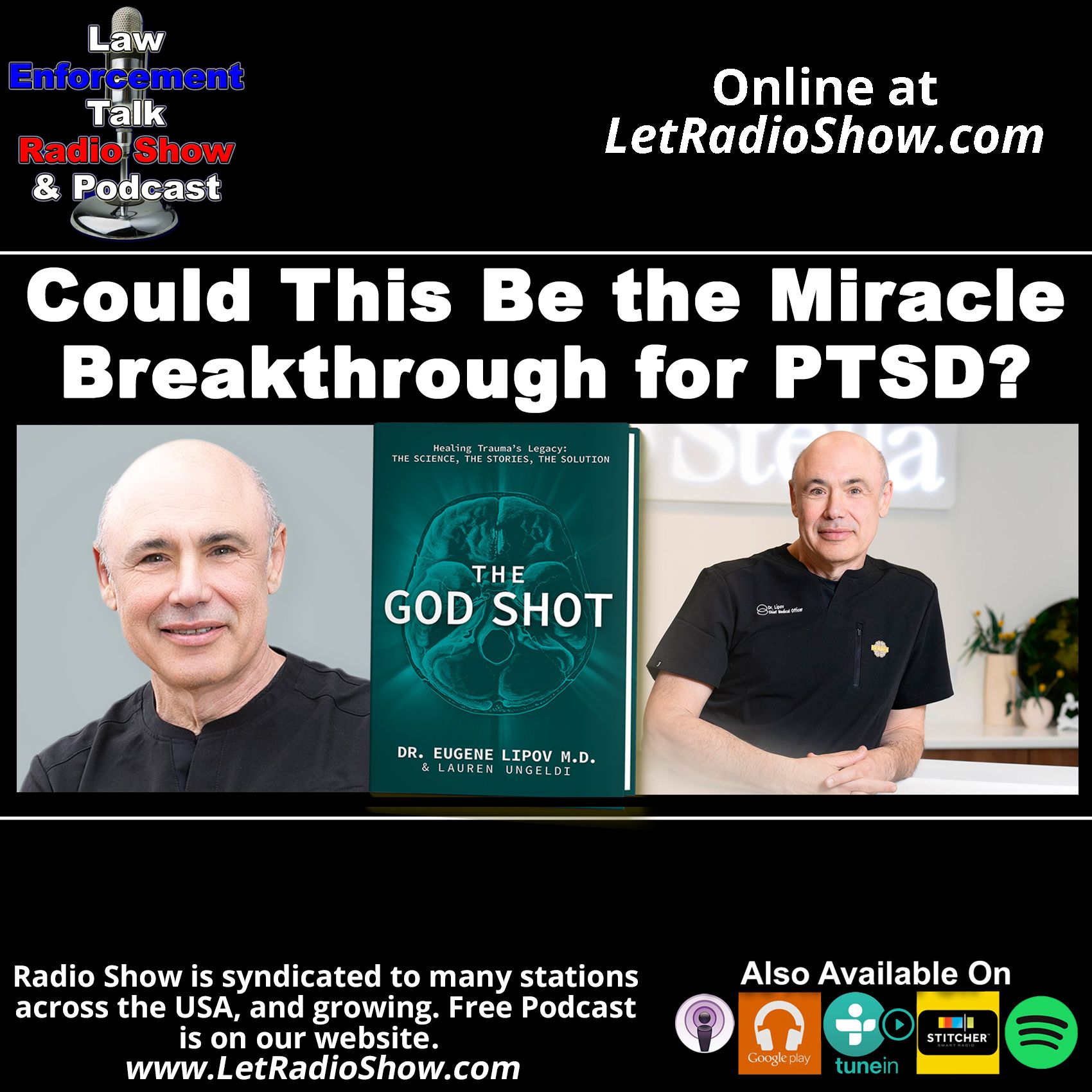
Law Enforcement Talk: True Crime and Trauma Stories
Could This Be the Miracle Breakthrough for PTSD?
00:39:37
Could This Be the Miracle Breakthrough for PTSD? A Doctor’s Personal Story and Treatment. When it comes to trauma and PTSD, countless stories of suffering and survival fill the News, Facebook, Instagram, LinkedIn, and podcasts on Apple and Spotify. But one story stands out, not just because of the personal tragedy behind it, but because of the revolutionary hope it brings.
Loading summary
Transcript118 lines
- [00:00]
John J. Wiley
This is the story of the One as head of maintenance at a concert hall, he knows the show must always go on. That's why he works behind the scenes, ensuring every light is working, the H Vac is humming and his facility shines with Grainger's supplies and solutions for every challenge he faces. Plus 24. 7 customer support. His venue never misses a beat. Call quickgranger.com or just stop by Granger.
- [00:26]
Dr. Eugene Lipoff
For the ones who get it done.
- [00:30]
John J. Wiley
He's a medical doctor. He was run over by a boat and severely injured by the propeller, almost blood to death when he was 21 years of age. He had an out of body experience after that incident. But hold on, there's more. About a year later his mother died by suicide. That affected him tremendously. It changed the course of his life and and he might have a solution for you when it comes to ptsd. Welcome to the Law Enforcement Talk Radio Show. In the Law Enforcement Talk Radio show we are joined by special guests talking about their experiences, their realities of investigating crimes plus those who have experienced horrendous trauma. Police, first responders, military and victims of crime share their stories. Hi, I'm John J. Wiley. In addition to being a broadcaster, I'm also a retired police sergeant. Be sure to check out our website letradio.com and also like us on Facebook search for the law Enforcement Talk radio show. You know we used to have an app and it was a very popular app and then guess what, we couldn't hold a candle through our Facebook presence. How many people have the mobile Facebook app already installed on their phone? How many people use it on their computer? Make sure you follow us, make sure you like us on our Facebook page. Just search for law enforcement Talk radio show and podcast and be sure to send us a comment to one of the posts. Best of all as 100% free. Joining us from Chicago we have Dr. Eugene Lipoff on the Law Enforcement Talk Radio show. He is an MD that stands for medical Doctor. For people like me who are there's a difference between PhD and MD and he's co author of the book the God Shot Healing Traumas, Legacy, the Science, the Stories of solution. His website's thegodshotbook.com he's here to tell stories here to tell how it impact them and what what he's learned and what he's doing about today. Dr. Lipoff, thanks for being guest on the law Enforcement Talk Radio Show. Very much appreciate it.
- [02:30]
Dr. Eugene Lipoff
Thank you so much for having me.
- [02:31]
John J. Wiley
It is a pleasure to have you here and I'll be honest with you, doc, I feel kind of honored because you may not act like it, but you're kind of a big deal in this world of treatment of PTSD with the God shot. And I can never say it right, this led to a shot that involves injecting a nerve. Am I correct?
- [02:54]
Dr. Eugene Lipoff
You're correct. That's very kind of you to say.
- [02:56]
John J. Wiley
What is the name?
- [02:57]
Dr. Eugene Lipoff
I always believe people should not become legend of their own mind. So thank you.
- [03:02]
John J. Wiley
I'm not legend my own mind because I'm married, and I got a wife that keep me in line, so I.
- [03:07]
Dr. Eugene Lipoff
Got the same chain of command, by.
- [03:10]
John J. Wiley
The way, you said chain of command is right. I referred to her as the boss because she really is. And let's be honest, I need her help more than she needs mine. And she's an integral part of reason why I'm successful today. I could not do what I'm doing today by myself. I just couldn't do it.
- [03:27]
Dr. Eugene Lipoff
I think it's. I call my wife commander and cheese.
- [03:33]
John J. Wiley
So how long have you been married?
- [03:35]
Dr. Eugene Lipoff
Almost 30 years, sir. 29 so far.
- [03:38]
John J. Wiley
We were starting our 25th anniversary probably next month or October, actually. And I told my mother the other day that before getting a story that time flies because she's like, this is your 25th wedding anniversary? Like, yeah, it is. And my first wedding. My first marriage ended miserably. And a lot of that was due to my. My own inability to deal with trauma better, which we'll talk about. But you've gone through it in your childhood. First of all, did you want to be a medical doctor first, or do you want to do something else first?
- [04:10]
Dr. Eugene Lipoff
No, I wanted to be a medical doctor first. Both of my father and my mother was a physician, and my brother is a physician. So I'm kind of the fourth of the four in our.
- [04:19]
John J. Wiley
And you went through some. I have my notes that you went through some really tough stuff beginning at age 21, and these had an impact on what you do today. Am I wrong?
- [04:32]
Dr. Eugene Lipoff
No, you're not wrong. So, basically, I mean, I've had a number of traumas, but two big ones were I was hit by a propeller blade in Mexico, and I almost bled to death. And then the next year, I was a surgical resident, and my mother took her life, and I just started my surgical residency, so that derailed my plan to become a surgeon, which kind of ended me in anesthesia. And then from anesthesia, I went to pain medicine. And in pain medicine, I had opportunity to start treating ptsd. And that's how that really had a direct impact on me creating this treatment modality, which has now been pretty. Except in many places, not enough yet. But we are moving along and we'll.
- [05:16]
John J. Wiley
Get to that in a moment. I just got to say this. My own personal story is deeply. I refer to PTSD as post traumatic stress injury. For me, it's more of an injury than a disorder. I understand with the medical field why they have to call a disorder, but I was diagnosed with that back in the 80s, late 80s, and it dominated my life through my early 30s, and things are much, much better today. But am I an exception to the rule or am I kind of like a lot of people?
- [05:49]
Dr. Eugene Lipoff
You mean as far as the name ptsi?
- [05:52]
John J. Wiley
Either one. Either one.
- [05:53]
Dr. Eugene Lipoff
Well, there are a couple of things to that I think. I mean, so ptsd, and I'm using it just for simplicity's sake and we'll get into more detail, but PTSD leads to misery in a lot of people. So it's about a quarter of United States have ptsd, probably higher number. But the whole term ptsi, you said you don't understand why the doctor. You understand why doctors call it that? I don't, and I'll tell you why I say that. So PTSD was a term that was originally coined in 1980, DSM 3, which is a manual. So now we still. So this is now 2025, and they're still using the same term. There's no scientific reason for that. Previously, the first time PTSD was termed clinically was Civil War. It was called soldier's heart.
- [06:44]
John J. Wiley
Right.
- [06:44]
Dr. Eugene Lipoff
Because people had, like multiple arrhythmias and they looked kind of faint. They didn't look so good, all of that. So that's soldier's heart. Then it became shell shock, World War I, then battle fatigue, World War II, then with NEM syndrome, and then PTSD. So there was a gentleman, his name is Frank Ugbert, very famous psychiatrist, he came up with the term Stockholm syndrome. But he also believed that the name needs to be changed to ptsi, which. You're exactly right. Post rank stress injury that reflect a current understanding that PTSD is actually a biological condition that is visible on brain scans. So if somebody says PTSD is invisible wound, my answer to that, it's invisible. If you have the wrong scanner, if you have FMR or PET scans, advanced scanners, you can actually see it. So I did a study in 2023 that showed fairly definitively that if you change the name PTSD to ptsi, the stigma gets better, Stigma gets better. Then people will get treated and then the suicide rate, which right now are the highest it's been since World War II, will be reduced. So I went to American Psychiatric Association. I said, hey, it's time to change the name. And they go, hey, you don't have enough information, go away. So they say get away from me, boy. Hard time, change it.
- [08:08]
John J. Wiley
They gave you a hard time saying get away from me?
- [08:11]
Dr. Eugene Lipoff
Not in those terms, but if you want to see exactly what I said, you can go. So here's what I would suggest that you can help and the audience can actually help make that change. If they go into the website, it's its PTSI. So it's, it's PTSI.com, its PTSI.com there's a survey. So I'm trying to. I did a survey on 3,000 people and APA basically said go away, give us more information. I want to get, my goal is to get 100,000 people to fill out the surveys. Seven questions takes about 40 seconds. It doesn't cost anything. You don't have to give your name or anything. I'm trying to get a massive number of people to do the survey and to replicate my study just on the bigger scale. And if you want to see a four star general talking about it in 2013 fighting with APA, then that's all there. All my TVA parents about it. Everything is there. It's in one spot.
- [09:09]
John J. Wiley
We're talking with Dr. Eugene Lipoff. He is co author of the book the God Healing Trauma's Legacy. The Science the Stories solution website is thegodshotbook.com we're going to take a short break. We return, we're going to talk about the incidents that he went through that had a profound impact on him physically, mentally and what he does today. Don't go anywhere. This law enforcement talk ready to show. We'll be right back. Of all the radio stations in the United States, there are no other shows like the law enforcement talk radio show. And on Facebook there's only one official page. Do a search on Facebook for the law enforcement talk radio show and be sure to like the law enforcement talk radio show Facebook page. Return to conversation with Dr. Eugene Lipoff. He is co author of the book the God Shot Healing Trauma's Legacy, the Science, the Stories. The Solution website is the godshot book which we will talk about later on. Earlier in the conversation, doc, you started talking about you were you're run over by a boat, which that doesn't sound like a big deal but the fact Is that you were severely injured by propeller. You almost bled to death. You had an out of body experience. Is it fair to say this had a profound impact on you? You were only 21 when this occurred?
- [10:32]
Dr. Eugene Lipoff
Yeah, I would say absolutely had a huge impact on me. And so let me just give you a little more detail what happened and you'll kind of get a feel for that. So I was snorkeling in Puerto Vallarta and there were buoys around us and the guy was drunk and ran. Ran me with his boat. So his boat hit my chest and then the propeller made a bunch of incisions in my butt. So I got. You know, people talk about being in a tunnel. So I was actually in the tunnel. So it was very interesting because it was very mystical. I didn't see God, but I talked to a bunch of people there and they're like, very pleasant. It was nice. And then at the end of the. That said, it's not your time. And I woke up, there was blood all over it. And the guy was. I was in the ocean. So the guy is looking at me bleed from the boat. He was drunk. So I crawl into the boat and I'm still bleeding. Fortunately, I had medical training by that point. I put pressure on those bleeding points and then they got into the shore and they almost killed me in the hospital when they apprehended on me. And I finally made it home. So I was, you know, I was really walking pretty poorly for about a year following that.
- [11:44]
John J. Wiley
And there's no wonder. You were. Well, I want to go back to. The incident is bad enough. But you had this. I don't know how to describe it. A lot of people use the term out of body experience. But you had this experience afterwards that you went through this tunnel and you met people that were near and dear to you. Am I. Am I oversimplifying that?
- [12:06]
Dr. Eugene Lipoff
No, no. So it wasn't. It was like, basically, you know, it's like. And I'm not trying to be mythical, right. I'm just telling you what. What occurred. I still remember it extremely well. Some of my relatives and some people I've never met before, but they were like. It was an amazing experience being there and then it was very comfortable. Yeah. Some of my family members who had been dead for years and then, you know, just other people that are just. Everybody was very nice and it was very comfortable. That's what I remember about.
- [12:40]
John J. Wiley
Doesn't sound like it was.
- [12:41]
Dr. Eugene Lipoff
I lost my. Go ahead. I'm sorry.
- [12:43]
John J. Wiley
It doesn't sound like it was a negative. It sounds like it was a positive experience that you had.
- [12:47]
Dr. Eugene Lipoff
It was very positive. So as a consequence, I lost my fear of death and dying. So I have no deep fear because I mean it was very comfortable. I got very comfortable. And before that I was very inhibited and shy. After that I lost my shyness. It kind of literally was knocked out of me. Figuratively and literally.
- [13:09]
John J. Wiley
The boat knocked it out of you. By the way, there's an old hackney. There's an old Irish saying that goes like this. There's two things in life to worry about. Whether you're healthy or sick. If you're healthy, you got nothing to worry about. If you're sick, you got two things to worry about. You get better or you get worse. If you get better, you got nothing to worry about. If you get worse, you're going to die. You got two things to worry about. We're going to go to heaven or hell. And by the way, you got nothing to worry about. Because of heaven, you'll be surrounded by people you love. In hell, you'll be surrounded by people you know that you fond with, you've gotten along with and you got nothing to worry about. And that's an old, old school thing.
- [13:43]
Dr. Eugene Lipoff
That's cute.
- [13:44]
John J. Wiley
It's really an old school thing. But I can get where. And this, this is where it's a little weird. I didn't have, I didn't get hit by a boat. But the one thing you're not going to do, you're not going to scare me with threatening my life. I've been through too many life threatening situations already where people try to kill me and they're like, ah, you want to get my attention, you got to work harder than that.
- [14:04]
Dr. Eugene Lipoff
Okay, all right, well, you know, so. But it looks like whatever occurred with you, you're doing something positive. I think that's the thing.
- [14:12]
John J. Wiley
And. But yours didn't end. We're just going to talk about two. So about a year later, your mom, while you were in, in medical school, she died by suicide. Am I wrong?
- [14:23]
Dr. Eugene Lipoff
There I was. I started my surgical residency training at that point.
- [14:29]
John J. Wiley
And how did you find out about this?
- [14:30]
Dr. Eugene Lipoff
I was finished with medical school. She got to see me graduate and three months later she died.
- [14:35]
John J. Wiley
And how old was she when she died?
- [14:38]
Dr. Eugene Lipoff
I think she was 54.
- [14:39]
John J. Wiley
That's a young person.
- [14:40]
Dr. Eugene Lipoff
Still very. Yeah.
- [14:43]
John J. Wiley
And this is your mom. That's a hard doc. I don't have the words to make it. Part of me still wants to make it better and I can't make it better. I know I'm not God. I'm not Superman. I'm just a guy doing the best I can. And you. You had to have a lot. A whirlwind of emotions going through your head for months after that.
- [15:05]
Dr. Eugene Lipoff
Yeah, it was beyond difficult because, you know, partly I got to see her dead on the floor with roadmaps on her neck. So that was a vivid, very vivid image. 1, 2. My father was depressed forever. So every day for the next three years, he was calling me. It's the worst day of my life. My whole family fell apart. And, you know, it was. Yeah, I was depressed, and I was. Actually, I drank quite a bit, which is kind of an interesting story. So I started drinking pretty heavily at that point, and I tried. I tried smoking cigarettes, and I couldn't do it because my lungs didn't like that. So I was coughing, so I couldn't do that. So I started drinking heavily. And at that same time, I was working at County Hospital. I took care of people with pancreatitis, which is pancreas dies from heavy drinking.
- [15:51]
John J. Wiley
Right. I was gonna say, you're telling them not to do what I do.
- [15:54]
Dr. Eugene Lipoff
I was telling not to do it. But meanwhile, I wasn't stupid. So I was checking my labs. So my pancreas was starting to tell me. It's like, you know, keep doing that. You're going to die from that. And then I had to knock off the drinking because I could see my labs going the wrong way. I didn't have to worry about that. So I stopped drinking. And, you know, somehow or other, I pulled together, but it. It took a lot of effort because my father. My brother wasn't doing well. But my father completely fell apart. All of his friends left them. The whole family turned his back on them and blamed them. So it was a disaster.
- [16:30]
John J. Wiley
And a lot of people do that, and I'm as guilty as the day is long. And I had a great conversation with a friend who. Her husband at the time was a Baltimore police officer that used to work for me. And I transferred to all the district. He was shot and killed in line of duty. And I got to a point where I had her on a show, and I said that, Kim, I know I would rather be like a rat and crawl through a wall than talk to you. And she's like, man, just talk to me. The worst thing you do is run away. And that's what I did.
- [17:01]
Dr. Eugene Lipoff
Yeah, well, I mean, sometimes that's what you got to do.
- [17:05]
John J. Wiley
And it doesn't surprise me when other.
- [17:07]
Dr. Eugene Lipoff
People And I feel good now. So.
- [17:09]
John J. Wiley
Yeah, it doesn't surprise me when other people abandon your family. I wish they didn't. But it doesn't shock me because I'm not defending them. But they don't know how to handle that either.
- [17:20]
Dr. Eugene Lipoff
Yeah, because everybody walks away from emotional pain. Nobody especially even then. And now I think there's still a huge stigma of suicide. Nobody wants to talk about that. That's a problem. Nobody wants to talk about suicide like it doesn't exist, even though it's the highest rate right now. It's been since World War II. But that's what it is.
- [17:44]
John J. Wiley
Nobody will talk about that in a few moments. When we return, our conversation with Dr. Eugene Lipoff. He was run over by a boat, severely injured by the propeller, almost bled to death. He had an out of body experience. About a year later his mother died by suicide. He co authored the book titled the Godshot Healing Traumas Legacy, the Science, the Stories of solutions websites the godshotbook.com if you want to be a guest on the law enforcement talk radio show, simply contact us. It couldn't be easier. You can send us a message on Facebook. Look for and like the law enforcement talk radio show page or email Jet. That's J A Y@L E T radio.com we got so much more to talk about, including how this shapes his life. Don't go anywhere. We'll be right back. There are more than 700 free podcast episodes of the law enforcement talk radio show. Episodes are converted to a free podcast.
- [18:43]
Dr. Eugene Lipoff
After airing on radio.
- [18:45]
John J. Wiley
You're bound to find a podcast episode that suits you@letradio.com letradio.com that's L E T radio.com during conversation with Dr. Eugene Lipoff MD he was co author, he's co author of the book the God Shot Healing Traumas Legacy, the Science, the Stories, the solution website thegodshotbook.com in his early 20s he was injured severely by a boat. The propeller almost bled to death. Had an out of body experience. About a year later his mother died by suicide, which we talked about in a few moments. And all that has a lot to do with what he does today. Doc, one of the things that I want to go back to is you're saying that you're dealing with pancreatitis, a lot of other people and you're doing the things that you tell your patients not to do. And you used the term you were drinking heavily. How bad was bad for you? And I take it that was your early 20s.
- [19:49]
Dr. Eugene Lipoff
I don't know, I mean, I was able to show up for work, so the functioning alcoholic for three months. But, you know, I don't know. I mean, I've never really drank much, so I probably four or five beers a night. Yeah, that was a lot for me. And my pancreas. Didn't like that.
- [20:07]
John J. Wiley
No, of course not. By the way, back then I didn't seem to care. Now I care way too much about my innards.
- [20:14]
Dr. Eugene Lipoff
Well, better late than never.
- [20:15]
John J. Wiley
That's true. I just had a prior interview and the older I get, Doc, the more I want. And I'll be turning 67 very, very soon, but. And by the way, I sobered up. I stopped drinking alcohol 33 years ago. And the reason why, and not making this about me is I. To this day, I think I understand why, but I don't know all the details. But for some reason, trauma and alcohol, for me, it's like throwing gasoline on a fire. It does not work well at all.
- [20:45]
Dr. Eugene Lipoff
That makes. Actually makes sense. That's not a surprise. We can talk about that if you like.
- [20:49]
John J. Wiley
Well, I think part of the reason I want to ask you this question is that alcohol in particular, it worked really well for a very long time. But what I've learned about it since is the first thing it does is it lowers your intellect. And the only thing I have to keep me above board sometimes is my intellect. And I can't function off emotion because that's where the problem resides.
- [21:10]
Dr. Eugene Lipoff
That's exactly right.
- [21:12]
John J. Wiley
You make me sound like I'm talking.
- [21:13]
Dr. Eugene Lipoff
I mean anatomically. So let's talk about that for a second. So basically, let me introduce you three structures in the brain. One is amygdala. That's where PTSD lives. Two is hippocampus. That's where memory lives. And pfc, prefrontal cortex is what makes you an adult. So that's why you don't pee on your shoes. So when you drink alcohol and PFC suppresses the amygdala, meaning if your intellect or your brain is working, it makes amygdala not cause as much PTSD problem and anxiety and doom and all of that. So if you drink, PFC is very sensitive to alcohol. So you reduce the governor to the amygdala and you start to have nightmares and anxiety and all the garbage. So that's why it happens with you.
- [22:07]
John J. Wiley
Another thing that I was taught is, and maybe you can answer this, because you obviously know more about this than I do, is that alcohol for what we consume. And it worked really well for me for a Very long time. It's a depressant. And I got severely depressed. And the combination between depression from the trauma, depression from alcohol, it almost took me out.
- [22:28]
Dr. Eugene Lipoff
No, that's exactly right. Yeah, exactly right. So depression, a lot of the stuff is in pfc, prefrontal cortex. So again, it's a big depressant. Alcohol is depressant, so Valium, Xanax, those drugs work in the same part of the brain. So it's kind of transient. Way to calm yourself. But there is a price to pay. And you know, pfc also, if PFC doesn't work, besides PTSD and anxiety, it can also cause depression. So there is a method of treatment called tms, which is Trans magnetic stimulation. What it does, it actually uses electricity to kind of fix the nerves. And pfc, and it works on depression.
- [23:14]
John J. Wiley
How old were you when you started making serious changes and you realized that maybe, and I know this is an overused term, maybe you didn't need to be an expert, you need to be a patient, and then you could be an expert.
- [23:29]
Dr. Eugene Lipoff
Well, first I used a great technique called denial. Not just a river in Egypt.
- [23:35]
John J. Wiley
That's right. I still use that period. Remember a conversation earlier? I'm married. I got a wife who keeps me alive. The very first thing she does is when I get in denial. She's the first one. Hey, you're out of line.
- [23:48]
Dr. Eugene Lipoff
Well, I wasn't married at the time, so nobody was around to tell me. Nobody really cares about how I was. Nobody cared how I was doing. And I was basically supporting my father, barely working myself. So that was pretty rough. And then I got married to a lady who had issues, shall we say? Then I got divorced, and then I married my wife now, which has been amazing. And actually I was functioning pretty good. I would say that was not a problem. Then we end up with a kid. And he put me through my faces like you wouldn't believe. I started to have fugues, which is basically, you know, I was very functional at work. I was running a pretty big pain clinic at that time. But he absolutely. I mean, I would just come home and be totally useless. I was like a bump in the log. And then my wife said, you go fix it. So at that point, I was already working on ptsd. I talked to one of the greatest scientists I know, Stephen Porger thing. He said, you have fumes, go fix it. And that point. So then I realized I had a problem. And then I had, you know, my old chairman did a procedure for me to treat me, and I had an amazing psychologist and that's how I pulled out of it. But it took me totally non functional and amazing wife telling, go get your fix. That's how we got together.
- [25:15]
John J. Wiley
Your story doc, is very similar to mine. And I say this and for a very long time I had a lot of hostility to one of the, towards my ex wife. But she's really responsible for saving my life because I was given the same ultimatum. You find a way to get better or else. And, or else it didn't work out the way I thought it would, but it worked out the best way possible. And I have a great life today with a great wife and I wouldn't trade her for the world.
- [25:44]
Dr. Eugene Lipoff
I wouldn't either. But my first wife was really not very helpful. She was problem. She had alcohol issues and, and she was aggressive and she started throwing things at me. And instead of getting her and me injured, it was time for me to go stage left. And that was one of the brightest decisions I made. So I actually was able to be married to an amazing woman.
- [26:06]
John J. Wiley
I want to go to your story. And you said this doctor, he did something that was earth shattering for you in treatment. What was that?
- [26:17]
Dr. Eugene Lipoff
Well, the doc I'm talking about. No, he made a diagnosis of it. Okay. I never thought of me as being someone who has ptsd. He said you have PTSD and you have fugues, meaning you get basically disconnected from reality.
- [26:32]
John J. Wiley
Oh, we used to call that dissociative disorder, but I never heard fugues.
- [26:37]
Dr. Eugene Lipoff
Dissociative disorder is a little different. That's like a multiple personality. It is a form of it. But think about somebody who's functional. So dissolcery disorder is like you have different personalities presenting. Right. As opposed to somebody who's walking around that look normal but they don't know where they are. They're confused. It's like walking, like walking around, stumbling around. That's called a fugue.
- [26:59]
John J. Wiley
So you were similar to me and so you're obviously not that way. Now. What do you give credit for making the progress you've made in your life?
- [27:12]
Dr. Eugene Lipoff
Well, a couple of things. One, being married to an amazing person, I would say it's number one. Two, I think I've become very spiritual after being hit by a propeller. Three, I had the treatment done to me Stella ganglion block, which I pioneered in 2008. I wish I would have known to do it earlier, but I didn't because I didn't believe I had it. And then grade 3 psychology by Dick Schwartz was my psychologist, who's a very famous psychologist. I Think combination, all of that and you know, part of it that I, I knew I have a pretty strong will. Once I realized the problem, it was subtle or not so subtle. Urging, kicking the patootie by my bride. I was able to get me there, but it took physiology. So the way I look at the world is, you know, mental disorders are real biological disorders. Can you look at it from that perspective?
- [28:08]
John J. Wiley
We will turn that conversation in just a moment. We're talking with Dr. Eugene Lipoff. He is co author of the book the God Shot Healing Traumas Legacy, the Science, the Stories of Solution. His website's the godshotbook.com we're turning our conversation, we're going to discuss that very issue. Don't go anywhere. We'll be right back. If you do any business on social media, creating content is one thing. The trick is how do you turn those people that comment on your social media into consumers? It's a great tool and you can get more information@letpops.com that's L E T P O P S dot com. Best of all, you can start it for free. Let pops.com check it out today.
- [28:59]
Dr. Eugene Lipoff
This is the story of the 1. As a custodial supervisor at a high school, he knows that during cold and flu season, germs spread fast.
- [29:07]
John J. Wiley
It's why he partners with Granger to stay fully stocked on the products and.
- [29:10]
Dr. Eugene Lipoff
Supplies he needs, from tissues to disinfectants to floor scrubbers, all so that he can help students, staff and teachers stay healthy and focused. Call 1-800-GRAINGER click granger.com or just stop by Granger for the ones who get it done.
- [29:34]
John J. Wiley
Return to conversation with Dr. Eugene Lipoff from Chicago. He was run over by a boat, severely injured by a propeller, almost bled to death, had an out of body experience. About a year later, his mother died by suicide. Both had a profound impact on him. He's co authored the book titled the God Healing Traumas Legacy, the Science, the Stories of Solutions. His website, thegodshotbook.com there's so much about your story that I can relate to, Doc, that it's not, it's. And this is something I felt prey to. I would say, oh man, they got really bad. I have no reason to compare myself. And people told me stop comparing because it's about what you go through. One of the things that you said earlier, I said was PTSD is a great way of describing this. I refer to as post traumatic stress injury because for me it a, eliminates the stigma but B, it really sets my mind to What I got to do. And I compare it to orthopedic surgery. I had shoulder surgery several years ago. I don't expect that shoulder to be the way it used to be, but there's things I have to do so that I maintain. And one of the things that we're going to fast forward. You got the shot that had a profound impact on you. Can you tell us about that shot?
- [30:49]
Dr. Eugene Lipoff
Yeah, so I had an injection. So, you know, it was the. The interesting part about it is when. When you come up with something, you know, like it's interesting, sometimes you blind it to your own fault. Right. So anyway, so before I had my injection, Stella ganglion block, it felt. I always had a feeling of doom, that something bad is going to happen. Somebody. Like when I was. When I found out my mother killed herself, I was operating, minding my own business. We were inside, you know, the belly. Then we got a phone call. And, you know, my. My father was crying, my mother was. I mean, my brother was crying. So, you know, I always had like, almost a tick. Anytime I get a phone call, I always said, something bad is going to happen. And I also felt like a cold hand was holding my chest, my heart forever, since I've been probably six. So right after the procedure, I woke up, the hand was gone, the doom was gone. And I was like, oh, my God, the colors around me look better. And I was relaxed. I have not been that relaxed forever. So that, that was a huge change. And like a couple of weeks after that, when my son was putting you through my emotions, so to speak, I was able to deal with it much better.
- [32:14]
John J. Wiley
And you attribute this to having the shot?
- [32:17]
Dr. Eugene Lipoff
Oh, yeah. I mean, the good thing about the injection, it works almost immediately. It works in five, 10 minutes. And a lot of people, not Everybody, but like 60, 70% of the people, they feel like they can take a deep breath right after the procedure. Like, it's like, oh, my God. I haven't been able to. I didn't realize I was holding my breath for 30 years or 50 years or whatever. And, you know, like the feeling of doom is gone. And, you know, my chest, I can actually take a full breath and be relaxed. I have not been relaxed like that.
- [32:49]
John J. Wiley
And this, this is called the God shot. Is that. What, is that where it got its name from?
- [32:55]
Dr. Eugene Lipoff
Well, let me give you the evolution. So the Stella ganglion block, I've been treating people since 2006. So then we treat it marine. I don't remember which one. And then he came up with the concept of the Gut shot. Because he said it's. Or one of his buddies told me when he came in for his injection. So he called it the gut shot because it changes lives. So he felt like, you know, the gut can change life, and the procedure shot can change lives. My current name for stellate, or the gut shot technically, is dsr, Dual Sympathetic reset, which is now the next level of sgb, where the procedure is two levels in the neck. And we're resetting the Fight and flight system. That's why what we don't call a gut shot, typically people come in for dsr.
- [33:49]
John J. Wiley
I think it's a pretty cool name, to be honest with you. I get that, that there's a difference. Basically, without going into a lot of details, what does the shot involve?
- [34:00]
Dr. Eugene Lipoff
So essentially. Well, if I may. Let me give the whole story, because one of the next questions. Okay, that sounds interesting, but what does it actually do? So the simplest way to look at the word is when something bad happens. Trauma, sexual abuse, military trauma, doesn't matter, whatever. So the brain reacts immediately by putting out norepinephrine, which is like adrenaline's brother. So if you almost got hit by a truck, your heart beats faster, you're breathing faster, all that. If the trauma is too much to handle, then the brain produces something called ngf, nerve growth factor, which makes the nerves in the brain called sympathetic nerves, or fight or flight nerves, sprout. So it grows extra nerves. And in order to maintain that, you need certain amount of NNGF thing in stellar ganglion, which is in the neck. So as long as you have this extra nerve fibers, think about typically, let's say somebody starts at 5 after trauma, now they got 10. Each one of those produces norepinephrine. And that makes people revved up. They can't sleep, they have nightmares. Sexual dysfunction. 85% of men have sexual dysfunction from that and anxiety, depression, all the usual stuff. So when we do stellate or dsr, whatever, we are reducing this ngf and the extra nerves that grow in the brain go away. That's called pruning. The way it's done technically is we have somebody lying on the table. We use ultrasound to find where everything is at. So I can see where the nerves are. I can see where the arteries are, veins, bones. So I put a needle under ultrasound guidance next to those vessels and inject the medicine. The whole thing takes about five minutes. So the patient lies on the back. Turn the head away from me to move the vessels out of the way, numb up the skin, put the needle under ultrasound, we do one level C6, then C4 and we're done.
- [36:07]
John J. Wiley
And somebody. You said earlier that the majority of people respond well to this.
- [36:13]
Dr. Eugene Lipoff
Yeah, our success rate is probably 80 to 85% immediate response and about 60%. And sometimes it may take up to two weeks for a full impact. And a lot of times we'll do both sides, right and left, not the same day.
- [36:28]
John J. Wiley
And do they have to come. Maybe I'm misconstrued in this. Do they have to come back for repeat injections later on?
- [36:35]
Dr. Eugene Lipoff
It varies. The longest outlier right now we treated was 18 years ago. So that guy was Special Forces from Peoria. He shot a kid in line of duty, 10 years old. He had an explosive vest on him. So he came home. The soldier came home and he tried to kill his wife accidentally three times. So we did two blocks on him. He's still doing well as far as I know. Some people like we treated Chicago police guy. He was doing great for a year and then he got to kill some in the line of duty and he got to come back and see me. So how long it lasts depends on genetics, depends on what happens to them, and also depends what they do afterwards. For the best effect, I recommend people meditate because it grows brain tissue back, especially PFC psychotherapy and staying away from problematic situations.
- [37:32]
John J. Wiley
Awesome.
- [37:32]
Dr. Eugene Lipoff
That can make it last much more.
- [37:34]
John J. Wiley
I do all that stuff except for the shot, and I'm open to that. I want to go to your book really quickly. The guide Shot Healing, Traumas, Legacy, the Signs and Stories of Solution. What prompted you to write this book or co author the book?
- [37:47]
Dr. Eugene Lipoff
Well, I mean, Lauren is an amazing writer and that's why we form a partnership. But you know, most of the ideas are mine in that book. So she. I'm a terrible writer, so she's a superb writer, but I'm a good idea person.
- [38:01]
John J. Wiley
Well, you seem to be pretty good about telling your story and look in a way that is, it's. You can almost reach out and touch that and the website thegodshopbook.com can people get in touch with you and find out more about you and a book there?
- [38:18]
Dr. Eugene Lipoff
Yeah. So I have three websites I'd like to give you. So one is to pre order the book. You can pre order it on Amazon or Barton Nobles. Also they can sign, give us an email and we'll keep them in the loop because there is going to be a digital version earlier than February when. And it's currently slated for. There's also going to be an audiobook which I'm not going to annotate just so you know, somebody was without an accent is going to do that.
- [38:45]
John J. Wiley
By the way, your accent is not that hard to understand. By the way you did good.
- [38:49]
Dr. Eugene Lipoff
I appreciate it but I mean I have a professional do it anyway. So then, so as far as the book, that's what's out there and also we're going to have shortly we're going to if people pre order it and send us a proof of that, we'll send them, I think it's called cardstock where you'll have like my signature and I can put inside the book once comes in. So that's the website for the book, my website about anything medical. If they want to figure out how to get treated or they want to read any article I've written, science and stuff, it's Dr.u g lipov.com and if they want to do a survey to try and change the Name PTSD to PTSI, that website at its ptsi.com Dr.
- [39:36]
John J. Wiley
Eugene Lipoff, thanks for all you've done and for spending time with us on the law Enforcement Talk Radio show. Very much appreciate it.
- [39:43]
Dr. Eugene Lipoff
Thank you so much.
- [39:44]
John J. Wiley
A huge thank you for listening to this episode of the podcast version of the law enforcement Talk Radio show, by the way, which is a nationally syndicated radio show and we broadcast on over 115 radio stations across the United States to more than 44 million combined population. If you like our show, there's two simple things you can do. Go to our website letradio.com, add your favorites, check it often. You can find episodes of the show right there. And the second one involves our Facebook page. It's so easy to find great content, including past episodes of the show. And when you see something that you like that resonates with you, be sure to share it with your friends. We'll be back in just a few days with another episode of the Law Enforcement Talk Radio show and podcast. Until then, this is John Jay Wiley. See ya.
- [40:38]
Dr. Eugene Lipoff
This is the story of the 1.
- [40:39]
John J. Wiley
As a maintenance supervisor at a manufacturing.
- [40:42]
Dr. Eugene Lipoff
Facility, he knows keeping the line up and running is a top priority.
- [40:46]
John J. Wiley
That's why he chooses Grainger.
- [40:48]
Dr. Eugene Lipoff
Because when a drive belt gets damaged.
- [40:50]
John J. Wiley
Grainger makes it easy to find the exact specs for the replacement product he needs. And next day delivery helps ensure he'll.
- [40:57]
Dr. Eugene Lipoff
Have everything in place and running like clockwork.
- [40:59]
John J. Wiley
Call 1-800-GRAINGER click granger.com or just stop.
- [41:03]
Dr. Eugene Lipoff
By Grainger for the ones who get it done.