← Law Enforcement Talk: True Crime and Trauma Stories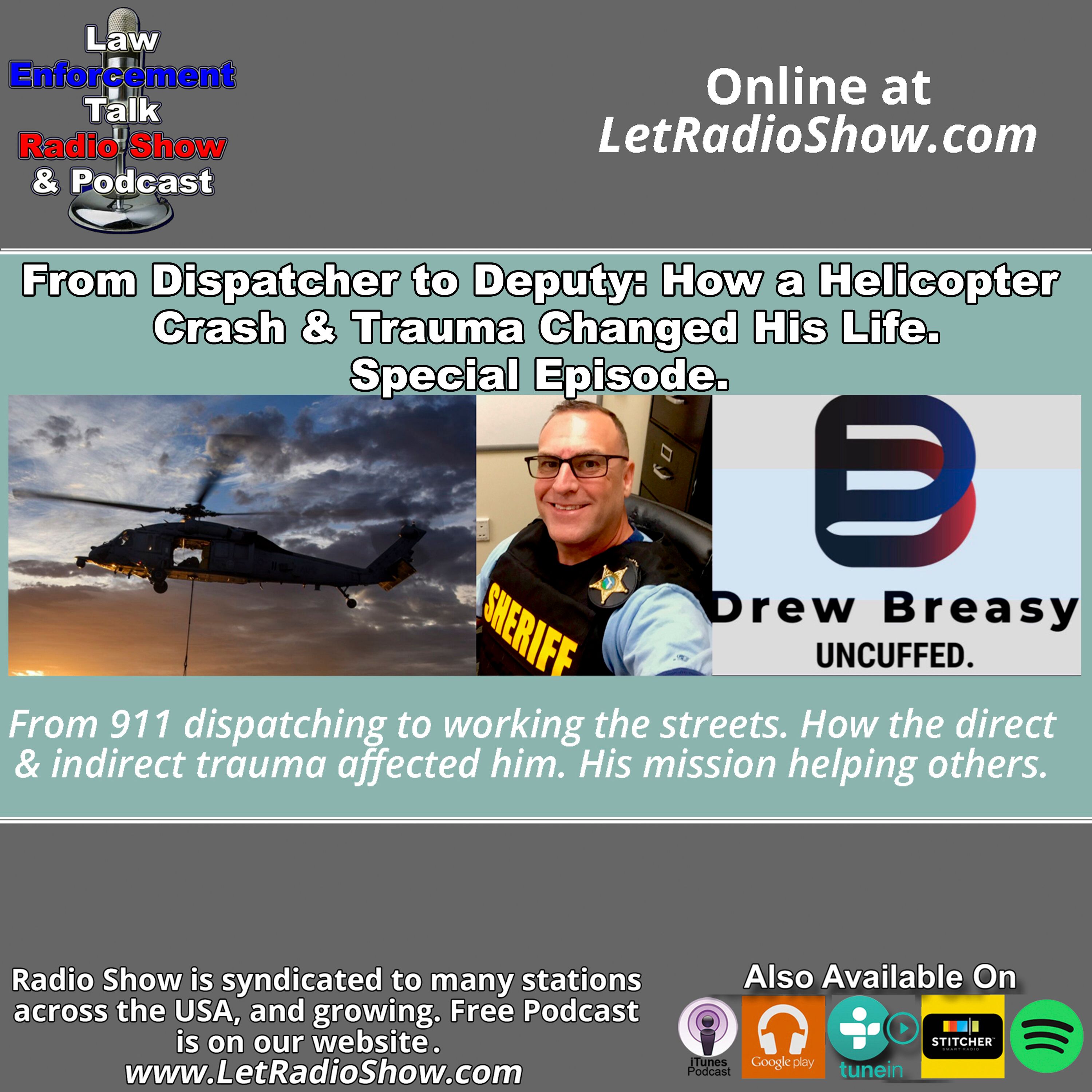
Law Enforcement Talk: True Crime and Trauma Stories
From Dispatcher to Deputy
00:40:10
From Dispatcher to Deputy: How a Helicopter Crash and Trauma Changed His Life. Special Episode. That call became the first of many moments that would shape his understanding of trauma, resilience, and eventually, recovery. When Andrew Baxter, better known by many as “Drew Breasy,” spent 28 years in law enforcement, beginning as a 911 dispatcher and ending as the lieutenant commanding a communications center that handled roughly 1.8 million calls annually.
Loading summary
Transcript65 lines
- [00:00]
A
He's a retired sheriff's department lieutenant. He's also the victim, adult victim of childhood sex abuse and went through his own battles with trauma and post traumatic stress from law enforcement. He's here to talk about what happened, what changed, and what he's doing today. Welcome to the Law Enforcement Talk Radio Show. In the Law Enforcement Talk Radio show, we are joined by special guests talking about their experiences, their realities, investigating crimes, plus those who have experienced horrendous trauma. Police, first responders, military and victims of crime share their stories. Hi, I'm John J. Wiley. In addition to being a broadcaster, I'm also a retired police sergeant. Be sure to check out our website, letradio.com and also like us on Facebook, search for the law enforcement talk radio show. Of all the radio stations in the United States, there are no other shows like the law enforcement talk radio show. And on Facebook there is only one official page. Do a search on Facebook for the law enforcement talk radio show and be sure to like the law enforcement talk radio show Facebook page. Calling us from the west coast of Florida, we have Andrew Baxter on the phone, also known as Drew Breazy. I'll tell you why that's important in just a little bit. Andrew is a retired Hillsborough County Sheriff's lieutenant. Andrew, thanks so much for being a guest on the show. Very much appreciated.
- [01:28]
B
Hey, thank you very much for having me. I appreciate the forum.
- [01:31]
A
We're going to be talking about some things, some realities of law enforcement from your perspective and your career. You came into your law enforcement career with some serious issues you had to deal with that you weren't dealing with. And we'll talk about them in a moment. First, how long was your career?
- [01:49]
B
28 years and 11 months. So 28 and change, you know, 29 would have been a nice round number. Obviously 30 would have been rounder. But, you know, I chose 28 and 11 to kind of, it was just time to move on and be able to speak freely a little bit.
- [02:06]
A
Was there a reason why you left other than being able to speak freely? Because a lot of people don't realize we have a First Amendment right to free speech. Unless you work for a law enforcement agency, then you've got to muffle muzzle everything you say.
- [02:19]
B
That's, that's 100% correct and it's understandable. I mean, you know, as you said, I've retired as a lieutenant, so I was middle management. I understand the perspective of the agency and I understand the perspective of the First Amendment. I'm huge advocate of the First Amendment. So in a sense, I do understand that. I don't. I didn't, as an employee, just have the right to say whatever I wanted to say because, you know, one way or another, I was a representative of the agency that I worked for. So absolutely, it just, it became. It didn't become an issue. It just was a freeing feeling to know that I had made it to my deferred retirement years and that I could go at any time. And there was nothing really that precipitated it specifically, other than, you know, just wanting to enjoy some of that freedom, which, by the way, I am absolutely enjoying now.
- [03:11]
A
Yes, it's. There's a great life after police work. I tell people, but here's the reality. I got hurt and retired young. I was 33, and it was the best, worst day of my life because I wasn't prepared for life after. This is all I knew. It's all I really cared about. I loved what I did, and physically I was not able to do it anymore. So at 33, I had decide, all right, what do you do with the rest of your life? What do you do when you become a grown up?
- [03:38]
B
Well, first of all, thank you for your service. I had the good fortune of being prepared to leave, like the state of Florida, the state that I work in, obviously has a good retirement system. We're very fortunate from that standpoint. And, and just, you know, whether you look at it negatively or positively, I didn't have any children. I have an ex wife that, you know, gets part of the payment. So it was just kind of me that, that I had to worry about from a financial standpoint. I'm still, you know, I'm well insured and I invested well, so I'm definitely not eating cat food. But I just, you know, when it was time to retire, I retired and, and I did have an eye on. I always kind of had a flair for social media and potentially podcasting. I've got an opinion and I've got something to say, so I kind of figured this is something that I could pursue. I also write. I'm kind of working on a book right now.
- [04:39]
A
So one of the things that sets my show apart from so many other people's is we don't talk about opinions. We don't get into politics. We tell people's story from their perspective, what they went through from their experience. And you've had a career. Well, by the way, thank you for your service is very much appreciated. Hillsborough county, by the way, for those who don't know, is where Tampa is located in that vicinity. It is not an easy assignment. I don't know that anywhere in law enforcement with a full career 25, 30 years is easy. You're going to get dinged up one way or the other.
- [05:12]
B
That's 100% true. Hillsborough county itself right now is about a 3,500 person department. And you know, we enjoy the diversity of the entire community. Hillsborough county itself is kind of a melting pot. So you do have to be very adaptive to the community. And I think I was well suited for working there. But at any rate, I started in, I got out of the United States air force, I did six years in the air force. I was stationed here at MacDill. And the conversation with my then wife was come high water. I'm going to be a deputy sheriff at the Hillsborough county sheriff's office. And it took high water. But eventually I made it to that position.
- [05:57]
A
And that's no small task in and of itself. A lot of people don't realize getting hired by any agency is a tough task. And then making it through the background check, the psychological, all that stuff. The academy and the education doesn't end there. It continues on. We had daily roll call training. We had yearly in service training updates, new classes. You're always being schooled, you're always being encouraged to learn more. And I'm not just talking about physical stuff. I'm talking about the law, patrol tactics, dealing with certain segments of society, autism, you name it. None of this stuff is new.
- [06:36]
B
It never ceases to amaze me when I hear someone in the public, in the general public, and just because of their lack of understanding say something like, you and law enforcement just need more training. Good God. If I could hand you my training folder, I think you need two or three binders to put it all together. And that's not to brag. That is the profession, that is law enforcement. Things change. Supreme court rulings come out all the time or case law within the state statutes change. And you're right, we have to respond to the days most significant problems like there are more kids on the autism spectrum now than there were when I got into that. So we got to understand how to respond to that better. The elderly community is ever growing, so we got to understand how to respond to that better. The training, you're 100% right, is ever. It's occurring on a nightly basis.
- [07:33]
A
And by the way, training is not cheap. So when people talk about defunding police, they need to understand that the first thing gets cut is training that gets scaled back. Because the priority for every agency, every department, every city, every county, state, doesn't matter, is making sure they have the numbers to handle the calls for service. So I tell people I'm very selfish. I'm self centered. When I call 911 because I have a medical emergency, for example, I know the first people are usually going to be. There are police or law enforcement. I want the very best of the best to show up. I don't want the second stringers. And when you defund police, that's what gets cut 100%.
- [08:15]
B
It's to your own detriment that, you know, I think some of the major cities are starting to feel that pain. But it's to their own detriment when you start cutting budgets. It's, you know, whatever you want to call it, rebranding or reimagining or whatever. But when you cut the training out, or you cut the cutting edge equipment out, or you cut the so called militarized equipment out, you're actually taking away from your own protection as a citizen when you do that. I mean we're kind of the experts and it's hard to, it's hard to present that message without sounding arrogant like just let us handle it because nobody wants to just let us handle it. But if anybody understands accountability, it's police.
- [08:56]
A
Absolutely. And especially when you start talking about the command staff and upper management. This is the law enforcement show. We return our conversation with Andrew Baxter. We're going to talk about some major events in his career that really changed his mental, physical and emotional health and how he's dealt with that. This is the law Enforcement show. We're taking a short break. We'll be right back.
- [09:18]
C
How would you like a free ebook on tips to improve your health? We're talking about tips you can use for free to add years to your life and possibly improve the quality of your years. Best of all, the ebook is free to Download@Let Healthy.com when we say free we mean free. No credit card, no sales funnels, none of that stuff. So you can download the free ebook to improve your physical health, all while preserving your financial health. Get the ebook for free today@Let Healthy.com that's@Let Healthy.com again the website is Let healthy.
- [09:52]
B
Com.
- [09:54]
A
If you're alignment in charge of keeping the lights on, Grainger understands that you go to great lengths and sometimes heights to ensure the power is always flowing. Which is why you can count on Grainger for professional grade products and next day delivery. So you have everything you need to get the job done. Call 1-800-GRAINGER clickgrainger.com or just stop by Grainger for the ones who get it done.
- [10:24]
C
Starting a business can be overwhelming. You're juggling multiple roles designer, marketer, logistics manager, all while bringing your vision to life. But for millions of businesses, Shopify is the ultimate partner. Shopify is the commerce platform behind millions of businesses around the world and 10% of all e commerce in the US from household names like Mattel and Gymshark to brands just getting started. Build a stunning online store with Shopify's ready to use templates, boost content with AI powered product descriptions, page headlines, and enhance photography. Marketing is easy with built in tools for email and social media campaigns. Plus, Shopify simplifies everything from inventory to shipping and returns. If you're ready to sell, you're ready for Shopify. Turn your big business idea into With Shopify on your side, sign up for your $1 per month trial today at shopify.com try go to shopify.com try shopify.com try.
- [11:26]
A
Back to our conversation with Andrew Baxter on the Law Enforcement Show. Andrew is a retired Hillsborough County Sheriff's Lieutenant. He's also a survivor of childhood sex abuse, a PTSD survivor. He's got a podcast and an online presence known as Drew Breesy. We will talk about that later on in the show. During your career, people don't go into law enforcement and stay in one place. That's very rare. Some people do. But when you get promoted, if your agencies like Baltimore, when you get promoted, you're changed to another district. You go back to patrol. If you're working special unit, you're back in uniform. It didn't matter what it was and everybody has rotation. Is that fair assessment of your career?
- [12:07]
B
100%, and I'm thankful for that part of it. A lot of people fall into the mundane or the routine in their professions. That's what's that's the beauty of my profession and specifically where I work. But I started, as I told you, come high water, I wanted to be a deputy sheriff. And the door to getting into being a deputy sheriff was to be a dispatcher for two and a half years. And I got a pretty good exposure to trauma at that point, having already been through my own personal trauma. So people may not understand that working in communications, it's a vicarious trauma. It's not necessarily one that you're witnessing stuff but you're hearing it. So it definitely takes on a little bit of it's a different tone of helplessness that you're feeling when you're on the other end of that phone trying to help somebody, and you can't crawl through the phone line and physically be there to help them.
- [13:01]
A
I've had guests on the show that were dispatchers, and they relate stories like being on the phone with someone. There was one, for example, was on the phone with someone who was in the trunk of a car, being held hostage, being kidnapped, and was trying to get help to that person, and they were killed. And the dispatcher heard it. And the frustration for them was they couldn't solve it. They couldn't. Just like the cops on the street, you want to solve it. You want to save people, you want to fix things, you want immediate remedies. They're not able to do that. And that frustration level is. I'll be honest with you, I don't comprehend it.
- [13:40]
B
I only comprehended because I studied it. I came full circle in my career. I had the good fortune towards the end of my career as a lieutenant to go back up to the exact same comm center that I started in to actually run it. And, you know, the running joke in the profession of law enforcement is you make lieutenant and you're in the comm center. What did you do wrong? But I always. I will, honestly, you know, I'm not ashamed of telling anybody. That was the biggest honor you could. You could have bestowed on me. And I researched dispatch trauma while I was in there. It was part of a promotional project, like to be promoted to captain. But it was, I think it was necessary, and I'll tell you where that comes from. Jay. I started up there in, we'll say, 1992. I came back up there in 2018, and I noticed nothing changed but the paint color, like everything else, is the same. The trauma is the same. The citizens are still nasty to the dispatchers. The cops are nasty to dispatchers, and unfortunately, sometimes the dispatchers turn on themselves. So I sought to find out why that is, and I found some very interesting stuff about trauma and vicarious trauma and what goes on in that comp center. When you think about it, you know, if you're a cop on the street, your computer or your dispatch, you may not be dispatched to a traumatic event for a week. You know, depending on where you work, it might be a night, it might be a couple hours or whatever. But when you work in the comm center, specifically, if you're an emergency call taker, a 911 person, you have 100% chance of dealing with something traumatic over the phone, 100% chance because just like you say, most of the time, those phone calls, those 911 calls, go directly into a law enforcement agency. And that's the case where I worked.
- [15:30]
A
There's going to be an absolutely tremendous feeling of helplessness where you really want to do your best. And by the way, I'm friends with some of the dispatchers I had back in the day, and we had friendly camaraderie with most of them. There was a couple who were difficult, but every one of them, to some degree, another helped save my life. I didn't realize at the time, but they're there, and here's how selfish I was. I'm focused on the incident in front of me. Yes, it's life and death. Maybe it's traumatic. Maybe there's a lot of violence, all this other stuff, and you're trying to get help and not even having any concept of what the other person on the end of the radio is going through and seeing this. And one of the calls for service that you were involved in, that I have friends that were involved with in Baltimore, was the police helicopter going down.
- [16:23]
B
Yeah, When I was a dispatcher, I was serving as kind of like a supervisor. I had been promoted pretty quickly when I was a dispatcher. And I was sitting at the supervisor's desk one night, and I got a phone call from the Coast Guard. There was a. There was an Orlando firefighter that had capsized in Tampa Bay. And the search, you know, had gone on for a couple days looking for this unfortunate, you know, the firefighter. Well, somebody called the Coast Guard to tell them, hey, I just looked out off the bridge, and I think I saw the body floating. So the Coast Guard called the desk I was sitting at and asked, hey, can you have your air service come out and support us? You know, shine a light down on us while we. While we, you know, go search the area. And I said, listen, I have absolutely no problem with that. Let me check with the shift commander, though, because the area that you're talking about is actually in a different jurisdiction. It's in Tampa's jurisdiction. So the Coast Guard guy said, look, if anybody understands jurisdiction more, it's me. So let me call the Tampa Police Department. Don't worry about it. I just, you know, and I was like, look, we're willing to help. Nope, that's not it. It's a jurisdictional problem. Let me call Tampa police. Next thing I know, probably within 15, 20 minutes, we're getting all these 911 calls in our. @ our place for a helicopter that went Down. And I really never got over the fact that it just. It's a common feeling within the dispatch field. You feel like you've marched somebody to their death. I understand that. I can't control the weather. I can't control the fact that this guy was in a helicopter. And jurisdictional, you know, it was the butterfly effect. One thing just led to another. But to this day, that still affects me. You know, the guy that died was not supposed to be in the helicopter. He was a canine officer that was on light duty that was just doing his time in air service. Unfortunately, he wasn't a good swimmer, and I believe his wife was even a dispatcher at the Tampa Police Department. It was just one thing after another. And I just felt this tremendous sense of, like, survivor guilt. And I kept that kind of to myself for most of my career, to be honest.
- [18:42]
A
You kind of forced into keeping those things to yourself because if you let them out, no matter what your rank, people's perception of you, the command sets perception of your and your trustability, reliability is going to be diminished greatly.
- [18:55]
B
Right?
- [18:56]
A
And you're right when you say survivor's guilt. Look, Drew, I get it. There's still things I. I don't know why I survived. I have friends who didn't survive. I have people I worked with who were as good at cops as I was, if not better. And I used to always think I made it through because I'm really good at what I do. Or maybe God was looking out for me. Well, God was looking out for them. They were great cops, and they didn't survive, right?
- [19:21]
B
Absolutely.
- [19:22]
A
And I remember being a rookie police, and I was really upset about a call that we had, and one of the old timers looked at me, and he kind of fetched me up rather sharply, said, listen, you got to stop trying to make sense out of things that don't make sense at all, because you will drive yourself insane and you will lose your mind in this job. And maybe that's something that I could have done better with. And maybe you could have, too. We're going to talk more about this when we return. This is the law enforcement show. We're back with Andrew Baxter in just a few moments. You know, we used to have an app, and it was very popular app. And then guess what? We couldn't hold a candle through our Facebook presence. How many people have the mobile Facebook app already installed on their phones? How many people use it on their computer? Make sure you follow us. Make sure you like us on our Facebook page. Just search for law enforcement, talk radio show and podcast and be sure to send us a comment to one of the posts. Best of all, it's 100% free.
- [20:23]
C
Starting a business can be overwhelming. You're juggling multiple roles, designer, marketer, logistics manager, all while bringing your vision to life. But for millions of businesses, Shopify is the ultimate partner. Shopify is the commerce platform behind millions of business around the world and 10% of all e commerce in the US from household names like Mattel and Gymshark to brands just getting started. Build a stunning online store with Shopify's ready to use templates, boost content with AI powered product descriptions, page headlines, and enhance photography. Marketing is easy with built in tools for email and social media campaigns. Plus, Shopify simplifies everything from inventory to shipping and returns. If you're ready to sell, you're ready for Shopify. Turn your big business idea into With Shopify on your side, sign up for your $1 per month trial today at shopify.com try go to shopify.com try shopify.com try.
- [21:26]
A
Back to our conversation with Andrew Baxter on the law enforcement show. Andrew, also known as Drew Breezy. We'll discuss why that's important a little bit later on, is retired Hillsborough County Sheriff's Department lieutenant. He's also a survivor of childhood sex abuse and a PTSD survivor, I guess it's fair to say, from both from law enforcement and the sex abuse as a child. Is that accurate?
- [21:49]
B
It's accurate. It kind of, they kind of stacked on one another and you know, they played off of one another, so to speak. I kind of got into this like a trauma filled profession with already, you know, some baggage. You know, I don't think it was anything that would have been picked up by a psychologist or anything. In fact, it wasn't. But yeah, it just, it continued from there.
- [22:14]
A
There's a popular line of thought that some people tend to have is that people become police. And I use that term, I interchange sheriff's deputies, whatever. When I say cops, by the way, that is a compliment, that is not an insult. So when I say a street cop, that's one of the highest forms of compliments I can give to someone. But there's a mindset that people have that a lot of people become cops because they have unresolved issues. As kids they were bullied, they were whatever it was and they want to seek revenge. And the truth is I don't know of anybody that has that comes out into adulthood that didn't have some sort of dings the leave it to Beaver families, the Ozzie and Harriet's and all those, they are the exception to the rule. Everybody has issues and everybody I know went into law enforcement had some issues. But we were trained early on to put those aside and do our job right.
- [23:11]
B
Later in life I found out, Jay, that it was. It was more of a reframing. I just wanted to break the cycle, to be honest. And I. Maybe I didn't understand that subconsciously that's really what I was doing, but that's exactly what I was doing. I do hear that also about, you know, they got into this because they're. Because they were bullied in high school or blah, blah, blah. I can tell you having. And I want to be clear, this is not a woe is me. I'm a victim by some legal definition, but I never let that define me. But I'm kind of sharing the story for the specific person purpose of letting people know I know I'm not the only one that this happened to. And on top of that, you. You can rewire your brain. You. You can actually rewire your brain. I mean, I fell into the depths of a bad alcohol problem and I've been sober for 13 years and over 13 years now. So, you know, it just. It started young. I was sexually abused between six and eight, three times. Three different abusers. One of them is dead. One I've completely forgiven, to be honest, and one probably doesn't even know that I remember. But that's kind of where I hold my power. Like I could put somebody in prison for the rest of their life if I really wanted to. But I don't. I mean, I'm not. It's not about being vindictive. So that kind of takes away the bullying moniker, if you will. But I just. All I wanted to do was kind of break the cycle. And I found that like so many examples in my life, as I've worked through this and processed through this, that that's all I've been doing my entire career. Little small examples of just breaking the cycle, thinking outside the box, just trying to make people see things a little bit differently or having a little bit more compassion, you know. And I'm not the only compassionate guy in law enforcement. I get that. But it's just that's. That's how I reframed everything.
- [25:05]
A
One of the things that we were taught there. I'll give you an example. When you receive a call for an armed person in a family dispute, your mind starts going. I should say my mind started going to, all right, you got to do this, this, and this. And if it's a shooting, you got to do this, this, and this. If it's a homicide, you got to do this, this, and this. We had the years of training that we already talked about that you relied on. It wasn't a whole lot of thinking about, oh, man, I went through something similar as a kid, and that affected how I felt, and that's how I reacted. We didn't really have that benefit. You're so busy thinking about the procedures you had to do, and first and foremost is to stay safe and make sure everybody else is safe. My biggest problem was afterwards, I tell people I cried many times in patrol car afterwards. Especially one of his crimes against children.
- [25:57]
B
Yes. That's actually more proof. That was the terrifying thing for me was that this kind of secret that I've held, there was probably about 10 people that roamed the earth that understood or that knew what had happened to me. And it's because I chose to tell them. And, you know, some were therapists. None of them were law enforcement in the sense that I reported it. But, you know, that's kind of where you don't understand how terrifying it is to think you're doing a child sex abuse case and you might have to testify on the stand. What if by some stroke of luck or bad luck, it comes out that you're a child sex abuse victim and all of a sudden the focus is on you? Like, you try too hard to put this guy away or this girl away or whatever. And I'm telling you, it just creates a whole different hurricane of thoughts when you're just trying to remain objective and just being protective of the child. And it just. It's something people probably don't think about often. And I understand why.
- [27:03]
A
Yeah.
- [27:04]
B
But it was a test in objectivity, remaining objective, especially when I'm interviewing somebody that is a suspect in a case like that.
- [27:14]
A
That's a great point you brought up. One of the big misconceptions we have is we are, and I'm a parent and I'm guilty. This as well. We tell our kids all the time, hey, watch out for the stranger. Stranger danger. The guy offering you candy. Hey, help me find my kitten. It's lost in the woods. Yet they are a threat. They are real. They are also very, very rare. The biggest threat to our children are family members and trusted people.
- [27:40]
B
My family knew all three of the abusers. They don't know. My family doesn't know today, but they knew all three of the abusers, so they were all trusted.
- [27:48]
A
That's the thing. And these people that work really hard. And I guess here's where, you know, my wife jokes, Drew, she says, you have a. I'm much more open with animals, dogs in particular and cats, than I am with people. I am much more, let's, you know, go tiptoeing through the daisies with my dog than I am with people. I've seen the things that people can do, and the ones who have what seems like the nicest exterior are the ones that frighten me the most.
- [28:20]
B
Yeah, that's true. Well, you know, that's. That is, by the way, a byproduct of trauma or ptsd. It's, you know, your brain is not processing. Why would you trust anybody at that point? You know what I mean? So I know what you mean. Mistrust is a very common symptom that I think we all live with. And, you know, we're cops anyway. We're cynical about everything. But you're right. When somebody is too nice, you always kind of give them that side eye they want.
- [28:49]
A
What do you want? Yeah, you're trying to too much to be nice to me. My wife jokes that we fly together. I always want to get on the plane first so I can visually frisk everybody that walks down the lot, the aisles, like, oh, if this guy breaks bad, I got to do this. If this one goes out of control, I'll do that. And I know I'm not the only guy like that. I know military guys. I know firefighters. I know EMTs. I know other retired police that think the same way.
- [29:16]
B
I think that is probably the biggest time robber or the. The. The biggest attention robber in law enforcement families today. I abuse this example. In the past, you're sitting in a restaurant, the people at the table next to you, you're out there with your wife, your girlfriend, whatever, and the people at the table break into an argument, A little domestic disturbance occurs next to you, and you're focused on, am I going to have to use force here? Am I going to have to step in at some point? I'm just trying to have a meal. I'm not wearing shorts and flip flops. I don't want to. Don't. Please don't make me into a cop. And then your significant others looking at you like, why are you so distant? Why are you never present? Because I'm present everywhere else. And it's. And it's hard to, like, define or articulate to that person. Like, look, it's not that I'm trying to ignore you. It's that I'm trying to keep both of us safe and I can't turn that off. But I'm glad to hear, by the way, that when you get on a plane, you still, I still check everybody because I did the same thing last night when I flew back.
- [30:18]
A
I still do the same thing. And when you talked about the restaurant, my wife, the best thing ever happened to me was my wife, because she, she understands and I had to tell her things about me. But one of them, when you talk about that couple that's at the table crossing, it's a little bit too loud and they start bordering on getting into an argument and I'm not able to listen to two conversations at the same time. I can, I can put on the act like, yes, honey, this is a romantic candle at dinner where I'm, I just got you in my eyes. But my mind is over here listening to them saying, what are they doing?
- [30:53]
B
That's exactly right. I know that feeling 100%.
- [30:57]
A
And by the way, got to have my back to the wall and eyes in the door and see people coming. I don't want to see people behind me sneaking up all that. She, we had this little routine. She goes, oh, this seat's perfect for you. And she's 99% of the time correct. This is law enforcement show, we're told Andrew Baxter, retired Hillsborough county sheriff's lieutenant and also known as Drew Breezy. We return, we're going to talk about more about post traumatic stress, his survival of child sex abuse and law enforcement ptsd. Don't go anywhere. We'll be right back. Don't you hate when they do the bait and switch on you when they tell you, check out a website and it's free to go there. And then there's hidden charges. You won't find any of that nonsense at our website, letradio.com it's free, it's always been free, and it costs you absolutely nothing. There's no hidden tricks. L E T radio.com check it out. Today you can find episodes of the show as available as a podcast after airing on radio. They're always free, always have been and always will be. Again, that's l e t radio.com where it's always free.
- [32:08]
C
Starting a business can be overwhelming. You're juggling multiple roles, designer, marketer, logistics manager, all while bringing your vision to. But for millions of businesses, Shopify is the ultimate partner. Shopify is the commerce platform behind millions of businesses around the world. And 10% of all E commerce in the US from household names like Mattel and Gymshark to brands just getting started. Build a stunning online store with Shopify's ready to use templates, boost content with AI powered product descriptions, page headlines, and enhance photography. Marketing is easy with built in tools for email and social media campaigns. Plus, Shopify simplifies everything from inventory to shipping and returns. If you're ready to sell, you're ready for Shopify. Turn your big business idea into With Shopify on your side, sign up for your $1 per month trial today at shopify.com try go to shopify.com try shopify.com try.
- [33:11]
A
Conversation with Andrew Baxter, also known as Drew Breesy, and you'll find out why that's important in just a few moments. Andrew is a retired Hillsborough County, Florida Sheriff's Lieutenant. He's also a survivor of childhood sex abuse and law enforcement related post traumatic stress. And I use the term survivor. You made a great point earlier. I'm not a victim by choice. These things happen and I had to find there's not another term that really describes this correctly. So the English language two things, the term D and post traumatic stress for disorder I do not like at all. I refer to it more like an injury that needs to be treated like an injury. Secondly, terms like anxiety and panic attacks I really can't stand because if someone's worked a career in law enforcement and handled all kinds of really bad things, they're not going to start blowing their stack over something a feather and having a panic attack. That's that. Those terms drive me nuts.
- [34:14]
B
I have empathy for people that are having a panic attack or whatever, especially on a call for service when I was still working. Like you see, just as an example, like I would never minimize anybody's mental health status, but sometimes these people are freaking out over just what seems like minimal stuff, you know, compared to what you or I or the firefighters or paramedics have seen over the years that have caused, you know, this post traumatic stress injury or disorder. And you know, in comparison, like you just kind of want to slap them back into reality. Like, man, just because you lost your ipod, it's really not the worst thing in the world. But. But you know, again, I understand the I get it. There are mental health, you know, aspects.
- [35:00]
A
And there are challenges. And there came a point in your life where you mentioned earlier you made a decision to get sober because I'm assuming from the conversation that you were self medicating heavily with alcohol. And quite often that is one of the byproducts of Post traumatic stress.
- [35:18]
B
I couldn't get anything to shut off. So the way to get everything to shut off was just to be constantly numb. I don't know that I spent, you know, most of my first 40 years at a BAC below 0.08 or whatever. I mean, I just. It was self medication and you know, to help me with. There was no insomnia related with my PTSD because I was blackout drunk. Every night I would pass out. You know, they used to have a term for me, the guys that I work with. Even the sniper got him. You know, one minute I'd be wide awake, next thing I would just be drooling asleep. And it was because I was just so hammered. And there just came a point. I had a pretty career, almost career ending situation when I was off duty one time involving alcohol. And, you know, I was in physical control of a car. I was sitting in a parking lot, but I had passed out and, you know, deputy sheriff knocked on my window and next thing I know, you know, I'm doing field sobriety exercises, which I passed. I was never arrested for dui. However, I had to do an administrative blow and it showed that I was above 0.08, which meant that I committed a misdemeanor. And that's. That's how our professional standards bureau and our command staff looked at it. Like you knew what you were doing, you went out, you had too many beers, and whether you pulled over, you know, how noble of you to pull over in a parking lot. But you committed a misdemeanor, and we can't have that. We're out here preaching not to drink and drive, and you drank and drove.
- [36:54]
A
So I understand from the department's point of view, and I understand from your point of view. Look, first of all, many careers, many great law enforcement officers have had their careers ended because of abuse of alcohol, primarily caused by post traumatic stress. You're a textbook case of what happens. And quite often they have no intention of drinking and. Or drinking too much and driving. Somewhere along the lines, though, things get out of control. The disease process of alcoholism for some, takes over and the career is over. Yes, I get being held accountable for your actions. I understand that. However, my biggest point of contention with a lot of these agencies is they ignore the warning signs beforehand and then don't do anything about it. And then when the officer really has some sort of catastrophic incident, they're like, well, let's fire them, let's prosecute them, let's make sure they don't get paid. So we can look like we did our job.
- [37:55]
B
I hope that we're seeing a change in that in the profession, because, you know, obviously, suicides have already been pretty high in the profession, but that was kind of the next step for me. So you're right in the sense that here we recognize this guy's got a horrible drinking problem, so let's fire him. You know what I mean? Like, let's not get to the root of it now. I had, in 100% fairness, that's not what they did with me. What they did with me, thankfully, I had a sheriff and a chief deputy who saw the good in me and gave me that second chance. I mean, they demoted me. I was. I was a corporal, and they took my stripes away, and that was that. That meant the world to me. But that also gave me the perseverance to pick up and realize, man, you've got more than a problem here. And by the way, having a few beers or having a lot of drinks and driving, when you're in a PTSD kind of mode, I mean, the risky behavior is another symptom of that. So you kind of feel the invincibility. I always felt, too, that, what's the worst that can happen? I could flip over in a ditch and die. Big deal. Like, I never really cared that much to live. But, you know, it's the selfishness involved. Like, you don't think about flipping over a ditch and onto a car with, you know, two kids and their mom and dad in it. So the risky behavior, I think, is all part of it, too. But thankfully, I got beyond that. Thankfully, they were accepting of me. And it took quite a long time, but I worked my way back.
- [39:36]
A
And, you know, I'm sure it took a lot of work. Your decision to get sober wasn't say, oh, I'm giving up drinking, and everything's peachy keen after that.
- [39:44]
B
Right? It was after my 40th birthday, and I literally just had this lightning bolt hit me one day. I was sitting in a bar. I had a horrible argument with my wife, which is, you know, caused by alcohol, and it just hit me like a bolt of lightning. I don't want the next 40 to happen. Way to go. The way the first 40 have gone. So let's fix this. And I fixed that part of it. I checked into rehab, and luckily it took the first time around, but there were still unresolved, you know, traumatic issues that I didn't deal with until even now, like, ongoing. I'm dealing now, but that's essentially what happened with the Alcohol problem. It just, it took an understanding of. I'm not, I'm the one that has to stop drinking. It's not. I have to stop drinking for so and so or, you know, it's gonna save my job. None of that really works. That's. You're doing that for somebody else. I wanted to do this for me and quite frankly, if I wanted to have a drink right now, I could, but I don't want to. And that's, that's probably that, you know, just. That's what's in me. Like my, my new addiction became sobriety.
- [40:53]
A
Well, that's. I'm glad you brought that up because your recovery from alcoholism or substance abuse or whatever term people want to use, your recovery from childhood sex abuse and post traumatic stress has kind of really inspired a lot of what you do. Earlier. I was saying you're known as Drew Breesy and it's important. Why is Drew Breesy important and why is this like part of your mission?
- [41:17]
B
Drew Breesy Uncuffed is. It's a, a nickname that was bestowed upon me by one of the sergeants that I've worked with right before I left. He was the, he was a self anointed master of nicknames. So he started calling me Drew Breazy and it's Drew underscore Breezy. B R E A S Y. You can find that on Instagram. But it just. The uncuffed part is I'm now able to speak for everybody. I can kind of shepherd. I can take what people are thinking that the people that are still in the profession and I can say it. I'm not tied to the agency anymore. I'm not tied to having to testify to anything or, you know, having some defense attorney come through my social media to find out whether or not I like the COVID shots or whatever. I'm uncuffed. I can speak freely and I intend to use that for good, like suicide prevention, like talking about stuff that affects our profession and whatever. But Drew Breesy on YouTube is what I'm, you know, what I'm working towards. B R E a S Y and I have not published my first podcast yet, but it's coming.
- [42:26]
A
We got to get that done as soon as possible. What is the easiest place and the preferred place for people to get ahold of you, get more information or maybe contact you?
- [42:35]
B
Drewbreezy B R E A S Y On Instagram, there's a Drew Breazyon cuff Facebook group or my personal LinkedIn is Andrew Baxter. I think it's like Andrew Baxter in Tampa or something like that. Listen, I'm available 247 when people need to vet talk or whatever. Even today I rarely shut my phone off at night.
- [42:56]
A
So Andrew, thanks so much for being a guest on the show telling your store all. Very much appreciated.
- [43:02]
B
Thank you very much for the form. I appreciate it.
- [43:04]
A
Jay I'd like to thank our guests for coming on the Law Enforcement Talk Law Enforcement Talk Radio show the Law Enforcement Talk Radio show is a nationally syndicated weekly radio show broadcast on numerous AM&FM radio stations across the country. We're always adding more affiliate stations. If you enjoyed the podcast version of the show, which is always free, please do me a favor and tell a friend or two or three. I'll be back in just a few days with another episode of the Law Enforcement Talk Radio show and Podcast. Until then, this is John J. Wiley. See ya.
- [43:42]
C
Starting a business can be overwhelming. You're juggling multiple roles designer, marketer, logistics manager, all while bringing your vision to life. But for millions of businesses, Shopify is the ultimate partner. Shopify is the commerce platform behind millions of businesses around the world and 10% of all e commerce in the US from household names like Mattel and Gymshark to brands just getting started. Build a stunning online store with Shopify's ready to use templates, boost content with AI powered product descriptions, page headlines and enhance photography. Marketing is easy with built in tools for email and social media campaigns. Plus, Shopify simplifies everything from inventory to shipping and returns. If you're ready to sell, you're ready for Shopify. Turn your big business idea into With Shopify on your side, sign up for your $1 per month trial today at shopify.com try go to shopify.com try shopify.com try.