← Law Enforcement Talk: True Crime and Trauma Stories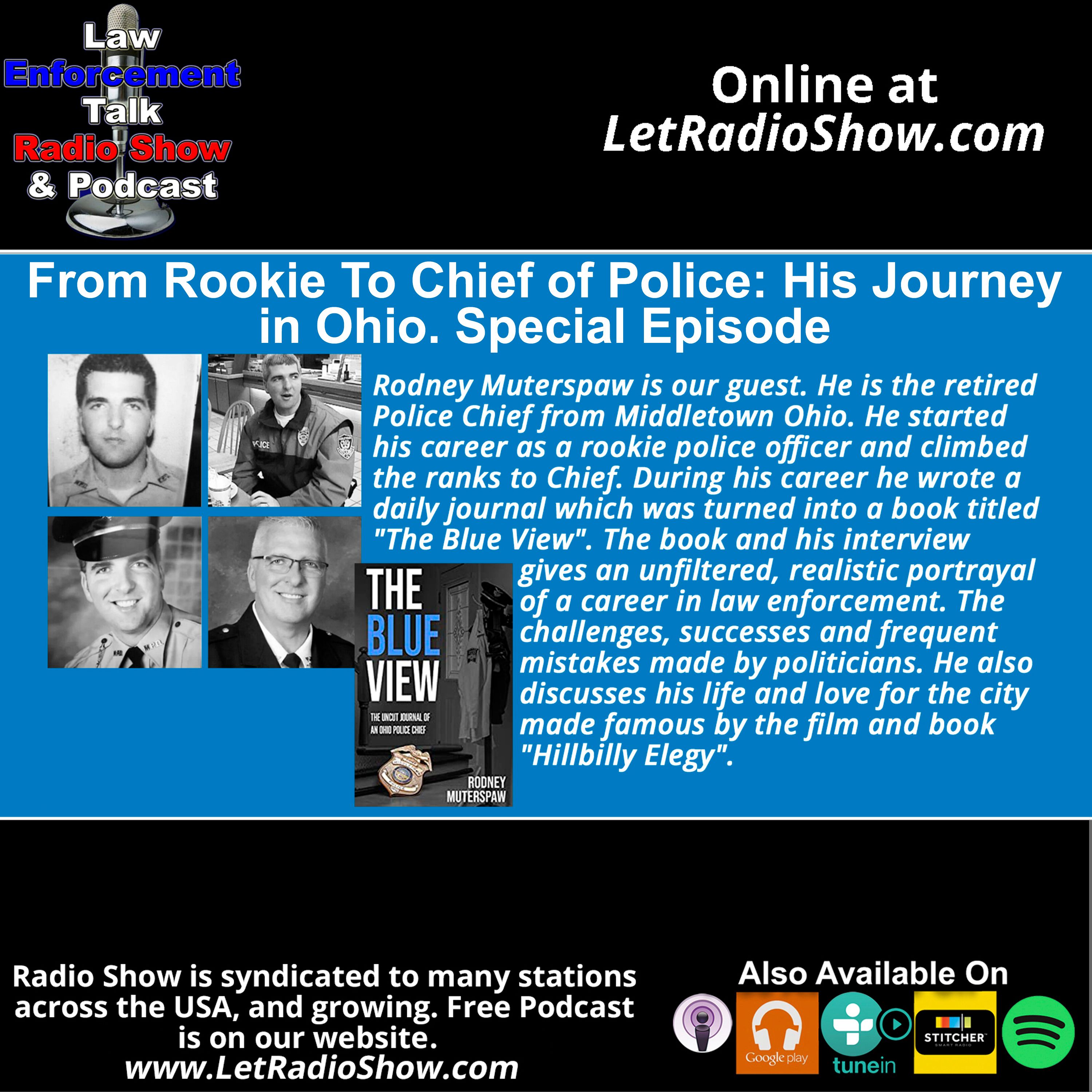
Law Enforcement Talk: True Crime and Trauma Stories
From Rookie To Chief of Police: His Journey
00:38:52
From Rookie To Chief of Police: His Journey in Ohio. In a special episode available for free on the Law Enforcement Talk Radio Show website, also on Apple Podcasts, Spotify, Youtube and most major podcast platforms, listeners are taken deep inside the world of American law enforcement through the story of Rodney Muterspaw, the retired Chief of Police from Middletown, Ohio.
Loading summary
Transcript111 lines
- [00:00]
WSECU Announcer
WSECU isn't just one of Washington's best credit unions. We're the only credit union to be on the Forbes Best in State list five years running.
- [00:08]
John J. Wiley
Why?
- [00:08]
WSECU Announcer
Because we put you first. Lower fees, early paydays, financial guidance and service second to none. As a member owned cooperative, we love Washington as much as you do. From the Olympic Mountains to the rolling Palouse. Join us and discover how much we care about your financial well being. Because what we really do best is invest in you. Stop by, say hi, we're wsecu. Let's credit union.
- [00:31]
Grainger Announcer
You're jamming your favorite song and while you aren't missing a beat, you could be missing a signal from your body. It's an SOS from your kidneys and it doesn't sound like music at all. It's silent. High blood pressure, type 2 diabetes and other risk factors can quietly stress the kidneys leading to negative impacts on the heart. That's why you should ask your doctor about a simple urine test called uacr. Most miss the signal for hidden kidney disease and related heart risk. You shouldn't visit detectthesos.com today to learn more.
- [01:01]
John J. Wiley
He rose through the ranks starting as a rookie and eventually becoming the Chief of Police. He talks about his journey and changes along the way. He also talks about the book and movie that made his hometown famous. Welcome to the Law Enforcement Talk Radio Show. In the Law Enforcement Talk Radio show, we are joined by special guests talking about their experiences, their realities of investigating crimes, placing plus those who've experienced horrendous trauma. Police, first responders, military and victims of crime share their stories. Hi, I'm John J. Wiley. In addition to being a broadcaster, I'm also a retired police sergeant. Be sure to check out our website letradio.com and also like us on Facebook search for the Law Enforcement Talk Radio Show. Calling us from Middletown, Ohio, we have Rodney Muterspaugh on the phone. Rodney is retired Chief of Police of Middletown, Ohio Police Department. Also author of the book the Blue View. Rodney, thanks for being guest on the show. Very much appreciated.
- [02:06]
Rodney Mutersbaugh
Hey, thanks so much for having me. I really appreciate that your book the.
- [02:09]
John J. Wiley
Blue View is available on Amazon and wherever books are sold, correct?
- [02:15]
Rodney Mutersbaugh
Yes it is.
- [02:16]
John J. Wiley
So just do a search on Google. I did. It's real complicated the Blue View and you put in Rodney if you want meter spa. I would say how to spell it but I'm afraid I'll mess it up. But the Blueview and Rodney will get you there. How long did you write the Man?
- [02:32]
Rodney Mutersbaugh
I started writing this when I was in the academy actually. And it's journal entries is what it is. And it was never meant to be released. It was something I wrote for fun when I was a young officer. And then as I got toward the end of my career as a chief, I wrote it for therapy. Basically it was a need to write. It was either write or drink, sometimes both. So I would write, but it just took off from there. And I had some friends in the media that read the journal entries and we decided to go public with it. Right now it's number one on Amazon for new releases in law enforcement. So that's pretty exciting. But it turned out pretty well. I hope people enjoy it again.
- [03:09]
John J. Wiley
Do a search on Google for the blue view. Put in Rodney if you want. It's run on Amazon or just go to Amazon.com and type in the blueview. You'll find it there. We'll talk more about the book in a moment. This spans basically your diary of your 30 year law enforcement career.
- [03:24]
Rodney Mutersbaugh
Yeah, it does. It's unfiltered. It's exactly what I wrote. What you're reading is things I wrote 25 years ago, 15 years ago. So it does span the whole career. Everything I've ever done is in that book. And I'm hoping that police officers get something out of it and understand more about a little bit about what the job really is.
- [03:40]
John J. Wiley
So you worked your entire career in middle time Ohio Police Department?
- [03:44]
Rodney Mutersbaugh
I did. I was there from 1990 and I retired at the end of 2019. So I was there the whole time.
- [03:50]
John J. Wiley
My hat's off to Middletown, Ohio. They did something a lot of departments aren't doing anymore. They actually hired someone to be police chief that went through their ranks, that knew their department, that knew their community, that knew the city, the town, whatever it might be, and knew the people working there. That's not a trend that seems to be happening a lot in the United States.
- [04:08]
Rodney Mutersbaugh
To me, it's the way to go. I mean I grew up in Middletown. I went to school here at college. This is where I've been. And you do know everybody. It makes for a community minded department and chief. And I think when you go outside console, you're getting people that just want to make changes or use it as a stepping stone. And every time the city has tried to change it and go with an outside chief, the community stepped forward and said absolutely not. They voted it down on voting and election time. So that's always worked well for us here in Middletown.
- [04:39]
John J. Wiley
V asked me that's the best way to Go. When departments hire an outsider, let's just say from the west coast, to be police chief in a major east coast or middle American city, to me, it says two things. Number one, it says I have no confidence in my men and women who work the streets and work their way up. They. They can't lead this department. Number two is telling me that these people from other agencies do things better than we do, which to me is an insult both ways.
- [05:10]
Rodney Mutersbaugh
Oh, I agree 100%. I mean, what are you telling the people that work their way up the ranks if you're saying, well, none of you are good enough for going outside to somebody who knows nothing about the city or the agency that you're coming into. And you know, I'm a big believer in, you have to know your community. It's not about going on Google. It's about being here and being involved. And I think what helped me as the chief here and achieve success was the fact I've been in these people's homes for years. Whether it's as a kid or my kids have been there. You know, my kids went to school here. It makes a huge difference on your problem solving abilities to get things done when, when you hire from within. It really does.
- [05:44]
John J. Wiley
A great example is I'm retired from the Baltimore Police Department. Baltimore is about 40 miles, 45 miles away from Washington D.C. the two cities are polar opposites. Crime may be similar in certain areas, but a lot of what is unique about Washington D.C. is totally different in Baltimore. And to say you can pluck any guy, any man or woman from Baltimore and make them chief of police in Washington D.C. doesn't work well. And same vice versa.
- [06:16]
Rodney Mutersbaugh
Oh, I agree with that 100%. I mean, and you know, I understand, you know, an excuse that you. Then I do get that is if there's major corruption in your department and you're at a small agency and everybody's involved, I get that. And sometimes you may need to do that, but the status quo, no, I mean, it's good to have an internal chief who knows the agency and knows the city. And it does flow outward to the community when you do that. And we've achieved great success here in Middletown with that. We really have. And you know, that's something we're really proud of. And it's always been like that.
- [06:44]
John J. Wiley
I agree with you 100%. The last little rant I have about this, for departments that hire from outside, for police chiefs, police commissioners, whatever terminology you want to use, the only thing I would say to these people, I don't care what department you came from. Thank you for your service. I appreciate where you've been. But do not wear the uniform of your new agency. Wear a suit, because you were never cop in it. For example, Phil, police chief in Baltimore, is from New Orleans originally. It was never a Baltimore police. He'd never police the streets of Baltimore. So to wear that uniform. And to me, it just. It speaks of hypocrisy and it's shallow. It really is.
- [07:24]
Rodney Mutersbaugh
Yeah. You know, the thing is, you know, when you like, I patrolled the streets of Middletown for years before I went into the drug unit and then became a supervisor and detective and all that. And just to be on those streets for all those years on patrol in a squad car, in uniform, with a partner to come up through the ranks is something special. And you take it more serious because this is your home. And not only that, this is where you've been. And you take the job, I think, more serious. You're not trying to go anywhere else. You're trying to make this community better. You're not trying to use it as a resume builder. And I think that's what sets it apart from an outside chief with an internal chief.
- [07:57]
John J. Wiley
Well, enough talk about being a police chief, because quite honestly, I never made it there. I. We'll talk some more about that later on. But you started off like everybody does in the academy, and you're working patrol. So that was what, 30 years ago?
- [08:10]
Rodney Mutersbaugh
Yeah, I was in the academy in 1989 and started the job 1990.
- [08:14]
John J. Wiley
That's right around when I retired. 1992, I got hurt. Retired at the ripe old age of 33. Did you ever, in your wildest dreams, when you're in the academy, think I would be police chief of this agency someday?
- [08:27]
Rodney Mutersbaugh
Oh, no, I never thought that at all. It was my whole. My whole goal was just to be a good patrol officer and work in detectives my whole career. And then, you know, what happens with a lot of people is there are some, you know, supervisors you don't like working for. That you said, man, I'm not going to work for them a whole career. I need to get promoted. Or there's things that you just want to see changed, and you can do that through promotion sometimes. So that's what happened. But I had no desire to ever be the police chief when I was a young officer. Never in a million years. Never crossed my mind.
- [08:53]
John J. Wiley
So you went to what we call patrol when you graduate from the academy?
- [08:58]
Rodney Mutersbaugh
Yeah. Best job I ever had, and I say to this day was patrol. Officer on midnight shift. And I worked with a partner a lot of times and did that for a while. Then I did some went to special operations, which is an undercover bison, which was a phenomenal thing. I really enjoyed that. That was the basis of my young career.
- [09:17]
John J. Wiley
When we return, we're going to talk about your narcotics career. Narcotics enforcement. I spent many years working narcotics. I gravitated towards that from auto theft. And we had a huge problem where I worked in Baltimore and was detailed DEA for a little over almost two years actually investigating violent drug gangs. And that certainly influenced my career in a way. I saw policing. However, there's a big distinction and Hollywood butchers this all the time. I was what we call a plainclothes surveillance cop. I was not undercover. Undercover people that do buys and those sort of things. And then you have the deep cover. The people who infiltrate organized crime is totally different beasts. And those men and women do that. They got my utmost respect. That's a different skill set. This is Law Enforcement Show. We're talking with retired police chief Rodney Mudersbaugh. You can find us on Facebook. Look for and like the law enforcement talk radio show Facebook page. Don't go anywhere. We'll be right back.
- [10:20]
WSECU Announcer
How would you like a free ebook on tips to improve your health? We're talking about tips you can use for free to add years to your life. Best of all, the ebook is free to Download@Let Healthy.com when we say free, we mean free. So you can download the free ebook to improve your physical health, all while preserving your financial health. Get the ebook for free today@lealthy.com that's at let healthy.com Again, the website is let healthy.com WSECU isn't just one of Washington's best credit unions. We're the only credit union to be on the Forbes Best in State list five years running. Why? Because we put you first. Lower fees, early paydays, financial guidance and service second to none. As a member owned cooperative, we love Washington as much as you do. From the Olympic mountains to the rolling Palouse. Join us and discover how much we care about your financial well being. Because what we really do best is invest in you. Stop by, say hi, we're wsecu. Let's credit union.
- [11:22]
Kidney Health PSA Announcer
In a world of endless notifications, there could be an important one you're missing. Your kidneys may be signaling an SOS with high blood pressure or type 2 diabetes. Your kidneys could be warning you of early signs of damage which may put you at higher risk for events like heart attack or stroke. But there's a simple test that can help spot a hidden signal. Ask your doctor about a urine test called UACR to help detect kidney disease and heart risk early. To learn more, visit detectthesos.com today.
- [11:53]
John J. Wiley
Return conversation with Rodney Mutersbaugh. Rodney is retired police chief from Middletown, Ohio. He's also author of the book the Blue View. You can go to Amazon.com just type in blue view or just do Google search, type in the blue view. If you still can't find it, type in blueview Rodney, and it'll pop up for sure. And basically, Rodney, this is a diary of your 30 year career.
- [12:16]
Rodney Mutersbaugh
Yeah, it's exactly what it is. It's unfiltered, it's pretty raw. It's exactly how I felt, things I saw and experienced over 30 years and it's now out there to the public to see.
- [12:26]
John J. Wiley
There's so many parts of my career I look back and I wish I had written things down. And here's another thing. I see young cops nowadays and we've got these smartphones, we can, you got a camera, you got a video camera, you've got whatever you want. Any. I have very few photos of me in uniform. I wish I did. So in a way I'm jealous, but I wish I had taken time to write down a lot of these stories because there's so many great stories that people just won't believe that occur during just about every police career.
- [12:54]
Rodney Mutersbaugh
You're right. You're 100% right. I mean there's. And that's why I did it. You know, it's. I actually had a captain in the academy mention that he wished he would have done that. He was near and retiring and it just kind of piqued my interest and I started doing it and it became addicting. But everything was in there and everything I like I said, experienced, but it's the best thing I ever done. When you go back and read it now in this book, it makes me laugh to this day. So it's one of those things. I'm glad I did it.
- [13:20]
John J. Wiley
A big part of your career, you went from patrol, uniform patrol to working narcotics to working undercover. Let's talk a bit about the narcotics days. About what year did you start doing that part of police work?
- [13:34]
Rodney Mutersbaugh
Well, I had two terms in that. Well, the first one was about 1994. I did about a year, a little bit over a year working in the unit. And they rotate you because of your face, you know, fresh faces and things like that. And you know, something else because that's when I first started doing drug buys and things like that. And there was a guy that worked with me that was phenomenal at it. And he was trying to show me how to do the job. Surveillance, you know, we had, you know, undercover vehicles, the wire things that you see on TV that people always talk about. That's where I learned it. And then a few years later, I was promoted and I went in there and I supervised that unit. And that was the best because I did that for about three years. And we took down some major players all over the country from Little Middletown, Ohio. And that was really rewarding in my career.
- [14:16]
John J. Wiley
We went from primarily having marijuana, heroin, a little bit of cocaine, meth, pcp. A big thing in Baltimore was PCP mixed with marijuana. They called it boat. And I remember when crack cocaine came in to Baltimore, and it's like almost overnight, everything changed.
- [14:39]
Rodney Mutersbaugh
Oh, man. When crack took over, it was. It was unbelievable. We went from having 10 guys standing on the street corners to about 100. And then every. It seemed like every car you'd stop. Every five cars you stop, one you get dope out of, you get crack out of. And it was out of control. The difference between that and the heroin game, what we saw for years, you know, recently, was nobody was really dying in the crack game as far as overdose, and there were shootings. But in heroin, it was a whole different ballgame because people were dying and overdose. But the crack game, it seems like everybody got in on that. Everybody. It was just an easy way to make money.
- [15:12]
John J. Wiley
And it's such fast turnaround. There was so much money, and it's so much. With all that money, there is so much violence and protecting self being ripped off from other dealers or junkies, whatever it might be. It's like our violence level changed tremendously. As far as shootings on a daily basis, was that similar to you guys?
- [15:31]
Rodney Mutersbaugh
Oh, absolutely. It was nothing like Baltimore. I mean, we're nothing like Baltimore. We're between Cincinnati and Dayton and about 50,000 population, but we got everything from Cincinnati and Dayton. And the shootings and the guns you recovered was just constant. It was an ongoing thing, and it seemed like it would never end. Every day was new and was something like that. So, yeah, we felt the same thing here in Middletown, Ohio, that you did.
- [15:54]
John J. Wiley
One of the things I look back on, and I take exception, Rodney, to the terminology a lot of people use with the. The opiate epidemic, or they use the heroin epidemic. It's. I'll say to them, we were dealing with this back in 1980s, what seems to have changed to me, and just my humble opinion, for what it's worth, doesn't mean I'm right, is as long as it's going on in inner city, no one seemed to care when it spread its wings and went to suburbs. All of a sudden, now it's an epidemic. We have people dropping like flies back then. And by the way, when someone. When you had a host of overdose deaths in an area, all the. All the addicts went there to buy.
- [16:36]
Rodney Mutersbaugh
Yeah, and that's true. That's the way it was. I mean, it seems like nobody cares. You hit the nail on the head again. I mean, it's like nobody cared. And then, you know, it started affecting people in different neighbors and stuff. And then all of a sudden, people started caring. But you're. You're right. I mean, I can't say any better than what you just did. That's perfect.
- [16:53]
John J. Wiley
It's sad. Sad to say that, but the loss on a family. And I know you went through this because I went through it. The loss on a family. When you have a young person who's addicted, let's just say heroin, when they're addicted to heroin and they die, and they die at 24 or 25, the loss of the family is no less than if they were killed in a robbery or killed in a car accident. The person's gone.
- [17:16]
Rodney Mutersbaugh
Exactly. Oh, I agree. I agree 100%. And, you know, and a lot of people don't look at it like that, unfortunately, but, you know, we do look at that like that. So, yeah, it's. You're right. I mean, death is the death, regardless.
- [17:28]
John J. Wiley
Did you ever get so frustrated? I remember almost like yelling out at overdose death. It's like, when is this insanity going to stop? When are people going to care?
- [17:37]
Rodney Mutersbaugh
Yeah, we. We would. You'd go to these calls, you go to these houses and, you know, or you beat her at the corner and you just shake your head and people, People would. When somebody would overdose in somebody's house, they would dump them in the alley out back or they would dump them in a, you know, somebody else's yard so they wouldn't get in trouble. It was the worst thing you've ever seen. And it's like, whatever happened to this, you know, and how did we even get to this place? So, yeah, the frustration is unreal.
- [18:00]
John J. Wiley
I hate to say it this way. You brought up a bad memory, actually, of a homicide scene where a young woman who was a prostitute was viciously murdered and thrown down the stairs of A Terrace Garden apartment. And I wound up catching the killer and found the crime scene quite by accident. But my thought was, Rodney, it's like they threw this person away like they're trash, like they're garbage. And overdose deaths, they're doing the same thing. They're discarding the people like they're garbage.
- [18:31]
Rodney Mutersbaugh
Yeah. And they do. And that's. We saw that so much that it just got so out of control. And so, you know, it was so overbearing to even be a part of, you know, and it was so frustrating. And it just seems like it got worse and worse until one day, I think everybody died off. And not just that. I think you saw different programs finally jump up and take place. But for a while, it was just out of control.
- [18:56]
John J. Wiley
By the way, if you have a loved one in your family who has a drug or alcohol problem, I don't care what terminology we use, substance abuse, addiction, whatever might be alcoholism. I always tell people, as long as they're breathing in and out, there's still hope. There's hope that they can get better, they can recover. And lots and lots of people do. It's when they die that all hope is gone. And I've met so many people in law enforcement and after retiring, that said, when a loved one, their son, their daughter was arrested and in jail, they. They were able to breathe a sigh of relief because they knew that they were going to be clean for a while and they'd be taken care of.
- [19:32]
Rodney Mutersbaugh
Yeah. And that's exactly what happens with it is. But eventually it catches up to everybody when you do that. And, you know, it kills because you see mom and dads and family members just. They're so distraught over because they do everything they can as a parent or family member, and nothing works. And you know. You know how it is. It's the saddest thing you'll ever see. And the thing with what these overdoses and heroin addiction did to people, it was hitting rich neighborhoods for the first time. Usually never had that. And that's when I think, when politicians started taking it serious because it was affecting them.
- [20:02]
John J. Wiley
Yeah, money comes power and politics, and politicians get attention. Of all the radio stations in the United States, there are no other shows like the law enforcement talk radio show. And on Facebook, there's only one official page. Do a search on Facebook for the law enforcement talk radio show and be sure to like the law enforcement talk radio show Facebook page. This is law enforcement show. We're taking a short break. Don't go anywhere. We'll be right back.
- [20:31]
WSECU Announcer
Remember when free meant free, no charge, no credit card information needed? Well, a place like that still exists on the Internet. The law enforcement talk radio show website letradio.com where everything is free including the podcast episodes are available after airing on radio. The website is letradio.com that's letradio.com where free means free. WSECU isn't just one of Washington's best credit unions. We're the only credit union to be on the Forbes Best in State list five years running.
- [21:06]
John J. Wiley
Why?
- [21:07]
WSECU Announcer
Because we put you first. Lower fees, early paydays, financial guidance and service second to none. As a member owned cooperative, we love Washington as much as you do. From the Olympic mountains to the Rolling Palouse. Join us and discover how much we care about your financial well being. Because what we really do best is invest in you. Stop by, say hi, we're wsecu. Let's credit union.
- [21:31]
Kidney Health PSA Announcer
In a world of endless notifications, there could be an important one you're missing. Your kidneys may be signaling an SOS with high blood pressure or type 2 diabetes. Your kidneys could be warning you of early signs of damage, which may put you at higher risk for events like heart attack or stroke. But there's a simple test that can help spot a hidden signal. Ask your doctor about a urine test called UACR to help detect kidney disease and heart risk early. To learn more, visit detectthesos.com today.
- [22:00]
Grainger Announcer
This is the story of the One as a custodial supervisor at a high school, he knows that during cold and flu season, germs spread fast. It's why he partners with Grainger to stay fully stocked on the products and supplies he needs, from tissues to disinfectants to floor scrubbers, all so that he can help students, staff and teachers stay healthy and focused. Call 1-800-GRAINGER, click grainger.com or just stop by Grainger for the ones who get it done.
- [22:32]
John J. Wiley
Back to our conversation with Rodney Muterspaugh. Rodney is retired police Chief from Middletown, Ohio. Spent his 30 year law enforcement career in Middletown, Ohio. He also author of the book the Blue View. Do a search on Amazon for the Blue View or Google and it'll show up. Rodney again, thanks for your service. And a big part of your career we're talking about earlier is you went from uniform patrol to working narcotics and narcotics. We talked about the different phases of it that I did, that you did. And part of was undercover. And I'll be honest with you, undercover. As far as drug buys go, I was horrible at it. I was not Very good. And people saw through me very quickly. But the surveillance part, man, you. Once I got eyes on you, you weren't getting away.
- [23:19]
Rodney Mutersbaugh
And that's the hardest part. I always try to tell people the surveillance is the hardest part of the undercover work because you have to constantly stay attentive to what's going on around you and who's coming, who's going, license plates, car descriptions. The buying part is so quick. You know, we had guys that were really good at that, and they would go into a buy within five minutes. They're in and out. But surveillance, you sit there for up to eight hours, sometimes longer, and you can't miss a thing. So, yeah, I see your point on that. But the value is in those who can sit and do that for hours and hours and keep notes. It really is.
- [23:48]
John J. Wiley
Yeah, don't even get me started on bathroom breaks on surveillance, because once you were on an assignment, there was no. I remember telling my wife at the time I was leaving house, like 8 o' clock in the morning. I, I'll be back around 4:30. Should be a short day. Was doing surveillance and they started moving, things started going and I didn't get back for like 18, 19 hours. And that's just the way it was. And that was before we had cell phones and everything else. So you couldn't call. You're like, if I don't show up, that's why. And they, she, she understood.
- [24:16]
Rodney Mutersbaugh
Yeah. And that's, that's so funny because that's so true how that works. It really does.
- [24:20]
John J. Wiley
One story real quick. I had to go do another surveillance on a target. And it was near the old Memorial Stadium in Baltimore where the Colts and the Orioles used to play. And as I'm driving down the street in an undercover car, an old Pontiac Firebird Formula. Typically like the movies, a guy whips open a guitar case and pulls out a sawed off shotgun and points at someone else. And here I am looking like a street guy in a Pontiac firebird armed with a.38 revolver. And I disarmed him. I was detailed DA at the time. And they were flabbergasted A, that this happened and B, that I was able to take them down without shots being fired. And by the way, police did that every day.
- [25:01]
Rodney Mutersbaugh
Every day, Absolutely. Every day they do that without, without anybody dying or getting shot. And I think that's what's frustrating because you don't see that on the media. You just see the bad stuff. So, yeah, absolutely.
- [25:12]
John J. Wiley
And that's part of the job. The violence is Part of the job, vast majority of time, it didn't end badly, and they didn't end in the use of force. Beyond that, it was very rare that people actually got shot by police. But, man, when it happens, the news media seems to blow it up like it happens every day to everybody.
- [25:31]
Rodney Mutersbaugh
Yeah, you're right. And it doesn't. We all know. We know that. We know better.
- [25:36]
John J. Wiley
I want to go back to your career. So take us back to you. Started off when you work narcotics, you're doing surveillance, and eventually they graduated, throwing you into undercover work, correct?
- [25:46]
Rodney Mutersbaugh
Yeah, I did some buys and some things like that. Mostly when I was doing marijuana buys. When I did it, we had a guy that was a lot better at it than me, and he just fit the part better, and he did a lot of the harder stuff. So I did a lot of the surveillance in the Cal units, the recording units. And then when I got promoted, I took over that unit. And that was a blast because we expanded the unit and we ended up taking down one of the largest gangs in America through Middletown, which was crazy. It was called the Rimble Gang. And a guy who served, who got life in prison as a part of these federal indictments, he led the gang and they had people killed. He tried to testify against him. And I think we put 19 people in federal prison on this case. But they set up a Middletown because we were between Cincinnati and Dayton, and it was easy pickings for him. So it ended up being something that was awesome. And, you know, we sent people out to Compton, California, to take them down with lapd, you know, on our search warrants that we did from Ohio. So those are the rewarding things that you get out of undercover work that are phenomenal.
- [26:42]
John J. Wiley
A lot of people seem to think, and I was guilty this, when I was a young police officer, that the guys. I said the guys, the men and women in the smaller departments in the more rural areas had it easy. They didn't a. There was a lot less of them. So they had to do every aspect of law enforcement. And what I found out was a lot of our big time, really violent drug organizations, they moved their stash houses and the places where I lived out in the counties and rural areas. So you're a great example being between Dayton and Cincinnati, a small town. Middletown, Ohio, is not big where this is going on.
- [27:16]
Rodney Mutersbaugh
No, you're right. And we're a medium sized town. But they would come here thinking it would be easy, you know, to take over because we were smaller. And they thought, well, we'll stay out of Cincinnati, Dayton. So we'll come here. And what they don't realize is, you know, we work regional, so we work with, you know, sheriff's departments, you know, the state, we work with counties. And so we all coordinated. And Middletown was the one who did this. And we ended up taking the case federal with the FBI, and so we able to do that. And same with the cartels. You know, we dealt a lot with different cartels. And over the course of my career, straight into Mexico, San Diego, you know, we'd have 40 or so indictments. And it was exciting working with the feds on that simply for the fact that we were able to take out people who were bringing dope into town that didn't live here. So that was really rewarding in the undercover capacity, being from a law enforcement.
- [28:03]
John J. Wiley
Background and being guests are hosting this show I've had many people on that don't view even towns like Nashville, Tennessee, cities that are. There are large cities as having a big drug or gang problem. But the cartels have hubs, distribution hubs, and they use the highways primarily to transport their stuff. So in a way, I'm. Part of me wants to be surprised this happens in Middletown, Ohio, but the other part of me realizes it happens everywhere.
- [28:30]
Rodney Mutersbaugh
Oh, it can't. Does it happen even small towns? Big. It doesn't matter. It's. It's a game to these people, and they're going to try to do whatever they can to get their products sold, and they're going to try to find somewhere easy to do it, and they'll take it to small towns if they need to. And that's the thing. The small towns, I think you just said, they don't have the resources usually to handle things like that. So it's perfect for drug dealers to go in these small towns and take over, because small towns with six, eight police officers, they don't. They can't do that. And in Middletown, we had almost 80 police officers in Aqua Chief, you know, so you. You got small towns around us who have five, six, seven officers. So those are perfect spots to set up.
- [29:06]
John J. Wiley
In your opinion, from your experience, what's one thing about policing in particular? Working drug enforcement, undercover work that Americans just don't get or don't hear the truth about.
- [29:18]
Rodney Mutersbaugh
The number one thing I would say that they don't understand is that we're not robots. We are human beings and we. We make mistakes, we suffer through things. We. You know, as a police officer, you take this stuff home with you every night mentally. And then people expect Us to come out the next day and just, you know, they'll complain for being rude or I don't like the way he looked at me. But we might have just came from a, you know, a dead baby call. We might have just came from a, you know, a sexual assault victim. And we don't feel like smiling, and people expect us to be robots on every call, and it's just not humanly possible. And no amount of training can change that about a man or a woman. You just can't do it.
- [29:54]
John J. Wiley
You also can't train for every possible scenario. We do the best we can with and people don't get is a lot of what you police do nowadays is result of people being killed or severely injured in line of duty elsewhere that we change our approach. A big example of this, Rodney, is I remember being a young patrolman in Baltimore and we had a detective, narcotics detective, named Marcellus Ward, who was detail dea, and he was doing a buy undercover on the second floor of a row house. And he was wired up and there's team listing, there's a whole backup team. And somehow they got the idea his police, and they executed him right there on the wire where everybody could hear. And by the time we got to him, he was already dead. That changed. And as long as I'm alive, I don't think I'll ever forget the impact that had on our entire department in our city.
- [30:51]
Rodney Mutersbaugh
Oh, I'm sure it did. And you're exactly right. That will change everything. And it changes attitudes and, you know, preconceived notions and things like that. And it's unfortunate things like. Like that happens, you know, to get people to change. But that's the way it is in this world, unfortunately.
- [31:05]
John J. Wiley
And the amount of bravery it took for people like Marty, we called him Marty, Marty Ward and other police across the United States doing what they do on a daily basis. When I say police, I mean our sheriff's deputies, other federal branches of law enforcement as well. The bravery it takes to go in and put yourself in harm's way, to work undercover, to know that you're going into the lion's den, so to speak, where really bad things can happen, that they deserve our respect. We're talking with Rodney Mutispaugh. Rodney is a career law enforcement officer, retired police chief from Middletown, Ohio, and also author of the book the Blue View. One of the questions I get all the time is how can I show my support for law enforcement? We're all busy. We've got busy lives, but there's something oh, so simple. You can do we with our Facebook page. Search for law Enforcement Talk radio show Facebook page and when you see a post you agree with that resonates with you, share it. Especially episodes of the podcast. To do all that, just search for us on Facebook, look for law Enforcement Talk radio show and be sure to click like don't go anywhere. We'll be right back. If you want to be a guest on the Law Enforcement Enforcement Talk radio show, simply contact us. It couldn't be easier. You can send us a message on Facebook, look for and like the Law enforcement Talk radio show page or email jaytradio.com that's J A Y@radio.com WSECU isn't.
- [32:34]
WSECU Announcer
Just one of Washington's best credit unions. We're the only credit union to be on the Forbes Best in State list five years running.
- [32:41]
John J. Wiley
Why?
- [32:41]
WSECU Announcer
Because we put you first. Lower fees, early paydays, financial guidance and service second to none. As a member owned cooperative, we love Washington as much as you do. From the Olympic mountains to the rolling Palouse. Join us and discover how much we care about your financial well being. Because what we really do best is invest in you. Stop by, say hi, we're wsecu. Let's credit union. Oh oh oh oh righty.
- [33:07]
John J. Wiley
Check engine ABS or Maintenance light on.
- [33:10]
Rodney Mutersbaugh
Take the guesswork out of your warning.
- [33:12]
John J. Wiley
Lights with O'Reilly Veriscan. The service is free and provides a report with solutions verified by ASE Certified Master Technicians. And if you need help, we could recommend a shop for you.
- [33:24]
Rodney Mutersbaugh
Ask for O'Reilly Veriscan today. Oh oh oh O'Reilly Auto Parts shoe.
- [33:34]
WSECU Announcer
Shopping should be fun and full of surprises. DSW has never ending options for every style, mood and occasion. All it really great prices. From sneakers to boots and everything in between. DSW makes it easy to discover the styles you love and maybe even a few you didn't expect. Whether you're shopping in store or online, you'll always find fresh looks at prices that make sense. Find the shoes that get you at prices that get your budget at dsw stores or dsw.com.
- [34:07]
John J. Wiley
Back to our conversation. Rodney Mutersbaugh on the Law Enforcement Show. Rodney is a retired police Chief from Middletown, Ohio. 30 years from patrolman Oy police chief. He's also author of the book the Blue View. Do a search on Google for the Blue View and it should pop up. Or just go to Amazon.com and you'll find it there as well. Rodney I retired to the rank of sergeant and that was one of the best jobs I had in policing patrol sergeant, you got to balance making sure your men and women are okay, making sure they have what they need to do the job, trying to watch out for their mental and physical health and make sure they do the job the right way so the citizens get what they deserve, which is the best, best service possible. So it's, It's a balancing act. But I never made it past that. I. I see a lot of police chiefs nowadays that they seem to be first in line to throw their men and women under the bus, unjustly so. And I often say to myself, they must have forgot where they came from.
- [35:05]
Rodney Mutersbaugh
Yeah, it's. It's. I, you know, I couldn't have said that better myself. It's, That's a problem in this profession, I guess, in any profession. But in this case, you know, these people depend on you, and they look up to you for guidance. They look up for you to mentor them. And, you know, one thing I was always proud of is always put the people first and the officers first. And it about cost me my job several times with the city, the city of Middletown, arguing with the city manager or counsel over the officers. But you have to put them first. And when you don't do that, when you lose them, you lose everything you truly do. They should be your first priority and with the community and then the politics, secondary.
- [35:41]
John J. Wiley
I'm sure during your career, you had to fire people. You had to maybe even take action. I had to do it as well. It's not part of police work I liked, but by and large, I would say 99% of the law enforcement people I worked with were the best. They may not have been superstars every moment of every day, but generally all around, they were phenomenal people, doing the best they could with the worst equipment and the worst working situations, worse circumstances and the highest risk.
- [36:12]
Rodney Mutersbaugh
Yeah, and that's the thing. I mean, good cops don't want bad cops around. They just don't. And, you know, the people I had to get rid of or fire didn't need to be police officers. They just didn't. But that's like 1 or 2% if even that. And the good. There's 97, 98% of these officers that they bust their tail for, the city they work for and their family men and their people, and they want to do what's great and want to do what's right, and they just want to help people. And that gets swept under the rug sometimes by politics or administrators and, you know, it just breaks your heart as a chief because you can only do so much. You know, we can't get bonuses for good work. You know, I can't do this or do that. Pat on the back and a thank you is pretty much all you can do in our line of work. But you got to look out for your people. Number one, get rid of the bad ones. Treat the good ones right.
- [36:56]
John J. Wiley
You retired right before this whole defund the police movement went crazy in the United States and seeing a lot of that going on. Look, politicians have always been the bane of law enforcement, in my opinion. It doesn't matter what brand, what side they're on in the aisle. They were. When I say corrupt, I don't mean taking money. I mean political power, corruption. When you see all this going on now, do you ever, like, scream at the television that you want to talk to this police chief or his peace commissioner and say, hey, you need to do this?
- [37:30]
Rodney Mutersbaugh
I do. And, you know, and I know I wasn't. You know, as a police Chief, you're never 100% right. I know that I made mistakes and, you know, but I watch these politicians and they get on there and they'll say things that you just stir it up, stir it up, stir it up. And they don't even consider for one minute the damage they're doing to the community by causing this division between the police and the community. And instead of focusing on the 98% of the good officers, they'll focus on the 2%, the bad officers. And, you know, the politicians make these laws, but then they, you know, then they throw the police under the bus when the police enforce those laws. That's the thing that drives us crazy as police executives. And so, no, the politicians can. They can really make it hard for you. They really do, because they don't. There's no consequence for their actions. None at all.
- [38:14]
John J. Wiley
Well, a lot of people don't realize, too, Rodney, you and I both know this, that the police departments are part of the executive branch of government. They usually fall under the purview of the mayor. The mayor or city manager, city council. And in a state level, it's a governor, and federal level, it's a president. Let's use Minneapolis as an example. This is what was the firing pin, so to speak, for a lot of what happened. And it was Mayor Jacob Fry's police department that was in question. It was his command staff that he appointed or kept an office that was in question. And everybody let him off the hook and then turn around and try to blame police in Los Angeles for what was happening. In Minneapolis. I never understood that.
- [38:56]
Rodney Mutersbaugh
No. And see, that's the problem. You know, one, if something bad happens in Minneapolis or Los Angeles, it affects us here in Ohio. This is the one profession where something bad can happen 2,000 miles away, and it affects you directly here. Look at the Rodney King thing. The Rodney King thing comes to mind. I was a new officer then, and we took a beating here in Middletown because of that. And we're literally, you know, 2,500 miles away from Los Angeles. And so people hated us here because of something happened there. So I don't think politicians and those making those decisions understand how that affects us as cops. And it makes it hard on you, really does. So you're right about that. It's just. It's crazy how that happens.
- [39:35]
John J. Wiley
It really is also history. We. We went through the same thing you talked about. If somebody did something horrible in Philadelphia, of course, in Baltimore, got chewed out for it. Same with dc but we were dealing with, I call the Ghost of Selma, Alabama, Birmingham, Alabama, civil Rights movement, and the horrible things that happened down there. Police departments in other parts of United States, 30 years later, 40 years later, are still being painted with the same brush.
- [40:02]
Rodney Mutersbaugh
Yeah, no, you really. It'll never go away, it seems like, because. And even when it does start to go away, something minimal or something bad might happen, and then it just stirs right back up. So that's an issue with it, too. And all you really want to do is try to just do the best you can and hope that doesn't come to your city. That's all you can hope for.
- [40:20]
John J. Wiley
Earlier in the conversation, you said that the one thing that people don't realize in America is that police are human. They do the best they can. And sometimes they're not perfect, and sometimes they make mistakes, and most of the time it's making mistakes trying to do their job. Is there part of policing that if you had a chance to tell America that the media is portraying totally wrong, whether it be Hollywood or social media or news, what would that be?
- [40:48]
Rodney Mutersbaugh
You know, I think just the fact that. I think I said earlier that, you know, how they portray it is that most police are bad or they have bad intentions. I think how they portray it a lot of times is that these people, all we do is shoot people, beat up people, you know, racially profile, and then go home and do it again the next day. And that's just so incorrect. I mean, it's. It's not like that. And you're going to have those instances no matter what agency you're in. And you've got to hope to weed those out. But these are people, these are human beings and these are people that took this job for a reason and that put up with this every day for a reason. Just try to make their city or their community better. And I just wish they would kind of focus on that. I know it's not interesting, I know it's not as exciting as watching a cop on TV shoot somebody, but that's just not how it is. I mean, the average police officer never fires his weapon in his career. I mean, that's a fact. And I think they, they dismiss that in some of the things that they do.
- [41:43]
John J. Wiley
You're so right about that. And another thing that people don't seem to get is there's an old saying. No one wants to see sausage being made. Everybody loves the way it tastes, but no one wants to see it. And when it comes to police use of force, it's the suspect who determines what's going to happen. They have multiple chances to make different decisions that will change the outcome. But it's the police that are blamed. And quite often it's not the cops fault. They did the best they could and they didn't have any recourse. That's their job. You can't just like run away. So we could talk about that at length, but before we do get lost in that conversation, I want to make sure we tell people about your book where they can get more information, what it's about.
- [42:25]
Rodney Mutersbaugh
Yeah, the book, like I said, it's unfiltered and it's, you know, it's, it's selling really a lot. We just released it this week and it's on Amazon if you go to the Blueview. Also the website is theblueviewbook.com but it's a book that is just, if you want to know what it's really like behind the scenes. And the good thing about it, you know, it was reviewed by J.D. vance, who wrote Hillbilly Elegy and he loved it. He wrote a review on it. Clarence Page of the Chicago Tribune, he's a Pulitzer Prize winner and he wrote a review on it and he loved it. So it's getting really good reviews, which we're really excited about. Just if you get a chance, check it out, see if you like it. But if you want to be a cop and you're young, read it and it'll tell you everything. What it's really like, what you don't see on TV or what you don't see. In the newspapers.
- [43:08]
John J. Wiley
Rodney, thanks so much for your service. Thanks so much for being a guest on the Law Enforcement show and thanks for taking all the time and effort to write that book. It's all very much appreciated.
- [43:17]
Rodney Mutersbaugh
Absolutely. Thank you for having me. I really appreciate it.
- [43:19]
John J. Wiley
Jay I'd like to thank our guests for coming on the Law Enforcement Talk Radio Show. The Law Enforcement Talk Radio show is a nationally syndicated weekly radio show broadcast on Numerous AM&FM radio stations across the country. We're always adding more affiliate stations. If you enjoyed the podcast version of the show, which is always free, please do me a favor and tell a friend or two or three. I'll be back in just a few days with another episode of Law Enforcement Talk Radio show and Podcast. Until then, this is John J. Wiley. See ya.
- [43:57]
WSECU Announcer
WSECU isn't just one of Washington's best credit unions. We're the only credit union to be on the Forbes Best in State list five years running.
- [44:05]
John J. Wiley
Why?
- [44:05]
WSECU Announcer
Because we put you first. Lower fees, early payday speed, financial guidance and service second to none. As a member owned cooperative, we love Washington as much as you do. From the Olympic mountains to the rolling Palouse. Join us and discover how much we care about your financial well being. Because what we really do best is invest in you. Stop by, say hi, we're wsecu. Let's Credit Union.
- [44:28]
John J. Wiley
At pluralsight, we don't just teach skills, we are building the tech workforce who deliver results fast, accelerated by top tier content. Lead with confidence, Lead with expertise.
- [44:39]
Rodney Mutersbaugh
Visit us@pluralsight.com to tap in and learn more.
- [44:43]
Grainger Announcer
This is the story of the One As a custodial supervisor at a high school, he knows that during cold and flu season, germs spread fast. It's why he partners with Grainger to stay fully stocked on the products and supplies he needs, from tissues to disinfectants to floor scrubbers, all so that he can help students, staff and teachers stay healthy and focused. Call 1-800-GRAINGER click granger.com or just stop by Granger for the ones who get it done.
- [45:14]
John J. Wiley
If you like the show, please take.
- [45:16]
Rodney Mutersbaugh
A moment to rate, review and subscribe. It really does help the show to grow.
- [45:21]
John J. Wiley
Thank you for listening.
- [45:28]
Rodney Mutersbaugh
Step into the shadows of history with the youe Town Podcast. Each week we uncover the chilling, bizarre and often forgotten true stories that shape towns big and small. From notorious crimes to legends that refuse to die. If you love gripping storytelling, dark mysteries, and a journey into the past that feels way too real, this is the show for you. New episodes drop every Monday, so Subscribe now and start exploring the story's history. Tried to bury the your Town Podcast, available wherever you get your podcasts.