← Law Enforcement Talk: True Crime and Trauma Stories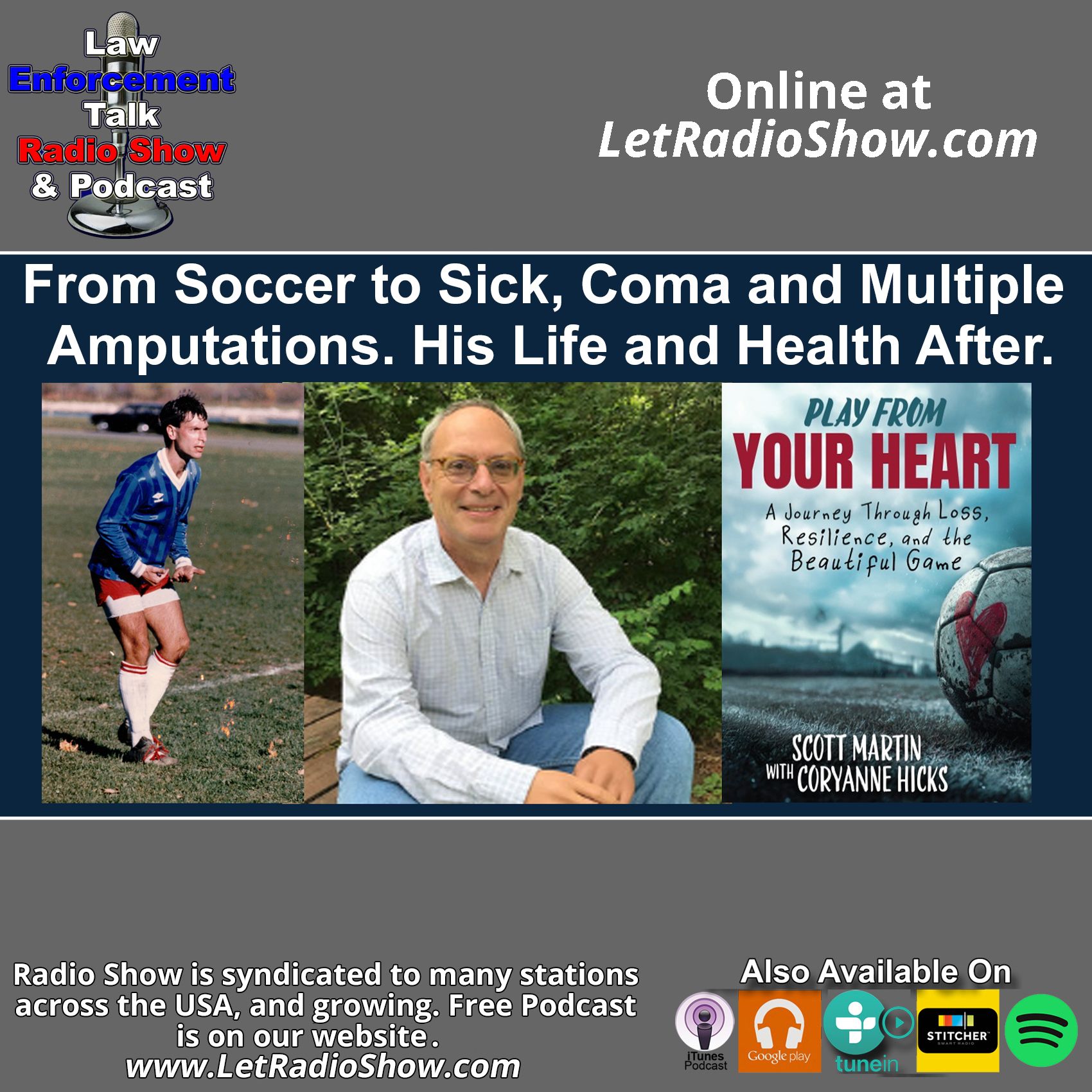
Law Enforcement Talk: True Crime and Trauma Stories
From Soccer to Sick Coma and Multiple Amputations
00:38:33
From Soccer to Sick Coma and Multiple Amputations. His Life and Health After. In college athletics, discipline, endurance, and mental toughness are often seen as the ultimate measures of success. For Scott Martin, those qualities weren’t just part of the game, they defined his life. A former college athlete turned successful college soccer coach, Martin had built his identity around performance, leadership, and resilience.
Loading summary
Transcript117 lines
- [00:00]
A
He was a successful college athlete and coach. He was suddenly stricken with Flushing's disease, had multiple amputations. Five months in the hospital and immediately returned back to work. Lessons learned and how he built his new life after welcome to the Law Enforcement Talk Radio Show. In the Law Enforcement Talk Radio show we are joined by special guests talking about their experiences, their realities of investigating crimes, plus those who have experienced Hrendro trauma. Police friends, first responders, military and victims of crime share their stories. Hi, I'm John J. Wiley. In addition to being a broadcaster, I'm also a retired police sergeant. Be sure to check out our website, letradio.com and also like us on Facebook, search for the Law Enforcement Talk Radio show do you want to be a guest on law Enforcement Talk Radio show and podcast? It's really quite simple. And before you get into this notion that I'm not a cop, I wasn't a cop, I don't have something contributed. Well, the show is about investigating crime. That's one aspect of it from the real life perspective of those who did it. And then it's also about trauma, how trauma impacted them, often crime based, but not always. Our guests quite often are law enforcement officers, other first responders, military victims of crime, their spouses or survivors talking about how trauma is impacted them, what happened, how it affected their lives and how they rebuilt their lives after. If you want to be a guest, just contact me. It's really simple. Send an email to jayetradio.com that's jayetradio.com or go to letradio.com and the contact Us page and you can get me right there as well. Joining us from Wisconsin, we have Scott Martin on the law enforcement talk radio show. Scott was a college athlete. I'd say he still is because I'm not an athlete. He was suddenly stricken with flushing disease, which we'll talk about. He did five months in the hospital, had five amputations or numerous amputations I'd say, and he immediately returned to work. A mistake I would make as well. And we're going to talk about that. Lessons learned and his book, which is Play from youm Heart, available wherever books are sold. Scott, thanks for coming on the law enforcement talk radio show telling your story. Very much appreciated.
- [02:25]
B
Thank you, John. I'm really looking forward to this. I've done some listening on your podcast. I understand where you're going to be going with this and I think the audience is going to be very intrigued with what they're going to be hearing from us.
- [02:35]
A
Well, here's the thing about it, Scott, is like when you first told me your story, because we have a brief conversation, I'm like, wow, that's a lot to deal with. And here's what happens. And the main reason I started the show is I wanted people to know there's light at the end of the tunnel. No matter how bad your circumstances, no matter how different they are, you can get a better life. It may not be the life you wanted, but it's a life that's far better than you decided you're going to have.
- [03:05]
B
Totally agree with that concept. Totally agree with that concept.
- [03:08]
A
John, let's talk about your case. You were a college athlete, and I said in the earlier portion of the show before I connected with you, that you were a coach as well, right?
- [03:19]
B
Yes, I was coaching at the university level when I guess everything's. Everything happened all at once.
- [03:26]
A
When you say everything happened, you went from what kind of sports were you coaching?
- [03:31]
B
Coaching soccer at college level. I had been teaching social studies and history at the high school level and running soccer programs. And I had an opportunity to jump over to that level as a profession, start coaching at the college level. And it's just something that was in the cards for me and I didn't want to pass up the opportunity.
- [03:51]
A
That's a great opportunity. By the way. I played soccer in college. In high school, I got yellow card in every game I played in because it was, I was just horrible. I'm a horrible player. I always said, the beginning, I was an athlete. The linemen, they ran too much. The halfbacks did a lot more running. I was a fullback and I didn't care if I kicked the ball or not. I could just kick the heck out of them.
- [04:11]
B
Well, when I was playing in college and then when I was playing after, John, I actually played center back. When I, when I showed up to the college, the coach knew that I came in as a forward. He said, I want you to take everything, you know, from attacking. I want to spin it 180 degrees and run the defense. I mean it looking back, that was the best move anyone ever played on me. And it worked out because that's where I really started learning the game. So when you're talking about playing it back, it's not so bad because you have such a vision from the back and you could see everything. You could see the entire game. And that's where I really learned the game. Especially when I got into coaching, it paid off.
- [04:47]
A
It's a, a big game, a big transition, and you know, I did it really for something to do because I was. We didn't have a football team at the time because it was such a small school, although if I had known I was going to grow this size, I was our private state of football and we. I work in radio and part of the ownership of the radio station. They have regional Mexican radio stations. They're big, what they call football fanatics. And I'm thinking this is as bad, as boring as watching pain dry. Come on, run, run, kick, kick. Out of bounds. That's it.
- [05:21]
B
There's a lot of tactics that goes into it and I hope people can pick up. Well, here's what I'll throw out here. Try to look at it with the World Cup. I suggest your listeners that they start watching the World cup and avoid focusing so much on that stupid little round thing that we all call the ball and watch everything else that's going on because the upper, upper level teams will do something that's scanning and they play according to not only the ball but everything else on the field. It's, it's considered at upper level and this is where I love to coach it as well. It's like playing three level chess versus checkers.
- [06:01]
A
Right?
- [06:02]
B
I, I guess there's so much more to it.
- [06:04]
A
And the thing is a coach, what I don't understand is and you're a relatively motivated person, otherwise you don't get to where you're at before the disease and after disease. But how do you get people motivated to get out there and perform and do things like running, which is, I don't care what you say, it is not good.
- [06:24]
B
Well, really at the levels where I was playing and then and coaching and still am, I'm coaching right now a group of under 18s in Wisconsin at the state league level. And comes down to winning, John. I mean we all know that, right? It all just comes down to winning. The enjoyment of that and then the accomplishment of it. I mean that's why I was an athlete and that's why I got into coaching as well. I enjoy that aspect of life.
- [06:49]
A
How old of a guy were you when you made the transition from high school to college?
- [06:55]
B
I actually started playing at upper levels, first division levels, when I was 16. I was asked to play with, well at that time, the club men's team. And that's where the feeder program was for at the time, the North American Soccer League. So that was our route. Even though there wasn't a very good route. Not even college players moved over to the NASL very well. A Lot of it was retired north retired players from South America, Europe and all around the world. So it was really tough to get into that aspect of it. But the club system was really strong at the time. And the club systems would generate money in order to play around the country. All the upper clubs had their own bar, their own pub attached to the main field. So before and after matches, the tradition was to go in and have beers together. And that's how they would generate the money in order to support the club. So it was a totally different system than it is today. Totally different.
- [07:56]
A
And things were. You're reminding me of my college days. And by the way, I majored in drinking and minored in sociology. Got a 4.0. My major, DNF1 minor. I was out in no time. But we did intramural football.
- [08:08]
B
I respect your honesty.
- [08:08]
A
And everything about it was about the clubs. It was about pubbing and drinking beer and socializing.
- [08:16]
B
Well, yeah, it depended on the level. But I will say this, that I had my first beer in the Jeff van at my first training session when I started playing with the men's club side. So there was some of that. And we got to be known pretty. To be pretty good on finishing up a boot. You know what a glass boot is?
- [08:39]
A
Job number? Yes.
- [08:40]
B
Okay. Yeah. So at major tournaments, and this is how casual things were, the teams that played towards the semifinals and stuff that were still around and we tended to do that would end up going into the pub when you're knocked out, or if you win the championship or losing championship, and you'd start passing around a boot. And the team that was second to last person finishing the boot had to buy the next boot. And we never had to buy.
- [09:09]
A
Yeah, well, that's. You got to be good at something, right?
- [09:13]
B
Yeah, that's true.
- [09:14]
A
You got to have a claim to fame. So we're talking with Scott Martin. Scott is a very interesting story, very interesting case. He was a college level athlete. He was very good at what he did. He went to coaching. He was stricken with Flushing's disease, which we'll talk about a few moments. And he was hospitalized for five months. Result of this, had numerous amputations. He wrote the book Play from youm Heart, which is available wherever books are sold. We're gonna talk more about life before what happened, what happened afterwards. And writing the book. Don't go anywhere. This is law enforcement talk radio show. We'll be right back.
- [09:53]
B
Someone asked, what's the catch? What's the cost? There is no cost for anything on the law Enforcement talk radio show and podcast website letradio.com letradio.com Again, that's letradio.com.
- [10:15]
A
We're during our conversation with Scott Martin on the law enforcement talk radio show, Scott was a college athlete and he was a college level coach, University of Wisconsin. And he was suddenly stricken with flushing disease, had numerous amputations, spent five months in the hospital and immediately returned to work, which is something I would do as well. He's talking about the experience and building his life back to where it is today. And his book they wrote about is called Play from youm Heart, which is available wherever books are sold. So let's go into your story, Scott, you are a college level coach. And then tell us what happened.
- [10:53]
B
Well, following my first season at the college level, we were nationally ranked, so everything was going quite well. Great recruiting class. I was heading over to Europe, which I tended to do during summers, to play and also to coach. And Nike heard about me and said, hey, we'd like you to come down to the regional camp outside of Chicago and speak like, okay, no problem. Well, there was a slight problem. Done. We were under contract with Adidas, so I showed up all in Adidas gear and kind of shuffled me off to a closet, said, grab whatever you want, put it on. Make sure you're wearing Nike, okay? So at the camp were national team players that were under contract with Nike and coaches from across the country. So it's not what you know, but who you know. And while we were playing an exhibition the first night, I had to pull myself out of the match because I was just so fatigued. I couldn't keep up what was going on. I spent that night either throwing it profusely in the bathroom or sweating like crazy and shivering like crazy in the dorm room where I was. Woke up that morning, tagged a note on someone's door apologizing. I had to leave no idea where doctors were outside of Chicago, even though I was there. And. But if you don't know where a doctor is, you can go to mom, right? And I did. She was in southern Wisconsin. I showed up, this was before cell phones. And she said, something's. I was, I was supposed to show up the next day, sorry. And she said, something is wrong with you. You did. You bugged over to the emergency room. Presented myself, took a temperature of 102.8, which should have been sending off red flags, sent me home and said, drink some. You're gonna be fine. Nope. Woke up the next morning even worse. Last thing I remember, John was being In a front passenger seat with my stepfather driving and my mother outside her kitchen door just looking freaked out as we backed up the driveway. I woke up a month later. I don't remember anything after as we were backing out of the driveway. I woke up a month later to learn that my mother and one of my brothers had to make a decision. And that decision was either unplug me and I was. What I was told was I was. I had every machine you can think of. I was intubated. Everything was going on dialysis that either unplug me and let me die, or amputate both hands and parts of both feet and see how I'd handle life. And it was heck of a decision, huh?
- [13:39]
A
It's a tough decision. You go from being. And you go from being okay to feeling sluggish. I can't compete. Pulling yourself out of game, which, look, I don't want to do. Going to the doctor, they think you're okay. Then the next day, you are lights out, you're in a coma.
- [13:58]
B
Exactly. I was in a coma for a month. I had lost 40 pounds of muscle, basically. So when I woke up, I didn't know what was going on. I couldn't move. I later learned that, you know, because I thought perhaps I was realized. So I was freaking out. I had a neck collar on and again, intubated. I couldn't speak or anything. The reason why I couldn't move was I lost 40 pounds from muscles.
- [14:23]
A
Right.
- [14:25]
B
That was too weak to move. So. But that gave me something to focus on. I'm going to go build that back so I can start moving and start becoming independent, I guess, though, John, I also did something extremely. I'll admit to that, no problem. Once the doctor started talking about group A, strep and necrotizing fascia. And then when he hit the term flesh eating disease was what, strong in the media at the time? Jim Henson from the Muppets, he passed from that a couple years earlier. And as soon as that locked in, I just. My mind just completely shut down. I don't want to hear it. Just put me in a wheelchair. Let me get back. I was supposed to be in Europe, but I missed that trip. My players were going to be coming at some time, and I just want to get back to work. And that's what I actually did for the next couple of decades, that. But four years later, I went back to coaching. We saw the national Rank program. I failed to look at anything in my head and my heart especially, and I ended up running in the Brick wall of depression.
- [15:35]
A
Yeah.
- [15:36]
B
And I had to make a change.
- [15:38]
A
Well, that's not, that's not shocking to me. First of all, to go from being someone who's in top physical and this is. I'm just speaking to the preaching of choir here. So if you watch television and they show someone to come when they get up and walk right away, that don't happen. I'm like this, you lost 40 pounds of muscle in one month.
- [15:59]
B
Yeah.
- [16:00]
A
And that's when you're young. When you're older, that goes away like in eight hours.
- [16:07]
B
Yeah. Well, there's just so much to unpack.
- [16:13]
A
How do you go. All of this, how do you go. We'll get to the depression part in a moment. But yeah, when you said. I was thinking, it's flushing disease, it's flesh eating disease. I understand, but here's the thing. My thinking is this would never happen to me. This will happen to someone else. It never happened to me.
- [16:32]
B
There was so much going on. Like I said, my mind just stopped. At one point when the doctor was first talking to me. Mine just stopped because I didn't want to hear it. It was so much too, God comprehensive. And even the term go by. How can someone comprehend that?
- [16:53]
A
Right. I don't get it. I don't. Where do you even start and say, oh, by the way, this is what's going on? Oh yeah, I'll show you. No, it's not.
- [17:01]
B
Yeah, well, part of it. What. The first thing that did run through my mind, John, was I'm done playing. I knew that. I accepted that boom right away, meaning basically amputated my feet. So that was done. For some reason I was able to accept that. I guess I had a decent enough career, I was okay with it. But I was in the midst of coaching at the college level, which is one of the ones, you know, I was on my way, man. I was on my way to be going up to whatever level I would end up working at. So yeah, to throw that all in. But also the maleness, I'll be honest, the maleness was a thing that I look back on and I know darn well that as society raises us to be quote males that got in my way, I think of really, truly healing.
- [17:51]
A
Look, first of all, I agree with you 150%. Part of my background. And we could judge this all day long. It just is I was brought up a certain way and I would never let him see me sweat. I still don't let him see me sweat. And I'm going to not Even ask for help. We're talking with Scott Martin. He was a college athlete, college level coach was stricken with flesh eating disease, had numerous amputations, five months in a hospital and immediately returned back to work. He wrote the book Play from youm Heart which is available wherever books are sold. When we return, we're going to talk about long term effects. Don't go anywhere. This is law enforcement talk radio show. We'll be right back. Get access to free podcast versions of the show and more on Facebook. Do a search for the law enforcement talk radio show and be sure to click like. Return to conversation with Scott Martin on the law enforcement talk radio show. Connecting with us from Washington, Wisconsin. He was a college level athlete and college level coach was stricken suddenly with flesh eating disease. He spent five months in a hospital, had multiple amputations and he went back to work immediately. And his struggles to build himself back up and what he did about it. He wrote the book Play from youm Heart which is available wherever books are sold. There's part of your story that is Scott, that is fascinating to me, but it's also part of it. It's like I understand my. I've never had to deal with anything like fleshing disease, nothing to that level and amputations. But there's an old saying my mother used to say all the time, we love our crosses the bear. And then it's easy to become overwhelmed and say, poor me, get angry. I'm not going to do this. You said earlier for the break you kind of accepted your playing career is over, but you didn't have the same mentality when it comes to your coaching career.
- [19:48]
B
Right.
- [19:48]
A
And you're talking about maleness is part of the.
- [19:50]
B
Because I was in the midst of it and we had done so well my first season.
- [19:53]
A
Yeah, I get that all this seems incredibly unfair and poor timing to say the least.
- [20:01]
B
I'll take that.
- [20:03]
A
Yeah. How do you not get angry?
- [20:07]
B
I never have, John. I never have. I've been discouraged, of course. Oh my God, I've been discouraged. And that goes hand in hand with depression.
- [20:18]
A
Yeah.
- [20:19]
B
And depression is its own animal, is its own thing, and that can just rip apart a person.
- [20:28]
A
We'll talk about that a few moments. There's so many people that get affected by that and I have my bouts with that as well. And we're not talking about having the blues and being sad. We're talking about an overwhelming lack of motivation for multiple years. Early on, when you were affected, you came out of the coma. You realized your mom and your brother Were in this life saving scenario for you about amputation or pulling the plug. Did the reality hit you at all because you had, what kind of amputations did you have?
- [21:05]
B
Both. Mid forearm. So I lost both hands at the mid forearm and mid foot on both feet. One foot. They had to. I had a Frankenstein plastic surgeon, I guess again, I was out. He ended up instead of doing a bk, a balloon knee amputation, he said, no, we're going to do this. He, he took muscles from my abdomen and skin from my thigh. I was on my back so I couldn't take muscle from there or excuse me, skin from there. He recreated the foot that I now used so I was able to avoid a bk, a blood knee amputation. So yeah.
- [21:40]
A
How old were you when this happened?
- [21:45]
B
I started feeling exactly one week after my 35th birthday.
- [21:49]
A
So you're still a young guy when it's going on. You're still a young guy now, but back then 35 is like, I don't know, I'm still kind of in the bulletproof stage.
- [21:58]
B
Yeah, man, I was still playing at a high level. I mean, we just won the championship up in Minneapolis playing indoor. So yeah, I was still going, you know, full bore. I'm looking forward to everything, you know, playing wise.
- [22:13]
A
Part of the conversation I get from you is you're picking yourself up other bootstraps kind of guy. And so you are doing well in coaching. And you say I'm going back to work.
- [22:25]
B
Yeah, I was in hospital, John, after I was fitted with hooks. I mean this is probably two or three months in, they moved, they switched me over, thank goodness, to my electric hands, upper level sort of stuff. And as soon as I put those hands up, for some reason I said, okay, please give me a pencil and paper. And I knew I had to change something in my coaching. So I wrote a coaching manual that was going to be for my program. And everything went into it. I mean, that took my day, filled my day with things to do. I have to design, write everything down and diagram and everything for the player and the program. But that kept me busy. But a lot of things had to change in a very short period of time. But what didn't change was how I viewed myself. Instead of negatively to try to switch into positive. There was no way I could.
- [23:18]
A
Did you have.
- [23:18]
B
I lost all my confidence.
- [23:19]
A
Did you have that learning curve of learning how to write and draw and all that stuff?
- [23:24]
B
No, it was just immediate. It was as if you could, you could look at my writing before the invitations and after. And it was exactly the same. I don't know. I can't explain it.
- [23:35]
A
Well, mine's horrible. I'll just put it this way. I read. I print stuff, Scott, and I can't even read it. My wife's got to read it.
- [23:43]
B
Okay, I hear you on that. No, everything was. Everything was fine there. You know, I just kept finding what needed to change and work on those things. Being in athletics as it was, it gave me something to do, so to speak, goals to go after.
- [24:02]
A
You were still relatively early on in the prognosis. Was there any legal action involved?
- [24:09]
B
Oh, yes. A couple months after I was released from the hospital, it was bugging me. How did I contract this? And so I called the doctor that I say saved my life, who's head of the intensive care unit, and I asked him point blank, you know, how does. He said, no, we didn't have time. We never looked into that. But. You're asking the wrong question, Scott. I. I don't understand, Doctor. What are you talking about? You're asking. You're asking the wrong question. You need to look at what happened in the emergency room. Yeah. That's as far as you could go. So I went out and got an attorney, and it was a three and a half year process to get everything together. There were. There definitely was a medical malpractice trial at the end of this, during it.
- [24:57]
A
And that involved the emergency room visit?
- [25:00]
B
Mm, yes. The physician there and everything that was found. It was. It was a two week long, very dramatic $10 million lawsuit that came up. So, you know, with that much money online, the doctor and the medical group of doctors, they had three attorneys, we had two. But, oh, yeah, it was very dramatic. A couple things happened where the judge had to clear the courtroom and all of these things. My mother was up on the stand and they tried to pin her down, and she came back at them and gave him a good one. I mean.
- [25:36]
A
Oh, yeah. I can only imagine.
- [25:38]
B
Interesting.
- [25:39]
A
What was the final outcome of that court case?
- [25:43]
B
Well, I was over at a friend's apartment when we got the call from my attorney who gave me the bad news that we had lost. But it was also at that time, John, that when there was a pivot point, a huge pivot point in my life with what I was going to do after that. Three months prior, I resigned my position and I started running into discrimination when I was looking for other positions just to try to change things. So that was. I went from a white guy in athletics to being labeled automatically as disabled. So therefore, people thought I couldn't do things.
- [26:22]
A
Yeah. And I'm going to be honest, I don't like that term disabled. Look, I had what ended my career. I was retired at the age of 33. I had multiple steel plates put in my right hand. I'm right handed and in my career. But I'm technically and I'm air quoting physically disabled according to the law. But that doesn't mean I can't do things. There's certain things I can't do, but I could do most everything. I just do them differently.
- [26:51]
B
Exactly, exactly. We're placed with a challenge in front of us. We need to overcome that challenge. So with me having no job and now losing the lawsuit, I needed to make a change. So when I went to my apartment and pulled in the garage, I literally got an egg. Right. Very honestly in the book, the whole book is very honest about I chuckled that thinking that a lot of people would think that wouldn't be surprised if I didn't turn off my car when I closed the garage door or if I want to block pistol.
- [27:23]
A
Right.
- [27:24]
B
I don't think anyone, a lot of people wouldn't have been surprised because like what the guy going to do now? Well that's exactly. I did the opposite figure out I stayed up all night listening to music and come up with, you know, a, B, C, D all the way through the Alphabet and all right when A doesn't work, go to B, you know, go to S, go to okay, whatever. I came up with something that ended up with me chucking every award I had ever won in trophy and everything popping into my car with my cat. I got rid of everything it didn't fit and we got it on because I had an opportunity out there to live in a apartment and go on food stamps.
- [28:00]
A
We're going to take a short break on that note. We'll return the conversation with Scott Martin in just a few moments. This is law enforcement talk radio show. I promise you there's so much war heading away, you don't go anywhere. We'll be right back. How would you like to improve your health? Let's get healthy tips you can use today for free. They don't require any money at all. You can download a free ebook 15 tips to improve your health@LetHealthy.com that's LetHealthy.com again it's LetHealthy.com and let's get healthy for free. Return conversation with Scott Martin on the law enforcement talk radio show. Scott is a college level athlete, world famous guy actually and he is a College level coach. He was suddenly stricken with flesh eating disease, which we'll talk about in a few moments. He had numerous amputations, spent about five months in a hospital, immediately turned to work. And he wrote the book Play from youm Heart, which is available wherever books are sold. Before, when the break, Scott, you're talking about, you had this opportunity and you took it. And it meant starting all over. It meant starting usually where you started. 18, 19, 20. Living in the worst scenario. Food stamps, ramen noodles, the whole nine yards. That was your situation. Right?
- [29:29]
B
I intentionally, John, I intentionally was breaking myself down in order to pull myself back up. I needed to refocus, redefine myself, and I did. I ended up at a small school out in Olympia, Washington, called Evergreen State College. I worked as an assistant to a guy, John Wedge. He didn't have the money to give me anything, like, no problem. I worked with him on the tactical side with his players and player development, and the exchange was that he was going to help me. Well, what John Wedge was doing, John, was because he was so well known on the west coast, he was going to help me get back into coaching again. Well, at least a paid position and back on the ladder, so to speak. And he did. He got me into a handshake deal coming in as the assistant coach at Gonzaga University with gentlemen going to be resigning immediately. So that would be able to slide in as the interim head coach. Perfect. Well, they hired a new athletic director at the same time. He was not aware of the handshake agreement, but he brought me in as the assistant coach anyway to someone that didn't know what they were doing. And it was extremely frustrating. But when the position came up again, the athletic director said, hey, I want you to apply for this. But a little something happened was watching a news show out of Seattle of this couple who had adopted two children from Haiti. Because it was a disaster there. I immediately started researching adoption. And the next morning I called my director and left a message. And I think it was a good thing. He didn't respond because I had no idea how I was going to explain it to him. Please remove my name from consideration. And I didn't tell him why. What I started doing was down the road to adoption. As anyone that's adopted knows, it's a long process. Year and a half later, we and little boy and little girl from Ethiopia, excuse me, from Armenia, come home. The next year, a boy from Ethiopia. Two years after that girl. And then I made her the basketball team of five kids, all toddlers with a Little girl from Ethiopia that came home. So I totally love soccer for 20 years and raised five kids from toddler stage. But John, they all came home after diaper stage. That helped things. Yeah, yeah.
- [31:51]
A
I remember those days. They're not fun.
- [31:54]
B
Oh no, no. And especially with my electric hands that are rubber. No, doing diapers would not have been a good thing. So it worked out the best. I thoroughly enjoyed myself. I got away from coaching, but I still stayed in the game. I still stayed in the game. I knew what was going on. So 20 years later I had an opportunity to return to coaching. And really that's the second half of the book with what happened.
- [32:19]
A
And the book is called Play from your heart, which is available where books are sold. I, I gotta ask this question because earlier you talked about the depression hitting in many, many years afterwards and it, it was overwhelming. When did that come about?
- [32:33]
B
When did it start?
- [32:34]
A
Yeah.
- [32:35]
B
Or when, when did it break apart?
- [32:37]
A
When did it start?
- [32:38]
B
Oh, immediately after waking up. The calm down. I mean right away, boom. I, I knew started, I'm sure with confusion. I mean I skipped through a lot of the, the stages. And I think the biggest thing that still with me a bit is guilt. I think a lot of people go through something that affects so many other people. Guilt is huge. And that stayed with me for decades. Still does somewhat, but depression and I called the fog and how I feel, that's gone.
- [33:12]
A
Good. That's really good. The guilt thing. And here's what I say and you can take it for what it's worth. I've got to learn to avoid the shoulders. Shoulda coulda, wouldas. I'm not God, I'm not Superman. I just did the best I could. And sometimes that's good enough.
- [33:29]
B
Sometimes it's good enough. We were both driven people and we know that. Make sure that everything's going to work out and be beneficial for everybody around us. Plus us.
- [33:40]
A
Now, before we get back to you,
- [33:42]
B
how are the kids doing in their 20s? Doing fine. One has a child, another one is in graduate school, other ones are out of college in the military, so they're doing okay.
- [33:55]
A
And do you give yourself credit for that?
- [33:58]
B
I'm a parent, so of course I don't.
- [33:59]
A
Of course your parent happens to be a male. Of course not. I'm supposed to do that.
- [34:05]
B
Of course not. It's up to them. So there is something I always follow John, and I still use it in my coaching today and I use it when I was in the classroom. My mission is not to teach you, but to put you in a position to learn. There's a big difference. And I did that raising the kids too.
- [34:21]
A
I look at this way, I had a conversation with a good friend talking about her now adult daughter. And my daughters are adults now and they're in the mid-30s. And it's like your job as a parent is over now. You've done all the hard work. Now you just kind of. You don't want to enable them. Want to be their excuse for lack of accomplishment.
- [34:43]
B
Yeah. They have to be responsible.
- [34:45]
A
And that's what we talked about the coulda, shoulda, woulda. And that sometimes I gotta avoid that guilt things the things I could done better. Absolutely. But I know better at the time. No.
- [34:57]
B
Yeah. Depends on what you want them to learn. So when did you position?
- [35:02]
A
When did you write the book play from your heart?
- [35:05]
B
After with what we're going to get into talking about when I returned to coaching happened. That's when I knew boom. We have a book. We actually have a movie. I think too.
- [35:15]
A
You do? I made a joke earlier about a B rated TV movie. I think this is your story is one that can remember Brian's song when we were kids.
- [35:27]
B
Yes.
- [35:28]
A
And you don't forget movies like that. That. That your story is so inspirational it needs to be made into a TV movie or a movie.
- [35:38]
B
Oh, wait till you hear the next part. This is total, total Hollywood, man. Total Hollywood. About my return to coaching.
- [35:47]
A
Please do.
- [35:47]
B
Shall we?
- [35:48]
A
Yes.
- [35:48]
B
All right, here we go. So I mentioned earlier on discrimination I was discriminated against, even my resume at this pretty big club in Bellingham, Washington where we were living at the time. And it was one of these clubs where parents pay thousand dollars for their kids with the expectation these kids might college scholarships down the road, who knows, professional national team, whatever. So there's large expectations. But I showed up with my resume and I met the new director of coaching. Never shook my hand, by the way. Told me a lot. Always tells me a lot from if people don't or how they do it right. Give me great insight into that person. So I showed up and he said well you're going to coach the C team of under 13s. So the C team is not the A team, not the B team, the C team, the ones that everybody skipped over and left me with. So right there it was okay. I've already. I remember watching these kids, they do have some talent, but what they lack is confidence and they like size. So I knew what to work on. Which actually John was the same thing I needed to work on. Not the size. But we worked on this together because with me putting them in positions to learn, I know what they were getting. But I was also getting something. At the end of the book I asked the question, I don't know if I needed them more than they needed me, but it doesn't really matter both
- [37:12]
A
of what you needed. The book is called Play from youm Heart. We're talking about Scott Martin. Scott, we're gonna wrap things up. I would love to find out more because I'm convinced your journey's not done yet.
- [37:26]
B
I agree with you.
- [37:27]
A
And this is where we have some level. I hate this word. Psychologists hate it, therapists hate it. We have some level of control over dictating our future.
- [37:36]
B
Agreed.
- [37:38]
A
And I can't control what other people do, but I can control my response to it. We're talking about Scott Martin. Scott was a college athlete, a college level coach. He was stricken with flesh eating disease, had numerous amputations, spent five months in a hospital, robbery, immediately returned to work and he wrote the book about his experience called Play from youm Heart. Scott, thanks for being a guest on the show and tell us all about it. Very much appreciated. I'd like to thank our guests for coming on the Law Enforcement Talk Radio Show. The Law Enforcement Talk Radio show is a nationally syndicated weekly radio show broadcast on numerous AM&FM radio stations across the country. We're always adding more affiliate stations. If you enjoyed the podcast versions of this show, which is always free, please do me a favor and tell a friend or two or three. I'll be back in just a few days with another episode of Law Enforcement Talk Radio show and Podcast. Until then, this is John J. Wiley. See ya.