← Law Enforcement Talk: True Crime and Trauma Stories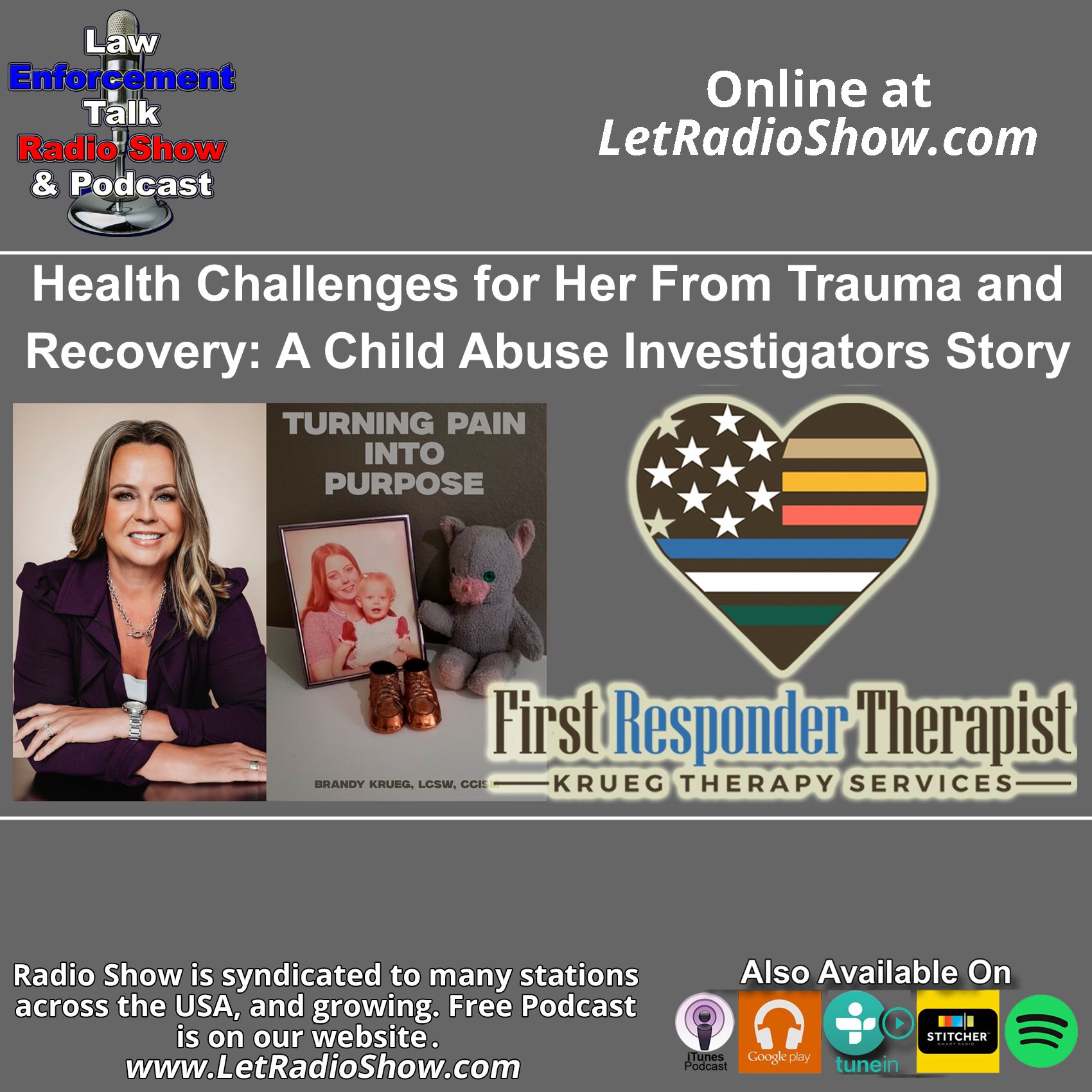
Law Enforcement Talk: True Crime and Trauma Stories
Health Challenges for Her From Trauma and Recovery
00:40:23
Health Challenges for Her From Trauma and Recovery: How One Child Abuse Investigator Turned Pain Into Purpose. For more than two decades, she stood on the front lines of child protection in California, investigating some of the most disturbing cases of abuse and neglect imaginable. As a seasoned Child Abuse Investigator, she bore witness to the darkest corners of humanity, stories most people never hear, and few could carry without consequence.
Loading summary
Transcript155 lines
- [00:01]
A
If you're an H Vac technician and a call comes in, Grainger knows that you need a partner that helps you find the right product fast and hassle free. And you know that when the first problem of the day is a clanking blower motor, there's no need to break a sweat. With Grainger's easy to use website and product details, you're confident you'll soon have everything humming right along. Call 1-800-GRAINGER, click grainger.com or just stop by Grainger for the ones who get it done. From walking barefoot in the snow to hiking for miles for a view, it feels good to connect with our simpler side. Simplifying your wellness with Cachava's all in One Nutrition Shake feels good too with 25 grams of protein, 6 grams of fiber, Greens, adaptogens and more. No fillers, no nonsense, just the highest quality ingredients. New customers get $20 off an order of two bags or more now through January 31st when they go to Cachava K A C H A and use.
- [00:59]
B
Code News she is a former child abuse investigator in the State of California. She was diagnosed with PTSD towards the end of her child abuse investigation career. She's here to talk about a couple cases that were particularly troublesome for her. She's now a therapist. She's going to talk about her recovery, her journey, and what she's doing about it today. Welcome to the Law Enforcement Talk Radio Show. In the Law Enforcement Talk Radio show, we are joined by special guests talking about their experiences, their realities of investigating crimes, plus those who have experienced horrendous trauma. Police, first responders, military and victims of crime share their stories. Hi, I'm John J. Wiley. In addition to being a broadcaster, I'm also a retired police sergeant. Be sure to check out our website letradio.com and also like us on Facebook, search for the Law Enforcement Talk Radio Show. Of all the radio stations in the United States, there are no other shows like the Law Enforcement Talk Radio Show. And on Facebook there's only one official page. Do a search on Facebook for the Law Enforcement Talk Radio show and be sure to like the Law Enforcement Talk Radio Show Facebook page. Joining us from California, we have Brandi Krug on the Law Enforcement Talk Radio Show. Brandi was a child abuse investigator in the State of California. She was diagnosed with PTSD towards the end of her career. She's now a therapist. By the way, a trauma informed therapist, which my hat's off to those people. She does a lot of work with first responders. Her website is brandykrug.com that's brandy, like the song from Looking Glass. And the last name is K R U E G Com and she's author the book Turning Pain and Purpose. Brandi, thanks for being guest on the show and thanks for your service. Both very much appreciated.
- [02:50]
C
Thank you. Appreciate being here.
- [02:52]
B
Number one, I'm retired police. I was diagnosed with what and I, I don't like the term PTSD. I prefer the term PTSI. I think that's more accurate back in the late 80s and it's really not problematic for me. It really is not. It doesn't mean that I can do and I'm not the same as I was when I was 18. It's just not what we think of when we typically think of this. But during my police career, you know, the two types of cases that really got to me the worst were child abuse investigations and elderly abuse investigations. Those I really struggle with tremendously. So my, my hat's off to anyone that did that for a living.
- [03:34]
C
I appreciate that.
- [03:35]
B
It's tough, isn't it? It really is tough.
- [03:38]
C
Very tough. But also can be very rewarding.
- [03:41]
B
It is. There's something to be said. And by the way, I just had my birthday and there's an old photo that a crime lab technician took of me with about a 5 year old child abuse victim that the mother was putting out lit cigarettes on him repeatedly and he was sitting in my lap and it's a treasured memory. I don't know what happened with that man. I hope he's doing okay today. Yeah, that's a big problem with the police and a little bit different maybe for you, but we didn't, we did the preliminary investigation, we did all this stuff and then typically we don't know what happened. Was that the case for you?
- [04:21]
C
A lot of times, yeah, absolutely, absolutely. But oftentimes there is not that closure that you get.
- [04:27]
B
Wouldn't it be nice if you could wrap everything nice in a bow and drink tea and sit on your front porch and laugh, laugh and laugh and everybody live happily ever after, Wouldn't it be?
- [04:36]
C
Yes, that'd be very nice.
- [04:38]
B
Life is not like that. And when it comes to traumatic crime things, it really can. It can upset the apple cart. Is that what happened with you?
- [04:50]
C
Yeah, yeah. It became too much fast.
- [04:54]
B
I hear you. We'll talk about your career. How long did you do the child abuse investigation?
- [04:59]
C
I worked for the child welfare system for about 15 years.
- [05:04]
B
So there's no fast. That's a long time, Brandi.
- [05:07]
C
It is a Long time. Yes.
- [05:08]
B
And I know, I looked at your website, brandykrug.com, the pictures. She doesn't look that old. I'll just say this right now. She looks like a youngster. You look like you're in your 20s.
- [05:18]
C
Oh, good answer. Good answer.
- [05:20]
B
No, I'm a happily married guy and my wife has trained me well and I've got four younger sisters, so. And by the way, I don't know how this happened. You don't have to answer this, but somehow my mother, who's still alive, she's still 29 and I'm 67, and I don't know how I passed her, but she refuses to talk about her age.
- [05:39]
C
Same thing I say to my kids. I just turn, yeah, my birthday is coming up. I'm going to be 29 again.
- [05:45]
B
Isn't that funny how 29 is a magical year?
- [05:49]
C
Yeah. Right.
- [05:50]
B
So you did this for 15 years. And if you were like I was, I was going to save the world. I was going to do all these great things. I had nothing but admirable reasons for doing this job. And without sounding corny, I got. I got damaged, not just physically, but mentally and emotionally as well. Is that a fair assessment for you?
- [06:14]
C
Very, very fair.
- [06:17]
B
What was a typical day like for you as a child abuse investigator?
- [06:22]
C
Typical day that. Well, I'm not sure what a typical day would be, but you always have your open cases that you have that are given to you, that you're working, trying to decide what you're going to do with the case. And then there's those times where you go to a house and you think it's going to be one thing, and you wind up holding on to a baby and running out. Like out and hiding somewhere till your backup couldn't come. It just really depends. There's not really a typical day.
- [06:46]
B
So it sounds a lot like our day. We thought it's gonna be great, thought it'd be smooth. And some, those turn up be some of the most hellacious days.
- [06:55]
C
Absolutely. The ones you think are gonna be, ah, this is nothing, tend to be the most work and have the most feelings behind them.
- [07:01]
B
I just had a gentleman on the show. He's retired San Diego, San Diego County Sheriff's deputy, and his name's Ali Perez. And he was shot multiple times by a pedophile. And he was shot with a.308 rifle. And it's the longest gunfight in the history, the modern history San Diego County. And he, he almost died on scene. And it's a wonder he's alive. Sometimes I. I think, and I know this sounds melodramatic and I guess this is a formal question. Sometimes I feel like life would have been better and easier for my family members if I had not survived.
- [07:41]
C
I could see how some people would think that.
- [07:43]
B
Do you think that at all, or are you beyond that point?
- [07:47]
C
I've never felt that way. I have never felt that my family would be better off. But I think that stems also from me being a widow. Things a little differently that way.
- [07:55]
B
Yeah, that would have a huge impact. So you did this for 15 years and then you migrated to becoming a therapist, A mental health therapist.
- [08:06]
C
I went from being in the field of child welfare and I was recruited to go work for a local hospital that is a. It's a trauma center, but they don't usually deal with kids.
- [08:21]
B
And how did you make that transition from that to the therapist part?
- [08:26]
C
I was already working on becoming a therapist. I went and got my master's degree while I was working doing investigations and I started getting my hours for a therapist. I knew that I always wanted to be a therapist for first responders. After I myself went to go look for a therapist and could not find one that was culturally competent.
- [08:45]
B
That's.
- [08:46]
C
So it's a long, long process to become a therapist. So I finished my hours and took my test since I've been working at the hospital. So it's been something I've always known I've wanted to do ever since I went to go seek help myself.
- [08:58]
B
One of the things that, and people ask me quite often, oh, by the way, meet my son, meet my daughter, meet my niece, meet my nephew, they want to be police officer. Piece of advice would you give them? And I think they are floored when I tell them, number one, get a clinically informed trauma therapist and be proactive about it because you go see a doctor once a year for physical, you go see a dentist once a year, have your mouth examined, all that stuff, do the same thing. Don't wait until things get bad and don't wait for the department to tell you to go.
- [09:34]
C
Well, when somebody tells you to go, as you know, you don't want to listen to anybody, so. And most of us are suspect of everybody. So it takes a long time to build that relationship with the therapist. So I always tell everybody, everybody should have a therapist. Even therapists have therapists.
- [09:49]
B
Yeah, even. Is that a misnomer that therapists have it all together?
- [09:56]
C
No, we definitely do not have it all together. No.
- [09:59]
B
I would wonder if. And maybe what is tougher being a therapist or being a child abuse investigator.
- [10:11]
C
I think it hits at me a little differently. I really love my job as an investigator. In fact, I thought that would be something I would do forever in addition to having my own private practice. So I did not leave on my own terms. I, I did leave on my own terms. It just hit me suddenly where I was like, I can't do this anymore.
- [10:29]
B
I hear you. We're going to talk about that in a few moments. We're talking about Brandi Krug. She is a former child abuse investigator in the state of California. She's now a licensed clinical therapist and she does a lot of work with first responders. Her website is brandykrug.com and she's authored the book Turning Pain into Purpose. This is law enforcement talk rated show. We're going to take a short break. We'll be right back.
- [10:51]
A
Someone asked, what's the catch? What's the cost? There is no cost for anything on the law enforcement talk radio show and podcast website letradio.com letradio.com Again, that's letradio.com if you're an H vac technician and a call comes in, Grainger knows that you need a partner that helps you find the right product fast and hassle free. And you know that when the first problem of the day is a clanking blower motor, there's no need to break a sweat. With Grainger's easy to use website and product details, you're confident you'll soon have everything humming right along. Call 1-800-GRAINGER clickgrainger.com or just stop by Grainger for the ones who get it done.
- [11:36]
D
My brother in law died suddenly. Now my sister and her kids have to sell their home.
- [11:41]
B
After that I told my wife we couldn't put off getting life insurance any longer. An agent offered us a 10 year.
- [11:47]
D
$500,000 policy for nearly $50 a month.
- [11:50]
B
Then we called Selectquote.
- [11:52]
D
Selectquote found us identical coverage for only $19 a month, a savings of $369 a year.
- [11:59]
B
Whether you need a $500,000 policy or a $5 million policy, SelectQuote could save you more than 50% on term life insurance. For your free quote, go to selectquote.com that's selectquote.com selectquote we shop. You save full details on example policies@SelectQuote.com. Return a conversation with Brandy Krug on the law enforcement talk radio show. Brandi is a former child abuse investigator in the state of California. She is now a mental Health therapist, licensed, all that stuff. And she works a lot with first responders. She is author of the book Turning Pain Into Purpose. And her website is brandykrug.com that's spelled k r u e g dot com. Brandi, during your career, there's got to be a couple cases stand out. Are you able to talk about one or two of them?
- [12:58]
C
Sure, of course. Of course.
- [13:00]
B
Go ahead with the first one.
- [13:03]
C
You know, I think over time we talk about compounded traumas that you sometimes don't even realize are there. So there was one big incident that I did have that I had a young lady that lived with her mom that I got called out on. I went out to her house. They were well known to us. Mom appeared to be doing good at that time. So there's really nothing much I could do except that I did recall seeing an unrelated. I saw a man standing in the background. He wouldn't ID himself. I couldn't force him to ID himself. So I just left mom and said, you know, make sure you don't leave your kids with any unrelated adult men. Because what we do know is that's who tends to harm children. So fast forward, I get this investigator coming and talking to me about the case. And what had happened was this mom, this mom, it was months later, but had checked herself into a psych facility to get a, I call them, tune up on her mental health. When she did that, she left her daughter with some man. It turned out to be the man that was in the house the day that I was there seeing them. But. And he wound up raping her. Jaydianna. Raping her, cutting her up, putting her in a suitcase, setting the suitcase on fire and leaving it on the side of the road.
- [14:29]
B
That's a tough one.
- [14:30]
C
He and his mom had both been arrested and are now doing time for that offense. But that took a big toll on me because it was one of those cases where I had nothing to go off of. There was nothing I could do at the time, but just didn't feel right. And then comes out and this happened.
- [14:47]
B
By the way, the gut is almost always right, but that doesn't mean you can follow it. And here's what a lot of people don't seem to realize is in the American justice system, we got to have a thing called evidence. We gotta have probable cause. You just can't kick indoors and take people to jail. Even if you think stuff, bad stuff's gonna happen. But that doesn't. If it's. If you're like me, that didn't get rid of the coulda, shoulda, wouldas did.
- [15:13]
C
It, you always second guess. You second guess things, right. If we would have known ahead of time how we could have done things differently. There was nothing I did wrong for my investigation. Thank goodness. Because that's the other part of the trauma that comes for us in the field is that there's always, you know, whatever entity you work for, they want to make sure that you didn't do anything wrong. So they want to make sure that they're covered. And so they kind of make you feel like you're the bad guy for a little bit while they're doing their own investigation, which then makes you feel.
- [15:43]
B
Even worse and did it for you.
- [15:47]
C
It very much made it worse for me.
- [15:50]
B
And by the way, there's something you said earlier and not to take away from this incident. It's a really, really bad incident is, you know, the term that people use nowadays. This is before my time. We didn't have critical incident. We didn't have peer support. We didn't have all that stuff. We didn't have critical incident. Stress debriefing, by the way. It wasn't the big things that was the problem. It was the daily grind. That's the one from policing that got to me. The big things. I think maybe I'm wrong, but I kind of learned to handle them with the help of other people.
- [16:24]
C
Absolutely. Absolutely. There was no peer support during this time. I'm actually trying to work with, with that county to get something started for them. Because you're absolutely correct. It's the things you see day to day today that really makes you start to question humanity.
- [16:38]
B
And part of what I dealt, I dealt with is, and I still don't have answers for this. And if you don't, you don't need to answer this as well. But I would sit there and say to myself, how can someone who supposedly loves someone, I'm air quoting, cause physical harm to that loved person? And I really can't understand a parent doing that to a child. I really can't understand a spouse doing it to another spouse, but I really cannot wrap my head around them doing to children.
- [17:08]
C
Yeah, it doesn't make any sense. Sometimes you just can't make sense out of things because they don't make sense.
- [17:13]
B
No, there's. What's the old saying. And then you reminded me an old timer, it was a Vietnam veteran, he said to me, stop trying to make sense of things that make no sense at all. You just drive yourself crazy.
- [17:25]
C
Absolutely, absolutely.
- [17:27]
B
And I, I think that's what happened to me. I think I, I got. And this is another question. The agency that I work for caused more stress than, than the, the bad guys on the street. But it was the courts that were, you do everything the right way, you do the way you're supposed to, and then it's up to the state's attorney in Maryland, that's what we call them. States attorneys, I mean, probably calls different. And then the court and the jury, if they picked a jury trial and sometimes they would be acquitted and found not guilty. And they were as guilty as the day is long. And there's nothing you could do about it.
- [18:02]
C
Absolutely. It's the worst feeling I hated the worst feeling. And I did get to that point. I did what I could do to the best that I could and I knew I was doing that and I loved my job and I knew I was very good at it, but it still, still aided me and I wasn't willing to, to tell anybody.
- [18:19]
B
That's the other thing which I promise you we will talk about a little bit later on. But one of the things that I found to be problematic was, you know, I became very good at doing my job. I knew what to do. But the things I have no control over, what the state's attorney does, what the jury does, what the judge does. And by the way, this is something I still find myself getting upset about. They're like, especially on social media, you arrest someone for some heinous crime, like, well, good, now keep them in jail. It's not the police's decision.
- [18:50]
C
Right, right. The police would agree with you, but it doesn't work that way. Sadly, no.
- [18:56]
B
So that was one case. And without naming their names, you said they both are sentenced to penitentiary during time.
- [19:05]
C
They are for the rest of their lives.
- [19:07]
B
And how old was the victim when she was killed?
- [19:10]
C
She was six years old.
- [19:11]
B
That's so it pains me even to hear it. And how long were you in your career when this happened?
- [19:21]
C
This was towards the very end of my career. I was probably there about 10 years, 12 years by that time.
- [19:28]
B
One of the things that a point so people will understand. I've gotten very good over time of talking about things that are horrendously bad. And I do it in a very clinical way. I'm not going to do it emotionally. And I'm kind of getting that vibe from you.
- [19:47]
C
Yeah, I can't think of it that way. I have to be very matter of fact about it because there's things I don't have any control over. And you can never really predict somebody's behaviors.
- [19:57]
B
No, you can't. And here's the other thing too, is like, and I know you're a therapist, you're going to hate this word. I hate giving up control of my emotions to people. I don't know, if I go there, you're not going to like. And by the way, it's my wife who pays the price. And it takes me days to get back to what I call my center. It doesn't come right away.
- [20:19]
C
Yes.
- [20:20]
B
So I'm very clinical. Matter of fact, I testify in court about certain things and I kind of get the same impression for you. Do you do that to protect yourself?
- [20:30]
C
Oh, absolutely, absolutely. And I also don't let people in that often. My circle is tight. I'm still to this day suspect of everybody.
- [20:40]
B
There's a reason why I met a guy at the gym yesterday. He's a retired Boynton Beach, Florida police officer and he saw my shirt. Oh, where are you? Police are. I said, I'm retired from Baltimore. And he goes, the one thing that really has changed with him is he hates people. And I was like, yeah, I'm a lot better with my dogs than I am with people. We're talking with Brandy Krug. She is a former child abuse investigator in the state of California, now a licensed veterinary physical, I mean, not physical, mental therapist. Works a lot with first responders. Her website is brandykrug.com that's spelled k r u e g.com and she's author book Turning Pain and Purpose. We return to law enforcement talk radio show. We'll talk a little bit more about the second case. Don't go anywhere. We'll be right back. One of the questions I get all the time is how can I show my support for law enforcement? We're all busy. We've got busy lives. But there's something oh so simple you can do with our Facebook page. Search for law enforcement talk radio show Facebook page and when you see a post you agree with, that resonates with you. Share it. Especially episodes of the podcast. To do all that, just search for us on Facebook, look for law enforcement talk radio show and be sure to.
- [21:56]
D
Click like if you're the purchasing manager at a manufacturing plant. You know, having a trusted partner makes all the difference. That's why hands down, you count on Grainger for auto reordering. With on time restocks, your team will have the cut resistant gloves they need at the start of their shift and you can end your day knowing they've got safety. Well in hand call 1-800-GRAINGER clickgrainger.com or just stop by Granger for the ones who get it done.
- [22:35]
B
Return to conversation with Brandy Krug on the law enforcement talk radio show. She is a former child abuse investigator in the state of California. She is a licensed therapist. All she works with is first responders, a lot of law enforcement people. Her website is brandykrug.com spelled k r u e g.com Brandi common first name, spelling and she's author book Turning Pain Into Passion. You talked about a case towards the end of your career where a young girl was brutally attacked, raped, cut up, set on fire. And the people did this are in prison. I want to call them parents because I think that's an insult and they don't really qualify. The mother doesn't because no parent would allow that. Was there another case? You said there was two that really were problematic for you. Was this during the end of your career?
- [23:24]
C
Yeah, towards the end of my career, I was actually staying on still at the department because I had an intern with me in one case. I had another case, so I was already falling apart. People had talked to me about, hey, maybe you should go talk to eap. And I'm like, hey, maybe I shouldn't. I wasn't interested that time. And I had this young boy, this case that came into me where this young man, he was about also six, where his mother asked him, he's a little younger than six. His mother asked him to kick the chair out from underneath her while she hung herself.
- [23:56]
B
Oh, geez.
- [23:57]
C
And what I recall about it, that really, which people often don't think about, we think about, oh, that's horrible. Because, you know, the mother hung herself and those kind of things. But what did it for me was this young man had a pair of Spider man shoes on. And I had a young son at the time who also had Spider man shoes. And so instantly in my mind, that young man was my son.
- [24:21]
B
Right. And. And he, he had to live with that. There, there's no shortcutting that.
- [24:28]
C
Right, right.
- [24:30]
B
And it would be nice if this is another point of contention, but a lot of investigators, a lot of police, a lot of what terms you want to use, deputy sheriff, state troopers, whatever, we have this thing called compassion. We have this thing called empathy. And a lot of times when we internalize that stuff, I've got really good at compartmentalizing certain things. But when it no longer worked, when it came out, it all came out in a flash.
- [24:56]
C
Absolutely. Absolutely. That was the case for me 100% I knew on that day that I was done.
- [25:03]
B
And you've been doing this for approximately 15 years at that point?
- [25:07]
C
Yes.
- [25:08]
B
And you said earlier in the conversation that people were hinting maybe you should go see EAP and talk about this. And did you meet that with some hesitation, some. No, I think I'll pass on that.
- [25:21]
C
You know, it was only one person who said something to me and I felt it was punitive. I didn't think it was a sincere thing. I did seek therapy, but the first therapist I went to speak with, I made her cry, which made me feel worse. So I stopped going.
- [25:40]
B
Yeah, yeah. Well, when they overreact or they are harsh towards me, I would have a problem with that. Sometimes it would. Look, I was the guy in group therapy, I'll just say this, who had to put his hands in his pockets and make fists so he couldn't get them out quick.
- [26:02]
C
Yes. It's a very, very real thing. I wasn't there to hurt anybody else. I was there to vent. And clearly she couldn't handle what I had to say and what was happening.
- [26:12]
B
Culturally competent, was it happening in your personal life? Because for me, that's where the real problems began.
- [26:18]
C
I was, at this time, I was actually separated from my husband and going through a divorce as well. Yes. My kids would tell you now they're grown adults, but they would tell you that I would come home grouchy, I would tune out. I wasn't engaged, so at the time I didn't see it that way. But looking back on myself, I absolutely see that I tuned out. I absolutely see that I was filling my time with things that I shouldn't have been and not taking the best care of myself either.
- [26:49]
B
Join the club, sister. I mean, by that point, when I got bad, the gym went by the wayside and I started drinking a lot to try to fall asleep because I couldn't sleep well. And I isolated. I withdrew from my wife. I went on what my wife was. My now ex wife called many vacations where I would be. The lights were on, but no one was home. I was somewhere else.
- [27:12]
C
Absolutely. Absolutely.
- [27:14]
B
And I think I had a guy on the show recently who is the author of the God Shot. And I can't recall his name off the top of my head, but he called them fugues. He said there's a difference in fugues and disassociation. But the fugues were a real problem for me.
- [27:32]
C
Yeah, I was always very anxious, uptight, you know, but if. But my friends, nobody saw it. I hid it from everybody. The only people that saw it, really saw it, was my people at home, my family at home.
- [27:46]
B
So what prompted you to seek help?
- [27:50]
C
When I knew that I was walking away from this career that I love so much and it had been my identity for so many years, which is also another problem. But I had become a widow during my time at work. He and I'd been through a lot, and I never really. I was that type that just like threw myself back into things. If I throw myself back into it, then I don't really have to think about it kind of a thing. And when it all just came crumbling down, boy, it just came crumbling down. There was no stopping it.
- [28:21]
B
That's the way it was for me. And without going really crazy in my story, I was. I remember shaving, which I didn't do a lot of time. I still don't, but I was in my early 30s and I was looking at myself in the mirror and I was £184. I was like a skeleton. And I was thinking, it's like someone pulled the rug off of me. How did things get this bad? Just this time last year, I was doing great. What happened? I didn't see the progression.
- [28:51]
C
Yeah, I did not. I knew something was off. I wasn't sleeping well. I was start having sweats. I would start, like, people come behind me and I get really jumpy. I knew there's something was going on. Something was going on. I just. I saw it as a weakness. If I went and talked to somebody and I was always the person like, hey, you need to serve that warrant. Let's go. I got you. Let's go, let's go. I got you. I'll stay late and we'll work this warrant together or we're going to go do a sweep. I was always down to do the sweeps with people. I loved working on teams. I loved doing the forensic interviewing. I loved it. And then all of a sudden, I didn't like any of it.
- [29:30]
B
It's like that, the light switch, all of a sudden it went from light to dark.
- [29:33]
C
It was done. I was done.
- [29:36]
B
Did you notice anything at home that you put your finger on? Say, I'll be honest, I'll share a little more story. I became deeply ashamed of the person I've become. Not ashamed of what I did because I didn't do anything that bad, but I felt like I let a lot of people down and that was part of the. And this was supposed to happen to other people, not me?
- [29:59]
C
Yeah, absolutely. You know, one of the problems that I had I do remember that really was something I had to go process was that I thought that if I left, what would happen to my cases? What would happen to those kids? Nobody knows those kids. Nobody knows those cases like I do. And I remember the first when I quit and I got served to go talking, you know, talk in court. And I just told him, I said, look, I've been diagnosed with ptsd. I'm still not in very good shape. I'm not going to be of any good to you. And after that, I never got another call. And I thought, wow, I'm just a number. Oh, yeah, I'm just a. There's somebody else that already has my number. They're taking my place.
- [30:41]
B
Well, what's your saying is in police work in particular, I can't speak for your field of work, but similar is the day you retire a your history and all they talk about is the bad stuff you did. They don't talk about the good stuff. And if you. Let's just say something happened, you died before the obituary hit the newspaper. They'd have a help wanted, they'd have you replaced.
- [31:01]
C
Absolutely. You are just a body, as we.
- [31:04]
B
Say it, and they've got a job to do. That's the other thing that I guess part of the question, one of my problems was that it seemed like to me at the time that all the people I worked with, I grew so close with. All the things you talked about, they like I didn't exist anymore. Did you feel that way?
- [31:24]
C
I still am very, very close to the people I was close with, but I don't talk to anybody that I. These people that I saw on a daily basis that I did not consider my friends, they were just my acquaintances. I don't talk to any of them anymore.
- [31:36]
B
I hear you. I hear you. We're talking about Brandi Krug. She's a former child abuse investigator in the state of California. She is diagnosed with PTSD during the last parts of her career which we'll talk about her recovery process in a few moments. She's a therapist. She works exclusively with first responders and her website is brandykrug.com that's spelled k r u e g.com and she's authored the book Turning pain into Purpose. This is law enforcement talk radio show. Don't go anywhere. There's so much heading away. We'll be right back.
- [32:11]
A
How would you like a free ebook on tips to improve your health? We're talking about tips you can use for free to add years to your life. Best of all, the ebook is free to download@lealthy.com when we say free we mean free. So you can download the free ebook to improve your physical health all while preserving your financial health. Get the ebook for free today@Let Healthy.com that's@Let Healthy.com Again the website is Let.
- [32:39]
D
Healthy.com if you're the purchasing manager at a manufacturing plant, you know having a trusted partner makes all the difference. That's why hands down, you count on Grainger for auto reordering. With on time restocks, your team will have the cut resistant gloves they need at the start of their shift and you can end your day knowing they've got safety well in hand. Call 1-800-granger. Click granger.com or just stop by Granger for the ones who get it done.
- [33:15]
B
Return conversation with Brandi Krug on the Law Enforcement Talk radio show. Brandi is a former child abuse investigator in the state of California and she was diagnosed with PTSD during the later stages of of her career. She's now a licensed therapist and she works exclusively with first responders and trauma informed therapy. She's authored the book Turning Pain into Purpose and her website is brandykrug.com it's spelled k r u e g.com Brandy, first of all, thanks for your service and talking about these, these are not easy things to talk about and that is not lost on me. You don't sound like the person you were when things were really bad. How did you get from when things are really bad to where you're at today?
- [34:03]
C
Well, like I explained earlier, I became a widow when I was 24 or 28 years old and I had two small children and I knew they were watching. So I knew the way I handled life was going to make a difference on my kids. So I started going to therapy. I went to an intense therapy with a culturally competent therapist that really got what I was going through. Really got what I was going through. And since I was no longer in the field, I was now working at the hospital in a trauma center. I wasn't responsible for anybody anymore and that was very, very, very freeing. It gave me an opportunity to really focus on myself. I went from working sometimes 60 hours a week down to working 28 hours a week and had nothing. No work I had to take home. It was amazing. It was amazing. So I got myself into therapy. As I was going through to get my own license. I worked a lot on myself. I took a lot of classes. I really focused on making sure that I was authentic to who I Was. And I'm also. I'm in my 50s at this point in my life. I am here and trying to play it forward to help every other people so they don't have to get to the point where I did it. They break down and walk away from a career they loved so much.
- [35:21]
B
Well, the title of your book is Turning Pain and Purpose. And one of the reasons I do this is to put a purpose to what I went through so others don't have to go as far. Or if they go as far as I did, they realize there's light at the end of the tunnel. Because so many of my guests, they have good lives today. How would you classify your life today?
- [35:39]
C
I have an amazing life. I'm a very blessed woman. I put a lot of work into it. I work very, very, very hard, and I'm doing exactly what I want to be doing.
- [35:49]
B
One of the things that I do is I live a very regimented life. I go to bed around the same time every night. I wake up around the same time every day. I eat around the same hour every meal of every day. I really limit the input of violence and violent behavior and all that other stuff. And the reason why is because I don't want to have a negative impact on my spouse or my children. My children, they're. They're older now, but I don't want to be that raw nerve. Is that a good way to describe you?
- [36:22]
C
Yeah, it's very accurate for me. It's very, very accurate. I'm very regimen. I do get up at the same time, pretty much. I tried to go to bed at the same time, and I've really. I went. The hard transition for me was I went from working days, long hours, and then I switched over to nights. And so I am now back to days at the hospital. And that's made a big difference. But I really. I don't surround myself by anybody who sucks my energy from me.
- [36:49]
B
Oh, the energy vampires and the replacement negative energy. They stay away from me.
- [36:55]
C
Yeah, I just don't have time, you know, and if it's. Even if it's a close friend, family member, I just tell them, look, I can't be your therapist and your friend. I have to be able to take care of myself. And so our friend. This has to be where I just encourage you to go talk to your therapist. And they've all been very respectful. You know, I only hang out with people I want to spend my time with. I no longer feel like I have to spend my time with certain people. Or certain things, and it sure has made life a lot easier.
- [37:26]
B
One of the things that I started laughing quietly to myself, and I have not said in years, but I used to say it quite often, is that, tell that to your therapist because they're paid to listen to your stuff. I'm not. And I'm not qualified. The other part of this, I didn't tell them this. I'm not qualified. You're not going to like what I have to say, so don't ask me.
- [37:48]
C
That is one thing I do tell my friends. I don't. I say, children don't come to. To me unless you really want to know how I truly feel.
- [37:54]
B
Right. What's the old Sleep With Mac song? Don't ask me what I think of you because I might not give the answer you want me to.
- [38:00]
C
Yeah, yeah. I'm going to tell you the truth. And you might not like what I have to say. Absolutely.
- [38:05]
B
Guarantee a lot of people won't like it, and they're very sensitive. The other question I have for you is, and this is based off my own thing, and I'm in my 60s now. What's really liberating is somewhere in my 50s, I began to transition where I no longer cared what other people thought it was. I care deeply about my mother thinks, my wife, my daughters, everybody else. And I say in a blunt way, they don't pay my bills anymore, so what they think of me doesn't matter, good or bad.
- [38:35]
C
Absolutely. And it's so freeing.
- [38:37]
B
It is freeing, isn't it?
- [38:39]
C
It's very. You know, it's one of these times, I think, when you get to a point in our lives that we realize. I tell people this often in my private practice. You know, these people that you're spending all this time with, away from your family, going out of your way for doing all these things for someday. They're not going to be there.
- [38:57]
B
Right.
- [38:57]
C
Who do you think is going to be there at the end of your time? It's going to be the people at home.
- [39:02]
B
It's like you and I have talked before in a past life.
- [39:05]
C
Yeah. Those are. Those are my people. Those are the people that I need to be home for.
- [39:11]
B
So when did you write the book Turning Pain into Purpose?
- [39:14]
C
I wrote the book this year. It's been a bucket list item. I often talk to people about bucket list items, and I was like, you know what? This is what I'm going to do for myself this year. So on the front of the COVID you'll see a picture of my mom and I, when I was young, I was raised to a teenage mom, she had bipolar disorder. And so a lot of us that go into this work of first responders is because somebody, we want to be that person that wasn't there for us, or maybe that person that was there for us. So I became, I went and wanted to be a child abuse investigator because I wanted to be that person that never showed up my door that should have, maybe life would have turned out a lot different.
- [39:55]
B
And you carry that same attitude with your private practice.
- [40:01]
C
I absolutely do. I'm blessed. All I work with as first responders and their families, they speak my language, I speak their language, they get my dark sense of humor and they know it's a safe space. And I also am an in house clinician for Stockton Police Department here in California. Where the goal is, like we talked about earlier, is to be there for those big moments, but also be there for the day to day moments, feelings of department betrayal, getting ready for retirement, you know, divorces, having kids, trying for promotion and hoping that we could, you know, minimize the stigma about going and seeking mental health. And I'm very blessed that they, that they came to me and asked me if I'd be interested in joining their department. And I've been there for about a year and a half now and it's been, it's always what I've wanted to do.
- [41:01]
B
And by the way, I always wanted.
- [41:03]
C
To be a first responder therapist. I wanted to be that person that was there to help the helpers. People think that we don't have traumas. What they don't see is that we dealt, we go from one call to another call. And if you're a medic, you don't get closure. If you're an officer, depending on what your role is, you don't know what happens to that person. You know, they're like, people often will ask me, well, how can somebody that is the first responder, how is it that they get into drugs or alcohol and become an addict? And I said, really the question should be coming, like how is it they've worked all these years and that not happened to them?
- [41:38]
B
Right? Yeah. I don't have the answer to that question. I know that for me, I tell people all the time, when I was in throes of doing my job, I knew what to do. I didn't know how traumatic it was, didn't matter how violent it was, didn't matter. I was, I felt like I knew. It's when things are quiet, that's when the real problem started when I didn't have that sense of identity. And a lot of people like to poo poo with that. But that's who I was. That's what I did. And that became part of my life and a big part of my life. I went to the same guys that we went through life and death situations together. We went through weddings, we went to their christenings of their children. It didn't matter what it was. And then all of a sudden that part of you is ripped out and it's gone.
- [42:24]
C
Absolutely. Absolutely.
- [42:26]
B
Well, Brandi, I really appreciate you spending time with us. And I just want to recap. Brandi was a child abuse investigator in the state of California. She's now a physical physical a mental trauma therapist works exclusively for first responders. Her website is Brandy Krug.com which you can get information about her book, their last spelling krueg.com and her book is called Turning Pain Into Purpose. Randy, thanks so much for being guest on the Law Enforcement Talk Radio show for telling your story. Both very much appreciated.
- [42:59]
C
All right, thanks so much for having me. Have a great day.
- [43:02]
B
I'd like to thank our guests for coming on the Law Enforcement Talk Radio Show. The Law Enforcement Talk Radio show is a nationally syndicated weekly radio show broadcast on numerous AM&FM radio stations across the country. We're always adding more affiliate stations. If you enjoyed the podcast version of the show, which is always free, please do me a favor and tell a friend or two or three. I'll be back in just a few days with another episode of Law Enforcement Talk Radio show and Podcast. Until then, this is John J. Wiley. See ya.
- [43:38]
A
If you're an H Vac technician and a call comes in, Grainger knows that you need a partner that helps you find the right product fast and hassle free. And you know that when the first problem of the day is a clanking blower motor, there's no need to break a sweat. With Grainger's easy to use website and product details, you're confident you'll soon have everything humming right along. Call 1-800-GRAINGER clickgrainger.com or just stop by Grainger for the ones who get it done.
- [44:08]
B
If you like the show, please take a moment to rate, review and subscribe. It really does help the show to grow.
- [44:15]
C
Thank you for listening.