← Law Enforcement Talk: True Crime and Trauma Stories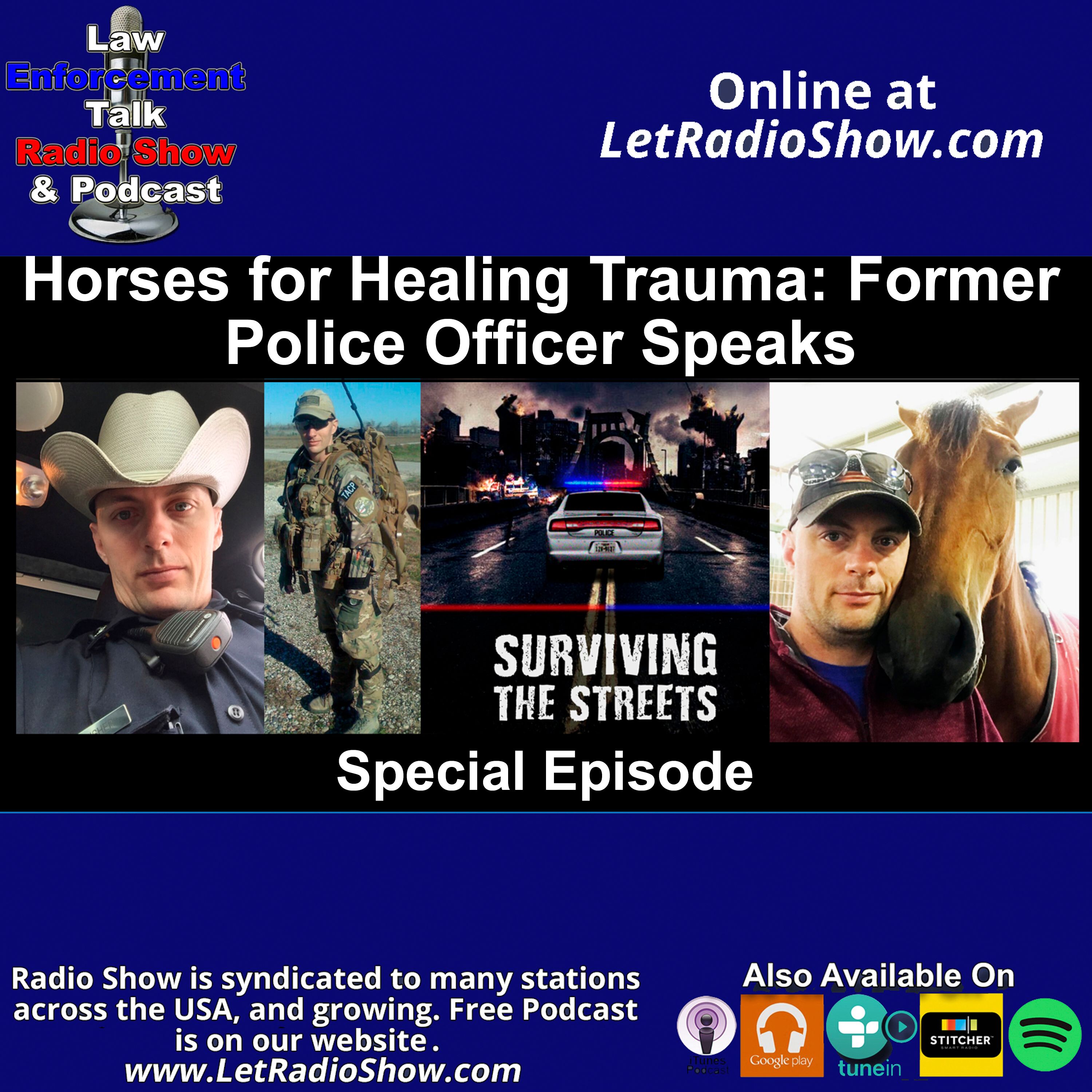
Law Enforcement Talk: True Crime and Trauma Stories
Horses for Healing Trauma: Former Police Officer Speaks
00:38:29
Horses for Healing Trauma: Former Police Officer Speaks. A former police officer opens up about losing his partner, battling PTSD, and how horses helped him heal. Listen to this powerful special episode.
Loading summary
Transcript85 lines
- [00:00]
A
He's a former police officer, member of the United States military, and a podcaster as well. A line of duty death of one of his partners, someone he was responsible for, had a profound impact on him. Combine that with marital problems, alcohol, self medication, it all became too much. He's here to talk about what happened, his life afterwards and what he does today. Welcome to the law enforcement talk radio show. In the law enforcement talk radio show, we are joined by special guest talking about their experiences, their realities of investigating crimes, plus those who have experienced horrendous trauma. Police, first responders, military and victims of crime share their stories. Hi, I'm John J. Wiley. In addition to being a broadcaster, I'm also a retired police sergeant. Be sure to check out our website, letradio.com and also like us on Facebook, search for the law enforcement talk radio show. Of all the radio stations in the United States, there are no other shows like the law enforcement talk radio show. And on Facebook there only one official page. Do a search on Facebook for the law enforcement talk radio show and be sure to like the law enforcement talk radio show Facebook page. Calling us from Texas, we have Nate Fisher on the phone. Nate is a former law enforcement officer. He is. Well, he went through the wringer. And I'm really grateful that you have decided to come on the law enforcement show, Nate, and tell your story. It's very much appreciated.
- [01:30]
B
Yes, sir, Absolutely. I appreciate you having me on.
- [01:33]
A
I think we connected via Facebook and I sent a message to Nate. I don't do this often, but every now and then someone will post something and it resonates with me and I send a message and if they get back to me, great. Nate, you were in two law enforcement agencies before you left, correct?
- [01:50]
B
Yes, sir. Yeah. Both here in the state of Texas.
- [01:52]
A
Awesome. And by the way, thank you for your service in law enforcement. And you're also involved with a branch of military we can't talk about. Thank you for that as well.
- [02:01]
B
Yes, sir.
- [02:01]
A
You went through the ringer trauma wise, and there's no real polite way of saying this. One of the biggest fears I had in law enforcement is having a partner killed or someone severely injured. And I had a guy who worked for me a couple months after I transferred another district. He wound up being shot and killed in line of duty. And I'm still bothered by that. And that was, I think 1989. That's how long ago it was. Those things don't go away.
- [02:28]
B
No, absolutely not. Absolutely not. It always stays with you, no matter. No matter what you do no matter what type of therapy you do, it's still with you.
- [02:36]
A
Yeah. You and you went through this?
- [02:38]
B
Unfortunately, yes, sir.
- [02:40]
A
And before we get into Nate's story, I want people to understand this. When I say my heart breaks for my brothers and sisters of blue, it also means their family members as well. And it also means all the law enforcement officers and first responders that were on scene, the paramedics, the EMTs, all those people, they get scarred by this as well. And let's not forget about dispatchers. They go through this and they have to deal with at the same time. So everybody pays a price.
- [03:09]
B
Oh, absolutely. I'm glad you mentioned dispatchers, because they definitely don't get recognized enough.
- [03:15]
A
Now, I'll be honest with you. I've had several on the show. And one of the things I say is, look, as a cop, part of the reason I wanted a job was I wanted to help people. I know that sounds corny. I know that's what the catchphrase that we all supposedly say, and it came in ideological. It's going to change the world. It's going to do great things. And in many ways, I got changed. And really nothing changed in the process. But as a dispatcher, when you're on a phone with people and you're trying to. You can't reach out through the phone line and solve their problems. You can't make things happen any faster than they are.
- [03:47]
B
Exactly. Yeah. And then you never get any closure because you're not on the scene. Whenever law enforcement officers get on the scene, we get the closure from it. Dispatchers that just take the next call.
- [03:57]
A
Yeah. You know what? I gotta tell you, Nate, I hate that phrase, closure. I used to really big be a big believer in closure and justice and all that. And for many people I've had on the show, there really is no closure. There's another phase, you know, especially when they lost a loved one. It's like, hey, you know, my dad died of lung cancer almost 30 years ago, for goodness sakes. It's been a long time. And the old saying, time heals all wounds, I don't believe is true. I just get more used to it. That's all there is.
- [04:27]
B
Yes, sir.
- [04:28]
A
And I think that's the case for you, correct?
- [04:31]
B
Yes, sir. Yeah. Just with time, it. I've gotten to where I can. I can deal with it better every day as I. As a new day comes. You know, sometimes I still have my bad days where it really hits me, but for the most part, as I move on and what actually Helps is me telling my story about it. That's pretty therapeutic for me. So it helps me move on and be able to handle it and control it a little bit better every single day.
- [05:02]
A
Let's go right into it. Let's. Tell me about the incident where your partner was killed.
- [05:07]
B
Absolutely. It all started on June 11th in 2016. My partner was assigned to me. He was a rookie straight out of training and at this time already had eight years of service in. And I had the most experience on my. On my squad. So the sergeant, lieutenant put him in my district so I could watch over them. Well, we get sent to a noise complaint, and it's something I've always dealt with by myself because you don't need to officers to tell people, turn the noise down. So I kept him coming to me. So we went out there, end up being bnb. This guy rents out to have parties. So we went out there, we tell him to turn it down. They gave us nothing but disrespect to us. So I was like, okay, if I have to come back out, you know, the whole typical, you know, if I come back out here, something's going to happen. You know, I'll write some tickets or whatever. So we leave there, you know, go about our day. Then June 12, 2016, at around 0300 in the morning, we get called back out to this house again. Something I always take care of by myself. I wanted to give. I want to give my partner a little bit more exposure to people being disrespectful to us. So I kept him coming. I never disregarded him, which is something I always do. So I get up to the house. Actually, you know, we always park, you know, a few houses down. So I'm sitting there waiting for my partner. A couple other officers show up because they know they were about to deal with some stuff and some people that don't want us to be there, so they're coming out to help. It was actually a pretty slow night. So we're sitting. We're sitting, sitting around, standing in our. Standing around our cars waiting for my partner to show up. And finally it's taking a little bit. So you know what? Hey, let's. Let's go and start making our way up to the house so we can at least start the process. So we start walking up, and then dispatch comes over the radio and I said, there's been a vehicle accident involving an officer, and the officer's unresponsive. The location that they gave, I knew exactly who it was. I just had that feeling like that's my partner. I know it is. So we run to our cars, hop in on. We take off down the road. I end up passing the other two officers because I need to get to my partner. So we get to the scene. I think I was the second officer on scene, but I was the first one to my partner. So I run up to him and I've been on a lot of fatality accidents. And I see the car, I was like, oh man, this isn't good. I run up to him, I look at him, he has that bright red blood coming out of his ear. And I've seen that in a lot of accidents where the person didn't survive. And I was like, oh, this, this can't be happening. So I reach in into his vehicle to check for a pulse and I felt a pulse. So I get on the radio real quick. As I got a pulse, I got a pulse. As soon as I get off the radio, I'm standing there, I still feel the pulse. And I realize I was feeling my pulse because my adrenaline is going so much. So I took a deep breath, try to calm myself down, reach back in there, and I didn't feel a pulse. I knew he was gone that very instant. I got overcome with guilt because a call that I always disregard my cover on because I can handle a noise complaint. I kept him coming because I wanted him to have some exposure and I just was responsible for his death.
- [08:47]
A
The old coulda, shoulda, woulda, you know, and hindsight is 20 20. It's perfect future vision. It really doesn't exist. We are talking with Nate Fisher on the law enforcement show. Nate is a former law enforcement officer. We turned our conversation. We're talking more about the death of his partner, how this impacted him. Also, we're talking about his podcast and his podcast is called Surviving the streets. This is law enforcement show. Don't go anywhere. We'll be right back.
- [09:20]
C
How would you like a free ebook on tips to improve your health? We're talking about tips you can use for free to add years to your life and possibly improve the quality of your years. Best of all, the ebook is free to Download@Let Healthy.com when we say free, we mean free. No credit card, no sales funnels, none of that stuff. So you can download the free ebook to improve your physical health, all while preserving your financial health. Get the ebook for free today at l e t healthy.com that's@l ethealthy.com again the website is let healthy.com.
- [09:59]
A
Return conversation with Nate Fisher on the Law Enforcement Show. He is a former law enforcement officer. We'll explain why that's important in a little bit. He is also a podcaster. Name of his podcast is Surviving the Streets podcast. He's a member of the United States military. We cannot talk about which branch. During your career in law enforcement, Nate, you had the extreme misfortune. And by the way, your partner who was killed, his family. I say his. I don't know, male, female.
- [10:28]
B
Your partner, he is male.
- [10:30]
A
Okay. When I say guys in particular, that meant men and women. That meant our squad. We didn't care. We never cared about ethnicity, gender, race, religion. Just do your job, and if I need help, just show up. That's all we care. I really didn't care how big you were. If all you could do was hold a hand, then hold a hand. You know, if I was in a brawl and all you could do is grab an arm, a hand, just do that and let us get the guy subdued. So I have the utmost heartache for the family of your partner, and I also have a lot of heartache for you and those who are there. That includes the EMTs, the paramedics, and dispatchers as well. When you said you heard the call for a bad accident involving an officer, you knew who exactly who it was, and you got there. One of my things, and I'm very fortunate. In my career, many police injured, law enforcement, many, many people died while I was there. Often say that the last thing these people saw was the face of a Baltimore police. That's just the way it was. And you tried talking to them and let them know you're going to be okay, and just hang in there and all those things, even if you don't believe it. Did you have that conversation with him? Hey, hang in there. Even though you knew he was already gone, or maybe somehow or another, we could find a way to rectify this and get you alive and healthy again.
- [11:52]
B
I honestly, I didn't. Whenever I checked for that pulse the second time and didn't get one, and seeing the injuries that he had from the accident, I knew he was gone. And like I said, that guilt just overcame me so much that I left his vehicle and just went and sat down on the curb because I literally. I felt like I just killed my partner. And then the other officers, you know, they arrived on the scene and they're doing everything they can to get him out. And I really have to give it to the fire department. They got there, they understood the situation, and they knew that there's no way they could push police officers out of the way to try and try and get a door off or anything like that. So they're just handing the other officers the tools because we're, I mean, it's one of our own trapped, gone. We need be the ones that do something. So they're just handing the tools to the officers as they try and pry the doors open. The only time that they actually had to push the officers out of the way, they had to get the jaws of life out to cut, to actually cut open the car because it was hit that badly as so much damage that they had to use the jaws of life to get about.
- [13:14]
A
It's kind of strange.
- [13:15]
B
And the entire time I'm just sitting on the curb, I just killed them.
- [13:21]
A
All too often we hear the term auto accident. We think, ah, not a big deal, fender bender. And we lose sight of the fact that many, many people are killed in vehicle accidents. And one of the top killers of police in our state. When I say police, that means sheriffs, anybody that's in law enforcement. Another first responders is auto accidents. It's a horrendous thing. And you know, there was a period of time in my career early on where I didn't wear a seatbelt. I had this mindset of, hey, I'm right handed. It would get hung up and I couldn't get out of the car and all that other stuff.
- [13:51]
B
Exactly. And that's how I was, that's how I was actually trained. That's what we're like, do put your seatbelt on.
- [13:58]
A
We started taking it off as we were getting close to the street. I remember a side partner, he got hit in a horrible accident. He had a seatbelt on and he walked away from it. And yeah, he was beaten up and he had lots of bruises and lots of injuries, but no one should have survived this accident. And from that day on and watching things like nascar, when you watch race car drivers and they don't drive without a seatbelt on them, thinking, maybe I should relook at this.
- [14:24]
B
Yeah, exactly.
- [14:27]
A
And it's a thing that's going on in our culture for a long time. And the truth is, you and I as active duty police officers, and I'm long retired and you're former.
- [14:38]
B
Yes, sir.
- [14:38]
A
You have a much greater chance of getting into a car accident. You do. Getting into a shooting.
- [14:43]
B
Oh, absolutely. But that doesn't. I mean, I always wear my seatbelt. Like whenever I first started out as a cop, you know, I was trained not to. So, you know, that Was instilled in me. But as soon as I got out of my cruiser and got into my personal vehicle, it came on. Then policies started changing to where it was mandatory to have it on at all times. Even for the people that were taken to jail. We had to make sure that they had their seatbelts on as well. Just because of all the accidents that are involved with the police.
- [15:15]
A
Yeah. And they're frequent. And I have three things I tell people. The three yeses now I wish I'd really known. And we had very inadequate, but we had soft body armor, seat belts. So there's two S's, seat belts, soft body armor, and the third one is sunscreen. If you're going to be out there working in the streets and you're outside, you're exposed to the sun all the time, put on sunscreen. I know you don't think you need it, but trust me, I go to the dermatologist so often, I'm getting chunks cut out of me left and right.
- [15:44]
B
Oh, yeah. I mean, I use that a lot. Now. My job today, while the cop always worked night. So I didn't really have to worry about it too much unless I was doing an extra, extra job or picking up an overtime shift.
- [15:56]
A
So when this happened, you were an experienced officer. You had eight, eight years on the street and you were considered one of the senior people on your squad, correct?
- [16:04]
B
Yes, sir. I had eight years on the street. My prior department, I was also a SWAT guy, so I had a lot of experience. And then with my military experience on top of that, you know, I had a lot of respect for, from my peers because of everything that I've been through and done to where whenever I spoke, people listened. And I had a lot of respect from everybody. So the fact that, you know, I was off, I felt horrible because I was off on the side, sitting on the curb when I should have been one of the ones helping the guys out. But I just couldn't do it. It was too much for me at that time.
- [16:43]
A
Was it accumulation, you think of everything, or was it just one sudden event?
- [16:47]
B
Oh, the accumulation of everything. I mean, when you're, when you're a police officer, I always say it's about 80% of time that you're dealing with public, you're seeing them at their lowest and you're seeing nothing but the negative stuff. And then the first apartment I worked in, I worked the smallest district, but I had have the most officers in it because of how bad it was to where I was getting the fights all the Time to where I started, including myself from society because I couldn't trust them anymore because I would get. I've been ambushed before where I'm talking to somebody and a couple other people come up from behind me and attack me. I've been through all this stuff that, you know, you see in the movies and stuff like that. So all that was just piling up. And then of course that affects my personal life. So while this was happening with my partner, my partner was, was killed that same week my marriage was ending.
- [17:45]
A
Before we take a break, what was your partner's name?
- [17:48]
B
Indy Ekpanya.
- [17:50]
A
This is Law Enforcement Show. We're talking with Nate Fisher. When you turn, we're going to talk more about the incident that killed his partner, the after effects, how it affected him and his podcast, Surviving the Streets podcast. This is Law Enforcement Show. Don't go anywhere. We'll be right back. Be sure to check out our website, letradio.com that's letradio.com there you'll find episodes of the show available as a podcast after airing on radio. And they're always free. There's 700 plus episodes on there right now. There's blogs. Get information about our sponsors, all that and much more@letradio.com again the website is let's radio.com return conversation with Nate Fisher on a law enforcement show date is a former law enforcement officer in the state of Texas, worked with two agencies. He is also a podcaster in his podcast Surviving Streets podcast and he's a member of United States military. Before the break, you're talking about the death of your partner and you said something I think is very important. I should have been there helping, but all I could do was sit on the curb. Yes, sir, I know there's certain things we're supposed to do, there's certain policies we go through our head, Hey, I do this, this, this and this. When this occurs, this, this, this. When something really horrific happens like this, quite often that checklist or mind of things that we're supposed to do goes out the window and it becomes, and I know it sounds dramatic, a matter of being overwhelmed by your emotions. Is that what happened to you?
- [19:31]
B
Oh, absolutely. Like I said, like the guilt and everything just kicked in and I physically just couldn't do it. I knew if I went up to the car and saw him again, I would probably have really broken down and all the other other officers would have seen it and then they would have to try and take care of me while they're trying to help him. So I removed myself from the situation and sat down and just was just frozen with the guilt and the anger of what just happened.
- [20:05]
A
There's so many questions I'd like to ask you, and my mind is kind of racing, to be honest with you, because I could imagine the situation. I'm so grateful I never had to go through this. However, I carry my own set of guilt from the death of my subordinate, officer and friend, Bill Martin. And yes, there's logic in your head. It tells you, hey, there's nothing you could do. It's an accident or whatever it might be. There's the logic, and then there's the emotional side. And when the emotional side takes over, like the survivor's guilt, I'm responsible. I was supposed to take care of them all these things. And as a sergeant, you take care of your men and make sure they take care of the people. They did the job right. And you're kind of like a buffer. But the number one priority is everyone made it home at the end of the shift. That's what we wanted. Everybody go home, and we wanted everybody to walk away. Okay. And that included civilians and citizens as well. We wanted them to be okay. We wanted to help them as much as we could. And when you can't, that's a pretty powerless feeling.
- [21:08]
B
Yes, absolutely. I mean, I saw my partner there and I knew he was gone. I knew I couldn't help him. I mean, as an officer, you're there to fix problems. You know, we don't take. We don't always take people to jail. We're there to help people and fix. And you're a problem solver. And I couldn't fix this problem. I couldn't help my partner anymore. I was. I was useless at this point. And I was. I was lost. And that's why I just sat down on the curb. And I've had people come up to me after the fact, after years later, like, yeah, whenever I think about it, all I picture is you on the curb. And of course, now that brings stuff back up for me. And I'm just like, yeah, I couldn't do anything. I was stuck on a curb. Because no, motions take over. Logic gets thrown off to the side.
- [22:02]
A
Look, there are many times I cried in patrol car, and that's usually after the fact that when fear would set in and all these other things and. But the guilt part, that's a very subtle thing. And that's something that creeps up very slowly and it stays for a very, very long time.
- [22:19]
B
Yes, sir. And it stayed with me for four years, I would drink because of it, trying to get rid of the guilt. And the guilt actually led me having some real bad mental health issues right after that, because I couldn't sleep for. There's like, three or four days where I didn't sleep at all. And I'm just finding out that my marriage is ending. So I'm. I'm losing my family. I just lost my partner. I'm losing my family, and I'm dealing with all this stuff, and I'm not sleeping. I must look like when I got to work, because my sergeant's like, hey, you need to go home, get some sleep. But, you know, I told him, I don't have any time off. Like, I don't have that much vacation time. He's like, don't worry about it. Just go home. Go to sleep. So I went home, but I'm going home to a. To where I can't get sleep because my marriage is ending. And this is where things really took a turn for the worse for me, because I'm feeling all this guilt from my partner being killed, and I'm losing my family. Me and my spouse at the time, we get into an argument, and I see. I see my sidearm on my. On my end table next to my bed. And this entire time of feeling guilt and everything, like, I'll be. I would be driving. I'm like, I want to drive off this bridge. I don't want to feel this way anymore. So I'm in this fight with my. With my spouse. I see my sidearm sitting on my. On my nightstand, and I'm done. I can't deal with this stuff anymore. So I pick it up, I look at my spouse, put it to my head, and I pull the trigger. And as cops, we always keep a round in the chamber. It's something that you have to do. The gun went click. And I've never had an issue with my firearm, so I was ready to go. I didn't want to be here anymore. I didn't want to feel the guilt. I didn't want to be the one responsible of losing. Losing my. My family. So I did what I'm trying to do. Not the whole slap, racking and slap. The bottom of the. Of the gun, you know, you try, rack another round. And I went to go do it again, and my spouse. My spouse at the time ran up and grabbed the gun from me, and I went. And I left the house and I went. Slept in my truck.
- [24:42]
A
First of all, it's a miracle. You're here because you said a point that we always keep around in the chamber.
- [24:49]
B
Yes, sir.
- [24:50]
A
People watch TV all the time, and the first thing the cop shows do is they show them racking the gun. Semiautomatic.
- [24:55]
B
Oh, exactly.
- [24:56]
A
And that makes no sense at all because who does that?
- [24:59]
B
I mean, no one's ready to go.
- [25:01]
A
Exactly. If you pull the weapon, you need to be ready to use it, and you need to understand the reason why you're using it. And it's not something that's played with. It's not something that is. There's no middle ground with drawing your weapon is what I'm saying. So the fact that you survived that and then your spouse took action and probably saved your life on the second round, the magnitude of that is not lost on me.
- [25:28]
B
Yeah, I mean, like, whenever I try to put another round in the chamber, I honestly, I. I don't recall flying out whenever I went to re rack it to put another round in. I can't remember, but I know I always had one in the chamber. And the fact that it didn't go off, like when I first pulled the trigger and all I heard was the click, I guess surprised me, but I didn't have. Like that. Oh, crap. I can't believe I'm about to do this. Like, you hear a lot of times where someone tries to commit suicide and doesn't work, and they're like, oh, my goodness, I can't do. I can't believe I did this. I didn't feel that way. Like, it went click. I was like, no, I'm doing this. I don't want to feel this way anymore. And I was trying to take the easy way out.
- [26:16]
A
I get that. Was this a bottom for you? You said you went out to the truck and slept in the truck after that. I'm sure sleeping is a mile away of putting it. I'm sure you're very upset and distraught.
- [26:27]
B
Yeah, I went my truck. I actually drove away. I found a parking lot. I said, I went to sleep. I laid there in the parking lot. Well, in my truck. And I just lay there till I don't know. That point in time is really hard for me to really remember a lot. Because during this whole week of filling everything, there's a lot of times where I can't remember things anymore.
- [26:56]
A
I think that might be a bit of a blessing. The older I get, the less I remember things. Finally. That's one of the. The positives about getting older. And by the way, getting older is a privilege denied to many. So I don't mock it that often. I can't do what I used to do. I pay the price. But many of the things that haunted me for so long have dulled quite a bit. We are talking with Nate Fisher. Nate is a former police officer in Texas. He is also host of the Surviving Streets podcast. Member of the United States military. We talk more about life after the death of his partner on the law Enforcement show. Don't go anywhere. We will be right back. One of the questions I get all the time is how can I show my support for law enforcement? We're all busy. We've got busy lives. But there's something oh so simple you can do with our Facebook page. Search for law enforcement talk radio show Facebook page and when you see a post you agree with, that resonates with you, share it. Especially episodes of the podcast. To do all that, just search for us on Facebook, look for law enforcement talk radio show and be sure to click like Return conversation with Nate Fisher on the Law Enforcement Show. Nate is a former law enforcement officer and I'll tell you why it's important in just a moment. I'm from Texas. He is also a member of the United States military and is the podcast host Surviving Streets podcast, the name of his show. The Reason why Former is Important now, there's very few things I will correct people on. I've gotten more diplomatic as I get older. If someone calls me ex cop, I do, I correct them. It doesn't matter who they are. I'll say, no, it's retired. So we have former meaning. You left your own accord. You have ex meaning, usually left in bad standing or were forced to resign or the other one is retired. And, and quite often formers are retired. They just don't have a pension. So for me, that's one thing that's very, very important. And when I say he's a former police officer, that's the reason why I bring it up. You went through many years on the job. All the toll that that takes. And then you had the catastrophic incident where your young partner, just fresh out of the academy, was killed in a car accident. And in the meantime, you're starting to disintegrate. You're starting to fall apart and your marriage is falling apart as well. And then for winter break, you talked about wanting to die by suicide. It was very, very. Was it a quick decision or was it something that's calculated?
- [29:29]
B
It was very quick for me. Like I said, I had thoughts of it. You know, I just like driving off the bridge or something like that. But whenever I was in that fight with my spouse, I saw the weapon and I was like, all right, let's do this right here, right now. Like, I'm ready. So it was very. It was a quick decision. It wasn't one of those where, you know, you have a lot of people that go write the suicide notes and everything like that. It was just very, let's do this right now.
- [29:56]
A
So, thankfully, you did not. You were not successful. You wound up going into your truck and that's for winter break. And explain the process of you're at your bottom, you're suicidal, you're overcome with survivor's guilt. Guilt, feeling responsible for his death. And it sounds like some post traumatic stress issues as well.
- [30:16]
B
Yes, sir. So, like, you know, I continue. I have to continue going to work. I used. I was a very productive officer in both the departments I was in. My productivity went to zero. I ended up sitting at the. At the crash site through most of my shift, just wondering how I could have fixed it, how I could have saved them. And then as time kept going on, you know, I'm going through a divorce now and everything, I end up getting sent overseas with the military. That just kind of removed me from the situation for a little bit because I was the lead guy in the military for what I did. So I had to make sure the job was getting done and everything. So I kept my mind busy. And then as soon as I came home, no, the divorce was over, all that. I'm trying to go back to work, I'm living on a buddy's couch. Reality strikes again, that I have the guilt from my partner's death, and now I have the guilt of attempting suicide. Wayne. Wayne. On me. So when I wasn't on duty, I was drinking to try and suppress everything. I started drinking heavily. As soon as I'd wake up, I'd sit in the garage, had a fridge full of beer, I'd start drinking. Now I started telling myself, you know what? Alcoholics drink alone. And I was, I can't do this. I can't. I can't drink alone. But I still need a drink. So then I started going out and meeting people, trying to, you know, make some friends, because I was with the second apartment I was in. I really didn't know anyone in the city because I moved down to the second department to try to try and save my marriage. And so I didn't know anybody. So I was trying to go out and meet someone just so I wouldn't be drinking alone. And that's how I Met my now fiance, and she's an equestrian, which. So she manages a barn and trains horses. So we end up meeting and, you know, I got a hook because I told her I was still a police officer. And I came up. I get free coffee as a police officer in a lot of places. Like, I can always hook you up with some coffee. She's like, oh, okay. So she was hooked.
- [32:39]
A
That worked.
- [32:41]
B
That worked.
- [32:43]
A
You tell her I said, thank you. I think she let that work because free coffee, free stale, horrible coffee really is not appealing to anybody.
- [32:52]
B
I didn't tell her it was good coffee.
- [32:55]
A
So you met her and is this when your life started to change?
- [32:58]
B
My life started changing. So as soon as I met her and within about two weeks of us talking and start trying to start a dating relationship, I end up leaving the police department. And I left the police department. And it was. Being a cop was one of my childhood dreams. And I left the police department knowing I could never be a cop again because I attempted suicide. So when I left the police department, I became a military contractor. Because my divorce and everything put me in so much debt, I couldn't handle having a financial stress on me anymore. So I became a military contractor. I was gone three to four months at a time. Only home for about 30 days. And my fiance stayed with me during all this. Now, during those 30 days, I still felt a lot of guilt for everything. So during those 30 days, I was spending over $300 a day on alcohol at the bar.
- [33:58]
A
You were a heavy hitter.
- [34:00]
B
Oh, yeah, I hit it very good. Like, for the longest time, my fiance had no idea what dad was doing that, like, she'd be at work working horses and stuff. And then she'd call me up like, hey, where you at? And like, oh, I'm just now pulling up to the bar. But I'd been there for about four hours already. Four or five hours. So finally she started telling me, hey, why don't you come out to the barn with me? I was like, okay, yeah, I'll come out to the barn. You know, give me something to do after the gym and stuff. So I'd go out to the barn and I started shoveling horse, you know, helping her clean the stalls and stuff, and started helping her with the horses, grooming the horses, you know, make sure they're taken care of. And that's where my therapy started. Without me knowing it, my bar tab started dramatically falling. Because the thing with horses, because there's a thing out there called equine therapy. And I didn't know anything about this, but the horses are just like how service dogs can pick up what you're putting off, and then they know something's wrong, so they come to you. A horse, they can pick. They pick up everything you're putting off, but they don't want you to touch them at all. If you're having bad anxiety or just having a real bad day, they. They pick that up. So I was having a hard time getting with the horses to help out my fiance so she can get her job done. So I had to learn how to control myself. I learned breathing techniques. Now I'd take nice big breath in and out, call myself down. Then I could go be with a horse and do what I need to do. I started learning how to handle my exact anxiety, handle my grief, handle my depression. That way I could actually be around the horses and help them. And I had no idea this is all happening to me. Like, I had no idea that the therapy was happening.
- [35:50]
A
It sounds like the horses help you more than they. You help them.
- [35:56]
B
Oh, exactly. They're the ones that provided the therapy for me. All I was doing was just brushing them and cleaning out their hooves.
- [36:04]
A
Did your other half. Did she realize at that point what was going on, or was that later?
- [36:10]
B
It was a little later because we started talking about it. She's. She's an open book. She's very open. And I tell everyone she saved my life.
- [36:18]
A
Absolutely.
- [36:20]
B
Then one of the things that has happened to her in her past is she actually attempted suicide in the past because she went through a pretty big ordeal. And she was an open book about it. And she told me about it, and that gave me the courage and the strength to tell her about what happened to me. And I started telling her about, yeah, the horses are. For the longest time, they wouldn't come to me until I. I started feeling a little bit better. And she was the one that told me about the horses, how they pick up what you're putting off.
- [36:54]
A
We have to have her on a show in the future, tell her story and not so much yours. We're almost out of time. I know that you started a podcast called Surviving the Streets. Tell us about that where people can find it.
- [37:06]
B
Yes, sir. I've been doing it for a year. It's on Apple, Iheart, and Spotify. So basically, I do one to two shows a month. I just have different first responders. Come on. I keep them anonymous if that's what they want. And we talk about mental health. They either tell their stories about their struggle or things that they're trying to do with mental health in the first responder community because we're real big on trying to break the stigma, the bad stigma of mental health.
- [37:34]
A
And you're working on getting a website? You don't have that yet, but are you on social media?
- [37:38]
B
I'm working on getting a website. I'm working on starting a nonprofit. That way we can help provide therapy for retirees and active guys. Because therapy is not cheap.
- [37:47]
A
No, it is not. Nate, thanks so much for being a guest on the show. Thanks for all. You do all very much. Appreciate it.
- [37:52]
B
Yes, sir. Thank you for having me on.
- [37:54]
A
I'd like to thank our guests for coming on the Law Enforcement Talk Radio Show. The Law Enforcement Talk Radio show is a nationally syndicated weekly radio show broadcast on numerous AM&FM radio stations across the country. We're always adding more affiliate stations. If you enjoyed the podcast version of the show, which is always free, please do me a favor and tell a friend or two or three. I'll be back in just a few days with another episode of the Law Enforcement Talk Radio show and Podcast. Until then, this is John J. Wiley. See ya.