← Law Enforcement Talk: True Crime and Trauma Stories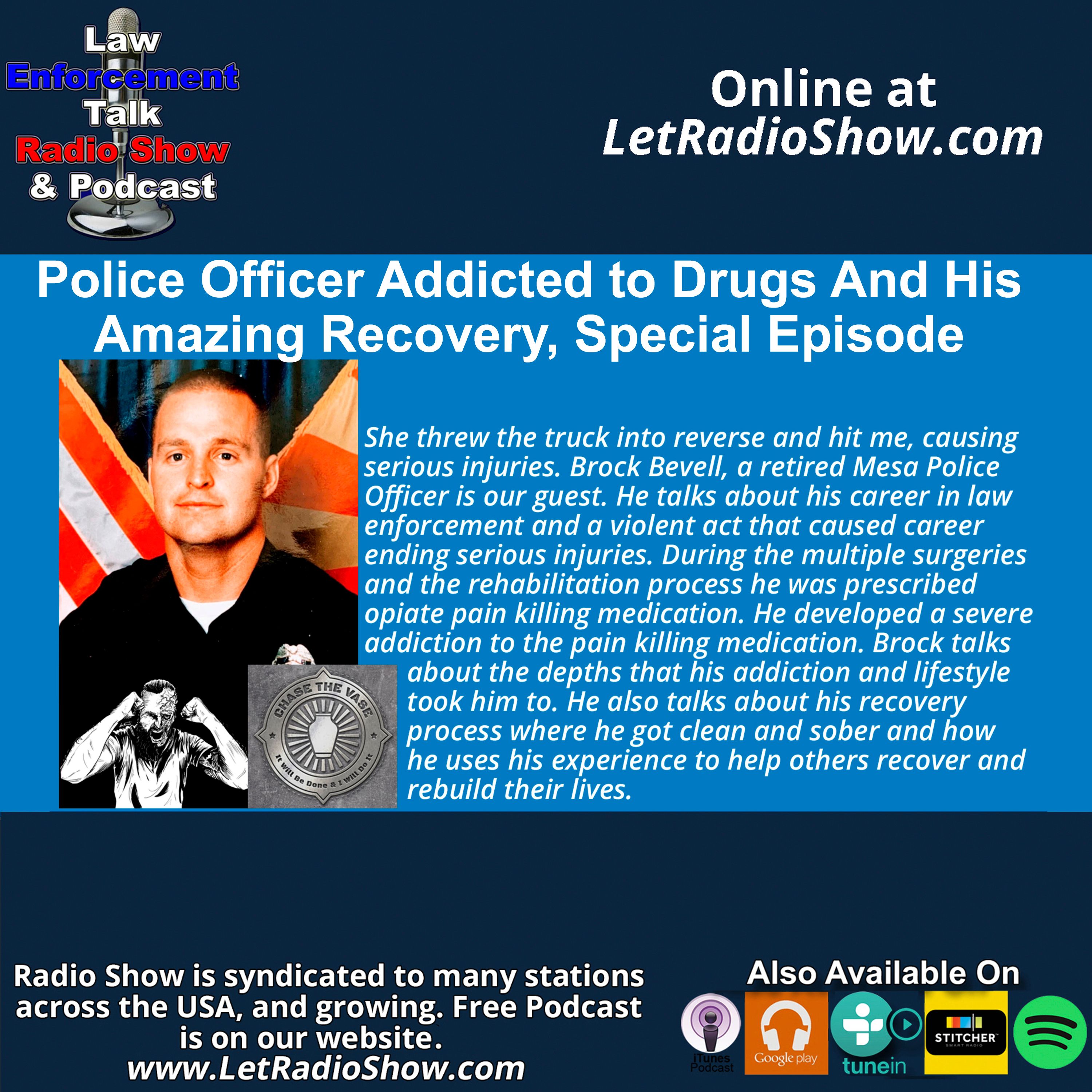
Law Enforcement Talk: True Crime and Trauma Stories
Police Addicted to Drugs And His Amazing Recovery
00:38:30
Police Addicted to Drugs And His Amazing Recovery, Special Episode. Police Officer Attacked, Multiple Surgeries, Forced Retirement, Addiction, and an Inspiring Recovery.
Loading summary
Transcript89 lines
- [00:00]
A
This retired law enforcement officer was severely injured in line of duty, which led to years of medical procedures, years of being prescribed opiates, and unfortunately, years of substance abuse. He's here to tell his story and more importantly, how he got clean and sober and how he uses experience to help others. Welcome to the Law Enforcement Talk Radio Show. In the Law Enforcement Talk Radio show, we are joined by special guests talking about their experiences, the realities of investigating crimes, plus those who have experienced horrendous trauma. Police, first responders, military and victims of crime share their stories. Hi, I'm John J. Wiley. In addition to being a broadcaster, I'm also a retired police sergeant. Be sure to check out our website, letradio.com and also like us on Facebook, search for the law enforcement talk radio show. You can find us on Facebook. Just search for the law enforcement talk radio show and be sure to click like calling us from Arizona. We have Brock Bevel on the phone. Brock is retired Mesa, Arizona police officer. And Brock, first of all, thanks so much for being guest on the show. Very much appreciated.
- [01:14]
B
Absolutely. Thanks for having me.
- [01:15]
A
It's a pleasure to have you here. And I want to thank you for your service as well because that's something I'm trying to make a concerted effort to get better at doing.
- [01:23]
B
Well, I appreciate that, man. That's, that's. It was, it was a good time. Good seven half years.
- [01:29]
A
I find it difficult because I never know quite how to respond when people say it to me. I used to go through a whole big rigmarole. Now I just say you're welcome and thanks for saying that. I understand and know firsthand the difficulties of working in law enforcement. I also understand what it's like to get injured on the job and go through the whole retirement process. And that's kind of your story, isn't it?
- [01:53]
B
Yeah, yeah, yeah. Definitely similarities.
- [01:57]
A
So before we go into that, you spent seven and a half years on the job. What was your primary focus in work? We all started in patrol, or what they call patrol, where I was after that. What did you do? Where did you migrate to.
- [02:10]
B
Specialty units? I went on our bike team, which is a really in Mesa, which is a pretty cool team. Coveted team where we got to do street crimes. And then I moved up to working as a detective in our SCAT team, which is the Special Crimes apprehension team. And then I came back to patrol for the last little while and I.
- [02:31]
A
Did some reading and research on you. You also spent some time doing some undercover work too, as well.
- [02:36]
B
Yeah, that was our, that was The SCAT team. That was our streets crimes unit, where we specialize in prostitution, escort services, massage parlors, drug deals. Yeah, that was the best part of.
- [02:48]
A
The job, I think, of. I think it's an old movie, and I think it's called Nighthawks. Was there Sylvester Stallone and some other people, and they focused on them dressing up as old women to get their purses. National stuff. I actually did that. I wasn't the decoy. I was part of the surveillance team, and it never worked out. But they always looked like cops dressed up like old people.
- [03:12]
B
Well, we used. We used things like that, but we used our female police officers as, you know, the prostitutes, and those worked well.
- [03:21]
A
Yeah, absolutely. We used female officers for, you know, looking like old women get the purse snatched, and they just still looked like young women, just like old people with grayed hair. All this other stuff, it never quite worked out right, but it was all kind of fun. I think it was more of an exercise in, hey, get something really cool for a couple days, and it's a total waste of time, man.
- [03:42]
B
I kind of like the idea, though.
- [03:44]
A
Yeah, it's cool.
- [03:45]
B
It definitely helps with your. With your undercover look.
- [03:49]
A
It is. And there's a big difference. And this is something that I think a lot of Americans don't get about police, and there's a lot that they don't get. But one of the things, the misconceptions is I worked plain clothes for years. I was a plain clothes narcotics detective. I specialize in very violent Jamaican drug gangs, and my job was in surveillance mode. Then you had undercovers who would do drug buys and other things of that nature. And then you had deep cover, where people are like Donnie Brasco's of the world, where they're infiltrating organized crime. And they do that for years and years. And there's a big difference between three. So when people say, I saw an undercover cop today, I go, no, you didn't. You saw a plainclothes guy in an unmarked car, didn't you? And they're like, what's the difference? And it's a big difference. And it all takes a different toll on the Austrian family, isn't. Am I correct on that one?
- [04:41]
B
Yeah. I mean, being plain clothes, that's pretty basic. You know what's interesting is when you have the eye when you're doing surveillance, and you're the one calling it out, I think for me, that was more stressful than actually doing the undercover buys.
- [04:57]
A
Yeah, that's the part I did. And fortunately, everybody's fine. All the time. There were some really, really close calls. And people did get hurt, unfortunately, on both sides, you know, officers and also the bad guys, for lack of better words. And. But thank God everybody went home at the end of the day. I know some cases in Baltimore, in particular. Detective Marcellus Marty Ward was doing an undercover buy. He was wired up. DEA and Baltimore police were there. And I was a rookie. I was very young, on job. And he was shot and killed on tape with backup right outside the door. And it was. It's a horrifying thing that will forever affect the families and the city as.
- [05:37]
B
A whole, I believe, man.
- [05:40]
A
Yeah.
- [05:40]
B
I was blessed never to have to listen to that or hear that. So you were the guy to handle it for sure.
- [05:49]
A
Thank goodness I didn't have to handle that one. I've got my enough baggage, Brock. I don't have that one to deal with. We're gonna talk about your career. And part of it, it was if your career is like mine, it was great. It was a lot of fun. It was awesome. I loved every part of it until I didn't love it anymore. And the reason I didn't love it anymore was I started to crack a bit from all the trauma, but it was really the injury that messed up everything. I got hurt. It was a stolen car. He had a lot of crack cocaine. I went to lock the guy up, and as I was trying to reholster my service weapon, a revolver. That's how long ago it was. He got a hold of it, and there was a fight on, and he's trying to shoot me with my own gun. And I was by myself. And fortunately, he lived, I lived. All six rounds were fired off. No one was hit in a devastating manner from the gunshot. He had a slight graze on his abdomen, but I thought I sprained my wrist. And what wound up happening. And it seemed like the weirdest thing was I wound up having three surgeries and two steel plates and a total fusion of my right wrist and part of my hand. And his disabling injury. And I was retired at the age of 33. It was all over.
- [07:03]
B
Wow. And you. So you would understand this. So going from working undercover work, just even as the police officer, going from that speed and then being home, that's devastating.
- [07:18]
A
It's going from full throttle adrenaline rush every day, multiple times a day, to absolutely. There's nothing going on. And I feel like I'm no good to anybody.
- [07:30]
B
Yes. I compared it to being on Nitro Circus every night, then riding a tricycle around the Next day.
- [07:39]
A
And how old were you when this occurred to you?
- [07:42]
B
I was, man, I was early 30s.
- [07:46]
A
Yeah, I wasn't quite ready for my career to be over at that point. And I see people say this, you know, I retired after 20, 25 years. I had my mind goals that I was a sergeant, that I was going to make rank and I was going to try to be, you know, in the admin and try to make a difference in the quality of life for not just the officers, but everybody in the area, the city that I worked in. That was my mind's eye, that I was what I thought would happen. I see people post all the time. Yeah, I did my 20 years or 25 years and I retired on my own terms and you know, I left with my integrity intact and everything else as well. But I felt like I didn't do the whole bit. So somehow my service was somehow not equal to others.
- [08:32]
B
Yeah, I see that. I can feel that.
- [08:35]
A
Did you ever feel that way yourself?
- [08:37]
B
I did. I always felt like it was cut too short, like I was loving it when I was there. I mean, I was struggling with some post traumatic stress. I had been in a shooting.
- [08:48]
A
We got to go to commercial break. This is a law enforcement show. Return our conversation with Brock Bevel in just a few moments. Don't go anywhere. We will be right back. Of all the radio stations in the United States, there are no other shows like the law enforcement talk radio show. And on Facebook, there's only one official page. Do a search on Facebook for the law enforcement talk radio show and be sure to like the law enforcement talk radio show Facebook page. This is the law enforcement show. Back to our conversation with Brock Bevel, retired Mesa, Arizona police officer. Before we went to break, Brock, you were talking about being involved in a shooting and going through some post traumatic stress issues. Would you tell us briefly about the shooting and what happened?
- [09:36]
B
Yeah, it was December 27, two days after Christmas. They were doing the DUI task force. The guy gets in pursuit with our motor officers up here on US 60, big stretch of highway that runs from here to California and so forth. And he's speeding as he's driving. He's telling, he calls dispatch, tells him, hey, back these guys off. You know, this will be my fourth or fifth dui. I don't remember how many. And he flees and ends up coming back into town after about an 18 mile pursuit back into town and gets wedged into a cul de sac where we come fan out to a felony traffic stop. And I'm in the Middle vehicle, I am armed with an AR15. He gets out of the truck, he has a knife in his hand. So we go through. You know, you're seeing a lot on the news today, but we went through and did everything with the use of force continuum, you know what I mean? Like, it was so we had so much time to work on this guy. So we gave him verbal commands, soft hands, hard hands. We bean bagged him. We canine him, we pepper sprayed him. We had an entry team go up and try to grab him and pull him down on the ground, and nothing worked. When he got hit with the beanbag twice in the kidney, I was like, oh, my gosh, this guy's not going down. And he got back into his vehicle, put it in drive, and drove head on to my police car, where I shot him through the windshield and killed him. Right? And so I remember approaching the vehicle, us pulling him out, gunshot wound to the face, and he was. He was dead. I mean, and I knew I shot two rounds. I knew he was dead, but it was like, I remember where my mind. When I was off, I was like, what is it about this alcohol that makes people do dumb things? And I was angry. Right. Well, fast forward. A couple months later, I'm in a deposition with his mom, his sister, and his dad, and the dad. And after the depo, off record, Mom's like, hey, can I ask you a question? And I'm like, absolutely. My attorney's like, hey, you don't have to answer this. But I was like, you know, I want. I'm a parent want. I want to help this lady sleep at night. And she asked me, hey, officer Bevel, if you had a chance to do it again, would you kill my son? Now, that's a difficult question. You know, that's a difficult question. So I answered. I took a step back and said with my training, with the information that I knew I would have done it again. I would have to. My job was protect life of my other officers. And as he got into the vehicle, drove at him. That was my job. So, yes, I would. But taking that away, you know, that was a big struggle for me, that answer, talking to that mom. It kept me up at night. You know, I kept wondering, should I have worded it different? Should I have lied? Should I minimize the situation? But then I'm like, where is his responsibility? You know, where is his ownership in this whole shooting? And so that right there is where I believe my. My PTS started. And then let's fast forward it four months, we're doing an investigation. We got some information, street level intel, that a lady was going to come to this location and prostitute her daughter in exchange for drugs. And you know how street level information is, it's never accurate. But on this date and this time it was the vehicle that was described, pulled up, the drug dealer rode up on the, on the passenger side, who goes to remove the 12 year old daughter. And we infiltrate, we come up and stop the scene. Well, once everything was in control, mom, the driver decides to run us over. So she throws in an act of haste, in an active desperation, she wants to get away, she knows she's going back to jail. Throws her truck into reverse and my right foot gets caught under the tire and I go to pull away and it breaks my ankle. And then I step with my left foot to brace myself and she runs and hits me right above the knee in the hamstring area and blows my leg out. And so I'm on the ground, my partner, he's in the front, he gets run over, she runs over his back. And so we were close to the vehicle that described, we were able to detain her, arrest her at the scene. And I just remember how. And there was drugs in the car, right? But I remember how angry I was. I was like, what is it about these drugs, about this alcohol? Because I wasn't a user. I was a clean cut kid, born and raised in Scottsdale, huge family, church going, right. And then I see this effect that these drugs had on people and it didn't make sense to me. How would a mom bring her daughter to a scene to be exchanged for drugs?
- [14:31]
A
I've never understood it and quite honestly, and I tell people this all the time in our prisons. I can't speak for Arizona, but in Maryland a large portion of the population that's in prison wouldn't be there if it wasn't for drugs and alcohol. Another portion would only be there because they made one bad decision in life. They had 10 bad minutes in their life where they made a bad mistake, a fatal mistake, and they're paying the price for it. And, and the rest are hardcore career criminals, but there is a small percentage, they're minority of the prison population, most of them drugs and alcohol. And earlier you talked about beanbags and pepper spray and all that stuff. We had an old saying in our department, the mace they gave us, this is a long time ago, the mace they gave us only worked on innocent bystanders and police. It never worked on drunks, it never worked on people that were drugged out of their minds. It never. And you could try compliance, pain points, all that stuff. If someone was out of their mind on pcp, that didn't work either.
- [15:32]
B
Nothing.
- [15:33]
A
And nothing worked. And it almost always escalated to some sort of force that the officer never wanted to do.
- [15:41]
B
But you got to detain that. You got to control the situation or.
- [15:44]
A
Defend yourself and the lives of others. You made a great point. Listen, I was never comfortable, and I'm still not comfortable with the amount of violence I had to be capable of in certain situations. But it was done because I had to prevent myself from being injured further or someone else. And it's a kind of a. It really is. At least in my case. I think of myself as a civilized guy, you know, I don't need to resort to that sort of stuff. And I'm above, above and beyond that. But somewhere deep down inside, there is part of us that is very primitive. And when push comes a shove and when it comes to life or death, we're capable of extreme violence. And it's not comfortable to have to live with that.
- [16:30]
B
No, not at all. And you're seeing that all over the nation right now.
- [16:34]
A
It's. And it's very disturbing. It really, really is. Boy, something else you said, you said twice that I have to comment on. You said after these life and death situations, you were angry. I was so angry when people tried to kill me that it was almost not human like. And it was a frightening side of me. And here's the reason why. This is just my opinion. I'm not a psychologist, I'm not a psychiatrist. I'm not a whatever. I'm just an old retired street cop. Fear is a necessary human emotion that helps keep us alive. And when someone scares us at a point where we think we're going to die, the number one reaction quite often is extreme anger. And it is a method of protecting yourself and protecting others. And that's what I had to do. And I think that might be what you're talking about. We are talking with Brock Bevel. He's a retired Mesa, Arizona police officer. This is a law enforcement show. Don't go anywhere. We will be right back. One of the questions I get all the time is how can I show my support for law enforcement? We're all busy. We've got busy lives. But there's something oh so simple you can do with our Facebook page. Search for law enforcement talk radio show Facebook page. And when you see a post you agree with, that resonates with you. Share it. Especially episodes of the podcast. To do all that just search for us on Facebook, look for law enforcement talk radio show and be sure to click like back to our conversation with Brock Bevel on the Law Enforcement Show. Brock is a retired law enforcement officer, retired Mesa, Arizona police officer and part of his job, he was working plain clothes and wound up getting hurt. You mentioned the woman backed up a truck trying to get away. She was trying to give her young teenage daughter away for sex in return for drugs and she didn't want to go to jail. And you wound up breaking your ankle, part of your leg and your partner was running over as well. Am I minimizing that?
- [18:43]
B
No, that's exactly. Broke my ankle, right ankle, tore my left knee up. And so that's where kind of where my life changed. You know, of course you have to go get the surgeries. I had a doctor who I really trusted, really liked the guy. I had had a previous injury that he on a knee, the opposite knee, and he actually had done some surgery and I was able to come back to work from that. That happened earlier in a foot pursuit. Fast forward to this event. I go back to him and I remember him. And this was kind of where my addiction started is when he prescribed me my opiates. He told me, hey Brock, you're never going to get hooked on these things. So I took that as like, okay, well I'm a cop, you know, I understand the street level of it. I understand what he's saying. I'm not going to get addicted to these. So basically carte blanche, I can take this medication. And that was a wicked, a wicked road to travel, if that makes sense.
- [19:44]
A
You're not, you're not alone. This. I've had so many orthopedic surgeries and every one of them and I don't, I don't fault the doctors. I understand why the pain is so intense afterwards that you have to have some heavy duty, heavy hitting painkillers to deal with it. The last one, a great example is I had shoulder surgery from an incident 30 years ago. I got hit by a car and I finally got to this about seven years ago. And it was severe rotator cuff tear and a few other things they had to do. And they said you're going to have to have heavy hitting pain pills and rotate every two hours, otherwise it'll be unbearable. And after five days I was so depressed, I was so scared. I was like, I gotta get something low dose and then go to Tylenol because within seven days I was back on, you know, Excedrin for lack of.
- [20:36]
B
Better Words and cj for me, it was scared of this. I loved it.
- [20:40]
A
Oh, I hated it, Brock. It made me. But then again, I was later in life and I had been a sober guy for, you know, 20 years at that point. So I'm very conscious about what I put in my body. Without going into a lot of details, it's very, very important to me for my physical well being and my mental health. We've had guests on a show that were motorcycle cops that were hit, almost lost a leg, had 23 surgeries prescribed, heavy duty opiates, and they become addicted. Anybody out there with these heavy duty opiates, it's a matter of time. You take it long enough, you're going to have a problem.
- [21:18]
B
You know, Jay, for me, it was the timing of was that was a hard part. So the doctor kept telling me, every time I go in, he goes, brock, this is a major deal. You're probably not going to come back to work. So. And I kept telling him, hey, let's get me back to work. Let's get me back to work. And so, mentally, I'm starting to collapse. Like, damn, what am I going to do without this career? I have all these people, my team, right? And it took me about a year of rehab and recovery before he said, I'm sending in your paperwork to the city saying that you're unfit for duty. Now, for me, that didn't make sense because the more opioids I took, the better my leg felt. But he says, you're a liability to the department. What happens if you get into a fight and he's unstable, you get pushed down the stairs, you're unstable. And I understood that to a point. But I'm like, I can't lose my career. And where it hurt was when I went into the medical retirement board, you sit in front of them, they read your case and they look at you. And these were peers of mine, I knew these guys and they looked at my, my medical charts, etc. The recommendation from the doctor says, hey, medically retired, this guy, he's unfit for duty. And when they said, hey, you're medically retired. We appreciate your service, bring your gear in tomorrow. Man, that was life changing.
- [22:43]
A
Yeah, it's like the door slamming on your face. And literally it felt like to me, five minutes after retired, I was obsolete and no one remember me.
- [22:52]
B
It was all over 100%. No phone calls, nobody coming over, nobody bringing your letters, nobody talking to you. You don't know what's going on. When the department, you are isolated, alone, and no offense to them, because they're doing their job, they're going back to work, they're continuing to protect the public. But for me, now, I'm going from that nitro circus to changing my baby's diapers and washing clothes and cleaning the house. And no offense to the people that do that, but I wasn't used to it.
- [23:20]
A
Right. And no, that's admirable to do those sort of things, but it's. Let me put it this way, I used to prepare myself mentally for work. And I try to do my best to prepare myself to go into civilian mode after work. And I say this all the time. It was peeling off the Velcro from the soft body armor was almost like undressing not just physically, but psychologically and trying to go from cop J to dad J to husband J to all that stuff. And I did that well for a long time until I couldn't anymore. And the cracks began to show. When you see cracks began to show, it was what, a year? How many surgeries did you undergo, man?
- [24:02]
B
Tons over 15 on my body. Hand surgery twice, shoulder surgery, knee surgeries, ankle surgeries, just to get me back.
- [24:12]
A
Right. And then during part of the rehabilitation surgeries, you're prescribed opiates, correct?
- [24:19]
B
Yes. And what I did notice though, was with my opiate intake, and this is for like, you had a different opiate. This is where people need to understand addiction, Right. So for me, I love them because I was myself. That depression, that sadness, that sorrow, that longing for work went away when I took opioids. So a lot of people think I was masking my pain from my. It was easy for me to say, hey, listen, I just got run over by a truck. I'm okay to take opiate. You know what I mean? Like that rationalization. But what I was doing was I was. I was medicating my mental pain.
- [24:59]
A
Which came first, the mental pain or the opiate? And self medicating with it.
- [25:06]
B
Well, I had a year to recover, so the medication was good while the pain lasted, but I continued the process. And when I noticed that, I started manipulating my doctors because I had a hand surgery, I had a foot surgery, I had a knee surgery, had three different doctors so I could go in there. It's actually, I think there was two at the time that I could go in there and say, hey, you know, can you. I need a higher dose. And then the other doctor be like, hey, that was making me sick. And I always told everybody that the opioids, the codeine, everything made me Sick, Right. It was because I knew I wasi could shape shift the doctors, what they were going to give me.
- [25:44]
A
The question I have is how far into your recovery from the surgeries did this, did you start to change? Because there is a point where you're being a patient, you're trying to be a good patient, I imagine, and you're trying to take these as prescribed and then all of a sudden a line gets crossed. How far along into that was that?
- [26:04]
B
Probably a year before I started making dumb decisions. And so what I mean by that, so I would say a year to answer that correctly because that's when I started stepping out, doing things that were inappropriate in my relationship with my wife.
- [26:21]
A
Gotcha.
- [26:22]
B
Right? Yeah. So, so my, my addiction started carrying on in. I wanted that adrenaline, I wanted that back and I didn't have it and I didn't know where to go to get it. And so I started reaching out to other women via text messaging, pictures and, and, and, and not living the way I was supposed to live with integrity.
- [26:43]
A
We're talking with Brock Bevel. Brock is a retired Mesa, Arizona police officer. To make his story very short, he was injured in line of duty, had multiple surgeries, was retired. During the course of his medical treatment, he was prescribed opiates and the opiates became a problem, led to substance abuse, which led to addiction. And he's here to talk about that. When we return, we'll talk more about how bad things got and then how much better things got. This is law enforcement show. Don't go anywhere. We'll be right back. Do you want to be a guest on law enforcement talk rated show and podcast? It's really quite simple. And before you get into this notion that I'm not a cop, I wasn't a cop, I don't have something contribute. Well, the show is about investigating crime. That's one aspect of it from the real life perspective of those who did it. And then it's also about trauma, how trauma impacted them, often crime based, but not always. Our guests quite often are law enforcement officers, other first responders, military victims of crime, their spouses or survivors talking about how trauma impacted them, what happened, how it affected their lives, and how they rebuilt their lives after. If you want to be a guest, just contact me. It's really simple. Send an email to jayetradio.com that's jayetradio.com or go to letradio.com and the contact us page and you can get me right there as well. Return to conversation with Brock Bevel. On the law enforcement show a very necessary conversation because we have a nationwide problem with people becoming addicted to opiates and then getting that supply of the opiate medication turned off and switching to heroin. Fentanyl, and it's a deadly combination for some. I don't know of any family who's not been touched by this. Brock, I'll be honest with you. It may seem in your case at times, I'm sure there was a time you felt like, it's just me and I'm different and all that other stuff. This is a nationwide problem, am I correct?
- [28:54]
B
It is. Mine was a while back, a little while back. So it wasn't as accessible or acceptable. Nobody really knew about it. And that was one of my problems. I didn't talk about it. Nobody knew what I was going through. And the reason was, is because I'd alienated everybody. And, you know, like you said, I worked undercover, so I knew how to talk around it. I knew what the signs and symptoms were. So the opioid addiction took me 10 years. Lost my marriage, lost the family. My kids were struggling with the divorce. So in the months of it, that's. That's where I started losing. I completely lost my path during that.
- [29:36]
A
Downfall, when things got really, really bad. Did you ever find yourself in a situation where. And I'm not talking about being ashamed of something you've done. That's a different. Different deal altogether. I'm talking about. Did you ever get to a point where you became ashamed of who you were?
- [29:51]
B
Oh, absolutely. Two. Two things happen. On one occasion, I honestly contemplated, had a gun to my head, was going to commit suicide. That was. That was one of, like, my bottoms. I'm like, I am not this guy. And as I pulled my service revolt of a service weapon up to my head, I heard my son, who was young at the time, say, dad, you're not a chump. You're not going out this way. He wasn't in the car with me. And I'm like, wow. The other one was when I just noticed how far I had fallen from a standpoint with my relationship with Christ. Like, I just. Everything that I thought I believed in, I went the opposite. I was having multiple relationships with women. I was just not living the way I was supposed to live. And so that, for me, was. I completely lost who I was.
- [30:46]
A
I've met many people who've talked about, especially in the police world and also a lot of our military veterans and firefighters as well, that are in high stress, high adrenaline jobs that when the rush is over. They look for something to replace that rush with, and this never happened to me. But chasing illicit relationships or relationships you shouldn't be in sexually, is a rush that replaces some of that emptiness. And while I didn't understand it back in the day, I do now. I'm not condoning it. I'm just saying I get it.
- [31:17]
B
Dr. Absolutely. Absolutely. You were looking for it. I was looking for it, man. So that was a huge struggle for me. So once I realized that was going on, I finally, after 10 years, made the decision to detox. Right. I'll make this really short. But what happened was because I'd been in so many drug houses, I went into my bathroom, opened my cabinet, pulled out a pill, took the pill, shut it, and the mirror shining a glimpse into my bedroom, and it showed me what a disaster I was living in. And I'm like, dude, you live in a crack house. And at that point in time, out of haste, and this is where my addiction probably took the. This was a big mistake that I want to caution everybody out there not to do, but this is what I did, because I'm a type personality. I got angry, opened the cabinet up, dumped all my pills in the bathroom and the toilet and dumped them.
- [32:15]
A
Dr. And that's really dangerous because people need to understand if you have a specific type of drug addiction problem and alcoholism problem, detoxing, withdrawing can be fatal. It can be fatal. So you need to get medical attention. I know it sounds corny. Like, people go, I'm going to a detox. Listen, I'm not going to hold that against anybody. As a matter of fact, it's better than suffering and prolonging the misery. It really, really is. If that's what you need to get better, then go do it.
- [32:46]
B
Yeah, that was the worst mistake of my life. Because then I realized, dude, you're out of medication. You can't wean off. You can't do anything. So I was there. I was in it. And that was. That was my rock bottom, and that was my. That was my pivot point.
- [33:00]
A
So you decided, I'm done. I'm throwing everything away. And then how bad was. And I'm gonna use street lingo, how bad was a dope sickness?
- [33:09]
B
Worst thing I've ever gone through in my life, honestly. It lasted seven days. My body felt like it was breaking. My bones were becoming something like they were brittle. My teeth felt like they were gonna come out of my mouth. I was throwing up. So at the beginning, so much. And then I was just dry heaving. I felt like every time I was coughing, my back was gonna break. I mean, it is, it is. That's why people don't want to get off opioid, because that dope sickness scares them. And. But I didn't have a choice. I couldn't go back to my doctor. I had just had a refill. So I knew that if I went back to him, I was done.
- [33:43]
A
You'd be busted, for lack of better words.
- [33:47]
B
And you asked about rock bottom. I was actually even at the time, selling some of my. Or giving my pills to a buddy who was taking them down, selling them and bringing me cash. So being a detective, being an undercover cop, knowing what I was doing, become an addicted, becoming a dealer and becoming what I hated.
- [34:07]
A
That's what I was going to say. I'm not saying it's to be judgmental, but you became the person that you used to arrest.
- [34:14]
B
Absolutely, 100% I was.
- [34:16]
A
And the feelings I'm sure of, hypocrisy of, this is supposed to happen to other people, not me. All those things are probably really doing battle in your head.
- [34:27]
B
Oh, absolutely. That was, that was the worst battle I've ever faced of who are you? You have to identify who you really are. And that was, that was, that was hard.
- [34:37]
A
So you got clean on your own. You detox on your own. Tell us about the next couple years of your process of recovery.
- [34:46]
B
You know, I. What was interesting was at that point in time, I didn't even know about aa. I didn't know about the big book. I didn't know about a relationship with Christ. I just did it on my own. I just knew that I had a major problem to opioids. Every time I used, it ended bad. And so I just clear turkey, killed it. Until I was met by a principal at one of my schools. I was working as a assistant principal. And he said, man, your story is pretty cool. Why don't you start a rehab, a drug and alcohol recovery center? And I said, I don't know about it. I don't know enough about it. So I went and did some research. And long story short, I started my own program five and a half, six years ago. And I loved it at first. And then I realized it was not what was healing people and my focus. I love law enforcement, love first responders. So my shift was. It was hard to get these guys out of their homes, right? It's hard to say, hey, come to my 30 day program, come to my 60 day program. Leave work, leave your job, leave your family and come here. And so What I did is I just organized a way that I can meet them online, do a challenge with them for 30 days, give them a pivot point and meet them in their, in their homes. And so that's what I do now. That's what I've, I've done with. My addiction is shifted to help other law enforcement officers not go through what I went through.
- [36:09]
A
So putting your past and the pain of your past to useful purpose today, to help others recover is a way of paraphrasing this.
- [36:19]
B
Every day. That's all I do. I meet with law enforcement officers, first responders on a daily basis and give them hope, give them opportunity to get through this.
- [36:30]
A
And what mechanisms do you use nowadays? We have so much technology that we didn't have back when I was going through my retirement and the dark days, as I call them. We didn't have all the stuff we have today. What are you using to help spread your message?
- [36:45]
B
Yeah, first of all, I have, I have a website called chase the vase.com. i do a 30 day challenge with the spouses as well. I think that's, that's an epic portion that we are missing in. This is the spouses are the first line of defense. Husband, wife, whatever it is, they're the ones seeing the red flags. They're the ones seeing the husband and the wife struggle on duty. So they're the ones that need to reach out because we're the last person to see it. We're in the muck. So for us to say, hey, I got an addiction problem, I have a problem with pts, we're not going to come out and say that.
- [37:20]
A
Right?
- [37:20]
B
So I. You agree with that or disagree?
- [37:23]
A
I agree with you wholeheartedly.
- [37:25]
B
I have a place, the vase.com. i have a podcast called Chase the Vase podcast. Those are two ways to reach out to us and to get a hold of us. Or you can email me at Chasing the Vase gmail dot com.
- [37:38]
A
And again, before we close, you have a website as well. What is that address?
- [37:43]
B
It's www.chasethevase.com and chase the vase challenge.com.
- [37:49]
A
Brock Bevel, thanks so much for your service and thanks for being a guest on the show. All very much appreciated.
- [37:54]
B
Yes, sir.
- [37:55]
A
I'd like to thank our guests for coming on the law enforcement talk radio show. The Law enforcement Talk radio radio show is a nationally syndicated weekly radio show broadcast on numerous AM&FM radio stations across the country. We're always adding more affiliate stations. If you enjoyed the podcast version of the show, which is always free, please do me a favor and tell a friend or two or three. I'll be back in just a few days with another episode of the Law Enforcement talk radio show and podcast. Until then, this is John J. Wiley. See ya.