← Law Enforcement Talk: True Crime and Trauma Stories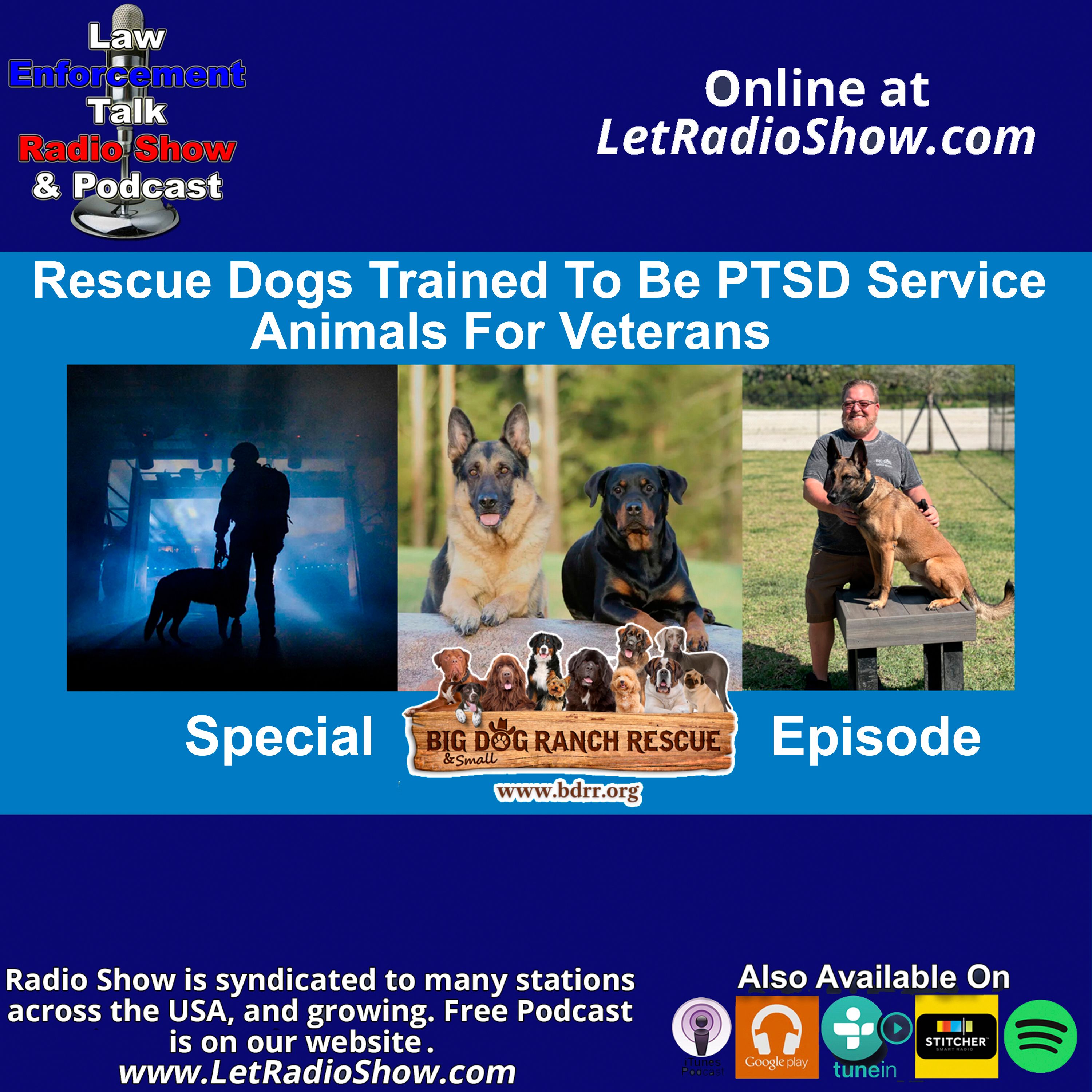
Law Enforcement Talk: True Crime and Trauma Stories
Rescue Dogs Trained To Be PTSD Service Animals For Vets
00:38:31
Rescue Dogs Trained To Be PTSD Service Animals For Vets: From Shelter to Service. In a powerful Special Episode Podcast of the Law Enforcement Talk Radio Show, listeners are introduced to an inspiring story of second chances, for both people and dogs. Brett Simon from Big Dog Ranch Rescue in Palm Beach County, Florida, joins host Jay Wiley to share how rescue dogs are being trained to become PTSD service animals for veterans.
Loading summary
Transcript69 lines
- [00:00]
A
He's a former law enforcement officer, also a military contractor. He worked for years as a K9 handler, both law enforcement and with military contracting. He developed his own post traumatic stress. Now he trains service dogs, PTSD and other service dogs for Big Dog Ranch Rescue. He's here to talk all about it. Welcome to the Law Enforcement Talk Radio Show. In the Law Enforcement Talk Radio show, we are joined by special guests talking about their experiences, their realities of investigating crimes, plus those who have experienced horrendous trauma. Police, first responders, military and victims of crime share their stories. Hi, I'm John J. Wiley. In addition to being a broadcaster, I'm also a retired police sergeant. Be sure to check out our website, letradio.com and also like us on Facebook, search for the law enforcement talk radio show. Of all the radio stations in the United States, there are no other shows like the law enforcement talk radio show. And on Facebook there's only one official page. Do a search on Facebook for the law enforcement talk radio show and be sure to like the law enforcement talk radio show Facebook page. Calling us from Palm beach county area of Florida, we have Brett Simon on the phone. Brett is a former law enforcement officer from Ohio. He's also a former military contractor and he is a service dog trainer for one of my favorite organizations, Big Dog Ranch Rescue in Palm beach county, one of the great, great rescue organizations out there. And you know, I'm a big dog person. We'll talk about that in a moment. Brett, you were training PTSD service dogs, correct?
- [01:41]
B
Absolutely. For veterans returning from Iraq, Afghanistan or any era of conflicts.
- [01:47]
A
Awesome. Thanks so much for doing that. Thanks for your service. All very much appreciated. Both in law enforcement and in the military contractor world and especially as you are now for service dogs. All very much appreciated. I want to go back to your your days in law enforcement. You worked in the Ohio area, Cincinnati, Ohio area, correct?
- [02:06]
B
Correct. I was with the city of Milford Police Department and then I moved to Miami Township, which both border themselves and is right in the Cincinnati, Ohio area.
- [02:16]
A
And how long did you do law enforcement?
- [02:18]
B
I was almost 15 years and nine of those years were working a dual purpose control and narcotics dog.
- [02:26]
A
By the way, I always thought I'm a big dog person. My wife is really over the top. I always thought I wanted to have a canine dog. I always thought that was something I wanted to do. The closer I got to working with canine handlers, the less I wanted to do that job.
- [02:45]
B
It definitely is a unique experience having the dog with you 24 7. The ability to you Know when you're in your cruiser, working to get the call for meeting a dog, or when you're called out from home. So your canine handlers are definitely putting in overtime all the time with the dogs, with the work and training. So. But it is one of the best partners you can have on the street, too, because they're always listening, they always have your back.
- [03:08]
A
My big concern, Brett, was I would have a dog that would be barking non stop in my ear. I love dogs. When he barked nonstop, something about me just goes, can't handle it anymore.
- [03:20]
B
Yeah, at the beginning, they used it, as one of my old lieutenants said, as a deterrent to approaching the car and those kind of things. These days, a lot of our dogs are extremely quiet in the back of the vehicle. Sometimes the siren may get them or, you know, the revving of the engine. They know something's getting ready to happen or the handlers ask for it on command. So get a little bit quieter cruiser than back in the day now.
- [03:42]
A
And you didn't start off as a K9 handler. You started off as a patrol police officer, correct?
- [03:47]
B
Correct. Yes.
- [03:48]
A
That's the way it is for most people. I listen to people all the time say, yeah, I want to be a homicide detective. I'm going to the academy. I'm going right to being a detective. Like, that's not quite how it works. And in Baltimore, where I worked, it was a long list, and I hate to put it this way, you kind of had to be in really good favor to get the canine job or any other specialty job for that matter.
- [04:12]
B
Yeah, we had our department was a three year wait list to get into any specialized assignment. Like you're talking about getting into robbery or homicide, something of that nature. So I waited my three years, but it kind of came full circle for me. So when I was growing up, the area I lived in, the canine handler is one of the reasons I got to really like dogs when I was young. Was my chief of police when I actually got on the police department. So he was definitely in favor of having a K9 and getting a specialized assignment and getting that unit out. So all those times I spent with him, petting his dog and trying to play with him and learning from him, you know, 20 some years later, he hires me, puts me on the street, and then gives me a dog three years later. So it was a great thing to have happen.
- [04:55]
A
What's the biggest misconception people have about police canine handlers and her dogs attacking?
- [05:02]
B
So police dogs, you know, everybody says that the dog Attacked me, The dog attacked. The dog is an apprehension tool. It is not an attack dog. It's not used for that purpose. It's for officer safety. It falls into the use of force continuum. Fairly low for some departments. So it's just. Even though we love our dogs and we love our animals, law enforcement, the military dogs are tools for us to do our job and to do it a little bit more safely. So that attack word has always gotten me in my career is the dog is trained to apprehend a suspect that has committed a crime. So it's not an attack. The dog is doing its job. And we don't use it as an attack dog, we use it as a tool for law enforcement. That's my biggest pet peeve, I would say.
- [05:49]
A
Yeah, and I get it. I remember being a patrolman and having a foot pursuit. And one of the things we were taught early on is the dog doesn't know good guy, bad guy, uniforms or what. If you're, if you're running and the dogs let loose, stop. And we were in a big foot pursuit and all of a sudden someone yelled canine. And we all stopped except for the bad guy. The bad guy kept running and the dog tackled him by his sneaker, ran.
- [06:16]
B
By all of you guys and went after him. So it does happen. I've had maybe one or two bites on the foot pursuit like you're talking about, of officers that didn't stop. But we were at least able to get the dog off and finish out and find the bad guy. So it does happen. But again, like I said, it's a tool for law enforcement to use. We love them. You know, the handlers love their dogs so much. The end of the day, we're there to do a job and so are they. And it's not to attack people, it's just to protect the community.
- [06:46]
A
I have a soft spot for dogs and I have Rottweilers that have one Rottweiler now, we've had them for about 20 some odd years and a German shepherd, and I love them both, don't get me wrong, but ultimately this Rottweiler, we stumbled across that breed quite by accident 25 years ago. Best thing you ever had to meet, best breed for our personality. And before we get into your career, there's a movie coming out, I'm not going to name the movie, and it involves a canine military dog, a Belgian Malinois and a military veteran. And it's a buddy film. And my big concern is people are going to see this and they're going to say, man, I want to have a Belgian Malwa. And they're wonderful dogs. Well, my big concern is a lot of people are not good fits for that breed and they're going to have tons and tons of these dogs being neglected. And I really, that really bothers me.
- [07:42]
B
It's a tough one. You know, it started actually with the Malinois breeding back in the movie Max and then on to another movie with its handler and dog. So people over the years have experienced these highs with the, with these out movie productions of going out and getting a dog. It's like the 101 Dalmatians. Same type of thing happened and you know, the breed isn't for everybody. I found Belgian mountain laws in the mid-90s when I was over visiting Europe and I've been working them ever since. It's not a typical house dog for your normal home because they need a lot of work, they need a lot of space to run, they need a job to keep themselves occupied or else they're going to end up tearing out the household or anything. And the worst thing that's going to happen is they're going to be adopted or purchased from breeders and they're going to end up in shelters which we know that probably over a million dogs a year get euthanized across the nation, if not more. And it's just adding to the population of shelters that are trying to save dogs. So my suggestion is to make sure people are doing their homework about it. While it's a beautiful breed and a strong breed, you have to have the time, the temperament and the ability to work with one constantly to make sure that the dog's needs are met and fulfilled.
- [08:59]
A
Perfect example of what you said is everything about that breed is great for certain people. I am not one of those people. I am not a high energy guy. I don't need exercise. I don't run anymore unless people are chasing me. A gun. That's it. Those days are long gone. We're talking Brett Simon on the law enforcement show. We talk about his journey as a canine handler and police work. Also as a military contractor. What led him to training PTSD service dogs for Big Dog Ranch Rescue? This is law enforcement show. Don't quite aware. We'll be right back. Foreign don't you hate when they do the bait and switch on you when they tell you check out a website and it's free to go there and then there's hidden charges. You won't find any of that nonsense at our website. Letradio.com it's free. It's always been free and it costs you absolutely nothing. There's no hidden tricks. Letradio.com check it out today you find episodes of the show as available as a podcast after airing on radio. They're always free, always have been and always will be. Again, that's letradio.com where it's always free. Return our conversation with Brett Simon on the Law Enforcement Show. Brett is a former police officer from Cincinnati, Ohio area. Also military contractor, served in Iraq and currently he is training PTSD service dogs for Big Dog Ranch rescue. Their website bdrr.org if there's one dog rescue organization you need to know about, it's Big Dog Ranch rescue. They're about 15 minutes from where my wife we love what they do. Brett, I want to go back to your police career. You had aspirations of wanting to become a K9 handler. Were you fully prepared for what was involved with that before making the jump and becoming a K9 handler?
- [11:01]
B
I had a good idea just from learning from other handlers and law enforcement guys that I'd become friends with. My father was in law enforcement, so he actually introduced me to several K9 members of the Cincinnati Police Department and got to know them and then through my career in the beginning I was trying to do shadowing and ride alongs on my off time with K9 officers and going to their training and trying to learn about it. Prior to me getting involved in it, I knew that I'd wanted a dog. I wasn't sure if I was ready for the responsibility that I learned that it was at the time being a young police officer. So it took some time blessed to be able to get in with a lot of great K9 trainers in Ohio area that helped me in my career to make sure that I was doing the right things from the beginning and not learning from my mistakes.
- [11:51]
A
Did you have an overwhelming concern for the safety of the dog? One of the big things for all police is I have nightmares still, even all these years being retired of accidentally hurting another officer or not being able to protect him. Did you have that kind of fear.
- [12:07]
B
With your dog when he was out of sight? You know, we train very hard with our canines. We put them in situations that sometimes they need to be able to handle by themselves until you can get your back up there. If I was holding the leash or with him, my concern was a lot less than when I had to let him just go completely loose off the leash and he was out of my sight and we were trying to catch up. But I Had to trust in the fact that he knew his job and that he was going to do it until he was. Until I got to him or until support got to them to help them out. But we prepare these dogs fairly well. But it's always in the back of your mind when you can't see them, what's going on, what's going to happen with the suspect and the dog, you know, because you can't help him. The time till you get there. So there is a little bit of fear in there. But you also have to have that trust that your dog's going to do its job just like you are to help him, he's going to help you.
- [13:00]
A
The other question is, in many departments the dog lives with their handler and family. Is that the case for you guys?
- [13:07]
B
Yes. Yep. He was an at home dog at the time. When I had him, I was single, so it was fairly easy. It was just me and him in the household. So that worked out for quite some time.
- [13:16]
A
Yeah. I was gonna say if there is a spouse involved or children, that's a 24 hour commitment. With a canine dog, it's not, hey, drop them off, go to work and then go home.
- [13:28]
B
That is correct. We have our care and maintenance time, you know, taking care of the dog, brushing, making sure that they're always in good working order. And then there's also the training time, where it was usually an 8 hour training day for our K9. Once a week we'd meet at a certain place on a Wednesday, certain time, and we would have that time devoted just to our training. However, you know, even from there you could still get called out and have to go to work. So you always had your uniform with you and ready to go.
- [13:57]
A
We rode in one man cars in our department. Did you find a measure of assurance or safety having the canine with you all the time?
- [14:07]
B
Absolutely. Number one, he was, he was there, you know, and made sure that I was watched his surroundings more than I watched my surroundings. They're so in tune with what's going on. And the fact that when you pull up and you see the canine on the side of the car and things of that nature, a lot of people don't want to argue a whole bunch when they hear the dog in the back of the car. See the dog in the back of the car made some of those interesting calls a little bit less interesting. And then just to know that we had the remote bailout systems on our vehicle doors, which I had to use a couple times when I was engaging somebody and was not Being getting compliance. I could hit that button on the side of my belt and the dog would come out from the rear of the vehicle and come to my rescue.
- [14:52]
A
Now, you and I both seen in police work what a valuable tool they are, not just for enforcement investigations, smelling drugs, guns, explosives, the police canine tactical part where they take down fugitives that are running away, people hiding in commercial burglaries, all those things. We just say, hey, we're sending the dog in. 99% of the time, they would give up. When they knew the dog was there, they would give. We had guys, I say guys, men and women that were so good at imitating police canines barking that people would just give up. And there's no dog there. But they're, hey, we're sending the dog in. And he, as one guy particular John, would start barking and okay, I'm coming out. I give up. Put the dog away. So it's a great tool. But what a lot of people don't realize is you've seen this, I've seen it. How valuable these dogs are for service dogs, in particular, PTSD service dogs. We're not talking about the companion animals. We're not talking about that sort of thing. We're talking about dogs with jobs. And their job is to make sure that person is doing the best possible. And by the way, people have physical disabilities, they have service dogs as well. Perfect example are the guide dogs seeing, clearing, whatever it might be, dogs that you need their help for leverage because you've got a walking problem. The PTSD dogs, I don't think a lot of people understand what they do.
- [16:22]
B
They consider, a lot of people consider them as an emotional support animal because they're not seeing a disability for most, for veterans with ptsd, law enforcement, first responders, because you don't see a limb missing or you don't see the cane and things of that nature. So it's really hard for people to grasp sometimes what the, what the purpose is for a PTSD service dog and why it's not considered just an emotional support animal, which is a therapy dog. And the big difference with that is the trained tasks that we have for the PTSD dogs, for the individual veterans and their needs. So, you know, it's really hard to see, but most are going to be marked with just a service dog on the side, have their vest on. And while it's working, we try not to distract them so they can perform the tasks for the veterans.
- [17:12]
A
We're going to take a short break. We're talking to Brett Simon. We're going to talk more about training dogs for PTSD service dogs. We're going to talk about a little more of his law enforcement career, military contractor career and why he is doing this at Big Dog Ranch Rescue. Their website is bdrr.org be sure to check them out. This is Law and Forth show. Don't go anywhere. We'll be right back.
- [17:35]
C
How would you like a free ebook on tips to improve your health? We're talking about tips you can use for free to add years to your life and possibly improve the quality of your years. Best of all, the ebook is free to Download@Let Healthy.com when we say free we mean free. No credit card, no sales funnels, none of that stuff. So you can download the free ebook to improve your physical health all while preserving your financial health. Get the ebook for free today@Let Healthy.com that's ETHealthy.com again the website is Let Healthy.com.
- [18:16]
A
Return a conversation with Brett Simon on the Law Enforcement Show. Brett is a former law enforcement officer. He served in the Cincinnati, Ohio area as a canine handler at the end of his career, last majority of his career and then went to war torn Iraq as a military contractor. And now he is training PTSD service dogs for Big Dog Ranch Rescue located in Palm Beach County, Florida. Their website is bdrr.org and by the way, Big Dog Ranch Rescue, they also do little dogs as well.
- [18:51]
B
One of the things I want, yes we do.
- [18:53]
A
Yeah. And reason I bring it up is I remember years ago I met a Marine veteran and he had PTSD and some other physical things from, from combat and he had a PTSD service dog. And this guy was a mountain of a man. He was huge, big musker guy and his service dog was a chihuahua and believe it or not the Chihuahua's name was Spike. But he said this dog does things for me that no one else can do. And I get what he's saying now, but I think most people don't comprehend what a PTSD service dog does. Can you give a brief overview?
- [19:28]
B
Absolutely. So I'm familiar with ptsd. I was diagnosed in law enforcement after a critical incident and then coming on return from Iraq. Second doctor I guess had to validate my diagnosis of ptsd. But so with the use of the dogs, we're using the dog's natural ability of the bond, the human animal bond and so that the dog is actually reading the handlers and we're teaching them the train commands as well. But just like a person running from the law enforcement, you See the dog tracking, they're dropping pheromones off, they're dropping skin grafts off, and those kind of things. And the dog is. That's what the dog is actually chasing and smelling and looking for. We're doing the same thing with anxiety, hypervigilance, fear. So when those type of things are coming off and the dog is reacting to a handler, we call it disrupting a behavior. Maybe they have their hands in their lap or their hands on their head. We can teach the dog to break that behavior, which will get the person with PTSD out of that thought pattern of what's going on in his head. We're distracting him from whatever is bringing them back to a flashback or back to a situation they may have been in while they were deployed. So that's one of the big things. And then the training tasks for them are pressure therapy. So if a veteran is having an anxiety attack and the dog is trained to go up into his lap, all the way up onto his shoulders, and we're just going to lay pressure against the handler so that he feels that comfort and he feels that support, and that way he can. The dog can be right there. He can be petting him. It's going to relax and calm things down. And then we have a couple preventative commands, is what I like to call it, where if you're working your dog, you'll be facing a counter or register or an atm. Your dog is actually facing the other direction in a sit, and it will notify you of somebody walking up behind for a startle response. Now, these dogs cannot do it by growling, barking, or being aggressive in any type of form. We use a tail wag or the dog to stand up so the handler knows somebody's coming, so that's stopping that startle response. And then another command, which is space control, where the dogs are about three feet in front of us, sitting horizontally to us, and we're basically keeping a distance, keeping our personal space bubble with the dog. Again, no aggression, nothing like that. That is allowing the veteran or the person with PTSD to feel comfortable in an environment. And once they are, they can move the dog to, like, the heel position. But what we want is for the veteran, number one, to get out, because the biggest thing with PTSD is isolation. They're isolated in their homes. They'd only go out, you know, late at night, or they shop at a gas station instead of a grocery store because it's quick and easy. So we want them, with these commands to be able to go out and use them to be to ease themselves back out into civilian life with the use of a service animal. Science says even dogs, everybody has at home, your Rottweiler, your shepherd, if they're loving on them, you're petting them, your anxiety is coming down, your blood pressure is coming down, you're calming down. So the dogs have a calming effect for everybody. It's just those trained tasks that allow somebody with severe PTSD or agoraphobia, whatever it is, to get back out into society and be able to do it with confidence and not have to go to store at 2 o' clock in the morning. So the use of dogs for PTSD and mental health is outstanding and the results are showing with the number of graduates of programs across the country, veterans getting back out and getting back to an active lifestyle with their families and attending events and just doing everything that they can to reach their potential.
- [23:08]
A
Some of the things you said, I think you're taking a lot of what, and I'm no expert by the way, a lot of dog training is taking natural instincts that dog has, like prey drive, whatever it might be, and honing it and redirecting it. For example, he said the dog paying attention pressure. My Rottweiler Doc, when I start getting upset, he knows somehow or another, instinctually, without training, that he makes eye contact with me. He'll nudge my hand with his head, and quite often he'll sit on my foot. And by the way, he's about 125 pounds. So when he sits on your foot, you can't help but notice it. And he does his thing where Rottweilers are great because they keep people away. And he rarely ever growls. All he has to do is look at people and like, I'm not going near that guy.
- [23:57]
B
Correct. And it's true. I mean, the dogs, every dog from you're talking about the big guy with the Chihuahua to a person with the Rottweiler, all of them are reading our body language, they're smelling our what's going on with us, and they're reacting to you to try to help, to say, I'm here, what's going on, you know, lean on me kind of kind of thing if you want to go there. But they are sensing everything we do every day and while we're interacting with them. And like I said, we are just honing those skills that already a dog has and using it to teach them a job to be able to help people. So said it can be from the littlest dog up to the biggest dog, they're There to help us all the time.
- [24:39]
A
Did your own PTSD journey inspire you to do what you're doing today?
- [24:44]
B
In part, it did, yes. So my mom was the big driving force behind me getting back into dogs. So when I went to, I left the police department, I went to work for my dad as a private investigator. He's had a. He was retired law enforcement, I said before, and he had a PI business that we were hoping to run together. And I felt that I could always do more with dogs. And at the time, there was a person that I trained with a lot and helped me out through my career that said they needed handlers to go to Iraq to take the first cross trained tracking and explosives dogs with him for the United States Army. My specialty back then was in tracking. I loved tracking and training it and things of that nature. So I was one of the candidates they sought out. And coming back from there, I didn't notice it. I was living again by myself and didn't see the signs. I knew some of the signs, but my mom definitely was seeing it and she knew that I always loved being around the dogs and working with dogs. So she started researching dogs for ptsd. And about six, seven months later, we founded the organization I worked for last, which was K9s for warriors and with three people. And within 12 years, it's the nation's largest service dog provider to veterans, with almost 800 graduates of the program. So it was her pushing me to be. To get back to myself. I mean, like I said, we all kind of get in a rut or we, you know, just live life and accept the things that are going on. At that time I hadn't given up, but I was pretty down. And I guess I didn't realize it myself until I got back with the dogs. And there was definitely a huge change in my personality, my demeanor, everything, because now it's back to training dogs. And then now not only just training dogs, training them for a veteran, and through my career of it, I've had two gentlemen that I was in Iraq with when they were 18, 19 years old, you know, as young army guys have come through and got dogs after they've been medically retired and receive dogs from our training. So to see it come full circle like that and to have these guys and girls that are still alive because the use of a dog definitely lends me to why we're doing this. And it keeps me in a good place with PTSD and knowing that what I'm doing is forwarding the mission for a lot of People, we're gonna take a short break.
- [27:09]
A
We are talking with Brett Simon from Big Dog Ranch Rescue in Palm Beach County, Florida. That's BDRR.org He's a former law enforcement officer, former military contractor and he trains PTSD service dogs. We return, we're going to talk about the training process, how dogs are selected and a little bit more of his personal story. This is law enforcement show. Don't go anywhere. We will be right back. I'm going to let you in a little secret that's been a game changer for me with social media. You can get details@letpops.com so read, write, letp. It's called chatbots. They're meta partners, Facebook, Instagram, Telegram, WhatsApp and soon to be TikTok. You can turn those people that visit and engage with your content and social media into consumers and then sometimes customers and you can market to them, get details. Best of all, you can get started for free. Let pops.com that's l e t p o p s.com again, that's l e t p o P s.com return to conversation with Brett Simon and law enforcement show. Fascinating conversation from a pretty fascinating guy. He is a PTSD service dog trainer for Big Dog Ranch Rescue. That is the name of the organization or websites bdrr.org they're located in Palm Beach County, Florida, West Palm beach to be precise. And don't let the name fool you. Big dogs, little dogs in between dogs, they do them all. Brett is a former law enforcement officer and also a military contractor. And now, as I said, he trains service dogs. One of the things that a lot of people have, I think, misconceptions about. We talked earlier about the Marine with the Chihuahua service dog named Spike. My personal dog, which is Doc the rottweiler and how good he is and how good Spike was. Any kind of dog, it's not breed specific, can do this type of work, correct?
- [29:16]
B
That is correct. As long as they have the ability to want to, want to have a job and work and have the drive to do it, we can train the task for that particular veteran. Now, depending on the veteran's disabilities is the use of a dog. So obviously the Marine we're talking about with Spike, he didn't need any mobility assistance. So because he wouldn't be pushing on the Chihuahua to help get him up off the ground or out of a chair.
- [29:42]
A
Right.
- [29:42]
B
So here at our program, what we use is the dogs need to be three years of age or younger, 55 pounds or more and right around 24 inches at the shoulder. And that is for some of the mobility commands that we teach. And the age is for the longevity of the partnership of a handler and a dog. We don't want to just have a short span there that they get assistance. We want to make it as long as possible to get enough training in. So between two and three years old, depending on when we get them to train them, which can take anywhere from three to six to nine months to get them ready here at the campus and then bring a veteran in to pair them up. So there is process to it and it takes a little bit of time, but we're pretty efficient at getting it done.
- [30:30]
A
You mixed breeds, pure breeds, all kinds.
- [30:33]
B
We use all kinds. There are some like we're talking about, and you said it earlier, your Rottweiler people see it and they go, maybe go around the other aisle at a grocery store or give a wide berth around you because it's the size and the look of the dog. So we do kind of stay away from cane corsos, American bulldogs, Rottweilers, Dobermans, those kind of things. Because we want the veterans to interact with people. We don't want them to go around the people. We don't want them to avoid. We want to interact them, have them interacting with general public in conversation or even just a wave. It doesn't have to be any more than that. But when people are afraid to be around them or approach because of the breed of dog, we have to look at that. And I saw that a couple times in the program where people would actually go two or three aisles over or one lady grabbed her kid and went really far away from the handler, even though it was the sweetest dog in the world. It was 100 pound American Bulldog.
- [31:27]
A
Right. Well, I get the same thing. People look at me. I'll be honestly, Brett, I tell people all the time, I can be the 85 year old guy in a nursing home with the walker with the tennis balls on the front. They're going, there's 5, 0 and they run the other way. They say I look mean, I look intimidating. And my wife goes, he's just him. So people see me and they, they, they go the other way.
- [31:47]
B
Yes.
- [31:48]
A
Right or wrong, that's just the way it is.
- [31:51]
B
Yep. We want that interaction because again, the isolation and not engaging in conversation is some of the worst behaviors of PTSD that we want to try to break. And we can facilitate that through a dog and it can be a mixed breed of all those dogs I talked about, we just need that little softer look to them, you know, and friendly appearance demeanor so that our veterans can get out and be involved in different things and not have the public perception of having to stay away from them because of certain breeds, which I don't believe in being breed specific at all. I just, I never get that feel.
- [32:26]
A
And here's the reality. And by the way, I do AKC dog shows with, with my Rottweilers. We've done German Schutz and shows. The only thing we don't do is bite work. We don't do that for specific reasons. But our breeder that has taught us so much, he goes, the Rottweiler has to live in today's world. So you can't have a dog like you had in the 70s because it's just, it will not live. Insurance regulations have a lot to do with things. So I get why you do that. I never got that feel from you and I don't ever get that feel from Big Dog Ranch Rescue either. Now I want to go to your dogs that you get. These are rescue dogs or are you bringing in dogs for a specific training?
- [33:09]
B
No, here at the Big Dog Ranch is just all rescue dogs coming from the main shelter, which is our adoption and kenneling area. We are in a separate building off the campus so we can have a little bit more quiet time for us to focus on the task training of the dogs. But they're all brought over from our main rescue mission here at the ranch and brought to our kennels and begin their training as soon as they get here. So we have the ability to hold 16 dogs for our veteran training program. And the ranch itself has the ability to hold over 600 and some odd dogs at any point in time.
- [33:44]
A
Is this for veterans only right now?
- [33:46]
B
For right now it is for all era veterans only. And hopefully one day we open up to the law enforcement, fire, EMS because they're suffering PTSD just as much as anybody else.
- [33:58]
A
Well, you've got advocate who lives like 10 minutes from you that just said anytime you need a little backup in that department, you let me know. But we're working on that. So if someone has a veteran in their family they know has issues that wants to inquire about Big Dog Ranch Rescue and what you do, what's the process?
- [34:18]
B
So they can go to our bigdograntrescue.org and check for the veterans program and there is a link in there to click and it will get an email over to our team who will get in touch with them and send out an application. So there is a little bit of work for the veteran to do. They have an application to fill out that gives us a little bit about themselves, their background, their lifestyles. So we want to match up the attributes of the dog to the handler. And they also have to get some of their military records. We need a copy of a DD214 and also a diagnosis that shows one of the disabilities that we train our dogs for, which again was ptsd, traumatic brain injury, limited mobility, and military sexual trauma.
- [35:02]
A
Thank you for doing that.
- [35:03]
B
And please fill that out. Then we interview them and start matching them, trying to match them with the dog.
- [35:08]
A
Please let everybody there know I appreciate what they're doing very, very much. This type of work is not cheap. Everybody I talk to and I know Big Dog Ranch Rescue is big in fundraising, but everybody I talk to that's in the nonprofit world says that that fundraising is the other F word. This has got to be a monumental task for your organization. How can people listening help?
- [35:32]
B
Oh, it definitely is. I mean, the average cost of a service animal and we're talking seeing, seeing dogs, seeing eye dogs, hearing do, and all the way down to. Not all the way down to, but including PTSD dogs, anywhere from 25 to $40,000 per dog before it even gets placed with a handler. So, you know, that's a big number. But they are getting. We are getting the donations to help out, but we're always needing more for the ranch and for the program. People can get involved by going to the website and seeing some of the different opportunities that are there for fundraising or donations because we are always looking to bring more dogs in and we're building more kennels here in the next year. So there's going to be opportunities that way for naming certain rooms in the new kennel. People get the name Wings or particular kennels after a family member, after military member or a company. So there's multiple avenues for companies or individuals to get involved with the program through, like I said, a fundraising event or donating themselves. They can just go to our website and check out the opportunities that are there. It's greatly appreciated and it definitely helps for our veterans world so that we can keep bringing veterans in and putting dogs out in their hands so that they can get on with their lives.
- [36:50]
A
And you said earlier the cost to bring a dog and train them is about how much total?
- [36:56]
B
Anywhere from 25,000 to $40,000.
- [36:59]
A
That's a big chunk of change. I'm not one of these wealthy people that can write a check. I know people can, but people can do five, ten dollars and it goes a long way, doesn't it?
- [37:10]
B
Oh, absolutely. So that's what I was saying. The other opportunities for fundraising are there, but every dollar that comes in goes right into the program. And like I said, it's saving big and small, small animals and it's also helping the veterans. So anything that anybody can give towards the, towards the ranch mission and to forward that mission just becomes a force multiplier. If we get a bunch doing it, then we can do a bunch more.
- [37:33]
A
Brett, I appreciate your service, all you do. And I really appreciate all that Big Dog Ranch Rescue does. Remember, their website is bdrr.org Big Dog Ranch Rescue. You can do a Google search. Hey, the big dogs, little dogs, rescues, training, PTSD and other service dogs, they do it all. Brett, thanks so much. I appreciate it.
- [37:53]
B
Thank you. Appreciate your time.
- [37:55]
A
I'd like to thank our guests for coming on the Law Enforcement Talk Radio Show. The Law Enforcement Talk Radio show is a nationally syndicated weekly radio show broadcast on numerous AM&FM radio stations across the country. We're always adding more affiliate stations. If you enjoyed the podcast version of the show, which is always free, please do me a favor and tell a friend or two or three. I'll be back back in just a few days with another episode of Law Enforcement Talk Radio show and Podcast. Until then, this is John J. Wiley. See ya.