← Law Enforcement Talk: True Crime and Trauma Stories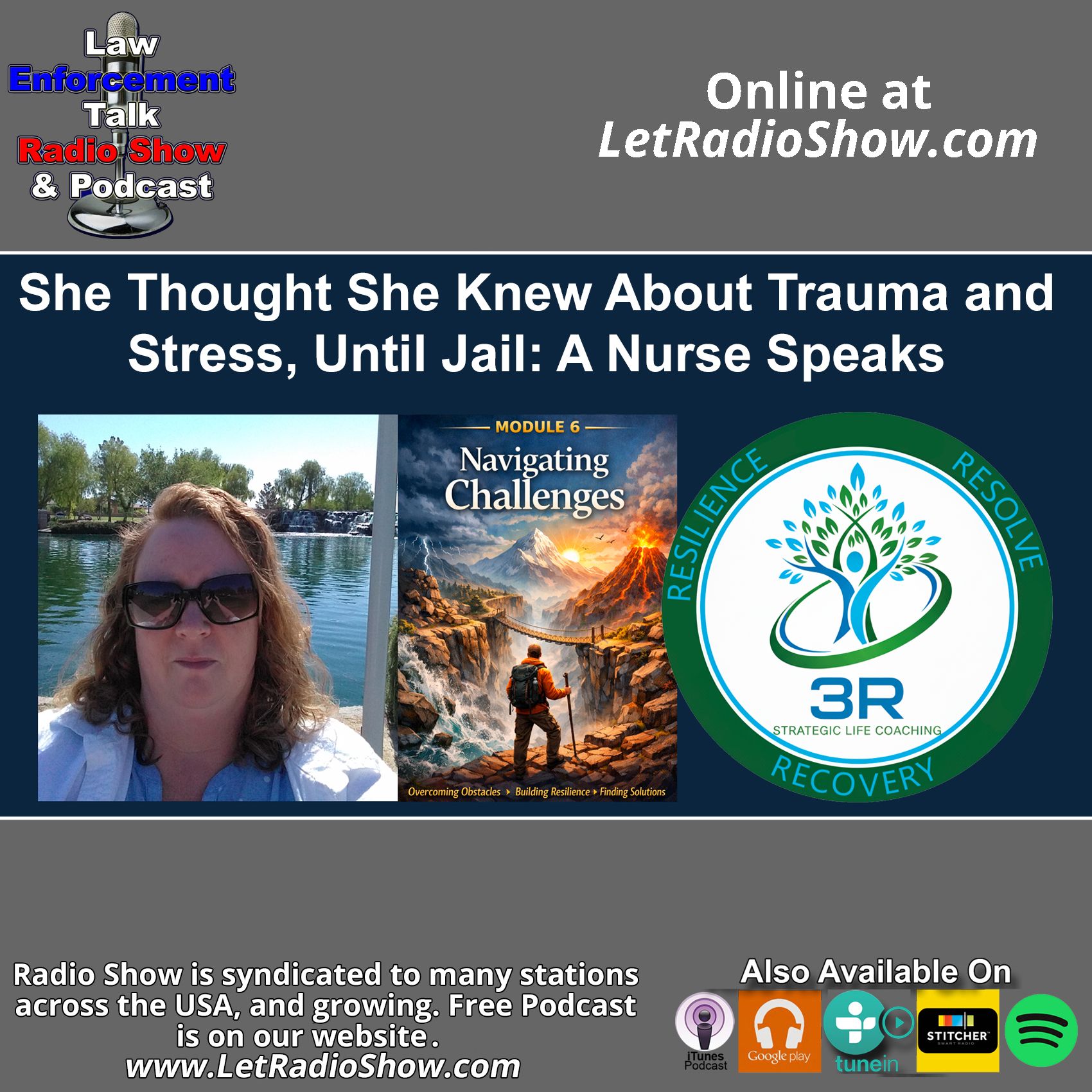
Law Enforcement Talk: True Crime and Trauma Stories
She Thought She Knew About Trauma and Stress
00:40:18
She Thought She Knew About Trauma and Stress, Until Jail: A Nurse Speaks. For years, she believed she understood trauma and stress. As a registered nurse, she had already witnessed illness, injury, and emotional hardship both personally and professionally. But nothing, she says, truly prepared her for what she would experience working behind the secured doors of a correctional facility.
Loading summary
Transcript95 lines
- [00:01]
A
Some would say she went from the frying pan to the fire. Trauma had a huge impact on her and what she did about it. Coming up on the Law Enforcement Talk Radio Show. Welcome to the Law Enforcement Talk Radio Show. In the Law Enforcement Talk Radio show, we are joined by special guests talking about their experiences, their realities of investigating crimes, plus those have experienced horrendous trauma. Police force, first responders, military and victims of crime share their stories. Hi, I'm John J. Wiley. In addition to being a broadcaster, I'm also a retired police sergeant. Be sure to check out our website, letradio.com and also like us on Facebook Search for the Law enforcement Talk Radio Show. There's a couple ways you can stay in touch and keep informed of what's going on with the law enforcement talk radio show. Number one, go to our website letradio.com, sign up for our email newsletter. It's really easy to find. I promise we don't spam you. I send out about one email every two weeks or so. And there's also a feature called Broadcast Channels on our Facebook page where we send messages directly to your inbox, directly to your messenger. Real easy to sign up for. Make sure you like or follow the Law enforcement Talk radio show Facebook page. And up top you'll see broadcast channels one for free podcast versions of the radio show, another one top post of the day so YouTube can stay informed quickly, easily and best of all, like always free. Joining us on the phone from Colorado we have Laura Bulbous on her law enforcement talk radio show. Laura's retired registered nurse, retired rn. She worked in jails. I know, it's just interesting choice and we'll talk about what prompted that a little bit. She is now a life coach and her business is 3R strategic life coaching website is 3rstrategiccoaching.com the3rstrategiccoaching.com Laura, thanks for your service. We love registered nurses. I do. I really, really do. And thanks for being a guest on law Enforcement Talk Radio show. Both very much appreciated.
- [02:06]
B
Wonderful. I'm glad to be here.
- [02:08]
A
It's good to have you here. I gotta ask this. You're a retired RN and my first wife was a registered nurse. She was an emergency room nurse in Johns Hopkins in Baltimore. And to say that she is as salty as I am retired police would be an understatement. Would you describe yourself as salty?
- [02:29]
B
Pretty much, yes.
- [02:30]
A
Yeah, I don't have a whole lot of chill in me when it comes any people's nonsense anymore. And drama and trauma. And who struck John? And he said, she said, I really have no problem. No chill with whatsoever. Is that a fair assessment for you?
- [02:48]
B
Yes. I don't have a whole lot of patience. So that kind of what I became, what I'm working on right now. That is part of what drove me to doing what I'm currently trying to do.
- [03:00]
A
I just had a conversation with a friend of mine before I came on the air. And not to go into his story, but it's like, here's what I told him. When life gets really challenging, especially older, I get and his situation is challenging. Sometimes I have a tendency to want to react, do something. And sometimes the best decision I can make is the decision not to do anything at all, because I can literally jump in a frying pan into the fire and make things much worse.
- [03:31]
B
I understand that too, very much.
- [03:34]
A
So you. You didn't start off like, as an. As an rn. What prompted you to do that?
- [03:40]
B
I started as an LPN and then rose up the ranks for my associate degree and my bachelor's degree. And I was working in nursing homes, and my mother was working for county jail. And all of a sudden, all the nurses left, and she's like, why don't you go apply? I'm like, oh, I don't know about that. I was only three months in to my nursing career, but I went, and the benefits were just amazing, especially with two small children. It was an. I just had to do it. And then it became what I wanted to do, advocating for the patients. And I did some programs through my bachelor's for my capstone course that were related to the jail as well, for discharge planning and making sure that the patients that were on medications before they left the jail understood their meds and what they were supposed to do, because we had some adverse events of them leaving without any of that information. And one patient actually died before even got to the bus stop.
- [04:44]
A
Right.
- [04:46]
B
So you learn those things along the way. I ended up being in charge before I even had my rn because of our staffing was so limited.
- [04:58]
A
Well, that's a good way of putting it. You said earlier in the conversation that you presented with these life changes and occupation changes, and you got your rn, all that stuff, and someone said, apply to a jail because everybody left. Was that a clue to you?
- [05:16]
B
It was a clue, but with two young kids and a husband that was having a hard time working due to his medical conditions, I thought, well, I'll just go out there if I don't qualify. Then I left that to the health service administrator, I thought, what the heck? And she loved me. So Fran's like, no, absolutely. And in I went. It was scary at first, but I did have very good mentors, I have to say, and that made all the difference in the world.
- [05:46]
A
How long did you do? How many years working as an RN in jails?
- [05:50]
B
28.
- [05:52]
A
And after 28 years of being a registered nurse in jails, has it had a tremendous effect on you? Good, bad, or indifferent or both?
- [06:03]
B
It's kind of both. You see both sides of the world. You see, you know, the people that are struggling off the streets, but then you also are working with your colleagues that are struggling as well with other things, their home stuff, things that are going on within their little clicks in the facility. And that kind of why I decided I wanted to do some nurse coaching, because it's hard, especially for officers. There's not a lot of places for them to go to be heard in a safe and confidential space, to kind of just work through some of those issues. It's definitely not therapy, and it's not clinical treatment. It's just a sounding board, really, for you to talk through it. And we ask questions to get you to kind of think more about it. And the amazing piece is it's listening. I found that the listening piece is the biggest part of it because nobody listens to anybody anymore. We're on our phones. We're doing this. We're not actually focused on somebody. And when someone is actually focused on you listening to what you're saying, it's just another experience that some people have never had.
- [07:17]
A
Right? Well, people are shocked when people actually pay attention to what they say and listen and respond to that. Right. And by the way, and I'm not blowing my own horn, but a lot of people ask me, well, what are the questions you're going to ask for this radio show? And I'm like, we don't have real conversations in real life like that. And most of my conversations with my guests, and we've been doing this going on almost 10 years now, that. That I listen to what my guest tells me, and our conversation goes from there. And you're no different. Because what happens on paper is people think, well, I got a pretty boring story. I don't really fit, and they don't realize the power of their personal experience. And we'll get into some of that with you. You said earlier in the conversation your husband has some health challenges and he was not able to work, and you got good benefits.
- [08:10]
B
Are you able to elaborate on that I have. Yeah, I've worked for a long time dealing with a lot of his medical issues. They've just gotten worse and worse throughout the years. And part of that too, it became a blessing that I became a nurse because then I learned so much that I could apply to his situations and what he was dealing with, which were pretty significant.
- [08:40]
A
And how old were you when these life changes came up for you? Because this was I look at my life now and I'm not the same guy I was when I was 20.
- [08:50]
B
I started in 1993 starting my nursing experiences. My husband and I have been married since 1988. So it's been a very long time of processing through and things just continued to kind of get worse and worse through the years. My knowledge made a big difference and I think his at least current outcome when I retired, he's only been a short break.
- [09:20]
A
On that note, we're talking with Laura Bulblitz. She's retired rn. She worked in jails, which we'll talk about a few moments and there's reasons why. And she is now working as a strategic life coach. 3R. Strategic life coaching is named for business and is 3R. Strategic coaching.com is website. This is Law Enforcement Talk Radio Show. We got more coming your way in a few moments. Don't go anywhere. We'll be right back. One of the questions I get all the time is how can I show my support for law enforcement? We're all busy. We've got busy lives. But there's something oh so simple you can do with our Facebook page. Search for Law Enforcement Talk Radio Show Facebook page and when you see a post you agree with that resonates with you. Share it. Especially episodes of the podcast. To do all that, just search for us on Facebook, look for law Enforcement Talk Radio show and be sure to.
- [10:17]
B
Click like if you're an H Vac technician and a call comes in. Grainger knows that you need a partner that helps you find the right product fast and hassle free. And you know that when the first problem of the day is a clanking blower motor, there's no need to break a sweat. With Grainger's easy to use website and product details, you're confident you'll soon have everything humming right along. Call 1-800-GRAINGER clickgrainger.com or just stop by Grainger for the ones who get it done.
- [10:54]
A
Return conversation with Laura Bulblitz on the Law Enforcement Talk Ratio from Colorado. She's retired registered nurse. We talked earlier. She's a little salty, which I am as well, which comes with territory. She worked in her entire, most of her career in jails, which had a profound impact on her. And she is now a life coach. Retired nurse. A life coach. And her name, her business, 3R Strategic Life Coaching LLC. Her website is 3rstrategiccoaching.com Laura, quick question. And I'm gonna phrase this as a formal question. It's more of a personal statement. I cannot stand the noise in jail and prisons. The noise alone and the people yapping and the non stop clatter, all that stuff would be more than I could handle. Did you have the experience when you made that choice? I'm going to become a jail nurse.
- [11:51]
B
In my first position. Not really. Because that facility actually had the inmates locked down into a pod and then locked down into their rooms unless they were out for day room time. So that wasn't too terribly daunting for me. But when I went to my other facility, it was like Alcatraz. And I was like, what did I do? And that was just chaos for me. And they let the inmates roam the halls to come get medicine. And it was just really made me very uncomfortable there. But it was a whole different culture of officers and the workspace. It was very, it was just amazing. I was like, what did I do? I even had to walk tears to pass medications on three tiers with a little tray. And so that became very scary, especially when one actually put his arm out and grabbed me through the bars because the officer couldn't even stand really next to us. They had to stand behind us because the tear was so small. But fortunately for me, he was just messing around, being difficult. And then his roommate, I said, well, if I drop my pills, I'm not coming back. And I don't think your day room's gonna like that. And his roommate's like, you better never do that again.
- [13:09]
A
Right, right.
- [13:10]
B
Because I'm like, you know, I'm not coming back if you're gonna do this. So, you know, there are times and what I learned, unfortunately, sometimes for the better and the worse of how I had to approach things, even with my colleagues, that may not have been the ideal route to take. And so that's when I started learning even more. And that's why I pushed my bachelor's degree so I could learn more. And I was, I did some management and things. But, you know, I am a nurses nurse. Other nurses are admin nurses. That's what they connect with and that's what means the most to them is administration.
- [13:52]
A
Right.
- [13:53]
B
But I'm not that way. I'm a nurse. Nurse. So I advocated for all my staff and my patients when I needed to. Sometimes it became confrontational with the officers, unfortunately, because we have that gap between medical priority and officer priority, which are both very important. But balancing those can be tough, especially with some different personalities.
- [14:20]
A
Oh, yeah.
- [14:21]
B
So over the years, I had. You got to learn some negotiations. Negotiation and kind of pick your battles. And I had to train nurses to do that because they would get angry at the simplest things. And I'm like, that's not the battle you want to take on with this officer. That's minute. You need to, you know, pick the ones that mean something. Not like, oh, you made me leave the pod sooner than I wanted to. I'm like, that's. There's a reason why he did that. But some nurses just can't understand that.
- [14:55]
A
So.
- [14:56]
B
And it makes it very difficult for the rest of us that are working in jails with nurses that have no concept or respect for security.
- [15:04]
A
So I get the sense this is the experience of someone that's done the job for a very long time. But there's a transition where I was young, idealistic, and I learned the hard way. Were you the same way?
- [15:19]
B
Oh, yes. With no. Zero trauma experience, going into a jail, that was not the best idea. I took the opportunity when I could, but I had none of those skills. I had no emergency skills. I didn't have any leadership skills. And there I went. But thanks to my mentors, it was a productive and a positive atmosphere. It was the management that was making it more difficult.
- [15:54]
A
My biggest battles were with management of the police department, not with the bad guys in the street.
- [15:59]
B
No, no. But I was a problem child in the booking area, too, I will admit, because I was the one that would medically accept or refuse patients before we would book them in from other jurisdictions.
- [16:15]
A
Right.
- [16:15]
B
And some of them would bring them in. They were, you know, they were blowing 0.4. And I'm like, I'm not taking jail at a point four. So one of the counties decided that, okay, they would just call booking and find out if I was on duty or not. And then they're like, no, we'll just go over to the ER and then we'll see you. Because I knew I was going to deny their patient. I'm like, no, we had those challenges, too. If he could leave the hospital, when the doctor saying, no, he had a 0.5, and the doctor's like, he is not medically stable. And they call me and say, well, you take him anyway. I'm like, no, right.
- [16:59]
A
No, I get it now. When I was going through that, I didn't, to be honest with you, because there was different mindset, different jobs. And one of the things, I'm not justifying my behavior. I'm just saying you didn't have to fight him to get in handcuffs. So I got him the handcuffs. I got him to detention centers, the jail, wherever it might be. And then they're saying, oh no, you got to tame the hospital and you got to watch them. Oh my goodness. I hated hospital details.
- [17:28]
B
And it's hard because like officers don't quite understand that like I had two nurses in the entire jail. We had 500 inmates. So we weren't too big, but I had two people there. No doctor, you had to try and call them. We had to page them at that time. And you're lucky if they ever called you. So if you really had a problem going on even it was kind of borderline ER or stability. We really had no choice but to send them the ER because I don't have a doctor to see them or treat them.
- [17:59]
A
Did you have any inkling this is going to be the case before you took this job?
- [18:04]
B
No, I did not. And yeah, no, in retrospect, yes, I probably should have gotten more training. Absolutely. But the amount of education, training and real life world of dealing with certain people in certain places in their lives, it's not really very comparable to other places. The hospital and correctional union I work, they did because they dealt with most of the homeless people and people that were really down on their luck. So they would see them throughout this hospital. So in this hospital that I worked in the correctional unit, there was a different respect throughout the hospital for taking care of prisoners.
- [18:56]
A
It's a different skill set altogether. We're talking with Laura Bulbitz and she's retired RN registered nurse. She worked in jails in Colorado for 28, almost 30 years and she's now retired and she is a life coach. The name of her business is 3R Strategic Life Coaching LLC and her website is 3 this is Law Enforcement talk radio show. More about her story when we return. Don't go anywhere. We'll be right back. Are you a fan of true crime shows? How about true crime with a twist? People that actually investigated crimes, what they did, what they experienced or trauma survivors, often crime based but not always impact on them and what they did to build their lives afterwards. All for free. Just go to our website letradio.com it's Ellis Lincoln ease and Edward teasentomradio.com letradio.com you find it all there for free. Return conversation with Laura Bubleston and law enforcement. Awesome talk ratio. Laura's retired rn, Colorado and she was a registered nurse in jails and which we'll talk about in a few moments. And she is now a life coach. Name of her business is 3R Strategic Life Coaching LLC. Website is 3rstrategiccoaching.com the3r strategiccoaching.com Laura I find part of this fascinating because I have a stricter version. My wife will tell you I don't like noise. I don't like unpredictability. I don't like unnecessary trauma. I've been through too much of that in my career. But that's what I think of when I think of jails and I think of prisons a little bit more stable, but jails can be a real nightmare. Are you in the same position as me where you like predictability? And I hate to use the word control a lot of people banner, but I want to control the situation. I don't want too much stimulus. I want quiet.
- [21:06]
B
Yeah, I definitely, I had to learn that in the beginning because it was just, there was just people everywhere. Even in my, the first position I worked in at the jail, piece of it, you know, the officers would be wandering around and doing their thing and, you know, at least I didn't have the inmates walking up to me in the hall, which was a benefit because that was really not appropriate when I went to the other jail. But, you know, it was, I think, you know, I had some, luckily I only had one death on my watch in the jail and it was might have been preventable had communication occurred between medical and the officers. And that pretty much devastated me because I specifically asked the officer to go check on this gentleman because he always took his meds, always. And he's like, nah, he just went up there. I just asked somebody, one of the inmates, and I'm like, okay. So I left and I get down to medical and on my radio he's like, laura, I need you back in the pot. I'm like, for what? He's like, you know what? I'm like, oh my God. And sure enough, he had hung himself with his laundry netting and we did not get him back. And I had never dealt with that, you know, prior in my career. I had some geriatric patients pass away in my clinicals and things, but this was so different. And it was, they knew that he had a lot of stress on him. Because they just separated him from his friend in the other pod that they thought was causing problems with the rest of the inmates. So they separated them and this kid couldn't handle it. And, you know, unfortunately. Unfortunately, I lost it so much that one of my nurses had to take over for me in dealing with the death process and working with the paramedics and working with the coroner and everything, because she had more experience than I did, which I was so thankful for. But you never know what might happen. I mean, with the inmates, depending on where they're at in their lives and what they're dealing with, in a drop of a hat, they can do something very traumatic and kill themselves. And it's not always easy to figure out. You know, you segregate them when they come in. Like our psychology team would talk with them and determine their lethality and then decide where they could help them. But a lot of them, if they really want to kill themselves, they're not going to tell you anything.
- [23:51]
A
There's not a lot you can do to supervise either.
- [23:55]
B
Yeah.
- [23:56]
A
And I think for me, Laura, and again, I'm going to ask you in this form of question, part of the most troublesome thing was that you wanted to do something to save a life, to preserve life, do all those things. But when you. There's so much you can't do, you're ultimately powerless over a lot of these things. And that can be a real struggle in himself. Did you encounter that?
- [24:20]
B
Definitely. I was very frustrated with that officer, and I knew him. It's not like we hadn't worked, worked together for a while, and he knew that inmate very well. And it was frustrating to me that, you know, I'm asking you to do one thing that will take you 30 seconds to go check on him. I'll wait. And he refused to do that. But I have no authority over officers.
- [24:42]
A
Well, that's the powerless part. There's nothing you could do change that. And so you couldn't prevent this guy from doing what he did. You couldn't make the CEO do what he was supposed to do, what you wanted him to do. But the only thing you can do, and I'm. I'm very much aware that this applies to me. The only thing I can do is focus on me and my reaction. Reaction.
- [25:07]
B
Right.
- [25:07]
A
It's a tough.
- [25:08]
B
That's a swallow, even for officers. It's like you have a responsibility to your inmates. There's different levels of that, but you still are responsible for their safety and their security.
- [25:21]
A
Right.
- [25:21]
B
And balancing that out other staff is Difficult because we all have different priorities and there's different focus. You know, one of my administrators held back up an ambulance with a laser to release her from custody before she went to the hospital. So the jail didn't have to pay for it. Well, she ended up delivering in the Sally Port.
- [25:46]
A
Right.
- [25:46]
B
So, I mean, these are the horrifying things you deal with. And it's like that was administration that nothing to do with officers. Our security staff was ready to go. If, you know, she's on the hospital, we will go, we will figure it out and we'll go. And she's like, no. And so the flight delivered in the Sally Port.
- [26:07]
A
Right. And by the way, just so you know, the one thing I worried about the most in my police career was delivering a baby. I did not want to do that. There's a lot of things I did, I did not want to do. But I came very close and I never prayed so much in my life, like, please, dear God, let the paramedics get here in time.
- [26:26]
B
We were so lucky that the ambulance had her in the ambulance when this happened. But she was, you know, she was ready, unfortunately. But we were very fortunate that they got there in time and had her in there to actually have some expertise at delivering her baby.
- [26:43]
A
One of the things. And by the way, it's a very natural thing and we talk about it all the time, but. But it is not natural. My reaction is not natural to it. It is not good. Use the word trauma a few times and they could be good, they could be bad, they can be life threatening, they could be deadly, they could be new lives coming in. All that's traumatic stuff and it has an effect on you. Did that have an effect on you?
- [27:09]
B
Absolutely. Because again, it was another thing I had no control over. I knew it should have been done as soon as she was having contractions as she should have been out of the facility. But you have no control over your administration. They decide for financial reasons what they're going to do or not. But I'm like, it's my nursing license, you know, it's going to come back on me because this was my patient and you stopped her from getting adequate care so that it is so difficult to deal with those things.
- [27:45]
A
So let's go into. You're a different person now than you were before you started nursing, your nursing career in hospitals. Is that a fair assessment?
- [27:56]
B
Yeah, I'm much more assertive than I used to be and I will speak up and say things, but I ended up, when I worked at the jail to begin with, I built a rapport with the officers. They knew me, I knew them. And it just because we talked about things like this might be what happens. This is what we are looking for. Call me if you see this happening or whatever. So we have that interaction. Whereas a lot of nurses go in there, think the officers are there to just walk around with them and give them their meds and they don't do anything else.
- [28:38]
A
Wow. It's a little more to the job than that.
- [28:40]
B
And by the way, that's the misunderstanding know of that they do much more than that. They're with these inmates 24 hours a day at their in their shifts. They know them, they see things. And if they don't feel comfortable reporting things to me that they're concerned about.
- [28:58]
A
We're done with Laura Bovitz. She's retired registered nurse. She worked in jails and when we return we're going to talk about life lessons and did she jump from the frying pan into the fire and how it affects what she does today she's a strategic life coach. Her name her business is 3R Strategic Life Coaching LLC and her website 3rstrategiccoaching.com it's the law enforcement talk radio show. Their short break. We'll be right back. How would you like to improve your health? Let's get healthy tips you can use today for free. They don't require any money at all. You can download a free ebook 15 tips to improve your health at let healthy.com that's LetHealthy.com again it's LetHealthy.com and let's get healthy for free. Return conversation with Laura Bulbus on a law enforcement talk radio shows. A retired registered nurse worked in jails in Colorado and she's the now retired from nursing. She is a life coach. Name of her business is 3R Strategic Life Coaching LLC and her website is 3rstrategiccoaching.com the3rstrategiccoaching.com Laura, gotta ask you a question and this is a statement I make all the time. Number one in policing in Baltimore. Everyone we contacted we didn't arrest and all the people we did arrest, the vast majority of them were if it was drugs or alcohol they wouldn't be in a situation they're in. They're not a threat to you. They're not a threat of violence. There was a few people that made bad choices, had five bad minutes of their life and then there was a very small percentage that were career criminals. And I Say it's the same thing in prison, in jail. Was that your case?
- [30:46]
B
It was especially working as a number one trauma hospital. We had a lot of the people off the streets. And being able to assess those things in jail versus also in an error are still requires that confidence or the ability of that person feeling comfortable to actually tell you the truth. And part of that, I mean, it could be life or death for them if they don't tell you the truth. But they're like, the officers are going to arrest me because I swallowed like five bags of cocaine. And it's like, well, we had people die from that probably.
- [31:24]
A
Yeah, we had people die from those bags exploded and they died.
- [31:28]
B
Yes. And it's that piece of it. And I found with the different areas I worked in, I had officers that were much more connected to people. They would treat the inmates with dignity and respect. And they didn't want to do that confrontation thing. They didn't have to.
- [31:51]
A
Right.
- [31:51]
B
They didn't want to push it and get into a fight. Whereas the other crew I used to work with at a different jail, that's what they. They love that they would push the envelope all the time because they wanted that adrenaline. And it's like, this is crazy. But they would treat them very badly and unnecessarily. And so I had a whole different culture change when I left that first jail. And it was difficult for me at first because I'm like, well, you know, you're just like, acting like their friend or whatever. But they had their confidence, and they had done it long enough that they knew where to draw the line and how to work things right. And it took me a while to really realize that, but I had a sergeant that would go above and beyond to try and get inmates to do what they needed to do. We had some psychiatric patients, and they don't want to take their meds, and it could get very ugly because they. They were emergency meds and we had to give them. So he went above and beyond to talk to that inmate so we didn't have to go in and have the officers pin him to the floor and all of that. So it was quite a shocker to me when that I saw those different cultures. But, you know, I worked with officers all those years, and I always could hear the, oh, well, she said this and so. And so said that. When they are trying to work through something in their lives, and it was. So it's like, who is safe for them to talk to about something that they really need to discuss and work through it's not a colleague because everybody in the jail is going to know about it very soon.
- [33:34]
A
Well, you can't, you can't talk about that. What's the old thing? Loose lips sink ships and law enforcement and corrections. I never worked corrections. But if you tell people the truth about what's going on with you, that could be career and true. And you said earlier in the conversation it was your children and your husband that depended on the benefits. It wasn't just you.
- [33:59]
B
Yeah, exactly.
- [34:00]
A
And that's what people need to be aware of. And by the way, in most police agencies, if you get suspended without pay, your health insurance stops immediately. So if you have like five kids, they got no health insurance, all of a sudden, it's catastrophic. It could be for a week, could be for a month, could be for three months.
- [34:17]
B
Exactly. And there are ways to, you know, if you can talk to somebody and actually work through yourself. It's not like we, as a coach, I don't tell you what to do. I don't tell you, you know, what you should or shouldn't do. Eat or not or not. Whatever we talk about trying to prevent some of that emotional blow up that takes forever for everybody.
- [34:43]
A
That takes forever to overcome. I gotta go back very quickly in our notes it said you became burned out. Would you describe yourself as being burned out from being an RN or being burned out being from being an RN in jail?
- [34:57]
B
As an RN in general, I think. But our administration at the facility was extremely difficult at the time. And we had. My mother in law passed away the year before, my grandmother passed away before that. So there was other personal trauma things too I was working through with my family as well. But the lack of support from administration did not help my matters any. And I decided I just can't do this anymore. I don't have the energy, I don't have the desire or the passion to take care of people like I used to. And I was being more difficult than normal with everybody. And I'm like, this isn't working. And it took me to now three years later, to actually find another path.
- [35:49]
A
And here's a good question because. And I'm just going to personalize this. I used to have a saying. I would say all the time to people, hire a therapist. They're paid to listen to your stuff. I'm not. And the last thing I want to do is listen to people complain about what's going in their life. And I know I'm oversimplifying it, but I find again, I have very little chill when it comes to that, are you that way?
- [36:17]
B
I can be that way, but not in this role that I've just, you know, I've acquired because it's now more of trying to change that person's focus when you're talking to them as to why, why is, you know, why do you feel this way? And it takes it into a deeper level of, you know, why, why is this really causing you this distress? So, you know, so they talk through that and they're like, oh, well, yeah, I guess I have directed my frustration in the wrong direction. I had that with a student I worked with that was mad at her children for taking them to their soccer games.
- [36:57]
A
Right.
- [36:57]
B
But as we talk, that's what kids do. She finally put the pieces together with her husband because he was making her schedule for, for her.
- [37:04]
A
There you go.
- [37:05]
B
And then it dawned on her. She's like, I'm, I'm frustrated with him. I'm like, yeah.
- [37:10]
A
Here's a statement on my part, Laura. I'm not big on life coaches. However, I think if I was going to hire one, I would hire you.
- [37:19]
B
Yeah. I am definitely not here to give you a goal, make you have a goal. I'm here to try and help you work through whatever you need to work through or if there's a goal you want to get to that you don't want to explode two times a day. How do I get there? I want to feel better. I need, you know, I'm burnt out. I need something. And we can talk through those things and provide, you know, you know, sometimes the fluffy stuff as they call it, with a meditation, whatever. But it does help calm the mind.
- [37:51]
A
I'm a big advocate prayer and meditation. I do that daily and it's really, and I hate these over overused phrase. It calms a savage beast in me. It really does. I don't think it's foo foo at all. I don't think it's woo woo at all. Very quickly you transition from nursing to this and your website is 3rstrategiccoaching.com can people get more details about you, what you do, contact you there?
- [38:21]
B
Absolutely. It kind of explains things because nurse coaching is kind of a misnomer. People think we train coaches. We don't. That's not what that means. But it's very confusing. The site explains that a little bit more. And there is a free download if you stick in your email. You get a download for a free how to manage stress little pamphlet that has some of the exercises in it that can be done in the positions that officers work. You know, very simple, very subtle things to try and reset. So that's offered in there as well. And my about story isn't much in there because you know, really what I'm doing right now is not about me.
- [39:08]
A
Right.
- [39:08]
B
It's about who I want to help.
- [39:11]
A
I would strongly suggest that maybe you want to expand that a little bit because you're a wealth of experience. That would have a huge impact. And very quickly, we're almost out of time. Is most of your practice working with corrections officers and police officers?
- [39:26]
B
My whole business is based on focusing on correctional professionals, law enforcement. I'll work with the medical staff as well too. But the things I've kind of put together, we're more focused at officers. I have another, I have a program that's like a six week thing that we kind of go through burnout and emotional triggers.
- [39:46]
A
And on that note, we got to cut things off. We are out of time. Laura, thanks for your service and thanks for being guest on the Law Enforcement Talk Radio Show. Both very much appreciated.
- [39:54]
B
Thank you so much for having me.
- [39:56]
A
Of all the radio stations in the United States, there are no other shows like the Law Enforcement Talk Radio show. And on Facebook there is only one official page. Do a search on Facebook for the Law Enforcement Talk Radio show and be sure to like the Law Enforcement Talk Radio Show Facebook page. I'd like to thank our guests for coming on the Law Enforcement Talk Radio Show. The Law Enforcement Talk Radio show is the nationally syndicated weekly radio show broadcast on numerous AM&FM radio stations across the country. We're always adding more affiliate stations. If you enjoyed the podcast version of the show, which is always free, please do me a favor and tell a friend or two or three. I'll be back in just a few days with another episode of the Law Enforcement Talk Radio show and podcast. Until then, this is John J. Wiley. See ya. The holidays are all about connection, good food, good friends and those cozy moments. This season, skip boring mocktails and celebrate with rk the world's first zero proof Spirits. All the taste and warmth of your favorite holiday pours with zero alcohol, zero guilt and the patented war molecule for that festive kick. Perfect for toasting, hosting or gifting. Celebrate freely with RK0 proof. Visit rkbeverages.com if you like the show, please take a moment to rate, review and subscribe. It really does help the show to grow. Thank you for listening.