← Law Enforcement Talk: True Crime and Trauma Stories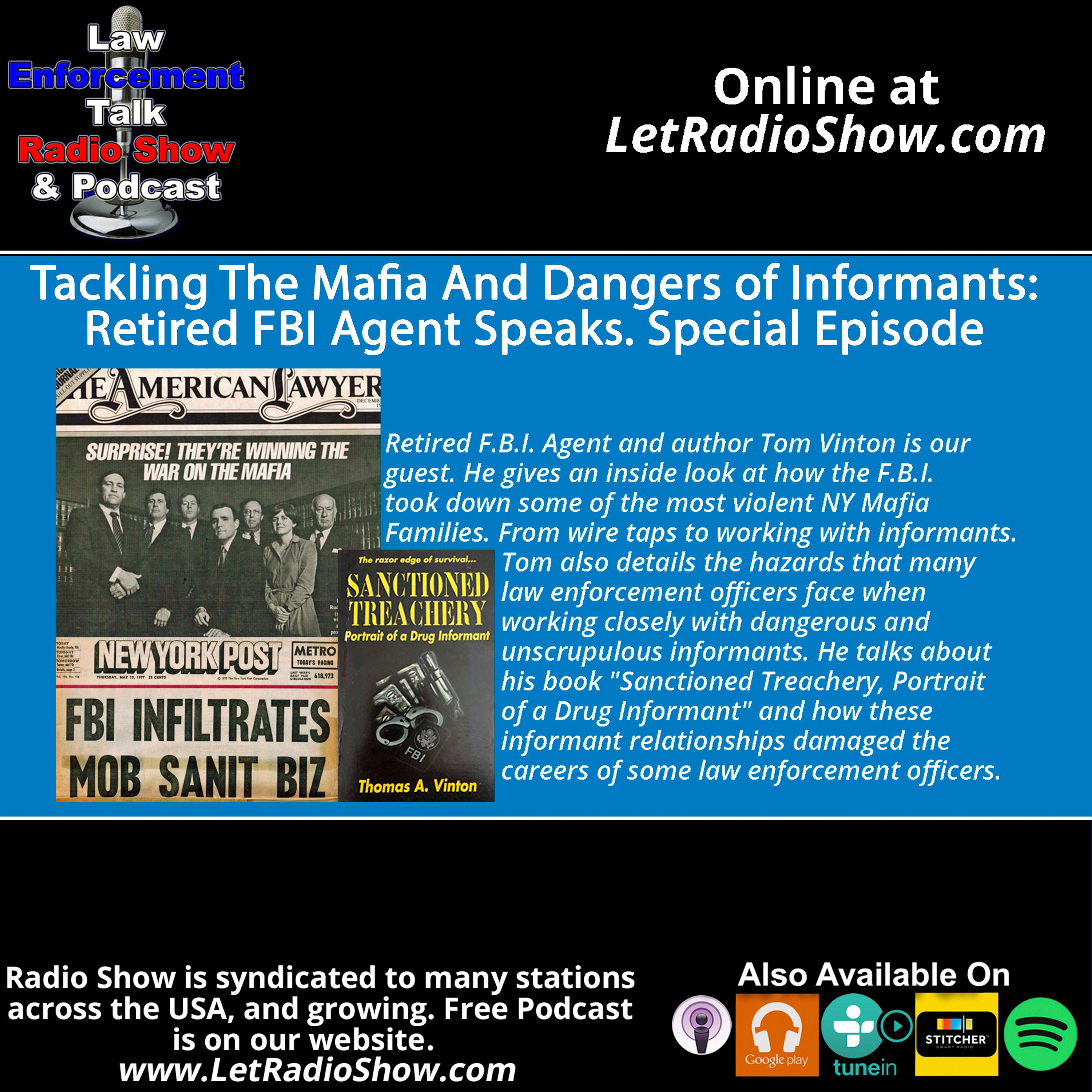
Law Enforcement Talk: True Crime and Trauma Stories
Tackling The Mafia And Dangers of Informants
00:37:46
Tackling The Mafia And Dangers of Informants: Retired FBI Agent Speaks. Special Episode. “This is a part of FBI work the public almost never sees,” Vinton explains. “When you’re Tackling The Mafia And the Dangers of Informants, you’re operating in a world where loyalty is a currency, and betrayal can cost lives or careers.”
Loading summary
Transcript109 lines
- [00:00]
Commercial Announcer
Whenever I need to send roses that are guaranteed to make someone's day, the only place I trust is 1-800-flowers.com with 1-800-flowers. My friends and family always receive stunning, high quality bouquets that they absolutely love. Right now, when you buy a dozen multicolored roses, 1-800-flowers will double your bouquet to two dozen roses. To claim this special double roses offer, go to 1-800-flowers.com wwo. That's 1-800-flowers. Com wwo.
- [00:31]
John J. Wiley
My place in tech changes every day, but I don't fear the future because I'm with the leader, pluralsight, their online learning platform has the hands on expert LED courses I need to master new tech skills and create bigger impacts so I can learn quickly and stay ahead. With pluralsight, I don't fear what's next. I embrace it. Tap in@pluralsight.com and see for yourself.
- [01:00]
Commercial Announcer
Foreign.
- [01:08]
John J. Wiley
Welcome to the Law Enforcement Talk Radio Show. In the Law Enforcement Talk Radio show, we are joined by special guests talking about their experiences, their realities of investigating crimes, plus those have experienced horrendous trauma. Police, first responders, military and victims of crime share their stories how hi, I'm John J. Wiley. In addition to being a broadcaster, I'm also a retired police sergeant. Be sure to check out our website, letradio.com and also like us on Facebook, search for the Law Enforcement Talk Radio Show. Of all the radio stations in the United States, there are no other shows like the Law Enforcement Talk Radio Show. And on Facebook there is only one official page. Do a search on Facebook for the Law Enforcement Talk Radio show and be sure to like the Law Enforcement Talk Radio Show Facebook page. From New York, we have Tom Vinton on the phone. Tom is a retired FBI agent, also author of the book Sanctioned Treachery Portrait of a Drug Informant, which you can find on Amazon. We'll talk about that in a moment. Tom, thanks so much for being a guest on the Law Enforcement Show. Very much appreciated.
- [02:16]
Tom Vinton
Okay, thank you.
- [02:18]
John J. Wiley
Before we get into the details of your book, I want people to understand something. Tom is not Bobby Vinton. All right? Same last name. And I would love for people to think that I'm old enough to remember Bobby Vinton. I'll just say this, he was big when I was a little, little, little boy. So that was a long time ago. You did a full career in the FBI, correct?
- [02:39]
Tom Vinton
Yes. Bobby Vinton. Actually one of my sons has that name. So to answer your question, Yeah, I spent 27 years in the FBI, 25 of those in the New York office.
- [02:51]
John J. Wiley
And you Were big throughout the New England area.
- [02:54]
Tom Vinton
From what I understand, we kind of coordinate investigations throughout the New England area. But our main focus was. Mine at the time, was organized crime and drug enforcement in New York City. They have satellite offices up in Westchester and out in Long island also.
- [03:12]
John J. Wiley
It's an ugly, ugly business, organized crime. I'm no expert in it, but drug game, I do know that very, very well. Before we get into details of your story, tell us about your book.
- [03:24]
Tom Vinton
Okay. The book basically tells the story of an informant, how he's developed and eventually at the end, how he turns against the agent. I came upon this only because I did extensive work in developing and handling informants during my time in the Organized Crime division. And in the introduction of the book, I kind of give an example of how good agents, dedicated agents, got involved with informants and through bad luck, lack of common sense or whatever, ended up getting fired or ended up going to jail. So I take a set of circumstances, peculiarities of the different informants that I handled, and I put together a work of fiction. Obviously, taking one particular one and making nonfiction out of it wouldn't happen because of the. They might have relatives, although all the ones I mention are dead, but they might have relatives here. And also, the FBI would never approve or let you write a book about an actual informant. So I took peculiarities, put them together, and to show basically what could have happened through lack of judgment or whatever reason in dealing with an informant, and how that informant, like a rat, turned upon the agent when he got cornered.
- [04:50]
John J. Wiley
So many officers have lost their careers over this.
- [04:54]
Tom Vinton
Yes, they did. I cite there was, you know, one situation where the. Many years ago, an agent killed a former. A female informant who he was involved with and who threatened, I guess, to expose him. And another who worked for me in New York, who I considered the epitome of integrity, got transferred to another office, was working drug cases, got involved, took some money and jewelry, and ended up going to jail. I could go on with a couple more, but I think probably the most noteworthy, which I cite briefly, is where in Boston, where two ranking bureau officials were fired, one is jailed, is still in jail now. And that's because I think everybody has heard the name James Whitey Polger.
- [05:44]
John J. Wiley
Absolutely. Yeah. And it was John o' Connor was the FBI agent that was implicated and convicted and is doing time.
- [05:52]
Tom Vinton
Well, John Connolly.
- [05:54]
John J. Wiley
John Connolly. That's it.
- [05:55]
Tom Vinton
Right.
- [05:56]
John J. Wiley
By the way, I want people to understand something. I'm of Irish descent. My grandparents immigrated from Ireland. Whitey Bulger and this other guy. I don't know either one person, but they both give Irish people bad name. I'm just saying that right now.
- [06:11]
Tom Vinton
Absolutely. And I think a lot of this occurs because, and I've seen it happen where agents use the term fall in love figuratively with their informant. Yeah, they think they're a good guy, they're nice guys, they're this, they're that. But underneath it all, I think you and I know both being law enforcement, I've had considerable experience with informants that the informant is a street guy, he's a survivor, he's a criminal, and he basically knows more than the person that is handling him.
- [06:42]
John J. Wiley
And they're working an angle. Look, I remember being in the academy and before we get lost in this conversation, because it's going to be a deep conversation, which by the way, you don't want to miss, the book that you've written is available for purchase right now on Amazon.
- [06:58]
Tom Vinton
Right. Amazon.com. if you Google the title Sanctioned Treachery Portrait of a Drug Informant, it will come up. It's been on about, oh, I better say about a month now.
- [07:10]
John J. Wiley
This is one of those angles aspects of law enforcement that Hollywood always gets wrong. I was saying back in the academy they had old timers teaching us, and I mean way back in the day about guarding your integrity, about how you had to really be very cautious about things like taking a cup of coffee. And of course they use extreme examples, but in particular when working with informants, because informants were always working an angle. 95% of the ones I've worked with were working off a charge.
- [07:45]
Tom Vinton
Right. And that's absolutely correct. There are other angles that they use and that reasons why they become informant. I could say working off a charge probably is the primary one. There are others that want an umbrella. By an umbrella I mean that they are involved in non violent criminal activity and don't want to go to jail for it. So they cooperate against people that are involved in violent criminal activity. I give as an example the Mafia, La Cosa Nostra, which I worked for probably about 10 years before I got into drug enforcement. And they were members of La Cozinosa. One who I personally developed member of the Colombo family, excuse me, Gambino family. And I was sure, I wasn't positive, but that at the time he was not involved in violent criminal activity, but he was associated with many of the other members who were. Now, whether that's true or not, I don't know. Many times informants tell you what they want to tell you and they leave out other pieces of information. They'll give you the beginning of the.
- [08:56]
John J. Wiley
Story and not the middle and certainly not the end.
- [09:00]
Tom Vinton
Right? Right.
- [09:01]
John J. Wiley
One of the questions I get all the time is how can I show my support for law enforcement? We're all busy. We've got busy lives. But there's something oh so simple you can do with our Facebook page. Search for law enforcement talk radio show Facebook page and when you see a post you agree with that resonates with you. Share especially episodes of the podcast. To do all that, just search for us on Facebook. Look for law enforcement talk radio show and be sure to click like we're going to take a short break. We are talking with Tom Vinton. Tom is a retired FBI agent. We return, we're going to talk more about his book. We're going to talk more about investigating organized crime, working drug informants and more. Don't go anywhere. This is a law enforcement show. I promise you. When we write.
- [09:50]
Commercial Announcer
How would you like a free ebook on tips to improve your health? We're talking about tips you can use for free to add years to your life. Best of all, the ebook is free to Download@Let Healthy.com when we say free, we mean free. So you can download the free ebook to improve your physical health, all while preserving your financial health. Get the ebook for free today@Let Healthy.com that's@L ETHealthy.com Again the website is Let.
- [10:17]
John J. Wiley
Healthy.com AI agents are everywhere, automating tasks and making decisions at machine speed.
- [10:24]
Lowe's Advertiser
But agents make mistakes.
- [10:27]
John J. Wiley
Just one rogue agent can do big damage before you even notice. Rubrik Agent Cloud is the only platform that helps you monitor agents, set guardrails and rewind mistakes so you can unleash agents, not risk. Accelerate your AI transformation@rubrik.com that's R U V R I K.com.
- [10:50]
Lowe's Advertiser
Here for the Lowes Early Black Friday deals. You're right on time. For some of our biggest savings, we're talking up to 50% off. Select major appliances plus up to an extra 25% off when you bundle. Select major appliances. Holiday lights going up soon. Select ladders are up to 50% off right now. Get Black Friday prices without the Black Friday crowds. Lowes we help you Save. Valid through 1119. Selection varies by location. Select locations only wall supplies last. See lowe's.com for more details.
- [11:29]
John J. Wiley
Back to our conversation with Tom Benton. Tom is an author, author of the book Sanctioned Treachery Portrait of a Drug Informant, available for purchase right now on Amazon.com he's also retired FBI agent I never quite know the ranks that you guys in the federal government have, and I don't want to butcher. What was the rank you retired from?
- [11:50]
Tom Vinton
Well, I started up as an agent, a BRIC agent, they call them. And then the next step is supervisor. And then kind of a step above that was coordinating supervisor. Fancy title. And basically that was developed because I was in charge of the New York office's Organized Crime Drug Enforcement Task Force, which combined local and some other federal agencies. In 19. This started about 1982, when the Bureau received concurrent jurisdiction over Title 21, U.S. code, which covers all of the drug violations. So that would have been it. The next step would have been go to headquarters and after that, become a supervisor down there, come back, become an assistant agent, charged, so forth, go back down. A lot of traveling and a lot of. Not traveling necessarily, but a lot of transfers, which I did not go that route.
- [12:45]
John J. Wiley
Gotcha. Well, thank you for your service. And I understand you were, I believe, in the military before that.
- [12:50]
Tom Vinton
Yes, I spent. I graduated from college in 1962 and the college of the Holy Cross, and I went into the Marine Corps. I went through the PLC program and spent three years as a lieutenant and then a captain in an infantry company.
- [13:06]
John J. Wiley
Well, thank you for your service in both. And I know that that was a time frame. I grew up in Norfolk, Virginia. My dad was a career Navy guy. And a lot of kids I went to school with. I'm not gonna get a long conversation, but a lot of people I went to school with their fathers or POWs in Hanoi and North Vietnam. That whole time period had a profound effect on me as a child and as an adult. And I think was a big reason why I went into police work.
- [13:34]
Tom Vinton
Well, yeah, I kind of always wanted to go into police work, although none of my relatives were in police work. And I wanted to go into the military. I'm not sure why. And I picked the Marine Corps because I thought that was the best. And after three years, my next. It was 1965 when I got out. My next stop would have been Vietnam. And I applied for one job, and that was with the FBI, and I got the job. I kind of felt now that, well, maybe I should have spent a year over there because I spent three years training. And you develop a little loyalty towards the troops. I should say a little loyalty towards the troops that you're training and so forth. So on one hand, I regret, in a way, not going. On the other hand, I'm probably fortunate because the shelf life of a lieutenant or a captain and A hot landing zone was very, very slim. So.
- [14:29]
John J. Wiley
And like a lot of people that served, and this goes for policing as well, and in federal agencies as well. It's not their call whether they. Where they're assigned. And some wind up seeing lots of action and some don't. And I've had many people apologize for. I was never in a hot fire fight either in the military or police work or any of that nature. And I always say this, it wasn't their call, it was someone else's. And we all gave some to some degree or another. Getting back to our conversation, you specialize in some areas that, as I said earlier, Hollywood gets so much wrong about policing in general. They really get a lot wrong about the FBI. I worked with the FBI when I was detailed the dea, and there's some great men and women and their reputation has been sullied a bit lately. And that I want to say is primarily the admin. It's not the agents on the ground. The agents on the ground are same dedicated people they've always been. So I don't want anyone to misconstrue that. But you worked specialized in organized crime, and in Baltimore, where I worked, it was a high crime area. But they never seemed to get a footing in Baltimore and. Or if they did, it was such low profile, I never could quite understand why.
- [15:44]
Tom Vinton
I really don't know. Like I said, New York, probably Baltimore, somewhat of a microcosm of New York when you look into the politics of who's running it and so forth. But it just never seemed to get a foothold. Maybe because the area was more lucrative towards certain types of violations, gambling, prostitution, drugs and so forth. But there was plenty of crime to go around.
- [16:10]
John J. Wiley
Absolutely. In New York and back when I was a kid, there was the impression that in La Costa Nostra they didn't, and I hate this term, they didn't snitch. You didn't have informants. And there was a period of time where that may have been true. I doubt it. But that didn't last, did it?
- [16:31]
Tom Vinton
No, no. In my time, like I said, I personally developed an informant in the Gambino family. We had informants in every one of the families for reasons that I mentioned before. Either it's revenge, maybe they want money because they're not on the winning side of their family, or because they're closing in on them and they want to keep themselves out of it. But nevertheless, we did have a lot of informants. And they basically used the informants to get wiretaps and not to put them into a situation with a recording device or anything like that, because that obviously would burn them. But it was mainly the wiretaps. There's a show on Netflix now called Fear City, which is a pretty good summary of how all the five New York families were taken down through the direction of, at that time, United States Attorney Rudy Giuliani and some good supervisors that I know very well in the FBI. So informants were used to pass on information in the Mafia regarding the. Excuse me. Like that led to wiretaps or led to the development of other informants. In other words, the informant tells you go see so and so. He's really mad because he didn't get promoted or he didn't get a lot of money that they made, et cetera and so forth. So you go out and see that guy and you pitch them and talk to them, and it doesn't happen overnight. It happens many visits. And some people like to do that. I like to do it. And I was honest on the squad once where we worked organized crime, and myself and another agent were detailed with strictly developing informants. I just enjoyed it. I considered it a challenge. Some agents don't like to do it. They want to work 9 to 5. They want to work background cases, and they don't get involved in that. But I enjoyed it.
- [18:21]
John J. Wiley
It takes a certain skill set and a certain. I knew guys that I worked with. I say guys. I say this all the time. That's men and women that were really good at developing informants. And it was a lot. You're right. It's a long. You got to be patient. It takes a while. It takes a long time to get that done. Me, I was never really good at it. I loved working narcotics. I was more of the surveillance guy, the door crasher guy, all those sorts of things. But, you know, Tom, I guess the best definition or explanation I can give example is I was like the bull in the china shop. And so I wasn't exactly cut out for doing what you. This is a law enforcement show. We are talking with Tom Vinton, retired FBI agent, author of the book Sanctioned Treachery, A Portrait of a Drug Informant, which is available on Amazon. Don't go anywhere. We'll be right back. Don't you hate when they do the bait and switch on you? When they tell you, check out a website and it's free to go there. And then there's hidden charges. You won't find any of that nonsense at our website, letradio.com it's free. It's Always been free and it costs you absolutely nothing. There's no hidden tricks. Letradio.com check it out. Today you can find episodes of the show available as a podcast after airing on radio. They're always free, always have been and always will be. Again, that's L etradio.com where it's always free.
- [19:50]
Lowe's Advertiser
Lowe's knows that saving is always top of mind, especially this season. That's why we've picked some great deals for early Black Friday. Get free select dewalt Cobalt or Craftsman tools when you buy a select battery or combo kit. More tools, why not? Plus we've got select pre lit artificial Christmas trees starting at $59.98 because it's never too early to think Christmas. Get Black Friday prices without the crowds. Lowe's we help you save wall supplies. Last selection varies by location.
- [20:18]
Ryan Reynolds
Hey, Ryan Reynolds here wishing you a very happy half off holiday because right now Mint Mobile is offering you the gift of 50% off unlimited. To be clear, that's half the price, not half the service. Mint is still premium unlimited wireless for a great price. So that means half day. Yeah, give it a try@mintmobile.com Switch upfront.
- [20:41]
Commercial Announcer
Payment of $45 per three month plan equivalent to 15 per month required new customer offer for first three months only. Speed slow after 35 gigabytes of network's busy taxes and fees extra. See mintmobile.com.
- [20:53]
John J. Wiley
Return conversation with Tom Vinton Tom, retired FBI agent, also author of the book Sanctioned Treachery, Portrait of a Drug Informed, which is available for purchase right now on Amazon.com by the way, I love the title, that Sanctioned Treachery. Did you come up with that yourself or did someone help you with that?
- [21:12]
Tom Vinton
No, I came up with that.
- [21:14]
John J. Wiley
Dude, that's like a made for TV title. I'm like waiting for Val Kilmer and.
- [21:18]
Tom Vinton
Other people to talk about it. That that happens. Some of the book sales have been very, very good lately, you know, through social media, my kids and so forth. So I'm hoping to publicize it a little more at this point.
- [21:30]
John J. Wiley
All the authors I've had on. And by the way, I said this before when I retired from police work, I thought I'd write a book because there's so many great stories that you can. So many are so unusual. Or open an Irish Tavern. Well, I didn't do the Tavern. Turns out I was brilliant not to do that. And secondly, I tried writing and just getting started was difficult. I'd get a page or two done and then lose interest. I just couldn't do it, my hat's off. The people that can.
- [21:54]
Tom Vinton
Well, I was kind of a voracious reader, you might say, back, back during my latter years in the FBI, you know, reading books like, I don't know if you, Lawrence Sanders, Anderson, tape, so forth, Nelson deville's books, Robert Ludlum and James Patterson and so forth. So I said, chief, I think I can write a book. And I bought probably almost every book you could find on how to write fiction, self editing fiction and so forth. And I would write it in my spare time. And every time I look over it I said, this really isn't a good night. Edit, re edit, re edit. So it wasn't something where I woke up one morning and said, I think I'll write a book. It took a lot of work and then piecing together a lot of the idiosyncrasies of the informants that I dealt with, making a story out of it, having different twists in it and so forth. So it was a nice project I had. Especially in the winter when you can't play golf.
- [22:46]
John J. Wiley
I hope it does really well for you and I hope that something comes out of it movie wise because reality is, we need a lot more in Hollywood that actually portrays the reality of what happens. I granted, I understand you've got to have fiction involved, they have to have drama, they have to do all these things to make it sellable for films. I get that, I understand it. But so much of what I see nowadays, especially from American producers is just nowhere even close.
- [23:13]
Tom Vinton
You're right, you're right. And it's, oh, I mean, you know, it shows shootouts going on for five minutes, cars exploding, etc, etc, and they've gotten away, I think, from the old, if you want to call it Humphrey Bogart movies where there were, you know, shows what detective work is kind of.
- [23:32]
John J. Wiley
Really like because that's really what most of it is. I try to describe police work, at least my experience of police work to people and I tell them, and I don't know where I got this from, but it was vast amounts of sheer boredom followed by just moments of extreme life and death adrenaline.
- [23:50]
Tom Vinton
You're right, you're right. It's almost like an airline pilot told me once, he says, you know, for the most part, 99% of sheer boredom, you know, flying a plane to be. But be prepared for that two minutes of sheer terror.
- [24:04]
John J. Wiley
Yeah, and by the way, they're going up and down, up and down, up and down. Adrenaline wise. I think it really takes a toll on you psychologically. And physically, I think a lot of us are much older than we appear.
- [24:16]
Tom Vinton
Yeah, yeah, I think you're right on that. If not on the outside, on the inside.
- [24:20]
John J. Wiley
Certainly on the inside. My wife will tell you we have a little routine when we go out to a restaurant. She's like, she knows which seat is the right one for me. She always picks it out. I don't know the FBI like I do police. And there are a lot of similarities. There's a lot of differences. One of the particular differences is you guys. The joke was you guys had the resources and the time. You get to pick the cases you worked on. Quite often we didn't.
- [24:49]
Tom Vinton
That's true. That's very true. We always would work long term on one case or two cases targeting one individual. A squad may, you know, consisting of maybe 18 agents, might work a few small cases, but would basically target one or two individuals. And this concept came about during the time when I was in. Be honest with you, when J. Hoover was alive, everybody wanted statistics, statistics. And they realized that quality is better than quantity. And especially in the organized crime arena, you didn't want to just lock up a bunch of low level guys. You wanted to go after the enterprise. And so the whole focus on investigations shifted at that time. And you didn't have to basically worry about inspectors coming in and say, well, wait a minute, you only got three convictions last year. And he said, okay, well, but next year we're going to have 20 because we're wrapping up the whole enterprise.
- [25:42]
John J. Wiley
Gotcha. How was it for you when you were a young agent? They said, okay, you're going to be assigned a working mafia.
- [25:50]
Tom Vinton
Well, I kind of volunteered for it. I was assigned to a squad that involved counterintelligence, which was very slow moving. And it wasn't really my cup of tea. I wanted something a little more, you know, more active. And so a friend of mine was on the organized crime squad, he says, come down here, we're looking for a guy. Speak to the supervisor. And that was it. And I really, I enjoyed it. You know, it's kind of a cat and mouse game at some times.
- [26:15]
John J. Wiley
And isn't it funny how. And maybe it's just me that sees us, but when you watch any movies nowadays that involve, I'll give you an example, Goodfellas, which is one of my favorite movies of all time. It really is. I love that movie. I love the music, I love everything about it. But they always portray the FBI agents and police as absolute bumbling, stumbling idiots.
- [26:37]
Tom Vinton
Right, right.
- [26:38]
John J. Wiley
If that was the case, no one ever go to jail.
- [26:41]
Tom Vinton
Right, right. But I think that's part of the media. They, you know, they want to do that. And sometimes they glorify. Glorified a bad guys. Like. Like in that movie.
- [26:52]
John J. Wiley
Well, they do. And this will go into our next conversation. One of the. There's been a love affair, for lack of better words, I don't understand about America is going as far back as Bonnie and Clyde and John Dellinger back in those days, back in the FBI's formative early days, that I just don't quite understand.
- [27:16]
Tom Vinton
I don't understand it either. You can go back to, you know, like you say, John Dillinger and so forth. And then more recently, you look at John Gotti and some of his associates. They were, you know, they're glorified in the media.
- [27:29]
John J. Wiley
And he was ruthless. I'm no expert, but I've heard stories about some of the things that he and his associates were involved in. And they were ruthless, bloodthirsty, absolute murdering scumbags.
- [27:42]
Tom Vinton
Right? Absolutely, absolutely. And you don't see it too much on the drug end, but when you see a person like, remember the name Nicky Barnes, who was a major heroin importer and dealer in Harlem, that he was kind of looked at as almost a folk hero, you know, And I don't know how it gets to that stage from hardened criminal, but somehow it does. I'm sure if we thought about it enough, we'd come up with several other examples.
- [28:08]
John J. Wiley
I think part of it, Tom, is that what they do is. And they're still doing it today in the news media. That is, they ignore the. The parts of the story that make the villain look like a bad guy. And they love to make the government agents, police, federal agents, whatever, look as if they are the ones to fear. There's an old saying, the greatest trick ever played was when the devil convinced everybody he didn't exist. Well, I think that's been trumped by the greatest trick is convincing people, Ms. 13 the mafia, hell's Angels, everybody else is less of a threat than the police.
- [28:44]
Tom Vinton
Right. I love that quote. I think I forget the name of the movie it came from, but it's a good quote about the devil. Like memes 13 I don't believe that that gets as much publicity as he much publicity as it should have. There are other arrests that come down that don't seem to get any publicity. And without getting political, there are certain events that have recently surfaced and the media refuses to even look into it. So.
- [29:13]
John J. Wiley
And that's one of the things Politics and police generally don't mix. People need to understand and I consider myself to be fairly conservative, but in certain issues I'm what people consider a moderate. In other issues I might be considered a liberal. But most police I know have, and this goes for federal agents as well, have very little trust for partisan politics as a whole. This is Law Enforcement Show. We're talking with Tom Vinton, retired FBI agent, author of great book as well. We'll talk more about that when we return. You can find us on Facebook. Look for and like the law enforcement talk radio show Facebook page. Don't go anywhere. We'll be right back. I'm gonna let you in a little secret that's been a game changer for me with social media. You can get details@letpops.com It's a redirect. L e t p o p s.com it's called chatbots. There are meta partners, Facebook, Instagram, Telegram, WhatsApp and soon to be TikTok. You can turn those people that visit and engage with your content and social media into consumers and then sometimes customers and you can market to them, get details. Best of all, you get started for free. Let pops.com that's L E T P O P S.com again it's L E T P O P S.
- [30:34]
Lowe's Advertiser
Here for the Lowe's early Black Friday deals. You're right on time. For some of our biggest savings. We're talking up to 50% off. Select major appliances plus up to an extra 25% off when you bundle. Select major appliances. Holiday lights going up soon. Select ladders are up to 50% off right now. Get Black Friday prices without the Black Friday crowds. Lowe's we help you Save. Valid through 1119. Selection varies by location. Select locations only while supplies last. Seelows.com for more details.
- [31:02]
Ryan Reynolds
Hey, Ryan Reynolds here wishing you a very happy half off holiday because right now Mint Mobile is offering you the gift of 50% off unlimited. To be clear, that's half price, not half the service. Mint is still premium unlimited wireless for a great price. So that means half day.
- [31:22]
John J. Wiley
Yeah.
- [31:22]
Ryan Reynolds
Give it a try. @mintmobile.com Upfront payment of $45 for three.
- [31:26]
Commercial Announcer
Month plan equivalent to $15 per month required new customer offer for first three months only. Speed slow after 35 gigabytes of networks, busy taxes and fees extra. Cmo.com.
- [31:37]
John J. Wiley
Conversation with Tom Vinton. He is a retired FBI agent. He's also author of the book which is available on Amazon.com right now. It is called Sanctioned Treachery Portrait of a drug informant. And by the way, working drug informants, no easy task. And some of them are phenomenal, some are horrible, but none of them are totally trustworthy. Even the ones with great credibility. We always had to verify the information ourselves. We couldn't act. Like you said earlier, you get information from an informant and it be used for a wiretap because you can't go on that information alone. That's something Hollywood gets wrong all the time. All the time.
- [32:18]
Tom Vinton
Well, you know, when we kind of not merged, but we received concurrent jurisdiction with dea, we found that our informed informant policies were very different. The FBI would try not to give up an informant, use them for wiretaps, or get information regarding other people. DEA's informants mostly came from a guy being arrested and said, okay, I'm going to work off my charge. So there's no long term informants in dea. You had to produce or you went to jail.
- [32:46]
John J. Wiley
And that's what we encountered working drug enforcement on the street level. That's what we encountered. And when I worked with the dea, we had a little bit of informants, but most of our information was gathered the old fashioned way, boots on the ground. It was, it was old fashioned detective work. It's shoe leather. And you didn't, you didn't make the cases from the office. You had to go on the street. And there were times I left my wife and said, At 8 o' clock in the morning, seat the night at 4, and I didn't get back till 8 o' clock the next day. Because once the surveillance started and they started moving, you couldn't break off. You had to stay with it. It's just the way it was. And that's, I think, another thing. I think Hollywood gets wrong all the time as well. In your book, which is fiction derived from fact, which is the only way to write real police type novels, if you ask me. It's either straight fiction or it's from fact, because otherwise there's too many people to be harmed. And one of the cases that I'm sure you've used for inspiration is the Whitey Bulger case.
- [33:49]
Lowe's Advertiser
Right?
- [33:50]
Tom Vinton
You know, Whitey as in, of course you being Irish would know it. Whitey Bulger, Irish name, he was part of the Irish called the Irish Mafia up in Boston. It was equivalent to or better than or more vicious than the actual mafia. So Whitey became an informant. He did it to keep himself safe. He would give up every Italian that he knew, but he would not mention anything about his own activities. And the agent handling him and supervisors, they thought Whitey was so great because he was giving up people around him, that when people came in and said, wait a minute, this guy's from other informants, say, go after this guy. He's a killer. He's no good. He's a crime family boss. Though it's Italian, they refused to believe it. In other words, the guy was so productive that you didn't want to hear about other criminal activities that he was involved in. And eventually the whole thing blew up. And the people that. When I say blew up, it came to surface at Whitey and had been doing abcd. The FBI knew about it. They let this go rather than put him in jail. And so the whole roof came down. And unfortunately, you know, a couple of good agents, a supervisor not using good sense and figuring that the end justified the means or whatever. Like I said, John Connolly is still in jail. The fellow, John Morris is the supervisor who I liked. I knew him. I just could not even as another person, you would never expect that he would be involved in condoning this stuff. And then the assistant agent in charge, he was fired over it. So it was a terrible mess. It was a black eye for the FBI and where, I think, up until this date, it's hard for the FBI, FBI to develop good working relationship with the state police up there.
- [35:51]
John J. Wiley
Yeah, it takes a long time. I'll be honest with you, Tom. In my opinion, we're still dealing with the ghosts for police, that is, of Selma, Alabama, and Birmingham, Alabama, from the 1960s that you can't seem to break away from. So I understand. I'm not saying I condone anything, but I do understand why that's happened. One of the things that people seem to love are these conspiracy theories. And I've seen them about Whitey Bulger. They're like, well, how can the guy be on a lam and on the loose for so long? The FBI must have known. They must have covered up. Did you encounter any, like. Well, you knew the agents involved and you were dumbfounded by it from basically what you said?
- [36:36]
Tom Vinton
Yeah, I was. And I don't think there was no evil intention there. They weren't taking money, they weren't doing this. They were just so happy and engaged in what he was giving them and cases they were able to make. They couldn't see the forest through the trees, if you want to say that. And as far as when he was a smart guy, and I think he had planned his departure with his girlfriend for when the time came and he was picked up out in California, Somewhere and that was a major fugitive investigation. They had agents working full time on that because it's a, it was a black eye to the FBI. Number one, he turned out to be really the bad guy. And number two, they couldn't find him. It was, it's kind of a black eye for the FBI. And then all the publicity that went around circled around that up in Boston area that didn't do the bureau any good.
- [37:29]
John J. Wiley
And plus people, no matter how much evidence they're presented, still want to believe these, these far fetched crazy conspiracy theories that so and so is involved. And I always say this, there's an old saying and I think this came from the outlaw motorcycle world, is that three men can keep a secret as long as two are dead. And I'd say conspiracy theories, you mean that everyone that was approached about this blank, blank, whatever example it is, agree to do it and won't talk. Someone's talking.
- [37:59]
Tom Vinton
Right, right.
- [38:00]
John J. Wiley
And that's never occurred.
- [38:02]
Tom Vinton
There was no conspiracy theory. And you know, the old saying is too, if you have, the more people there are involved in a conspiracy, the less chance it has to succeed.
- [38:16]
John J. Wiley
Right. Or even get off the ground. And that's a number one thing I say about the 911 conspiracy theorists. Look, there's no way everybody, thousands of people would agree to this. Just they're not doing. Makes perfect sense to you and I. But people who believe this stuff, you're not getting through to them. So in closing, writing your book has to help.
- [38:38]
Tom Vinton
Well, when you say who would it have to help?
- [38:41]
John J. Wiley
Or I would think it would have to help. Yeah.
- [38:45]
Tom Vinton
I think the people that would enjoy it most would be either active or former law enforcement. And it kind of gives an insight into the mentality of an informant who you're from Baltimore and you're familiar with, I'm sure policy, betting numbers operations and so forth. And how he evolves from numbers operator, sees greed, becomes a drug dealer, gets caught by dea, gets after they work him for a while, he gets turned over to an FBI agent and then he decides to set up a bunch of drug dealers and so forth. And in the meanwhile then he is involving self in actually selling her heroin himself. And towards the end it all collapses on him after he sets up a mafia guy, et cetera. And it is something that I look at, this could have happened. It's something, it's fiction but, but it could very well be a nonfiction because I've seen cases where agents aside, the ones that got in trouble could have gotten in trouble without the proper coaching from their supervisor, their partner or whatever, because you get blinded sometimes. You say, wow, this guy is a really, really good guy. He's a great guy. And you, like I said, fall in love with him. He's my guy. And you give him your phone number, he calls you at night and so forth. But underneath it all, there's a lot of larceny, I think, in the hearts of all of them. And if trapped, then I kind of cite a few examples here. And in the beginning of the book, if trapped, they're going to turn on that agent so quickly or that police officer so quickly, ruin his career, send him to jail, ruin his marriage or whatever. And they don't give a about that.
- [40:35]
John J. Wiley
Absolutely not. And if you allow that to happen, give him an inch, they'll take a mile. Without a doubt. Again, the name of your book is.
- [40:42]
Tom Vinton
Sanctioned Treachery and subtitle Portrait of a Drug Informant.
- [40:48]
John J. Wiley
It's available for purchase right now on Amazon.com Tom Vinton, I want to thank you so much for your service, both the Marine Corps and the FBI and for writing the book and taking time to talk to us about it here on the Law Enforce Show. Very much appreciate it.
- [41:03]
Tom Vinton
Thank you for having me.
- [41:04]
John J. Wiley
Get access to free podcast versions of the show and more on Facebook. Do a search for the Law Enforcement Talk Radio show and be sure to click like I'd like to thank our guests for coming on the Law Enforcement Talk Radio Show. The Law Enforcement Talk Radio show is a nationally syndicated weekly radio show broadcast on numerous AM&FM radio stations across the country. We're always adding more affiliate stations. If you enjoyed the podcast version of the show, which is always free, please do me a favor and tell a friend or two or three. I'll be back in just a few days with another episode of Law Enforcement Talk Raider show and Podcast. Until then, this is John J. Wiley. See ya.
- [41:49]
Lowe's Advertiser
Lowe's knows that saving is always top of mind, especially this season. That's why we've picked some great deals for early Black Friday. Get free select Dewalt, Kobalt or Craftsman Tools when you buy a select battery or combo kit. More tools? Why not? Plus we've got select pre lit artificial Christmas trees starting at $59.98 because it's never too early to think Christmas. Get Black Friday prices without the crowds. Lowes we help you save while supplies last selection varies by location.
- [42:17]
Ryan Reynolds
Hey Ryan Reynolds here wishing you a very happy half off holiday because right now Mint Mobile is offering you the gift of 50% off unlimited. To be clear, that's half price, not half the service. Mint is still premium unlimited wireless for a great price. So that means a half day. Yeah, give it a try@mintmobile.com Switch upfront.
- [42:41]
Commercial Announcer
Payment of $45 for three month plan equivalent to 15 per month required new customer offer for first three months only. Speed slow 135 gigabytes of networks busy taxes and fees extra. See mintmobile.com Step into the shadows of.
- [42:49]
John J. Wiley
History with the youe Town Podcast. Each week we uncover the chilling, bizarre.
- [42:52]
Tom Vinton
And often forgotten true stories that shape towns big and and small, from notorious.
- [42:57]
John J. Wiley
Crimes to legends that refuse to die. If you love gripping storytelling, dark mysteries.
- [43:02]
Tom Vinton
And a journey into the past that.
- [43:04]
Ryan Reynolds
Feels way too real, this is the show for you.
- [43:07]
Tom Vinton
New episodes drop every Monday, so subscribe.
- [43:09]
John J. Wiley
Now and start exploring the story's history.
- [43:11]
Tom Vinton
Tried to Bury the Yorktown Podcast Available.
- [43:14]
John J. Wiley
Wherever you get your podcasts.