← Law Enforcement Talk: True Crime and Trauma Stories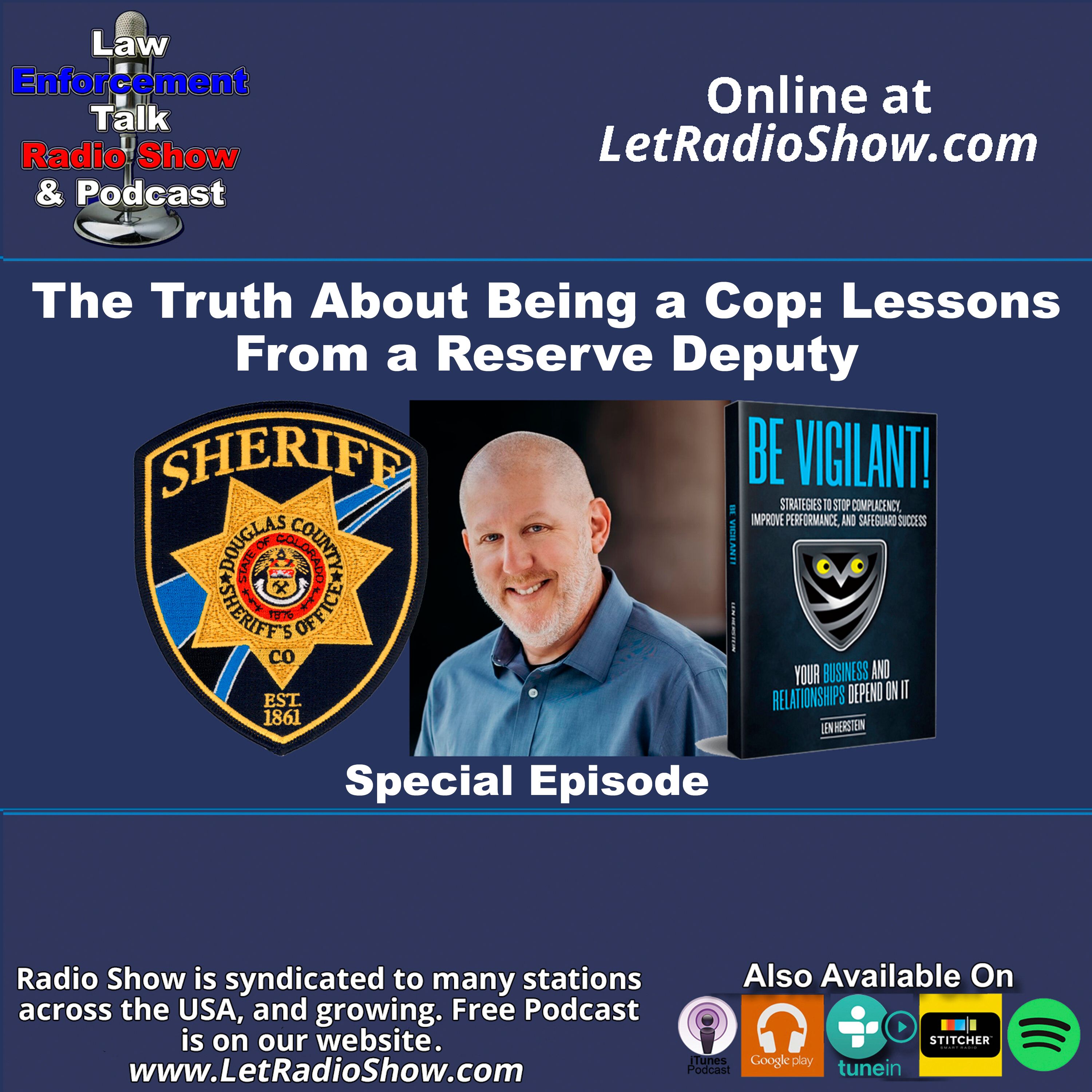
Law Enforcement Talk: True Crime and Trauma Stories
The Truth About Being a Cop: Lessons From a Reserve Deputy
00:40:10
The Truth About Being a Cop: Lessons From a Reserve Deputy in Colorado. A Special Episode of the Law Enforcement Talk Radio Show and Podcast. Hollywood and the media often paint a glamorous, high-speed picture of police work. But as Len Herstein, a Reserve Deputy in Colorado, reveals, the truth is far more complex, and far more human.
Loading summary
Transcript88 lines
- [00:01]
A
This is the story of the one As a custodial supervisor at a high school, he knows that during cold and flu season, germs spread fast. It's why he partners with Grainger to stay fully stocked on the products and supplies he needs, from tissues to disinfectants to floor scrubbers, all so that he can help students, staff and teachers stay healthy and focused. Call 1-800-GRAINGER Click grainger.com or just stop by Granger for the ones who get it done.
- [00:30]
B
He's a reserve sheriff's deputy, meaning he does law enforcement for free. He had a certain mindset being a businessman about law enforcement and it changed dramatically once he started doing the job. Welcome to the law enforcement Talk Radio Show. In the law enforcement talk radio show, we are joined by special guests talking about their experiences, their realities of investigating crimes, placing plus those who have experienced horrendous trauma. Police, first responders, military and victims of crime share their stories. Hi, I'm John J. Wiley. In addition to being a broadcaster, I'm also a retired police sergeant. Be sure to check out our website, letradio.com and also like us on Facebook, search for the law enforcement talk radio show. Of all the radio stations in the United States, there are no other shows like the law enforcement talk radio show. And on Facebook there is only one official page. Do a search on Facebook for the law enforcement talk radio show and be sure to like the law enforcement talk radio show Facebook page. Calling us from Colorado, we have Len Hurstein on the phone. Len is a reserve deputy sheriff. Now. What that means is he does this for free. I know technically I'm air quoting free. There may be some benefits to it, but what he's not getting paid, which I find hard to believe that people would do this job and not get paid because it takes a toll. He came into law enforcement with a certain mindset as a businessman and it's safe to say that has changed. Len, thanks so much for being guest on the law enforcement show. Very much appreciated.
- [02:06]
C
Thanks Jay. Excited to be here, man. Thanks for having me.
- [02:09]
B
You're at the Douglas County Sheriff's Office, I believe we had someone on earlier from that agency. Was it Dan Bright?
- [02:16]
C
Yes, absolutely. Dan Bright.
- [02:18]
B
Phenomenal story by the way. You can check it as a podcast version show. Just go to letradioshow.com or go to our Facebook page. So like the Facebook page, a phenomenal story. I don't want to take away from your story because part of it is very appealing and interesting to me. You came into law enforcement as A volunteer, correct?
- [02:39]
C
Yeah, yeah. When I was 45 years old, I started my law enforcement career.
- [02:44]
B
So safe to say you were like the grandpa when you're in the academy.
- [02:48]
C
Yeah, yeah. Oh yeah. You know, the funny thing is now that I've been out there for a number of years, but I'll be out there with, you know, guys who are half my age who've been doing it maybe as long as I have been doing it. But citizens always look to me because of my bald head and white beard as the, they think I'm the. I'm the most experienced guy there.
- [03:07]
B
You look like the elder statesman, but you may not have as much time on the street as everybody else.
- [03:12]
C
Yeah, well, you know, with turnover these days, I'm pretty high up there at this point, but. But along the way, I've always been treated as the elder statesman. Yeah, I went, I started the academy in the early 2015 and then, you know, went through a full academy and then did my 440 hours of field training to get certified for patrol. And I've just been doing it ever since.
- [03:35]
B
Before we get into the conversation about your mindset before and everything else, you come from a business background.
- [03:42]
C
Yeah, so I've been in marketing and business and entrepreneurship for the last 30 plus years. So I started out in management consulting and then moved into consumer packaged goods brand marketing. So I worked for Nabisco and Coca Cola and Campbell Soup doing marketing for them. And then I started my own company. For the last 18, 19 years I've been putting on marketing conferences. So it's called Brand Managed Camp Conference and I've been doing that since 2003.
- [04:12]
B
Now that's a totally different ball of wax than working in law enforcement.
- [04:17]
C
Yeah, and that's the way I went into it. I went into it thinking it was going to be a completely different part of my life. But I was kind of surprised early on by how much overlap I saw and things that I was learning that I felt like I could apply back to business and life in general.
- [04:32]
B
One of the things I tell a lot of cops and retire is, believe it or not, police, sheriff's deputies, whatever term you want to use. If you've got a full career in your belt, you have years and years and years of sales experience, you've been selling options to people. And a perfect example is you get a call for disorderly person on the corner and explain to them, hey Joe, you can go to jail or you can leave and have a good weekend. Those are your choices. Which do you prefer?
- [04:58]
C
Yeah, and in this day and age, I would even classify it as, you know, sales, but also really customer service. We're in the business of customer service. We're in a business, especially me, being part of a sheriff's office with an elected sheriff. You know, we're in the business of, you know, making sure our constituents are happy.
- [05:17]
B
And that's a tough task because, well, we did the same thing. We handled every call that came down. We actually even went to calls for water in the basement. It didn't matter what it was. And we carried little books in our back pocket of different numbers people could call. We didn't refer to plumbers or things like that. But here's the water agency, here's so and so, here's the number for such and such. They can cut off your water, whatever it might be. The police came. We were a full service agency. And the funny thing is, and I'm sure you relate to this, the vast majority of our calls were not about criminal behavior. They're about quality of life issues.
- [05:50]
C
Yeah, yeah, for sure. In fact, one of the calls that we don't do anymore, that we used to do, but just because of the call volume, we just can't do it anymore, is we used to do sneak calls. So anytime someone had a sneak, they would call us and we would come out and we would help them with this sneak snake. And so I can't tell you how many snakes I've moved or done other things, too. And I'm glad we don't do that anymore. But you're right. Yeah, we get called for a lot of things that people would not typically associate with law enforcement.
- [06:16]
B
I could tell you in a story, but it's a long one. When I was a rookie cop about a bat in a house that I had to get out. And, you know the horror films you see about bats getting stuck in your hair and the old reefer over your head the whole night. It was ugly. But we got the bat out. It was successful.
- [06:33]
C
That's one of the reasons why I shaved my head. I don't want any bad hair.
- [06:38]
B
I thought you shaved your head for vanity reasons because of gray and maybe balding issues.
- [06:43]
C
No, no, no. I actually could have a good head of hair, but I just got. I got to a certain age where I got. I got tired of it, honestly. And then once I got into law enforcement, I was like, you know what? There's a lot of reasons to keep my hair short. And then I just kept going shorter. It's kind of an addiction. Some people do it with tattoos. I do it with. With shaving my head.
- [07:01]
B
So you came into law enforcement with a lot of years experience in marketing and sales and in the business world, and many people, the vast majority of people, really don't have a good concept of what law enforcement officers do or what they go through. And they're very quick to make judgments about, hey, you should have done this, should have done that. Is it safe to say that you had a different mindset about law enforcement before getting into it?
- [07:26]
C
Yeah, I mean, you know what? There's. There's a lot of things that I missed or, you know, had. Had misperceptions about coming in to. When I got to the other side, I saw things that I didn't even. I wouldn't have even thought about before. It was just kind of assumptions I had that once I got into it as a profession, started seeing, you know, how wrong I was and how different was. You know, it's probably five or six different things off the top of my head that, you know, were very different than what I would have expected.
- [07:55]
B
Did you find you're less judgmental about law enforcement, what they do, compared to before?
- [08:01]
C
Yeah, I mean, I think that's probably safe to say. I was never judgmental. You know, I had friends who were cops, and I had, you know, a very healthy respect for the profession. So I was never one of these folks who was kind of pointing fingers or. Or being judgmental. But. But, you know, there were definitely things that my eyes were open to that still changed my perception, for sure.
- [08:22]
B
One of the things that I say jokingly, half jokingly is I got so sick and tired of being introduced at barbecues and cookouts is, oh, here's Jay. He's a cop. And everybody go, oh, hands up. Or. And then stupid questions. Did you ever shoot anybody? Do this? And it got to the point, Len, where I just say yes, and then I walk away. Or I'd say something totally ridiculous like, yeah, did you ever get caught doing blankety blanky blank in the closet? And they go, what's that got to do with this? I say, exactly. Why. Why do you think I want to have this conversation about one of the worst incidents in my life with a total stranger, someone I never met, I don't know, and won't understand. Over a beer at a barbecue. We are talking with Len Hurstein. Len is an interesting story. Got so much to talk about. He is a reserve sheriff's deputy, and he went into law enforcement at the age of 45. Overturn. We're going to talk about some of the incidents he's involved in, how it's changed perspective and how he uses what he learned in his marketing and business career. This is the law enforcement show. Don't go anywhere. We'll be right back.
- [09:34]
A
Remember when free meant free, no charge, no credit card information needed. Well, a place like that still exists on the Internet. The law enforcement talk radio show website letradio.com where everything is free, including the podcast episodes are available after airing on radio. The website is letradio.com that's letradio.com where free means free.
- [10:02]
C
This is the story of the 1. As a maintenance supervisor at a manufacturing facility, he knows keeping the line up and running is a top priority.
- [10:11]
D
That's why he chooses Grainger.
- [10:13]
C
Because when a drive belt gets damaged, Grainger makes it easy to find the exact specs for the replacement product he needs. And next day delivery helps ensure he'll have everything in place and running like clockwork. Call 1-800-GRAINGER click granger.com or just stop by Granger for the ones who get it done.
- [10:37]
B
Return conversation with Len Hurstein calling us from Colorado. Len is a reserve deputy with the Douglas County Sheriff's office, meaning he does this work for free. And he went into law enforcement at the ripe old age of 45. That's what a lot of people are talking about, retiring from law enforcement.
- [10:59]
C
Yeah, for sure. You know, in fact, the question I get from a lot of the guys is like, why are you here? Like, what are you doing? You know, people outside the profession definitely don't get it. People inside the profession don't get it more, you know, they're like, what are you, how are you doing this for free? That's crazy.
- [11:14]
B
Well, to be honest with you, Len, you know, where I worked in Baltimore, we didn't have reserve officers, we didn't have part timers. We had, you know, full time sworn officers and then civilian employees and that was it. And the thought of someone doing that kind of work and exposing themselves to the violence, the threats of violence, the trauma, everything, all the, all the stress that goes on and doing it for free baffles me.
- [11:37]
C
Yeah, no, I mean, there are times where my wife questions the validity of the psychological, you know, testing they did on me when they were trying to figure out if I could do this or not. But it's, you know, it's something that adds more than it detracts from my life and that, you know, it's a net positive for me. So, you know, I, I went through my Entire career, you know, I didn't, you know, never saved a life, you know, doing marketing. Right. And so or never, you know, had that kind of impact on someone's life. So, you know, for me, it fills a hole that I was looking for, and I'm happy and proud to do it, you know, But I. I get why it seems strange, for sure.
- [12:16]
B
Yeah. I think your wife might be onto something, to be honest with you. The sad part is, and it's kind of funny is, look, I know I'm not right. I have mental, emotional scars from years of pleasing. So that's quite a right. And it comes with the territory. I don't. I'm not ashamed of it, and I'm very proud of my service. And I'm sure it sounds like you are too.
- [12:39]
C
Yeah. Oh, absolutely. I mean, you know, and I've been scarred as well, for sure, you know, no doubt. I mean, you know, I could. I never seen a dead body before. Before I did this, and then, you know, now I've seen a whole lot of them. Right. So, you know, that has to change you, the way that you act around it, the way that you have to, you know, conduct yourself, all the things that. That happen around that change, as well as all the other things. And I've. I've seen and been part of some. Some tragic things and. And you know, you. As, you know, you just got to learn that, you know, you got to be that type of person who can compartmentalize that and use it. Use it for something good. And that's, you know, we'll get to talking about it later, but that's. That's where my book comes from. And taking that and using it for something positive.
- [13:25]
B
By the way, your book is called Be Vigilant Strategies to Stop Complacency, Improve Performance and Safeguard Success. And it's not just for law enforcement. It. Everybody.
- [13:34]
C
Yeah. I mean, it's specifically for business and for life. It's not a law enforcement book. It uses examples and experiences from my law enforcement background, but it's a business book and it's a. It's a. It's a lifebook.
- [13:47]
B
So you went into law enforcement at the age of 45. You do it for free. And after going through all your training, the academy, everything else, you hit the streets. What was the first call? Were you like, oh, my goodness, this is nothing like I thought.
- [14:02]
C
Well, you know. Yeah, a lot of calls. I think, you know, I think the one that really woke me up to, like, how quickly things can go from nothing to serious was I was on patrol and got a call about, you know, a potential drunk driver, we call them ready reports. So a potential drunk driver, someone swerving in the road and they had a small child in the backseat and went to, they had pulled into a parking lot of a local store and so went, went in, found the car, you know, kind of determined that the person had entered the store. And so me and another, you know, we ride solo, but me and another deputy were kind of waiting outside for, for her to come out. She came out, she had a small child with her, you know, maybe 4 years old. And talking with her, kind of, you know, quickly figured out that she wasn't under the influence or didn't appear to be under the influence of anything. She was distracted by her kids, she was trying to discipline her kid. And she did, you know, kind of turn around and, you know, put her attention on the kid instead of the road for a second there. And that's, that's kind of what had happened. So, you know, really nothing criminal going on other than maybe, you know, some sort of driving infraction, but we weren't really going to go there. And so she said, hey, you know, do you mind if I put my kid in the car? And we said, no problem. And you know, just keeping an eye on her as I'm talking with my partner and all of a sudden I see her kind of doing something in the back seat. And next thing I realized is she has a gun pointed at her kid and it, you know, it's a revolver, it's a silver revolver. So immediately I kind of disengage my partner. I, you know, draw my weapon, you know, give her commands, you know, drop the gun, drop the gun, right? She starts turning towards me with the gun in her hand. As she gets about quarter away around, she drops it and as it hits the ground, realized that it's a plastic play gun, right? And she had been playing with her kid for some reason with a, with a gun, didn't have any orange on it or anything like that that would indicate it was a fake gun. It looked real enough from a distance. And you know, at that point in time, you know, really got driven home, that these are split second decisions we're going to have to make and I'm going to have to make throughout this that, you know, if you're not in the right mind, if you're not doing the right things, if you perceive the information incorrectly, things can go really, really wrong really quickly.
- [16:24]
B
They can. And I wanted to say when she had the gun and pointed her child to normal people who've never been through this. You would think, oh, there's no way. Nothing's going to happen. They're not doing anything. There's nothing to it. However, people do bizarre, unexplainable things all the time. As a matter of fact, I hate to say this, but the vast majority, Majority of children who are killed in the United States are killed by their parents.
- [16:48]
C
Yeah, yeah. And you know what I. What I say to people whenever they ask me, look, why did that person do that? I mean, I gave up seven years ago trying to explain why people do things. I have no idea why people do things. And if I try to predict it, I'll be wrong, you know, more than half the time. So I just go with what I see and what I can perceive. And, you know, that that's where you have to be able to, you know, kind of be in the moment and be able to take in all the information. You know, these things with both eyes open is what I talk about, you know, as opposed to being, you know, having tunnel vision or, you know, anything like that. And, you know, I. I don't. I'm not in the business of trying to explain why people do things. There's. There's a. I've been. I don't get surprised anymore.
- [17:32]
B
Were you able or are you able to explain why you did not shoot?
- [17:37]
C
Yeah, I mean, I think, you know, if I was gonna go through what was happening in those split seconds in my head, there was, you know, a degree of angle that was going to happen before. You know, as soon as I. As soon as I gave command, she disengaged from the child. So at that point, she wasn't an immediate threat to the child. Whereas if she had stayed in there and was disregarding my things and slowed that gun pointed at kid, you know, we got a different situation. But as she started turning towards me, I mean, she was pretty close to getting to that degree of turn where things were going to get worse for everybody.
- [18:14]
B
Here's the thing. Quite often, and you brought up a memory for me, and I'll talk about it in a moment, but quite often I could not explain why I did or didn't do something at the time. Later on, as you have a chance to process what happened, what you saw, what you went through, you're able to piece me up together. Now, body cameras can fill in a lot of the gaps, but ultimately it boils down to, I did not perceive a threat. I did not receive a threat to myself or someone else. That's why I did or didn't do use of Force. We're talking with Len Hurstein. Len is a Reserve deputy sheriff in Colorado. He's also a businessman, author of the book Be Vigilant Strategies to Stop Complacency, Improve Performance and Safeguard Success. There's so much more to talk about. Don't go anywhere. We'll be right back. There's a couple ways you can stay in touch and keep informed of what's going on with the law enforcement talk radio show number one. Go to our website letradio.com sign up for our email newsletter. It's really easy to find. I promise we don't spam you. I send out about one email every two weeks or so. And there's also a feature called Broadcast Channels on our Facebook page where we send messages directly to your inbox, directly to your messenger. Real easy to sign up for. Make sure you like or follow the Law Enforcement Talk Radio Show Facebook page. And up top, you'll see Broadcast Channels one for free podcast versions of the radio show, another one top post of the day. So you too can stay informed quickly, easily and best of all, like always, free.
- [19:52]
A
This is the story of the One As a custodial supervisor at a high school, he knows that during cold and flu season, germs spread fast. It's why he partners with Grainger to stay fully stocked on the products and supplies he needs, from tissues to disinfectants to floor scrubbers, all so that he can help students, staff and teachers stay healthy and focused. Call 1-800-GRAINGER Click grainger.com or just stop by Grainger for the ones who get it done.
- [20:25]
B
Return conversation with Len Hurstein Len is a reserve deputy in Colorado. He's also a businessman. By the way, Reserve deputy means he does this for free. He's the author of the book Be Vigilant Strategies to Stop Complacency, Improve Performance and Safeguard Success before when the break Len we're talking about this incident where you had a woman and she had in her hand what you thought was a gun. Turns out it was a toy and you didn't want to have used deadly force, which no cop I know of ever wants to do. And immediately I started thinking it reminded me of I was a young patrolman. I was driving in Northwest District of Baltimore, and you know, the corner of my eye see in an alley adjacent to a major street, three or four young men kind of huddled around something. So I stopped the car, I turn in, I start going up there, I drive up and as they start to disperse, one turns towards me and in his hand he has what looks like a.45 semi automatic and it's about a 45 degree angle pointing downwards. I didn't know the time it was a BB gun and they were examining, talking about it and he was probably 12, 12, 13 at the most. Very young looking, 12 at that. And if you'd asked me at the time why I did not shoot or why didn't feel, dude, I just didn't have the immediate perception of a threat to my life at that point. I couldn't tell you because it happened so fast. You couldn't tell what's a real gun or not a real gun. Could that have been a deadly situation where I could not hurt? Yes, it could have. It worked out well. But if I tell people that now, they'll say, oh, that's copaganda. Because it goes contrary to what people believe.
- [22:05]
C
Yeah, for sure. I mean, you know, one of the things that, and I've thought about this before, you know, what you're talking about, as to why, why we do the things that we do. And one of the things that I've come up with is that, you know, we are able to, to make those decisions in those split seconds because of the training that we go through, right. And because of, you know, the individual training that we might do on our own. Right. So, you know, what I always tell people is that, you know, there's this common misconception and this is what I've learned through law enforcement. I didn't know this beforehand, but there's this common misperception that people will rise to the occasion. And, you know, I think most people in law enforcement know that that's not true. What happens is we, in a time of crisis, we fall to our highest level of training. Right? And so, you know, the more that I'm confident in my abilities, the more time that buys me to make the right decision and gather the right information. And so, you know, I spent a lot of time at the range and I know I'm a very good shot and I'm quick, right? So that knowing that and being able to have that confidence allows me to, you know, I think, you know, this is me backwards analyzing, right? I mean, not, not in a moment, but I think what that does is that gives me the opportunity to gather even that split second more information that can help me make a different decision. And so, you know, it's the same thing where I spend a lot of time thinking about, you know, and we all do in Law enforcement thinking about what if scenarios, what if this happens? What am I going to do if that happens, what am I going to do? I think playing those scenarios and doing that scenario planning in our head also you know, shortens our OODA loop. You know, we talk about the observe, orient, decide and act. You know, it shortens that because we already know what we're going to do in situations. So it buys us that just a little bit more time to gather that little bit more information.
- [24:00]
B
And there's nothing quite like street experience. I was a totally different cop and much more confident when I was at the end of my career than I was in the start, right, of the academy. At ride the academy, I thought I knew a lot. Truth is I knew almost nothing.
- [24:15]
C
Yeah, yeah, that's, that's absolutely true. I mean, when your boots hit the street, it's a different story, right? It's not a textbook anymore. And that's why we do field training. Right. So, you know, that was one of the, you know, misperceptions that I had coming in. You asked me things that I thought differently before and after. You know, I didn't have any sort of clue as to the amount of training that we do. And you know, that it doesn't stop with the academy. So I mean, people, you know, a lot of times when they want to kind of, you know, put forth that, you know, maybe police aren't, you know, as, you know, well trained as they should be. I mean, nothing stops with the academy. We have our academy and then we've got hundreds and hundreds of hours of time spent in a car with a person just, you know, hyper evaluating every move and every decision you make. And then, and then, you know, and then we've got our in service and continuing training that goes, you know, through all of our skills. And then we've got, you know, training for, you know, everything from like, you know, how to handle autistic people to, you know, how to work with, you know, all these different situations, right. Deaf and blind and, and handicapped and you know, these are all just, you know, trainings that we've recently gone through. So, you know, I think that's something that I didn't realize going in.
- [25:23]
B
I think a lot of people have that misconception and part of it, I believe is to blame is Hollywood. They love to create this image that, you know, a knuckle dragon, cretin, Neanderthal type cop who really doing his job because he can't do anything else. And, and by the way, I am that knuckle Dragger. But I'm a lot brighter than people think.
- [25:43]
C
Yeah, well, you know what, Hollywood's to blame for a lot of things, I think. And you know, listen, I like watching movies, I like watching tv. But you know, I can't tell you how much angst it causes me every time I see someone on a, on a TV show with their finger on the trigger walking around and it's like, oh my God, like how can you, how can you responsibly put that out there for kids and everybody to see? Like, you know, my kids can't even watch a show with me anymore. They know I'm gonna get upset.
- [26:10]
B
I'm the worst. I'm the worst. And here's my chief pet peeve with American, not so much BBC American cop shows. Yeah. They'll always have this dramatic moment where they cock their semi automatic weapon. I'm thinking, I look at my wife and go, who walks around with an unloaded gun?
- [26:29]
C
Or they'll all, they'll rack the slide like four times in the same chase or something.
- [26:33]
B
Oh yeah. I remember being a rookie cop going in these garden style apartments, we have multi levels going in and we're going to do a raid on a house and there was like three uniform cops, I was in the middle and a couple plain clothes guys. And our policy always have uniform on any kind of raid. And I didn't realize at the time that I had my service weapon pointed directly at the officer in front of me. And when it was all said and done, let me tell you, I got a talking to like nobody's business. And if you didn't learn the lesson through the talking to. And it wasn't just the sergeants, it wasn't a ranking officers, it was the senior officers and they taught you. And if you couldn't learn the lesson the easy way by talking, they would handle it in the back of the parking lot.
- [27:20]
C
Oh yeah, yeah. Well, I tell you that that's another pet peeve of mine that my, I've got, you know, my, my 14 year old, you know, we'll be watching a show and she'll yell out crossfire, crossfire. When she sees everybody converging from the same, from different directions. She, she knows what, what I'm about to say. So you know, or you know, muzzling someone in front of you. Yeah, you know, these, these are things that, you know, they happen. But, but you know, Hollywood, unfortunately, you know, another thing that Hollywood teaches you is that there's no paperwork. You know, I mean like you get through with a Big chase and you're out having a beer with the guys somehow. And 10 minutes later, as opposed to, you know, the six hours of paperwork and interviews you're gonna have to do when you get done with that thing.
- [28:03]
B
And you're doing this for free, that's the thing that really blows my mind. It's official right here. I'm in a radio city. My mind is blown.
- [28:12]
C
Yeah, yeah. You know what? Again, people can't believe it sometimes. I, I honestly, I honestly love it. And I think one of the things is that I got to do this after having, you know, 20, 25 years of business experience. And so I, you know, I come at this a different way than someone who's, you know, 20 years old going into the academy. Right. I've got all this different life experience and, you know, not, not necessarily better, just different, different life experience. And so, you know, I think that also helps ground me and helps me appreciate, you know, the value that I'm able to bring and the things I'm able to do. And, you know, I just go, listen. I don't go home every night feeling great. You know, there's a lot of nights I go home not feeling great.
- [28:55]
B
This is law enforcement show. We are talking with Len Hurstein. Len is a reserve deputy sheriff in Colorado for the Douglas County Sheriff's Office. He comes from business background, marketing. He's also author of the book Be Vigilant Strategy to Stop Complacency, Improve performance and Safeguard success. Lessons he learned in law enforcement that he applies and other people working in business, no matter what kind of business it is, especially marketing, can use these tools to benefit them. And I would suspect that some of these tools might help the rest of us and our everyday life. We got so much more to talk about with Len. Don't go anywhere. We will be right back. If you're on the Clubhouse drop in audio chat app, be sure to look for me and follow me. My name's John. The letter J. Wiley W I L E y. You can also search for that's John J. Wiley W I L E Y at let radio show on the Clubhouse Drop in audio chat Apple this is.
- [30:05]
D
The story of the one as head of maintenance at a concert hall, he knows the show must always go on. That's why he works behind the scenes, ensuring every light is working, the H Vac is humming, and his facility shines with Grainger's supplies and solutions for every challenge he faces. Plus 24. 7 customer support. His venue never misses a beat. Call quickgranger.com or just stop by Granger for the ones who get it done.
- [30:38]
B
Back to our conversation with Len Hurstein on the law enforcement show. Len is calling us from Colorado. He is a Reserve deputy in Colorado in Douglas County Sheriff's Office. Been doing it for some time now. He's also a marketer, businessman, author of the book Be Vigilant Strategies to Stop Complacency, Improve Performance and Safeguard Success. Back in your career, you came from a business background, which, by the way, I love what you said. We're all different backgrounds. Not better, not worse, just different. One of my biggest pet peeves of Hollywood, and that includes the news media, is we all look the same because of uniform standards, haircuts, mustaches, whatever might be. And there is this mindset that we are all some big homogenized machine that will do whatever we're told. Hence, for example, conspiracy theories. No one's going to balk at anything. The truth is, we are all radically different. We just do the same job.
- [31:35]
C
Yeah, absolutely. And I think. I think an offshoot of that, too is, you know, people assume that we all, like, you know, are here to, like, protect ourselves and hide things and things of that sort. And I think. I think one of the things, you know, getting back to what I learned different, I mean, there, you know, one thing that is super obvious once you're in this is like, nobody hates a bad cop more than a good cop.
- [31:58]
B
Exactly.
- [31:59]
C
And, you know, there is no protection for people doing bad things. You know, at least in our department. I can't speak for every department.
- [32:05]
B
I'll be honest with you. In my department, we never saw it. And I actually had the displeasure of having to arrest officers, not for anything major, for minor stuff, and was very unpleasant. I've had people fired that did things that were against rules and regulations. The last thing is, and I know you relate to this, no one I know of is going to lose their job, their insurance benefits, all their benefits, and risk going to prison and put their families at risk for someone else. They're just not going to do it for corrupt behavior. They're not doing it.
- [32:36]
C
No. And, you know, listen, the one thing that you have to have in this profession is integrity. And if you lose that integrity and you get yourself a Brady letter or something like that, you're no good to be on the stand. You're done in the business. You can't. You can't do the job anymore if you can't be trusted. Does that not mean that we don't have some bad apples, like every profession in the world. Of course not.
- [32:56]
B
Right.
- [32:57]
C
But. But I think, you know, the. The vast, vast majority of us get up. Wanted one of. Wanted to do good things for good people. And you know, if there's one thing that we just have no. You know, you can do things wrong and the, you know, go through remediation and fix those, you know, but nobody has any patience for. For someone who's. Who lies or is, you know, not credible or is not trustworthy.
- [33:24]
B
We were always.
- [33:24]
C
We just can't deal with.
- [33:25]
B
Yeah. We were always told, get in trouble doing your job. Don't get in trouble not doing your job. And crop stuff just wasn't stood for. You know, everybody has their moments too. Were. Especially in traumatic scenes because we all react differently. You came into this. This line of work with a certain mindset and I'm sure you encountered sit that made you. You said earlier in a conversation doesn't mean every time I came home. It's wonderful. I had some bad days.
- [33:54]
C
Yeah, no, I've had. I've had. You know, listen, we all have bad days. You know, there are. There are ones that are worse than others. So I mean, you know, I've been part of, you know, three separate incidents or, you know, at least, you know, here for three separate incidents. You know, two that resulted in deaths and one that resulted in, you know, you know, Debbie being paralyzed. You talk to Dan Bright, you know Dan Bright's story. You know, those, you know, all three of those, I was, you know, one, you know, heavily involved in the other two, you know, more ancillary involved in. But, you know, they. Those are the types of things that change you. Right.
- [34:29]
B
In your training, did you get any skill sets to help you deal with these better?
- [34:35]
C
Yeah, I mean, you know, in terms of like, mentally, you mean. Yeah, I. I don't know what it is. I'm somehow. I don't know if it's a blessing or a curse. I have the ability. I didn't. I was scared about this coming in. I didn't know how. What was going to happen the first time something like this happened. Right. Because I'd never dealt with it before. Here I am at 45 years old. I didn't know what it was gonna be like. So what I've learned is that I do have this ability to compartmentalize and to, you know, to grieve and then. And then use that grief for something. For something bigger. So, you know, for, you know, one of the ones was, you know, Colorado State trooper Cody Donahue, you know, was struck by a truck on Interstate 25 here in Colorado. I was, it started off as a, as a single car accident on the highway that I was called out to because we will handle stuff on the highway. It's really, you know, primary jurisdiction is going to be state patrol, but we'll handle it until they get there, or if they can't get there, we'll take care of it. So it was just a single car accident and I was there and state patrol showed up and they kind of took over the scene. You know, fire left because there was no injuries and I left because that, that's kind of the protocol is once they take over, they don't, you know, I ask them if they need anything from me and then I, and then I move on. And you know, about, I started heading back south to, you know, I was working a southern district that day and you know, within 10 minutes I got the officer down call, you know, went right to the next exit, turn around, sped back and you know, Trooper Donahue had been, you know, working the trap, the crash and had been struck by a semi that, that did not move over. Give him a lane. And so, you know, I was the first, you know, deputy on scene there. There was some state patrol people there. But, you know, and I was there from, from the time where I went up and had first words with the driver of the truck to, you know, to, you know, out many, many hours later into the night. And you know, I left that scene and went back and had a good cry, you know, and, you know, that's, sometimes that's what you got to do. You just got to get it out. Right? And you know, I had resources available to me. You know, I'm going to be honest with you. I didn't, I didn't take them up on, on them. I didn't, you know, I was able to get through it in my own way. But, you know, now obviously, you know, one of my big things is, you know, taught me things about vigilance and it, and it's something that I talk to people all the time. If there's one message to get across to people out there right now is, you know, please give emergency workers a lane. You know, you can see our lights forever. Give us a lane. If you can't move over, slow down, way down and pay attention. But, you know, that that's one of those things that it's a, that's a, that's a bad day, right? That's a bad day. You know, not worse, way worse day for the family and the friends and and, you know, the colleagues of Trooper Donahue, obviously, for Troop Donahue, but. But, you know, it's a bad day for everybody involved.
- [37:40]
B
One of the things I say quite often, you know, I have a lot of compassion and empathy for the family members of law enforcement officers who remained injured, killed. But I also say I hold my thoughts and prayers for those first responders on scene because they have to deal with something that no one ever wants to deal with. And it's your worst nightmare come true.
- [38:03]
C
Yeah, it's. It's terrible. I mean, again, you know, you never want to, you know, for those of us in it, as, you know, we don't really want to bring attention to ourselves because it's not about us. It's about, you know, the trooper lost his life and his wife and children and all that. But. But, yeah, you know, it's painful for everybody. It's something that you never want to deal with. And. And you know that you learn a lot about yourself when it happens, too, as to how you. How you act. And I was. That was the first time I really had to, you know, you know, do with that, with something where I was actually on scene for it and, you know, with everything that went along with that. So.
- [38:41]
B
But you carried a lot of these lessons learned from your law enforcement career and what you're still learning in law enforcement into your business practice, in particular with your book. Tell us about that.
- [38:51]
C
Yeah, so the book, like you said, is called Be Vigilant Strategies, Stop Complacency, Improve Performance and Safeguard Success. And really the idea for it came very early on in my career. So what if my law enforcement career, one of the first things that we learned, obviously, is this concept that complacency kills.
- [39:07]
B
Yes.
- [39:08]
C
And I kind of, you know, I was like, man, complacency kills. And I started looking at what that meant and, you know, and then I started thinking, well, you know what? Complacency, you know, in a different way kills businesses, it kills brands, it kills personal relationships. And I started becoming a little bit obsessed with this idea of complacency of what it is. And one of the things that I realized is that in our world, in the non law enforcement world, complacency has kind of become like this kind of filler, throwaway term that people will use. You know, you'll hear it a lot in sports. Oh, they're getting complacent out there. You know, hey, let's not get complacent. And people throw it out there. But nobody ever talks about what it is, what it means, and more importantly, what do you do about it? Right? Like, you know, when people say, don't be complacent. Well, that's, that's like saying, you know, like, don't be lazy. You know, like, you have to, you have to think about what, what does that actually mean? Like, how do I actually do that? And that, that's where the book came from, was me looking at the things that we do in law enforcement that we do every day without talking. We don't talk about the things that we do in the context of fighting complacency. But as I look at them, you know, the way that we approach, you know, traffic stops, the way that we, you know, the things that we do with briefing and debriefing, how we think about threat awareness, how we think about getting off the X and being strategically unpredictable, all these things, you know, I was able to tie back and say, you know, the real reason we do a lot of these things is to help us fight the complacency. Because the reality is complacency is born from success. And 99% of the time we are successful in this business and things go right and we can do a thousand.
- [40:37]
B
They go right almost all the time. And when they go wrong, it's horribly wrong. Where can people get more information about you in the book?
- [40:44]
C
So you can. The easiest place to do is just go to lendherstein.com L E N H E R S t e I n.com and it's all, all the information about me and the book is there. It's available on Amazon and Barnes and Noble and all those places. So you can go to any one of those and just type in Be Vigilant book. And you know, if you want to just connect with me, just look me up on LinkedIn. And I love connecting with people and hearing about their stories.
- [41:09]
B
Len, thanks so much being guest on the show and for sharing your story. Much appreciated.
- [41:13]
C
My pleasure, Jay. And thanks for doing what you do and thanks for having me on.
- [41:16]
B
If you want to be a guest on the Law Enforcement Talk Radio show, simply contact us. It couldn't be easier. You can send us a message on Facebook, look for and like the Law Enforcement Talk Radio show page or email jayetradio.com that's J A Y etradio.com I'd like to thank our guests for coming on the Law Enforcement Talk Talk Radio Show. The Law Enforcement Talk Radio show is a nationally syndicated weekly radio show broadcast on numerous AM&FM radio stations across the country. We're always adding more affiliate stations. If you enjoyed the podcast version of the show, which is always free, please do me a favor and tell a friend or two or three. I'll be back in just a few days with another episode of the Law Enforcement Talk Radio show and podcast. Until then, this is John J. Wiley. See ya.
- [42:11]
D
This is the story of the One as head of maintenance at a concert hall, he knows the show must always go on. That's why he works behind the scenes, ensuring every light is working, the H Vac is humming, and his facility shines with Granger's supplies and solutions for every challenge he faces. Plus 24. 7 customer support. His venue never misses a beat. Call quickgranger.com or just stop by Granger for the ones who get it done.