Loading summary
Transcript48 lines
- [00:00]
Arm and Hammer Advertiser
Let's be honest, if you have a cat, you've probably wondered what your house smells like before guests walk in. Thankfully, Arm and Hammer cat litter helps take that worry off your plate, because not all litters are the same. Arm Hammer Hardball Cat litter gives you long lasting odor control plus strong clumps that make scooping quick and easy with low dust too. It's a five in one litter made for busy people helping your home stay fresher every day so you can feel confident opening the door for family and friends. Candles, air fresheners not needed here. Odor control is Arm and Hammer cat litter's job, not yours. Be guest ready with Arm and Hammer Hardball cat litter. Find it now at Walmart or Amazon.
- [00:41]
Peter Frankopan
The United States is about to turn 250, and the question of what the Declaration of Independence actually meant or who it was meant for has never felt more urgent.
- [00:50]
Afwa Hersh
Today we are looking at the founding story from a completely different angle. Peter we are not the men in the room, but the women who were never invited into it.
- [01:02]
Peter Frankopan
I thought women who heard the words all men are created equal and figured there was something missing and maybe that they shouldn't be taken literally. A teenage poet who became one of the most celebrated writers in the Atlantic
- [01:13]
Afwa Hersh
world, and a young enslaved woman who walked out on the President of the United States no less, and spent the next half century living on her own terms.
- [01:24]
Peter Frankopan
This is the founding of America as it was actually lived by the people the Founding fathers forgot to mention. Hello and welcome to a new episode of Legacy. I'm Peter Frankenbaul.
- [01:35]
Afwa Hersh
I'm AFWA Hersh.
- [01:36]
Peter Frankopan
And this is Legacy, the show that explores the lives, events and ideas that have shaped our world and asks whether they have the reputations that they truly deserve.
- [01:45]
Afwa Hersh
This is 1776, the founding of the Mothers.
- [01:54]
Peter Frankopan
Thanks for joining us on Legacy today. To support the show, sign up to
- [01:58]
Afwa Hersh
Legacy plus you can enjoy early access Fewer ads Q and as bonus content, like when we spoke with Professor Helen Thompson about the conflict in Iran, or like when we explored the legacy of the humble fish finger.
- [02:12]
Peter Frankopan
So sign up to Legacy supportingcast fm.
- [02:16]
Afwa Hersh
It really makes a difference to us and our work if you subscribe, so please sign up. Follow Us subscribe and become part of the Legacy community.
- [02:24]
Peter Frankopan
So we're talking about the forthcoming 250 years since the signing of the Declaration of Independence. We've done a whole bunch of episodes on the Declaration itself, on the Founding Fathers, but yeah, it did cross our mind. There are quite a few people we haven't managed to talk about we need
- [02:39]
Afwa Hersh
to go back to 1776 and think about those iconic words and how they were actually received by people living the reality of American life at the time and how they would have compared that reality to the glorious sentences they were reading. So in 1776 the Declaration of Independence was printed in newspapers, it was copied by hand, it was shouted aloud in public spaces, it reached printers in Philadelphia and London, it reached merchants, it reached farmers, ministers, and it reached enslaved people, free black people and African American men and women who served in both the British and Continental armies. So just put yourself in the position of an African American, one who had had to fight and constantly protect their freedom, or one who was still enslaved. And what it would be like to hear these words. We hold these truths to be self evident, that all men are created equal, that they are endowed by their Creator with certain unalienable rights, that among these are life, liberty and the pursuit of happiness.
- [03:50]
Peter Frankopan
The date of independence is taken to be the fourth of July, when Timothy Matlak of Philadelphia endorsed the document that Thomas Jefferson and The Committee of Five had drafted and Congress had approved with the date the 4th of July 1776, one of the most famous dates in history. And that document was and is taken to be the heart and the soul of American independence. But how does that look afwa, from a different perspective?
- [04:13]
Afwa Hersh
Well, one of one of my favorite responses to that question, Peter, is in the words of the incredible abolitionist Frederick Douglass, who became a sensation in the 1800s. In the mid 19th century when he was campaigning to abolish the still then existing institution of slavery, he gave an address to the Rochester ladies anti slavery societies and also uttered one of the most famous censuses in American history. What to the slave, he asked, is the 4th of July? And he said that because it's quite clear that the gap between those words in the Declaration of Independence and the reality of enslavement was wider than the gulf that existed even between the American revolutionaries and the British crown. It was like they were living on two different planets and enslaved people didn't need that explained to them because when they heard the Jefferson's grand words of self evident truths that all men are created equal, they obviously already knew that. They knew that slavery was an absurdity, that the idea you can enslave a human and declare them a chattel, that their descendants and their descendants descendants will all be born unfree with absolutely no rights over their bodies, their labor, their income, that it was not only ridiculous, but it was profoundly incompatible with the essence and the substance of the Declaration of Independence. So today we are looking at the legacies of women whose lives, deeds, words and legacies go to the heart of the struggle to close the gap between what these ideas espoused and what they really meant for all Americans. And those women are Phillis Wheatley, Elizabeth Freeman, and Ona Judge.
- [05:56]
Peter Frankopan
So let's start at that intellectual heart of the American revolution. Boston. It's 1775. The British are occupying the city. Colonial militias are forming. As we talked about George Washington just been appointed commander in chief, we mentioned about enslaved Americans yearning for their freedom. So tell me AFWA about how they see the possibilities of what's unfolding. What do people know about this revolutionary movement that's building?
- [06:20]
Afwa Hersh
This is one of the things that's probably most grated me in the way that black history has been taught. To the extent it's been taught or discussed at all, it's often presented as this kind of passive, enslaved population in, and then the arrival of these kind of noble white savior abolitionists who decide eventually to bestow freedom. And actually, that completely mischaracterizes the reality of the African American experience. From the day that Africans were captured on the continent, put through the middle passage, enslaved on American soil, they were rebelling, they were rejecting, they were sabotaging. They were constantly strategizing, fighting, fighting, and working out how they could gain what they knew already from the beginning were their inalienable rights as human beings. And so they hear this Declaration of Independence, and they think less about the doctrine and what they can do to leverage it to get closer to what they know is their right, freedom. And one of the major events that takes place in terms of their calculations are this announcement by the British colonial governor of Virginia, Lord Dunmore, who issues a proclamation that inspired enslaved Africans who leave their plantation owners to join the British side in the war will be rewarded with freedom. They need no persuading. They flock to take up that call. Hundreds of black men, thousands, in the end, join what become known as the Ethiopian regiment, and they fight on the British lines in southeastern Virginia. Meanwhile, other African Americans have made a counter calculation that actually fighting on the revolutionary side is likely to help them get gain greater rights after independence. So even though this is also a side in which they're not treated as equal and they're far from welcome, in fact, they actually often have to fight their fellow comrades on the revolutionary side as much as they do the British. They are as individuals, as collectives, trying to work out where they will be best protected both during the war and afterwards. But These are men who are taking up arms, fighting amidst all of this. Imagine a teenage girl sitting down, not with a gun, but with her pen.
- [08:31]
Peter Frankopan
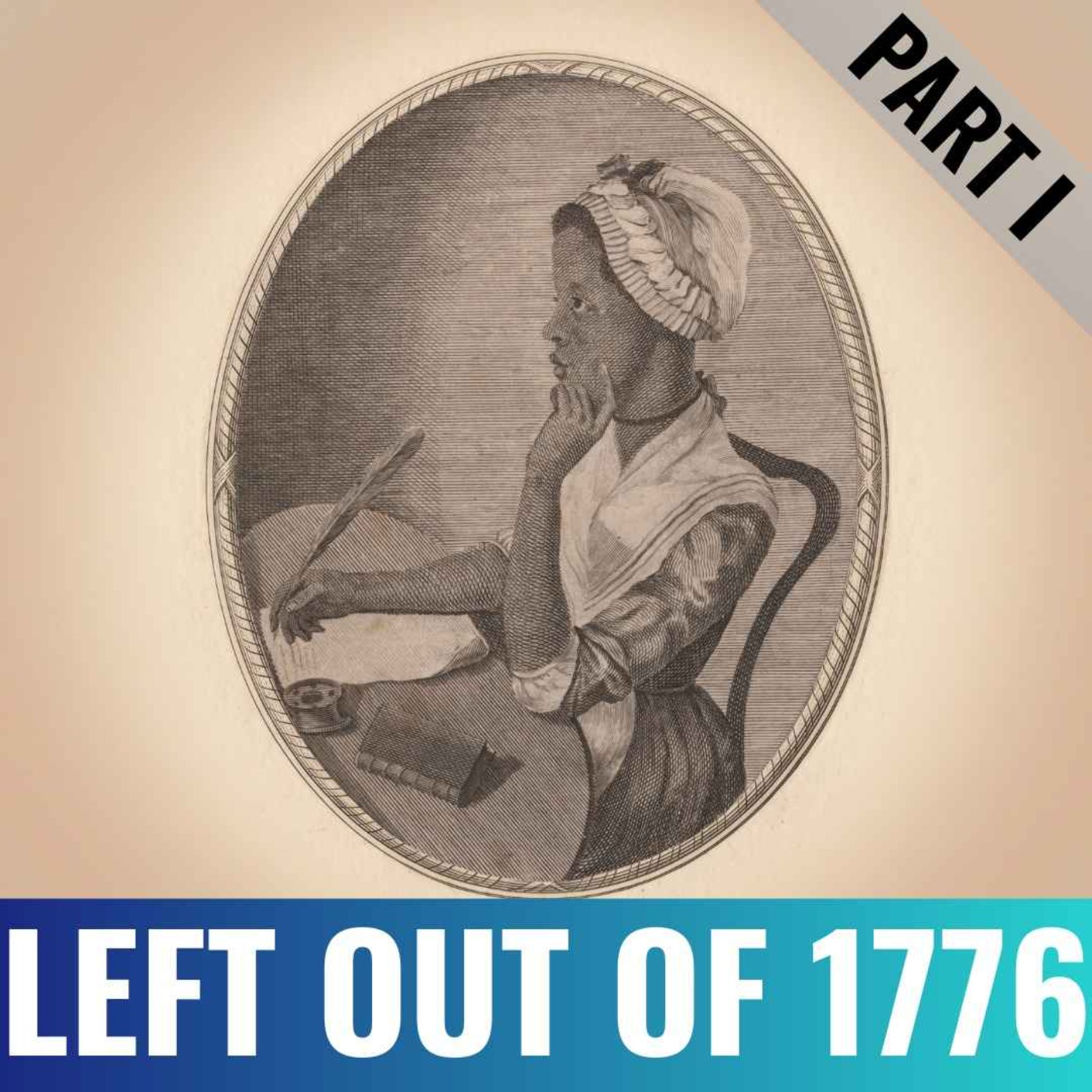
PETER so her name is Phillis Wheatley, and she is kidnapped from West Africa, probably Senegal or Gambia, when she was just 7 or 8 years old. And she seems to have only barely survived the Middle Passage, where the survival rates were horrific and in horrific conditions. And her subsequent owners, the Wheatleys, by her in Boston in 1761 for what, what they describe as a trifle and described her as dressed in only a scrap of dirty carpet and visibly suffering from the climate. And they gauged her age by the fact that she had four missing teeth. And she gets named Phyllis after the Phyllis, the slave ship that she was transported on. And Afra, I know you've done lots of work on Phyllis Wheatley, so I think I should put myself on, on mute and let you tell Phyllis, tell us her story and also why you were attracted to writing about her, spending so much time digging into the story of her life and what she represents, too.
- [09:24]
Afwa Hersh
A muted Peter Frankapan sounds like an oxymoron, but it's true that I have done a lot of work on Phillis Wheatley, and actually her stories really resonated with me for years. And, you know, there's just the human story of this little girl, such a small child, being kidnapped and trafficked in such a violent way, and the fact that none of her identity is really her own. Her age is gauged by the number of teeth she has missing. Her name is the name of the slave ship she was tortured on, essentially. And that in itself is such a chilling detail, you know, to be not only your name, not to come from your culture, your ancestry, or your parents choice, but to be named after the vessel that is the seat of your trauma. But the Wheatleys are what's kind of regarded at the time as humane enslavers, another oxymoron. But I suppose it's meant to convey that, you know, of the range of behavior that people who enslaved Africans engaged in, they were not sadistic. They actually looked after this child, and when she showed a real interest in reading and writing, they allowed her to pursue those interests. She was making letters on the wall in chalk and really keen. So her mistress let her have lessons, and she quickly showed how incredibly talented she was. Within a few months, she was literate in English and Latin. Within a few years, she'd mastered Greek. She was reading Homer, Horace and the Bible. And to put this in context, by the time She's a teenager. She's not only one of the most well educated enslaved girls in the American colony, she's actually one of the most highly educated women in Boston, period. Because, of course, this is a time when women of all races are being denied an education.
- [11:08]
Peter Frankopan
And she starts to write that. She starts to write. That's one of the amazing things we've got her. We can hear her own voice.
- [11:14]
Afwa Hersh
Exactly. She starts to write poetry. And she initially starts quite cautiously writing in these couplets, poems dedicated to famous personalities in Boston and very safe themes about the virtues of Christian salvation. And these mirror, I think, her upbringing in this religious, classical environment of New England, but also her calculations that it's radical enough to be a young black girl writing poetry. The last thing you want to do do is start writing revolutionary poetry. But one of the things I love about Phyllis Wheatley is that she's writing this quote, unquote, quite safe poetry. It is radical one because it shows her genius. And being a genius, enslaved girl is subversive. But also she finds ways to sneak in this nascent proto Pan Africanism. Because this is a climate where black people were not only physically enslaved, but they were also expected to aspire to whiteness. They were expected to look up to white people, to look up to white culture, to want to become as Christianized and as Europeanized as possible in their manners. And they would get rewarded for that. You know, if you could speak and behave in a way that was amenable to white people, you might get into the house, you might be able to climb up the very limited rungs within slave society. But Phyllis, even within that, is finding little ways to signal that she's proud of her Africanness, that she identifies as an African, that she is proud, I think what today we would say proud of her blackness. And that's one of the reasons why she's now regarded as the mother of African American literature. The first person to be publishing works in America in English that speak to her identity, not just as an American, but as a black American. And you know that for somebody who has been enslaved from such a young age, who has so little physical power, I just think it's an incredibly profound act of courage, but also an assertion of identity that I find really inspiring.
- [13:17]
Peter Frankopan
And afwa, I mean, I know that she's had a huge influence on you. Not just you being interested in her life and what she's done, but in the legacies that have brought forward a whole intellectual tradition, too. But what was so special about her experience? I mean, There are so many other young women who are enslaved, young girls who were enslaved. How come Phyllis managed to take a different trajectory? How did she manage to break free and to become so fundamental to cultural life?
- [13:47]
Afwa Hersh
Well, it wasn't easy. She writes these poems that are incredibly competent and as a result she attracts the negative attention of other white Bostonians who refuse to believe that a black girl would could be capable. They assume this is plagiarism. It's impossible. And this is speaks to the brainwashing of white Americans at this time. They actually don't realize that black people are as sentient and intellectually competent as white people. They've been persuaded that black people are closer to animals. You know, this is the reality of their dumbing down. And so they take her to court. She has to fight in courts to defend her reputation and the fact that she is the original author of her own work. You can just how amazingly degrading that is to have to argue that you are capable of writing your own work because of your race and gender. And she still, in spite of winning in court, can't find publishers. The American press will not publish her work. And yet instead of caving in, she continues. And as a teenager, one of her earliest poems is a defiant statement of her blackness. It's called On Being Brought from Africa to America and we'll see how her journey goes from there after the break.
- [15:00]
Arm and Hammer Advertiser
Let's be honest, if you have a cat, you've probably wondered what your house smells like before guests walk in. Thankfully, Arm and Hammer cat litter helps take that worry off your plate because not all litters are the same. Arm and Hammer Hardball cat litter gives you long lasting odor control plus strong clumps that make scooping quick and easy with low dust too. It's a five in one litter made for busy people, helping your home stay fresher every day so you can feel confident opening the door for family and friends. Candles, air fresheners not needed here. Odor control is Arm and Hammer cat litter's job, not yours. Be guest ready with Arm and Hammer Hardball cat Litter. Find it now at Walmart or Amazon.
- [15:38]
Peter Frankopan
Hi, this is Ben Green from the Athletic fc. The podcast you're about to listen to is brought to you by Hotels.com as a Hotels.com member, you save up to 20% on hundreds of thousands of hotels and earn rewards on every single stay. Which means the trips you're taking now help pay for the ones you're already dreaming about. And unlike some other places, there are no blackout dates. So when you Want to travel? Your rewards are ready to go. So the next time you're planning a work trip or a getaway, make sure to book it at hotels.com and start earning rewards. Hotels.com, it's all in the name. So Phyllis progresses through her teens, and she's constantly visited by the great and the good of Boston, who had asked her to write poems for them as eulogies or as dedications. But. But tell me, what happens to Phyllis and this remarkable young woman? What happens next?
- [16:31]
Afwa Hersh
Afraid it's such an opportunity and an indignity at the same time. 1773, age 19. Her slave masters send her to England on what they think is a pro slavery propaganda tour. So the idea is that she's going to show how civilized and benevolent slavery is in Boston because she's educated, she's well dressed, she's well looked after, and she's showing that slavery is not actually as bad as abolitionists make it out to be. That backfires so spectacularly because abolitionists welcome Phyllis Wheatley immediately as a potent symbol of the inhumanity of enslaving people who clearly are equal in their ability, in their dreams, in their dignity as white people. And so Phyllis has the opposite effect of that which was intended. And she gains the patronage not just of abolitionists, but also some quite powerful people in London, like the Countess of Huntingdon, who finally gets her books published. Because, remember, in America there's been this coordinated attempt by publishers to prevent her works being published. And so in England, ironically, she finds the opportunity she was denied at home. And her book of 39 poems, poems on various subjects, religious and moral, is published in 1773 and makes her the first African American woman in history and only the second woman of any race in America to publish a book of poetry. She's also the first black woman in the world to publish poetry in English. And her works are continuously reprinted right up till the present day.
- [18:11]
Peter Frankopan
And it gets incredible reviews. It makes her an international celebrity. So the London magazine describes it as displaying an astonishing power of genius, which is quite something. And her work is praised in the gentleman's magazine, the London Chronicle, the Scots magazine, you name it. When Benjamin Franklin comes to London, he goes to visit her, and the Lord Mayor of London gives her a rare edition of Milton's Paradise Lost as a gift. She's about to be presented to the king at court when her mistress dies and she has to go back to Boston. But her work, afwa, isn't as well regarded or even read in Boston as it is in England.
- [18:46]
Afwa Hersh
Boston is by now in the midst of revolution. And we're talking about Phillis Wheatley, not just because she's the founding mother of African American living literature, but because she is physically, personally caught up in this moment of revolution. So she's actually in Britain when the War of Independence between Boston more than any other colony really, and England breaks out. She's still enslaved at that point. She returns to her city in rebellion. The Boston Tea Party happens just after she gets back home and the War of Independence begins in earnest. So she is quite caught up in this battle and she decides to take a stand. Sometime around 1775, she gains her freedom. Her slave mistress has died, and she, having a high opinion, quite rightly, of her poetry and her influence, sends a poem to none other than George Washington. And she calls it to his Excellency General Washington. And she writes, proceed, great chief, with virtue on thy side. By every action let the Goddess guide. And she coins the term Columbia for America, championing freedom's cause. And it's interesting because this is not a low stakes thing to do at the time. It's far from guaranteed that the colonists will win this War of Independence. So she really is choosing a camp and endorsing this rebellion. But her endorsement is a very clear sign that she regards this as a revolution that cannot exclude either black people or women, and especially not her black women. And it's fascinating that she feels entitled to contact George Washington himself. It's also fascinating that he, remember, he is also from a family of plantation slavery and owns enslaved people himself. He actually replies to Phillis Wheatley. He writes he would be happy to see a person so favored by the Muses. And he invites her to visit him in Cambridge, which she does in March 1776. In the middle of this war, they actually meet. It's a staggering collision of the wealthy Virginia enslaver and the young woman who until recently has been enslaved. And it shows, I think, the complexity of this revolution that these men were enslavers. They were fighting for a freedom that didn't include people like Phillis Wheatley, but at the same time couldn't ignore the humanity and the talent of this young girl's writing and perhaps also the novelty that she felt that she should be included in this movement for liberty and
- [21:14]
Peter Frankopan
for Washington to see her. I mean, when she's written her book has been so widely praised in England. Boston printers refuse to believe that a black woman could have written it. And in fact, she has to defend her ability and literacy and authorship in court. And a group of Boston luminaries say that it must be plagiarized. They refuse to accept a young black woman was capable of literary greatness. But Washington agrees to meet with her and knows her by reputation as well. It's not just because she's written politely. He knows that she's someone who's been so favored by the muses. And she's still very, I mean, I know age is a slightly different thing in this time period, but she's only 23, 24 years old. So she's very brave to think that she should have the right, you know, the ability to send a letter to anybody and then will be seen by Washington. So she's kind of a, she's a woman of enormous character as well as determination. But, but what about, what about her legacies?
- [22:03]
Afwa Hersh
AFRA well, she's a sensation in her day. Her reputation precedes her, as you said, Peter she's strategist. She's using the neoclassical language of the Enlightenment to prove her humanity and her place within it. She's looking at the revolutionaries and saying, I, I, this enslaved, recently enslaved black woman, I am the embodiment of the freedom you claim to be fighting for. She reaches them. She meets with George Washington. Thomas Paine actually publishes one of her poems in the Pennsylvania Magazine, in her words are used to fuel the propaganda machine of the revolution. She is a metaphor for its promise. And yet, Peter, one of the first things that happens to her in post independence America is that publishers still refuse to publish her poetry. And I think that in itself is a metaphor for exactly what this freedom means, because it's not the end of racism. There are still enslaved people who are abandoned the same lives as they did before. And this free black woman who has defied all the odds and overcome every obstacle in her way, still cannot get published. And you know what she does in response to these barriers? Something I think we might recognize, she basically starts a substack. PETER she uses the subscription model as 250 years before we started our substacks, she creates a new volume of poetry by publishing it regularly through subscriptions. And that is the only way she can raise the funds to live on to continue funding her work. But as anyone listening to this who tries to survive on substack alone or any other subscription service knows, that is a pretty precarious financial model. And it's a really sad ending to her story. PETER and actually the death of Phyllis Wheatley is something that genuinely haunts me because I can't think of an equivalent in the terms of a young black woman who is chronically disadvantaged, who reaches the absolute upper echelons of society in the heart of the British Empire. The King, the Countess of Huntingdon in London, George Washington, Thomas Jefferson, Thomas Pey. And yet she dies in poverty. She ends up marrying a grocer who squanders her money, is in and out of debt, in jail. She can't get the publishing that she needs to continue her reputation and her prominence and the income that she needs to survive. And she and her three children all die in quick succession in a boarding house in squalor. And she's only 30 when she dies. And it's very bittersweet. I think it's so important that we talk about Phillis Wheatley because her legacy really does live on. And actually I first wrote about her in my book British in 2018 and and I hadn't heard of her before I started researching for that book. Since then I've seen her reputation proliferate. She's now the subject of loads of YouTube videos and reels and she's in documentaries. And I think that she's kind of reemerged as an icon in the American and in the global consciousness and that's really important and it's really important as well not to erase the tragedy of her life and the fact that having achieved all that, she's still could not get the recognition and the material income that she deserved. And that post revolutionary America, this land of freedom, the pursuit of happiness, liberty, was not able to do justice to a woman like her.
- [25:33]
Peter Frankopan
Thank you Afra for giving Phyllis her a small moment back in the sun and letting her voice come through 250 years later. How proud she would be to know we were talking about her. So what a privilege to hear you share Phyllis's story. When we come back, if I want to hear about somebody else, I want to hear about Elizabeth Freeman. And let's talk a bit more about some of those founding mothers of the American dream out of the American republic.
- [26:00]
Arm and Hammer Advertiser
Let's be honest, if you have a cat, you've probably wondered what your house smells like before guests walk in. Thankfully, arm and hammer cat litter helps take that worry off your plate because not all litters are the same arm and hammer hardball. Cat litter gives you long lasting odor control plus strong clumps that make scooping quick and easy with low dust too. It's a five in one litter made for busy people helping your home stay fresher every day so you can feel confident opening the door for family and Friends, candles, air fresheners not needed here. Odor control is arm and hammer. Cat litter's job, not yours. Be guest ready with arm and hammer Hardball cat litter. Find it now at Walmart or Amazon Foreign.
- [26:44]
Peter Frankopan
We talked a lot in our series about how the Declaration of Independence has got lots of, lots of different kinds of meanings and that freedom is in the eye of the beholder. Tell me a bit more about how enslaved people understand and see that this is a call for freedoms that they, that they should be able to take for themselves.
- [27:03]
Afwa Hersh
Enslaved people in America are not waiting around. They seize on the language and the opportunity of the Declaration of Independence to petition for their freedom. For example, In Connecticut in 1779, a group of enslaved people make this point very explicitly. They write, we beg leave to submit to your honor serious consideration whether it is consistent with the present claims of the United States to hold so many thousands in perpetual slavery. Can human nature endure the shocking idea? So they are litigating this clear hypocrisy, this massive contradiction in the founding documents of this new nation, and finding ways to very literally seize on the language written, for example, by John Adams, who drafted the Constitution for Massachusetts, which contains the very specific phrase all men are born free and equal. And so they've got all of these litigations, these group petitions from enslaved people challenging it. But there's one that really stands out to me because it's by a single woman and she is an enslaved woman called Bet.
- [28:12]
Peter Frankopan
She takes the name Elizabeth Freeman. She's enslaved in the household of Colonel John Ashley in Sheffield, Massachusetts. And Ashley is a wealthy, even tempered man, but his wife Hannah was notoriously cruel. She's probably heard the Declaration and she certainly hears the words of the Sheffield Declaration, which includes the language. It becomes part of the ultimately the new Massachusetts state constitution. And Freeman, like Phillis Wheatley and so many other black Americans in this period, carries with her the demand of what is fair, that all people on all humans are born free and equal. But to tell us a bit more about, about Freeman, affwah.
- [28:51]
Afwa Hersh
So there's this contradiction between what's being said about America, what's going on in her head, where she's thinking about this language and the ideals and what it means and the reality she's living. For example, in the winter of 1780, less than four years after the Declaration of Independence, her slave mistress, Hannah Ashley, flies into a rage at a servant girl in the household, grabs a heated iron from the fireplace to strike this servant and Bet, who will later be Elizabeth Freeman, steps in the way she intervenes to protect this servant girl, she takes the blow herself. And as a result she receives a massive iron shaped wound on her arm. And she's expected to, as other enslaved people do, constantly cover up the scars that are testaments to the brutality of their enslavement. But Bette refuses to do that. She wears this scar proudly on her arm like a tattoo. It's a symbol of what has been done to her. And when people ask her like, what's that mark on your arm? She says, ask Mrs. So she's weaponizing the visual evidence of her brutalization. And you can imagine how triggering that is to her enslavers who want to be seen as respectable people while also quietly behind the scenes brutalizing their slaves. And this kind of speaks, I think, to the character of Bet. She's just not one to take any of this lightly. And not long after this incident, she just simply walks out of the Ashley
- [30:23]
Peter Frankopan
house and she walks miles to the home of Theodore Sedgwick, who's a young abolition minded lawyer. And to your point, Alfred, she's very punchy. So she puts it to him pretty directly. Tell us what she says.
- [30:34]
Afwa Hersh
She goes, I heard that paper read yesterday, it says all men are created equal and that every man has a right to freedom. Where's my freedom? I love that. Like where's my freedom? And it's so simple. But it's genius because what she's articulating is the existence of a pretty ginormous legal loophole in the language not just of the Declaration of Independence, but also of the Constitution of Massachusetts.
- [31:00]
Peter Frankopan
Do you think the founding fathers, when they wrote that line, really just didn't think it through? When they said all men are created equal, do you think they were just blinded to think all men, that means just all of us rich white white men. Do you think that it was, it was, it was, or it was about something that was more high minded but very abstract, that all men are created equal? How, how did they not see what's so obvious? That half the population of, of women don't get included and nor does anybody else who's not like that. They didn't really mean it.
- [31:30]
Afwa Hersh
There are some fascinating intellectual gymnastics. I would say three things, Peter. The first thing is that they, when they're talking about freedom and slavery, they're thinking about themselves. And they have been reading all this, this classical literature and they even during the War of Independence, wear what I would describe as the MAGA hats of their day. These kind of red floppy caps that are supposed to symbolize what kind of Greco Roman slaves would wear when they were liberated. So they see themselves as like rising up from the yoke of slavery, from the British crown over taxing them with no irony. I mean, they really think that they have the moral high ground here and that they're throwing off this oppression. So that's one thing. The second thing I would say is that they cannot acknowledge slavery, much as they know, because they are also rational creatures on some level, because their economy is completely dependent on it. Without slavery, the south doesn't work the trades, and the merchants of the north cannot sustain themselves. Their whole project requires slavery. It's not tangential, it's not a nice to have. It's absolutely existential to their economy. So they don't have, as they probably saw it, the luxury of abolishing this institution on which their livelihoods depend. And the third thing I would say is that they do. Some of them really wrestle with it. I mean, Thomas Jefferson initially included in the Declaration of Independence this whole paragraph about slavery, and he did something which I again would describe as cognitive dissonance, where he basically tried to add this to the list of grievances against King George iii. One of the wrongs you did to us was that you introduced slavery to the colonies, and that was really wrong. Just fascinating, because Thomas Jefferson owned slaves and by the way, continued to own slaves while he was complaining that the King of England introduced slavery to America and we'll come on to him. So there's a lot going on in their heads, but they leave wide open the potential for the Elizabeth Freemans of the world to get litigious. And that's exactly what she does.
- [33:34]
Peter Frankopan
So Theodore Sedgwick takes on the case, and he adds another enslaved person, this time a man, a Brom, to strengthen the suit, because women, and especially black women, had virtually no legal standing. And that's a very famous case, Brom and Bett vs Ashley, which was heard in 1781.
- [33:50]
Afwa Hersh
It's fascinating because Sedgwick argues exactly what Betts suggested, that the new state constitution nullifies slavery. And what I find really interesting is that a jury of local white men agreed. They ruled that Brom and Betts were not the legal property of John Ashley. They fined Ashley 30 shillings. They awarded the plaintiffs compensation for their labor, and much more importantly, they immediately, through this ruling, abolished slavery in Massachusetts. So Bette wins not just her own case, but she successfully achieves the abolition of slavery in her state. She's the first African American woman to be free under the Massachusetts state constitution. And she sets the precedent that effectively ends slavery in Massachusetts. It's such an incredible achievement. And to crown it all, I think, and to really own the victory, she changes her name immediately from BET to Elizabeth Freeman.
- [34:47]
Peter Frankopan
And one of the interesting things as well, aphwa, is that slavery in British American society follows maternal lines. So if your mother is enslaved, then you are deemed enslaved. And of course, that's to mask massive sexual violence. But there are lots of other suitcases that follow.
- [35:03]
Afwa Hersh
It starts a cascade of cases where other enslaved people seek to launch similar challenges against the idea, not necessarily just in their state constitutions, as Elizabeth Freeman's case was, but based on the founding principles of this new nation, that the Declaration of Independence is incompatible with slavery. And of course, the difficulty of successfully arguing that is one of the things that will, almost a century later, lead to the Civil War. And you could argue that it's still not fully resolved today. But Elizabeth Freeman's case really stands out because she couldn't read or write. She'd been deprived in education as an enslaved woman, yet she engineered one of the most significant acts of abolition in history in one of the most important colonies in this new nation. And she lived, I'm happy to say, a long and prosperous life. She lived till she was 85. She died in 1829 as a free property owning woman. She owned her house. And on her gravestone it says she was born a slave and remained a slave for nearly 30 years. She could neither read nor write. Yet in her own sphere, she had no superior or equal.
- [36:13]
Peter Frankopan
What a g. What an amazing woman. Yeah. And what a great story. Well, next episode we're gonna look at three more amazing women with extraordinary stories who should we should all be better known. Sally Hemings, who is quite well known. We mentioned her already a couple of times in our episodes about Thomas Jefferson. We're going to look at Sally, we're going to look at Venture Smith, and we're going to look at owner judge. But thanks for listening to this episode of Legacy.
- [36:53]
Arm and Hammer Advertiser
Let's be honest, if you have a cat, you've probably wondered what your house smells like before guests walk in. Thankfully, arm and hammer cat litter helps take that worry off your plate. Because not all litters are the same arm and hammer hardball. Cat litter gives you long lasting odor control, plus strong clumps that make scooping quick and easy with low dust too. It's a five in one litter made for busy people helping your home stay fresher every day. So you can feel confident opening the door for family and friends. Candles, air fresheners not needed here. Odor control is Arm and Hammer Cat Litter's job, not yours. Be guest ready with Arm and Hammer Hardball Cat Litter. Find it now at Walmart or Amazon.