Loading summary
Transcript83 lines
- [00:05]
A
You do it all. So why not get all the electrolytes hydrate better than water with new Gatorade lower sugar now with no artificial flavors, sweeteners or colors and 75% less sugar than regular Gatorade. New to the fridge. All the Gatorade electrolytes you love. Gatorade lowers sugar. Is it in you? Now available nationwide
- [00:32]
B
AFWA.
- [00:32]
C
I haven't had a chance to try your vogue diet from 1977 from last time. But I'm still thinking about.
- [00:37]
B
This is not an endorsement by the way. Before anyone sues me.
- [00:42]
C
Eggs and shabli and coffee and then at the end of the day a steak on top of the eggs and the shablis of the coffee which I
- [00:48]
B
think but the steak, even the steak isn't tasty because it's with lemon juice and salt. Like there's no olive oil. It's not even fried. It's going to be not the one.
- [00:59]
C
It's not going to be the way we stay healthy. But then when we ended last time you were talking about how ideas about empire plug into diets. I'm going to be interested to hear about that and about the ways in which globalization or something I've thought about worked on quite a bit in the past about frontier economies, about how you push the frontiers further and further to get hold of new resources to bring back the center. And often those food related substances are things like ivory and metals and things like that. But often it's to do with. With food. So I'm going to be interested to talk about. About how new things being recovered or being claimed. But have you got. Are you interested in new ideas, new foods? Are you quite. Quite ambitious? Afro? Will you eat things you haven't eaten before? Do you go try new things or do you prefer things you already know?
- [01:45]
B
This is the biggest source of conflict in my household because I love to experiment. I'm so curious. I always want to do something new. I hate eating the twice in a row, even twice in a week. Like my idea of a good food life is one where you're constantly in search of some new thing you haven't tried. My family would be quite happy to eat the same thing every single day. As long as it's the thing that they know and like they're like it's tried and tested. That's all we need. So I just find that so boring. You know, I don't want to eat the same thing every day. So yes, I am a big fan of experimenting in food and. And I live with people who are not. What about you?
- [02:26]
C
I. I love tra. You know, I love traveling, I love being in new places and I therefore love trying what it is that people eat. I mean I, I think that when you are away from home, eating what you eat at home anyway seems to be a bit of, a bit of a shame. So that can sometimes mean things that you know, in most parts of, of East Asia the idea of eating lamb is absolutely considered totally awful in same way that in some cultures in the Middle east eating pork is considered awful. So you know, you roll with it. But you know, Central Asia being served really good horse meat or camel milk or horse milk. If you're going to spend your time out there then you should try and try and eat what, what it is that locals are eating and the food is unbelievably good but you've got, have
- [03:08]
B
you noticed any impact on your diet and well being. So for example, do you find that when you're drinking camel milk instead of dairy milk, do you feel better? Does, do you feel fuller? Like what's the camel milk?
- [03:20]
C
It comes in a whole host of different. And horse milk comes in a different range of flavours depending on the age of the mare that gets milked. And it can, this is a, this is a bit much, can be very bitter, you know, first like everything first time it sort of.
- [03:35]
B
I thought you were going to say, you know, it can be pumpkin spice, it can be vanilla.
- [03:39]
C
Well, you could try, you could.
- [03:41]
B
It's how, how decrepit the animal is, is what's determining the flavor.
- [03:45]
C
Well, you know, yes, there's all of that, I mean all depends but I think there's, there's a range of things. I thought you were going to say have you noticed anything impacts that had on my own gut health And I've never really thought too much about that. But then a friend of mine did a project based on the latrines in Bristol and Lubeck and Hanseatic cities which is, you know, the ports of the North Sea area more or less. And he was literally working on the shit. The toilets, the lavatories where sailors came back from short and long distance trips.
- [04:13]
B
That is not for the faint hearted.
- [04:15]
C
It's all history, isn't it? I mean it's what you work with the material for fundamental in this particular case, if you forbid, pardon the pun. And what he was particularly looking at was the reproductive cycles of parasites that you could find in shit because parasites reproduce incredibly quickly. So you could tell what it was that sailors were eating when they were trying new foods and when they were carrying infections because food was bad or they were ingesting things that had parasites in them, et cetera. And you can learn a lot about trading patterns, you can learn about frequencies, you can learn about the ways in which mutations are happening in the parasites themselves. Having read all of that work, it did make me think a little bit more carefully about the kitchen experiment, welfare. And in fact, there are lots of these amazing books, particularly in Baghdad, that's the height of the great Islamic world in the 10th, 11th centuries, that don't just give lots and lots of recipes about what to cook and how to cook it, but also about the importance of kitchen hygiene. So here in the uk we have a quite an elaborate system of making sure that kitchens come up to standard for their hygiene ratings, but other parts of the world doesn't, you know, doesn't always work quite like that. So I've thought a bit more about what I eat and who's cooking it, what I can't see, rather than just, does it taste good as a result of the last five or ten years,
- [05:30]
B
what you didn't realize when you tuned into our diet series is that listening to this is a diet, because now you have been so put off your food that you'll be fasting today. So you're welcome. Thanks for that, Peter. I can't. I now can't unsee the parasitic insights of toilets that sailors frequented that is 20 meters deep. Yeah, a lot for me. Someone's got to do a lot for me.
- [05:56]
C
Anyway, we're going to talk about Empire, we're going to talk about new diets, we're going to talk about the body, we're going to talk about disease, illness and flu. Hello and welcome to a new episode of Legacy. I'm Peter Frankopan.
- [06:15]
B
I'm Afwa Harsh.
- [06:16]
C
And this is Legacy, the show that explores the lives, events and ideas that have shaped our world and asks whether they have the reputations that they truly deserve.
- [06:34]
B
This is the Legacy of Diet, Episode two. One stomach flu away from my goal weight. That's not, not, not my view, by the way. We'll. That will make sense by the end of the episode.
- [06:48]
C
Well, I was just going to say, I mean, we've had the eggs and the wine and the coffee. Diet. Dysentery is another way to get thin.
- [06:53]
B
We've had the parasites. Yes, the dysentery is now involved. Let's just rewind a bit and go back to early modern diets, which thankfully weren't quite that extreme. So the first real precursor to the modern diet book was actually published in 1558, so even before what historians call that early modern period. And it was called the Art of Living Long, the Vitae Sobrietate, published by the Venetian nobleman Luigi Cornaro. And he basically advocated a strict regime to manage his own severe health problems. And it was based on, in quite a modern way, calorie restriction. He limited himself to just 12 ounces of food and 14 ounces of wine per day. Notice the food wine ratio here. And it was influential and successful enough that this book was still in print centuries later, well into the early modern period.
- [07:44]
C
It's ironic, Alfred, because of course, the etymology of sober also on the sober life devitus sobrietate. Sober literally means without not being drunk. If you're sober, it's not that you're happy, it's not that you're abstinent, it's that you're not pissed. So his book literally about the life without wine. And it turns out that 14 ounces is not a small amount to be
- [08:06]
B
to be taken, only 14 ounces per day.
- [08:09]
C
But some of this is about. About health. We mentioned about printing and the ways in which people are better informed about each other. They're traveling a bit more. But people are also starting to get concerned about massive overindulgence. And there are a few big sort of big names, I mean, literally big people who. Whose examples start to become quite well known, aren't they?
- [08:29]
B
The Scottish physician George Chaney was a big influence in this regard. And like many of these people, he struggled with his weight himself. And again, because they didn't have the same pressures about body image in that era. It was more about health and the health and gut problems that he was experiencing. So he went on a diet, which was rare at the time. It wasn't a conventional thing to do. And it basically involved cutting out alcohol and cutting out meat. Also very avant garde things to incorporate into your eating at the time. And George Cheney lost a huge amount of weight. He went from 32 stone, which is, I think, morbidly obese now physicians would call it, to what was regarded as a normal size. And he published news of his weight loss success in a book in 1740 called the Natural Method of Curing the Diseases of the Body and the Disorders of the Mind. What I find so interesting about that, Peter, is that through his own experience, he's linking body health and harmony with wellness and mental harmony, which was also a pretty cutting edge idea at the time.
- [09:36]
C
Sounds like a slightly, you know, needs to be Worked on Amazon number one for next Christmas waiting to happen. Is it an actual method of curing the diseases of the body and the disorders of the mind? It's basically, here's something that you can do to make yourself beautiful in body and in mind. And better still, it's natural, no extra supplements. So this stuff, it's all old. And better still, it's not just an Amazon number one. George Cheney recognizes that this is a way that he can also make some cash so he can use his own lived example, his own lived experience, I guess we call it, to drum up
- [10:08]
B
his before and his before and after
- [10:10]
C
portraits and charge for the privilege. Because in those days also being clinically obese or being being overweight was a function of the fact that you had more food than you needed rather than the fact you were too poor to be able to afford it.
- [10:22]
B
And he really did charge for it. He became the first modern diet doctor. He charged celebrities, the super rich, the royals, all of the elites in society became aware of him and many of them became his clients. And newspapers, influenced by this trend, started featuring adverts for tonic, even diet pills, early precursors to a zempic. And not that there's any ev that they worked. And suddenly weight loss became fashionable and that was a big change. It's kind of incorporation into what people found desirable and interesting. And of course, Peter, and this is what I always love about your analysis, this wasn't taking place in a vacuum. This is also a moment where the geopolitical climate and the actual climate are also influencing the pressures, the strains and the aspirations that people have.
- [11:10]
C
Well, the late 1700s is a time of revolution. I mean you have the 1776, the so called Glorious Revolution where the United States breaks off. You have the revolution of France in 1789 and then that's followed by the Napoleonic wars that we talked about when we did one of our very first series on Napoleon. And that means that the government is having to spend a lot of money in England on defense and on soldiers and on rationing. So getting food to soldiers on the front lines is logistically complicated, but it means you've got a whole of state effort to try to plug into your defence capabilities. And that's happening in France, it's happening across all of Europe too. So suddenly people are worried about expenditure, they're worried about production of food because all those soldiers who are going to fight in Europe against Napoleon are not agriculturally productive. They're not making things, they're not growing things, they're not reaping things so yields are under pressure. Of course there's inflationary spikes too, because there's shortages as well. And so when that all sort of settles down after 1815, there's an idea that things need to change. And that's manifested politically and socially with things like demands for greater political rights in England leads to the mansion of the Peterloo massacre where innocent protesters are shot by the police. In Europe, you find the move towards new forms of revolutions too that mature a couple of decades later. But one of the things is that the reason why that people need to be more careful with their resources and a lot of attention. Afra picks up on King George iv, who gets attacked for being a representation of an order that is passed. Doesn't help that he's had a variance. He's from a German family, but at the same time, it's also that he's living his best life with no obvious consequences. And there's a pushback against him in particular about what it means to live and eat well.
- [13:02]
B
We will find out more about King George influenced our diet culture after the break.
- [13:15]
A
You do it all. So why not get all the electrolytes hydrate better than water with new Gatorade lower sugar now with no artificial flavors, sweeteners or colors and 75% less sugar than regular Gatorade. New to the fridge. All the Gatorade electrolytes you love. Gatorade lowers sugar. Is it in you? Now available nationwide.
- [13:39]
D
We've all heard those scary IRS radio ads that try to frighten you into calling. But Tax Relief Advocates is different. If you owe the IRS 5,000, 50,000 or even $500,000, TRA has a solution for your tax problem. It doesn't matter if you're in your car or at work or with your kids. No matter where you are, visit tra.com don't lose hope. TRA could reduce or even eliminate what you owe. Their passion is taxes and helping people and businesses fix IRS problems. They have over a thousand five star Google reviews and an A plus rating with the Better Business Bureau. You no longer need to fear the irs. Generous tax relief programs are available now to give you a fresh start. So don't wait. Simply visit tra.com that's tra.com or call 800-583-6428. Once again, that's 800-583-6428. Tax relief advocates real solutions for real people.
- [14:46]
C
Okay, afwa, this one's over to you. You know, everyone's heard of the mad King George iii George IV I suspect is probably a little bit less well known, except for people who watch Black Ada iii. But tell us about George iv.
- [14:59]
B
Well, this is a time when there is a huge amount of anxiety obviously about monarchy and established class and aristocratic order given events in France. So it's a time when you would want a British monarch who really embodies the best of the nation, who reassures people about continuity and stability. That is not what you had in King George iv. This was a monarch who had an incredibly indulgent lifestyle in he loved to eat, he indulged in lots of foreign foods, he was very fond of Persian and French delicacies, all of these newly available sweets and spices from around the world. So also foods that most people in the general public still couldn't easily access, which may have been additionally triggering and maybe unsurprisingly he was really very overweight. So here you have a monarch who is not seen as physically fit to rule or embodying any of the virtues that Britain more than ever wants to believe about itself, but also project onto the world stage. And of course this is now the height of empire building, where Britain is perpetuating this idea that it has this kind of inherent physical and moral superiority around the world. It's inconvenient, if that's your message, to have a king who's frankly increasingly the focus of press and public ridicule.
- [16:19]
C
So that's one part of it. I think those ideas about empire are really important afwa, because it changes, of course it is about race as we've talked about before many times, it changes idea about women, their so called virtue, their body form. How does that all blend into ideas about diets?
- [16:37]
B
It's impossible, I would say, to separate ideas about diets and bodies from ideas about race and inferiority. So you've got imperial Europe going around the world, colonizing land, seizing resources, drawing on ideas about its inherent destiny to rule. And part of the justification of that, and there really is this huge push to create a kind of pseudo scientific rationale for what's essentially theft and exploitation is about the idea that the people being colonized are other. They're inferior, they are closer to animals, they're savage, they're primitive and you know, as visual creatures as we are all humans. One of the easiest ways of doing that and one of the shortcuts to messaging that to populations back home in imperial centers is to say, look at these people. The way they look shows they are uncivilized. So what you get is that the body composition the cultural and dietary behaviors of indigenous peoples in Africa, Asia, the Middle east, everywhere that Europe goes, are being used as evidence that these people are not fit to manage their own affairs. And there are, there are lots of examples, but some really drive home the kind of physicality and diet element of this idea. So if you take indigenous people like the Koiko of South Africa, they are fetishized to such an extreme extent that I think most people have heard of Sara Baartman, who's a Kaiko woman who is brought to Europe and put on tour in freak shows. And the reason was because she had this backside, she had these buttocks that were extended, that were large and shapely. And that was really something that Europeans weren't used to seeing. And it was also something that conveniently fed into ideas that these people were physically unhinged. Sarah Bachman actually was a really extreme case. She became known as the Hottentot Venus. She was paraded around London and Paris where crowds would literally come and look at her bum. And even after she died in 1815, organizers continued to profit from her display. In fact, her brain skeleton and genitalia remained on display in a museum in Paris until 1974. And she wasn't actually properly buried and repatriated until 2002. And so while that is an extreme example, it's only one example of how so called native women were often depicted in states of nudity. So you imagine this imperial world, you've got these black and brown women who are basically regarded as kind of semi naked and barbaric. They have breasts and buttocks that are not seen as shameful in their own cultures. You're juxtaposing that with European women who need to be contrasted because they're supposed to represent civilization, which is supposed to be the opposite. And so these women are, you know, dressed in, in an incredibly buttoned up way with very strict dress codes about respectability and femininity and the increasing demands of thinness, these corsets, these small silhouettes. And it's almost as if the more indigenous women are paraded as kind of close to nature, the more European women are controlled and constrained in these very strict, rigid contraptions. And along with that come these ideas about diets and thinness. So it's all about. And this is exactly how race works. You know, blackness was invented to justify whiteness and vice versa. Fatness, corpulence, this supposed state of nature that Europeans are seeing in indigenous women helps justify the thinness and superiority of European women. So you get these ideas that as we've seen, have been kind of in the ether about bodies and diets and their connection to holiness and purity. But now they're being weaponized in a completely new way.
- [20:28]
C
Well, I suppose if one, you know, obvious example is the paintings by Paul Gauguin of his visit to Tahiti and to the South Pacific of women who are all dark in colour, skin colorations with their breasts out compared to in 19th century Europe where women weren't allowed to show their ankles without sort of touch of cries of obscenity. And yet at the same time an enormous pornographic industry that starts to build up as soon as cameras can start to distribute too. So there's this kind of double edged sword of what it is that a woman should look like, in particular her thinness, as you mentioned, afraid the corsets, which as it happens involve the catastrophic overfishing of whales, because that's what corsets are made out of, whale bones too. So the expropriation of the natural world through whether it's ivory and tusks to make toothpicks for fancy dinner tables or billiard balls or piano keys or whales too are all part of this idea that Europe and Europeans can remodel the earth in the way that they want to and that therefore they need to look and behave in a different way. So femininity, thinness are all really important. Part of it, and I suppose some of it is the attempt to say we are able to be more disciplined than other people, we are more rational. So those ideas you mentioned about people's, not just their skulls but their genitalia being on display. This is the age and an era of skulls being collected, of brains being measured, of typologies that also intrude into Europe too. Of course, you know, in 1900, those who are not being allowed access into the United States are from southern Europe. They're considered civilizationally backwards compared to northern Europeans who are blonde and from places like Scandinavia. If you're Italian or Portuguese or Greek, you know you're not welcome into the United States then too. So there is a kind of sliding scale as you move further and further south from the north. That's got a lot to do with body image, a lot to do with empire, and therefore it's got a lot to do with food. As it happens though, afraid things start to change as well because the new technologies that allow foods to be distributed into global patterns change as well, particularly with the arrival of new ways to be able to cool food and to be able to transport it. So when we come back, let's talk about the ways in which that kind of proper era of Globalization from the 1870s, 1880s, starts to change how people think, how they behave, and also what they eat.
- [22:46]
A
All right, ladies, when you've done the work, you want your hydration to do the same. Introducing new Gatorade, lower sugar, now with no artificial flavors, sweeteners, or colors, and 75% less sugar and all the electrolytes of regular Gatorade now available nationwide.
- [23:10]
B
So anyone who, who is interested in weight, diet, body image in contemporary times will recognize these kind of two broad factors. Peter. And it's a bit of a simplification, but let's just say there are two. One is the whole narrative about attractiveness, desirability, body image, and the other is the reality of food availability, food marketing, food price. So, you know, you find that people who are on low incomes, for example, can't afford organic, locally sourced, fresh, healthy foods. They're much more likely to be buying processed, unhealthy foods that also contribute to obesity because they're much cheaper. So if you, if you think of it through that lens, we've just talked about the imperial world and these ideals of thinness and whiteness that are starting to be constructed in this binary way as opposed to native colonized people. But we've also got the incredible change with industrialization and globalization that's making food more readily available with more variety, at greater speed, more over bigger distances, and that's really affecting people's diet. And in places like Britain, these imperial centers that are benefiting from this imperialism and globalization, people are able to eat more at a cheaper price.
- [24:20]
C
It's ships, it's refrigeration, it's the trade routes that make things move quicker and therefore cheaper than ever before. And some of these things are breathtaking. When I wrote Earth transformed, I mean, you can get. You can get a ton of wheat more cheaply from Chicago and then New York to London than a ton of wheat from Ireland, from Dublin. So these scales of mass movements of crops, et cetera, are really important. And by the beginning of the 20th century, you then start to have people in Britain to say, well, we should be buying only from within the empire itself. So you have the royal family producing recipes at Christmas time that only brings products from different parts of the globe that Britain controls. So those ideas about what are you eating, where does it come from, how does it reflect your identity is interesting and important. But in the early 20th century, too, Afra, you also get the birth of the modern Diet industry, How does that all come about, about, about this world where, particularly if you're in Britain, you could have whatever you want cheaper and in bigger volumes than ever, but. And yet people are starting to say, I want to manage what I eat more carefully.
- [25:26]
B
Scarcity is always desirable, isn't it? Everyone wants the thing that is less readily available. Now that you've got refrigeration and new transport methods making meat widely available, you know, the idea that only the elites can afford to eat meat and can afford to have these corpulent bodies is really changing now. It's becoming a sign of status that you actually have the resources and discipline to manage your food. And that is helped by, in the late 1800s, the discovery of the calorie. PETER the discovery of the calorie will change the world forever because it means that calorie counting is, is now an accessible tool for managing your weight.
- [26:05]
C
You get on every menu today. I mean, I don't know, do you pay a lot of attention, Afra, when you see, when you see it's a 252 or 812 calories, does that, does that ever affect your decision of what to eat?
- [26:16]
B
I mean, we'll get there, but I'm scarred enough by the 80s to know that calorie counting is a very bad road to go down. But, but to be very honest, I was going to say no. I'm so above that. If I've been to the gym and I order like a protein smoothie at my gym juice bar, sometimes if I do pay attention to the number of calories on each jute, I will see like, you know, the kind of like max out banana. Actually, I hate bananas. I wouldn't, but I noticed the banana.
- [26:44]
C
Are those potatoes you hate?
- [26:46]
B
I don't hate bananas as much as potatoes, but we haven't done the legacy of the banana, so I haven't been
- [26:51]
C
able to tell you that.
- [26:54]
B
But sometimes the smoothie that I want has like a thousand calories. When I've just broken myself on like a spin bike in a class and I've burned like 400 calories after an hour of extreme suffering, the idea of buying a smoothie that has more than double that calorie intake is kind of, doesn't make sense. But if they didn't tell me how many calories were in it, I would buy it and live happily ever after. So that is why I still resent the invention of the calorie.
- [27:24]
C
Okay, you should turn that bit of the display off when you realize that, you know, two hours in and it's like one pack.
- [27:30]
B
I know it's very demonic.
- [27:32]
C
In the early 20th century, apart from the the discovery of the calorie, the way which people count, we also have the development of diet pills, of fat melting creams, lots of. It's all total rubbish, it's not real. And it's just about trying to sell people product. But this is also an age I mentioned, we mentioned photography before, but also film where people can start to get standardized idea about what beauty looks like. Before you'd have to go to a museum, you just see a work of art, you might have a similar idea. But when everybody can start to see the same kinds of things, then you start to get people driven towards ideas about beauty and about perfection too. And this is all after the first World War that destroys and scars so much of Europe. So ideas about food then also change because there's a shift from this world of plenty to suddenly one of hyperinflation, of economic problems, the Great Depression, the rise of nationalist fascist parties, the Russian Revolution which changes supplies of foods to Europe too. So suddenly Europe feels distressed. It feels like it has to worry much more about its food. But at the same time there are ideas about how to market ideas about beauty. That happens with things like cigarettes, isn't it?
- [28:43]
B
I don't know if you remember when we did Freud, Peter. Peter's still by our Freud series. Because I did, I'm afraid, try to do quite a lot of Freudian analysis on him. Sorry, Peter, I had.
- [28:54]
C
It was very helpful. I've learned a lot about myself.
- [28:57]
B
But one of the most surprising things about Freud is that his nephew, a man called Edward Bernays, who was I think born in the US or was part of the Freud family that had emigrated to the US in the early 20th century, kind of revolutionized advertising. I mean we are all living in the world that he built when it came to marketing campaigns. And memorably, one of the things he did to help cigarette companies sell more cigarettes was to create this idea, very much influenced by his uncle Sigmund Freud, that women really, really want a penis. And so because they can't have them, they'll settle for anything that lets them feel closer to having one. And that cigarettes actually, you know, help a woman project herself physically into the world. And so by kind of marketing this woman penis envy connection to cigarettes, he actually had an incredibly successful track record of selling women more cigarettes. The other thing that he did was work out that cigarettes are a weight loss device that women instead of snacking can smoke a Cigarette. And that also stuck. It connected cigarettes to ideas about thinness and fashion. And it transformed smoking from a taboo to a sign of a sexy woman who's in charge of her body is so ironically, given how unhealthy smoking is. And that's had huge consequences. And, you know, I mean, maybe it's real because a lot of women, for example, who give up smoking talk about how much it's made them gain weight. In fact, I was watching an interview with Aretha Franklin recently where she was talking about her struggles with her weight during her life. Incredible American soul singer. And, you know, she blamed giving up smoking. I think she was a kind of 30 cigarettes a day person for decades with her kind of ballooning weight. And then how much that then affected her career because she wasn't this, like, spelt sexy young women anymore. And that connection between smoking and being able to manage your weight, whether real or imagined, is still very real, I think, in people's minds.
- [30:51]
C
So you've got these ad campaigns, AFWA and Sigma for his nephew. The idea of popularization of multimedia Hollywood plays an important part in that too, as does magazine culture, as women are encouraged to be slim, to have the kind of Marilyn Monroe ideal, which is great if you can. I guess it's not necessarily for other women's pleasure and satisfaction. It feels quite patriarchal to me and the titillation. But there's a lot of pressure on what you look like and where your curves or otherwise might be that creates these ideas about beauty that are extremely oppressive because not everybody. It's not attainable.
- [31:27]
B
By the way, quick, shout out to our season on Marilyn Monroe. If you haven't listened to it, it's good. And it covers some of the pressures that she experienced in trying to maintain that which was really kind of the image that men wanted her to have, rather than one I think she would have necessarily chosen for herself. But yes, you know, from that kind of inauspicious start of working out that you can make women's anxieties about thinness a way of selling more cigarettes. There are more and more industries that become predatory on women's anxieties about their body. And, you know, those anxieties we've seen have morphed but existed in some form for millennia. But now they're getting connected to consumerism, to entertainment, fashion, film, advertising in ways that are really immersive. And it means that for many women, and I kind of include myself in this, as someone who was born in the late 20th century, you know, you can't get away from it. It's omnipresent. And there's no woman unaffected, at least in the western world by this idea that slimness is attractiveness. Slimness is, unlocks all of these other desirable things. Money, wealth, beauty, fame, success.
- [32:32]
C
And the beauty industry becomes enormous. I mean still one of the biggest companies in Europe today is l'. Oreal. You know, how you wash your hair, what makeup you have. It's big, big, big business. And that flows through into controlling your diet. So in 1963 Weight Watchers gets founded and that has group weigh ins. It has a point system, it has a way to try to get community to women to be encouraging each other to eat the same things, eat the same way, look the same. And that's going to be something interesting to talk about too, just for now.
- [33:01]
B
Peter, I just need to ask you a question because you're just a little older than me, so maybe you, you are at an age where things, maybe things made more sense to you in the 80s than they did to me. But could you please explain to me why anyone ever thought cottage cheese was a good idea? Because in my childhood there were a lot of women trying to eat a lot of cottage cheese in the hopes that it would help them achieve. It's a supposedly ideal, it's a total,
- [33:29]
C
total mystery to me. I've got no idea. But my lovely wife loves cottage cheese and won't hear a word against it. It's, it's a, it's one of the few things about her I also don't understand cottage cheese. I've never, never got it. I mean I've, you know, and also I've made cottage cheese by mistake a few times by leaving the milk in the fridge for too long. No, I, I, I can't, I can't crack it at all. But it was a kind of classic 70s thing along with avocado roulades and space dust, that kind of stuff. But yeah, cottage cheese doesn't do anything for me, nor for you by the sounds of it.
- [34:03]
B
The thing that was really toxic for me about the 80s was that this idea that to be thin you had to eat foods that would otherwise have no place in a sane person's life. So cottage cheese, which as you said looks kind of like gone off milk or baby vomit, all of these like. I remember our fridge being full of like Weight Watchers yogurts which were essentially like stuffed full of sugar and carcinogenic sweeteners and had like no fat. So they were all marketed as like 0% fat yogurt and they were just so bad for you. They didn't have any of the healthy fats that yogurt actually has or the probiotics. They were full of chemicals and artificial ingredients. But this idea that if you eat fat free food you'll lose fat, which has been completely debunked scientifically.
- [34:47]
C
What I do remember about the 80s after that you won't have is, is the, the ubiquity of women wearing leotards doing exercise on the tv. And as a teenage boy, that was a mystery to me about what that was designed to achieve because men weren't in leotards until, or the equivalent for quite a long time. Instead we had people like Lee Majors or Action Men and Superman that just didn't need to buff up because they were already sort of tough, rugged men. But there was definitely an idea that women need to work on their beauty in a way that men didn't. That was definitely something in the kind of popular culture, TV culture, magazine culture of the 80s as well.
- [35:24]
B
It's also quite funny looking at some of those exercise videos because I don't think putting on a leotard and leg warmers and jumping around, not even jumping around, like doing a few kind of sidesteps is really going to transform your body. Like none of it is really transformative. And you know, now actually the advice for women, especially as you get older, is you need to lift heavy weights. You need to make sure you're eating a lot of protein. You need supplements like creatine. We'll get to that.
- [35:50]
C
Do you think there'd be a market if we had a top tier for our subscribers? Afraid that was prohibitively expensive, but the both of us could lead exercise classes online to any corner of the world. Is there a price that someone that you'd be willing to do to lead a regular exercise class on a Friday morning?
- [36:07]
B
I actually do train people in the gym. I keep it quiet, but I do. Yeah, I do.
- [36:12]
C
So you'd be reasonably priced.
- [36:15]
B
I don't know if I'm legally qualified to sell, to sell that service. But you know, if you would like diet and exercise advice from me and Peter, I guarantee they'll probably be a bit different. Peter's will probably involve some kind of cricket and mine will probably involve some protein.
- [36:32]
C
Cottage cheese.
- [36:33]
B
Yeah, but, but yes. And maybe Peter's wife, who is lovely, can make a guest appearance and explain to all of us why cottage cheese deserves its place in the fridge because I am mystified by that one.
- [36:46]
C
But as we go into the 90s then there was a different idea about diets and culture. Afwa, wasn't there?
- [36:51]
B
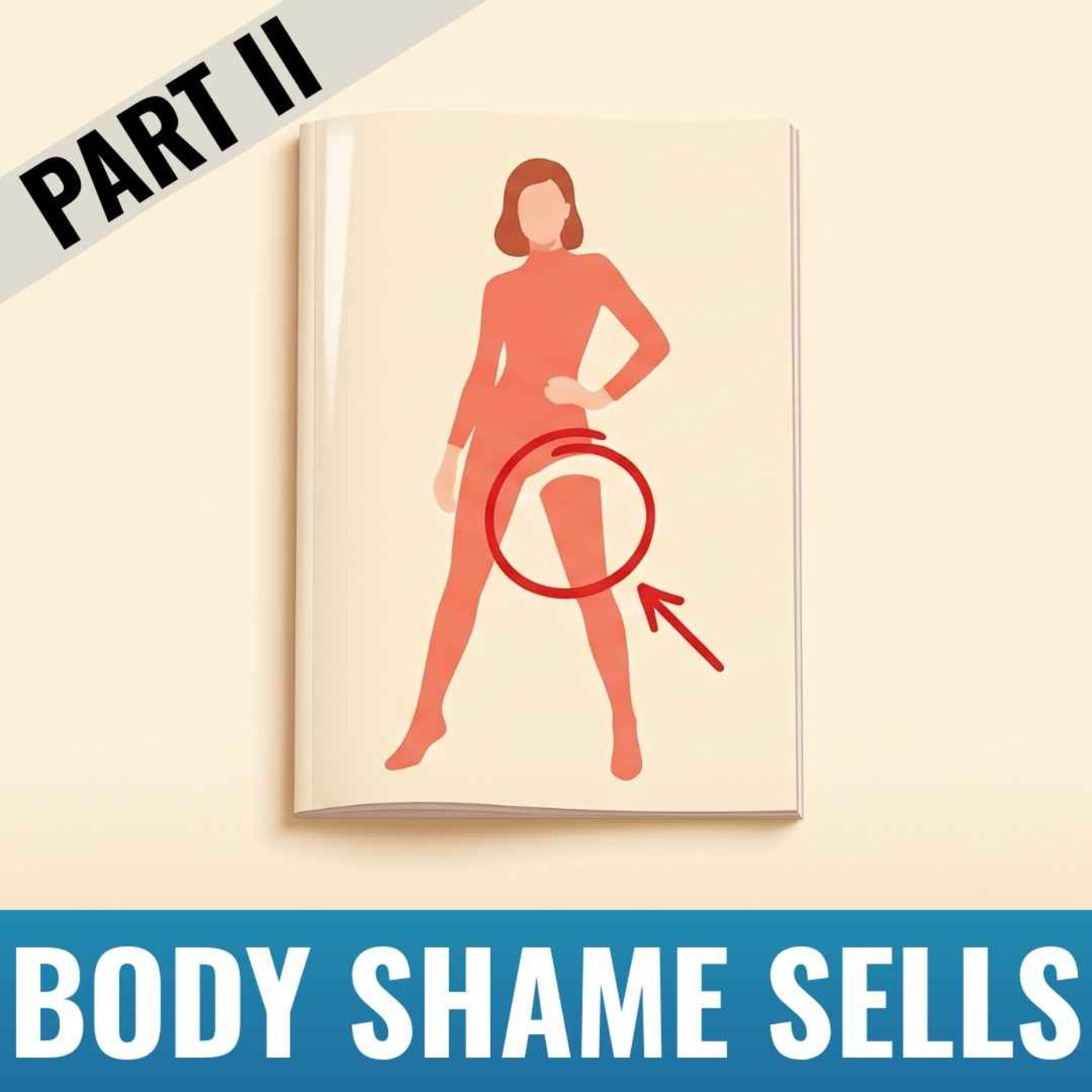
Yeah. I mean, it gets a lot to me, less funny when we get into the 90s because it became so extreme. And I grew up with this real anxiety that I was never, ever going to be attractive because I wasn't thin, you know, because my, my hip bones didn't jot out and you couldn't see my ribs. And, you know, girls like as young as 13 and 14, as I was at the time, were being pushed these images of these supermodels who in hindsight, you know, had eating disorders and drug problems but were regarded as really beautiful. And then alongside that, these very extreme diets are recommended as a way of achieving that look. So it's actually dangerous. And I think there are a lot of women my age who still live with the legacy of the kind of disordered eating. You know, this idea that you should be really fastidious about what you eat and then alongside it, this kind of guilty pleasure. All of these ads that marketed chocolate bars like it's a guilty pleasure that, you know, you deserve to treat yourself and do something really naughty and have a chocolate. Like, why is it naughty to have a chocolate bar? If you want a chocolate bar, eat a chocolate bar. Just understand the nutritional consequences and work out if it's what you want to do. But it was all tied to guilt and blame and shame. Shame and the desirability of thinness. And it was a really, it was a really tough time that, you know, I had lots of girls in my year at school be hospitalized for anorexia during that era. And I, you know, it still happens now. So, you know, and I think eating disorders are more complicated than just diet pressure. They're serious mental health conditions. But the culture became very, very punitive towards women. And, you know, if you, if you looked at the COVID of most of the magazines that were popular in that era, I remember they would feature a really slim celebrity and they would on the front cover have this big red mark around their thighs with an arrow saying cellulite alert. And it was just constantly body shaming women who actually basically met the standards of thinness but still weren't enough. And it sent the message that, you know, it's never enough. And the sinister side of that is it was being used to sell us things. It was being used to sell us these diet products, these horrible foods, in some cases, you know, these diet pills, these regimes and products, you know, you could get this kind of slim, fast lifestyle where you would, you know, exist on this disgusting shake and that was all you would eat, you know, twice a day.
- [39:05]
C
And the language is so bad too. So you know, the fact it's called cleanses or detoxification which the idea is that what you've had or what you, how you're living is toxic. The idea that you know things are bad and dangerous. And so I think that you're right afraid that the ways in which this became a really bad time where you'd be asked to measure your body fat index, you know, your in fear of obesity, that there's a kind of perfect form that you've got to look like all the time while being pushed heroin chic supermodel images. And people are clearly not living healthily. I mean ironically, you have at the same time as that's all taking shape, a real proliferation of really quite dangerous foods of super fast, super cheap poly saturated fats that were extremely dangerous. And in fact there's been a big pushback about those in the last few years too because you know, from school meals where kids are being fed absolute garbage through to try to make people more aware of what they're eating. Some of that is because these new technologies we mentioned about the ways in which transportation, refrigeration allowed things to move quicker. The fact that you could make food at massive scale without thinking about home economics or teaching children about the value of eating well and healthily and projected it all into either high margins foods or to body image moved us away from why do we eat in the first place. And one of the great joys of eating is, you know, we've talked about how you like experimenting with your food alpha, but it's also about the joy of eating together and of talking. And again this period, the last 20 to 30 years, we measurably how irregularly families or couples will eat together. You know, we both know that you go to go to a restaurant and you'll see a couple either taking photos of their cocktails and their food or just checking their phones the whole way through. So that process of breaking bread, of sharing ideas, of talking about what you've been doing has also given way to the idea that what you look like is more important than the substance but
- [40:57]
B
also connection to your culture and your ancestry. You know, in many cultures you eat what your ancestors ate. You know, these foods are grounded in the culture and they serve, they offer a meaning more than just like calorie intake and nutrition. And that's actually one thing I really appreciate when I go to Ghana you know, is that they're not trying to reinvent the wheel. They've got these foods. There are narratives about the foods. There's a time for them. Some of them have ritual meanings. You eat them at certain times of the week or certain times of the year or, you know, on certain occasions. And I think that, you know, there's something very natural about food having symbolism that is not stripped from community, family and culture. And what we're seeing in the 90s and noughties and up till today in Western countries is this complete decoupling of food from any sense of community or social good. It's highly individualized, and it's all about selling ideas, selling some kind of aspiration about what your body can look like, selling a product, selling a weight, and that it really makes it possible for very bad ideas to take root. And it's funny because, you know, on the one hand, yes, you've got more awareness about health because there's so much unhealthy processed food, but you've also got these diets that are terrible ideas. I mean, I remember when I was an undergraduate in the late 90s and everyone was on the Atkins diet. So I tried the Atkins diet and, you know, it was just. Just absolutely terrible. And I'm lactose intolerant. So the idea of kind of, you know, having like, cheese for lunch and then a cheeseburger for dinner with no bun, it's all kind of like dairy, meat and fat, because you're cutting out carbs completely and you're eating basically whatever can fill you. I mean, you might have the odd green leafy vegetable, but the emphasis was really heavy on the protein, no carbs. And I've never felt in my life as unhealthy as when I never really tried that seriously. But I dabbled with. With that idea. And, you know, the one positive was I think, the awareness that actually protein is good for you, as opposed to the Weight Watchers days where it was all, like, zero fats. You would eat all these sugary carbs with no fat. Now it's moving to the other extreme where it's, like, high in saturated fats, no carbohydrates, and lots of, like, salty, oily proteins and dairy. So that, in my opinion, was an extremely bad idea. I'm very happy to see the back of that, although I think it might have reinvented itself in slightly healthier forms like the paleo, the keto. I just want to end this episode with a quote from the brilliant film the Devil Wears Prada. Which summarizes the ideas about food in the 90s and 40s to me, which is I'm just one stomach flu away from my goal weight.
- [43:36]
C
How about that as a way to end? I mean, you can't do better than that. What a great film. But the idea that there is an ideal goal weight and also that you're so close to getting there. But yeah, the tyranny and oppression of, of having to look good for other people because that's how you feel good about yourself. It's an amazing one.
- [43:54]
B
And also that it has nothing to do with health. Like stomach flu is great because you'll get thinner.
- [43:59]
C
Thank you for listening to Legacy.
- [44:01]
B
Don't forget to hit subscribe on your favorite podcast player. You can also watch all our episodes on YouTube, so make sure you're subscribed there, too.
- [44:08]
C
And of course, we're on all the socials and the links are in the show notes for this episode or just search up Legacy Podcast. I'm Peter Franker. Pen.
- [44:16]
B
I'm AFWA Hirsch.
- [44:17]
C
We'll see you next time on Legacy.
- [44:38]
A
Does your day move faster than you can keep up with new Gatorade lower sugar? My family and I can stay at the top of our game. No artificial flavors, sweeteners or colors. 75% less sugar and all the electrolytes of regular Gatorade now available nationwide.