Loading summary
Transcript77 lines
- [00:00]
Thumbtack Advertiser
Avoiding your unfinished home projects because you're not sure where to start. Thumbtack knows homes, so you don't have to. Don't know the difference between matte paint, finish and satin or what that clunking sound from your dryer is. With Thumbtack, you don't have to be a home pro, you just have to hire one. You can hire top rated pros, see price estimates and read reviews all on the app. Download Today.
- [00:23]
Afwa Haas
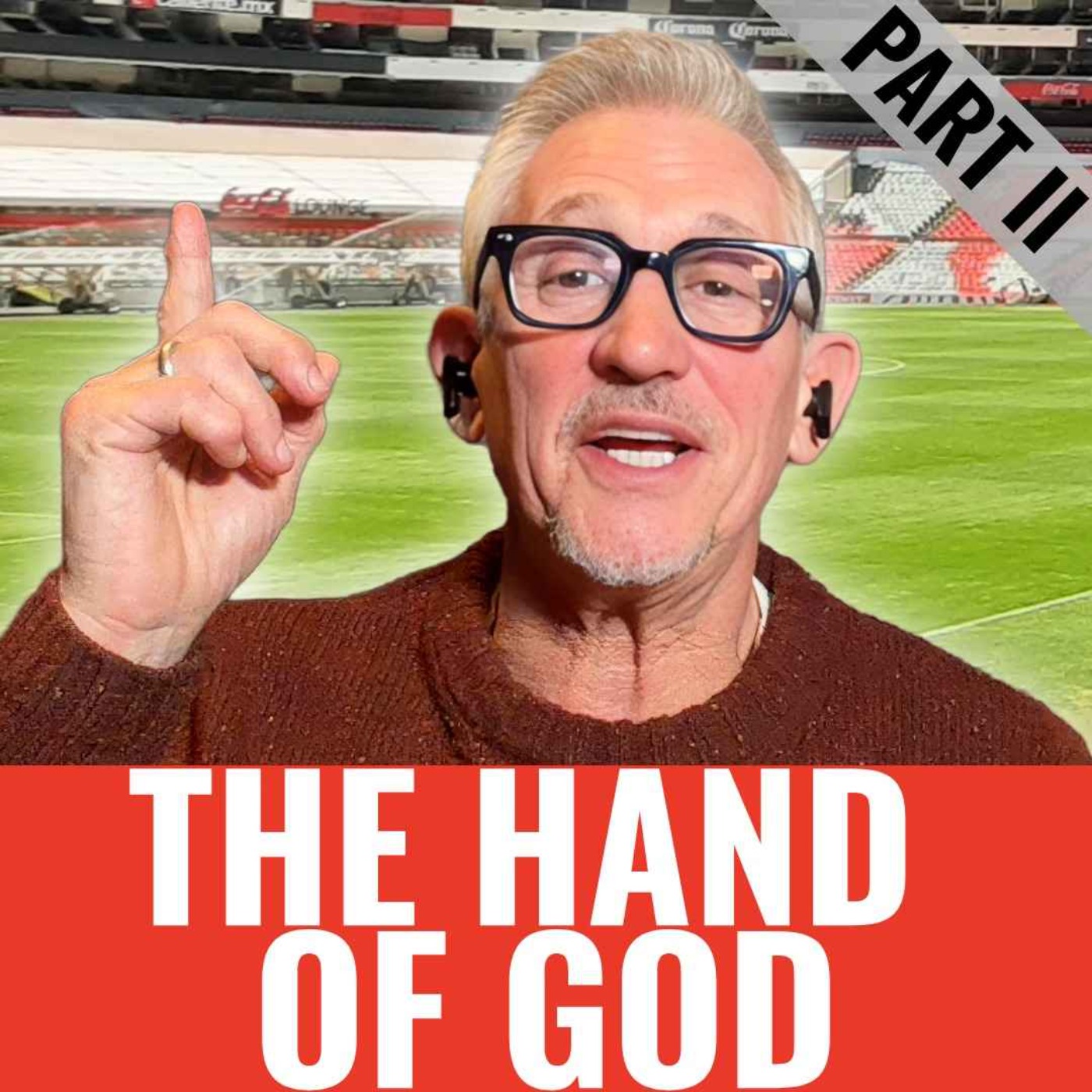
Last time Gary Lineker took us through the politics of. Of football, power, FIFA, Trump, and the most nervous buildup to a World cup he can remember. Today we're going to get even more personal.
- [00:37]
Peter Frankenberg
Well, because this World cup incredibly marks 40 years. I mean, God, that makes me feel old. Since Carrie won the Golden Boot at the World cup in Mexico in 1986. And that's the Tournament of Maradona about the hand of God, the greatest goal probably ever scored in the World cup finals, and a quarter final where England played against Argentina just four years after the two countries had been at war over the Falklands.
- [00:59]
Afwa Haas
And that opens the door to a conversation I've been waiting for for a long time where we really get into questions of pride, patriotism, identity, and how the weight of history hovers over a football pitch. This is part two of three of our special episodes with Gary Lineker.
- [01:24]
Peter Frankenberg
Hello and welcome to a new episode of Legacy. I'm Peter Frankenberg.
- [01:27]
Afwa Haas
I'm Afwa Haas.
- [01:28]
Peter Frankenberg
And this is Legacy, the show that explores the lives, events and ideas that have shaped our world and asks whether they have the reputations that they truly deserve.
- [01:37]
Afwa Haas
This is Gary Lineker on Nation, Identity and the beautiful game.
- [01:45]
Peter Frankenberg
Thanks for joining us on Legacy Today. To support the show, please sign up to Legacy.
- [01:50]
Afwa Haas
Only Legacy subscribers can enjoy early access to our episodes. Fewer ads, Q&As, bonus content. And when we say bonus content, it's not just scraps. It's really our best bits.
- [02:03]
Peter Frankenberg
I think it's our best bits.
- [02:05]
Afwa Haas
Bits.
- [02:05]
Peter Frankenberg
Yeah.
- [02:05]
Afwa Haas
Including the third and final part of this conversation with Gary, which is going out just for you Legacy subscribers. And that is where we will get into racism in the game, the, the trouble with FIFA and the rise of the women's game.
- [02:19]
Peter Frankenberg
I think they are our best bits, Afra. I think to find topics that are going to be unusual and rewarding to people who become members, we really think hard. So it's not our offcuts, like you say, it's our golden nuggets. So please sign up at Legacy supportingcast fm. So afwa, if part one was the World cup as geopolitics, the big cold machinery of power. Part two is the World cup about something much more warmer and something much more personal. It's about identity. It's about belonging, about. It's about who we are when we pull on a shirt.
- [02:49]
Afwa Haas
It's no secret, Peter, that these are questions that are of very special interest to me. They're actually the questions I'm probably most preoccupied with in my books, in my writing and reading. So it's always just so interesting to take your life's work and put it in a slightly different context, because I'm not a massive expert on football. And even though I'm actually friends with Gary, these aren't exactly conversations you have every time you meet up for dinner or a drink.
- [03:18]
Peter Frankenberg
So you're missing something. If I got invited for dinner with you and Gary Liquor, I would be only asking you about his greatest goals of the 1985 and 1986 football seasons.
- [03:27]
Afwa Haas
So you wouldn't be asking Peter about what Englishness means to you in Englishness versus Britishness.
- [03:33]
Peter Frankenberg
It's why he's a friend of yours and why you get invited back. And I'm still waiting for my phone to ring.
- [03:39]
Afwa Haas
But I think the things you would ask about are also very relevant to this conversation. And actually, we're going to start in 1986, when we were both alive, although one of us was probably following the World cup that year more closely than the other. I'll leave you listeners to guess which way around that is. And Maradona, the England Argentina quarter final. And even though, okay, to answer the question, I wasn't really following football because I was a very small child. It doesn't matter, because that game just lives on in the culture. People talk about it, people feel passionately about it. People have kind of given it this, like, supernatural status. And it is a game where football and history fuse completely because, well, for many reasons, not least that that was played only four years after the Falklands War.
- [04:25]
Peter Frankenberg
So here we go. Over to Gary Lineker. Enjoy.
- [04:32]
Afwa Haas
So, Gary, this World cup marks the fulfillment 40th anniversary of you winning the Golden Boot in 1986.
- [04:42]
Peter Frankenberg
He's looking all right. He's still looking. Okay on it.
- [04:44]
Gary Lineker
You've done your research.
- [04:46]
Peter Frankenberg
Thanks.
- [04:46]
Afwa Haas
I mean, I knew I could wing it with all the insane football knowledge I have. But, you know, everybody is still obsessed with that World cup. And I have actually done my research and spoken to football lovers in my life, and they all still want to know about Maradona, about the hand of God, about What it was like playing Argentina just after the end of the Falklands War. So how does that memory stand out now? How do you look back on that time?
- [05:14]
Gary Lineker
I was. I was just a boy back there. I felt like I was 25, but
- [05:18]
Afwa Haas
that's actually not that young in the scheme of schooling, careers.
- [05:23]
Gary Lineker
No, not in terms of football, but in terms of life, you know, so it was. We knew that. Obviously, I was always interested in the politics and news and stuff. I always have been. I didn't have a platform to voice my ideas or beliefs or concerns or things I agree with, things I disagree with, but I do. I mean, I remember going to. To Mexico and it was, you know, and I. I used to think, wow, this is amazing. If we go to a game or a training and we're in a bus and they had outriders on, they've all got, like, machine guns all around us,
- [05:59]
Afwa Haas
you're thinking it's a bit of a
- [06:00]
Gary Lineker
red flag, unsafe about this country. But, you know, eventually I watched a season series called Narcos, and I thought that was in that era, that would
- [06:10]
Afwa Haas
have been a bit of a way.
- [06:12]
Gary Lineker
I genuinely had my, you know, talk about being in a bubble. I had no idea about this stuff at that particular point in my career. But we did know we'd been at war with Argentina in terms of the Falklands or Las Malvinas, So we were aware of that. That had only happened two or three years, three years before, but I think all of us wanted to avoid that going into the game, and I think the Argentinians were the same. Did they use it as a motivating factor? They may have done, but we certainly didn't. They said they didn't either, but we went into this game and it. I think actually probably until the final in Qatar between Argentina and France, for all that happened on the pitch, I think it was probably the most famous game of football ever. And to be in a part of that, not just because of. It followed the, you know, the war, but also because of what happened in the game. And Diego, he scored the most impotent goal of all time. You know, he punched it in with his hand, he got away with it, and then he scored the greatest goal of all time. And for those two things to happen just a few minutes apart, and in many ways, those incidents encapsulated his life. You know, that. That incredible brilliance and genius that was there, but also that slightly cheeky, naughty side that he got away with as well. I mean, I've met Diego. I did a documentary with him and I spent three days in his life and his life was bonkers. But he, what a man, you know, what a man as well talk about in your day now. He would stand up and speak about political issues.
- [07:52]
Afwa Haas
Yeah.
- [07:52]
Gary Lineker
And always did, you know, he was, always did. He was very pro Palestine way back in, in when he lived and he made that very clear. He's pro Cuba, all that kind of stuff. Very much an underdogs man. I'd great village. He was, he was such a lovely, lovely guy as well. But on that occasion I probably didn't like him that much that day. But we were aware of all the politics going on around us. You couldn't, you couldn't not be. But it wasn't a part of a motivation going into the game at all.
- [08:25]
Peter Frankenberg
But do big matches between rivals and traditional rivals, do they feel different? I mean it's a, it's a quarterfinal, the World cup, so of course it's going to feel big no matter what. Everyone's desperate to win. It doesn't really matter who's on the other side of the pitch. But is there something special when you have local derbies, when you have Barcelona against Real Madrid, when you've got a kind of England, Germany, does it feel different or is it, is it just the day job that it only feels different to the people watching?
- [08:48]
Gary Lineker
No, it does feel different. No, no question. It definitely feels you. It's. I used to love that. I love those big games because they were special, meant a bit more, got the adrenaline flowing, you know, I used to struggle in the games that didn't mean very much and there was no crowd there. But those games, you always feel it. There's an extra something, there's an extra rush of adrenaline going out into playing those games. Unquestionably,
- [09:19]
AT&T Business Wireless Advertiser
not every sale happens at the register. Before AT&T business Wireless, checking out customers on our mobile POS systems took too long. Basically a staring contest where everyone loses. It's crazy what people say during an awkward silence. Now transactions are done before the silence takes hold. That means I can focus on the task at hand and make an extra sale or two. Sometimes I do miss the bonding time sometimes.
- [09:44]
Peter Frankenberg
AT&T business Wireless Connecting changes everything.
- [09:50]
Mazda Advertiser
You're more than just one thing. And your vehicle should have more too. More connectivity when you're the boss. Hey, Google, when's my next meeting? More space when you're the ringleader and we're good. And when you're the mom. Everyone in the all new Mazda CX5 more to move every side of you learn more@mazdausa.com Google is a trademark of Google LLC. Sequences shortened and simulated.
- [10:25]
Afwa Haas
I wore this specially for you today. Can you see
- [10:29]
Peter Frankenberg
Ghana for those listening, it's was in her football merchandise today
- [10:33]
Afwa Haas
in her black star, my Ghana strip. Ghana is in the same group as England. So there's going to be a match, at least one, hopefully more. And I this is one of the things I do love about the World Cup. I cannot help but see the symbolism in countries that may have had rivalries playing each other, as you were saying, but especially a colonizer playing a formally colonized. It's always special. I was living in Senegal when they beat France in 2002. It was unlike anything I've experienced.
- [11:05]
Gary Lineker
That's interesting. Actually, can I ask you there because I switch it here a little bit because obviously I'm, I'm a person from a country that's been the occupier, not the occupied. So I don't think we, as I never thought of it this way before, but as playing for England. I never thought about it that way. But you're saying that opposition teams that have perhaps been occupied by you in history would definitely think that's a bigger game.
- [11:35]
Afwa Haas
Yeah, like that was for Senegal. That was existential and it was almost like all of the trauma and frustration and pain was vindicated in that moment. And of course it doesn't undo the history of colonialism, but I think just for a matter of personal pride and dignity. And that's one of the things about colonization. It's like your dignity has been taken. Another country has said it's superior, its culture and religion and language is superior, and they've imposed it on you. And so when you show that you have the strength and power to actually reverse things, there's just something quite deep about that and on an identity level. And that I think is one of the things that you see, see when those contests happen between countries, it's like a vindication, like, we are your equal, actually. We can beat you. And then you add to that with football, of course. And you know way more about this than me. The way that teams play there is always that there's a kind of like national spirit in the way that people play. Right. That's why people love Brazil and Argentina. You know, you can just see the culture in, in the moves.
- [12:36]
Gary Lineker
I'm very against, I'm very against occupation. I think it's the light of our history. But does that mean I, I, I can still cheer England against Ghana?
- [12:48]
Afwa Haas
You kind of have to like it would be weird.
- [12:50]
Gary Lineker
I mean, it's, you know, definitely, I think.
- [12:54]
Afwa Haas
But I think you can also recognize, like, you can want England to win, but you can also recognize that if Ghana were to be England, what that would mean.
- [13:03]
Gary Lineker
Yeah, that would be amazing for them. I think we'll both go through the group anyway.
- [13:07]
Afwa Haas
That would be my idea, I think.
- [13:09]
Gary Lineker
I think we'll definitely, definitely go through.
- [13:11]
Afwa Haas
I mean, I'm not torn, but technically I should be, right, Because I'm half of each. And I think that's also why a lot of people who are mixed race or have dual nationality, it's like you support the underdog because that just feels like a more compelling story. But I wanted to ask you, I mean, do you think that we're right to load all this symbolism in history onto the game, especially in the World cup, like this?
- [13:35]
Gary Lineker
I just wish we could resolve all these things with a bit of football leave and, and, and just. I mean, football's very tribal and I get that, but if, if we could just, just leave that and. And all the other tribalist stuff. Leave it apart. But no, I don't. I think, I think it's totally understandable. Totally understandable. I mean, I think nationalism and all those kind of things, but I think, I think having a bit of joy and a bit of support for your own country, you know, however bad they've behaved at any point in the history, I think it's. When it's down to things like football, it's okay.
- [14:13]
Afwa Haas
But also, as you pointed out, you're essentially supporting a group of probably working class lads. It's not the government, it's not the elite, it's people who are themselves underdogs just for being on that stage. You know, they haven't probably had point.
- [14:28]
Gary Lineker
At some point the world will realize that the governments and the elite, the people that get to the actual, you know, to make all these decisions and the enemy.
- [14:39]
Afwa Haas
I mean, we should have footballers running the world. Is that what you're suggesting?
- [14:43]
Gary Lineker
Gary, that's not necessarily a good idea.
- [14:47]
Afwa Haas
Of course. My mind is going back to the dentist chair story that you were telling us about before we recorded and inauspicious.
- [14:55]
Peter Frankenberg
But the World cup does. The World cup does more for geography lessons than just about anything. I mean, the only time people are going to come across Ghana and Ghanaian history comes with the World cup, sitting not just in England, but other countries that didn't colonize Ghana, but a bit like Eurovision, you know, people's experience of Lithuania every year is because they see. They see some sort of fantastic 80s disco. But people are going to hear about Cap Vergio, they're going to hear about Uzbekistan, then there'll be always. Because, you know, TV channels do quite a good job of a good two minute video before the match and people will get a chance to see it. And so in that sense, football is like the Olympics are really good at expanding people's visions and perspectives, but it's whether it actually does anything beyond a bit of eye candy and a bit of sort of very light engagement.
- [15:39]
Afwa Haas
Well, I was thinking what you just said, Peter, about it expanding people's knowledge of other countries. In a way, I think the World cup expands our knowledge of our own country. Because there's always this existential moment in recent years during a World cup where people start to notice what the England team looks like. And the reality is the England team is so diverse. And there's a way in which it actually reflects the makeup of our society better than most of our other institutions. Right. You see all these players of different heritage playing for England, working for England, winning for England. And it often prompts these conversations about multiculturalism and culture. And I just wonder because, Gary, the England team looked really different when you were playing in it, you know, in the, in the 80s and 90s. Have you observed that trend and what do you think it means for England as a footballing team competing on the world stage?
- [16:32]
Gary Lineker
Yeah, it has changed gradually. I was in the era of when black players first started to play for England. We have Viv Anderson that I played with many times, John Barnes, of course, Des Walker. So, you know, it's not like Paul Parker, another one. So there were quite a few. We were mixed, not as mixed as now. And do you know what? This is what, this is why I get so much joy from football. And I think football can be a lesson. In fact, I think actually football is reflection of actually how we really are. Most people, Most people, I think, you know, you get a football dressing room and in that dressing room you'll have black players. I have brown players, my players from Japan or Korea. You've got players from England that might be different colors. You'll have Muslims, you'll have Christians, you'll have different, you know, Jewish players or wherever they're from, and whatever their creed or race or religion. Nobody ever, ever even thinks about that in a dressing room. They think about, well, he can cross the ball, he'll get us a goal, he'll stop him, he'll stop him playing. And I think that real kind of togetherness of a Dressing room is a lesson for all of us that why, why do we ever judge people by the color of their skin or their religion? Basically, you're either you're a good person, which I think most people are, and want to get on with your life, or you're a rotter. And. And thankfully, there are not many rotters, but the rotters are the ones that appear to get to the top in everything and make all the big decisions. But I think football really, I think the harmony of a dressing room, of a squad is an example to all and it's something I'm proud of within football now, there are aspects of football that are not right, like the amount of diversity in terms of management in club owners. That sort of thing is very different. But actually, the players themselves, the young lads that have come through, that really, really makes me feel proud about football. And I don't think we shout loud enough about that sometimes.
- [18:48]
Peter Frankenberg
I think sport in general, that it's, you know, you can't, you know, at the end of the day, it's. Sometimes you might think you agree by the results, but it's very clear who's played better. It. It therefore rewards merit, you know, and I think that that's why people love sport across all kinds, because, you know, you can have a good day and a bad day, but you can't argue with the results. And I guess that's why people stand behind it and want to cheer, because all those, you know, whatever somebody looks like, what skin color they have, what language they have, faith, creed, et cetera, it's seeing someone do the best they can.
- [19:23]
CFA Institute Advertiser
When finance professionals need trusted insight, they turn to CFA Institute. Now, as private markets become essential to modern portfolios, we bring the same commitment to ethics, education and professional excellence that has defined our work for over 75 years. With with professional certificates, a new private markets pathway in the CFA program, the latest research and more, we are helping professionals build deeper knowledge and stronger judgment in a complex field. Visit cfa institute@cfainstitute.org to learn more.
- [20:00]
Afwa Haas
I have to say, it is pretty cool to be able to ask Gary about his first person experience, experience of being in the hand of God game. Because it's just such an iconic game, such an iconic moment. And the fact that he then later got to know Maradona just gives it so many more layers. I just loved this conversation, Peter. And again, I just really appreciate how Gary is just very open, you know, even if you ask him a question that he hasn't really thought that much about or he doesn't feel particularly qualified to answer in depth. He's just not defensive at all. He's really transparent and really curious to, to learn more and get into new topics. I just think that is such a compelling quality in a person and I really admire it.
- [20:45]
Peter Frankenberg
Yeah, look, when you asked him about, you know, how does it feel if you're part of a country that had once colonized another one, you know, he sort of stopped and thought he'd, you know, said he'd never thought about it like that. And would that be how people playing for Ghana would think? And of course, I know when people, people are funny because we posted a clip of this on Instagram and got, got hundreds of thousands of views and lots of people with comments. I mean, it's not just, amazingly, about England and Ghana. It's not just about the slave trade. Lots of countries have colonized others. Lots of these matches up during the World cup are hugely sensitive. But that, that question about how does it feel if, if your past and your present have been controlled by other people? It's not surprising that those are going to be interesting topics. But what the, the bit that was revealing was that when he wanted you to explain how that felt from your perspective, and like you said, that's, that's open and that's, that's very rare, but it was a fantastic conversation to listen in on because it asked about the questions that you're so interested in Afro, about identity and how do you, how do you square what's happened rather than, you know, complain about it or ask for an apology? It's, what does it mean today? And, you know, it's, it's not a surprise to know that that England Ghana match was such an exciting matchup and, and the way we recorded it before the match and then having watched both of us whatsapping each other as play went on, you could see the determination, how well Ghana defended. And it wasn't just that it's the World cup and they're determined to do it, but that passion is drawn on the building blocks of history, too.
- [22:12]
Afwa Haas
Such a good way of putting it, Peter. And I'm also really excited for, I think, the logical evolution of that conversation, which will be in our next episode, which is a bonus episode for Legacy subscribers, subscribers only, where we take these themes of belonging, identity, what it means to play under a flag, what it means to play under the England flag and talk about those big questions of race, of racism in the game, of the ways in which black players are sometimes held up to different standards. And you Know what that means to Gary, who's white, who's English, who's kind of uncomplicated about his identity, but feels really strongly that there is no place for racism in football, who really believes in the potential of the sport to unify and overcome prejudice and division. But, you know, it's easy for us to talk about it. I've never been inside the England locker room after a game for the World cup, but Gary has. So if you want to hear that final and I think really powerful part of our conversation, subscribe to our Legacy plus and become a member of our community where you get to hear this really special content.
- [23:18]
Peter Frankenberg
And it's some of the most candid things that he spoke about with us. And I'm so grateful to you, afwa and your friendship with Gary. It speaks to how much he admires you and your work that he was willing to come and spend his time because as you can imagine, plenty of other people want to get his opinions. But the fact that he was so open and was so generous is a real reflection on you. So I'm hugely grateful to have had a chance to listen in as a Legacy plus contributor as well as some subscriber. But, you know, it was fascinating to get these perspectives. So I hope we get it to come back maybe after the World cup and talk about reflections too, because these are really important conversations and I don't know that because people feel very strongly about them and that strength of feeling, it's kind of actually taken me a bit by surprise about how people think that they feel threatened by some of the things we've been talking about.
- [24:05]
Afwa Haas
If you are not sure what Peter's going on about, just have a look on our Instagram page, Original Legacy Podcast and look at the comments underneath our posts on, on the World cup and especially our conversations with Gary. It kind of has to be seen to be believed and, you know, like it's water off a duck's back to me, Peter, because I've been attracting this kind of attention for a long time. Some of it's amazing, really substantive conversations that I think are really important. Some of it is just trolling and people who are just triggered by the fact that we're even having this conversation. But, you know, it's real. I mean, these views and sentiments exist, and I think the only way to move forward is to kind of air them and put the disinfectant of sunlight on what can sometimes feel like quite a festering grievance instead of a really open conversation. We only do open conversations on this podcast. That's just one of many things I love about it, Peter.
- [24:55]
Peter Frankenberg
But, you know, there are so many people in this country, afwa, of dual heritage, you know, who got a parent from a different part of the world or even a different part of Europe. And I do understand that multiculturalism sounds, that it brings a whole load of baggage with it, but the celebration of people with different perspectives, the idea that people have different views about things is about the richness of our lives. And yet we're sort of in a particular moment, I think, here in Britain, where we saw that, we spoke to Gary about that, too, about the euros and missed penalties and how identities can suddenly become toxified when they suit some people to do it. But I'm surprised in a way that we're still having to have these conversations, but navigating them with someone who is very much in the public eye and, you know, like you, who've been having to live with this for a long time as a bystander, it's been very interesting to see how people could be threatened by the idea that unless you're, you know, all of your eight great grandparents were born and bred in England, somehow you're an outsider and don't deserve to be here. It's, it's a funny one because as a historian, I can tell you that most of the British population didn't, weren't here because human beings are not indigenous to the British Isles. So we've all come from somewhere. So this conversation is, I think there's so much more we can talk about,
- [26:04]
Afwa Haas
but I was scared for a minute you were going to get into it. Let's save that for another day. I think we've had enough.
- [26:10]
Peter Frankenberg
We'll put that one behind the paywall, too. So if you want Alpha saving me from the precipice again, but yeah, please come and join us as part of the Legacy family and our last and final episode in our Gary Lineker series as part of the much bigger World cup events we're doing are on Legacy. So come and join us there on Legacy supportingcast.
- [26:30]
Afwa Haas
Yes, do it. Do it now to hear all of our amazing bonus content, including that final episode with Gary. You'll also get early access, fewer ads Q&As and more go to Legacy Supportingcast FM.
- [26:44]
Peter Frankenberg
And don't forget, you can watch all of our episodes on Spotify and YouTube too. And for anything else, including our substack, just check out the show notes or search Legacy Podcast. I Peter Frankenberg.
- [26:54]
Afwa Haas
I'm Afrah and we'll see you. On the next episode of Legacy.
- [27:15]
AT&T Business Wireless Advertiser
Not every sale happens at the register. Before AT&T business Wireless checking out customers on our mobile POS systems took too long. Basically a staring contest where everyone loses. It's crazy what people will say during an awkward silence. Now transactions are done before the silence takes hold. That means I can focus on the task at hand and make an extra sail or two. Sometimes I do miss the bonding time. Sometimes.
- [27:40]
Peter Frankenberg
AT&T business Wireless connecting changes everything.