Loading summary
Transcript64 lines
- [00:00]
A
This is a Monday.com ad, the same Monday.com designed for every team. The same Monday.com with built in AI, scaling your work from day one. The same Monday.comwith an easy and intuitive setup. Go to Monday.com and try it for free.
- [00:17]
B
Okay. Aphra, it's my great excitement to be taking you into the Middle Ages. Is that a subject that you're interested in generally? Do you love your Crusades and your castles and barons?
- [00:27]
A
That's not a simple opening question, Peter. I am super curious about history, as you know. Well, one of the reasons I love talking to you, I'm fascinated by the Middle Ages. I have been a little alienated over the years and through the long years of my formal education by the kind of glamorization of the Crusades, which to me always seemed like a series of really horrific atrocities that we should mourn rather than really exciting battles by bold knights and bloodthirsty warfare for the Holy Land. Like, it just didn't sit well on multiple levels. And I think maybe that put me off an area which actually I think does have a lot to offer me. So it's one of the reasons I love talking to you because it feels like a more nuanced conversation.
- [01:07]
B
That's a very diplomatic answer. I couldn't. I wasn't sure also whether you said bald knights or bald knights, but I like the idea of lots of people with very bad hair hair trying to attack castles. But the Middle Ages is also the time of great literature of Chaucer, of Petrarch, of Boccaccio, of storytelling, of thinking about some of those big global connections, you know, as the Mongols build their great empires. I mean, maybe I could talk you around to it about doing something on the Crusades too, because there are, you know, like, everything, there's, I don't want to say pluses and minuses, but you could think about these, those ideas about knightly piety and what they, what the Crusaders think they're doing. Maybe in slightly different ways, but what about things like the Leaning Tower of Pisa? Is that something that, that you. Have you been up. Have you been up the Leaning Tower? Do you like those Italian cities that speak of the Middle Ages?
- [01:54]
A
I do. I love them. I haven't been up the Leaning Tower piece. I have seen it. I find visiting medieval sites in Italy fascinating. All over Europe and actually also all over Africa. I mean, I've been to Timbuktu, I've been to Jenna. I've been to a number of ancient cities in Africa, and that's another reason why I think a lot of the literature I was exposed to about the Middle Ages felt limited because it confined it to a very European setting where I actually. And this is another reason I love your work and I'm not just blowing smoke up your ass. I love understanding it through this lens of global connection. There was so much more going on. That is interesting. And actually, you can't even understand Europe on its own terms without the influence of the Islamic world, without Africa and Asia. So, yes, absolutely. When it comes to the global picture, I couldn't be more interested. And I feel like what we're going to talk about today has all those elements of a global story. Story. Even if many of the main impacts were felt in Europe.
- [02:53]
B
Well, when we were talking about environmental disasters, you know, the most important, I guess the most famous thing in the Middle Ages, probably, probably as well as the Crusaders, is the Black Death. But we did just in the anecdote plague, so I didn't want to just repeat that. But I have a particular fondness for cows. I don't think I've ever told you that I love cows.
- [03:11]
A
You haven't, Peter, that's really sweet.
- [03:13]
B
Well, cows, they. First, they're incredible. I mean, they're very sweet animals. They're very curious. They form friendships. They get very. They get distressed if they're not with their buddies. They recognize each other. But a cow is a kind of incredible machine because it produces milk. That's, you know, it eats grass, it produces milk, it makes cheese. And not just any cheese. I mean, I know neither of us like cottage cheese, right? But amazing. Different kinds of cheeses.
- [03:36]
A
I'm not sure you could even insult the rest of cheese's name by associating it with cottage cheese. I mean, real cheese. And I am so lactose intolerant. And yet I. I still eat cheese because that's how delicious it is. But, Peter, just before we continue, do you eat cow meat?
- [03:55]
B
Yes. Yes. So I'm.
- [03:57]
A
The way you were talking about cows, I thought you were going to say, you know. And that's why I really don't think we should eat them because they're such loving creatures with great intelligence and social capacity. And then, and then I always feel really guilty about eating animals when we conversation.
- [04:14]
B
I think that's fair enough. No, but I am interested in cows because they're lovely animals. They are kind of incredible what they, they produce. But also the importance that they play, speaking as historian rather than as an animal lover is the role they play in domestic economies. We forget about the role of logistics, about where leather comes from, all the sort of products that come out of pastoral economies. But in this particular example that we're going to talk about today, the impacts that they have and the legacies they have are really important because what happens to cows in the 14th century helps explain one of the great environmental catastrophes in history. And it's one of those things that very few historians, even his rulers, the Middle Ages, spend time thinking and talking about. So I'm very grateful to you for letting me indulge my love and passion of cows and in the Middle Ages and bring that all together to talk about environmental shocks. I hope you're going to enjoy listening to this one. Hello and welcome to a new episode of Legacy. I'm Peter Franker.
- [05:17]
A
I'm Afua Hersh.
- [05:18]
B
And this is Legacy, the show that explores the lives, events and ideas that have shaped our world and asks whether they have the reputations that they truly deserve.
- [05:35]
A
This is before the plague, the environmental crises that weakened the world.
- [05:45]
B
Thanks, everybody, for listening to Legacy. It's so fantastic to bump into people in the streets, on an airplane, on a train, people who are listening. So thank you for supporting us. Please do also sign up to Legacy to get bonus content, early access, few ads, and to join me and AFWA with some of our Q&As.
- [06:03]
A
It's really important if you love and appreciate our work, that you subscribe and join our community. It helps support this podcast and make sure we can do many more. And we have awesome content for you. We have bonus episodes like the Legacy of the Fish Finger. Where else are you going to hear that, guys? And the Legacy of the Telephone.
- [06:23]
B
So to find out how to join Legacy plus, go to Legacy SupportingCast FM. That's Legacy SupportingCast FM, right? This is a really exciting story, Afra. I promise you it is.
- [06:39]
A
I'm excited because nobody has ever started a conversation with me before by asking me how I feel about cows in the Middle Ages. So, you know, Peter, that's just one of the joys of having you in my life. And, you know, it may also be the last time that anyone starts a conversation with me that way.
- [06:54]
B
So suspect that that could. That could be true. Okay, well, we're going to start with. We're going to start with climate stress, and we're going to start at the end of the 1200s. This is a time where lots of. If you want to have a read of. I've already tried to get you to join Legacy plus, but a book I wrote about the Earth transform that. I've done a lot of work on climate data, climate science, and thinking about environmental change. At the end of the 1270s. We see lots of strange patterns in written sources, but also from paleoclimatic materials like tree ring data, ice cores, and so on, that shows a sudden cooling trend in China, Korea and Japan. In east asia in the 1270s, we hear about crop failures. We hear about late frosts and unusual snowfalls. We hear about food shortages and disruptions of planting cycles. And that's the beginning of what we historians talk about as the beginning of the Little Ice Age, which is a time of something that we'll talk about on another occasion. But all these kind of natural disasters start to worry people about the fact that the world is going through a. A time of environmental change.
- [07:59]
A
And we know that they were worried about it because local gazetteers in China, for example, who were known as Fangzi, repeatedly described abnormal cold and frosts disrupting their planting cycles. So you can imagine for societies that were primarily agrarian, that were very much dependent on these forces outside of their control, the weather, the seasons, and the productivity of crops, these kinds of changes, unexplained and seemingly out of nowhere, were very alarming and could potentially have huge consequences.
- [08:31]
B
You mentioned Afua that you've been to Timbuktu and Jenna. But in a lot of different cultures, the role of a leader and his legitimacy, or their legitimacy, is often linked to benign environmental conditions, good harvests, plentiful food. Some of those things we're seeing, in fact, at the moment where the Straits of Hormuz have been closed and suddenly the price of oil goes up, that has direct impacts on. On living standards and on people's disposable income, if you have to spend more on getting things. So in lots of cultures, if there is a problem of compression and life gets harder, then often the person at the top gets blamed for it. And in the Chinese cultures, for example, at the Yuan court in this period, across all periods in Chinese history, the emperor has what's called the Mandate of Heaven, or Qian Ming, which means that a good person and a good leader is blessed with good environmental conditions, and a bad one faces flooding, epidemics, disaster, shortages. So, for example, at the end of the 1290s, things get so bad that one of the emperors changes his title to Dade or just means great virtue, to try and say, look, this isn't my fault. I live a very virtuous life. Those fortunes that are declining are not my responsibility. And it's not because I'm out of favor with the gods. It's because of a whole bunch of other things. And I'm doing my best to stem the tide, but you can see that there's a whole bunch of things that are moving around, natural conditions that are changing, that are making climatic conditions in some parts of Asia very, very complicated and difficult.
- [09:54]
A
In 1308, a climate shock on the Mongolian steppe triggers a mass migration. The court records, the Yuan Shi record catastrophic snowstorms in 1308, and these kill vast numbers of livestock across the steppe. So, Peter, we did a whole series on Genghis Khan and the Mongols. Where in that history does this climate shock fit?
- [10:18]
B
Well, those steppe lands that link the belts from the Black Sea right the way to the Korean Peninsula are where the world's great livestock are reared, particularly horses. But what happens when you have environmental shocks is that you can have deep and sudden impacts to flora and fauna of all kind. And so when you have, as happens in 1308, you have catastrophic snow forms, you can have enormous loss of life. I mean, to give that some sort of scale, at the beginning of the 20th century, there was something similar that happened in Warsaw, Turkmenistan, and an estimated million animals died in the space of 24 hours. So suddenly, that means that people's livelihood, their ability to eat, the value of land, suddenly changes dramatically. And with these snowstorms that will get written about in some of the Chinese sources in the early 1300s, it forces not just animals to die, but it forces people to move, to look for food. They head southward. So that produces migration problems. People in the past were no happier about sudden arrival of lots of people with caps in their hand and starving than they are today. And also you have a demographic catastrophe in the Yangtze river because of famine, a disease that kick in. You have one source that says that dead bodies lay upon each other. Fathers had to sell their sons, husbands had to sell their wives, and the sound of their crying was so loud that the earth trembled. And of course, not surprisingly, when you've got these kinds of problems, the economy comes under strain because people aren't in the right place. They can't be productive, they can't pay their taxes, and so they're desperate for help. And the only way you can get out of that is the government then has to bail out, and that empties the coffers very quickly. So you get a set of disasters that magnify that. That's what I think is interesting about looking at questions like this, not just because we're living in the age of Climate change. But it's when something goes wrong, then lots and lots of things go wrong. So again, looking at the crisis in Iran today, blocking a narrow body of water suddenly means that fertilizers can't reach people. In Africa, you're going to have hunger, you're going to have inflation, you're going to have economic pressures too. And so small things can create enormous cracks in the system. So what's interesting is that we don't just see the Zafwa in China and East Asia, we see this start to happen in other parts of the world as well at the same time.
- [12:32]
A
Yeah, that's right. So as well as dramatically affecting these East Asian societies, there are these parallel climate shocks in the Middle East. And we know this because chronicles from Syria and Mesopotamia record clusters of what to people living through them seemed like freak weather events. So, for example, in 1319-20, there were a series of incredibly violent storms that destroyed homes in Damascus and left people trapped indoors, trapped under falling trees. And the same system hit Aleppo with dust storms, hail and lightning, uprooted oaks, olives and vines, which of course were also really important sources of income and food for the region. And these weren't just spectacular weather events, which of course they were, and must have felt like they had divine significance, because when you have this unusual weather coming from the sky, you can't help but connect it to powers of supernatural proportions. But it also had really concrete repercussions. So the destruction of orchards, which means long term loss of capital, and it takes crops like olive trees decades to mature. You can't just start again for the next harvest. So this is a loss that's going to affect these societies over the long term. And of course, and as we know from our contemporary experience, the effects of these losses aren't distributed equally. It's always the poorest who are least resilient and most vulnerable. And these environmental shocks are no different. So the urban poor and rural laborers are most seriously affected by the loss of housing, the destruction of tools, and then the consequential experiences of inflation. The cost of grain increasing beyond their purchasing capacity, the cost of fuel and building materials which they need to rebuild their homes, now becomes out of their reach. And then after these cold winters and floods, chroniclers at the time note a sharp rise in wood prices because trees have died or become inaccessible. And this isn't just in Damascus and Aleppo. We see similar dynamics in Cairo, in Tabriz, and it's this pattern of scarcity which leads to price hikes, which leads then to Social unrest, riots and uprisings, and then scapegoating often of people who are visible minorities or already unpopular for some reason, who are disproportionately blamed for these patterns.
- [14:51]
B
So.
- [14:52]
A
So it's a classic example and something that I think we can still recognize of how these climate shocks have very far reaching social and political consequences.
- [15:02]
B
And it's partly because the world's climate is a set of very complicated, interlocking, different systems and patterns. And that picture we painted of China and, or East Asia and the Middle east is part of a reasonably regular reorganization. But it shows that worlds that are not prepared for shocks don't know how to deal with them particularly well. And often the ways in which they try to deal with them make things worse. So we're going to talk today, really about the case in Europe and about a period called the Dantean Anomaly, which is the beginning of the 1300s, named after Dante Alighieri, which is of course the most famous author of that time. And there are some of the most vivid and contemporary descriptions of extreme weather, of famine, anxiety and of urban crisis comes from those medieval cities initially that we talked about afw, precisely when Dante is alive. And we can match that up with reconstructions from climate data today. It's quite new for U.S. historians over the last 20 or 30 years or so, where we can see unusually dry summers followed by extremely severe winters. And you can see that through urban fires and cities trying to work out how to solve the fact that they can't feed themselves in the way that they used to. So places like Siena acquires a port to try to make sure it can protect its own supply chains. Again, lots of resonances with the world. In 2026, cities start to invest in deeper wells or in water infrastructure to make sure that they can get through drought conditions and so on. And all of these measures are showing ways of people trying to cope with shocks. So there's something that's going on here that is worth paying attention to.
- [16:35]
A
These measures show how early urban resilience strategies can try to respond to climate volatility. But in this case, these early experiences were actually a prelude to something much more serious that was on the horizon. So after the break, we'll find out what it was that was coming and how these catastrophic events don't just happen to humans, of course, they affect other species as well. Foreign.
- [17:14]
C
Hi, this is Pablo Torre from. Pablo Torre finds out. And today I want to talk to you about Boost Mobile because we spend a lot of time analyzing inefficiencies in sports, overvalued contracts, money tied up in the wrong places, and so on. But those inefficiencies aren't just on a roster. Sometimes they're in your own monthly expenses. Boost Mobile says switching to their $25 Unlimited Forever plan can unlock up to $600 in savings a year. That's $25 a month for unlimited data, talk and text when you bring your own phone. If that money is trapped in a pricey phone bill, it might be worth a second look. Visit boostmobile.com to learn more. After 30 gigabytes, customers may experience slower speeds. Customers pay $25 per month as long as they remain active on the Boost Mobile Unlimited Plan savings claim. Based on a January 2026 Boost Mobile survey of 1,000Americans with single line unlimited plans, comparing average annual payments of major carriers to 12 months on the Boost Mobile Unlimited plan. For full offer details, visit boostmobile.com all
- [18:10]
D
right, ladies, when you've done the work, you want your hydration to do the same. Introducing new Gatorade lower sugar, now with no artificial flavors, sweeteners or colors. And 75% less sugar and all the electrolytes of regular Gatorade now available nationwide.
- [18:36]
B
So let's paint a quick picture of Europe in in 1300. So this is a time when Europe has been emerging from two centuries of expansion. Population has roughly doubled since the year thousand forests have been cleared to create new fields, new lands are being opened up to be farmed, and rural economies are dependent on my friends, the cows, for not just for the meats, but also for plowing, for for manure and fertilizer and for ploughing fields too. But Europe above all is no longer a closed world. It's connected through trade routes that link English wool to Flemish looms, from Baltic grain ports to Italian markets and from Mediterranean harbours not only into Central Europe and the Rhine and the Danube, but also into those silk roads of the East. Meanwhile, Asia has been connected by Mongol conquests that we talked about when we did Chinggis Khan that have created a world that's highly connected. So information, goods and news is being passed along as well as products along these networks incredibly quickly. So these have deep infrastructural legacies, trade routes, shipping routes, ports, merchant colonies, habits of long distance mobilization that set the conditions for the Black Death for one day when we talk about that. But I'm really interested in, first of all, just rounding out the society that we can think of as being crusaders who are thick but want to go and kill people with that Literate world and of culture. Tell me a bit about Marco Polo and about trade. Afwa.
- [20:01]
A
Well, everybody knows the name Marco Polo, even if they don't know exactly what he was up to. But his travels are one of the most fascinating medieval accounts of a European really embarking on a global adventure that became incredibly influential in creating the narrative that endured for centuries about what China and East Asian lands were like for the audiences he took his stories back home to in Europe. So he reached the Chinese court around 1300, and he fed Europeans with the sense that Europe was part of a far bigger world than they had previously understood. That connected them to China and all of the states in between Europe and China, which, of course, was pretty far away. And he allowed Italian merchants to really build on their position at the center of this connectivity. And in this era, Venice started to become an unparalleled trading state, dominating routes into the Eastern Mediterranean and the Black Sea. Genoa built a commercial center to rival Venice with colonies of its own in Caffa, in Crimea and along the northern Mediterranean littoral. And if you even go to West Africa, you find medieval glass beads in. In countries like Mali and Senegal that trace their roots all the way back to cities like Genoa and Venice who were trading across not just Asia, but Africa at that time. So it is a globalized world. If you want to find out more about that globalized world, I recommend this incredible book called the Silk Roads by a historian named Peter Frankopan, which for me, was a really crucial missing piece of my understanding of that puzzle. It really is an incredible, detailed account of exactly how that works and why we should care about it. But these maritime networks were backed by very sophisticated financial systems. And of course, if you're trading on this scale across cultures and currencies, you need fairly sophisticated legal and financial instruments to back that trade. So we're talking bills of exchange, marine insurance, credit instruments, and merchant partnerships that allowed goods and risks to be shared in a way that didn't jeopardize the potential for trade and profit, which, of course, was at the root of. Of all of this travel.
- [22:14]
B
So basically, we're talking about a highly integrated world of connections where northern Europe is. Is bound into its own circuits of trade, but also into these overlapping rings that spread out really across Africa, Europe and Asia. And, you know, when you talk about that now, you know, we've talked before about covering Matsumusa and some of the great leaders in West African history and about explaining how they sit not just with their own region, but how important they are in Transcontinental networks, in what people are writing about them, how they're being seen, and how these influences are moving in every single direction. One of the challenges about this world that's highly integrated, becoming richer, more prosperous, is not just migration, but public health has got better, so populations are growing, and that means that there's high levels of pressure on the land. Lots of regions are quite close to the limits of what they could produce from their capacity of the land. So peasants living close to subsistence levels, very poor livestock losses can be the sudden collapse, like we mentioned, with the death of livestock in the Central Asian wetlands, too. And so you see that alongside cities getting much, much bigger in this period, places like Cairo and Paris, Venice, you mentioned Florence, Bruges, all grow quite quickly, putting in which pull in food from the surrounding areas, too. So it means that Europe, which we're mainly talking about today, is part of a genuinely interconnected world. But it means that interconnections have high levels of vulnerability to shocks. And that brings us to the cows.
- [23:44]
A
AFWA cattle were the engine of this world for arable farming. They were absolutely the tractors of their day. They pulled heavy mouldboard ploughs through clay soils in England, Flanders, northern France, and much of what is now Germany. And they were able to plow land that horses struggled with, especially the sturdy oxen that were at the center of farming there. And English accounts from Winchester, for example, show ox teams plowing lands, and a single ox team, which would have comprised six to eight animals, could plow roughly one acre a day in heavy soils. Now, that might not sound a lot compared to what modern mechanized farming can do, but at the time, it was the difference between being able to farm on a scale that meant feeding the population and sustaining the community and not being able to do that. So the loss of cattle for these communities would mean fields could not be worked on the schedule, and fields not being worked on the schedule meant the risk of crop failure the following year. Because, of course, these schedules were designed to make sure crops were in rotation according to the seasons and according to the cycles needed to keep them fertile over the years.
- [24:57]
B
And so the importance of cows, you get sources at the end of the 1200 saying, A man's oxen are his livelihood not just because you make your money, but it's also that if without your oxen, then suddenly you're in trouble. And of course, the protein elements that are produced by cows is important. We know that meat is important for early brain development and also muscle development, but meat consumption is as you'd expect highly socially stratified but economically crucial. So urban elites in cities like Paris and Bruges and Florence and so on are eating beef and pork and mutton and driving large scale provisioning systems. But places like Paris at this time, probably a population of about maybe a quarter of a million 200,000 people are dragging in protein from Normandy, from the Bourse, from Burgundy. And livestock will get walked on, on hoof, they get fattened in the cities, they get slaughtered and so on. And it's very important to be constantly eating meat because they're strategic assets all over Europe.
- [25:55]
A
I feel like this is a message that will probably resonate quite easily with our listeners because, of course, history moves in these incredible cycles and we're now back in an era where the value of protein has become almost a social signifier. And, you know, if you live in a big global urban center and earn enough, you can go to probably a nice gym and buy protein smoothies and just protein that's probably coming from whey, which is probably coming from cows, but also creatine and collagen, which is coming from high quality bovine sources. So again, we're in a world where people really pin their physical health and longevity on their ability to source these high quality beef and bovine products. So it was very much like that in the Middle Ages, Peter. The people who could afford it prized being able to access the protein and other products that came from cows. And to lose that would have had an effect not just on their social status, but their health, their whole way of life.
- [26:53]
B
And so that means that cattle are not just the backbone of, of wealth and resilience. They're also hugely important in legal systems because rustling cows or stealing cows is obviously something that's taken extremely seriously. But it really is, like you said, Afra, that means when you have loss of cattle, there's societal stress and social stress that come through it too. So as Walter Henley says In the late 1200s, without oxen, the land cannot be tilled. Or German proverb from the same time says, anyone who loses their cow loses their living. So meat is important as a status symbol. It's important for biological growth and for personal health and so on. But it also means that those interconnections mean that there's a sort of perfect storm waiting to happen, and that that's really what the purpose of today's episode is really about. It's about in this age of rising connectivity and therefore vulnerability, anything that goes wrong with, with, with cows and the bovine system will have catastrophic spillover events. So after we come back for the break, we're going to find out, why.
- [28:05]
D
Does your day move faster than you can keep up with new Gatorade Lower sugar. My family and I can stay at the top of our game. No artificial flavors, sweeteners, or colors. 75% less sugar, and all the electrolytes of regular Gatorade now available nationwide.
- [28:32]
A
So we talked about climate shocks in the late 13th century, the 1290s. Now we're into the 1310s, and there is a whole new set of climate problems. And these problems become known as the great famine. And essentially they are back to back harvest failures caused by abnormal levels of torrential rain. And what we see is a plummeting amount of grain yields from harvest over this period. So in 1315, grain yields are 40% of what they normally should be. The following year, they're 60% of what they should be. And in 1317, they are 10% of the normal yield. Now, that is catastrophic for societies that depend on their local harvest to feed their population.
- [29:19]
B
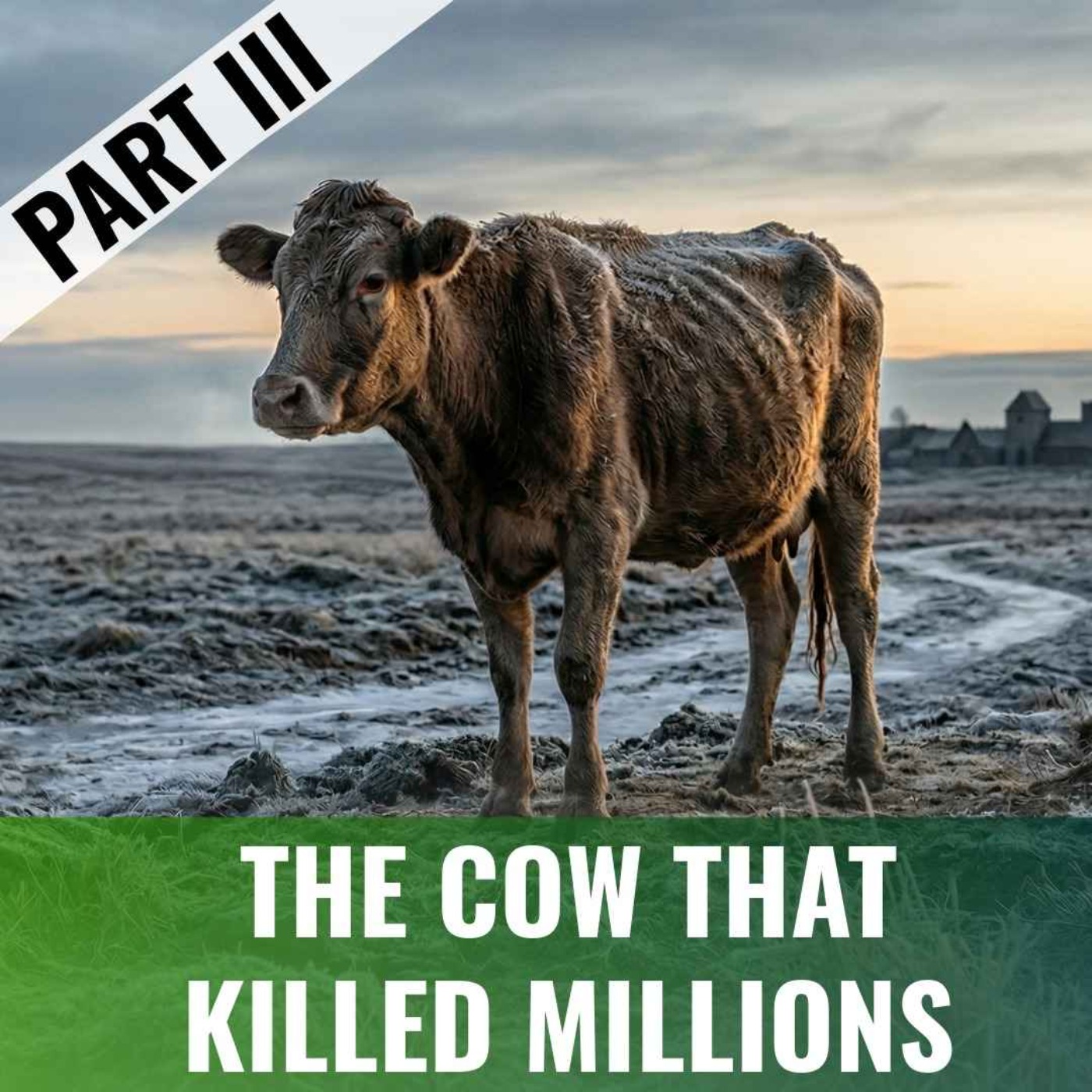
PETER and it's not just grain that's a problem. We get that from chroniclers all over northern Italy saying that wine is freezing solid in barrels and that wells and springs are freezing and the orchards die. And when there are climate shocks, it's of course not just humans who struggle with cold. It's also animals and plants, too. In this period, scholars estimate that between 10 to 15% of Europe's population die from hunger or hunger related disease. It's arguably one of the worst subsistence crises, in relative terms, in recorded European history. But what makes this worse is that it's not just the human suffering, it's that bovine pestilence strikes in about 1315 and takes out a great proportion of the cattle that are alive in Europe at the time.
- [30:06]
A
Bovine pestilence is a horrible family of diseases that affect cows. And the one in this era is probably rinderpest, which is this highly contagious viral disease that affects not just cows, but other cloven hooved animals. So buffalo, yaks, some antelope. It's a morbillivirus from the same family as measles, which affects humans, as we know, and it's spread primarily by close contact and aerosols. So by that, that's breath secretions from the mouth, as well as contaminated fodder, water, hides, carts and people moving between herds. And the symptoms are high fever, nasal and eye discharge, sores in the mouth, severe diarrhea, dehydration and collapse, and animals would weaken rapidly from these symptoms and die quite quickly. And you can imagine, in an era long before modern medicine, very poor understanding of how diseases and viruses are spread with poor hygiene and poor sanitation practices, this spreads like wildfire through the cattle population.
- [31:14]
B
And the truth is it can spread like wildfire in the modern era, too. So again, it's useful sometimes to look where you've got reliable data about mortality rates. But in Africa, in southern and eastern Africa in the 1880s for about a decade, there's something called the great African rhinopest pandemic, which leads to about 80 to 90% of all cattle that are infected regions dying. And in that case, it spreads the same sort of way, it spreads by contact, along trade connections and trade routes. So when this strikes Europe in 1315, it has catastrophic impact. And you can see it fanning out a bit like sort of seeing train routes or seeing motorways or tentacles spreading out, taking out regions one BY1. By 1319, it reaches Britain, and in England and Wales, we think somewhere between 60 to 70% of all cattle die. Some regions lose their entire herds, Others are lucky and for fluke and by chance escape. So it means there's also regional inequalities too. But you also have these cascade effects. Afro we talked about that already, when one thing goes wrong, it produces all these knock on effects that do other things too.
- [32:20]
A
Well, if you're an animal lover or you care about animal welfare like we do, it's terrible for the animals who die these horrible deaths. But that's really only the beginning, because, as we said, oxen were central to plowing these very heavy soils in northern Europe. So the loss of oxen means the loss of the ability to farm. So that means lower crop yields, which means much higher human labor is required for the same output. So the six to eight oxen that could plow a field, an acre field in a day, now that's requiring humans to do that work. And panic sales are depressing the value of the cattle that remain, Followed by shortages of draft power, manure, which is essential for growing crop plants. So that's weakening rural economies in, in multiple ways. So now you're seeing human populations and experience really badly affected by these cattle deaths. And that is still not the end of it.
- [33:15]
B
Peter well, because bovine disease is bad, but the cold weather that we mentioned, those grain yields coming down and other foods too, means that there's a disease multiplier multiplication factor in here. So these harsh winters, they likely weaken livestock immune systems. Incessant rain, sodden fields mean there's also less fodder and so there's less to eat. So your immune system is quite connected. If you're starving, then your ability of your body to defend itself against pathogens is lower. Unusual cold means that your metabolic rate demands more food for warmth. Those then also increase your susceptibility to disease and pathogens. And then pregnant and lactating cows are particularly vulnerable. That amplifies mortality too. So you get reports of great deaths of cattle so that the land is left untilled according to English sources, or that there's no meat to be had and the men are having to eat bread with tears. So protein shortage, death.
- [34:11]
A
That was from a French source. And I have to say that is so French. I mean, the idea of these, these poor Frenchmen kind of sobbing over their bread with no beef, you know, is. Yeah, it's very real.
- [34:25]
B
It's a shocker. And as you mentioned, Afra, you mentioned about persecutions, that's something that we both very interested in anyway. But in the spring and summer of 1320, we start to find people looking to blame minorities for what's gone wrong. So we have bands of so called pasteuro in France, or shepherd crusaders sweeping through southern France, especially through Languedoc, attacking royal officials, trying to attack castles and attack clergy. And then after they turned on Jewish communities.
- [34:56]
A
There's a really horrible dark tradition in Europe over this period, especially in the Middle Ages, where when anything went wrong, they would turn to the visible Jewish minority and blame them for everything. And contemporary accounts describe from this time forced baptisms of Jews, killings of Jews and mass expulsions mean one of many waves of this horrific antisemitism we'd see over this period in history. And this was condemned by the French Crown and the papacy as lawless. And that's not something that always happened when there were these pogroms against Jews. But within a year, by 1321, panic had shifted to accusations that lepers, who are often also said to be in league with Jews or Muslims, who were also often targeted during this period, that these groups were working together in this sinister conspiracy to poison wells. And as a result, leper hospitals started to be attacked with mass arrests and this time sanctioned and even ordered by royal authorities. So there are studies that suggest that for every decline in growing season temperatures over a five year period in this era, the likelihood of pogroms against minorities rose measurably.
- [36:10]
B
It's amazing. There's incredible work that's been done on correlating climate factors and stress with persecutions and you look for people who are visibly different, who worship in a different way, who speak a different language, particularly people involved in credit networks, because you think they must be benefiting from these kinds of things too. And that creates social poison that spreads through the system too. So these shocks have these incredible multiplier effects. You see something quite similar, by the way, in the Middle east where again you've had these climate systems that you mentioned, where life is becoming tricky, where in that instance the Muslim populations turn on Christians, they loot churches, they set fire to monasteries, Christians accused of setting fires on purpose to try to make people convert, and in fact they're then tortured into confessions. And you get the same kind of parallel answer, which is you have people becoming very puritan. So with the Nile failures that are connected to the same climate stress, you have people insisting that alcohol should be banned, or that it's the fault of prostitutes, or that people are wearing clothes that are too fancy, or that you need to police minorities more aggressively. So these things are standard. You see them across different kind of cultures at the same time faced with shocks. So I'm interested in the idea of legacies Afro and about how famine and disaster can sear ideas about danger into making things that look normal. So there's persecutions of Jews, for example. I mean, what do you think? That they just become normalized? That you always fall back on what generations before have done, which is to blame other people.
- [37:43]
A
I think that for me it's a symptom of a deeper underlying cause, which is that there is this tendency. I mean, you can see it very clearly in Europe, even though Europe obviously doesn't have a monopoly over this tendency. I think all human societies can be guilty of it, but it becomes this pattern. And I think that there's a version of it in our contemporary society, society where people see minorities, they notice them and they often harbour this ignorance about them, these preconceived ideas, this fear of the visible other. And it makes it very easy, it's the, the lazy thing to do instead of asking deeper questions about what might be going on, or instead of being curious, I mean, maybe it's too much to ask that these medieval societies could be curious about the underlying causes of climate shocks because their, their understanding of that area was so limited. But generally, instead of pursuing curiosity or asking bigger questions, it's this default to just blame a visible other. And I think that often comes as well from those in position of power, Peter, wanting to shore up their own position and to avoid blame falling on them, to Offer the people an easy answer. It's not my fault for not having stores of grain or for having planned for catastrophe. It's their fault. And you blame someone who's already vulnerable. So I think we see that now as society is changing so fast and we have our own climate change disasters to grapple with. Instead of really thinking about how we could strategically get ahead of the shocks that are coming, we tend to turn to populism or xenophobia or talking about the role that refugees and minorities play. So I actually think that we have more in common with this era than we often like to think or that is comfortable to acknowledge.
- [39:20]
B
I think that's right. And then you get things like humanitarian intervention, export bans, where the state has to react to sudden shocks of the economy. And so you find in England, for example, repeated proclamations in this period that ban the export of grain from ports to other countries. You get similar bans in northern France and Flanders, where cities say, we can't afford to allow anybody else to be put in front of us, so we need to protect this all for ourselves. So you get interventions by governments. That's, I think, an important legacy about how do you try to make sure that you've got enough for yourself rather than let the economy work through fair and free trade? You've got things like memory shaping as a result of these kinds of shocks. We mentioned persecutions too. But it's also people interpret dearth a disease through the lenses that get sharpened in this period. So how you explain who's hoarding and who's poisoning wells, how you accuse people, how you learn how to do that, and that comes out, not just with persecutions of Jews that we mentioned, but when we did Martin Luther Afro, we talked about how witches, or women, rather, I should say, get accused of being witches when you have these shocks in the 1500s too. And it's part of that sort of interpretation of the legacy of famine. You teach societies how to read climate shock, that someone somewhere is to blame. And in a way, that's quite a standard thing that you see across different cultures, different societies, from China through to Europe at this time.
- [40:45]
A
Perhaps the most lasting legacy of these shocks is the way it physically, biologically reshapes the population of Europe. Now, we think of the Black Death as the event that reshapes the population of Europe in the medieval period. And of course it did in profound ways. But this is a phenomenon that weakened human immunity before the Black Death. You could actually look at it as laying the conditions in which the Black Death would run rampant and reap the destruction that was still to come.
- [41:17]
B
PETER well, it's amazing, this new research, it's so exciting. So there's an idea amongst biological historians that you get something called cohort scarring. So I mentioned how important protein is for brain development, but also for biological immunity. And there's an idea that children in utero or in early childhood, in this period of famine and shortage and shock, experience such specific protein energy deficiency and micronutrient stress, particularly at such a key part of their lives, where immune systems, lungs and bone growths are being programmed, that this creates a higher lifetime risk to infection and earlier mortality too. So skeletal remains from later medieval cemeteries show all of these markers, by the way, that suggest that something happens to this generation that means they are uniquely susceptible for when the Black Death strikes in the 1340s. So the legacy of this bovine pestilence, the lack of food supply, the stunting of growth, means that you have survivors with compromised immunity and lower physiological reserves. So those things are just, I think, fascinating, the kind of longer term legacies that run through for decades, generations after the event in question.
- [42:26]
A
It strikes me as so ironic that you're producing essentially a generation with compromised immunity just when, and they wouldn't have known it at the time. You need a generation with better immunity than ever because of the pests of pestilence that's coming. But I think it's so interesting to hear about cohort scarring. PETER and again, it's something that I think we're still learning about in modern life. For example, I don't know if you have read Gabor Mate, who works on ADHD and neurodivergence, linking it in his personal case to his mother having survived the Holocaust and the persecution of Jews by the Nazis, and how, you know, being a child who couldn't access his mother's breast milk because she was starving and persecuted, you know, has affected his neurological development at a time when his brain was still very plastic. It's so fascinating how the conditions of birth and early life, from nutrition to trauma and stress, can have really long term consequences on mental, but also physical health and resilience. And we see in this era that adults who survived the famine caused by these bovine diseases did so by depleting body fat and muscle. And when you deplete body fat and muscle, you become susceptible to repeated bouts of illness. And of course, each time you experience illness, it has a knock on effect on your immune system and leaves less reserve capacity for when the next severe infection strikes. So this experience in the 1310s casts a really long shadow. And part of that is this persistent poverty, this depleted immunity and these reduced diets that last well into the decades that follow into the 1320s and the 1330s. Essentially there is lower protein and fat intake for poorer households for a long time. And these are the very nutrients that those households will need the most to survive the catastrophe that's coming.
- [44:20]
B
It's so interesting. These long legacies are not always straightforward to show, improve. But again, you know, there's been quite a lot of work done on Spanish flu in the early 20th century and the similar kind of impact it had to children who were in utero or were small when that happened. That, that longer term cohort scarring is something we should be paying quite a lot of attention to because those legacies are span over so many decades. So I mean, it's fascinating seeing these cascade events of an event that's not particularly well known and seeing what it, what, what it did at the time, but also that the longer range impacts that it had on persecutions, on narratives, on state interventions and on human biology and physiognomy are very, very intense. So I wonder why Afro, if we just to wrap up, why do you think the great famine is so unknown and so little known? I mean, it's one of those things that no one's ever really heard of unless you're a medieval historian.
- [45:15]
A
I think the Black Death is just so the superstar of the medieval era. It kind of sucks up all the limelight, doesn't it? And it's something that every child learns in school. I mean, if I were to really talk about what I was fascinated by in the medieval period, it's this ghoulish story of so much of the population getting killed and we all know what those quack doctors look like and we all heard the stories of mass burial pits and which parts of London might be haunted by ghosts because so many people were left to die there in the plague. And it's such a visceral visual story that captures people's imagination. Also helped by the name the Black Death, which is just, you know, such a, it's, it's such a catchy name that lives forever in, in popular culture. And I think it obscures maybe these more subtle legacies of other things that were happening in the immediate period before and after. And you know, until I read your work and other historians in this field, I didn't really appreciate the long shadow caused by the Black Death as well. It's kind of the event itself itself, not the knock on effects for gender roles, for example, or the structure of medieval society. So I think it's really important to reintroduce this story, this climate shock and bovine disease into the picture. And it helps us understand that things like the Black Death don't just come out of nowhere. And, you know, I think that is important to make us understand in our own lives what patterns we might be living through that could be leading to something catastrophic as well, if we don't stop and understand and diagnose and think about preparing for those as well.
- [46:49]
B
I guess there are a couple of other reasons why it's unknown or poorly known. First, you know, famine. It's less sexy than mass lethality of the Black Death, where you've got the bags of pus that are discolored and people dying and so on. All those terrible stories. It's sort of, it's much less easy to have a kind of story hook. You know, why did it happen? Who did it affect? There's no obvious person to blame, no particular villain that you can go for. Rinderpest is kind of one thing. Yersinia pestis, that's carried by rats, brings all these other things together. I guess that's also part of it. I guess another one is that it's not a kind of one person, one nation story. It affects Poland, it affects Ireland, it affects Britain, and therefore it sort of belongs to everybody, rather than having a kind of start point and an end point. But I think it's also, you know, somebody's worked on some of this. It's also because it's technically quite difficult to write about. I mean, no one is that excited writing about cows, although I love them for lots of different reasons. But there's that, there's all the kind of climate data, climate science, you've got to plow through to work out what's going on and where. And I guess this sort of synthetic work sits a bit awkwardly between economic history, environmental history, archaeology, demographics and so on. And so until recently, there are not many historians who can handle that kind of complex material. So I think it's one of those events that once you start to look at it, becomes really important. But if you don't go looking for it or try to understand the consequences, you are enveloped by the shadow of. It's a very nice way of putting it. The Black Death is the superstar of the Middle Ages, Aphra. And you can't beat the superstar, right? So why bother trying?
- [48:23]
A
But I think you make a really Good point about there being no obvious villain as well. And when you think about the other great plagues of history, the Black Death, everyone's heard of the rats arriving on ships from Central Asia that are kind of now blamed for bringing it to Europe. When you think about. I mean, you mentioned the Spanish flu, which I' course, I know the Spanish have always resented it being called the Spanish Flu after the First World War because it was only called that because Spain was uncensored and its press were able to report the fact that this flu was happening globally. It was nothing actually Spanish about it in origin. We know about COVID Everybody's heard of Wuhan. You know, this alleged source, this leaked lab in China. Maybe we'll do a whole other series on the veracity of that.
- [49:04]
B
I think if you say. If you say alleged. Yeah, I definitely want to do that one with you. Yeah.
- [49:08]
A
People need a clear narrative about where a plague that has terrible consequences comes from. And this, of course, is much closer to the reality, which is it's more nebulous and more widespread, and it's a phenomenon that has its roots in climate change rather than in one bad actor. So I think that that in itself is. Is a lesson and a legacy that we can learn.
- [49:32]
B
So there you have it. We are, for our next episode, the fourth in this series and the last one. In this particular series, we do have a bad actor, which is a catastrophic earthquake. So we hope you're going to come and enjoy that as well. And if you are enjoying listening to Legacy, please become part of Legacy plus and become either a Legacy envoy or ambassador. And get special episodes, early releases, ad free listening and exclusive Q and A with the two of us. And you can find details of us at Legacy supportingcast fm.
- [50:04]
A
Don't forget, you can watch all our episodes on Spotify and on YouTube. And for anything else, including our substack and updates on TikTok and Instagram, just check the show notes or search Legacy Podcast. I'm Afra Hersh.
- [50:19]
B
And I'm Peter Frankenban. And we'll see you for the next episode of Legacy.
- [50:47]
D
You do it all, so why not get all the electrolytes Hydrate better than water with new Gatorade lower sugar. Now with no artificial flavors, sweeteners or colors. And 75% less sugar than regular Gatorade. New to the fridge. All the Gatorade electrolytes you love. Gatorade lowers sugar. Is it in you? Now available nationwide.