Loading summary
Transcript83 lines
- [00:00]
Farnoosh Tarabi
Hey, this is Paige Desorbo from Giggly Squad, and today I want to talk to you about Boost Mobile. Quick question. Why are we letting our phone bills bully us? Here's a money tip. Stop paying a carrier tax when you bring your own phone and switch to boost mobile's $25 unlimited forever plan. You can unlock up to $600 in savings. That's real life money, not money trapped in a pricey phone bill. $600 is a trip, a shopping spree, or paying something off. Your money belongs in your life. You get unlimited data, talk and text for $25 a month with no contracts and no minimum line requirement. Your phone head to boostmobile.com to switch today and unlock the savings you actually deserve. After 30 gigabytes, customers may experience lower speeds. Customers pay $25 per month while active on Boost Mobile Unlimited Plan savings claim based on a January 2026 Boost Mobile survey comparing average annual payments of major carrier customers to 12 months on the Boost Mobile Unlimited plan. Visit boostmobile.com for details.
- [00:56]
Peter Franken
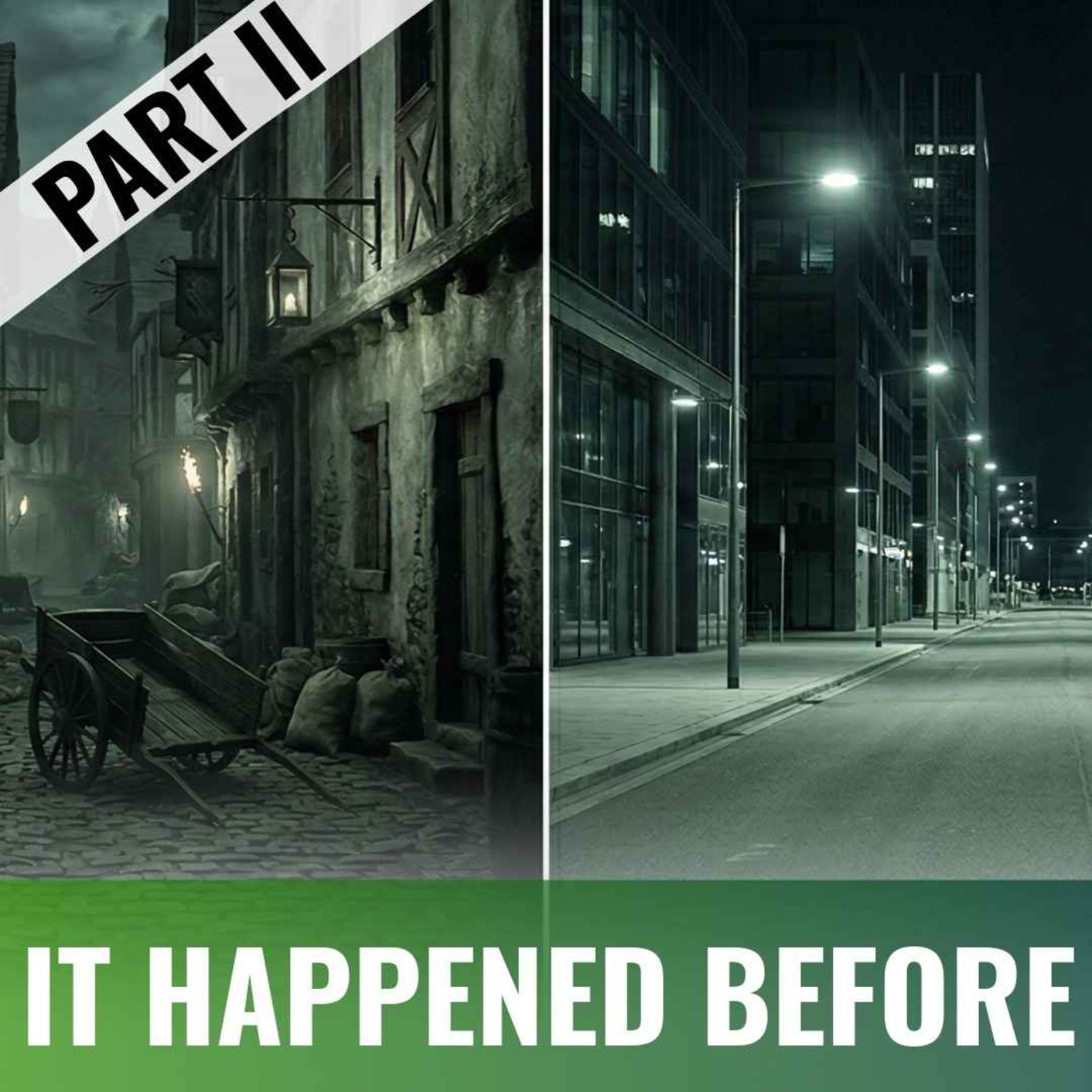
Last time on Legacy, we looked at the way that volcanoes linked to the demise of Cleopatra and the rise of the Roman Empire. We talked about butterfly effects, ecosystem changes, and how small or seemingly small events can have massive impact.
- [01:10]
Afua Hirsch
Is the butterfly effect a concept that is widely accepted in scholarly circles? Peter is it legitimate, the idea that a really tiny, although a volcano isn't tiny, but just let's say it is a tiny phenomenon can have ripple effects that end up with massive impacts elsewhere? Is that something that's taken seriously in academic circles?
- [01:33]
Peter Franken
Academic circles, we argue about everything, so you can argue about the name in quantum physics. It's about major impacts of small signifiers. So I think that most historians would understand that there can be single events that have catastrophic impacts. I guess the most famous one in all of history, certainly in Europe, is the assassination of Franz Ferdinand, the Archduke of Sarajevo. The Archduke of Sarajevo, which I remember
- [01:57]
Afua Hirsch
in my school history lessons was kind of described as like the spark that lit the tinder fire whose flames then spread into the First World War.
- [02:07]
Peter Franken
And you'll be hard pushed to find a historian who'll agree with you, right? Even though there is some truth in it. It's all about the underlying themes, et cetera, et cetera. So normally it's about trying to find an event that does the tinder is more important in lots of ways than the spark. I guess what historians would say if it wasn't that spark, it would have been another one. And therefore the spark itself is less interesting than et cetera kind of like
- [02:30]
Afua Hirsch
in California, where I live half the year. Where if it's dry enough and there hasn't been rain. Somebody is gonna drop that cigarette or light a barbecue in the wrong place. It's a matter of time. Because it's inevitable that a spark will calm. If the conditions are that dry and parched. It's inevitable. Right.
- [02:50]
Peter Franken
Well, it's very interesting you ask about that. Because in fact, what happened with the terrible wildfires at the start of 2025. Was partly because there'd been terrible drought. But it also that two years earlier, after terrible drought, there'd been unbelievable amounts of rain. So it meant that the vegetation grew incredibly thick. So it's all about how far back you want to look at these things. I was interested to know for whether you. When you studied history at school. Whether the environment ever came into the way which you thought about the past.
- [03:22]
Afua Hirsch
That's a really easy question to answer. No, it was never present in the conversation. And I mean, I'm old enough that we didn't even really have a concept of climate and climate change. I remember the big environmental issue when I was at school was the ozone layer. Remember that? It's like this hole in the ozone layer. And that was the biggest problem. And everyone in Australia was getting skin cancer because of the hole was over Australia. And we had to stop using deodorants and change our fridges. And that was the thing. But I remember that because sometimes I reflect on how little space there was for thinking about bigger systemic climatic issues. It was all kind of narrowed down into this one problem that was presented as solvable. If you just change what kind of aerosol you use. So it's really noticeable how much that change. And I think it's still changing. I think with your work, the Earth transformed. And it's now kind of entering a new level of visibility. That these are actually ways of understanding big events through history. It's not just a modern problem.
- [04:19]
Peter Franken
And what about Afro Amelia? We're a few years on now from the outbreak of COVID And people had to read a lot about bats and zoonotic jumps. I mean, is that something you heard about before? Is that something that you've thought about since? I mean, the idea of how spillover events. I mean, everyone heard about those, everyone know about. Is that something that, for you, that was a window that opened because of the pandemic. And now it's closed again? We don't really think about it too much. Or is that something you've worried about more as a Result?
- [04:44]
Afua Hirsch
Well, because I spend a lot of time in Africa and, you know, have a lot of African family. I was really worried about Ebola, which was a huge, right, cause of death and mayhem on the African continent, and which, you know, was believed to have come originally from primates and made that jump into humans. And there's actually, as we record, a very live conversation happening in West Africa about what we call bush meat, which is basically any mammal that people kind of hunt wild and eat and sell for human consumption, and whether that is actually a dangerous practice for facilitating those kind of zoonotic jumps. So I think that that has not been isolated to Covid. It already affects. Affected some people in some parts of the world, and it's never gone away. And Covid has maybe helped clarify that. That is something we should be thinking about and focusing on. Peter.
- [05:33]
Peter Franken
Okay, since this episode, right, I think we've never done one that has so many different bits in it. I say if I was kind of creating a kind of mega film, you know, that had to win all the awards in this one. We've got volcanoes, we've got pathogens, we've got zoonotic jumps, we've got. We've got famine, we've got economic collapse, we've got global implications, we've got what this means for the world today. And so it's got everything. It's a kind of full multimedia extravaganza. And I suppose if I had to boil it into one simple lesson, which is going to be important because this is a series of podcasts about environmental shocks. It's this, which is nature does not care about humans, which is definitely not what I was taught in my history lessons when I was at school.
- [06:19]
Afua Hirsch
After you've said that, I'm going to have another sip of my coffee, and everyone buckle up.
- [06:34]
Peter Franken
Hello and welcome to a new episode of Legacy. I'm Peter Franken.
- [06:37]
Afua Hirsch
I'm Afua Haysh.
- [06:39]
Peter Franken
And this is Legacy, the show that explores the lives, events, and ideas that have shaped our world and asks whether they have the reputations that they deserve.
- [06:55]
Afua Hirsch
This is episode two in our series on the great environmental shocks in history. Darkness at Noon. The Justinianic plague. Darkness at Noon. Peter, you're getting literary out here. Love it.
- [07:10]
Peter Franken
I'm in the wrong job, actually. You know what? Darkness at Noon, I reckon I've never given a lecture called that. But, you know, one of the nice things about doing podcasts is you have to think about how do you communicate outside the academic world? So I don't. No use of the Word epistemology or these kinds of things. It's about. But I think I quite like that darkness at noon. Anyway, we're going to crack on and we're going to start with the world of the 500s. So I'm going to take you to the year five, three six. That's a period which, if you're brought up in Europe or certainly in England, where nothing is happening because you get to the end of the road, you get to the sack of Rome, and then the next stop is William the Conqueror. If you're lucky, you might get a little bit of King Alfred the Great, but that window where a lot is going on in other parts of the world. 5, 3, 6. Something very strange happens to the sun. This is when a historian called Procopius of Caesarea, living in Constantinople, the capital of the Roman Empire, in fact, that's carried on going despite what you might have heard otherwise. He writes that during this year a most dread portent took place, for the sun gave forth its light without brightness, like the moon during the whole year.
- [08:20]
Afua Hirsch
And he wasn't alone. Peter. Another contemporary, John of Lidas, wrote, the sun was dark and its darkness lasted for 18 months. Each day it shone for about four hours each. Yet this light was only a feeble shadow. It sounds a lot like January in London, Peter. But anyway, I'm not. I'm not minimizing how dire it must have seemed.
- [08:42]
Peter Franken
We're going to explain how between 536 and 541, the Earth sees a cluster of massive volcanic eruptions that inject vast quantities of sulfate aerosols into the atmosphere. And these particles reflect the sunlight back into space. That dims the sun's rays and cools global temperatures, in this case for more than a decade. And the result is a volcanic winter. Dark skies, failed harvests, and widespread famine. And climate scientists now think about this as the coldest decade for the last 2000 years.
- [09:14]
Afua Hirsch
It sounds a lot like one of those Hollywood apocalypse movies. And I'm curious, Peter, whether all these volcanic eruptions which we're going to talk about are linked or whether they are just coincidentally happening around the same time. Because we don't think of volcanic eruptions that as something that happen in a kind of chain. They're all individual volcanoes. At least that's my maybe rudimentary understanding.
- [09:37]
Peter Franken
Well, I'm not a volcanologist, but some of my best friends now are. And there are different parts of the world. There's a ring of fire in the Pacific where volcanic eruptions are quite closely linked to each other. So they're like families. So sometimes one goes, then another one goes too. And so there are connections, but lots of the volcanoes are dotted in different parts of the world and then they don't seem to have any obvious connection with each other. And in this case it looks like that they are completely isolate, separate and they just beat marching to the beat of their own drum. Just to explain what we're looking at in the 500s we've got a, a Roman Empire that has more or less carried on despite what people might think. It's now its primary capital is not Rome itself, but New Rome, the great city of Constantinople, what's now Istanbul, its most important and richest provinces, all of the east by the way, were never really in the west. And then a series of empires ride to the east. The Sasanian empire of Persia, you have the Gupta empire in India. You've got massive constellations of nomads across central Asia that have big confederations and then you've got dynasties in China as well. And these hyper connected worlds encourage the flow of ideas, of goods, of people, language, et cetera, et cetera. But also when you've got lots of things connected to each other, you have fragility. So the style of this story is a world that's connected, but it's about to be broken down. That starts with the first eruption in 536 Afwa.
- [11:00]
Afua Hirsch
This eruption is known as the mystery eruption from historical testimony like Procopius, John of Leidus and Cassiodorus. And it describes this initial eruption that caused the dimming of the sun and a temperature crash that was recorded across the the northern hemisphere. So in 536 AD this feels at first like a one off mysterious and pretty serious event.
- [11:27]
Peter Franken
So sorry, in the notes that I wrote for this and I said it creates dim sum. I know Aphro, you're probably not to connect this to.
- [11:35]
Afua Hirsch
It did actually make me feel hungry. But anyway let's just. I kind of like that. We could have called this episode dim sum.
- [11:42]
Peter Franken
We're not quite sure where this eruption takes place but we can detect it from ice core layers that something bad has happened and we could date that accurately. We know that there's a second eruption probably in 539, 540. It's identifiable both in the Antarctic and Greenland ice cores. So it's huge. That means it's spreads into both hemispheres. That suggests or points rather to the fact that it's a tropical volcano because it reaches both hemispheres and that that makes the Cooling that's already starting, it makes it worse, keeps global temperatures depressed until the mid-540s.
- [12:17]
Afua Hirsch
So just to make sure I understand this, if a volcano erupts closer to the equator, it has the capacity to spread to both hemispheres, to both poles of the Earth.
- [12:27]
Peter Franken
It's about air currents and it's about the flows of the interlocking climate systems. So the location of the volcano matters. So if you are closer to the equator, the chances of it spilling over into both hemispheres, much greater than if you're in the northern hemisphere. But a lot depends on how powerful the explosion is, what time of year it happens as well. There are luckier and less lucky times for that to happen. But these things are all connected into much wider climate systems too. So there's a third eruption, by the way, in 541. It's probably smaller, but it's still significant. Again, we could pick that up from sulfate traces.
- [13:04]
Afua Hirsch
We don't know the exact location of any of these volcanoes, but the evidence points to, to two different sources, one northern high latitude and one, as we were saying earlier, tropical, because the way it spread across the whole earth. So the AD536 eruption, the mystery eruption was probably in the northern hemisphere, likely Iceland, possibly a volcanic fissure system such as Katia Torfajokol or.
- [13:31]
Peter Franken
Brilliant.
- [13:31]
Afua Hirsch
Yeah, brilliant. Can you just say for me, just for party tricks, Peter, the name of the famous Icelandic eruption that caused that ash cloud a few years ago? Because you are the only person I know who can just reel it off.
- [13:45]
Peter Franken
No, I think these ones are more exciting. This one for Feuillekull and Duvutun are important volcanoes and in fact they have legacies later on too. So we talked about last time, big eruptions. An volcano blows its lid once, but some can be highly active all the time. In these particular cases, there is a Nordic Balzatic signature. So we know that they must have come from one of these. It's pretty likely, although there is a potential that they came from Alaska or North America to some extent, doesn't really matter for us here, where, I mean, in fact, the models suggest probably Iceland because of the atmospheric transport patterns. But it's the fact that it's the first one in a kind of machine gun effect is the first. It's the first bullet that already causes challenges and problems.
- [14:29]
Afua Hirsch
The second eruption, the one we think is near the equator because the sulfate spread to both equator hemispheres, could have been Ilopango in El Salvador, which has long been believed to have erupted in the 6th century. Although there's been new radiocarbon work that places it earlier in 431ce. It could have been Rabaul in Papua New guinea or Krakatau in Indonesia, which was once proposed. But Peter, now people don't think that idea is as credible anymore.
- [14:58]
Peter Franken
But the point is, you've got one eruption in the north, one tropical one, so it's a kind of one, two punch. And I'm not. I'm not a boxer, despite my physique, might suggest otherwise. But, you know, it's the sucker punch is the real.
- [15:12]
Afua Hirsch
I'm really not.
- [15:14]
Peter Franken
It's the sucker punch, I think is what magnifies. I think that's what's really important in this one. Those both these two events rank as VEI 6 as the volcanic explosivity index. That's about the same level as Mount Pinatubo, if you're old enough to remember what that was in 1991. You measure volcanic explosivity up to 7, but a bit like Spinal Tap, for reasons that are slightly unclear. Although it goes up to seven, there is also a category eight. So it always reminds me of Nigel Tuftel and Spinal Tap just explaining that there is an 11. But anyway, each of these volcanoes erupts somewhere between 50 and 100 cubic kilometers of ashes aerosols into the atmosphere, and the combined effects are at least the same, if not bigger, than any other eruption of the last 2000 years. Except for Tambora in 1850, which we're definitely going to do an episode on another time.
- [16:05]
Afua Hirsch
Where is that, Peter?
- [16:06]
Peter Franken
Tambora is in what's now Indonesia and helps create the conditions for democratization, for revolutions, for economic depressions, for some of the world's great works of literature. But. So that's going to come later in the year. But in this particular case, the forcing models, the fact that so much is pushed over the atmosphere suggests that global temperatures on average fall between about 1.5 to 2.5 degrees centigrade. But in the Northern Hemisphere, you have anomalies of 4 to 6 degrees. That's a lot. I mean, a nice summer's day In England at 25 degrees, you take that down to 19 and you're probably wearing a jumper. If you're 10 degrees and you take that down by 4 or 5 degrees, you're really cold. So these numbers don't sound like a lot 4 and 6 degrees, but they
- [16:51]
Afua Hirsch
really are meaningful, especially when you think about crop cycles and ecosystems that are very sensitive to temperature. We all know that if there's a frost too early in the English winter, your flowers might die.
- [17:04]
Peter Franken
But you kill all the slugs, though, so the slugs suffer even if your flowers don't make it.
- [17:08]
Afua Hirsch
You sound exactly like my mum. So how do we know, Peter, about the dates and effects of these volcanoes?
- [17:18]
Peter Franken
So we can measure from ice cores. So there are high resolution ice cores from places like Greenland and the Antarctic which you can pick out. It's a bit like a lollipop. You could pull out a sort of big long spike and you can find things in it. You can find carbon dioxide bubbles. They sound like ricles or Rice Krispies when they go slap and crackle and pop. But you can measure impurities. You can measure if there's soot or dust, and then can use. You can work out what that comes from. These layers are dated precisely by annual counting, and you can confirm them through radiocarbon calibration and through things called crackedotephra, which are, or cryptotephra, which are sort of volcanic ash fragments. That's one way. Tree rings, Aphora. I know you know about tree rings now, too. Tree rings are another way which you can date these kinds of events.
- [18:06]
Afua Hirsch
What I find fascinating about tree rings is that you can see from the thickness of the ring how much suppressed growth was caused by a cooler than average summer. So if you look at Scandinavian pines, Irish oaks, even in California bristlecone pines, you can see frost damage preserved in the history of the tree through the size of the rings. And what scientists have seen in these tree rings is the sharpest sustained cold anomaly of the last 2000 years during that period between 536 and 545. And this means, by the way, for people listening, that there are trees that are 2,000 years old that are still living, right, Peter?
- [18:56]
Peter Franken
Yes, there are. And in fact, because you're seeing what that level of growth is, it's, again, it's a reminder that we're not the only living being on this planet. I mean, there are so many different ways in which there are other impacts to the world around us. Typically, we think about nature in terms of human damage done by environmental pollution and climate change. But organic materials are really valuable tools for investigating the past. So in this particular case, as you say, we can pick out that this is the coldest anomaly for a couple of thousand years. And as you already mentioned, afraid that's going to have an impact on the ways in which photosynthesis happens, ways which crops grow. And in this particular case, what's really interesting about it is it's, you know, with Vesuvius, people all know about it destroys Pompeii. In this case, it doesn't have much of an impact anywhere else. But this one has proper global significance.
- [19:49]
Afua Hirsch
Chinese chronicles, like the historical account the Nanxi, describe yellow dust falling like snow. If you've watched Stranger Things, maybe a kind of like yellowy version of what you see in the upside down Irish annals mention a failure of bread. It's literally like the dimmer switch has been flicked on for the world and everyone is feeling it.
- [20:11]
Peter Franken
And you get chronicles written in the near east saying that the fruits don't ripen, the wine tastes like sour vinegar, as well as the yellow fog and the sun being dim and the snow in winter. In China, you have emperors advisors, in Japan, for example, saying what avails a thousand boxes of pearls to him who's starving of cold? Which I think is a very beautiful way of putting. If you're, like, legit minted, there's no point having all these luxuries if you're freezing or starving. But it's a big shock, in other words.
- [20:46]
Afua Hirsch
And there is real famine across the Northern hemisphere. Grain yields collapse, Peter. And in Constantinople, food prices double and then triple, pricing many people out of the ability to feed their families. In Gaul, Gregory of Tours wrote that the earth failed to give her fruits and men died of hunger. So, again, this is a wide geographical impact of this decline in temperatures causing havoc across the world.
- [21:16]
Peter Franken
And it's terrifying. I mean, it might feel at the time that it's divine punishment, but it's basic biology, you know, so when photosynthesis fails, plants don't grow. And so it's not surprising, but it felt like God or the gods had turned hostile. So you have halos around the sun, you have strange clouds, you have earth tremors. And you get people being really terrified that this must be the end of the world that's coming. It's the prelude to something that's even worse.
- [21:43]
Afua Hirsch
And it's not a short experience, Peter. The temperatures stay low for years. So from the North Atlantic to Central Asia, this is multiple harvests, faltering or failing. And it's not just humans experiencing food shortages and famine. This cooling has dramatic effects on other life forms, too. We'll find out more after the break.
- [22:18]
Kareem
Hi, everyone, this is Kareem, the voice of Simon Fairchild from the Magnus archives. And today I want to talk to you about Boost Mobile. Some things quietly drain you like an expensive phone bill, trapping your money month after month. Here's a quick money tip stop paying a carrier tax when you bring your own phone and switch to boost mobile's $25 unlimited forever plan, you can unlock up to $600 in savings. That's money that belongs in your life, not trapped in a phone bill. Reclaim those savings for something you're actually into an EMF meter, a thermal camera, or whatever strange corner of the universe you're currently exploring. Visit boostmobile.com to unlock your savings and take back control. After 30 gigabytes, customers may experience slower speeds. Customers pay $25 per month as long as they remain active on the Boost Mobile Unlimited plan. Boost Mobile January 2026 survey comparing average annual payments of AT&T, Verizon and T mobile customers to 12 months on the Boost Mobile Unlimited plan. For full offer details, visit boostmobile.com with
- [23:10]
Peter Franken
almost half a million customers and over a trillion dollars of secure payments, Bill isn't new to intelligent finance. It's the proven way to simplify bill pay and maximize cash flow. Want to learn more? Visit bill.comproven for a special. So already people are cold and they're hungry. But then things take an even darker turn. So in 541 a new enemy arrives, and it's what we now call the plague of Justinian, or the Justinianic plague that got a little bit of coverage during COVID People trying to think of some of these worst moments in the past. And Procopius, who we've already mentioned, who's witnessing it in Constantinople, says it begins in Egypt at Pelusium and then spreads to Alexandria, and from there it spreads over the whole world, and there are
- [24:08]
Afua Hirsch
scenes of pure horror, he says. At first only a few died each day. Then 10,000 and more corpses lay piled in houses, in the streets, in the harbors. Burial workers could no longer cope, Procopius says, and the Emperor Justinian himself fell ill, although in his case he did manage to recover.
- [24:32]
Peter Franken
It's amazing. We have a coin of Justinian which looks like he has got some kind of scars from this moment of falling ill. Another witness, writing in Syria, says that the world just changed. Cities were emptied of inhabitants, and there was no one left to even bury the dead. And another eyewitness that lived through it said that so many perished that there were nobody left to bury them. That's how we hear again and again and again that the dead are just lying in heaps. And we keep being told that not only does plague come, but it recurs. So you think you're past it, and then it bites its way back again it's those kind of waves of pandemic that makes everybody terrified. People writing that the whole human race is in jeopardy and danger.
- [25:14]
Afua Hirsch
If this sounds like horror stories you're familiar with from other periods in history, there is good reason for that. Because this pandemic was caused by Yersinia pestis. That's the same bacterium that that was responsible for the Black Death eight centuries later. And as anyone who's ever studied the Black Death will know, it circulates naturally among wild rodent populations and fleas transmitted by them.
- [25:41]
Peter Franken
When conditions change, ecological stress or famine or cold, the equilibrium between rodents and fleas and the wider environment breaks down, and it allows for spillovers into humans. So this period of change, where you have cooler, shorter summers and erratic rainfall, disrupts ecosystems across Eurasia. In Central Asia, there are unusually wet springs followed by unusually cold summers, and that creates perfect conditions for flea proliferation. Then there are periods of drought and sudden cooling, which reduces food availability for wild rodents like marmots and rats, gerbil species that force them out of their steppe burrows and get them closer to villages, to caravanserais and to grain depots. And then on top of that, you've got predators and commensal rodents like black rats, the ones who live around humans all the time, becoming more aggressive and more invasive into settlements, into warehouses, and into ships. So that combination of climate stress and expanding trade networks creates a bridge for plague reservoirs and humans to come into contact with each other.
- [26:48]
Afua Hirsch
Now, Peter, you know so much more about this than me, but I've read that the tendency to always blame Asia for the origins of plagues may have been influenced by factors other than science and evidence that there may be this kind of predisposition to look to the east or look to people of a darker race as the explanation for problems. But is it the case that in this case, and maybe also in the case of the Black Death, there are actually good reasons for turning to the Central Asia as the cradle of the bacteria that caused this plague?
- [27:22]
Peter Franken
Yeah, well, partly because there are natural plague foci where Yersinia pestis survives. I mean, you find some of those in East Africa as well, but so you can trace because of the natural habitats where other life forms thrive. It helps, probably, if you want to blame other people for diseases. A lot of the world's emerging infectious diseases respond are very sensitive to climate. So some of the most deadly diseases in history require tropical climates. So the reason why you blame people living in tropical parts of the world is because those are home to lots of diseases. So things like malaria or dengue fever, you tend not to find them in Finland or Scandinavia, but you do find them closer to the tropics. So there's a geographical distribution that's part of that too. But certainly I think the idea that the Ottoman Empire is the sick man of Europe, it was called that by lots of historians. Not just because the economy was paralytic or the political, you know, or the society and politics were decrepit and so on. It was because literally you had waves of plague that came through again and again and again. And you need a whole set of combinations for that to happen. But it's all connected to the geographies of where the transmitters all live. And the plague foci in places like Kyrgyzstan and in different parts of Central Asia, particularly the bottom of the mountain pots, means that that's where typically these things spread from. So in this particular case, we know from genomic materials excavated from burials in Bavaria and France, Spain and even, even in England, they all come from a Central Eurasian lineage that's found in the Chenchan Mountains of what's now modern Kyrgyzstan. So, so on top of that, as well as having the pathogen, you need to have networks that spread it. And this is a very connected world, as I mentioned before, lots of empires that are competing with each other, but also trading with each other. In this particular case, you've got routes that come both over land, but also through Persia and the Red Sea. And they are connecting into ports, they're connecting into grain ships, pack animals are moving around. And so it means that the vectors for fleas to be able to jump onto things along Indian Ocean, Red Sea networks is extremely significant. And that's as important as the climate and the disease. You need the networks for things to spread along to.
- [29:33]
Afua Hirsch
It's one of the facts of globalization that people are a bit more reticent to pay attention to, Peter, because we often focus on the benefits of the movement of goods, people, ideas. It allows humanity to progress, I suppose, benefit from knowledge in other parts of the world. But if people and things are moving across these hyper connected networks, so are rodents, so are fleas, so are bacteria, and so is disease. So it's something we see again and again through history. And the earliest outbreak of this particular plague appears at Pelusium, which is the Eastern Nile delta port in Egypt. And of course, Egypt, as we heard in the last episode, is such a crucial hub for the importation, export, redistribution of grain through Alexandria, Gaza, Constantinople. And where there is grain and where there is movement of people and Ships and goods, these are the ideal vectors for rodents who feed on that grain and then intermingle with human populations on ships and imports.
- [30:33]
Peter Franken
So this pandemic comes at the height of the eastern Roman Empire. At the time it's ruled by a emperor called Justinian, is very famous for a wife who creates scandal because that's what women tend to do. How they'd been depicted will do something on her, I hope, one day. But Justinian has led a kind of revival of the Roman Empire. He's been busy reconquering North Africa from the Vandals. So sort of movements of peoples in the, in the century beforehand has meant that Rome has had to reinforce its own infrastructure of power. So he's recovered North Africa, he's been leading campaigns into Italy, and he's built one of the most important buildings in human history. The largest Christian church on earth for a thousand years, the Hagia Sophia in Constantinople. And this is the moment of great imperial revival and great ambitions where Rome is thinking about how can it expand its frontiers and how can it take on its primary rivals and particularly the Persians. So when the plague hits, as Procopius puts it, in the midst of it striking the whole race comes a disease that is going to decimate Rome's capabilities.
- [31:38]
Afua Hirsch
And it has real impact on its fiscal and demographic core because the ground zero areas most affected are Egypt, Syria and Anatolia. And this is devastating for the entire Roman system.
- [31:52]
Peter Franken
I mean, the death toll is enormous. Alpha. Right. It's absolutely catastrophic. Just reading about some of these, some of the sources. I mean, it's biblical and epic in its scale.
- [32:00]
Afua Hirsch
Procopius reports up to 10,000 deaths per day in Constantinople. Evagrius calls it the greatest plague since the beginning of the world. And modern estimates suggest that the Roman Empire may have lost between 25 and, and 50% of its population within a few years. I mean, that is a statistic. It's actually hard to get your head around, Peter.
- [32:23]
Peter Franken
I mean, there's a quite a vibrant academic community trying to challenge what these numbers actually are. And to some extent, I think you can look past that, around what exact number you want to settle on. But certainly we have evidence of villages basically completely disappearing, of fields being left on their own, of livestock herds collapsing because they don't want to look after them. You can see that laborers start to demand higher wages, which your negotiating position gets better if there are fewer people to go around. We know that the government in Constantinople, in the Roman Empire tries to freeze pay and to refuse to allow salaries to go up. But the tax registers, that's kind of the backbone of the state can't even be maintained anymore because there aren't enough people to do it. So you get the breakdown that we talked about, very similar to how we had it with Cleopatra last time, where the price of grain and of food starts to go up. People are terrified about how they pay their bills. So the government starts to debase the coinage and then corruption or rumors of corruption start to spread because governors are presumably creaming off cash to look after themselves and try to save their own backsides at a time where the whole apparatus and state has tried to try to collapse.
- [33:30]
Afua Hirsch
I mean, let's just talk a tiny bit about that apparatus of the state because Peter, I know you've got a bit of a chip on your shoulder about the way people talk about things as Byzantine as an insult, like overly complex and inefficient. And I heard you say before that actually the Byzantine system of bureaucracy was actually pretty efficient and streamlined. Whatever it was, it was decimated by this plague.
- [33:53]
Peter Franken
Well, I do have a BMI bonnet about it. I mean, the Roman Empire is. The Roman Empire keeps going until 1453. It gets later remodeled by Western Europeans to use the word Byzantine in a highly negative, negative way. As I get older, I realize there are other battles to fight than trying to tell people why they're wrong about things. But I mean, all states in whichever type of social structure doesn't have to be urban based, you know, regulations of how nomadic and pastoral societies work too, that they work because they're well run. And that well run doesn't mean everybody benefits equally. But they're well run because their structure and there's order and it doesn't take much for those things to start falling apart. So institutions that are seemingly hyper efficient, it doesn't take much to knock them and to suddenly for things to go wrong. And you can see that with sort of massive corporate blowouts of things like Enron or how Polaroid could go from being the kind of most desirable camera in the world to then disappearing. So I think in a world where you have efficiency and you have records being kept, if people stop keeping records because they die or because they are so scared or they flee, then suddenly your ability to work out who owns that land and who should inherit it, if people have died, what should you pay for things? Suddenly you get to a state quite quickly of maybe anarchy is too strong. That happens when you have proper state breakdown. But a sudden hollowing out that can take generations to recover from so in this particular case, you have more or less the collapse of the imperial armies, like I said, all fanning out in different directions, about to conquer everything. And suddenly they're decimated because soldiers either die or they head off home. Recruitment collapses because people are required to work at home. And so you then see the state try to solve that by hiring mercenaries, paying them more. And so all those things that the empire had its eyes on start to disappear. But, you know, I wonder what you think afua about what the religious and cultural impact would be about these kinds of moments of real pressure and confidence collapse, as well as the economic stuff.
- [35:57]
Afua Hirsch
The plague deepens this apocalyptic mood, and that has real consequences for the Church, because if you conceive disasters such as this as divine punishment, it's an opportunity for people in positions of religious authority to take ownership of that moment and tell people it's their fault for straying from the institution, for straying from. From the orthodoxy. And that's exactly what the Church does. Men forgot their human ways. They fled from their friends and kin. They need to come back into the fold of the Church. And there are multiple ways the Church was able to use this to consolidate power. For example, relics and processions, using the Virgin as the emperor's protector. The icon of Theotokos, for example, which is carried through the streets of Constantinople during outbreaks. And I find it so interesting, Peter, that this happens, because you could see how it could go either way. I mean, if people have been practicing a religion and disaster strikes, you'd think it would be grounds for saying, actually that whole church thing isn't working. But instead, people double down on Christianity and they become more pious and more receptive to the teachings of the Church.
- [37:12]
Peter Franken
I think you're right. It could go both ways. And in fact, it often does go both ways. So some people react well one way and the other. And in fact, what we're going to talk about later is a bit about how this has impacted other parts of the world, because you can see that these global impacts that we've already hinted at has an impact on how other people make their decisions about religions. And there's a major series of shifts that comes as a result. But in this part of the world that we're talking about, you see the contraction of the state. You see trade networks start to collapse. You see, Gaza is the great port city that is the hub of the wine. Trade across the Mediterranean and beyond just goes quiet. I mean, it's a bit like the shops being closed during the pandemic. And in the Negev desert, you find archaeological layers which show oil and olive presses and storage jars just being abandoned because there's no more market, there's often no more labor. And so this is a breakdown of the Roman Empire. But what makes this story so interesting is it's not just a story about the Roman Empire. So when we come back, we're going to talk about some of the global significance in different parts of the world, too.
- [38:28]
Kareem
Hi, everyone, this is Karim, the voice of Simon Fairchild from the Magnus archives. And today I want to talk to you about Boost Mobile. Some things quietly drain you like an expensive phone bill, trapping your money month after month. Here's a quick money Stop paying a carrier tax when you bring your own phone and switch to boost Mobile's $25 Unlimited Forever plan. You can unlock up to $600 in savings. That's money that belongs in your life, not trapped in a phone bill. Reclaim those savings for something you're actually into, an EMF meter, a thermal camera, or whatever strange corner of the universe you're currently exploring. Visit boostmobile.com to unlock your savings and take back control. After 30 gigabytes, customers may experience slower speeds. Customers pay $25 per month as long as active on the Boost Mobile Unlimited plan. Boost Mobile January 2026 survey comparing average annual payments of AT&T Verizon and T mobile customers to 12 months on the Boost Mobile Unlimited plan. For full offer details, visit boostmobile.com.
- [39:32]
Peter Franken
Right, so we mentioned that it wasn't just about, about Rome. So Rome's primary rival to the east is the Persian or Sasanian empire. This time it's ruled by Khusraud the First, who's the great rival of Justinian at exactly the same time that Rome is kind of mobilizing to reform and to think about what comes next. So too are the Persians. But the same factors impact there, too. So you have lots of data from tree rings, from pollen and so on that shows unusual weather conditions and poor harvests. And you see the collapse of Persia in very similar kinds of ways. Agricultural labor starts to fall down. Irrigation canals start to get silted up because there's no one there to clean them. The taxes being brought in from the land start to fail. And as a result, instead of these two states digging in for war, they agree something called the 50 year peace that's going to allow both to recover from the exhaustion of famine and disaster. But you see the, the degradation of the whole infrastructure of canal systems, of coins of trade and ceramics, et cetera. Over the course of the last half of this century, from 540 up until about 600. And that means that you've got a world that is thinking about how does it come out of it, the other side. So it's body blow to both of these two great empires. But it has impacts too, elsewhere for like in India.
- [40:54]
Afua Hirsch
In India, we can see from tree ring and cave deposit data that the summer monsoons were unusually weak during this period. And there are chronicles recalling years where the sun shone without warmth. This caused failed harvests and reduced rice production. And that had huge consequences both for the political cohesion of the Gupta empire, which was already under the strain of Han invasions. But it also led to changes in the relationship between people and religion. So Buddhist and Jain institutions expanded their charity networks as famine intensified people's need. And the idea of kings as these dharmic protectors of grain begins to appear around this time in Sanskrit inscriptions. So it's almost an increase in the kind of spiritual conception of the relationship between people and religion and the place of kings within that. And we can see those consequences stemming from that era into the centuries that follow in India.
- [41:57]
Peter Franken
That's exactly right. And in fact, one of the great questions about the spread of Buddhism is that Buddha alive around about 500 years BC. So about a thousand years before this, it sort of splutters, it does well to start with, and then it sort of, it loses momentum. But there's a sudden surge in the 6th century. And there are lots of potential explanations, but this would seem to be one of the most obvious ones, which is a need for charitable giving of re engagement with the natural world, which is obviously an important part of Buddhism. And you see these kind of shockwaves of how people think they need to change how they're doing things. You see that, for example, in China, you mentioned the Nanxi, the history of the southern dynasty. You find parallels in other Chinese texts talking about frosts killing the crops, followed by disease, and these odd omens in the sky of red suns and halos and everything. We again, we know from lots of proxies that this is the coldest decade for 2000 years. Repeated crop failure, repeated floods, famines and so on, and large migrations of people trying to get closer to safety. And ironically, when people try to get closer to safety, they head towards cities, which is not the best option because those are even more stressed. And so things become terrible. And you get things like the Book of Way saying that the great pestilence spares no one, whether you are a posh aristocrat or whether you're just humble. But again, it spurs an acceleration of the fragmentation of the state. So all these things that we've seen before, we're seeing it repeated again and again. Even like you mentioned Afro with Buddhism and Taoism, you find in China and Chinese cultures apocalypse. The idea about the apocalypse started to rise again. Thinking about there's going to be cosmic renewal after these disasters, so that there's a change in how people are believing and thinking about the world around them.
- [43:45]
Afua Hirsch
You were saying, Peter, that this is kind of boom time for Buddhism. Well, this is the era where Buddhism is introduced to Japan, which is also suffering similar consequences. We can see from Japanese tree ring series that they're cooler, shorter growing seasons that affects rice paddy cultivation in Japan, poor harvest famines. And this is the era in which Buddhism is introduced. And it's giving Japanese people this cosmological explanation for the suffering that they're experiencing and the promise of ritual protection. And it's because of this context that we can see the rapid adoption of Buddhism by Japanese elites in this period.
- [44:22]
Peter Franken
At the beginning of this episode, Afwa, you talked about how this would be all ready for. Ready for movies. And the good or the bad news is that someone's already beaten us to it. Because in Scandinavia this all prompts the idea of the fimbulwetter of the year without a summer, of the constant winter. And that plays such an important role in Norse mythology and in the kind of Viking belief systems, or what we call Viking societies, Scandinavian belief systems around what happens with the competition between the gods to inflict damage, pain and never ending snowstorms. So that, that unfortunately, I think the Avengers, is it the Avengers or one of those Marvel movies beat those to it. But I think that idea about how people are engaging with huge ecological and climatic stress is really, really interesting. But I like to do a quick sort of. To wrap up after a kind of a counterfactual game with you about what would have happened if there hadn't been these eruptions. No pandemic, whether. Whether the world will look different, whether it looks similar. I wonder what you think.
- [45:26]
Afua Hirsch
Well, I'm interested in the elephants, Peter.
- [45:29]
Peter Franken
Go on.
- [45:29]
Afua Hirsch
I love elephants. And there is a theory that if it hadn't been for these colder, drier climates, elephant populations might have remained more abundant and that that might have had consequences both obviously for the natural world, but. But also for warfare. Because elephants started to disappear as an instrument of warfare during this period. But if there had remained such abundant elephant populations, there had been in Ancient times, we might have seen more elephants being used in war. During this period, we might have seen more ivory trade. We might have seen different military formations and less of the stories of knights on their horses in stirrups and more like Hannibal riding these great elephants. So that's just one thing that could have been different had it not been for this big long decade of volcanic winter.
- [46:25]
Peter Franken
It's one of my favourite historical anecdotes, which is that elephants are the kind of supreme gift that kings give to each other. Cause it shows your power. And elephants are rare. People might think I'm talking about Abu L Abbas, the elephant given to Charlemagne. It's not mert, it's an elephant. The Khazar ruler, one of the great nomad confederations that rules the Eurasian steppes, knows that kings give elephants. So he asks to be given an elephant to show how powerful he is. And one of the things that happen when you give one of these elite gifts is you don't get an instruction manual. So they eventually have to hand it back because they don't know how to what to feed the elephant with, how to look after, how to tame it and so on. So you've got to be careful what you wish for when you get given elite gifts. I'd like to do. I'd love to do an episode on elite gift giving Afro. I don't know whether our listeners would be interested in that. Please let us know what you'd like us to talk about. But anyway, all of this, I think, is a reminder from the 6th century that nature can humble empires. And not by destroying them outright, but by sapping their confidence, by draining the wealth, by spreading fear. And environmental shocks rarely create new worlds, but they quite often decide which worlds are going to survive.
- [47:39]
Afua Hirsch
Next time in this series, we'll see how ecosystem collapse resulted in the reshaping of Europe in the Middle Ages. Different age, but a similar pattern. A planet reminding us, regardless of our plans, who's really in charge. Thanks for listening to Legacy.
- [47:58]
Peter Franken
Don't forget to hit subscribe on your favorite podcast player. Please do tell your friends to listen in too. You can also watch all of our episodes on YouTube, so make sure you're subscribed there too.
- [48:08]
Afua Hirsch
And of course, we're on all the socials. All the links are in the show notes for this episode or just search Legacy podcast. I'm AFWA Hirsch.
- [48:15]
Peter Franken
I'm Peter Frankerpern. We'll see you next time on the next episode of Legacy.
- [48:34]
Kareem
Foreign.
- [48:37]
Farnoosh Tarabi
Hi, this is Farnoosh Tarabi from so money with Farnoosh Tarabi. And today I want to talk to you about Boost Mobile. Quick Money Tip Stop paying a carrier tax. If your phone bill feels trapped in a pricey plan, this is your sign to unlock savings. Boost Mobile helps you reset your spending. With the $25 Unlimited Forever plan, you can bring your own phone, pay $25 and get unlimited wireless forever and and that simple switch can unlock up to $600 in savings a year. That's money you could put towards paying down debt, investing, or something that actually brings you joy. Those savings are based on average annual single line payment of AT&T, Verizon and T Mobile customers, compared to 12 months on the Boost Mobile Unlimited plan as of January 2026. For full offer details, visit boostmobile.com.