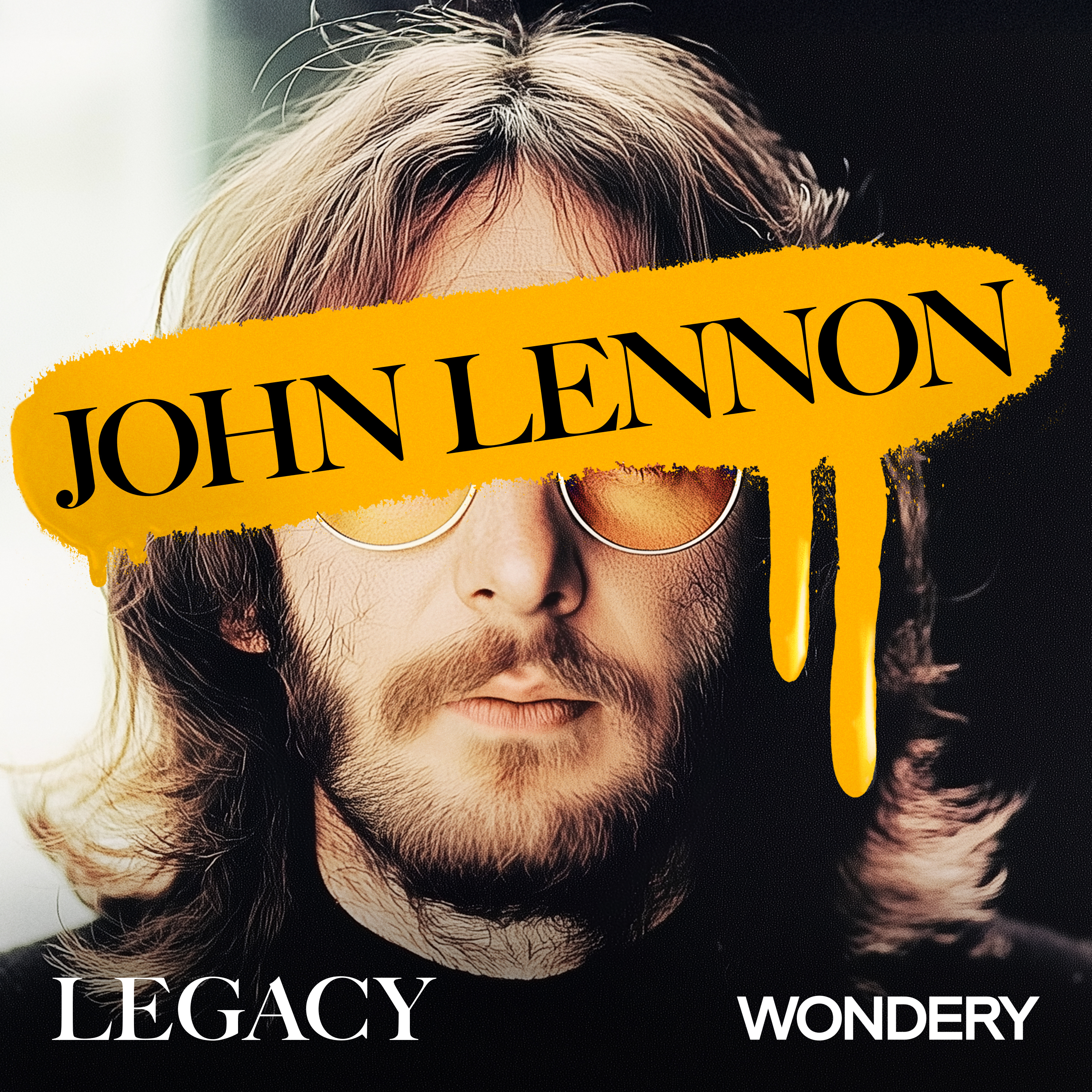
Loading summary
Transcript103 lines
- [00:00]
Afua Ha
Wondery subscribers can binge seasons of Legacy early and ad free. Join Wondery in the Wondery app or on Apple Podcasts.
- [00:08]
Peter Frankopan
Warning this episode contains strong language and mention of domestic violence. Listener discretion is advised.
- [00:17]
Wondery
Wondry.
- [00:24]
Peter Frankopan
Hello and welcome to a new series of Legacy. This time we're talking about a man who smashed pop conventions and changed the course of the music industry. His band sold more records than any other group, an estimated 1 billion discs and tapes to date, and billions of downloads.
- [00:43]
Afua Ha
He personally still holds the record for the most UK number one singles by a songwriter. 30 of his songs have topped the charts and just last year an AI version of him released the fastest selling single of the year.
- [00:59]
Peter Frankopan
He was a global champion for peace. His high profile activism established the playbook for just about every campaigning pop star to date and made him a target for President Nixon.
- [01:11]
Afua Ha
But the revered pacifist struggled with his temper, admitting that he fought men and hit women. And his relationship with drugs descended into headline grabbing chaos even as it fueled that groundbreaking creativity.
- [01:26]
Peter Frankopan
Of course, we're talking about John Lennon, founder of the Beatles and one of the most successful songwriters in the history of popular music. In life, his notorious stunts attracted both worship and ridicule, but since his death, he's become a mythical icon and a standard bearer for integrity from Wandery and Goal Hanger. I'm Peter Frankopan.
- [02:02]
Afua Ha
Hi, I'm Afua Ha.
- [02:03]
Peter Frankopan
And this is Legacy, the show that tells the lives of the most extraordinary men and women ever to have lived and asks if they have the reputation that they deserve.
- [02:21]
Afua Ha
This is John Lennon, Episode 1 the Boy Everyone Wanted.
- [02:37]
N/A
If you're tired of endlessly scrolling through multiple streaming apps to find your favorite movies and shows, then it's time to simplify your entertainment with subscriptions on Prime Video. Now you can add over 100 subscriptions, including Macs, Apple TV and Paramount plus all in one app. Imagine the convenience of accessing all your favorite streaming subscriptions in your Prime Video account with just one login and one password. No more app switching or forgotten credentials. From binge worthy original series to blockbuster movies and live sports, everything you love is at your fingertips. Streamline your streaming today. Check out Add on Subscriptions on Prime Video. So I just used NerdWallet's card finder tool to find a better credit card for me and listeners. This is genius. All you have to do is answer a few questions and in minutes you'll get matched with recommendations tailored to you. Some of these cards weren't even on my radar, but look like a perfect fit. The Best part, no research needed. The nerds already did that for us. So if you, like me, want to easily find the right card for you, go to nerdwallet.com to get matched today. Terms and conditions apply. Credit products subject to lender approval. See nerdwallet.com for details.
- [03:57]
Peter Frankopan
So what about John Lennon? Afwa, what do you reckon? Is he a big hero of yours?
- [04:00]
Afua Ha
I'm just going to take a moment to tell you my personal Beatles story, pet. Just a moment, because it's a bit weird. So I was born long after the heyday of the Beatles. But when I was seven, I became best friends with a girl at school whose parents were, I would say, eccentric. They were Beatles fanatics. So on the weekends when I was at playdates at her house, they would host the South London Beatles Appreciation Society. So all these kind of aging rockers would come and we'd have to carry chairs from different people's houses. And they all had like really long gray hair. And I remember through a 7 year old's lens, like weird leather clothes. And they would sit around on chairs playing vinyl Beatles songs, talking about the Beatles. And my friend who'd grown up in this cult of Beatle nostalgia was similarly indoctrinated. So I got a quite intensive Beatles education. I think I probably know every Beatles song, but it took me a while before I could have my own relationship with them, untainted by that slightly cultish introduction. But I'll tell you a big takeaway from it. Beatles fanatics do not necessarily grow out of it. It was hardcore, the devotion, the worship. I mean, I don't use the word cult lightly. So even though I'm totally the wrong generation, I feel a bit of a glimmer of insight into how fanatical people were about the Beatles in their heyday.
- [05:32]
Peter Frankopan
I mean, there are worse bands I'd have thought to be fanatical about than the Beatles. You know, we're talking 55 years after they split up. But, you know, the music is incredibly influential. The Beatles sound, the influence on culture, on fashion are so enormous. I mean, to talk about legacy, I mean, to pick two examples out of, you know, hundreds, even thousands, you get people like Ed Sheeran saying, the Beatles are the reason I started writing songs. And if you're not an Ed Sheeran fan, you know, you know who to blame in that case. Or if you're a Foo Fighters fan, Dave Grohl saying, if it weren't for the Beatles, I wouldn't be a musician. You know, I loved their groove and their Swagger, the grace and the beauty, the dark and the light. And I think some of it's to do with the time when they were performing. The heyday in the 60s was about change across so many different things. You know, Vietnam War, the environmental movement, civil rights movement, the Cold War. Do you have a favorite track?
- [06:23]
Afua Ha
I actually really struggle because I have different favorites for different moods, you know, and there's the ones that, like, really stick in my head and then I can't stop singing them. But then there's the ones that I think move me more, you know, so it's really difficult to say one. I think Yesterday is a favorite of mine. I like Strawberry Fields. Help is the one that gets stuck in my head. It's tricky to pick one. What about you?
- [06:46]
Peter Frankopan
Rubber Soul. We had Rubber Soul on vinyl and used to listen to it for basically the entire summer. So I could do that all back to front. But I think as an author, paperback writer, you know. Dear Sarah Romano, can you read my book? Took me years to write. Can you take a look? There's not a single person who's had a book published or not published who that doesn't resonate with.
- [07:05]
Afua Ha
I also have a real soft spot for Here Comes the Sun, which I feel like is underrated, but I don't know, it's a vibe.
- [07:16]
Peter Frankopan
So. John Winston Lennon is born on the 9th of October, 1940 at Liverpool Matilda Hospital. He's born to the sound of air raid sirens in the middle of a raid by the Luftwaffe on the great port of Liverpool. And he's given the middle name of Winston, after the wartime prime minister and his grandfather. And number nine. The date of October he's born will be his lucky number throughout his life. His father is Alfred Lennon, who's 27, a merchant seaman of Irish descent.
- [07:44]
Afua Ha
And he's not exactly from a musical family, but music is a big part of his family's life. And his paternal grandfather actually earned a living as a blackface minstrel. And that's really interesting because I think we'll see throughout this story, the role of black culture is like, under the surface. It's often left out of the Beatles story and the John Lennon story, but it's absolutely there. So much of Liverpool's history was shaped by the transatlantic slave trade, Britain's connections to the Americas and West Africa in particular, and the Caribbean. And that's also part of his story. And it will go on to shape so much Beatles music, which I hope will be able to talk about. And then there's his relationship with his mother, who is basically this gorgeous woman, red haired, quite voluptuous, she plays the banjo and loves to sing and she's not a conventional mother figure and it's a complex relationship that I think we're gonna see affecting his relationships with women later in life as well.
- [08:39]
Peter Frankopan
They live in the Penny Lane district of Liverpool, in a modest red brick home with a front room that's kept for best when people come to drop in. While John's father Alf, is at sea, Julia, his mum, is living the life of a single woman, according to her big sister Mimi, who we'll hear about a bit, who often looks after John while his mum is off flirting in the pub and his dad wants to be there for somebody's often away at sea. Once for 16 months in fact, and ending up in prison.
- [09:06]
Afua Ha
After you've described it like that, it actually helps us make sense of why Julia might have had enough of the marriage. After a few years, as she did, she decides she wants a new start and she leaves with little John, still a young child, and sets up home with another man, Bobby Dykins, a handsome hotel waiter. But from her sister Mimi's perspective, and Mimi really is the more conventional, respectable member of the family, this isn't an appropriate setup for John and she, Mimi is not a big fan of this new relationship and she sends a message to John's father, his biological father Alf, who's away at sea, that she doesn't like this setup. June 1946, Blackpool, Lancashire. Five year old John Lennon has been having a whale of a time. His dad Alf brought him to Blackpool three weeks ago and they've been here ever since. There's so much to see and do, the fair rides, the donkeys, not to mention the never ending stream of sweets. The town is packed. Thousands of people pour onto the beach daily, the golden sands stretching forever in both directions. This whole adventure is almost perfect. There's just one thing missing, and that's John's mother, Julia. John doesn't know it, but she's been frantically looking for him, asking at the Seamen's Mission in Liverpool for a forwarding address for her ex, Alf. Today, despite the sunshine, John and his dad are indoors. Suddenly there's a knock at the door. As the door opens, John sees his mother silhouetted against the sunlight. She's brought her new boyfriend, Bobby, who hovers by the garden gate, kicking loose gravel with his foot. John is ushered away into the kitchen. He can hear raised voices, but he can't make out what's being said. Maybe his mum and dad are going to get back together. Suddenly the door opens and his father calls him in. His mum and dad are halfway through an argument. John tries to understand. Alf's big plan is to start afresh in New Zealand, wherever that is. He's just got to go to sea first so John can go ahead with some family friends and he'll join them later. No. Says Julia. This is absurd. Come with us. We can all go. Exclaims Alf. No. Says Julia again. Alf sits down and looks over at John who looks back at him with his wide brown eyes. It's up to you son. John feels his little heart pounding in his chest. Do you want to start a new life with me or do you want to stay with your mother? The five year old feels short of breath. He's panicking. This is not what's supposed to happen. He runs over to his dad and jumps on his lap. Julia gasps, taking this as a rejection. She starts to cry and gets up to leave. No. Shouts John. He runs over to her, burying his face in her flower patterned skirt. She reaches down putting her hands on his head. John turns to his dad pleading with him to come too. But Alf just sits there slumped, lost and silent. The choice is made. John Lennon is going back to Liverpool with his mother.
- [12:41]
Peter Frankopan
So John does end up living with Julia and Bobby. But Aunt Mimi disapproves. She declares the house his unfit for him to live in and arranges for a visit from a child welfare officer because she's so worried. Ultimately it's the sheer force of her personality that wears Julia down. And a five year old John goes to live with Mimi and her kindly husband George in a comfortable suburban semi called Mendips. And in later years he says he's had a happy childhood. But the dysfunction and instability has obvious long term consequences.
- [13:13]
Afua Ha
It really does. And I think there are positives that come from this intervention by Aunt Mimi, but also negatives that seem to haunt John really for the rest of his life. And I think you know there are different perspectives on what happened at this stage. But almost everyone agrees that well intentioned and loving as she was, Julia and John's dad Alf were neither really equipped to provide that stability for young John.
- [13:38]
Peter Frankopan
I wonder, aiya, whether you think whether a young child, because they sort of see their parents hurting each other or being hurt, you develop great emotional intelligence too. It's terrible to be stuck in the middle but at the same time it forces you to mature quite quickly because you see how people treat each other.
- [13:54]
Afua Ha
I think that's really true. Peter And I think the idea of emotional intelligence is so apt here. Because there's a way that he's able to tap into emotion that he will use throughout his career. But I think that's also something emotionally that's broken in him at this point. That will maybe help explain why he makes choices and treats people in ways at times that seem quite harsh or callous. John is somebody who strives to do good in life. But he often does things that are inconsistent with that. And sometimes in quite shocking ways. And I do wonder if it stems from these early childhood problems.
- [14:36]
Peter Frankopan
I just think there are these two things with John Lennon. Huge sensitivity, but then callous insensitivity that we see again and again. And those two sides are sometimes in sort of competition with him, as we're going to find out. But certainly when he gets to Mendips, he settles down into newfound stability. He has regular meal times, he gets sent to bed on time. He's encouraged to speak nicely, you know, and anything other than classical music is frowned on.
- [15:00]
Afua Ha
And it's funny when we talk about encouraged to speak nicely. Because Aunt Mimi is basically a total snob. So she wants him to sound middle class and speak the Queen's English rather than the kind of Scouse that is part of his background. And I think he also will navigate this complexity in his class background. But he's now being raised in quite a solid middle class aspirational context. And he's not always totally comfortable with that. He often reaches back to roots that would make you think he maybe had a tougher or more unstable life than he ends up having with Aunt Mimi.
- [15:36]
Peter Frankopan
So John sits as 11 plus, he passes it. And then he gets enrolled in the Quarry Bank High School in Liverpool. And he's seen as being a clever young man. You know, his head teacher describes him as being sharp as a needle. But also he's a difficult boy to deal with because he's free spirited, unruly and argumentative. He's easily the most unruly student the headmaster says he's ever had to deal with. And his classmates, Leonard's classmates, describe him as someone who's always looking for trouble. Including the comedian Jimmy Tarbuck. I'm not sure you're going to be old enough to remember Jimmy Tarbuck, but Jimmy Tarbuck.
- [16:11]
Afua Ha
No idea who that is.
- [16:13]
Peter Frankopan
Crikey. He feels pretty recent to me anyway, but saying if there was a playground fight, John Lennon would be involved in it. And he is very creative. He's looking to make a mark for himself. So he, in fact sets up his own school rag, which he calls the Daily Howl. And he fills it with cartoons, with surreal comments, often slightly tactless, but, you know, it shows him wanting to find an audience for things he thinks are interesting.
- [16:37]
Afua Ha
Anyone who's ever taught children or young people knows that the most nightmarish combination in a pupil is one who is both unruly and naughty, but also really clever. That's the total nightmare. And God forbid they're creative with it, because you're really going to suffer. And that was John Lennon. I mean, he must have been so difficult to manage. His dad, Alf, has disappeared by this point, but his mother, Julia, is still around.
- [17:02]
Peter Frankopan
Oh, yes. So her big sister Mimi, is disapproving of John, seeing too much of his mother. But that starts to mellow in time, and John becomes a regular visitor at his mother's home. And they huddle around her, listening to Elvis or to new music being played on Radio Luxembourg, one of the pirate radio stations. And Julia loves her music, so she plays the banjo, as you mentioned, and she starts to teach John how to play some chords, too. But Mimi doesn't approve. You know, she likes her classical music.
- [17:30]
Afua Ha
They just couldn't be more different characters. Aunt Mimi is very disapproving of anything unconventional. And famously, in a judgment that did not age well, says to John, the guitar's all very well, John, but you'll never make a living out of it. On the other hand, Julia gets John his first guitar, and it had to be delivered to her house because if it had arrived at Mimi's house, where John was living, she might have sabotaged the delivery. So from the outset, the guitar, contemporary music is something that is connecting John with his mother, who he feels a deficit of in his life. And it's got elements of being illicit, which is always the most attractive thing to a rebellious young person. So I wonder if the fact that Mimi disapproved actually had unintended legacy for John's career as a musician. It helped him gravitate towards the guitar of something deliciously forbidden and afa.
- [18:30]
Peter Frankopan
What about talking about forbidden? I mean, a few biographies of John Lennon make quite a thing about John's feelings for his mother and that they're not as straightforward as a maternal bond. I mean, you know, talk about Oedipal complexes. What do you make of all of that? How do you understand his supposed feelings for his mother?
- [18:46]
Afua Ha
I mean, you're being very diplomatic about it. Basically, the suggestion is he had sexual feelings for his mother. He fancied her, he was attracted to her. There's this story about her lying on the bed one day, and he remembers exactly what she was wearing, these kind of tight, sexy clothes, and he accidentally touched her breast and started to have all these thoughts. It's really quite dark in a way. This really taboo, forbidden connection, I think. I don't know. But there is a version where it makes sense, in the sense that she's obviously someone so important to him that he hasn't had a lot of access to, and he hasn't enjoyed the experience of having her as a straightforward maternal figure. So I guess that's a dangerous space where, you know. You know, it's like those stories of siblings who've grown up without knowing each other existed. And when they first meet, they feel attraction because they've got something that connects them and they don't know that it's familial. It can be misinterpreted as something sexual instead. I can see how that could happen. And I think that she sounds like somebody who doesn't really have appropriate or healthy boundaries. Julia in general, I just think that.
- [19:57]
Peter Frankopan
From when you look at John Lennon in the round, he's so intentionally provocative, you know, he goes out of his way to say things that are gonna get reactions. And so comments like that, you know, the taboo of incest. And, you know, I just. That's half me that just thinks these things that sometimes Lennon says you need to slightly take with a pinch of salt.
- [20:15]
Afua Ha
To me, the best evidence that there was this incestuous connection is later. No spoilers, I hope. But when we start to talk about his relationship with Yoko Ono, and for me, there are elements of that relationship that really speak to this troubled connection with his mother and the blurring of boundaries between a maternal relationship and a sexual relationship and the confused desire. So I think he himself has a narrative about that later when he's had therapy and tapped into, you know, more esoteric and introspective ways of looking at himself. So I think that when we come to that, this might also seem a little more credible as a suggestion about what that relationship was like in childhood.
- [21:06]
Peter Frankopan
So now he's at home with Mimi, he's not getting the support he wants for his musical ambitions. He's not doing particularly well at school, even though he could be. He's definitely smart enough. His temper's getting him to trouble all the time. But none of this is going to matter when he meets a soulmate who's going to change his life forever. And I'm pretty sure most people listening will Guess who that person might be?
- [21:38]
N/A
You sign up for something, forget about it. After the trial period ends, then you're charged month after month after month. The subscriptions are there, but you're not using them. In fact, 85% of people have at least one paid subscription going unused each month. Thanks to Rocket Money, you can see all your subscriptions in one place and cancel the ones you're not using anymore. Now, boom, you're saving more money. Rocket Money is a personal finance app that helps find and cancel your unwanted subscriptions, monitors your spending, and helps lower your bills so you can grow your savings. Rocket Money has over 5 million users and has saved a total of $500 million in canceled subscriptions, saving members up to $740 a year when using all of the app's premium features. Cancel your unwanted subscriptions and reach your financial goals faster with Rocket Money. Go to RocketMoney.com Wondery today. That's RocketMoney.com Wondery RocketMoney.com Wondery it's time.
- [22:36]
Wondery
To transform your healthcare experience with Amazon. One medical pay per visit. Perhaps you're dealing with hair loss or looking to clear your skin. One Medical PPV offers upfront affordable healthcare available 24. Seven, easily access treatments for common concerns like ED hair loss and prescription solutions for beauty and skincare. With One Medical ppv, you can quickly connect with a provider right from home. No insurance necessary, just one flat fee per visit. Plus you'll receive transparent pricing and fast free medication delivery through Amazon pharmacy. Head to www.Amazon.com omppv to learn more. That's Amazon.com omppv a provider determines eligibility. Prices may vary.
- [23:33]
Afua Ha
So can we just take a moment to talk about Liverpool in this era? Peter? I mean, this really is and feels like the aftermath of the Second World War. We're talking about a city of docks that was literally heaps of rubble. I mean, it had been bombed by the Nazis. And Paul McCartney grows up thinking the word bomb site basically means a playground. This is a city where there is rationing right up until John's teenage years, and it's really been damaged both physically and spiritually. But out of the rubble is this incredible musical energy.
- [24:11]
Peter Frankopan
I mean, Everybody knows the Second World War thankfully comes to an end in 1945, but the legacy of warfare and destruction goes on for decades. I mean, rationing doesn't stop until 1955. And Liverpool, you know, its real heyday had been in the 18th and 19th centuries, very closely connected to ideas about empire. And also slavery had been the sort of Primary port on the west coast for bringing goods back into Great Britain. In the Second World War, Liverpool had had a renewed importance because it was the main route through which materials, men, things needed for the war reached Britain from across the North Atlantic from the United States. It was also a place of sorrow because lots of ships didn't arrive and it was a major target for the German Air force. So Liverpool is hit by about 80 big bombing raids during the war and that they flattened parts of the city aiming for the docks.
- [25:02]
N/A
But.
- [25:03]
Peter Frankopan
But as the city starts to get going again in the 1950s, one of the questions, it's not just about Liverpool, it's about what does Great Britain mean? What is the connection with the United States that is kind of vibrant, self confident, has taken Britain's place in the world in lots of different ways. And one of those routes that gets moving again and is such an important conduit for culture and music are passenger ships crossing the Atlantic and they're staffed by young guys called Cunard Yates. Tell us a bit about the Cudard Yanks at work.
- [25:30]
Afua Ha
Of course, as a port city, lots of local lads work in shipping and they are traveling around collecting records which they bring back from all of these glamorous, exotic, Technicolor countries like the USA to dreary old Blighty. So there is this influx of really radical new sounds that have hitherto been unknown and to any audiences in Britain are arriving in Liverpool. I'm talking about rock and roll, soul and blues. And you know, we heard about how John's grandfather performed in a minstrel band. I mean, minstrelsy was one of the only ways British people had ever heard black music. They were hearing a caricature of it performed by white British people dressed up as African Americans. Now they are actually hearing these sounds for the first time. And you can imagine just the overall effect of these new sounds. This different energy, complete injection of cultural disruption. And it's from a world that is untainted by the war in the way that Liverpool has been. So it's really like Technicolor coming into a black and white world. That's how I imagine it. And it seems like that's how it would have felt at the time.
- [26:46]
Peter Frankopan
Liverpool is the kind of gateway towards new tolerances, towards ideas of acceptance that come as a shock to other parts of Britain. It's kind of. It's a liberal city and young kids in Liverpool are at the cutting edge of this. So the fact we talk about the Mersey Sounds and the Beatles, there's a reason why this happens here at this particular time.
- [27:07]
Afua Ha
Absolutely. And the music that we're talking about is really across the spectrum. So Elvis was revolutionary to the young Beatles. I mean, there's a quote of Lennon saying, before Elvis, there was nothing. But Elvis, as we know, is kind of packaging black music that came from the south, from gospel, and making it accessible to white audiences. But they were also really gravitating towards black musicians. I mean, there's famously the Chuck Berry Little Richard dynamic in the Beatles. That John was the big Chuck Berry fan and Paul McCartney was the big Little Richard fan. And they always took the lead for covers of those two artists, respectively. And I say covers plural because they covered so many songs by those artists because they loved them so much. But this is also a context where there's just so much inequality baked into the music industry. And the legacy of that is still completely visceral today. So it takes an Elvis, and people would later say it takes the Beatles, these wholesome white bands, or at least they present a wholesome image in the beginning, to market these black sounds to white audiences, make them seem more accessible and mainstream, that super tainted word. But Liverpool is still getting some of these black artists and young John is hearing these sounds.
- [28:26]
Peter Frankopan
And one of the other things is that young people have the highest income since the end of the Second World War. So they're earning enough money to be able to go out in the evenings to buy different kinds of clothes. And on top of that, you know, we mentioned about the bomb sites and the physical destruction left by the war. The war also leaves its own legacy, partly because the Cold War follows straight on of young men going to do national service. And as national service starts to wind down in the early 1960s, there's a real sense of being liberated. So Lennon says from then on, the whole music thing burst out with the generation that we're allowed to live.
- [28:58]
Afua Ha
I spoke to my parents about this, about what it was like being a teenager in the early 60s. And they really drove home for me, you know, that it's not just the music that was getting imported. It was the concept of teenagehood. As you were saying, you know, they've got money for the first time, they've got fashion that's different from the fashion of their parents now. They've got sounds that are different from the sounds their parents like. And my mum said to me, it was for us. It was for us. It was singing about our experience. It was singing to our generation. Our parents disapproved of it, which was the Absolute best thing about it. And they felt this exhilaration of also being this new generation who had a new identity and a new category. It's so interesting to me because, you know, I think for me, and certainly my daughter's generation, the idea that, like, being a teenager was invented seems so crazy, it seems so obvious. But it was really something that was invented alongside these new consumer opportunities and new creative outlets. And the Beatles, of course, will not only be shaped by that, but will go on to shape it in such a huge way.
- [30:06]
Peter Frankopan
Well, because new ideas are coming from everywhere. I mean, this is the Windrush generation too, of people coming from all parts of the former British Empire to settle in Britain. So the makeup of what Britain looks like, what people eat, what they're interested in, the things they want to listen to, means that there's a real cosmopolitanism that is considered very threatening by lots of people who think that anything that's new is dangerous. And Mimi is part of that world of wanting to be a traditionalist. But if you are open minded, then your opportunities to do things are boundless. And so Lenin is quite a good magpie because he works out what he's interested in and steals the best nuggets from here and there. He's very inspired by skiffle. People like Lonnie Donegan and this whole DIY aesthetic of borrowing and pinching and puts together his own skiffle band where he's on the guitar. But the lineup includes things like the tea chest, the washboard, banjo, drums and bass. And they call themselves the Quarrymen, named after John School. So they do cover versions of things like Buddy Hollies, that'll Be the Day. And they're tapping into something that they think of as mainstream in the us.
- [31:10]
Afua Ha
I think it's so sweet that this first band they form is named after their school because it really speaks to how young they are. And of course, they're still too young to play in clubs, so they just take whatever bookings they can get. And it's on a hot Summer's Day in 1957, when John Lennon is 16, that the Quarrymen play their second ever gig at the local church fete. And by the end of the day, Lennon's life will be changed forever.
- [31:40]
Peter Frankopan
6Th of July 1957, St. Peter's Church Hall, Woolton. John is not happy. He and the other members of the Quarrymen have agreed to spend all afternoon and evening at St. Peter's annual Garden Fate. This is Pete Schottensfeld, the washboard player. His mum had convinced the committee to let the band play. But it's a waste of time. They're on the back of a flatbed lorry as part of a long procession trudging through the streets of Woolton and Hunt's Cross in the sweltering July heat. There's a brass band at the front and then the Rose Queen, who will be crowned later this afternoon. The procession isn't exactly moving fast, but it is moving at enough of a pace to ensure ensure no one in the streets gets the benefit of even one full song. On top of that, the band can't hear themselves play because the lorries engine is drowning them out. The day improves when they set up in St. Peter's Church field. But then from the stage, John spies his aunt Mimi, who looks disapprovingly at him. In his red check shirt and quiff, he looks far too much like a disreputable teddy boy for her liking. Their final set is inside the Churchill at 8. As they wait bored in a side room, in walks a young kid. He's wearing drainies and a white sports jacket. His hair is black and styled in a quiff. He says hi. Then he asks if he can borrow a guitar. John watches as he turns it upside down, retunes it and then plays left handed. He starts with the Rat a tat intro of Eddie Cochrane's 20 Flight Rock. This guy's good. He knows all the words. John looks around the room. This kid Paul has grabbed everyone's attention and he oppresses them even more when he starts on the piano. Jerry Lee Lewis. John goes over to him, leaning on his shoulder so close that he's sure Paul can smell his beery breath. There's no doubt this guy's talented, but should John let him in? Should he make the group stronger or keep his own place as the King?
- [34:22]
Afua Ha
It's so fascinating that a moment in the radical rebirth of British culture in the 20th century starts at something that couldn't be more old fashioned and traditional and twee an English summer church fte with a Rose Queen. It seems like a throwback from another age. And I think that's really apt actually, because John Lennon and now his new friend Paul McCartney are just straddling two completely different historical eras. It's almost like a metaphor for everything that will follow.
- [34:55]
Peter Frankopan
It's so funny when you sometimes meet somebody like that. I mean, I could imagine that John Leonard would react the other way around, which is to be very threatened by the fact that here's someone who's brilliant at what they're doing and to then have the question of, do you let them into your band? Will they say yes? What does that mean for everybody else? You know, it's that kind of sliding Doors moment.
- [35:14]
Afua Ha
It feels like destiny. They just got the connection. And that's not to say there wasn't a competitive streak in their relationship, as we will see, but it feels like all the forces of the universe were gravitating towards these two meeting at this exact time in this exact way. And it's easy to imagine how different history would be if that hadn't have happened.
- [35:39]
Peter Frankopan
Paul's background and life is much more calm and balanced than John Lennon's. You know, his mum is a midwife and is well paid. His father's a great musician. He'd urged his son to learn the piano because you get invited to parties. He said, I learned the piano, I didn't help me get invited to anything. Nor did playing the oboe. You don't get invited anywhere if you play the oboe. So one step below the bagpipes. But they did. They did.
- [36:02]
Afua Ha
You know, we're going to get loads of really angry emails from oboe players, Peter. I can already.
- [36:07]
Peter Frankopan
No, I know. The solidarity. All hail oboe players. Yeah, I never thought that would come up in a John Lennon legacy discussion, but, you know, that's a different story. But they do, they do hit it off. And about A year later, 7th of August 1957, the Quarrymen play their first ever paid gig. And it's downstairs at the Cavern Club, a key name in the Beatles legends. Have you been to the Cavern Club in Liverpool?
- [36:30]
Afua Ha
I haven't, Peter. Have you?
- [36:31]
Peter Frankopan
I have. I got asked by a lovely historian called Frank McDonagh at Liverpool, asked me to come and give a talk years ago. And after the talk, he said, do you want to go to the Cavern Club? And I thought, well, of course. I mean, of course I do. You know, as a historian, it's kind of where history is made. I think that's what Frank had said, do you want to see where history was made? So I assumed he was going to show me, you know, a factory or railway bridge. But the Cavern is about as kind of momentous as it gets.
- [36:55]
Afua Ha
So I want to know, have they spruced it up or has the Cavern stayed true to its. What's the best way of putting it?
- [37:03]
Peter Frankopan
Cavern. Dandruff.
- [37:05]
Afua Ha
Cavern. Dandruff. Roots.
- [37:06]
Peter Frankopan
Cavan. Dandruff. It's the flakes of whitewash drifting down from the ceiling. I probably should be careful, you know, particularly luckily you're A lawyer. Afwa. So you could protect me from saying anything that might be considered unfair or libelous. I don't think it presents as though it's just had millions spent on it, let's put it that way. So it feels honest. It feels like the sort of place that a band that is just starting out should cut its teeth in. John and his bandmates might be thinking about making it big, but that's not what his aunt is worrying about. His aunt is worrying about his school, about his homework, about his O levels and about his job prospects.
- [37:42]
Afua Ha
And while he's now going to Liverpool College of Art, Paul McCartney and this other person that some of you may have heard of called George Harrison are at the school next door and they get the bus together in the mornings. And George always has his guitar on him. And after he does a rendition of the rock and roll song Raunchy, everyone agrees that he belongs in the band.
- [38:07]
Peter Frankopan
And it's not just George who gets recruited at art school. John bonds with the good looking and charismatic Stuart Sutcliffe, who'll also become a bandmate. And both of them, John and Stuart are mad keen on Buddy Holly's band the Crickets, and want a similar name for their band. So Stuart Sutcliffe suggests, what about the Silver Beatles?
- [38:28]
Afua Ha
It's kind of got a ring to it. There's just a tweet that it needs. I can't work out what it is. They have a manager now, a local promoter and nightclub owner called Alan Williams, who gets them an audition to support the Liverpool Rocket Roller Billy Fury. Now, by this time they already look the part. They've got matching dark shirts and jeans, but they haven't gelled musically yet.
- [38:49]
Peter Frankopan
You're telling me. I mean, they lose out to Cass and the Casanovas, but a week later, Williams comes back with another offer, supporting crooner Johnny Gentle in Scotland. So John Lennon skips out of his art school exams and Paul McCartney convinces his dad that the experience will help him prepare for his A levels.
- [39:07]
Afua Ha
Don't you think that's the difference between John Lennon and Paul McCartney? They'll both do the thing, but one will find a diplomatic route and John will just follow what he wants to follow, whatever the consequences. Then, in the summer of 1958, tragedy strikes.
- [39:26]
Peter Frankopan
John's beloved mother, Julia is run over and killed very close to Mimi's house. And it turns out that the driver is an off duty policeman who has yet to even pass his test. And he just gets off with a reprimand and suspension of duty. But Julia's death is a completely life changing event for Lennon. Not surprisingly. I lost my mother twice, he later says.
- [39:48]
Afua Ha
And John will also later say, it was the worst thing that ever happened to me. We'd caught up so much in just a few years. I thought, that's fucked everything. I've no responsibilities to anyone now. And you can really imagine how it just made him feel disconnected from the values of society, that the one person who was anchoring him in that way is now gone. And it does create a deeper bond with Paul, whose own mother had died. And I've often wondered if actually even the initial bond between John and Paul was maybe influenced by Paul's loss of his mother. Because even though John had a mother, he still hadn't grown up having her raise him. So they already kind of had that disconnection from having the experience of being mothered. But now they've literally both lost their mother. John's actually going through a lot of huge changes at this time. As well as losing his mother, he's recently lost his Uncle Mimi's husband, the affectionate Uncle George. So that's a lot of bereavement at a really formative time in John's life.
- [40:51]
Peter Frankopan
But John doesn't talk about the pain. He pushes it all away and focuses on the excitement on offer at art school. And that's not just the lessons and the lectures. There's a new woman he meets there, fellow art school student Cynthia Powell. She hears that he's into Brigitte Bardot, I suppose, fair enough. So dyes her hair blonde and scoops it up into a bouffant style. And that catches his eye and they start going steady. But Lennon is very easily made jealous by anybody else paying attention to her, isn't he?
- [41:21]
Afua Ha
He's got real issues with possessiveness, jealousy, control. And all she has to do is innocently dance with Stuart Sutcliffe before John feels like a huge line has been crossed and he flips out.
- [41:36]
Peter Frankopan
Well, he doesn't just flip out. He does much worse than that. He hits her across the face with such force that she bangs her head against the pipes on the wall behind her. And, you know, not surprisingly, they split up. But like often happens in abusive relationships, Jon is able to wheedle his way back in again. But, I mean, how do we understand this SAFWA, you know? Leonard in 1980, in an interview, says, I used to be cruel to my woman. And physically, any woman, I was a hitter. I couldn't express myself. And I hit. I fought men and I hit women. Does he get a free pass? Do we just say, well, it was different times, or he was repressed, he'd lost his mother? Or should we be saying that we shouldn't listen to Lennon's music?
- [42:14]
Afua Ha
I mean, I personally don't think we should cancel artists because they do bad things. So, no, I don't think we should not be listening to his music. But I also do wonder why it's such an asterisk. It's so little talked about. Or it's kind of phrased like, well, he had a few problems. It's never really stuck to his legacy or his reputation. There definitely wasn't the same discourse about abusive relationships then, but it was certainly not socially acceptable to hit women. So John's friends and contemporaries frowned on that at the time, and he knew it was wrong. So I think that, you know, the fact that he was honest about it later helps us understand how big a problem it was for him, but it doesn't make it better. And you can imagine how damaging and traumatic this relationship must have been for her as it continued, for reasons we'll discuss later, it continued to be a damaging and traumatic relationship for her for years.
- [43:08]
Peter Frankopan
So the last song on Rubber Soul, it's called Run for your Life, and I used to love that song, but as I was thinking about, I don't know, 12, 13, and I understood what it's saying, you know, I'd rather see you dead, little girl, than to be with another man. I've always found it difficult to listen to after that, because it's not just written by someone who was abusive towards women and admitted it, but, you know, it's. It's celebrating it in song, and unfortunately, quite a good one, too. But, you know, his personal life is volatile, no doubt about that. But he and Paul McCartney are starting to turn out some brilliant songs, honing their harmonies on Mimi's front porch.
- [43:50]
Afua Ha
John brings his playful love of the surreal and his raw attitude. And Paul's musical hinterland is broader. His dad is a jazz musician, so he's been exposed to a wider range of genres and artists. And Paul not only plays the guitar, but he also plays the piano and plays it very well.
- [44:07]
Peter Frankopan
They wanted to be bigger than Elvis. That's what John Lennon says, that they've definitely got ideas of what they want to try to achieve. But Paul McCartney songs are by far the most mature. You know, in fact, he's already written the draft of when I'm 64 before he joins the Quarryman. He thought it might come in handy for a Musical comedy or something. You know, it shows that he's got quite a good idea of what might be commercial too.
- [44:26]
Afua Ha
I find it amazing how many of their most successful songs were written so early in their careers. It's really remarkable. But that doesn't necessarily mean the doors a big record deal are flying open, does it?
- [44:38]
Peter Frankopan
Hea, no, I mean to get the recognition that they are convinced that they deserve, they're wondering maybe they need to find a new audience, maybe try a new city, maybe even a new name.
- [45:04]
N/A
Thank you to our partner, Mentoscum. You ever feel like you're just going through the same motions day after day? We've all been there. Staring at brake lights in traffic or stuck in a long meeting. Not anymore. With Mentos Gum. Listen up. This isn't just your regular gum. We're talking about a whole vibe refresh. Think of it as your personal reset button. One piece. And suddenly that traffic jam becomes your private concert venue. That meeting that should have been an email. It turns into a full on fiesta. From flavors like fresh mint to bold strawberry, Mentos gum transforms ordinary moments into fresh possibilities. Whether you want to switch up your route home or keep your mind fresh in a meeting. Refresh the everyday with Mentos gum. Yes, to fresh with Mentos gum.
- [46:05]
Peter Frankopan
So in August 1960, the band auditioned for a residency in Hamburg. A cauldron of noise, existential politics and rude poetry. And another port city with a vibrant music scene.
- [46:17]
Afua Ha
It's a more permissive sexual culture than Liverpool. There's a lot of striptease and nudity. Sex is in the air in a more tangible way. This is the place where these young men will become hardened leather clad hedonists. Oh, and they've got a new name to go with the new location. Peter.
- [46:39]
Peter Frankopan
Yeah, the Silver Beatles isn't quite right. It's quite hard to do this one without people being able to guess where it ends up. Right. But Silver Beatles isn't quite right. John Lennon, his love of wordplay has him itching to try to change it. So they drop the silver and they swap one of the E's for an A to become the Beatles. And as a pun on beat. And they're playing in a seedy part of a seedy town pretty much every night. And they're playing a lot. They're doing four and a half hours every weeknight and six at the weekends. And you can't help thinking that that's quite a good way to really hone your craft, you know, nothing better than actually being out in front and working out not just what works and what people like, but how to play together as a band.
- [47:19]
Afua Ha
This is a grind, to play that many hours, that many days a week. And on top of that, they're basically living in squalor in the back of this establishment. It's run by these, like seedy underground characters. They're earning 30 Deutschmarks a week, which is about £3 a week. And the average weekly pay at the time would have been £15 a week, just for some context. But this is all the brainchild of their manager, Alan Williams. He's been to see them, he's heard their grievances, but he has zero sympathy for their plight.
- [48:03]
Peter Frankopan
October 1960. The Kaiserkeller 36. John Lennon breathes in the foul, thick, smoke filled, stale air and looks at his bandmates in turn. He's exhausted. Paul, George, Stuart, Pete. They're all exhausted. And he's thirsty. Always thirsty. He looks into the dark space of this cavernous venue. It's a Saturday and they're contracted to play for six hours. He picks up his glass of lager. He's taking Preludin, a weight loss drug, to keep his energy levels up. He's not sure he'd be on stage at all without it. But the price he pays for taking it is that he constantly needs to drink. There doesn't seem to be any water around, so German lager it is. John takes care not to put his foot through the rotting stage floorboards and remembers when Alan visited them here recently. He told them what for, standing there like cardboard cutouts. Make a show, boys. He shouted, and now the German audience has picked it up like a mantra. Mach Shau. Machau. They shout in a mix of both languages. So John makes a show. He jumps all over the stage, contorting himself. Crates of beer start to appear in front of them. They all drink. More. Someone shouts. You can have even more if you sing Hound Dog. Mach schau. John thinks. Mach Shau. I'll give you Mach Shau. He starts goose stepping across the stage, forgetting the dodgy floorboards. He performed Siecht Heil Salutes. All this is illegal in post war Germany. Fucking Nazis. He shouts the crowd. We won the war. He turns his back and drops his trousers. The audience love it. Either they don't really know what he's saying or they don't care. They just want more. John must have been playing for hours by now. He could barely stand up. A crate of champagne arrives. Drink this and keep playing. They're all told these fellas are gangsters. Who knows what what might happen if they don't fall into line. But John is on the verge of collapse. He sidled towards the piano and falls to the floor behind it, almost unconscious as the rest of the band play on. Yeah, no glamour in that.
- [50:38]
Afua Ha
These are the kind of scenes that you don't really see when you see really successful acts, just what they had to go through to hone their craft, nail their performance, build their characters as public Personas. And also this is where the toxic relationship with drugs and substances, which will become a theme for much of the story, start to creep in. And it's really initially for the quite innocent reason that they just need something to help them keep going. I mean, I guess you couldn't get lattes on tap in Hamburg this era cause that would have been a healthier choice.
- [51:11]
Peter Frankopan
You had me until you started mentioning drug Sapphire. I thought you were talking about us, the countless Apple recording these podcasts, the years of grind to get to the point where you get asked by the producers to come and see if you can talk about legacy. But no, I think that earning your spurs in a public facing career is really tough work. But you know, John Lennon, to do that in front of the Germans could easily got himself beaten up, if not worse. That's also part of the act. If you provoke people, talk about you dropping your trousers, people went nuts for it.
- [51:38]
Afua Ha
Between August 1960 and New Year's Eve 1962, they do five of these exhausting stints in Hamburg and by the time they leave, they are starting to get recognised in Germany. But it's time now to start building their fan base back home, or at.
- [51:55]
Peter Frankopan
Least some of them. Because Stuart Sutcliffe stays on in Hamburg with his girlfriend, Pete Best is replaced by Ringo Starr, who can sing and drum. But even so, big time agents and London record labels see Liverpool as a real backwater. So there's still talk of the band going to get day jobs.
- [52:12]
Afua Ha
But at a Cavern Club lunchtime show, dapper talent spotter Brian Epstein sees their.
- [52:17]
Peter Frankopan
Raw potential, but only on the condition that they smarten themselves up. They have to ditch the leather jackets they'd started to wear in Hamburg. They've got to do no more eating and smoking on stage and above all, no swearing.
- [52:29]
Afua Ha
I mean the eating on stage thing. They had so few breaks in Hamburg that they were having to kind of gnaw at chicken drumsticks while they were performing. You can see why somebody with a more professional eye on how they should hone their image wants to ditch some of this.
- [52:43]
Peter Frankopan
I'm a big fan of banning eating in public. Definitely.
- [52:47]
Afua Ha
I mean, I just don't want to see someone chewing a chicken drumstick while they're singing at me. I have to say, it's not the dream. Will Epstein's plans SAP the raw energy that makes them so thrilling? Or could this be the ticket to a coveted record deal and international stardom?
- [53:04]
Peter Frankopan
That's next time on Legacy, when we'll see how Lennon McCartney's brilliant songwriting unleashes Beatlemania and how all hell breaks loose because of John's big mouth.
- [53:31]
Afua Ha
Follow Legacy on the Wondery app, Amazon Music, or wherever you get your podcasts. You can binge seasons early and ad free right now by joining Wonder plus in the Wondery app or on Apple Podcasts. Before you go, tell us about yourself by completing a short survey@wondery.com survey from Wondery and Goal Hanger this is the first episode in our series about John Lennon.
- [53:57]
Peter Frankopan
A quick note about our dialogue we can't know everything that was said or done behind closed doors, particularly when we go far back in history, but our scenes are written using the best available sources, so even if a scene or conversation has been recreated for dramatic effect, it is still based on biographical research.
- [54:15]
Afua Ha
We've used many sources for this series, including Philip Norman's John Lennon the Life and Mark Lewison the Complete Beatles Chronicles. Legacy is hosted by Me Afwahesh and ME Peter Frankerburn. Scene writing by Stephanie Power.
- [54:31]
Peter Frankopan
For Goal Hanger, our series producers are Kate Taylor and Anoushka Lewis. The associate producer is Karen Piri. Our production managers are Izzy Reid and Alex Hack Roberts. The executive producers are Tony Pastor and Jack Davenport.
- [54:45]
Afua Ha
Legacy is sound, designed and engineered by Dan King. Music supervision is Scott Velasquez for Christmas. Our producer for Wondery is Emmanuela Quinarte Francis and our managing producer is Rachel Sibling.
- [54:58]
Peter Frankopan
Executive producers for Wondery are Estelle Doyle, Chris Bourne, Morgan Jones and Marshall Louie.