Loading summary
Transcript51 lines
- [00:05]
A
You do it all. So why not get all the electrolytes hydrate better than water with new Gatorade lower sugar now with no artificial flavors, sweeteners or colors and 75% less sugar than regular Gatorade. New to the fridge. All the Gatorade electrolytes you love. Gatorade lowers sugar.
- [00:26]
B
Is it in you?
- [00:27]
A
Now available nationwide.
- [00:32]
B
Thanks for joining us on Legacy today. To support the show, sign up to Legacy.
- [00:36]
C
You can enjoy early access, fewer ads, Q&As and bonus content like the remote control and its legacy.
- [00:45]
B
So sign up on Legacy supportingcast fm. So this series we are looking at great inventions we have covered so far. Amphorae, we've covered the Roman empire, we've covered steamships, oil, war. Today we're going to look at something a little bit different. Afwa But I wonder, do you, are you interested in where things come from? Do you, are you a buy local? Do you turn things over in the shop to see where they've come from? Are you conscious about carbon emissions? Is that something you pay a lot of attention to?
- [01:13]
C
I try. I try to pay attention. I'm not someone who spends ages reading every single label, but I have tried to build my understanding of what comes from where and be conscious when I buy things, to try and buy things that are in season, not to be dependent on things that necessarily come long distances. But of course, I'm human and there are some exceptions, Peter. Like I can't really survive without fresh mango in my life. I struggle without avocados, you know, and these things are expensive, they're painful to buy because of the cost. But also I know that they involve these not very carbon friendly journeys. So I try to think of them as a treat rather than the main event. But it's pretty hard and sometimes even to try and work out where the food you're buying in supermarkets is coming from. It's not always made that obvious. And even if you go to farmers markets, which I do as well, some of the things in the farmers market are also imported.
- [02:06]
B
It's funny when we talk about where things come from and food, Miles, that's a conversation that is completely natural. Now with food that you get a restaurant, you want to know that the restaurant where you're having lunch or supper has, you know, a good relationship with the local farmers, that the sausages aren't coming from too far away. But I wonder why it is that we ask that about food, Miles, but we don't ask that about other things, you know, your TV set or your remote Control or your coffee mug. You know, we tend not to think about hard stuff. Is that because the food lobby has been better at explaining that there are carbon emissions to do with supply chains evolve animals too. Is that, is that why, I mean, sort of slightly at a loss. Why you don't, you know, you don't think that when you, when you pop into local Dixon's or, you know, you go to a bookshop, you ask where the tree was cut down, where it came from or where the ink comes from.
- [02:51]
C
But I think it has a lot to do with cost, Peter. I mean, you can buy locally grown spinach, you know, it might cost you a couple of pence extra, but if you want to buy a locally made car, for example, our Made in Britain brands, it's where in the UK right now tend to be luxuries like Range Rover and Jaguar. You know, not everyone can afford a British made car. And I think, you know, as our manufacturing industry has declined, it's become this kind of hub for luxury goods, even ceramics. You know, we love to buy pottery from the potteries from Stoke on Trent, but it's now these kind of like really niche designer artisanal brands that you pay a premium for. And I think that's one of my big grievances, that it shouldn't be a luxury only for people who have money to be able to buy locally grown, seasonal things that have come fresh from the local farm or from the local manufacturer round the corner. It should be something that everyone can do. And I think now if you're on a lower income, you're going to be buying things from a cheaper outlet that is importing them in bulk from somewhere really far away without even giving you that much information about it. And I mean, as for a tv, I don't know where I would go about buying a locally made TV. Do we make TVs in the UK, Peter?
- [04:02]
B
Yeah, I don't think many places in Britain make TVs, but I think it's what we've talked about all these three episodes is that we do think about where things come from and we do care. You're absolutely right that things, things that come locally often mean they're more expensive. So slightly funny that, you know, you're willing to pay a few more extra pence for locally sourced spinach, but the things are really expensive. You kind of go, well, that's just too bad, I can't do anything about it. But I think as well as wondering where goods come from, I don't think we spend a huge amount of time thinking how they get to us and reach us. So all these three have been a little bit logistics heavy and the importance of inventions of stuff, steamships and of bulk shipping. Today we're going to look at something that I've been obsessed by for a while and it's the container unit. So buckle up or enjoy hearing about a metal box and how it's changed the world, because I think there's a lot to say that's quite interesting. Hello and welcome to a new episode of Legacy. I'm Peter Frankenbert.
- [05:06]
C
I'm AFWA Hersh.
- [05:08]
B
And this is Legacy, the show that explores the lives, events and ideas that have shaped our world and asks if they have the reputations that they truly deserve.
- [05:24]
C
This is episode three in our great inventions that change the world. The TEU, which is. Or the 20 foot equivalent unit, I promise it is sexier than it sounds.
- [05:39]
B
That's a big promise, Afra. I'm not sure, I'm not sure about sexier, but let's give it a go. Tell, tell me a bit about the TEU and where the shipping container is invented and who by.
- [05:50]
C
Well, there's actually one person whose name most people don't know behind possibly the most important modern invention in shipping and maybe even global logistics. His name is Malcolm McLean. He's an American trucking entrepreneur. And in the early 1950s, he was running a trucking company and he started to become frustrated with how long it took to unload cargo from his trucks onto ships at ports because it was costing him money. His trucks would sit idle for hours while individual crates, barrels and sacks were hauled out and moved piece by piece onto the docks. And he later recalled watching dock workers unloading his truck and thinking, there has to be a better way. And he said it would be a lot simpler if my trailer could just be lifted up and placed directly onto the ship. You see where this is going? So in 1956, he put the idea in practice. McLean bought a tanker, converted it to carry large steel boxes and sent the Ideal X, as it was called, on its first container voyage from Newark to Houston, carrying 58 containers. These were units that had been built to be on his truck and then loaded directly onto the Ideal X without any unloading of the contents and reloading. Just seamless. Lift it up and put it on the ship. It worked immediately and it wasn't hard to persuade others that this was going to be a major cost and time efficiency driver in shipping and logistics.
- [07:23]
B
So we all know what these containers look like. I mean, they're like a sort of giant LEGO brick. They're a rectangle. And they are completely, despite what I was promised you, very unsexy to look at with. The best you could do is perhaps paint them, make them look slightly different, but they disagree.
- [07:40]
C
But we'll come to that. Peter.
- [07:42]
B
Okay, all right. You're going to work hard on this, but okay, good. I like, I like a challenge. But before the container, the way that cargo was handled was as brake bulk. That means that ships are carrying thousands of individual items. You know, sacks of coffee, barrels of chemicals, crates of machinery. And it means that loading and unloading could take a long time because everything is a different size, different shape, different weight. And containers change that completely because instead of handling thousands of separate objects, cranes can be standardized. They can lift entire boxes that weigh 20 to 30 tons in a single movement. And the economic historian Mark Levinson has summarized the impact. He's wrote a book called the Box I've been reading to familiarize myself with the shipping container that makes shipping and shipping cheap, reliable and secure. So port turnaround times collapse. It suddenly becomes much quicker to be able to standardize things. Ships that once took a week in port can now be turned around and reloaded in less than a day. So it transforms global trade once the industry starts to agree on standard sizes.
- [08:48]
C
In 1961, the International Organization for Standardization ISO adopts common container dimensions, including the now familiar TEU 20 foot container and a larger 40 foot container. It's quite incredible to think that in only 1956, Maclean trialled his first container container on the Ideal X. And this is only five years later that the container he basically devised has become an international standard adopted globally. I mean, it spreads like wildfire through the global shipping industry because it means that now suppliers can move their cargo seamlessly between ships, trains, which are now also built to carry containers, trucks and warehouses. So even storage doesn't involve unloading and offloading without anything being opened. The whole process has been streamlined and this concept becomes known as intermodal transport. And once this standardization spreads, container shipping can expand across all global trade networks.
- [09:52]
B
I thought you were going to say afwa. That's only five years for this to become standardized. I thought you were going to say how did it take thousands of years for people to realize that it might be easier to just use a single container and load, load like that. And I guess some of it's to do with cranes and port infrastructure. But I guess there's a logic to it which is that if I'm shipping My few bags of whatever it is, fabrics, textiles. I don't want them in a container with other people's things. I want my things to be kept on their own. So it requires a lot of different things that come into place and come into practice. But these early container ships, once they start getting built in the 1960s, only carry a few hundred containers. But we've talked in both the previous episodes about how ship technology starts to change. The size of these vessels is going to grow incredibly fast and incredibly large. And we're going to have a talk about that after the break.
- [10:45]
A
You're locked into a lot of things you can't change. Weather, traffic. Hey, stay in your lane. Your wireless carrier's latest price hike. But you can unlock a better way. Unlock the savings at Boost Mobile and save up to 6, $600 a year. Switch to the $25 a month Unlimited Wireless Plan. No contracts, no price hikes, and you keep your phone. Stop being locked into their games. Unlock the savings@boostmobile.com unlock based on average annual single line of payment of AT&T Verizon and T Mobile customers compared to 12 months on the Boost Mobile unlimited wireless plan as of January 2026. For full offer details, visit boostmobile.com does
- [11:16]
D
your day move faster than you can keep up with new Gatorade lower sugar My family and I can stay at the top of our game. No artificial flavors, sweeteners or colors. 75% less sugar and all the electrolytes of regular Gatorade now available nationwide.
- [11:41]
C
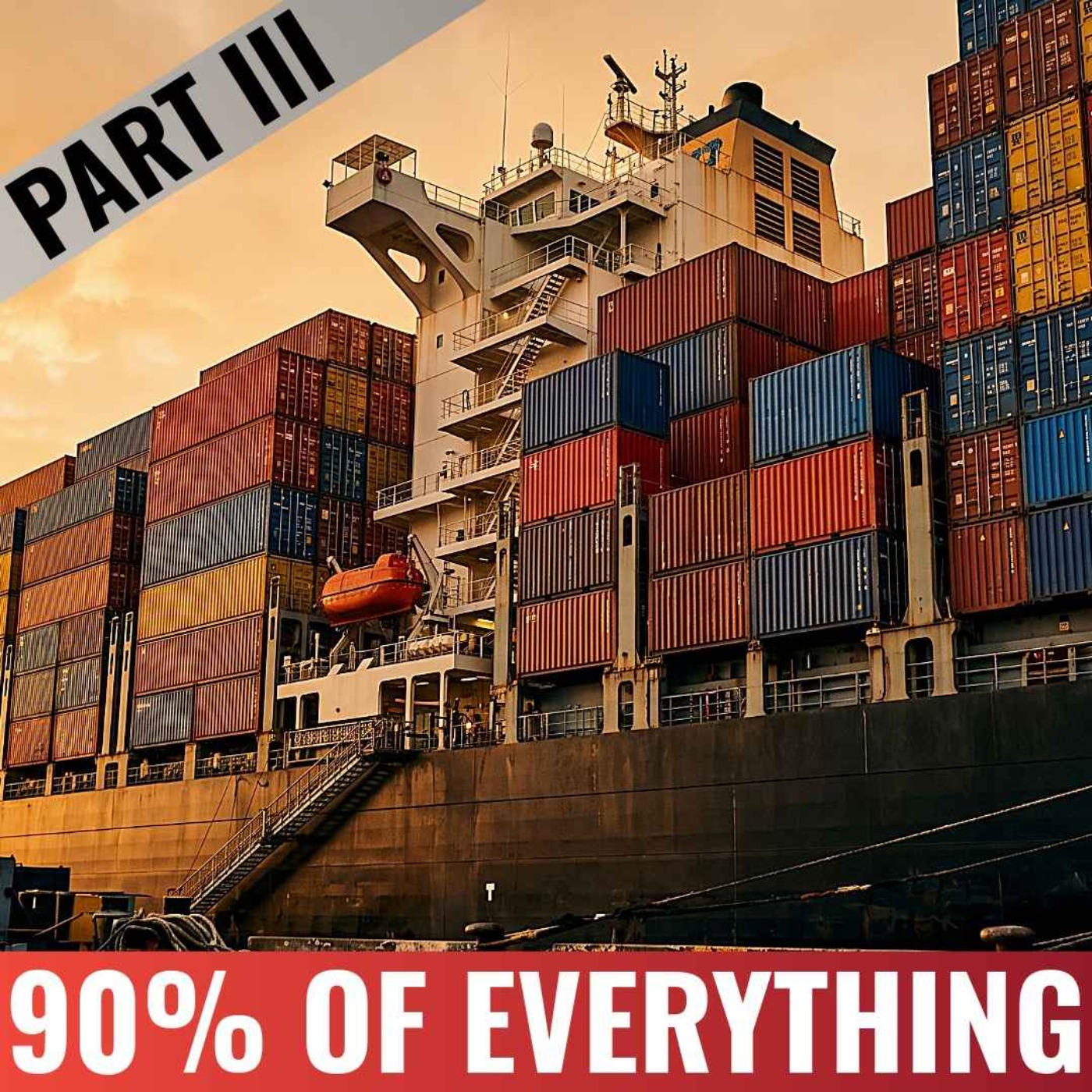
So here are some numbers that put this into perspective. So the Ideal X McLean's first experimental container system, that ship contained 58 containers by 1968. So that's just 12 years later you start to see the first dedicated container ships. These have 1,000 TEUs or 20 foot containers on them by the 1980s. So 20 years after that, they are carrying three to 4,000 TEU. By the 2000s, over 10,000 containers. And today we are talking ships that have 24,000 containers. And I'm sure most people have seen these images of these basically like flat barges piled high on the open seas with this mountain of metal containers. Different colors, different labels, but they're all just stacked on top of each other. It's like this huge floating skyscraper of containers. It's quite a, an, an awesome thing to see. Peter.
- [12:44]
B
They are absolutely, absolutely enormous, these ships. I mean, some of them are 400 meters long, so that takes the Olympic athlete 40 seconds to be able to run from one end to the other. I mean, it's they are vast.
- [12:57]
C
Some of them say it take, it takes me 40 seconds to run from one.
- [13:01]
B
Well, it would take me somewhere like between 38 and 39 seconds if I'm, if I'd be chased by a bear. I mean, they are vast. I mean, and we sort of see them sometimes in films, but unless you've stood next to one or seen one go past you, I mean, they are absolutely astonishing. So the world. One of the biggest class of ships is the MSC Mediterranean Shipping Company is one of the world's biggest container shipping companies. They have a new vessel that was launched in 2023 that can carry more than 24,000 of these containers. And they can also move quite fast through the water too. So I've been very lucky to have seen some of these giant ships in the Malacca Strait of Singapore, the Panama Canal. And you know, it's, it's like seeing a sort of planet or a death Star go past you. I mean, they are many, many, many times bigger than jumbo jets. I mean they're so huge. I mean the 400 meters, that's the length of four football pitches.
- [13:54]
C
And when you think about the weight, that's the thing I find mind boggling. So if you take one of these huge 24,000 unit ships, they are carrying sometimes more than 245,000 tons in weight of cargo. That makes them among the largest moving objects ever constructed. And you just think about that weight sitting on the water. It's kind of a feat of engineering to be able to float and move at high speed. Vessels containing that much stuff, again, I
- [14:29]
B
mean when you, they are moving at high speed, I think most of us think high speed is, are those Olympic athletes running backs and forwards. But you know, to get the energy to propel these ship through the waters, the size of their propeller shafts, the size of their engines, you know, they are enormous feats of engineering. And you know, nothing in the water that size moves quickly. So, you know, not for nothing, it's turning around a supertanker. It takes an enormous turning circle and a lot of energy too, but they are the things that move goods all over the world. And to be able to handle these kinds of ships, again, something we talked about repeatedly is the changes to port infrastructure that are able to get these ships in. You need to have deep water ports, you need to have the infrastructure that's going to be able to get warehouses to store these things and the shipping containers. Those small docks are no good anymore. When you have these vast container terminals. You've got to have the cranes that can move them quickly. And also ideally, technology that is able to map what's being taken off which ship and when. Because all these things are coming through in international waters, they're typically coming into new jurisdictions. So you need to have a customs infrastructure that's able to process them too. So you have enormous transformations of whole cities. So LA Port, you know, I know you know LA well Afra, but, you know, and Long Beach, New York. The skylines and the cities themselves get changed by containerization.
- [15:52]
C
And not just the pubs where containers are offloaded, but you now have these train lines that if you ever see a container train going, for example, out of la, across the desert, through Palm Springs, sometimes they are miles long. These trains are just like unit after unit of containers and they just snake through the landscape like some strange creature. You can be driving for 10, 20 minutes and you still haven't got to the end of one of these trains. And that's something that you see everywhere there are ports, because of course, once the containers are offloaded, they have to get transported somewhere else. So they're reshaping entire urban landscapes. They're reshaping the space in between urban landscapes. And one of the most important economic effects is this massive reduction in shipping costs. Before containerization, it would cost around five to six dollars per ton to move cargo from just the loading. And the unloading costs that cost $5 to $6 per ton has now been reduced in some cases to 15 to 20 cents. That's a more than 90% reduction in cost. And economists often describe this as one of the most important factors behind globalization. For example, the Nobel Prize winning economist Paul Krugman once noted that the container was more important for global trade than tariff reductions. If you think about the way we shop, you know, you can order next day delivery of goods from China or from the US or from South Asia. There is no way we would be able to access these globalized goods so quickly and so cheaply were it not for the containerization of global trade.
- [17:31]
B
And those containers are shipping 90% of the world's traded goods by volume. So everything from electronics to furniture to toys to trainers are moving through these container networks. They're getting from a factory onto a port, into a container and then shipped to wherever it is. And they're held in a hub, probably somewhere in a vast aircraft hangar, which when you then click onto an online ordering site, then gets distributed to you and it comes the next day. But all of those arteries and sinews are hidden because we don't Spend a great deal of time thinking about them. But at any given moment there are millions of containers moving across oceans, roads and railways. And the scale of the system is enormous. I mean, there are more than 25 million containers circulating currently through global supply chains. And that's what's keeping all of us in new clothes, getting us to upgrade our TVs, getting us to be all the things we're used to getting on a day to day basis, all coming overseas. So the genius idea AFU is not just the steel box itself, but it's also the fact that it can move seamlessly between ships and trains and trucks, like you already mentioned.
- [18:37]
C
Yeah, I talked about the trains, but of course, trucks are the other major way that containers are moved on land. So, so they have these container chassis, these simple skeletal trailers that are designed to carry one container. And a typical 40 foot container can weigh 30 to 32 tons when fully loaded. So each of these trucks has to be engineered to specifically carry this heavy load. And so these container trucks now are probably the most critical link between ports and the inland distribution centers for populations who depend on these goods for just about everything you can imagine. There are thousands of these vehicles shuttling containers between terminals and warehouses in every port in the world. You'll see them if you go to Los Angeles or Rotterdam, Shanghai. Fleets of container trucks operating continuously day and night, collecting containers, lifting off ships by giant cranes and transporting them inland. And you get these incredibly global systems. So you might have a product where the components are made in Vietnam, the product's assembled in China, it's then shipped by container to Europe or North America and then delivered by truck to the destination warehouse before a courier then delivers it to the shopper or it's taken to a retailer or to an industrial user. And a single container can carry so much. For example, you can put in one container 10,000 pairs of shoes or 20,000 bottles of wine, or tens of thousands of electrical components. So they really are crucial, Peter and
- [20:13]
B
it is amazing because, you know, if you, if you drive up and down from Oxford to London, or you know, quite often the A12 heading past Cambridge, where you can see trucks heading towards Felixstowe and Harwich and ports on, on the east coast of England. Each lorry has, has one of these units typically on the back of it. It's all the same size. You don't know what's inside it. It's like ants moving leaves around towards the colony. It's making sure that place is in the right place and at the right time. There's lots of other parts of the story as well. It's not just about who's buying and who's selling, where stuff being made. It also means that things have to be in the right place at the right time. It also means if something goes wrong with the supply chains or if containers, for whatever reason, are not in the right place at the right time, then things could go really, really wrong. And after the break, we're going to talk about some of that, too.
- [21:03]
D
Does your day move faster than you can keep up with new Gatorade lower sugar? My family and I can stay at the top of our game. No artificial flavors, sweeteners or colors. 75% less sugar and all the electrolytes of regular Gatorade now available nationwide.
- [21:27]
B
So we mentioned AFWA just before the break that the container system is absolutely central to global trade, but it means that disruptions can have some dramatic consequences. That there are a couple of those disruptions I think it's worth talking about.
- [21:39]
C
One famous example is March 2021, when the giant container ship ever given became stuck in the Suez Canal. And if you follow the news, you will have seen images and breaking news about this story. It sounds quite harmless. A ship gets stuck in a body of water somewhere, probably far away from where you live. But this one ship blocked the canal for six days, holding up hundreds of vessels and disrupting global supply chains. And it's a bit like if you live in London, imagine the M25 being blocked for six days, or Route 66 in America being blocked for six days. These really crucial arteries on which the flow of goods is totally dependent. And it's not blocked for hours, which would be bad enough, but for days at a time. And this particular blockage of the Suez Canal is estimated to have cost 9 to 10 billion dollars worth of trade. I cannot imagine what the lawyers involved in the litigation around that blockage must. In fact, they're probably still working at it now, five years later. I wouldn't be surprised at all, Peter.
- [22:50]
B
Yes, because it's not just the ship getting blocked, it's whose responsibility was that? Was it a misfiring piece of equipment on the ship? Was it the ship's captain? Was it negligence? Was it the port authorities? But the difference of, of the, of the Suez Canal as opposed to the M25 is that there's no workaround. You know, you can't find another shortcut. You've got to go around the southern tip of Africa in a case like that, where you have a case of what looks like it's just extremely bad luck. Then those knock on effects are enormous. And it's not just those costs. It means that factories that are waiting to load their goods onto containers, the ships that are waiting for them in the wrong place, the containers are in the wrong place. And so things escalate and they affect people's daily lives too. So often we tend to think of it as those costs mean that prices of goods are going to go up, there's going to be inflation, which has its own consequences too, but it can disrupt things in very, very dramatic ways. And another example comes with the pandemic. So in early 2020, global trade initially sort of collapses because factories shut down as lockdowns spread around the world. And container shipping volumes fall very sharply in those first few months. And many shipping lines just cancel sailings. And it looks like it's the end of the world. But as lockdowns continue and things start to get going in the background, consumers in Europe and in North America in particular, stop spending on services they can't. You can't spend. We couldn't spend our money on travel or restaurants. So instead they spent money, all of us spent money on buying physical goods, you know, bigger TVs, because you're locked inside for months, furniture to redecorate your home, home exercise equipment because you couldn't go to the gym, household appliances and so on. And so there's a sudden surge in container demand. So by late 2020 and early 2021, where container traffic had dropped off a cliff, suddenly you find imports to the United States running at record levels. The single biggest item being imported to the United States by volume is furniture. The Port of Los Angeles, on its own, which is, which is the biggest one in the United states, handles over 10 million containers in 2021, the highest annual total in its history. And suddenly you find ports dealing with more cargo than they can actually process.
- [25:02]
C
And this imbalance between demand and the actual ships and containers available causes freight prices to skyrocket. So shipping a 40 foot container from Shanghai to Los Angeles cost around $1,500 in 2019. By September 2021, just two years later, the price has multiplied tenfold to roughly 12,000 or even $15,000, with some spot prices reported above $20,000. So that means the cost of shipping a single container is exponentially higher. And economics at the International Monetary Fund later estimated that the surging global shipping costs added 1 to 1.5 percentage points to global inflation in 2022. So this is economically transformative and it has real Knock on effects for everything. And it's one of those things, Peter, that I think was a little hard to predict. You know, you would expect more intuitively for there to be a drop in demand because people aren't living the way they usually do. But of course it's this, this distorted demand for certain things, things that tend to require shipping. All these household goods and items that you mentioned that are some of the most globalized products imaginable, like we were speaking about earlier, you know, parts from one place, constructed in another place, shipped to a third place and then transported to a fourth. So it's a really, really important problem that Covid uniquely produced.
- [26:36]
B
And it's not just supply and demand. I mean you get it that if there ever wants to buy furniture and have it shipped for from one part of the world to the other, suddenly there's a lot less space. You know, you need more containers to go around. It's also that if there are delays getting ships unloaded, then suddenly ships are in the wrong place. So in LA, for example, in 2021 sometimes there were more than 100 container ships just waiting offshore, waiting for a berth because there weren't enough places in the harbor to bring them or the port rather to come and take the ships to unload them. So you've got, you've got this knock on effect. So it's partly to do with prices going up because of supply and demand, but it's also to do with the problem about logistics becoming suddenly stuck in the mud and suddenly everything being slowed right down. And that creates compression across the whole thing. It's not just then the container that's in the wrong place, it's the truck is in the wrong place. The railways struggle to deal with cargo to move it around too. So you have these concentrations of problems that escalate upwards constantly during moment when you have these issues. And so Covid was a very good example of that too. That gets solved by entrepreneurs thinking how do you take advantage of that? So China in the course of 2021 produced 7 million new containers to try to alleviate some of the pressure. But then when we go back to normal, suddenly there's less demand as before. And so you get these swings of fortunes for shipping companies that go through the consumer, the cargo shipping world too. So you've got lots of problems with delays. And we've seen that more recently in other parts of the world too, particularly because of military pressure. So Covid was one type of example. The Suez crisis with evergreen and human error. But then we've had that with the Red Sea. Afwa.
- [28:18]
C
Well, what you get with global shipping is these really important passageways that save shippers long, costly in time and fuel voyages around a longer route. So. So an example of this would be the Panama Canal, which saves a journey around the whole coast of South America to get from the Atlantic to the Pacific coast. You've got the Suez Canal, which connects the Red Sea to the Mediterranean, saving ships from detouring all the way around the Cape of Good Hope, which would add 3 to 4,000 miles of nautical journey, 10 to 14 days of travel time. And you have the Straits of Hormuz, which connects the Gulf States, which of course massive producers of oil and natural gas, to larger global shipping routes. Now, these are bottlenecks. They are small, relatively narrow passageways through which a huge and very, very valuable amount of global trade passes. And what it means is that these straits have incredible strategic importance. Who controls them and who has access them, who's capable of disrupting them is now a power that has a huge amount of leverage or on the world stage. And that's why we have in history these crises related to these waterways. Now, of course, the Suez Canal crisis in the 1950s toppled a government and fundamentally altered Britain's place on the world stage. And what we're seeing now is this crisis in the Straits of Hormuz. Peter and the war between the US and Iran.
- [29:44]
B
I wrote something recently about reminding that Sir Walter Raleigh, one of the most famous British maritime figures in history, who are alive in the late 1500s, early 1600s, wrote in a discourse on the invention of ships, he said, whoever commands the sea commands the trade, and whoever commands the trade of the world commands the riches of the world and consequently the world itself. So that's a reminder about the importance of strategic choke points around control over trade and a control over shipping. And it's one of those subjects that gets reflected. We've mentioned that in both the previous episodes in Law, where commercial law, so much of it is connected with shipping, but that's for very good reason because that is the ways in which we are also intensely globally connected. So you mentioned the Red Sea. Afraid the the need to sail around the southern coast of Africa. That adds not just time, that adds cost. So typically, a trip around the Cape of Good Hope will burn another 2,000 tons of fuel for a big container ship. That's one thing. And as we've seen since the attacks of 28 February on Iran by United States and Israel and over the weeks that have followed, we've seen the pressures as you mentioned on the Humes Strait, where the inability of ships to get out in significant number, particularly carrying energy supplies, but also as well as oil and lng, liquefied natural gas, also fertiliser and helium, and things that are really important for supply chains of things being built in other parts of the world suddenly means that you face a global economic crisis. And that can get resolved if you put resources into protection, if you can make sure that you don't have any disruptions. But there is an ability to hit the Achilles heel. And the Achilles heel means stopping ships from moving. So one of the things I think is most interesting about global shipping is that it's just invisible to most of us most of the time because we don't spend any time thinking about it. But when there is a problem, when things go wrong, then suddenly we get a knock on reminder. What's funny though, in the last five years we've had that with the sewers incident, we've had that with Red Sea, we've had that with COVID But yet the number of people who've suddenly been taken by surprise about these narrow body ways of water, how vulnerable they are, seems to come as a shock very often. We should be better at thinking about those vulnerabilities, Peter.
- [32:07]
C
That's all so important and so relevant right now. But before we finish talking about shipping containers, I cannot let this topic pass without the thing I'm most excited about, which is the role containers are playing in developing beautiful new homes. So one of my best friends in Ghana just built an incredible new home out of shipping containers. And I have to say, when she told me that was her plan, I was slightly imagining a creatively designed Porterville, you know, something quite rough and ready with maybe some nice interior furnishings. Her home is beautiful. And when I started looking into it, I realized that the use of containers for residential homes is a massive growth industry. It's actually being called cargo texture shipping container architecture. And as of this year, it's valued at roughly 70 to 75 billion dollars. And it's a market that is growing at 6 to 8% annually. And the reason is this. Everybody everywhere knows about the cost of property, of buying a home, of building a home, whatever cultural society you live in, it's something that people struggle to afford. Basic container homes can cost from $25,000 and the top end is like 80,000 to $100,000. Although there are some mega luxury multi container homes that are worth about $250,000. But if you compare that to the price of a traditional bricks and mortars house. It is so much more affordable. And I think that's why many people are being quite innovative in how they use containers to build homes. And of course they're also quite carbon friendly in the sense you're using prefabricated units, sometimes you're recycling containers that have been taken out of commercial use and you're creating these fixed modular buildings that can be quite flexible. You know, it's quite easy to rearrange them or refurbish them, or repurpose them. And it's something that I personally think is quite an exciting area of new development. So that's why I think the container is sexier than people realize.
- [34:19]
B
I think that's a very compelling. It's quite hard for me to argue with that. Having told, having said at the beginning, I was going to find it hard to, to, to explain or justify. But look, you know, I've been in Buenos Aires recently and in the Boca part of town of the amazing capital of Argentina, you have lots of houses that are made out of the remnants of ships and of shipping containers from the past, before the teus. But the ways in which recycled materials have been important in housing is really important. But I got to know an architectural practice in Amsterdam about 20 years ago called concrete, and amongst the things they've done is modular housing and modular hotels. The Citizen M hotel chain is something that they've been behind and that is about having hotel bedrooms in container units that you stack on top of each other. And there are lots of reasons why that's a smart idea. Not just because they're easy to assemble like LEGO bricks, but also you can pre prep them off site so you can build them and then when they're ready, you can build your construction very much more quickly than if you're pouring concrete into the ground or having to build from scratch. So the are all sorts of ways in which these ideas, if you're smart and you're thinking laterally, you could be extremely creative. So I'm not surprised that in lots of parts of the developing world, the use of finding ways to be able to reduce your costs, to be able to build at scale, the fact that you can replicate, you could do it high scale, low scale, mid scale, whatever it is, it just shows how creative and innovative people are. Because the problem they're actually solving is how do you do things quickly, cheaply, with predictable prices. And if you can do all of those, then your risks come down. So if you think that no risk equals sexy, which I do because I love logistics, then I'm all in. But I think that's probably a conversation to have another time around. One of the sexiest inventions in history rather than the greatest ones. But I'm definitely up for that as well. But I'd be very interested to do it with a Q and A with our members to see what they think about not just great innovations, but also what they think about the containers and what it is that they could be used for that they're not currently being used for. But that's very interesting that you've got some experience with this. So what did you say it's called?
- [36:26]
C
CargoTechure.
- [36:27]
B
Okay, I'm writing that down. That is my word of the day. That's unbeatable. If we can think of a better word of the year, cargotecture Genius.
- [36:36]
C
So there you have it. The reason that the shipping container is one of the most important innovations in in modern history. How it's changed everything from shipping consumption, the configuration of world power, to the future of residential architecture, caritecture.
- [36:56]
B
I love it.
- [36:57]
C
Thanks for listening to Legacy.
- [37:00]
B
To dive deeper and to support the show, please sign up to Legacy Plus. You'll get to enjoy bonus episodes early access, fewer ads, Q and A and more. So go to Legacy supportingcast.
- [37:11]
C
Don't forget, you can watch all our episodes on Spotify and YouTube. For everything else, including our substack and updates on Tik Tok and Instagram, just check the show notes or search Legacy Podcast. I'm AF I Peter Frank Pan.
- [37:26]
B
I will see you next time on Legacy.
- [37:48]
D
When you've done the work, you want your hydration to do the same. Introducing new Gatorade Lower sugar now with no artificial flavors, sweeteners or colors. And 75% less sugar and all the electrolytes of regular Gatorade now available nationwide.