Loading summary
Transcript55 lines
- [00:00]
Stamps.com Advertiser
Still waiting in line. Again, that's time you will never get back. Save time and money with stamps.com over 4 million businesses have skipped the line with stamps.com join them to save up to 90% off carrier rates from your computer or phone right now. Print postage for certified mail, registered mail and packages in seconds. Then schedule a pickup right from your home or office. For a limited time, go to stamps.com and use code podcast for a free welcome gift. Taxes and fees apply.
- [00:32]
Peter Frankopan
So today we're going to be Talking about an 18th century equivalent of a global multimedia superstar. A scientist who literally pulled lightning from the sky. And a media mogul whose almanac reached more people than most people's modern substacks.
- [00:47]
Afuaha / Afwa Hash
But Benjamin Franklin wasn't born a rebel. He was a proud Briton until a savage public humiliation in London forced him to realise that the empire he loved didn't love him back.
- [01:01]
Peter Frankopan
So needy these guys. I don't know who that reminds you of in the modern American political world. So we're going to talk about him and we're also going to be talking about James Madison, the so called father of the constitution. At just 5 foot 4 and often very sickly, he wasn't a man of the sword, but he was a man of the lab. Treating 2000 years of history as a laboratory of political failure.
- [01:22]
Afuaha / Afwa Hash
Madison is the ultimate 18th century Brexiteer. He didn't just want liberty, he wanted a system that could survive human nature as he saw it. Because in his words, if men were angels, no government would be necessary.
- [01:38]
Peter Frankopan
So today we're going to talk about two of the founding fathers of the U.S. declaration of Independence. We're going to be its inventor and its architect. This is the story of how a printer and a scholar built the most influential republic in history. Hello and welcome to a new episode of Legacy. I'm Peter Frankopan.
- [01:56]
Afuaha / Afwa Hash
I'm Afuaha.
- [01:57]
Peter Frankopan
And this is Legacy, the show that explores the lives, events and ideas that have shaped our world and asks whether they have the reputations that they truly deserve.
- [02:06]
Afuaha / Afwa Hash
This is the founding fathers, the OGs.
- [02:16]
Peter Frankopan
Thanks for joining us on Legacy today. To support the show, Sign up to
- [02:20]
Afuaha / Afwa Hash
Legacy plus you can enjoy early access, fewer ads, Q&As and bonus content. Like when we spoke with Professor Helen Thompson about the conflict in Iran. Or when we caught up with surgeons Dr. Minyan Gray and Dr. Isosa Omarogbe to go deeper into the world of facelifts. Or when we explored the legacies of the remote control. Or the legacy of fish fingers.
- [02:42]
Peter Frankopan
I love Those episodes sign up at Legacy supportingcast fm. Okay, so we're going to start our founding fathers after. We're going to start with the biggie, right? Benjamin Franklin. And by the 1770s, I think it's fair to say, Benjamin Franklin was the best known American in the world.
- [02:58]
Afuaha / Afwa Hash
He was a global rock star as far as that existed at the time. Peter, he was born in 1706. He was the son of a candle maker and a soap boiler. So he represented a very different background from the landed Virginia elites like Thomas Jefferson, who would later dominate revolutionary memory. He had had little formal education, but he built himself through trade, printing, journalism, and relentless self improvement. He is a classic product of the American dream before such a thing existed. And by the time of the revolution, he had become one of the most respected intellectuals, not just in America, but in Europe and in the colonies, one of the most influential political figures. He, he was pragmatic, he was witty, he was adaptable, he was very charming. He was definitely the life and soul of the party.
- [03:50]
Peter Frankopan
Definitely. He'd have had a podcast, no question about that. He actually did effectively have a substack. He was available for interviews, but, you know, you've got to be charming, you've got to be able to bring something new to the party. And Franklin, what is interesting about him is he's deeply curious as a person, but he's also very clubmable. So he loves being in salons, he loves diplomacy, loves gossip about what's going on in politics. And he fashions himself as a kind of republican virtuous man. So he has spectacles, simple clothing, a fur cap, understated manners. There's nothing showy about him on the outside. But beneath that image is a very ambitious and a very skillful political operator.
- [04:31]
Afuaha / Afwa Hash
He first became prominent through publishing. His Pennsylvania Gazette became one of the colony's most influential newspapers. And Paul Richard's Almanac, first issued in 1732, made him wealthy and famous. It was selling 10,000 copies a year.
- [04:49]
Peter Frankopan
But Paul Richard's Almanac, it's a kind of compilation of stuff that's going on, and that 10,000 circulation is absolutely enormous at a time when the population of the colonies is not big, the time when literacy levels are not high. So it means that everybody who's anybody is reading it.
- [05:05]
Afuaha / Afwa Hash
And that means, why, Peter? Why is poor Richard Zalmanack so popular? What's making people want to buy it?
- [05:10]
Peter Frankopan
I think it fills a space of people who want to know about things that are interesting, are going on, and never underestimate people's Curiosity. That's why people listen to such great podcasts as ours, but they want to be informed. And so Franklin taps into something. So he's commercially quite savvy. He recognizes that there's something that you can use your knowledge to be able to build yourself a platform. Because he's got a kind of a journalist's eye for a story and he's got the good way of telling it and he learns how to do it better and better. So he combines humour and aphorisms and practical advice that is a kind of combination of kind of bedside chat. So, you know, some of his famous expressions are things like early to bed and early to rise, which that's not how it works for me. Early to bed, that means I'm going to wake up late.
- [05:53]
Afuaha / Afwa Hash
I mean, I'm not sure how much I'd pay for that advice, but I guess I'm not an 18th century colonist in America. Maybe it seemed more radical then.
- [06:02]
Peter Frankopan
Yes, but it's that sort of idea that it's what everybody's talking about, so you need to be in on it. He becomes wealthy as a result and becomes well known. That's equally important. He also dabbles with science, or does more than just dabble with it.
- [06:14]
Afuaha / Afwa Hash
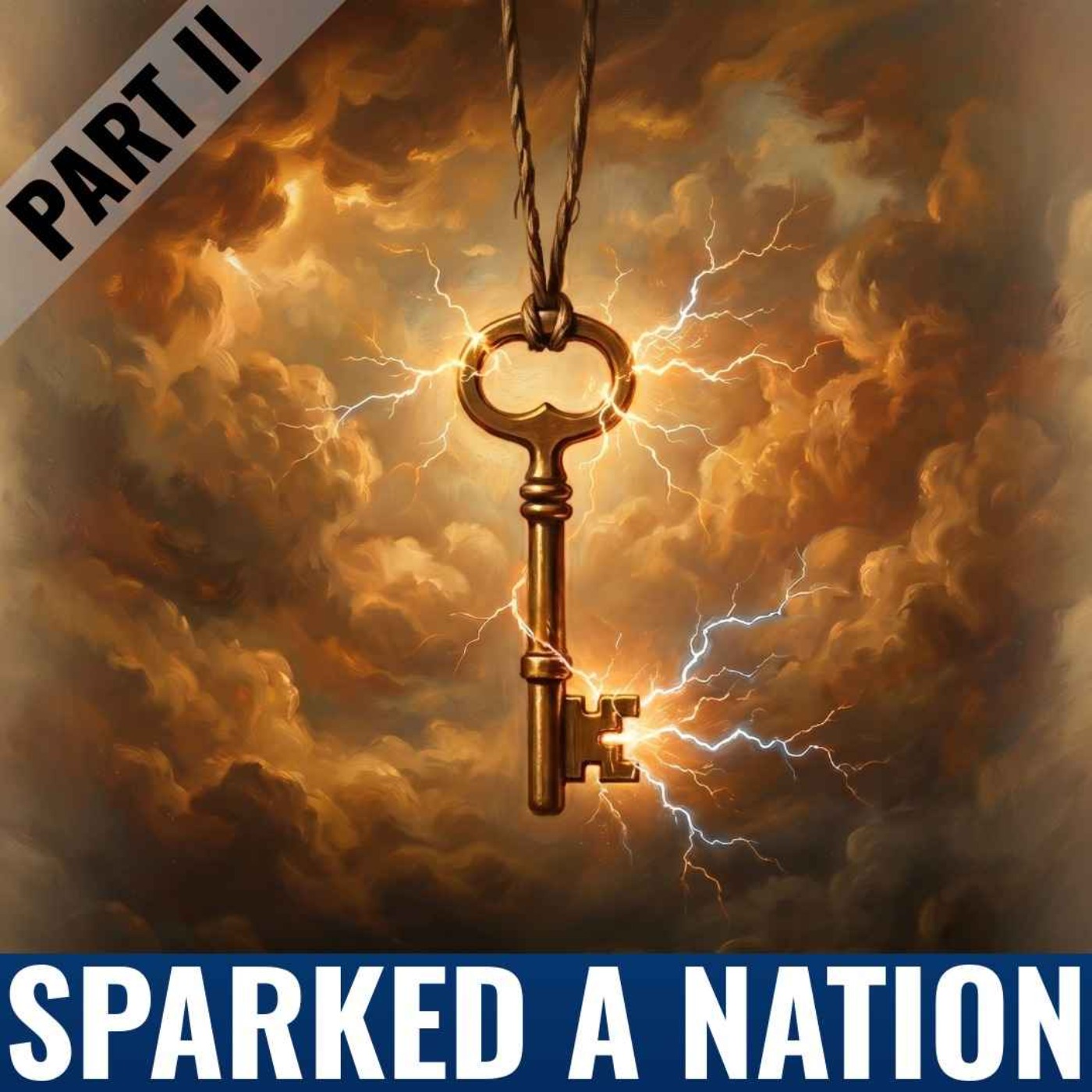
He does science the Benjamin Franklin way, and he actually coins terms that are still used today, like battery, positive and negative charge. He proposed that lighting was electrical, which at the time was a radical suggestion. And he's actually conducting experiments that are leading him to these scientific conclusions. And the most famous of these is the kite experiment of 1752. Now, according to the traditional story, Franklin flew a kite during a thunderstorm and he attached a metal key to the string. And as the storm clouds passed overhead, the electrical charge traveled down the wet string and produced sparks from the key of apparently proving that lightning and electricity were connected. Is that actually a true story, Peter?
- [07:03]
Peter Frankopan
Yeah, it is, yeah. I mean, I think when you think about globally famous experiments, I'd have thought that the key on the string, I'm struggling to think what else. Getting into a bath that's a bit too full to show displacement, but, you know, it's one of those things.
- [07:16]
Afuaha / Afwa Hash
I think putting a key on a string and managing to get it struck by lightning is more impressive than getting into an overfull bath. Come on.
- [07:23]
Peter Frankopan
Well, that's true, but, but that, that image, you see it in the Simpsons, you see it, you know, films. I mean, that image becomes legendary of Franklin standing, standing in the storm, trying not to get hit by lightning himself, but being close enough that it's actually pretty dangerous. Yeah, yeah, don't try that at home. But it turns him into one of the best known men in the Atlantic world as a whole. So scientists in Europe are discussing his findings, and his work is being translated into several languages. And in 1756, so he's 50 at this time, he's elected to the Royal Society in London, which is the highest accolade for sciences, and is awarded the Copley Medal. And to many people in Britain, Europe, the colonies, Franklin kind of embodies the Enlightenment. He's curious, he's empirical, he's optimistic. He's convinced that knowledge can improve society. And he's working systematically to try to find out ways in which that could work. So Franklin, and the way he's going to have a political consciousness is going to be really important for whichever side of the discussion about independence the Founding Fathers are going to find themselves.
- [08:29]
Afuaha / Afwa Hash
And crucially, at this stage, he is 100% British. You know, like most of these men who are involved in shaping the Declaration of Independence that creates America, he at this point sees himself unambiguously as a British person. And until the 1760s, he's not advocating for independence, but he believes that the colonies are flourishing as these proud colonies within the British Empire. He's proud to be part of the British Empire. He admires it. He enjoys the sense of being part of this global, dynamic community of trade and exchange, much as that is so founded, as we've been speaking about throughout, on exploitation and the lack of freedom for many others. But, you know, like many men of his race and time, he feels proud of this construct and to be part of it. And he spends years in London representing Pennsylvania and other colonies, and it's a very comfortable position for him. You know, he is the voice of the American colonies. In London, he moves comfortably among British intellectuals and political elites. He's being rewarded and recognized by them for his achievements. And so his vision of the future is constant improvement and reform through imperial partnership rather than any kind of separation. Until it's not.
- [09:44]
Peter Frankopan
Yeah. And I think what's interesting is that he's not alone who's thinking about that. All these guys milling around London, too, are thinking about reform. They're all thinking about how can you make the British Empire even better? How do you control the power of the king? How do you stay away from tyranny? So sometimes the Americans get all the credit for thinking about ideas about freedom, but Franklin is circulating in a world where everybody's thinking about progress and about enlightenment with a little E as well as with a big e. But things do then change. Aphrod after the break we're going to see how he takes a slightly different direction and turns towards things that move away from just reform to something more radical.
- [10:25]
Stamps.com Advertiser
Still waiting in line again. That's time you will never get back. Save time and money with stamps.com over 4 million businesses have skipped the line with stamps.com join them to save up to 90% off carrier rates from your computer or phone right now. Print postage for certified mail, registered mail and packages in seconds. Then schedule a pickup right from your home or office for a limited time. Go to stamps.com and use code podcast for a free welcome gift. Taxes and fees apply.
- [10:55]
Depop Advertiser
This episode is presented by Depop. We all have pieces in our closet that deserve a second life. That jacket you loved for a season, someone out there is literally searching for it. And that's why I love Depop. It's a fashion resale app where your personal taste actually has value. Selling is quick, simple and genuinely worth it. You can list an item in just a few taps on Depop, just snap a photo and their AI powered listings fill in the details. Plus make money easily. With no selling fees on Depop, no seller fees means what you earn is yours. Even selling one item is a win. So if you've been thinking about clearing out your closet, this is your sign. Download the Depop app and list your first item today.
- [11:43]
Peter Frankopan
The turning point comes with the Seven Years War, when Britain starts to tighten control over its territories and starts to put high levels of tax on the colonies. The Seven Years War is a vast global conflict played out between Britain, France and their respective allies all around the world, across Europe, in North America, in the Caribbean, in West Africa, in South Asia. I mean, it's kind of it's a world war in all but name. And Britain emerges at the end of these seven years victorious with huge new territories as a result, including much of French Canada. And in fact, in 1759, there are so many victories it becomes known as the annus mirabilis, the sort of the miracle year. But the war, as all wars do, leads to high levels of debt, unprecedented levels, in fact, in the case of Britain. And there are high costs of maintaining troops across a greatly expanded empire. So British ministers start to argue that American colonies, which have benefited, of course, from the victory over France and North America, need to be chipping in and paying more for imperial defence and administration. And they start to introduce a series of taxes that bring all of that in.
- [12:52]
Afuaha / Afwa Hash
I think it's fair to say Britain's a little distracted at this point, both by its sense of victory, but also its preoccupation with the Caribbean. The Caribbean is the big earner. It is the big wealth generator for the British Empire. All of this enslaved labor and sugar cultivation is so lucrative. And so while America, you know, the colonies on the east coast are, you know, these kind of gentlemen's clubs of like minded figures like Benjamin Franklin, they're not as important to Britain at the time and it's not really focusing on what the consequences of burdening these colonies with new taxes to pay for this war will be. So they're not really thinking through the consequences, I think it's fair to say. And if they were, they underestimated how much opposition there would be among colonists in America to the Stamp act, for example, which is one of the lightning rods that starts to radicalize people like Franklin, who'd been quite comfortable within this imperial landscape. Although initially the opposition is much more moderate. So Franklin, for example, famously told Parliament during questioning in 1766 that Americans were would never accept internal taxation imposed without representation. And that becomes a slogan for American independence. And what they mean by that is that they do not have any representatives in Parliament yet Parliament is imposing laws which directly affect them. And not only has Parliament not got any representatives from the colonies, but Parliament's never been to the colonies. You know, the vast majority, majority of MPs know nothing about America have never stepped foot there. It's, as we said in an earlier episode, a very long way away. And so people like Franklin resent this idea that they are having to bear the burden of policies that are made without them even being in the room or even understood actually when the policies are made.
- [14:41]
Peter Frankopan
That's why we've sort of slightly tongue in cheek called some of these episodes, referred to Brexit because it's the sort of take back control. Why are we contributing if we don't have the ability to be autonomous? And you know, it's perhaps, perhaps not surprising that some of the Republican with the Capital R Party support for people like Nigel Farage and for Brexit in the first place in 2016 has this kind of long pedigree of recognizable arguments of kind of, you know, you don't deserve to be as part of a federated union. Of course, the irony being the United States turns into a federated union as though which is what, what Europe was effectively tried to become. But that idea of how you should be represented, who gets to take your shots, who gets to charge Taxation, who gets to make laws, is a key touch point. Another thing that frankly gets very hot under the collar about is about what he thinks of as contempt for the colonies, the fact that they're kind of given second class status. And the turning point with his sort of perspective here turns on something called the Hutchinson Letters Affair. So Franklin obtains a series of private letters written by Thomas Hutchinson, who's the royal Governor of Massachusetts, in which Hutchinson suggests that colonial liberties need to be curtailed and that stronger imperial control is needed in America. Franklin quietly circulates these letters in the hope they're going to expose how aggressively some British officials see the colonies. But instead the letters get leaked and published and that causes uproar in Boston. And the British ministers back home in London are furious and they need someone to blame. So attention quickly turns to Franklin, who admits that he's transmitted the documents. And in 1774, he's summoned before the Privy Council at Whitehall. And rather than having a meeting behind closed doors or telling off, it becomes a public humiliation.
- [16:28]
Afuaha / Afwa Hash
The Solicitor General, Alexander Wedderburn, launches into a savage takedown, accusing Franklin of theft, manipulation, dishonour. He mocks Franklin before a crowded chamber packed with the political elites who Franklin considers his equals and peers. And he portrays Franklin as this disloyal schemer masquerading as a respectable man of science. And this attack reportedly lasts close to an hour and it's incredibly humiliating for Franklin. Witnesses are struck by his reaction. He's dressed in this simple brown suit and he stands completely still and silent during the tirade. He says nothing in his defence, and one observer later remarks that he appears as if possessed by a man not capable of feeling. I think this is incredibly traumatic for Franklin and there's a level at which he in shock. And I think, you know, this whole escalation is so interesting because I don't think the stamp tax on its own could have sparked these events. Like so many things, Peter, I don't know if you've ever had an argument with someone you're close to where someone does something that's not great, but it's actually the response to the thing that causes it to escalate. So instead of saying, you know what, this is a problem, I should have listened more to your feelings, you kind of double down, which is what Britain does with these Hutchinson letters saying, well, if they're going to complain, we're going to need to curtail their freedoms and impose more control. That sends the colonists in America mental, you know, you do not mess with their Freedom. They're supposed to be your equals. They're gentlemen philosophers and Enlightenment disciples, just like the Brits. That's how they see themselves. They are British. And that is incredibly insulting. And then to then turn on Franklin, who is very dignified, beloved figure, is a big mistake.
- [18:14]
Peter Frankopan
I think he's in complete shock, as you say, Afra. I think that the sort of having spent his life feeling he was part of the inner circle in London, he was, you know, trusted, he'd been all his awards and so on, very, very well known that it teaches him that Americans are actually seen as being culturally inferior, that they're not seen as being rational. All the stuff that's thrown at him, he takes it not just personally about himself, but about Americans more generally. And so he starts to complain about this in greater and more fierce language. And he starts to be convinced that Britain is itself the problem. So he describes later the hearing as being the moment he stops to think about himself as being British. He thinks himself as being an American. And within two years, of course, he's going to be helping draft the Declaration of Independence and being one of the revolution's most important diplomats. But by the time he returns to Philadelphia in 1775, just a year before the Declaration, Franklin has definitely concluded that reconciliation with Britain is impossible. You must have a feeling, I guess, that he has also a sense of settling scores or getting revenge for the way in which he's been treated. Because even though he's less ideological than some of the so called revolutionaries, he's very practical Afro, isn't he? So I mean, he doesn't just throw his toys out of the pram because he's upset. He's trying to think about what this means for the colonies, even in this
- [19:43]
Afuaha / Afwa Hash
state of kind of shock and trauma and humiliation. This is a man who's been around the block a few times. He understands things about how the world works. He's 70 in 1776, so he's thinking about independence in a way that is pragmatic, that an independent America is still going to need friends and allies in Europe and specifically with Britain. And there's going to need to be an element of continuity. And because of his age and because of his accomplishments, young revolutionaries do look up to him. John Adams, for example, who's not that easy to impress, later wrote that Franklin's reputation was more universal than that of Leibniz or Newton. So his position on independence, that it needs to, to work and that it needs to be part of a world in which America becomes a respectable player on the world stage is really important. And his evolution from somebody who was very, very proudly British into being someone with a grievance and then somebody who supports this revolution in a practical way is a really important part of the story.
- [20:48]
Peter Frankopan
So there's Franklin. You know, the personal slights, the embarrassment, humiliation, plus the thoughtfulness, the driving away of the most famous American, you know, seems like something of an own goal. So when we come back, that's one of the founding fathers. When we come back, we're going to talk about another one. We're going to move on to James Madison, who I think is one of the most interesting figures behind the American Declaration of Independence, of which we're celebrating the 250th anniversary this year.
- [21:20]
Afuaha / Afwa Hash
Still waiting in line.
- [21:22]
Stamps.com Advertiser
Again, that's time you'll never get back. Save time and money with stamps dot com. Over 4 million businesses have skipped the line with stamps dot com. Join them to save up to 90% off carrier rates from your computer or phone right now. Print postage for certified mail, registered mail and packages in seconds. Then schedule a pickup right from your home or office for a limited time. Go to stamps.com and use code podcast for a free welcome gift. Taxes and fees apply.
- [21:56]
Afuaha / Afwa Hash
Talking about James Madison makes me think about the role. Having a major Manhattan avenue named after you plays and people remembering your name. Peter because it seems a little unfair. I mean, one one of these guys has the capital city named after him. That's a little hard to compete with. But Madison lives on in the imagination of everyone who's ever been to New York. Because if you've been to New York, you've been along Madison Ave. Right.
- [22:22]
Peter Frankopan
And Madison Ave is a good one, right?
- [22:23]
Afuaha / Afwa Hash
It's a good one.
- [22:24]
Peter Frankopan
Yeah, it's a good one. So it's not just. It's there, it's. And it's not just a big one, it's a good one. So Madison Ave, you know, with, with ad agencies and marketing, publicity, etc. That's a good one. But tell me a bit about James Madison. Aphra.
- [22:36]
Afuaha / Afwa Hash
Well, he's the youngest and in some ways, and this is a high bar, the most intellectually formidable of the major founding fathers like Jefferson. He is part of the Virginia plantocracy. He's born into a wealthy plantation family. But he's very different from the others in his temperament and personality. He's actually not an imposing, impressive, charismatic figure. He's physically small. He's quite sickly. He's very quiet. He's intensely studious rather than this charismatic or commanding figure, and where Washington, for example, projects authority. And Benjamin Franklin is super charming. Madison's influence comes through his intellect and how prepared he is and how sharp his political analysis can be.
- [23:19]
Peter Frankopan
So he's educated at Princeton, which is at that time known as the College of New Jersey, and he absorbs Enlightenment philosophy, classical history, political theory at an unusually deep level. And that's one of the interesting things about these founding fathers. They're very different from their backgrounds. They've all been boiled and stewed in the same broth that makes them think about the same things in the same way. And in Madison's case, he, he's read obsessively and gets completely preoccupied by the central historical problems that he's learned from the study of classics, which is why do republics so often collapse into instability, into factual civil war or into tyranny? So he's read and thought very deeply about ancient Greece and Athens and Sparta. He's thought about republican Rome and the violent political struggles of later periods too, like 17th century England and the decapitation of Charles I and his overthrow. And Madison treats history almost, it's like his as a laboratory of political failure. He's read widely in Greek and Latin, in the originals of course, especially authors like Polybius, Plutarch and Livy and Tacitus. And he's looking for patterns to explain why states decay. So he's already thinking about what can he learn about the world around him? What does it all look like? What are the how the tectonic plates shifting. And in the case of Athens after the Peloponnesian War, he becomes obsessed about the fact that the instability of Greek city states and later the collapse of the Roman Republic into dictatorship, they all haunt him. So he's wondering about where Britain is on this arc, has it already passed it? Where are the colonies? How are the colonies? How those 13, in what ways are they all different? And he's particularly interested in the danger posed by groups are formed. He's worried about passion, about self interest or ideology. So as those discussions take shape in the 1770s, you have plantation owners, you have merchants, you have business people, you've got grandees who've got connections back to England, very different groups. He can see that they're all going to jostle for position. So he's trying to learn and apply his lessons of history, which as a historian myself, I think is admirable, but can be dangerous.
- [25:32]
Afuaha / Afwa Hash
Well, it's fascinating how he kind of uses 2000 year old history to catastrophize and he's not inspired by it. He is inspired by it. You know, they all are inspired by it. But unlike the others, he's got this very pessimistic reading that he feels as if, you know, repeating what happened under Caesar is kind of the fate that's awaiting these founding fathers. I'm just curious, Peter. This is like a counterintuitive question because we always talk about how relevant history is and how much you need to understand history to navigate the present. I wonder in this case if he's actually over projecting history onto the present in a way that's a little unrealistic. Or do you think he's right to take these lessons about the constant fragility and the idea that mob rule is like two wrong moves away? Is that actually a correct interpretation?
- [26:17]
Peter Frankopan
Well, today when we think about the classical world, you think, well, in today's world where we have universal voting rights, we don't have slavery, we don't have women being kept out of decision making, but in some ways the kind of classical Athenian democracy or the Roman republic resemble the colonies in the United States quite well because there's self governance, there are lots of slaves who don't get a vote, there are lots of women who don't get to vote. And so those parallels are more resonant, more obvious then than they are now. But I guess the thing was you asking the question, afraid that one of the ideas that's become very popular, perhaps even the single most popular trope in discussions about geopolitics in the US over the last 15 or 20 years has been the discussion of the so called Thucydides trap. So you've got elites today at universities like Harvard, which is where Graham Allison, who's brilliant by the way, has sort of patented or thought about the idea of the Thucydides trap. And what can the modern United States learn from the fracture of ancient Greek city states? Those questions are still being asked 250 years on, which tells you lots of things. One is that our sample set is not particularly extensive. Right. So if you think about history, it's always ancient Greece and ancient Rome and there's nothing else, and certainly nothing outside Europe, but that kind of dominance that Classics has in shaping discussions. So there are lots of people in my world as academic historians who are worried about the idea of applied history. You know, how can you take lessons from the past and make them resonant today? But I think in Madison's case, he is trying to think about a changing world and about where the you say catastrophizing which I think is the right word. But he's also trying to think about stress points, about where things might go wrong. And he's really worried about the instability because of rival factions. And so that shapes his view that he thinks he becomes convinced and expresses it to all of his fellow Founding Fathers. The United States can't be a loose confederation of small states and former colonies. It needs to become a large republic. And basically the larger it becomes, the more stable it will become. That's an interesting idea. And in fact, in some ways it's a reversal of what he. He thinks earlier on in his life.
- [28:28]
Afuaha / Afwa Hash
It's just so interesting listening to you as you're speaking. I'm thinking, you know, one of the problems of the kind of white supremacist underpinnings of this world that the Founding Fathers are inhabiting is that they've lost out on the full range. If they really want to study ancient history, how much richer their perspective would be if it included ancient Mali, if it included, you know, a second dynasty China, if it included feudal Japan, if it included the Central Asian experience. There are so many other lessons, but because they are so focused on Greece and Rome, they've got this, as you said, like, very small sample set of what can happen historically. But that's also, I think, fed into the narrative Americans have about themselves today, that that is their inheritance. They see it very narrowly as coming from, you know, as some historians are calling it, like Plato to NATO anyway. But back to Madison. He is angered by arbitrary British power. After the imperial crises of the 1760s and 1770s, he's convinced that constitutional liberties are under threat. And the Stamp act for him, this direct tax on printed materials, newspapers, legal documents, licenses, that's meant to raise the money needed after the very expensive seven Years War is also a big trigger point. And like his fellow Founding Fathers, he's not just angry about the tax itself, but he's very angry about the principle behind it, which is taxation without representation. Parliament taxing people in the colonies who have no elected representatives in Westminster. And this really, really speaks to him. The unfairness, the injustice, the democratic deficit of this arrangement.
- [30:10]
Peter Frankopan
And a bit like the Brexiteers, there's a kind of an obsession about, it's not just the unfairness of paying taxes, it's that the bureaucracy, right, who stamps all this stuff, who's involved in all the paperwork, and the thin state is a good state. But then, so he's persuaded Madison, by Franklin's call, about no taxation without representation, but a Decade later. Then we had the British introduce a new set of acts that are called coercive acts, but the Americans call them the intolerable acts. Those get introduced after the Boston tea party in 1774. We're going to come to in another episode. And that radicalizes Madison. One of the revealing anecdotes about his experience during these years comes in Virginia, where Baptist preachers are still being jailed for preaching without licenses. And Madison is just appalled by this. So he writes his friend William Bradford in 1774, where he calls the diabolical hell conceived principle of persecution, adding that religious imprisonment fills him with horror. And it's again, it's about the state overreaching past its powers. I think that's again, that's something which you find on the right in the US and in Britain today, but as well as everything else that shapes his alliances with Jefferson. But he pushes with Jefferson for the idea of religious freedoms in Virginia and eventually for constitutional protections of religious freedom in the United States, which is such an important part of the Constitution too. Although, again, some of that is in the eye of the beholder too. But Madison's role in shaping some of these arguments is about him reacting to worlds he sees around him. So what makes him really influential is that he's able to think systematically about power and about government. And even before independence, he understands that resistance to Britain requires coordination. Right. And particularly between people and groups and states that mistrust each other. So he recognizes that the revolution might descend into chaos, that that's a real risk that this nascent republic is going to face.
- [32:06]
Afuaha / Afwa Hash
Yeah, I think what's interesting and unique about Madsen is his understanding that in an independent world where the colonies have broken away, they are going to need to unite in a very meaningful way with each other. And that might sound obvious to us, but there was a lot of rivalry and distrust within them. And, you know, we see this on the right today, that it's one thing to have this kind of distrust of central government, this very, you know, kind of do it for yourself Republican with a small R is spirit. But you need some kind of authority. You need some kind of organizing principle. Everyone can't just go their own way, otherwise you can't do anything. And that can be a very difficult tension. These are by definition, quite a kind of unruly bunch to try and organize. And he understands that the political system, the way the Constitution is structured, is going to have to overcome that. It's going to have to create a level of unity and cohesion without repeating the oppression and the prescriptive power of the colonial arrangement. And that is one of the reasons that the American Constitution is regarded as an achievement, is that it manages to, in its structure at least, attempt all of these things.
- [33:12]
Peter Frankopan
So Madison isn't some romantic, you know, dreamer about freedom. He's thinking a step or two ahead. And in particular, he's thinking about what happens if and when independent comes. Right? How does that partnership with Britain that's broken down, and it's very nice to think about liberty, but how do you make sure that political order doesn't self destruct? So Madison, who goes on to become the fourth president of the United States, he goes also to earn not just the name of a street in Manhattan named after him, but to earn the title of the father of a Constitution because of the central role he plays in designing that American political system. So he's quite a small man, five foot four, but he's a giant in the terms of his legacies. He's physically quite frail. And he's described by one contemporary as the smallest man I ever saw in public life. But his intellectual legacy and influence is enormous. So he believes passionately that humans are driven by ambition and by self interest and by the desire to create factions, and that the US Constitution needs to stop that from happening, that people need to be protected from their own worst impulses. And again, in today's world, regardless of what your political persuasions are, you can see United States navigating and jostling with some of these questions about do single groups have too much power and too much control? Whether it's the Democrats or the Republicans, whether it's Trump's inner circle, whether it's the tech bros. Those questions about are there dangers of a state becoming top heavy are ones that Madison would have recognized.
- [34:37]
Afuaha / Afwa Hash
I actually wonder what Madison would think about American political life today, because every single one of the systems he helped put in place, the separation of powers, checks and balances, the relationship between federal and state authority, the independence of the judiciary, those are all live subjects that are constantly being contested, possibly with more passion than in my lifetime right now in America. But you could argue maybe that the fact that they're being contested is evidence that they work as in they exist to be contested. They still hold. There is a meaningful tussle over exactly how to interpret them. But that is what a Constitution is supposed to do. It's supposed to provide a groundwork that people kind of regulate and interpret and litigate over time. And maybe that's the greatest compliment. But we will talk more about that in the coming episodes.
- [35:25]
Peter Frankopan
Well, just as a final one, you know, again, faced with what we're seeing today. So the set of papers that Madison played a role in the 1780s called the Federalist Papers, that sort of set out the architecture of the America of the United States that's being born. He writes that if men were angels, no government would be necessary. And I think that that sense that you can have as thin and as small a government as you possibly want, but you need to be protected from each other. You need to make sure there are constant checks and balances to stop groups becoming too dangerous, too powerful. That is a key lesson that Madison picked out of ancient history and as it happens, I think was a sensible one, partly because you can see those struggles, not just the United States today, but all over the world, the need to keep the ship of state moving forwards. You do need to have some checks, balances and protections to stop that from going on. So Madison has a reputation, I think that probably gets underscored here in the uk. He's not as famous for sure as Benjamin Franklin, I guess Thomas Jefferson is certainly not as George Washington. But I think he's done well to protect a legacy in history that looks favorable on him. But anyway, that's two more of our founding fathers. Come back and join us for our next episode of Legacy. And we're going to look at a few more. Thank you for listening to Legacy.
- [36:40]
Afuaha / Afwa Hash
To dive deeper and to support the show, sign up to Legacy. You'll get to enjoy bonus episodes, early access, fewer ads, Q&As and more. Go to Legacy Supportingcast FM.
- [36:52]
Peter Frankopan
And don't forget, you can watch all of our episodes on Spotify and YouTube too. And for everything else, including our substacks and update on TikTok and Instagram, just check out the show notes or search Legacy podcast. I'm Peter Frankenberg.
- [37:04]
Afuaha / Afwa Hash
I'm Afwa Hash. And we'll see you on the next episode of Legacy.
- [37:24]
Stamps.com Advertiser
Still waiting in line again. That's time you will never get back. Save time and money with stamps.com over 4 million businesses have skipped the line with stamps.com. join them to save up to 90% off carrier rates from your computer or phone right now. Print postage for certified mail, registered mail and packages in seconds. Then schedule a pickup right from your home home or office for a limited time. Go to stamps.com and use code podcast for a free welcome gift. Taxes and fees apply.