Loading summary
Transcript87 lines
- [00:00]
A
Hey, Yetis, this is Nick and Jack from the Best One yet podcast. Now, the last company we worked at, they used Paylocity and everything just worked. It wasn't until launching our own media business this show that we realized how rare that is. Because Paylocity is one delicious burrito of operational needs. They roll up HR finance and it seamlessly into one delicious bite. When everything wraps together like that, all at once, your workforce, your tech stack, your business, you don't need more tools, you don't even need cilantro. You need one solution and. And that is why Paylocity built a single platform to connect HR finance and IT with AI driven insights and automated workflows that simplify the complex and power what's next? Or as we call it, a delicious operational burrito. Yes, we do experience a one place for all your HCM needs besties. So start now at paylocity.com1paylocity.com o n
- [00:50]
B
e we think we know what the World cup is and it sounds pretty straightforward, right? 22 players, a ball and 90 minutes of football.
- [01:02]
C
But look a bit closer, Afra, and you're going to find something else entirely. And this is going to be up your street. The football is here for me, but the empire, the conquest, the slavery, the migration is here for us. Right? I want to talk to you about the story about how countries that were colonized ended up beating countries that colonized them.
- [01:20]
B
One of my favourite topics, Peter. And today we're looking at how a game invented by Victorian England became the world's game. And why the World cup might be the last place on earth where the legacy of empire is still performed in public in front of 4 billion people.
- [01:40]
C
We're going to look at the routes that smugglers and merchants took that took football across all the different trade routes. We're going to look at the dictators who turned it into propaganda. And we're going to look at the barefoot players from India who defeated a British military team and made it an act of resistance.
- [01:55]
B
It turns out the World cup was never just about football.
- [01:59]
C
It never was just about football. Hello and welcome to a new episode of Legacy. I'm Peter Frankapen.
- [02:06]
B
I'm Afwa Hash.
- [02:07]
C
And this is Legacy, the show that explores the lives, events and ideas that have shaped our world and asks whether they have the reputations that they truly deserve.
- [02:16]
B
This is the World cup and its origins in Empire.
- [02:25]
C
Thanks for joining us on Legacy today to support the show. Please do sign up to us at
- [02:29]
B
Legacy plus, it really does make a difference for you to subscribe. Subscribe, tell your friends, support the show and in return you'll get early access, fewer ads, Q&As bonus content, like when we talk about the legacy of the escalator and why we get annoyed by people who don't use them properly, annoys me. It's triggering. We also talk about remote controls, how they have changed, how we live, what we eat, where we buy, even what we look like. And we get special guests to come and help explain the world to us, like Helen Thompson of Cambridge, who joined the dots between what the US has been doing with Iran and its policy towards China.
- [03:11]
C
So sign up please, at Legacy supportingcast fm, and get to know and love me and Afro even more than you already do. Right, Afwa, it's the World Cup. I've tried to clear my desk before all this stuff happens. I go nuts for the World Cup. And then I asked you about what you thought about the World cup and you gave me a bit of a look. Like when I asked you about how much you like potatoes.
- [03:30]
B
No, I didn't. I like the World Cup. I do. I do like the World Cup. It is the only time I can really get into football. It's because I find it is. And I'm not just saying it's because I find the politics interesting. I find the politics, I find the cultural dynamics. It is really fascinating as a social experiment to have such a diverse range of nations, all showcasing their sense of what their identity is and what they stand for, competing on what does feel like a level playing field. And when you think about it, it's pretty rare that nations from what's often called the global south and the global north, the richest nations, the poorest nations, the biggest nations, the smallest nations, during that 90 minutes, they are all on the same pitch with the same rules. And that for me is a metaphor, I guess, for how the rest of the world doesn't work, but you kind of wish it did.
- [04:20]
C
It's been amazing watching all these teams arrive at Midwest college towns in the US and all these, I don't know that you've seen it online, of college age kids will come out going, I've got no idea where Algeria is. I've got no idea where they're from. I understand that they used to be ruled by the French and they kicked them out, but. But we're like super pleased they've come to our town. We're super going to be supporting them. We think Algerians are great and no problem at all. So it's a way of learning about geography. So this World cup where Uzbekistan is there for the first time, Cabo Verji Kurasa, you know, it's, it's a joy. But I also do happen to love the football. I mean, I'm always scared to ask you for what the first World cup you even remember is, because that shows my age relative to yours.
- [05:03]
B
Definitely 1990.
- [05:05]
C
Is that right? Okay.
- [05:06]
B
And that's because. Well, it was pretty memorable. That was the lesson. Dormer World cup, right?
- [05:11]
C
Yes.
- [05:11]
B
And what I didn't understand then because I was only nine, but now I look back on, it's like, apparently that World cup and we'll talk about it more, was a bit of a turning point in England in terms of the class perception of football. It was the moment where opera entered the stage and Gary Lineker was a household name and it stopped being a kind, see, seen as like a working class sport and something that people from middle classes and even the upper classes were kind of enjoying as well. And that, the way I've just phrased it probably makes it sound really stratified. But I guess what I'm trying to say is that it joined people from quite separated backgrounds because this really is a very segregated class society and it's quite rare that there's a sport in which people transcend that divide, even if briefly for 90 minutes. And I just remember people in my world who I didn't have any sense of as being football fans, got really into that World cup and as a nine year old child, you know, Nelson Dormer was just such a memorable song. There were such big characters in the England team. You had Gary Lineker, you had Gazza, you had the heartbreak of our penalty. So that, that really like sealed itself into my imagination.
- [06:19]
C
Gaffer, I thought our new neighbourhood was Gary Lylik, a friend of the podcast. He is, he is our lovely Gary. Who you can come and listen to. Exactly. Teammate and supporter. We've had Gary on a couple of times and then for subscribers you get bonus Gary Lineker. But I think you're right. I think it was the opera, it was the setting, it was Italy, it was the tears. And there was something about that time as well. You know, I always, you know, thinking through the history side that that match that England lost was against the Germans. And it's one of the great rivalries, it's the great rivalry of the 20th century. And you know, it was one of those things that the people in Britain sort of joke and laugh about going to world wars and one World cup. You know, the Germans are much, much more successful at the World cup than we are in Britain. I mean, every generation of German has grown up knowing a German victory in the World cup in 1954, 1974, 1990 and most recently in 2014. But I think that that idea about these great rivalries has this dark side to about where those things come from, that it's fine to play each other on the pitch and to taunt each other, but actually, when it comes to trench warfare, mass murder and so on, things are much, much darker. But I remember 1990, I just left school and it was a kind of turning point in the world because the Berlin Wall had fallen. It was the last time that. That Germany played as a divided Germany, as West Germany, rather than. That's what the team used to be called, rather than Germany.
- [07:40]
B
Did East Germany used to have its own team as a separate team?
- [07:45]
C
Yeah.
- [07:45]
B
And it's. It wasn't. And the USSR was a team.
- [07:49]
C
Yeah.
- [07:50]
B
And then there were all of the kind of satellites.
- [07:52]
C
Then the 15 different republics after 91 got their own. I don't even remember atomization.
- [07:58]
B
And I don't remember East Germany ever having, like. I don't remember them being. Were they. Were they good?
- [08:03]
C
Well, they put a lot of money. I mean, we're going to talk about one of our episodes about why dictatorships pour cash into sport. In fact, why countries pour cash into sport. But, yeah, it was a huge rivalry. And the GDR or the DDR, the East German side, that was hugely significant about who could you be on the field. And of course, it wasn't just about World cup, also things like the Olympics, but those ideas about national identities, about waving flags in a way that is much less threatening. You know, our clip that we put on Instagram talking about flags and what it means to be British rather than English or Scottish. You know, we're now up to more than a million views, people complaining or all agreeing about flag wavy. But somehow with the World cup that goes on, people put it all to one side.
- [08:42]
B
So when you say that, it's complicated for me because I have very divided loyalties. Peter. Because at some point in the late 90s, early noughts, the Ghana team, the Black Stars, became players on the World cup stage. And I say, I've got divided loyalties. I actually don't. If Ghana's playing, I'm rooting for Ghana.
- [09:02]
C
How are you going to do that? Because Ghana are the same group as England.
- [09:06]
B
Time. Ghana and England are in the same group, which is.
- [09:08]
C
So what do you do do you do Ghanaian food and cheer for England? English food, cheer for Ghana, or do you just. You go full Ghana?
- [09:15]
B
Absolutely. Full Ghana.
- [09:16]
C
Because they're the underdogs or because. Because you.
- [09:19]
B
Because they're the underdog? Well, I guess, to be very honest, there are two reasons. One, it's the underdog status, and they do have a fraction of the resources that the England team have. And then on top of that, they were colonized by England. So there's a sense of the oppressed rising up and overthrowing their oppressor through sheer grit and talent, which is. I think even if you don't share my loyalties, you can relate to the sentiment. But. But there is the added complexity, and I know we will talk about this as well, of England being a complex identity for someone like me, that it's actually really recent, that I think black people, people descended from places that were colonized by Britain, felt able not to claim Britishness, but to claim Englishness. You know, felt safe in spaces where people were waving the English flag. Until the 90s and even into the naughts, the England flag was represented the far right. You know, it was so inextricably linked with the idea of the fascist far right and anti immigrant and anti black sentiment and anti Muslim sentiment. And that's slightly kind of coming back around, unfortunately. I think it's been complex. And I remember maybe only two World Cups ago, it being a thing that people of all races were wearing England shirts and waving England flags and. And going to pubs for England games publicly. So the fact that that was like a new story shows how difficult it's been for people of different.
- [10:46]
C
But that's good news too, right? I mean, that. That's got the fact that we get to be inclusive and put it to one side. But listen, anyway, when we spoke to Gary and we talked about this and you asked him about. We were. When England were playing against countries that England had colonized, you know, was that something that the players thought about? And it was amazing. He said, look, I never really even have crossed my mind to think about how history plays. I mean, it's one thing when you're playing the Germans because it's sort of, you know, or against Argentina because of the Falkland Wars. But so when we wanted to do World cup series, I did think, will I talk to Afro in a few episodes, which are her favorite goals? Which scissor kick does she think was the best one? You could probably answer that. In fact, I mean, told me how much you like your football, but I thought to think about legacies of empire, of colonization in a way that kind of adds to how we think about the World cup rather than detract it. I thought, I thought would be, would be great. So look, when we come back up, let's talk about the origins of how football starts to spread around the world and who starts to spread it and what we can learn about the legacies that have accompanied football through this great World cup that we're now 94 years since the very first one that took place in 1930.
- [11:50]
B
And I will let you do the league table of best scissor kicks. You're welcome.
- [11:59]
D
Disordered eating messaging is all around us. You can hardly leave your house or check your phone without seeing something about dieting, weight loss or exercise. With all that pressure, it can be hard to recognize habits have become harmful or even an eating disorder. If you're concerned you or a loved one might have an eating disorder, I want to introduce you to Equip. Equip is a fully virtual evidence based eating disorder treatment program that helps patients achieve lasting recovery at home. Every Equip patient is matched with a multidisciplinary care team that includes a therapist, dietitian, medical provider, and mentors. And you get a personalized treatment plan that's tailored to your unique goals and challenges. Equip treats patients of all ages and all eating disorder diagnoses. It's covered by insurance and there's no wait list. If you think that you or a loved one could be struggling with an eating disorder, don't wait to get help. Visit Equipment Health to learn more. That's Equip Health. Summer smells like salt in the air and warm sand. Restore your sense of place with PUR's new summer fragrance collection. Discover transportive clean scents@pura.com.
- [13:17]
C
Okay, well, now we're back from the break. I'm wondering whether whether my hamstrings were. Maybe I could recreate them in the garden. Oh, someone's going to throw me a ball. That might take a lot ofboost.
- [13:25]
B
Our YouTube subscriptions if people get the chance to see that.
- [13:30]
C
Okay, I'll do this. You do the head.
- [13:32]
B
Now I'm going to hold you to it. Do you think people actually think about this when they watch the World Cup? Do you think they think about these themes of history, empire, politics? I know that they're there, they're legitimately there, and I'm super interested. But I do wonder whether I'm a little bit out of touch. Are people just watching football because they want to switch, switch off and enjoy the game. Or is it. I think so. To load all this?
- [13:54]
C
No, I. I think so. I think that there are particular touch points. The England, Germany, particularly England, Argentina, and every country has their rivalries, you know, Brazil, Argentina, and so on. But. But generally within the context of football matches, rather than something deeper, that the English thing is a different one.
- [14:10]
B
That's a really fair point. You know, when people say to me, like, why can't you just move on from history? I always think, well, I don't know a single single English person who's moved on from the England German rivalry stemming from two world wars. And it's the song that people will default to. Two world wars, one World Cup. So I feel like that's a very selective idea. We're perfectly happy to remember history when it comes to those rivalries. And these ones are not the ones that people have talked about as much, but for me, they're just as important.
- [14:41]
C
But I guess the kind of starting point is it's a bit odd that countries like Brazil or Argentina or Senegal or Ghana or South Korea, countries that were colonized and ones that weren't, are obsessed with a sport that was invented in Britain, or that some of the greatest football nations on earth are places that will be ruled by other people, not by the Brits. So, I mean, football must be Britain's most famous export, apart from crisps and Andrew Lloyd Webber musicals. I mean sport generally, but football in particular, because it's spread around the world at the same time as the British Empire, along with tea and railways and bureaucracy.
- [15:19]
B
In Gary's case, it's still football and crisps spreading.
- [15:24]
C
He joins them up. There you go. You see the perfect ambassador.
- [15:27]
B
Yeah, it is. It is. It is an incredible export. And. And I think to understand it, we have to really look at how it went from beyond being an imperial sport that Britain was literally exporting to its colonies, and then how in the 20th century, it kind of became a globalized culture. And I think that South American nations have a lot to do with that story, Peter.
- [15:51]
C
I think that's exactly right. I mean, the South American story is absolutely key, partly because they're the ones who make this all happen in the first place. I mean, Brazil makes the game beautiful. Argentina makes it theatrical. Uruguay makes it not just heroic, but is the kind of the great underdog in sports history. West Africa, you know, if you've ever watched football match and you see the West African fans before the match, during the match, whether they're winning or losing, you know, it's just the riot of
- [16:14]
B
noise, colour, it's joy from start to finish, even just to watch, it's so. It is so fun.
- [16:20]
C
Whereas most fans of other countries, they're either elated because they've scored or they're biting their fingernails, right? So the first match I saw when Kurosaw played against Germany, Kurosaw, their most famous support is a guy called Blue who paints himself top to toe in blue and is just there beaming at the camera. I guess he loves, he loves being centered, potential, I don't blame him. But that, that joy, it's there. And there is something, as you know about this Alpha, I think that you can speak to authorities, countries that were colonized, they never forget it, they never lose it. And so beating the country that came to you means something. Whereas the English players don't think about it because it doesn't mean anything to them about whether the British ruled one part of Africa or another. Whereas if that's where your heritage is from, it's much, much sharper. That's why I think that's one of the reasons why the World cup matters so much.
- [17:06]
B
I agree with that. I think it's more complicated as well. Because actually if you go to Ghana, for example, or Senegal, where I've also lived, which was colonized by France and has beaten France in high profile World cup matches in recent years, there aren't actually that many opportunities in daily life to express that history. It's not something that people talk about day to day. They don't sit around talking about the history of colonization or, you know, in the case of Ghana, Britain as the former colonial overlord. In fact, there's actually not as much awareness of that history as you'd expect. And because of the complexities of global politics, Britain is still very much in control of many aspects of life in a country like Ghana, you know, owns a lot of the businesses and conglomerates that import so many goods, extracts the gold, you know, is tied through aid and political influence. So it's not like a neat break with colonialism and that makes it harder for people to really have the distance to critique it. So football actually creates a space in which people can express what they feel and what is objectively part of their history, that they have had this history of oppression and colonization. And it's actually quite an important space to express it without having to have a deep knowledge of the dates and facts and statistics about what colonialism did. It's just a way that it comes out in people's identity that there is a level of Joy. But when you beat your former colonial overlord, that just is expressed without even having to explain it.
- [18:34]
C
And I think it's about identity, I think it's about pride, in some cases it's about revenge. But, you know, and if that sounds exaggerated, some of the matches that I've been looking through the schedule of what's coming and you've got England against Ghana, France against Senegal, Portugal and drc, Spain and Uruguay and all those things, they, they, they do mean something to those for whom it means something. And if you're just watching the football, it doesn't mean you don't necessarily need to enjoy it and, but they are echoes of these much bigger histories of empire and of interdependence and of independence. They're about migration, about belonging, about who controls the narratives of history. But all this starts from a game invented in Victoria Britain, or codified in Victorian Britain, I should say, which becomes the world's game. And so the World cup is as born from that kind of legacy. And people don't think of it as an imperial story, but it really is. Tell me about where, about when football sort of starts in its modern form.
- [19:26]
B
Well, I think people will be surprised that modern association football only dates from 1863. That's when the Football association was founded in London. Of course, that wasn't like the origin date of football. There were lots of smaller local versions before that and they were not regulated and they were often chaotic and sometimes violent. And it was when the middle class started to get, get involved with these sports, there was this demand for it to be more orderly, more codified, not
- [19:53]
C
just regulated for old have won the FA cup twice. It was, it was the poshos who wanted to have the structure and the order and the regulations, the yellow cards and the red cards. That all comes from, from the top, not from the middle class as being upper teeth.
- [20:07]
B
So it is, it's another story of kind of, I think like working class people who. And underdogs, you know, out of the grit and kind of genius creating this phenomenon. But then as it becomes popular, it kind of becomes more organized and that's not happening in isolation, it's happening alongside other expansive forces in this era of Victorian England, where you've got the railways, the telegraph, steamships, this high noon of British imperial power, where ideas are traveling and the rules and cultures associated with those practices are also travelling.
- [20:43]
C
And that's partly to do with the spread of empires. So you have, particularly in Britain's case, merchants, railway engineers, sailors, telegraph operators, missionaries, teachers, factory Workers, expat communities, and football follows those routes. So for example, in Argentina, British investors build much of Argentina's rail network. And Alexander Watson Hutton, who's a Scottish schoolmaster, arrives in Buenos Aires in 1882 and founds both the Buenos Aires English High School, but establishes the Alumni Athletic Club. And Argentina becomes football mad before many parts of England and Britain. And even though Argentina never gets colonized by the Brits, it's very closely connected, particularly before the First World War. And it's a similar kind of story after in Brazil.
- [21:25]
B
Well, I've actually just come back from Guyana, which is the only former British colony on the South American continent, still the only English speaking countries on the South American continent. And it was really interesting. It was a Dutch colony and then it got taken over by the Brits. But, but there is this whole story of British colonialism in South America that I think gets obscured by the fact that most of the, well, all of the other countries aren't English speaking. They weren't formal British colonies. We think of South America as a kind of Spanish and Portuguese former empire. But the British were super involved, as you were just saying in the case of Argentina, with trade, with infrastructure. There's still a huge British corporate and export presence on the South American continent. It's just a little bit harder to see. But football is one of the legacies of that, that these British imperial figures and business figures were also responsible for the spread of the game through such important football nations, Argentina and Brazil. So in the case of Brazil, it was actually the son of a Scottish railway engineer called Charles Miller, who had a Brazilian mother. So he was half Scottish Scottish, half Brazilian. And he came to Brazil in 1894 from Southampton with two footballs and a rule book. And that was enough to kind of set this, this kind of virus spreading through the country. And it started with these quite elite clubs, I guess, reflecting his social class and background. But it soon caught on with dock workers and immigrant communities and that totally transformed the game. Peter.
- [23:01]
C
And you find this elsewhere too, that India British footballers are playing in Calcutta gets embraced by Indians. And Mohan Bagan's victory over the East Yorkshire Regiment in 1911 becomes a Nationalist milestone of the fact that Indians indigenous people can compete with the people who are ruling them. This is when they're all wearing, weren't wearing boots, they were barefoot. And so it becomes part of anti colonial identity. And then you've got Uruguay, which is a kind of great surprise nation, population of only 2 million people. It's pretty much the richest corner of South America, strong British commercial links. It wins the Olympic Gold in 1924 and in 1928 and becomes a kind of powerhouse, despite the fact it's got this small population and it's the f. The host of the first World Cup. But what's interesting in all of this is, although it's that the rules come out of Britain, I mean, in fact, the FIFA museum says that the balls are kicked around first in China a thousand years ago, which may have a reflection on how FIFA thinks its revenue streams will work. The organizing of international football isn't done by the English at all. Ironically, it's founded by the French. So FIFA, which any young person knows because of the video games, I mean, that's just synonymous with what football means. It's a French label. It's the Federation Internationale de Football Association. So it's not even an English name. Viva. It's founded in Paris in 1904, and its original members are all European and all Northern European, except for Spain. So that's France, Belgium, Netherlands, Denmark, Sweden, Switzerland and Spain. Those are the powerhouses that create the framework for the World cup and for football. And it's kind of interesting, there's not done by a Brit. In fact, the president of FIFA from 1921 is Jules Rime, whose name was given to the first World cup trophy. And he wanted desperately football to become a force for peace. After the First World War, he dreamed of tournament that could bring nations together. And he thought the First World War had shown the dangers of globalization and of empire and how that could lead to catastrophe. And so that's how the kind of. The idea of. Of international tournaments and eventually the World cup gets born. But the British are not evolved.
- [25:05]
B
But the British not evolved. But also that it's not Britain. Like, why from its outset, do we have separate footballing nations for. For the nations of the United Kingdom? Why? Because this is hundreds of years after unification with Scotland. I mean, we've got the United Kingdom, it's got four nations.
- [25:27]
C
Don't rock that boat. Afwa. We're gonna get into trouble again.
- [25:29]
B
Why does England join separately?
- [25:33]
C
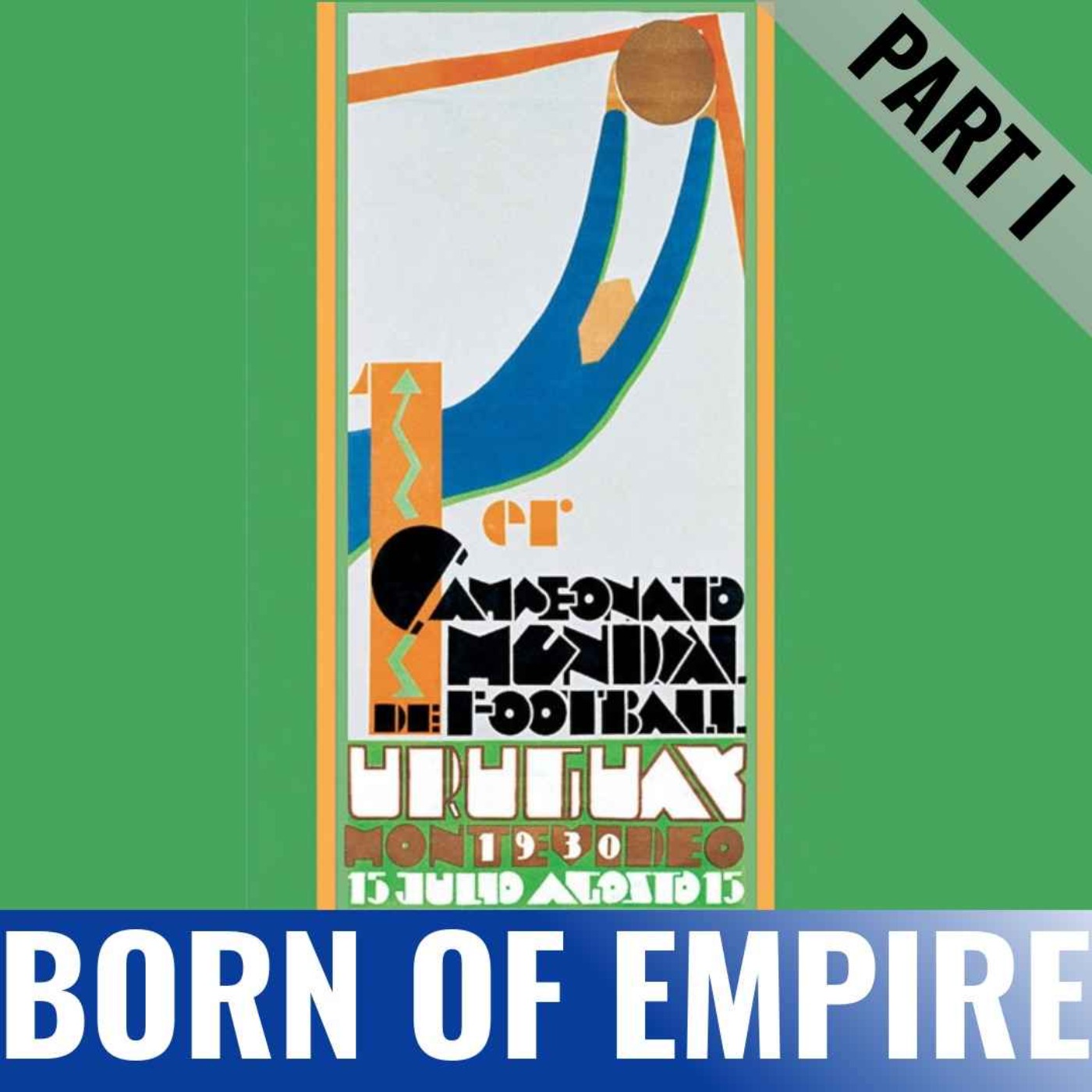
Yeah, well, that's going to be. Well, because in the United Kingdom, there's the creation of the home. They're called the home nations for their tournaments in between themselves at both things, like football, but also other sports too, most notably rugby. And it's a question of real concern, for example, in Spain, where Barcelona has been one of the two dominant clubs in Spanish football for the best part of the last 60 or 70 years, the Catalans have often said, we want to have our own team, and how come one region of the United Kingdom gets to have their own one, too? And basically, it's the kind of conversation that most people involved in English or British football try to forget about, not get involved in, because it's super toxic. But when Uruguay hosts the World cup in 1930, like you said, Afro, it's not held in England or in Britain. They're one of the richest countries in the world, but only four teams bother to go to it from Europe. France, Belgium, Romania and Yugoslavia. Everybody else comes from the Americas. And that's partly because it's expensive. It's partly because travel takes a long time. So empire, technology are shaping who even participates. And it's not a particularly Great tournament. The two semi finals, the Argentines beat the US 6:1 in one semi final. Uruguay beat Yugoslavia 6:1 in the other. But the final everybody wanted was Argentina against Uruguay. And the fact that this big tournament is being sort of sneered at by as not being really that important turns out to be a bad investment by countries in Europe. You know, England could have had loads of World Cups if we bothered to show up early on, perhaps, but it was too far away, a bit beneath us.
- [27:06]
B
But Argentines do travel. I mean, this final, in this first World cup, is a really big deal. It's a big showdown, and people travel by ferry from Buenos Aires to be able to watch. They cross the Rio Plata overnight carrying their Argentine banners and flags. And the biggest controversy of this Showdown final for 1930 is not even necessarily what happens on the pitch, it's when which ball should be used. Because the level of distrust between these two sides is so extreme that they don't trust the other's ball. So they have to reach a compromise where the Argentina ball is used in the first half and the Uruguay ball is used in the second half. And I think that's an interesting metaphor for how important trust is, that you need to have these kind of standards that are globally adhered to. And that as well as a conversation that hasn't gone away, which maybe we'll come back to, because I think trust in FIFA, trust in the organization and the integrity of the people behind the game is so important. If people are going to place their loyalty, their pride, their hope, their dreams on this game, which has always been what football is about, People kind of projecting their dreams and their pride and their sense of identity.
- [28:17]
C
That's exactly right. And those dreams and identity, it takes everybody's surprise that that many people show up, you know, in Europe. It's unbelievable that that many people would come to the final. But then When Uruguay win 42 in the final, the border gets temporarily closed. Montevideo explodes with joy. You get all the churches ringing their bells, ships in the harbour sound their sirens, people pouring on the streets. The government declares a national holiday. And you remember it's a tiny population, Uruguay, just 2 million people. But it's proof that a small country can stand alongside the great powers. And AFWA is the opposite in Buenos Aires.
- [28:50]
B
Buenos Aires deteriorates into anger and frustration. Angry crowds attack, attack the Uruguayan consulate. There are police deployed to restore order. There are anti Uruguayan demonstrations. And this outcome in the first World cup only intensifies the rivalry between these two nations. And I think that's very real as well, that, you know, on the one hand you have this kind of outburst of pride and joy when a winning team overcome the odds. But you can also get, especially in nations that see themselves as, as powerful and have more to lose, you can see these quite ugly outbreaks of anger and resentment. And that's something that, as we know, still happens today. But this really above all, I think speaks to how football, even at this very early stage, is really becoming integrated into people's sense of their national identity, their national pride. And when we come back after the break, we're going to look at how that plays out on the global stage of international politics, empire and race.
- [29:50]
D
Disordered eating messaging is all around us. You can hardly leave your house or check your phone without seeing something about dieting, weight loss or exercise. With all that pressure, it can be hard to recognize habits have become harmful or even an eating disorder. If you're concerned you or a loved one might have an eating disorder, I want to introduce you to Equip. Equip is a fully virtual evidence based eating disorder treatment program that helps patients achieve lasting recovery at home. Every Equip patient is matched with a multidisciplinary care team that includes a therapist, dietitian, medical provider and mentors. And you get a personalized treatment plan that's tailored to your unique goals and challenges. Equip treats patients of all ages and all eating disorder diagnoses. It's covered by insurance and there's no wait list. If you think that you or a loved one could be struggling with an eating disorder, don't wait to get help. Visit Equip Health to learn more. That's Equip Health.
- [30:56]
C
By the time the second World cup comes around in 1934, the atmosphere is very different from the optimism that surrounds the Tournament in Montevideo four years earlier for one thing, Jules Rimet has hoped that football might help foster international understanding after the horrors of the First World War. But instead, this is an era of the rise of dictatorships, of people like Hitler, Mussolini, Stalin, realizing that football and cultural production offers more than just games. It's something that can be powerful. It's a stage on which nations and empires and ideologies could perform in front of millions of people. And the tournament is awarded to Italy in 1932, at a time when Mussolini's been in power for a decade already. And he understood something that many statesmen hadn't really appreciated properly, which is that football provides all the same ingredients that rulers have always looked for. I mean, Mussolini's model, of course, being imperial Rome, but heroes and rituals and flags and mass participation and victory. And also significantly amplified by modern technology.
- [31:58]
B
AFWA radio ownership is spreading rapidly in this era, and newspapers are also really expanding their audience, so millions are able to access the spectacles that are taking place in the stadia. And nationalism is riding off both the football and the media technology that is broadcasting the football. And it means, in the case of Mussolini's Italy, that sports can occupy a central place within the fascist ideology. And unfortunately, they go together pretty well, because you have these fascist leaders like Mussolini, who have these kind of fetishes about physical discipline, strength, this kind of idealized masculine vitality and physicality. It's kind of like the manosphere. 1930, first generation. I think we're in manosphere. I don't know. Would this be called football maxing these days?
- [32:55]
C
Is it football maxing?
- [32:57]
B
I'm so on the new lingo that works for me. And it's these physical stadia, which of course fascists love, these like big narcissistic building projects that are extensions of their own desire for physical prowess. And then you have these footballers who are these kind of hyper masculine ideals, these embodiments of a rejuvenated nation. And then the only ingredient you need on top of that is success on the pitch to cement the inherent superiority of the nation, the race. So the World cup in this era is coinciding with Mussolini's dreams of empire and his. His penchant for fascist propaganda. Invoking ancient Rome, he speaks of the Mediterranean as Mare Nostrum, our sea. And the newspapers are celebrating Caesar and Augustus. So this is a very specific context in which football is able to fill a space already created by fascist rhetoric.
- [33:53]
C
And this is even before the invasion of Ethiopia the following year, 1935. So while Europe is becoming more increasingly nationalist. The competition is becoming more global. So this time you've got 32 countries enter, with 16 reaching the final. And for the first time, a country from Africa qualifies. So that's Egypt, which defeats the Mandate in Palestine in qualifying before losing to Hungary in Naples. But the appearance of Egypt is historic. It also shows, shows the inequalities of the age because it's the only country that represents a single and entire continent. So the four semi finalists in 1934 are part of the old world. It's Italy, Austria, Germany and Czechoslovakia. And at the time, Austria's team is known as the Wunder team, widely considered the strongest side in Europe. And this is at a time when Hitler is consolidating his grip on Germany. And the Anschluss takes place a couple of years later. But throughout this whole tournament, the political symbolism is everywhere. The fascist salutes, Afro like you mentioned, the military bands, the uniforms, the forest of flags. Makes the World cup look like it's a gathering of competing ideologies, not just sporting competition. And there's lots of, lots of talk about Mussolini's direct involvement. There used to be stories that he used to go to the dressing room and tell the Italian players they had to win or die. That's probably not true, but there's no question that the regime expected and was desperate for victory because it becomes a symbol not just of sporting success, but it proclaims that fascism produces champions, Italy produces champions. That once we led the world, now we're leading again. So football as an instrument of state power is incredibly important.
- [35:28]
B
There's just one problem with this narrative of kind of racial purity and national pride. And that's the fact that many of the players in Mussolini's Italian side are not actually Italian street speaking. They are South Americans with Italian ancestry, like Luis Monti, Raimundo Orsi, Enrique Gaeta, who are the so called Orioni, South Americans of Italian ancestry who've been recruited to represent Italy. And it's interesting that these are the South Americans who've been recruited to represent Italy. There's still this attempt to welcome South Americans who, who have this claim to Italianness and whiteness. But the reality is that even at this early stage, this is already an imperial world and leaders are selectively defining what counts as a member of their nation, depending on what their sporting needs are. And that's something that I think we can still see very much today, that somebody who, like Mo Farah for example, was always described in the press as kind of Somali until He wins the Olympics and then he's like a British hero that we have these kind of shifting boundaries depending on whether it's convenient to include someone or not.
- [36:42]
C
So I mean this world then comes to a head of the final on 10 June 1934, where Italy faces Czechoslovakia in Rome at the name of the stadium Stadio Nazionale del Partito Nazionale Fascista. The national stadium of the Fascist party. That tells you something with Mussolini watching from the stands. And it's a tense match. Czechoslovakia, one of Europe's few remaining democracies, takes the lead with 20 minutes to go. And then Italy fight back. Score then and win in extra time. But the final itself perfectly captures the spirit of the age. The Czechoslovakia has been born from the collapse of the Austro Hungarian empire. A new state created after the traumas of the First World War, matched against a rising ambitious new empire that wants to make Italy great again. There's some echoes of the present day to like we said a year later, Mussolini, emboldened not by just by the World cup but by his vision of what Italy means, invades Ethiopia through the conquest of one of the few remaining independent African states. That sends shockwaves through the black world and from Harlem to Lagos and Kingston, Haile Selassie becomes a symbol of resistance to imperial aggression. And Italy's football triumph look like they are speaking to a world of Italian dominance. That means that other people are on the menu and get destroyed. So the idea about what empire means alongside football becomes quite a complicated one because this is the time when the game is flourishing for far beyond Europe too.
- [38:09]
B
It's popularity is spreading like wildfire in India, in China, Egypt, as we've heard, which competed in that World Cup. Palestine, French North Africa, the Dutch East Indies, the these places are still on the whole colonized rather than sovereign states. Apart from China, India belongs to the British Empire. Algeria forms part of France. Indonesia in the Dutch East Indies is still part of the Dutch colonial world. And Africa is now completely divided among European powers. Ethiopia having been invaded shortly after the World cup with the exception of Liberia, which is colonized by freed enslaved people from America and as got its own colonial situation going on in that regard. So the world is not free. And that means that membership of FIFA is very limited because it depends on being internationally recognized as a sovereign nation. So football associations from people who are still colonized and colonial subjects themselves do not enjoy equality in this place of footballs biggest stage. And that I think speaks to the founding inequality of FIFA. It is a vehicle created by European colonizing powers. And states in South America dominated by European colonizers. And even within that world, it's very, very prohibitive for ordinary people to attend World cup matches because you have to take an ocean steamer on a very long, expensive journey. It's not like now where you can get on a plane. And even that, as we know, talking about this World cup in the US can also be prohibitively expensive. So imagine weeks long crossings by ship to Uruguay in 1930, for example. That's not something that the vast majority of people in Europe are in any way able to do. And then if you imagine coming from Asia or Africa to somewhere like Uruguay, it's an even greater logistical difficulty. So as a result, the early World Cups were more local and overwhelmingly white and overwhelmingly European, in spite of, ironically, the fact that football is increasingly becoming a game that is played by Asian and African people who are from much lower income brackets, who have much less privilege. But they're not reflected in FIFA or the World cup at all at this stage.
- [40:30]
C
Yeah, it's not just the spectators of travel, it's the teams themselves. It's the cost of the time away from work and so on. But you know, you've got, you've got places like India that don't even enter tournaments because they're not encouraged to do so. The British encourage them to play cricket instead. But by the time France hosts the World cup in 1938, Europe is drifting itself towards catastrophe. Only three months before the tournament begins, Hitler annexes Austria and one of the one of Europe's strongest football nations disappears overnight. And a lot of the players absorbed into the German team, Although not everybody cooperates. One of the probably the best Austrian footballer of the time, Matthias Sindelar, resists attempt to turn him into a Nazi symbol and is found dead alongside his partner in slightly mysterious circumstances a few months later. But the 1938 World cup brings together many of the great imperial powers too. This is a time where Britain rules across the globe. France controls territories across North Africa, West Africa and Indochina. Belgium rules the Congo. The Netherlands governs the East Indias, and it has just conquered Ethiopia. These are not just nations meeting in France. They are empires. And almost none of their colonial subjects appear in their teams on the pitch. But there are a couple afwords. It's not just about people from Europe too. There are. So tell me about some of the players who play for France, for example.
- [41:46]
B
Well, there are very few who are black or Arab, but there is Abdelbekah Ben Bouli, who is born in French, Algeria, and he plays in the 1934 World Cup. He's ethnically Arab and a Muslim, and probably the first player with either of those identities to play in a World Cup. And there's Raoul Dian, who was born in French Guian, also on the South American continent, but culturally part of the French Caribbean. He's the son of Blaise Diane, the Senegalese politician who became the first black African elected to the French Chamber of Deputies, and a really important figure in the decolonizing story of the French empire in Africa. Raoul de Yang is regarded as the first black player to represent France at a World Cup. And the fact that he's there and the story of his presence is such an interesting story. His father has spent his political career arguing that Africans should be not radically overthrowing France, but accepted as French citizens. So his son is now there playing, embodying that aspiration as somebody who is representing France. But you can imagine that full inclusion and acceptance and being celebrated for his identity is still very far off at this early World cup because he really stands out as the only black player. But then there is also Brazil, and Brazil has been a multiracial player on the World cup stage from its inception.
- [43:20]
C
I mean, in a way, you could see that Brazil has done more to drive ideas about inclusivity and to inspire change both in football and politics than any other single country because of what's happened in the World Cup. We're going to talk about Brazil a few times in this series, but in 1938, their great star is called Leonidas de Silva, who's nicknamed the Black Diamond. He's born in Rio in 1913, so he's 25 at the time. So as his peak condition, he's one of the first truly global football superstars and finish as the. As the top scorer winning the Golden Boot. That friend of the podcast Gary Lineker, is to win in 1986, too. And he's. But he's described Afwa in classically and highly racialized language of the way in which black people are often described about their natural gifts and their athleticism as being different to white Europeans. But this is also at a time that we said a few times that fascist Europe is embracing ideas about racial hierarchies and purities. And at that time, Brazil represents something completely different, mixed, cosmopolitan, culturally creative. It not yet the dominant force that it's going to become in the second half of the 20th century. But many people sense that something new is emerging when they watch the Brazil team play.
- [44:30]
B
We will talk more about that. But for now, at this stage, colonial subjects are, if at all involved in these early World Cups only as spectators. The tournament itself mirrors the racial hierarchy of the imperial world and the racial mistrust of countries like Brazil that have a much more mixed population. And Latin America is expressing its frustrations in another way as well. Both Argentina and Uruguay, two or the two finalists from the first World cup, boycott the competition in 1934. They believe that European nations have failed to reciprocate the long journey made to Montevideo in 1930. And they accuse Europe of arrogance and double standards. So already on only the second installation of this competition, two of the biggest players are unhappy with the way it's being organized.
- [45:27]
C
And there are tensions elsewhere, too. The sole representative in 1938 is the Dutch East Indies, which is effectively modern Indonesia. And their participation, too, reflects the realities of empire. So they don't compete as an independent nation, but as a colony. And most of the players are Dutch settlers and colonial elites. And they tournament only lost a single match. They lose 60 to Hungary. But their presence makes history because they're the first team from Asia to appear at the World cup, and they do so under imperial rule. And in the final in 1938, Italy defeats Hungary 42 to become the first country to retain the World Cup. Before the kickoff, the Italian players perform the fascist salute, and Mussolini and his regime, of course, celebrate again wildly. And that's the final World cup before the outbreak of the Second World War crowns fascist Italy and what it thinks it's going to do to create a new empire alongside the Germans. But beneath the surface afwa, another story is unfolding about new worlds.
- [46:24]
B
In the next episode, we'll look at how this story unfolds in a radically altered world. But as you can see here, what has begun as a game for entertainment in Victorian Britain has already become something exponentially larger. A global game. No longer just a game or a sporting tournament, but a theater in which ideas about race, empire, nationalism, civilization and fascism are playing out before millions and
- [46:56]
C
long before TV and social media really bite. Football has become one of the great games of the 20th century, and the World cup perhaps the greatest stage of all for sport in the 20th century. So join us next time for more on the World cup and the legacy of empire. Thanks for listening to Legacy.
- [47:13]
B
If you want to go deeper, please support the show. You can sign up to Legacy Plus. You will get so many goodies, bonus episodes, early access, fewer ads, Q&As, and even better, the warm glow of knowing you are supporting our work, go to Legacy supportingcast fm.
- [47:33]
C
And don't forget, you can watch all our episodes on Spotify and YouTube too. For everything else, including our substacks and updates on TikTok and Instagram, just check out the show notes or search Legacy Podcast I'm Pete Fragrant.
- [47:45]
B
I'm Afra Hersh and we will see you on the next episode of Legacy.
- [48:05]
E
Today we'll attempt a feat once thought impossible overcoming high interest Credit card debt. It requires me merely one thing a SoFi Personal Loan. With it, you could save big on interest charges by consolidating into one low fixed rate monthly payment. Defy high interest debt with a SOFI personal loan. Visit sofi.com stunt to learn more. Loans originated by Sofi Bank NA member FDIC terms and conditions apply. NMLS 696891.