Loading summary
Transcript60 lines
- [00:00]
A
So when the World cup is played again in 1950, the world that created it was gone. Hitler and Mussolini were dead. Europe was in ruins. And across Asia and Africa, independence movements are demanding to be heard.
- [00:12]
B
But football had not caught up. The same countries that had just lost their empires were still running the game as if nothing had changed. And they weren't exactly in a hurry to change it.
- [00:25]
A
This was the age of decolonisation. Ghana, Algeria, Cameroon, Nigeria. Dozens of new flags appearing at the United nations and eventually at the World cup too.
- [00:36]
B
But it was also the age of the Cold War. The Soviet Union and the United States were competing for influence. Dictators and revolutionaries are discovering the power of football. And countries are using sporting triumphs to tell stories about who they are and. And what kind of future they represent.
- [00:57]
A
And then there's Brazil, a country that many Europeans had once viewed with curiosity and sometimes even with outright prejudice, which transforms itself into the spiritual home of the beautiful game.
- [01:08]
B
So in this episode, we're going to tell the story of how the World cup became a stage for decolonization, nationalism and the Cold War. And how the old imperial powers slowly discover that they no longer own the game that they have initially given to the world.
- [01:25]
A
Because if the first half of the 20th century is about empire exporting football, the second is about the rest of the world taking possession of it. Hello and welcome to a new episode of Legacy. I'm Peter Frankenpair.
- [01:39]
B
I'm Afra Hersch.
- [01:40]
A
And this is Legacy, the show that explores the lives, events and ideas that have shaped our world and. And asks whether they have the reputations that they truly deserve.
- [01:48]
B
This is the World cup and the post colonial world.
- [01:58]
A
Thanks for joining us on Legacy today. To support the show, please do sign up to us at Legacy.
- [02:03]
B
Plus, it really does make a difference for you to subscribe. Support the show and in return you'll get early access, fewer ads, Q&As, bonus content. Like when we talk about the legacy of the escalator, we also talk about remote controls, how they have changed, how we live, what we eat, where we buy, even what we look like. And we get special guests to come and help explain the world to us.
- [02:28]
A
So sign up please at Legacy supportingcast fm and get to know and love me and Alfred even more than you already do. So the Second World War interrupts the World cup for 12 years, no tournaments held in 1942 or 1946. By. By the time that football returns with the World cup of 1950, the world that had produced the interwar competitions had vanished. Hitler, Mussolini gone, Europe exhausted. And the great imperial powers emerging from the war weakened financially and morally. And across Asia and Africa, AFWA independence movements are gathering momentum. The age of empire is giving way to the age of decolonisation.
- [03:05]
B
And yet the World cup is the last to get the memo. It's still still looks as if it reflects an order that no longer even exists. Europe and South America continue to dominate FIFA. Most of Africa is still formally under colonial rule. India has just gained independence in 1947, Indonesia in 1949. But Africa and much of Asia is still governed from London, Paris, Brussels or Lisbon. And political independence is being fought for and won. But footballing recognition is not exactly arriving simultaneously.
- [03:44]
A
And then there are ideas about race and sport Afro that are changing too. So the defeat of Nazi Germany, of course, discredit supposedly scientific racism and theories of racial hierarchy. But it's not like these things disappear overnight.
- [03:58]
B
The legacy of so called pseudo scientific racism, this tendency to class people according to a hierarchy of racial superiority, is slow to disappear from the culture in Europe. And you see that reflected in the commentary about football. European observers continue to describe people from Africa, Asia and Latin America in patronizing and racially disparaging language. Black athletes, for example, even when being praised, are done so in a way that that racializes them and reduces them to these types, singling out their natural abilities and physical prowess, for example, in language that echoes much of the narrative of transatlantic slavery. And Europeans are claiming a monopoly on organization, discipline and intelligence. So the language has changed and become more coded, but the underlying racial assumptions have not.
- [04:52]
A
And the World cup reflects a new world order. So Germany and Japan are excluded from the World cup of 1950. Russia reflecting the moral geography of the immediate post World War. But there are other absences too. So not a single African team takes part, Not a single Asian team takes part. Egypt had represented Africa in 1934, hadn't qualified. India, on the other hand, had qualified after the withdrawal of Burma, Indonesia and the Philippines, but then withdraws partly because of financial reasons, but also because of a famous story that FIFA bans Indian players from playing barefoot, which is more myth than reality. But India's absence matters because football's becoming increasingly entangled with ideas about sovereignty and national prestige. And in the emerging post colonial world, all recognition matters. But sporting recognition matters too. Because marching behind your own flag, hearing your own anthem, is in itself an assertion of equality. And being excluded from doing that means that you're not able to have the same rights and the same visibility as others.
- [05:55]
B
This is an era where newly independent countries are proudly writing their national anthems and designing their new flags. So the demand to be able to rally around these symbols couldn't be greater. But they're not able to find expression in football. There are other avenues though. For example, in 1948 London hosts the so called Austerity Olympics, which also becomes the stage on which newly independent India competes for the first time. And four years after that, the Helsinki Olympics sees growing participation from Asia and the Middle east, if not Africa. And sport is globally and outside of football, fast becoming the language through which newly independent nations are able to announce themselves to a popular audience.
- [06:44]
A
So when we come back, we're going to have a look at the emerging new world order and what that means for football in general, but for the World cup in particular.
- [06:55]
B
Right.
- [06:55]
A
Afra, I know you've done lots on the bandung conference of 1955 and what it means for decolonisation movements, what's going on in this post Second World War era as countries are becoming independent and forcing their path towards independence.
- [07:09]
B
It's a combination of this surge of new independence movements, newly decolonized countries, but also the context of the the Cold War. And it sees 29 Asian and African countries gathering to define their own identity, but also strategy as a group that don't want to be co opted into these almost new imperial forms of east and west spheres of influence. So you have Nehru from India, Sukarno from Indonesia, Xu En Lai from China, Ganal Abdel Nasser from Egypt all attending. And this is a conference that is far from peripheral. It represents nearly half the world's population. And I think that's so important because sometimes we see Bandung as this kind of left field subversive movement. This is half of the world's representatives gathering to try and create this new non aligned movement and symbolizing a much more profound vision that Asian and African peoples should no longer have their destiny determined by former imperial masters and that they should, as people, as citizens, members of these societies, no longer be spectators in a world in which others are organizing and rigging the system. And sport is such an important cultural element to those demands because it offers a symbolism for this independence, for this control over their own destiny.
- [08:36]
A
And that's partly because FIFA itself remains overwhelmingly European and Western centric in outlook. But as new states emerge, they demand representation at FIFA. So the growth of membership eventually is what starts to transform the organization. So in 1946, FIFA has just over 50 members. By the early 1960s that number has risen to more than 120 as decolonization accelerates. And so in the meantime, the struggle against colonialism increasingly intersects with football. And the World cup is of course, only one part of that story. But long before many newly independent countries appeared on football's biggest stage, they're already using the game internationally because football becomes a surprisingly important part of diplomacy and of state building and of anti colonial solidarity. And the most striking example for this, as far as I'm concerned, is Algeria. So in 1958, as the war against French rule intensifies, the National Liberation Front, or the flm, establishes its own national team. And although it's not recognized by FIFA and it's officially non existent, the side becomes a traveling ambassador for the independence movement. So several leading professionals, like Rashid Mehrufi of Saint Etienne and Mustafa Zitouni of Monaco secretly abandon their clubs and make their way to tunisia. And between 1958 and independence in 1962, the flm team play nearly 90 matches. And these aren't kigabouts, they're tours of Morocco, of Tunisia, of Iraq, Libya, Yugoslavia, Bulgaria, Vietnam and China. They play against national teams, against military sides and representative selections. So this FLN team is not representing a country that even exists in an independent capacity, but it's part of the way of trying to win friends around the world. And that's received at the top level. Mao Zedong receives them in Beijing, while Ho Chi Minh welcomes them in Hanoi. And their victories, the losses, the games they're playing, just their very existence helps persuade governments across Asia and Africa that Algeria deserves international recognition. And so football becomes part of the anti colonial diplomacy.
- [10:44]
B
It's both the symptom and cause of the movement at this time. These newly independent nations are not being treated as equals on the world stage. So they're creating their own stage. They are creating these rogue tournaments. This is a kind of subversive World cup in which the FLN team, ignored by FIFA, just creates its own tournament and is touring and being recognized and being welcomed and being celebrated. And I think that captures the spirit of many of these nations that they are no longer asking nicely to, to be treated with dignity. They are finding their own partners. And that is incredibly threatening to the old world order, where Europe and its allies was able to determine who had a platform and who didn't. And this is the context into which Egypt steps with Gamal Abdel Nasser, who is a nationalist, a Pan Africanist, an Arab nationalist, and a key figure in the struggle against imperialism in this age. And he also is leading his country as they compete in Their own tournaments. They're playing Turkey, Yugoslavia, other European nations. And Cairo is hosting clubs and representative teams from across the Arab world. And this leads in 1957, the year Ghana also becomes independent, to the Africa cup of Nations. Initially, the founding members are Egypt, Sudan and Ethiopia. And the inaugural tournament in 1959 brings these newly independent African countries together, but also allows Nasser to present himself as a key figure who straddles both Arab nationalism and liberation, and African Pan Africanism and liberation as well.
- [12:24]
A
And then Afra, we get to former friend of the podcast, Kwame Nkrumah, who we did a four part series on, and the role that Ghana played. When we talked about what we were going to cover in this series, I thought the black stars and the role that football has played in Ghana. It's not just here for you, Alfred, but it's a big thing to talk about. Tell us a bit about Nkrumah and his role in football and how that ties with Ghanaian independence and identity.
- [12:47]
B
Nkrumah was a genius at nation building. He understood the importance of identity, of symbolism, and the challenge of unifying a country that did not have a national identity. It was a colony. It was actually a series of different colonies that United States under this independence banner and comprised of dozens of different ethnic groups and languages. So Nkrumah understood that if this nation was to be able to compete on the world stage, it had to create a new identity. He chose Ghana, a name which actually has nothing to do with modern day Ghana is an ancient African kingdom thousands of kilometers away in the Sahara. Because he understood the importance of having a history and a narrative that stretches back, back and conveys this sense, you know, rather than the European narrative of Africans having been savages and slaves, he is centering the historical truth of African empires and civilization in that name. And he created a symbol for Ghana, the black star. The lodestar represents for a ship, a guiding star that leads others towards a safe passage. Ghana was playing that role on the African continent where the vast majority of people are still under the colonial yoke. Ghana operating as this pathway to liberation, this light and the blackness of that star, the black star, because it was symbolizing pride in the black race. After centuries of black people having been told by Europe that they were closer to animals, that the best thing that could happen is that they assimilate into whiteness. And Krumer is leading Ghana towards pro black, proudly black civilizational nationalism. So that's his vision. And football is part and parcel of what he is creating. So he's using football, the Name of the team, the Black Stars, as a way of rallying other Africans who are still struggling for their independence together. For example, in 1960, when Patrice Lumumba attends Ghana's independence celebrations, Patrice Lumumba, the leader of what would become the Democratic Republic of Congo, who was assassinated very early on in that journey. Football's part of the wider language of solidarity among newly independent states. And it's so interesting how I think you can see the legacy of that today, Peter, because there is a symbolism around the contemporary Black Stars that it really inspires pride. And there are so many, so many rivalries among African nations, you know, so many incredible African teams. So there's lots of competition on the African continent. But I think there is a way, I'm obviously quite biased as a Ghanaian, but that other Africans will rally around the Black Stars if it's the only African team left. And there's a way it still speaks
- [15:33]
A
to that Pan African vision, which doesn't happen in Europe. You know, if the Germans are playing Brazil in the final in England, there's no chance, no chance that English would be supporting the Germans. Likewise, if the English are playing anybody in the final, there's no way that our friends north of the border in Scotland are going to be cheering for England either. So those rivalries being put to one side in Africa speaks to the kind of common journeys that so many people have taken. And this is the time where football is becoming part of the diplomatic vocabulary of many other parts of the non aligned world too. So India starts to play regular international fixtures against Burma and Indonesia and Malaya. Asia, it's called at the time South Korea, participates in the Asian Games and in fact qualifies for the 1954 World Cup. You've got various Arab states and Israel competing quite uneasily in the Asian Football Confederation before politics make those kinds of encounters increasingly difficult. You have Indonesia under Sukarno, which sees sport as a weapon against colonialism, culminating in what's called the Games of the new emerging forces in Jakarta, which is a kind of alternative festival desired to arrive at the Olympics, a kind of non Western led, non Western centric. And also picking sports that are perhaps not the ones that are designated from the Olympic Committee or from FIFA. The instructions, the rules being set by others too. So this creation of continental competitions reflects a new politics of decolonization. So you have things like the Asian Games, first held in 1951 too. The idea that there's a world that doesn't have to have European dominance in it too, as you already mentioned, Alfred. The Africa cup of nations, too. So obviously all of these things are taking place alongside a new world order that is emerging. And it's all to do with the ideas of identity, of independence, of decolonization, of what a flag and what an anthem, of what players representing a country and a culture and a civilization can do. So when we come back, Afro, I want to talk to you about what this means for the World cup itself. So across the developing world, Aphra, we've talked about how governments are recognizing how sporting success, people like Nkrumah can understand that the prestige, the legitimacy, the international recognition that could come from sports in general and from football. What about the World cup itself?
- [17:44]
B
The World cup belatedly, is beginning to show signs of change. In 1954, South Korea becomes the first independent Asian nation to compete. Although it's not covered in glory, they lose 9 nil to Hungary and South Korea.
- [17:59]
A
Ouch.
- [18:00]
B
It's a little bit of a painful inaugural appearance, but it still represents something profound. It's less than a year since the end of the Korean War. The Republic of Korea is a brand new player on the world stage. So just its presence is a triumph, regardless, thankfully, of the result, which obviously isn't. And by 1958, the pace of decolonization on the African continent is starting to really accelerate. So Ghana was one of the very, very few independent nations in 1957. But then 1958, guinea follows, led by Segaturi, a close friend of Kwame Nkrumah. 1960, Nigeria follows, led by Namdi Azikiwe, another close friend of nkrumah. And then 17 other African states in what becomes known as the Year of Africa. So almost overnight, the balance of power among the community of nations has changed, and yet the World cup remains overwhelmingly dominated by Europe and South America. For example, In Sweden in 1958, of the 16 teams that participate in that World cup, one is from Asia. Guess how many are from sub Saharan Africa, as it's often called. Peter.
- [19:14]
A
Out of 16, I'm going to say 15.
- [19:17]
B
Yeah, that would make sense. None. Zero. Nil.
- [19:21]
A
You see what I did there?
- [19:21]
B
Yeah. But this is still an important World cup, despite its unbelievable exclusion of the whole African continent.
- [19:29]
A
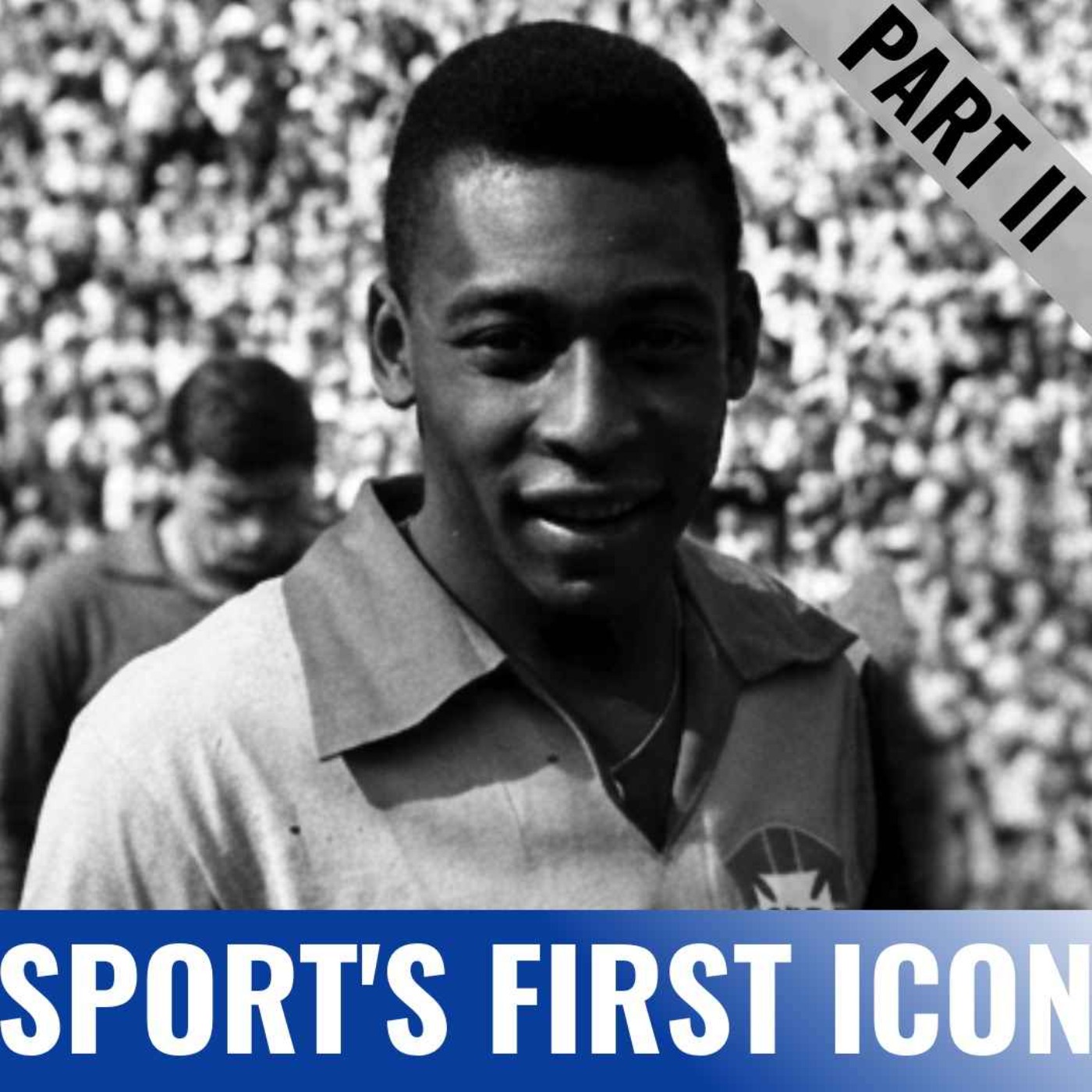
It's important because it's won by Brazil. And it's not just won by Brazil, it's how it's won. In the final, Brazil beat Sweden 5 2. But it's to do with the new kind of global celebrity that gets born at a World Cup. And it's partly. This is the age where television is becoming proliferating. Around, around the world, obviously starting in rich income countries first. But the key figure at the 1958 World cup is a 17 year old young man called Pele. He scores six goals in the tournament, including a hat trick in the semi final against France and two goals in the final against Sweden in Stockholm. And the image of Pele, this young teenager, collapsing in tears on the shoulders of his teammates, becomes one of the defining moments of 20th century sport because it carries a significance that extends far, far, far beyond football. What do you know about Pele, afwa? Is he a hero of yours? Did you grow up admiring him? Knowing his name? He must be the most famous footballer before Maradona.
- [20:26]
B
Absolute icon. I've always been aware of Pele because I didn't follow football closely, I was only aware of him. But I watched the film that was made about him a few years ago and it really helped me weave together all the strands that I picked up about why his life was so impactful and the things that I felt intuitively. And that was that he brought actually a blackness to the game. That, you know, Brazil as a. As a country with very complicated racial politics, obviously benefited from all of this African heritage and this culture, this rhythm, this. This kind of ancestral way of doing things that so many Africans brought to Brazil. But it was still considered taboo to celebrate that. It was still this idea that the more European you were as a Brazilian, the more sophisticated you were. And Pele just flipped that on its head because he had this, as it was called, Jinga, Jinga, this way of doing things that kind of centered those African traditions which made him brilliant. And it was radical. It was radical to do that and be unapologetic about it. And his background is really just such a tale of rags to riches. Peter.
- [21:29]
A
I mean, he was born Edson Arante de noschimento in 1940 to a poor family in Minas Gerais. And he'd shined shoes as a child and learned to play the game with makeshift balls stuffed with newspaper and rags. And the fact that a black Brazilian from such hubble backgrounds would become the brightest star not just at the world's premier sporting event, but in the world at the time, spoke to the ideas of having to rethink about talent and what one understood by that. So he was such a trailblazer at a time when the segregation in the United States, there's as civil rights being disputed. The fact that you can have such an iconic player and someone who is just there by single name, just as Pele, it speaks to the idea of an emergence of a new world. And he's a trailblazer for other figures like Muhammad Ali or Michael Jordan or Tiger Woods. He was the first truly global sporting icon, I think, not just from the developing world. He's probably the first true global sporting icon, full stop. And I think that that changes how Europeans think about Brazil as being an exotic, racially mixed society that lacks the discipline to do anything great, to really be an empire. And yet in Sweden, this young black kid had stood at the center of the world's attention and handled himself on the pitch and off the pitch incredibly successfully, under huge scrutiny. So this, as you mentioned, the time when, just when Ghana and other countries in Africa are becoming independent and looking for ways to express themselves, that bandone spirit reshaping international politics, you know, onto the stage springs a hero who can help define how capabilities and merit and brilliance can shine on their own rights.
- [23:06]
B
And I think, you know, there's another layer to it where these countries are gaining formal independence now in this era, but they still are so far and even today, are still far from economic parity with the rich nations of the world. And so even till today, you don't see people who grew up in poor homes in favelas in Brazil playing tennis or horse riding or golf, sports which require access to resources. Football is a leveler because you can be a kid who has a makeshift ball made out of newspaper and wire. You don't need shoes. You can play in the dirt barefoot. And I think that's part of the iconography of football that it really is. And not to be dismissive of the incredible barriers that someone from that background still faces, but there's a way that talent can shine through, can overcome all of the structural barriers in its way, because you just need a patch of land and a ball. And Pele is such a symbol of that. He's such a symbol that's different from Tiger woods, who, you know, had access to golf and also has a very complex relationship with his blackness. Pele was representing something that other people who are black, who are poor, who had no privilege, can relate to. And he offers a hope that if you are talented, you can shine, you can come through on merit when everything is rigged against you. And I think that's still a really important part of the identity of football. It is a level playing field. And that's why you see so many kids from poor backgrounds, so many black kids, so many kids who are marginalized in other ways are able to come through in football. And so this is the era where we're starting to see that play out. And it makes it all the more unforgivable, Peter, that FIFA and the kind of structures of global football are still not reflecting that reality.
- [24:58]
A
So, as you said, Afrin, I've done lots of work on social mobility and how important sport is in being able to benchmark ability and to judge on merit, because you can't fake that stuff. It's empirical, it's data based. But as you see this political independence arriving, it's coming quicker than sporting inequalities. And as lots of new states entering the un, many begin to ask why football still reflects the geography of empire. Why Does Europe get 10 places at the World cup while Africa, Asia and Oceania effectively compete for one? By the early 1960s, those questions are becoming really difficult to ignore, because the World cup is becoming a battleground for a wider struggle about a world that's supposed to be equal. So you've got all these new sovereign states joining the UN and joining FIFA. But while the political map is being transformed, the World cup doesn't reflect that changing world. So at the 1966 tournament, for example, Europe gets 10 places, South America four, North and Central America won, and Africa, Asia and Oceania are forced to compete for a single spot. And to many, the developing world, this doesn't look like meritocracy. It looks like the survival of colonial hierarchies. And there's a very dramatic reaction effort. Tell us what happens in 1964.
- [26:12]
B
Well, there's outrage because this is supposed to be a level playing field, and you are shoehorning huge part of the world. Incredibly diverse nations. Asia, Oceania and Africa forced to compete for one spot. It's clearly trying to eliminate the threat of all these talented teams from all these underdog countries. And people notice, in Africa, the reaction is unequivocal. 31 African nations withdraw from qualification in outrage. They're not willing to compete against each other. For one spot. To play in a tournament in which many of them on merit would be able to qualify is actually still one of the largest sporting boycotts in history. And you have the Kwame Nkrumahs at this time who are openly and very powerfully denouncing the discrimination embedded in this arrangement and using it as a metaphor for the fact that political independence and sovereignty is not meaningful if it's not accompanied by international institutions becoming equitable, which they are not. And so you might say this is football. It's a game, it's competition, but it is symbolic of the larger structures of the world where these nations are Formerly members of the un, but they're not on the Security Council, they are not in the room and at the table for the decisions that are having the biggest impact on the world stage. And so they withdraw. And this is part of the story of how football is shamed by its colonial attitudes in this era, because race
- [27:42]
A
and representation can't be detached from sport and politics. And so, as all of this is happening, there's not a single African team. The World cup that takes place In England in 1966, that same year sees Rhodesia's unilateral declaration of independence, mounting international pressure against apartheid in South Africa, and the sports authorities are either fudging or just putting their heads in the sand. So you have this kind of terrible dilemma about what people's expectations are of a World cup versus what the realities are, being inclusive. So everyone thinks it's all about everybody gets to play on the same playing field. But if you control who gets to enter and what matches they play, then there could be challenges. And yet, despite all of that, the 1966 World cup, and we're going to get to the very famous final, it creates one of the world's greatest shocks in international football. I mean, probably the number one is the defeat of England, United States in 1950. The second is probably the defeat of Italy by North Korea in 1966 at Ayrson park, which is classed as one of the great upsets in World cup history. And the image of Italians defeated, leaving, while the English fans are supporting North Korea, which again had been fought over by Brits only a decade earlier, it's a sign that the world is changing. And in fact, in the subsequent quarterfinal, North Korea play against Portugal. And that also has a mythical status as a game, because within 25 minutes, the North Koreans, members of a communist state led by a dictator who seized power after the end of the Second World War, races into a three nil lead. And for a moment, one of the poorest and most isolated countries in the world looks like it's going to eliminate one of Europe's traditional football powerhouses. And Portugal recover to win 5, 3. But largely thanks to four goals scored by Eusebiu, who's widely considered the best player in the world at the time. But even this story, Afua carries the imprint of empire. Tell us about Eusebiu.
- [29:34]
B
Yeah, so on one level, you have this kind of old World colonial Europe defeating this kind of upstart North Korea underdog. But then you look at the football team and Eusebio is a product of empire he's black, he's African, he's Mozambican. He is winning for Portugal. He is the talent that is allowing Portugal to triumph. So that in itself is a symbol of how much the colonial motherland has been shaped by its former colonies. And it subverts all these ideas about racial hierarchy, because now the former colonizer is dependent on racism, the people from the colonies, for its future. So this is all happening as well in the context of Portugal as a military dictatorship under Antonio Salazar. So Salazar is able to weaponize Eusebio's role as evidence that Portuguese colonialism is actually quite benevolent because it's so inclusive and harmonious. And this is a message that Salazar is promoting even as Portugal is fighting anti colonial movements in Angola, in Guinea Bissau and Mozambique. So Eusebio, a footballer, is striding into one of the most charged political moments in Portuguese history. And he is both the representative of justice, but also being used by those who want to defeat justice in such a complex moment.
- [31:04]
A
And listen, we know that why you're choosing to listen to us talk about football, the World cup, or legacy is because we dig under the surface. If you want to hear other people talk about how Jeff Hurst scores all of his goals in the World cup final, there are some other apparently excellent podcasts out there. But we were thinking about the World Cup Final itself, one of the most important moments in English sporting history. We could tell you about how 96,924 spectators at Wembley watch England defeat West Germany after extra time to win their first and so far only World Cup. Unless you're listening to this in 2027. And England managed to win the 26 World Cup. But it's to think about what that symbolic, the symbolism of that final meant, because it brought together two countries, England and West Germany. Okay, well, the Germans, who had done more than any others to shape and destroy the old imperial order. Britain, of course, had presided over the largest empire in history. And and Germany, although only unified in 1871 in the modern era anyway, arrived late imperial competition, but had sought to remake Europe through force twice. And together they dragged the world into two catastrophic wars that have brought down empires from Vienna and Berlin to London and Paris. And this match is played only 21 years after the end of the Second World War. And memories are really raw. Lots of English players had grown up amid bombing and amid rationing. Alf Ramsey, who was the England manager, had served in the army. Helmut Haller, who scored Germany's opening goal, was born in 1939 and lived through the whole of the Second World War, while Franz Beckenbauer belonged to the first generation to come of age after Hitler. So the final wasn't just about a football match between rivals, but it was an encounter between two societies attempting to redefine themselves after the collapse of empire and the trauma of war and the attempt to find a new place for themselves in the world. So the football itself is extraordinary and spectacular and heroic and an amazing match. But these undercurrents, I don't think the things you've come to us to listen to.
- [33:00]
B
It's beautiful. I don't know where to go from there. Peter. I'm so moved. Decolonization is still accelerating. In 1956, the Suez crisis has exposed Britain's newfound weakness. It's no longer able to act unilaterally with consequences, and it's no longer able to act independently of the United States without facing severe repercussions. Between 1947 and 1968, the British Empire loses. India, Pakistan, Ghana, Nigeria, Kenya. Dozens of other countries around the world are becoming independent. So this 1966 English sporting victory, which is still so much part of a culture as anyone who's ever spent any time in England, especially during a World cup tournament, knows, it's coinciding with the twilight of British power. And I think that's part of the reason that it is so iconic, because I think many people in England are nostalgic for that moment. Not just because it's the last time England won a World cup, but because it's the last time England was objectively a great power on the world stage. And it has been in decline both in terms of its physical possessions as well as its influence and economic might ever since then.
- [34:18]
A
And you've got the German parallel too afraid. We talked last episode about Germany being split into two and the West Germany representing the free world and East Germany representing the behind the war, part of the Warsaw Pact and the rise of communism. But West Germany's journey also carries its own symbolism that only two decades after the defeat of Nazi Germany, the Federal Republic, West Germany has undergone it's Wirschalt Wunder or its economic miracle where it's had to rebuild a country bombed to smithereens from scratch and to look for pluralism to try to get over the sins of the Holocaust and the genocide that have been committed and the disruption of the 20th century. And football has given the West Germans a way to restore national pride without reviving militarism. And so both these two countries have been through empires, have been through Conquest and have had to reinvent themselves as being prosperous, as democratic, but also able to foster sporting excellence. And I think it's really important to emphasize that, like you said, Alfred, the nostalgia for England winning the World cup, looking back on it 60 years later, is it feels like it was a happier, more inclusive time. Now, that romantic view is not absolutely spot on accurate in terms of equalities that were around at the time, but it allowed a country to be able to wave flags, kick footballs and to feel that they were able to bring something positive to the world. So the world has changed a lot since 1966. I mean, it was the greatest single sporting moment I think that England has had in history. And the fact it hasn't been repeated tells its own story. So I know you're going to be cheering for Ghana for when they play England the World Cup. They could both get out of the group, as Gary Lineker promised they would do. But would be great to see in England gala final if they meet again. But you'd still find, I mean, wouldn't it be great? Forget about the Ghanaian side. I know what it would mean for everybody in Ghana and Accra. You'd see fireworks, celebration like you've never seen before. What would it mean in England if England won the World cup in 2026?
- [36:14]
B
I was thinking about that. I do wonder. I mean, we're recording this at a moment where there really is, I think it's fair to say, a new level of polarization and divisiveness. You know, we've seen all these right marches from the far right, anti immigrant, anti Muslim, anti racial diversity, anti multiculturalism. We've seen counter protests who are demanding we keep the gains of the 20th and 21st century. And I was thinking, if England won the World cup, would that create a moment in which people could unify again under the England flag? Would it allow the England flag to become, become inclusive again? Or would it intensify those problems, that divisiveness that those attempts to police who gets to be included in English and who's excluded. And I mean, I'm an optimist, so I like to think it could inject some optimism into the identity that allows it to once again be expansive. But speaking for myself, I don't know right now just put Ghana to one side. Whether I would feel safe, for example, in like a national parade celebrating England's victory, because there are so many people who seem to feel emboldened to use Englishness as a weapon against people like me right now. So I don't know, I think it. It's an interesting question, but I also do Wonder, thinking about 1966, there is such a mourning and grieving for this sense of decline. And I wonder if something that made people feel optimistic again and able to see a positive future would flip it and make it harder for the populace, who are hijacking people's grievances to dominate the conversation. So I don't know, but I do
- [37:58]
A
think, look at how diverse the team is at the moment, look how well they carry themselves. It would be a complete joy. And sometimes you do need to have these signposts that allow people to. Something to be proud of and to rally around. So I know that it can be negative. I mean, in fact, as we saw in the Euros, when things go wrong is when it's with a loss and then suddenly everybody gets blamed and fingers get pointed, unfortunately, in racial stereotypes that deserve to be consigned to the deep, dark dustbins of history. But success can breed optimism and hope. So let's hope that England can get that. I do think that they are important to have these things, that you can put differences to one side and sometimes they need to be engineered. But that was kind of what the World cup was trying to do.
- [38:42]
B
The problem is, and maybe this is the problem with football as a strategy for social cohesion, it feels conditional. You know, if black England is celebrated because black England players lead England to victory, and obviously that's great and that's positive, but in the back of my mind, I know that if they missed a penalty that cost England the World cup, it would lead to this backlash where black people be racialized and singled out and demonized. And so much as I would celebrate that victory alongside everyone else, it's hard to feel genuinely celebrated when you know your inclusion is conditional.
- [39:23]
A
Okay, I'm now going to do the bit that you get to read, you know, you hear on a radio advert when you. When you get that which says, you know, when someone speaks incredibly quickly and you can't quite hear what they say, but they're basically saying you can't rely on anything you're told. History is a bad predictor of those kinds of things. That is definitely what has happened. But that cycle can get broken, and it does get broken. So let's hope that we find a way that you're absolutely right what you say. Let's hope we live in better times than we did a few years ago. And let's hope that people be more generous, more understanding, more compassionate, because that is why we listen to podcasts. That's why we make these podcasts. It's about learning, it's about sharing, it's about being compassionate. If we don't find it so hard, then maybe we should rather than looking for the, for the sins and the problems which are definitely there, there. Maybe we, if we can remind people that looking on, on the bright side maybe has its own value.
- [40:11]
B
So I add this.
- [40:13]
A
I'm going to leave it. Happy thoughts. Yeah.
- [40:15]
B
England's performance in football on the world stage is about nothing. If it's not about hope, if it's not about blind hope.
- [40:25]
A
Okay.
- [40:26]
B
And indefatigable optimism. So, so, so let's leave it with that.
- [40:31]
A
Good. I've talked. I think I've talked you back up the hill. Thank God.
- [40:34]
B
Okay.
- [40:34]
A
So look, thanks for listening and join us next time for more on the World Cup. And next time we're going to be doing the World cup and the New World Order. Thank you for listening to Legacy.
- [40:43]
B
If you love Legacy, please show your affection and support by signing up to Legacy. Plus, you'll get so many goodies, bonus episodes, early access, fewer ads, Q&As, and much more. All you have to do is go to Legacy supportingcast fm.
- [41:03]
A
And don't forget, you can watch all of our episodes on Spotify and YouTube too. For everything else, including our substacks, an update on TikTok and Instagram, just check out the show notes or search Legacy Podcast. I'm Peter Frankenpen.
- [41:14]
B
I'm Afua Haysh and we'll see you on the next episode of Lexi.