← Let People Prosper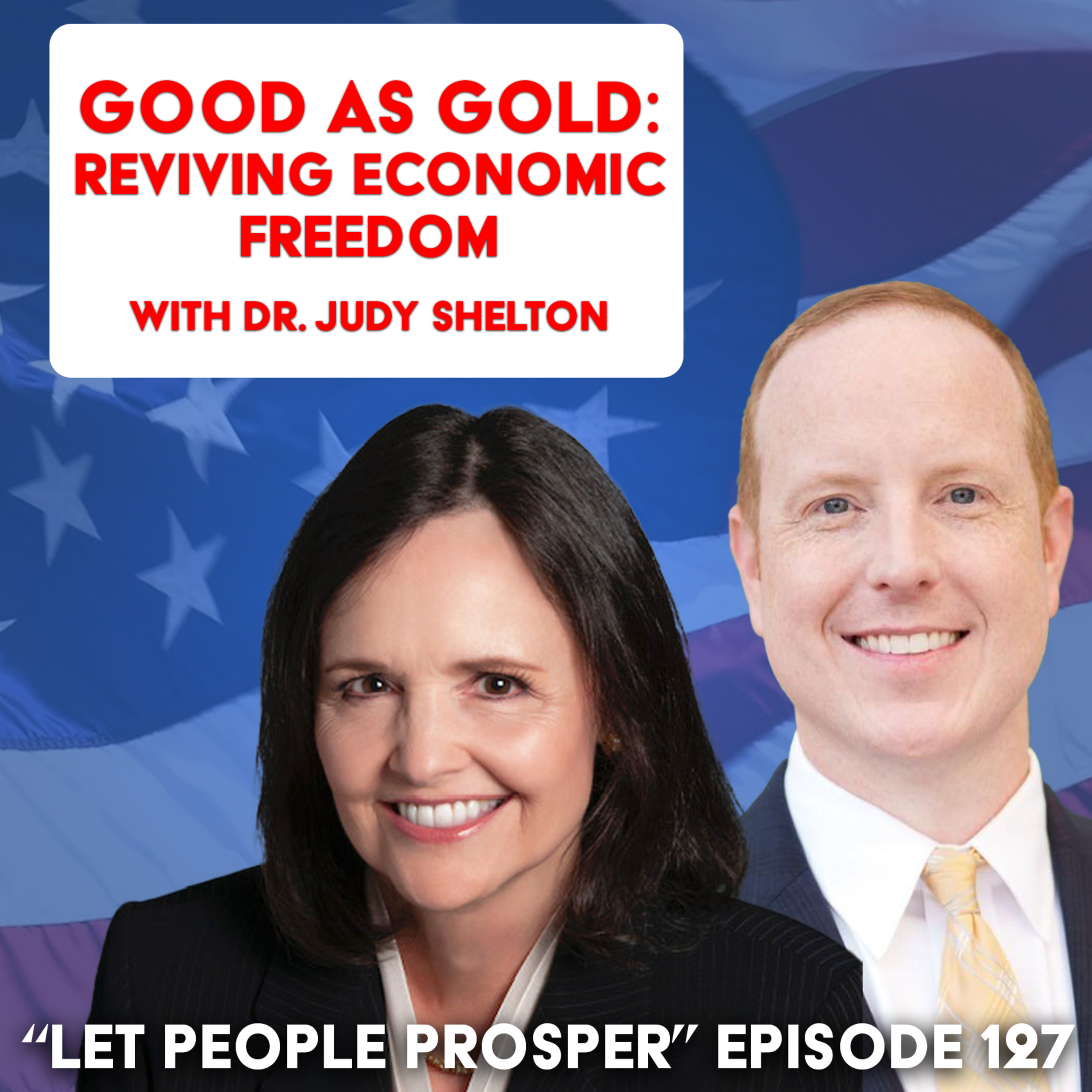
Let People Prosper
Good as Gold: Reviving Economic Freedom with Dr. Judy Shelton | Let People Prosper Show Ep. 127🎙️
00:56:17
Loading summary
Transcript132 lines
- [00:01]
A
What you really want is a dollar to be a dollar and be as good as gold. That if gold is worth $2700 today, how nice if 50 years from now $2700 buys an ounce of gold. That is what I call price stability.
- [00:22]
B
Hello. Welcome again to another episode in the Let People Prosper Show. My name is Dr. Vance Ginn. I hope you're having a prosperous day. Well, today I'm delighted to bring on who's been on before. She knows a lot about the economy and gold and currencies and the Fed, and it's none other than Judy Shelton. Judy, welcome to the Let People Prosper Show.
- [00:44]
A
I'm delighted to be with you. Vince, thanks for asking me back.
- [00:47]
B
Yeah, no, it's a, it's really a pleasure. And you have a great book called Good as Gold that we're going to talk about today. And I'll make sure to put that in the show notes page and everything. But everyone, all the audience should go out and get a copy, that's for sure. It's a great book. And, you know, Judy is on TV all the time and doing a number of other things. And so I was like, hey, come back on. Let's talk about some of this in the new book. But let me go ahead and ask you the first question. I do all the guests and you've already been on before, so why are you doing what you're doing today?
- [01:20]
A
Well, I thought you were going to ask my main motivation.
- [01:24]
B
Well, there you go. That works, too.
- [01:26]
A
My husband, he's my number one fan and he was a banker and long retired. But I think that financial intermediation is a noble calling. I really like to connect capital with entrepreneurs. And I think the capitalist system is the most consistent with a moral approach to economics and allows people to be free and express themselves and productive and pursue their dreams. So I'm very big on capitalism for both economic and moral reasons. That motivates me, too.
- [02:11]
B
Yeah, it's a great one in so many ways, Judy. I mean, it seems like capitalism is under attack and it has been for a number of years. I mean, particularly here with the Biden administration, but then also in Europe, China, of course, Venezuela, I mean, you kind of name it, but there are some, you know, some bright shining lights. I think Argentina, what Javier Milei is doing down there is heading in the right direction. Hopefully what Trump's going to be doing in this new administration will be heading in the right direction. But where do you kind of see things? You know, if you're looking at globally, what's happening with capitalism? Where do you see things?
- [02:48]
A
Well, just as you said, it's been under attack for a few years, but I just think everything has completely changed. I'm so optimistic, and I feel like it's wonderful that the Trump administration is turning that around completely. My husband and I do spend a lot of time in Europe, particularly France. France is just a sad case. There's a great society, wonderful culture, and their fiscal situation is so disastrous. And so you see that irresponsibility on the part of government and doing the most basic things, balancing the budget, sound money. I mean, I just feel that those are. That's like a moral contract with citizens. You have to do the basics. And you can see that the difference in Europe, the pessimism, they just have gotten sclerotic. They can't escape this burden of government. And what we're doing here, I think, is inspiring the world. And we, in turn, as you said, see that in Argentina with Javier Milei. It's beautiful.
- [04:05]
B
It is.
- [04:06]
A
It's magnificent. Turning around almost a hopeless situation and saying, no, we're not going to run budget deficits and we are going to have sound money, and we're not letting monetary and fiscal policy destroy the productive potential of our nation and our people. And I just feel that maybe, maybe with Trump at the helm and a great team he's bringing in, that there will be maybe an alliance across the Americas, make the Americas great again. Why? Why can't we spread the good news? And some of it, they'll just see what's happening. I can't imagine that Mexico and Canada won't just see how much better it is in the United States and say, we want to be more like that. We can be the example. But it's great to have under our wing a great country like Argentina setting such a spectacular example that you can do a turnaround.
- [05:06]
B
Yeah. Amen. In a very short period of time. I mean, I thought. I mean, I loved what he was doing down there, and cutting regulations, cutting departments, balance the budget in just a few months. That's right. That's right. And it's just amazing what you could do in a short period of time where I don't think anybody thought that it was going to happen so fast. And now they're already getting the returns on quote, unquote, their investment, if you will, of turning things around. I mean, it's just extraordinary. And as you mentioned there, I mean, you know, the last few years of the Biden administration, we just saw this election. I mean, Just a historic election. The way that things turned around and the number of people voting for Trump and everything else. And in Texas, where I live, South Texas, along the border, is all turned red now after being blue for decades, if not forever.
- [05:56]
A
Against all odds, democracy succeeds.
- [05:59]
B
Amen. Yeah. And, and now we see this great opportunity with so many people coming in and the Doge, the Department of Government Efficiency, External, non governmental, and Elon Musk and Vivek Ramaswamy with their kind of megaphones on X and other things. I mean, we have an extraordinary opportunity to do that here, don't you think?
- [06:19]
A
Oh, like nothing I've ever seen. And I love the Reagan administration. I mean, that was, that was exciting as well, but. But then, you know, we haven't had those days since then. And this new energy and this new resolve and just a straightforward approach to tackling problems from very successful people. Yeah, that's so encouraging. Yeah, because they're the kind of people. I mean, the culture of the private sector is so different from the bureaucracy and the layers of regulatory oversight of government that is just like night and day. And I think there's nothing more cruel than bureaucracy because it takes away the humanity of individuals. Whereas people like Vivek Ramaswamy and Elon Musk, they know what it takes to accommodate the needs of consumers. It's a very, again, going to the morality. You're forced to think of your fellow man and their needs and how you can serve them. And maybe there's a profit motive in there, but nevertheless, you're helping people. I mean, I think seeing Jeff Bezos come around, I mean, Amazon really is consumer friendly. And so just this idea of making these, these government agencies more responsive to citizens and engage with them and serve them.
- [07:53]
B
Yeah, yeah, exactly. Right. And when you think about all the regulations we have, the Chevron deference, that was overturned, I think that was huge and huge. Yeah. And then you think about, I mean, from what I understand what I last heard was I think 6% of federal workers are going into the office these days. I mean, so let's say they came in and said, we're going to require all of you go in the office. I don't know if it's every day, but most of the time, I mean, maybe we get a large number of people just quit and say, you know what? I'm going to go to the productive private sector. That would be a huge boost, I think, to productivity.
- [08:27]
A
And now you're kind of saying it's your choice. Yes, but this is what the job requires. And I think that would be very important. Or it may be that you say you can continue working for that agency, but the agency is moving to Arkansas.
- [08:42]
B
Yes.
- [08:43]
A
Or Nebraska. It's not going to be in Washington. And just bring some efficiency to the way the agencies operate. Go back to basics. What is your function? What service are you providing? How can you do that in the most cost reduction but effective manner? And what is, look at how many people Elon Musk cut out of X and it functions better than ever. So my husband always would say take out the center row of desks in a giant room and see if you can still provide the same service. And in some ways that empowers workers. They don't feel like deadwood. And why not have government employees who in most cases are diligent and well intentioned, but I've even heard that they might even give them fairly generous severance pay. But the point is go to work in the private sector and even if it takes a couple of years to cut the government force in an impressive substantive way, still, who thought that was possible even within the normal 10 year planning horizon? It would be miraculous.
- [10:02]
B
That's right.
- [10:03]
A
It would do so much to improve service, make it more responsive and then more bang for the buck, which shows respect for the taxpayers.
- [10:13]
B
Yes. And I think, Judy, that it would also bring about more dignity to these workers. I mean, I do when you have some that are unproductive around you, it tends to feed off you a little bit to where you're like, well, I don't really know if I want to be as productive either. What's it going to do? I mean, they're getting paid as much as I am. Why would I want to be more productive? So if we had some of these changes within government that might also help them to be more productive. Now I don't want them to go out and regulate more things but, but maybe they can help to reduce the bureaucratic bloat and nonsense. I mean, it's just the bureaucracy is just so large these days and it has been for many years now. But I know whenever I was there at OMB as 535 people within OMB, many of them are career staff, not political appointees like I was. And there's not always the same. Well, there's not the same incentives in place for what they want to do and there was a lot of clashing going on and I can only imagine what that's like at HHS or some of these other even bigger agencies.
- [11:10]
A
I totally agree, totally agree. And during transition for 2016, I was assigned to treasury and then ended up working for the Trump administration in London, working with one of our multilateral banks, the European bank for Reconstruction and Development, representing the United States. But I saw then that you have the career people and they're more interested in getting through this administration and maybe through the next and the next. And I'm not saying everyone should be an ideologue, but if you embrace the same philosophy of government, you're going to be taking that perspective into your job definition for yourself and always looking to be, say, more efficient and to do things in a better way. I also think that a lot of the government fiscal overspending has fostered an attitude of cynicism. Some, some agencies are like, well, let's, let's. We haven't used up all our budget allocation. I'm sure you really saw these things. So let's put in a bit for this or that. And we don't want it to be cut next year. Yeah.
- [12:21]
B
Because if you don't spend it, you lose it, you know, and see.
- [12:25]
A
And no business person would think like that. They would say, let's bank the efficiencies and what we've saved and invest that in something to continue to improve productivity or level of output or quality or even pay your workers more and get better all around or give dividends. I don't know. But you would use it in the right way instead of saying, we don't need this, but we don't want to cut our budget, so let's just make sure we use it up by wasting it on something.
- [12:57]
B
Yeah. Amen. Well, I think if maybe you or I could also be a part of Doge and we could give them some insights. But I do think they're going to do a great job. I'm excited about it. I'm hopeful that there will be teeth to it to some extent. That's one thing I'm kind of concerned about, is that I don't want to just be another thing to put together, just to put something out that Congress isn't going to listen to. But I'm hopeful with some of the changes in Congress and President Trump, you know, in the first administration, he wasn't too big about doing anything on spending. We tried Russ Vote and I and others, we were trying to get him on board with spending cuts and everything. It just wasn't, it wasn't talked about a lot. Right. It was more about tax cuts and dereg and that sort of thing. But I think it seems like we're in A new. We're in a new situation now after Covid and the massive debt that's been brought up by Biden over the last few years, the massive inflation that we're about to talk about and the reduction of the standard of living for so many Americans that I think it's more at the top of his mind, hopefully, than ever before. And maybe that's one way that we could have some teeth to this is let's say that they come out with some big reforms and cuts to the government and dereg and spending cuts. And then maybe President Trump can say, you know what, Congress, I'm going to veto every bill until you pass this. That could be one way where he could use the bully pulpit of the president to get something done, because there's only so much you can do with the executive orders. But I don't know. What do you think?
- [14:22]
A
Well, I'm interested in what you think because I think you were closer to the process. And I mean, and I didn't sense it was a huge priority in going into the 2017 and the new administration, the first administration under President Trump.
- [14:37]
B
Right.
- [14:38]
A
But I thought there was, I thought Mulvaney wasn't. He seems like Mickey Mick. I met with him once and he was trying to cut unnecessary spending, but it wasn't as if the full thrust of the presidency was behind that. And now it's relatively new. But I think that that's turning out to be extremely popular and that kind of makes other things work. Yeah, you're right. Because then if you can cut the expenditures, then then keeping the lower tax rates seems consistent with trying to reduce the deficit. So you could be making progress on balancing the budget, but only now because spending cuts have become as high a priority.
- [15:27]
B
Yeah, I've always been waiting for that, for populism to be more populism to be more about reducing government than handouts. Because populism can kind of go in different ways and especially with this more competition from Javier Milei. That's one thing Donald Trump doesn't like is a lot of extra competition where somebody's maybe doing better than he is on something. So maybe that might help people.
- [15:50]
A
And people, even though the fear is always that people will resist when they get their own personal interests cut, Milei remains very popular. And so I think that's important people understand it's hard. But he's saying, I can't keep giving all these fiscal transfers for people who aren't producing.
- [16:15]
B
That's right.
- [16:15]
A
So it's not that you're hard hearted but you have to be much more discerning.
- [16:19]
B
Yeah, that's right. And we have the states. Right. Our laboratories of competition here in America where a lot of the Republican governors in red states are doing just so much better in cutting taxes and eliminating income taxes that I think that will also help out at the federal level. So we've got a lot of good things going for us there.
- [16:36]
A
Well, let me ask you one more question. Of course, since you were involved, what do you think the chances are of clawing back unused money from say Inflation Reduction act or prior fiscal giveaways?
- [16:47]
B
Yeah, I think that there's going to be a lot of room for that with sequestration, where you claw back some of that money and not spend it or using the Impoundment Act. That's something we were looking at a lot during the first term. And I know with Russ Vote there and Mark Paoletta, who's going to be general counsel at omb, they were looking at this a lot. So I think they will have a lot of resources and avenues to pare back that spending. Some of the bigger parts of the ira, the Inflation Reduction act will probably have to be done by Congress. But but I think given the dynamics that are there now, that there's going to be a big push to eliminate that because that's a massive amount with all that green energy agenda, the big scheme they have going on.
- [17:27]
A
Well, terrific. Yeah. And there'll be pressure on Congress this time.
- [17:30]
B
Yes, that's right. That's right. Well, speaking of fiscal policy and the connections with monetary policy and going into your book Good as Gold, it helped me to connect the dots also with exchange rate policy, oftentimes a lot of books. Miss that, Judy. And I thought you did a great job of piecing those together by talking about Robert Mendel. And many people may have missed him, but there's a lot of good stuff that he was talking about at the time about fixed exchange rates or being backed by gold in particular as being an important part of that. I remember I talked a lot with Brian Dimitrovic, who is a good friend for a number of years. He's been pushing this idea a lot as well. Art Laffer and others.
- [18:16]
A
Art Laffer, yeah. And Brian wrote the Iconoclast, which really captured the supply side revolution and talks a lot about Robert Mundell.
- [18:27]
B
Yep. But you also did a good job of like connecting it with and contrasting with Milton Friedman, who is my favorite favorite economist. But because, I mean, he was more for flexible exchange rates and how these things go Together, but. And you also laid out a nice way of saying, look, if you have fixed exchange rates, it makes more of your fiscal policy more difficult to deal with. And if you have flexible exchange rates, or maybe it's the other way around, the monetary policy can't play as big of a role. But either way, there is another avenue that we can deal with speaking about the exchange rate policy. So with all that said, I want to hear your spill though, on how you like to explain the book and then we can dive into some deeper parts.
- [19:14]
A
Well, I just want to key off what you were, I think you were alluding to the trilemma.
- [19:19]
B
Yes.
- [19:20]
A
I mean, what things? Because that comes out of Bob Mundell's work. And I really had a great situation because Milton Friedman's office was like four minutes away from mine at the Hoover Institution at Stanford. And we were both, I love this senior research fellows, me because it was like my highest possible calling. And he, because he didn't care. He could have been named senior fellow of anything. But he says I'm fine. And so I have many single space typewritten letters overwritten with hand notes from Milton. But I always felt, I felt I was at the knee of Socrates talking with him. But on the other hand, Robert Mundell I got to know and very, very well. And in his last few years, it's so sad he passed away his last few years. I co chaired with him his International Monetary Conference he's held since the 70s in Italy. And Paul Volcker would come and just.
- [20:29]
B
Fantastic, just to be a fly in the room at some of that.
- [20:33]
A
Oh, it was marvelous. It was absolutely marvelous. And roughly there would be 30 economists. Brian, who you mentioned, Domitrovich was there one year and it was roughly a third economist from Asia, a third from Europe and a third from the US or I'll say the Americas.
- [20:50]
B
Yeah.
- [20:51]
A
And just some really great people. Steve Hanke was always there and Jacob Frankel and just, you know, I think he was the head of the Central bank of Israel. And anyway, fantastic. But what I wanted to say is that I sort of had a choice as a doctoral student to decide if I believed in a monetarist approach, say a Friedman approach of flexible exchange rates versus, I mean that was the debate, fixed versus flexible or a Mandel approach. And that was even before I met Mandel. And I just decided, I thought it made more sense to have a fixed exchange rate regime. And it seemed like we had more higher economic benefits in the eras when that existed. It just makes sense to me. I Guess because we spend time in Europe, we just had the Olympics this year, and I think everybody comes to compete from around the world, but they're all using the same standard for evaluating performance. And so if you're talking about competing in the global marketplace and all of the logic of free trade, it doesn't make sense if one competitor is using a different measure of performance than another. It would be like allowing European competitors to, to mark how far they, they, they jumped or swam or ran in, in a, in a different unit of measurement than, say, American competitors. And so it's so obvious that in competition, if you're cheating by having a devalued currency, it's just not fair.
- [22:49]
B
Yeah.
- [22:50]
A
And, and I would point out that the United States really became a champion of free trade only after the 1944 Bretton Woods Agreement was put into place, which had fixed exchange rates within a 1:1% up or down of the fixed exchange rates. All the trade partners had to maintain that with the dollar. And then the dollar anchored the system by being convertible at a fixed rate into gold. But only if you were a foreign government or foreign central bank could you exercise that convertibility privilege. Nevertheless, it was very effective. And so my point would be, I'm for free trade, but it has to be based on a level international monetary playing field. And so when I would refer to gold, whether it was going through the nomination process to serve as a governor of the Federal Reserve, I was, I have to admit, as kind of an academic, even monetary historian, who had written Money meltdown back in 1994, which talked about the theory and reality of different approaches to money, fixed floating, competitive currencies, commodity backed. It didn't have to be gold, but what you would find is by looking at the prior systems that worked very, very well. And on this, I had close colleagues, I would say Alan Greenspan especially, who I got to know. I guess that was after the Soviet book came out in 89. He sent me a note. He was the chair of the Fed. He said, if you're in Washington, I was in, you know, out at Palo Alto. Let's stop by and talk about your book. Well, I was encouraged by my boss, Martin Anderson, who had been Reagan's chief domestic policy advisor. Go meet with him.
- [24:50]
B
Wow.
- [24:51]
A
So. But Greenspan's so conversant in talking about the connection between gold and money. Paul Volcker always, it was very conversant. We always sat together at the Mundell Conferences each year, and he would poke me, say, he said, pipe up about gold here. He always said that he thought that the Bretton woods agreement would be restored just at a higher rate of convertibility to account for the fiscal overspending by the US during the Guns and Butter era. But I keep coming back. What I want to say is that mundell, right around 94, 95, I got to know him in person, and he invited me to a conference at Claremont McKenna and insisted I sit around the table. And Milton Friedman was sitting there. It was alphabetical order, so I was seated between Paul Samuelson and James Tobin. Wow. Modigliani was there. We had six Nobel Prize winners, plus Mundell would become one, and Bob Bartley from the Wall Street Journal. But Mondell would tell me, he said, Milton is so smart on domestic policy issues and his concept of the role of government versus the private sector. He said, but he's not so good on international. And they had that wonderful rivalry, and they did that debate in the National Post for Canada about fixed and floating. But ironically, if people really read it carefully, Milton comes around to saying that a gold standard is totally consistent with free trade. And so he just didn't trust governments to honor a gold standard. And he particularly didn't like pegged rates, which is the way he saw Bretton woods, because he didn't trust governments not to mess that up. And I have to say, he proved right in that.
- [26:58]
B
Yeah, yeah, yeah, yeah. Wow. I love that history. I really do. Like, I'm a fan of history and economics, which they all go together, in my view, anyway. And so I can just imagine you sitting in that room with Milton Friedman and Mundell and all those others. That's extraordinary. That would be.
- [27:15]
A
And I spoke up, too.
- [27:16]
B
Yeah. Okay. Okay. Do you remember what you said?
- [27:20]
A
I think it actually had to do with Mexico, but everyone was interested.
- [27:24]
B
Oh.
- [27:25]
A
Because it was around 94, 95, and we had just had the collapse.
- [27:28]
B
Yeah. The Tequila Crisis, right.
- [27:31]
A
Yeah. Well, it was when Mexico, the peso, went out of control and the US Put together under Greenspan package around Christmas time.
- [27:41]
B
Yeah, yeah, yeah.
- [27:42]
A
And our government was kind of. You know, everybody was out on vacation, and the Mexican government, their head of finance, his wife was about to have a baby. I mean, it was a big, big mess.
- [27:52]
B
Yeah.
- [27:53]
A
But basically all the money fled from Mexico and their President Salinas ran off to Ireland or something. It was just a disaster.
- [28:02]
B
Wow.
- [28:03]
A
And I believe that was December of 94.
- [28:05]
B
Okay. Yeah, yeah, yeah, yeah. I remember that now. Okay.
- [28:07]
A
The peso crisis.
- [28:08]
B
The peso crisis. Not the Tequila Crisis. That's a different thing. Peso Crisis.
- [28:12]
A
That is a crisis.
- [28:15]
B
Okay, well, you know, so. So with all that background going on, I think you laid it out there well, as usual. How can we get to that point now? I mean, because, like, I share some of Friedman's concerns about the government getting involved and manipulating gold and building it or what and everything else. Because one thing I will say, though, that I read a book not too long ago about the benefits of gold. It may have been by Larry White. I think it was actually.
- [28:42]
A
He's terrific. He's terrific.
- [28:44]
B
And he talked about how. And I don't know, it opened my eyes, Judy, about the benefits of gold, about how there's all the productive resources that are behind gold. That's not in a fiat system. Because gold. Because gold, you have to produce it. Like, you have to have tractors in order to dig. You have to have the labor and the capital and everything else to dig it. So there's actually productive resources that go into mining the gold that allows for it to build value there compared to fiat, which is just a debt instrument, and there's not really the backing behind it. I guess you could argue that it's helping out the economy in some capacity from government's rules and property rights and stuff like that, but there's not a direct connection with the economic factors of production that go into gold. I thought that was pretty fascinating.
- [29:31]
A
I totally agree. And interestingly, looking at that aspect of gold and the fact that the supply increases roughly, say one and a half to 2% a year, which is very comparable to the increase in global population annually, normally corresponds to the increase in productivity. It's just. It's so widely held and exists in so many different places, and does require mining in some ways, a finite supply, although we don't know how much is out there, you might say. And it is subject to when there's suddenly a discovery of gold, whether it was California or Australia, historically there's an increase. But I think now what's making that an interesting discussion, and I agree with you, it's fascinating is the emergence of cryptocurrencies. And you look at Bitcoin and it is superior to me to fiat money, because we really don't have limits on fiat money. Whereas bitcoin has the attraction of being finite. You mine it in that sense. It's like gold. You have to work for it. It uses a lot of energy, which is a. You know, you do. That's not necessarily an advantage. Right, but you're generating that. I do find that. I was reading about dogecoin last Last night, you know, they, they need to do updates and get everybody who's, who's involved in verifying the chain to, to, you know, and so it can, it's not as simple, it's not as straightforward as goals.
- [31:11]
B
Right, right.
- [31:12]
A
People understand that if you define a currency in gold and then that's the value of the currency and it's very straightforward. And if you had it like say the classical international gold standard, it's accessible to individuals, which seems very important to me because instead of having a dozen people meet eight times a year to decide what should be the cost of capital, you would have every individual who's, who's an actor, who's an agent within the economy on an organic basis with sense. I think things are getting frothy. I think I'd rather have the gold than the money. I mean, I would rather see a self correcting, internally disciplined approach that's controlled by free market forces and individual evaluations than the smartest central bankers in the world. Because nobody's that smart. No one's omniscient. So when I use the title good is gold, I'm doing two things. One, I think it should be okay to talk about gold and to say, you know, gold, you could even compare it to bitcoin. You have to mine it. As you said, it involves productive endeavor. Although Jack Kemp used to say, you never hope to use your military weapons, but you need to have them. And the gold is in the ground and you dig it up and who knows, if people want to then use that and somehow instead of the money. But he said you have to have it, you have to put the resources into having it. But I just think that we need to be able to say, well, why do we like bitcoin? It's decentralized finance. So that's some of the same aspects you had under a gold standard. It's so not controlled by government, not fiat in the sense of, can be based on debt and there's no limit to how much debt the government might issue. But on the other hand, it comes to an end. I mean, when it's done, it's done. And to me, I think the idea of gold that keeps increasing at roughly the age that through millennia the human population has grown and presumably their level of economic activity, I find that sort of worthy of a discussion. That seems more attractive to me in some ways. And you can boost gold production. You can have people melt things. Who knows, maybe 50 years from now we'll be mining asteroids, I don't know.
- [33:57]
B
But if Elon Musk has way we might be.
- [34:00]
A
Well, honestly, it's crossed my mind. Used to rule those things out. But I guess what I want to say is it brings up this idea of what makes a good form of money. And if you wanted to have some kind of finite or at least limit on how much is available versus unlimited debt issuance by governments who then force you to honor that as legal tender and use it as money, I think I would. To me, I would rank gold the best on that basis. The most inclined to be organic, bitcoin, extremely innovative, and I love the technology. Blockchain, distributed ledger, all of that serves the consumer better, no question. But I'm not sure I love the idea that it ends well then 100 years from now. How is that a store of value if it just keeps getting more and more valuable? What you really want is a dollar to be a dollar and be as good as gold. That if gold is worth $2,700 today, how nice that 50 years from now $2,700 buys an ounce of gold. That is what I call price stability.
- [35:13]
B
Yeah, yeah, there you go, man. I love it. And it's interesting too, because we have so many factors today that I think are poor, pointing us more in the direction for the need for a gold standard. I mean, I've been kind of skeptical, just kind of throw my cards on the table. It's kind of some of the arguments from Friedman. I mean, I'm a, you know, I'm a student of Friedman, if you think about it in that sense, where I've learned so much from him over time. And I've learned more and more about the gold standard over time as well. And trying to. I mean, I. The issue I have is what happens if the government starts to manipulate the price of gold or the production of gold or something else? What will that do? You remember Money Mischief by Friedman? He talked.
- [35:52]
A
Yes, I have it on my show.
- [35:54]
B
Yeah, there you go. He talked about the bimetallic standard with silver.
- [35:58]
A
That's very interesting.
- [35:59]
B
So to me, I kind of like that one, Judy.
- [36:02]
A
I also do. And I once said that at a conference with Bob and Dale. We were both on a panel, and when I brought up bimetallic, he said, you like that? I said, yeah. He goes, I do too. Okay, let me. I think I should clarify because when the times people say, oh, she's a gold bug, you know, I guess, versus a fed bug. But the. I'm not really. I'm not saying we can go on a gold standard if People, I guess my first reaction is what do you think you mean by that when you say I'm for a gold standard? And not to you, but I mean to someone who would use it in a disparaging way. If they mean the classical international. Well, Federal Reserve notes outstanding, I think are about 2.4 trillion. And about 70% of Federal Reserve notes circulate outside the country. Our gold holdings are worth roughly 700 billion, which is not small change. But I mean, am I saying, no, I'm not suggesting that you can redeem your Federal Reserve notes and have it. So I'm not saying that the Bretton woods approach was very interesting and very good features, which I think the level international monetary playing field, I think that helped stabilize. I mean, it supported the principles of free trade, but it also helped direct capital investment to its highest and best use. So I think that. And people benefited during that roughly 30 year era. You had a decline in wealth inequality, you had extremely high economic growth, you had extreme improvement in productivity, you had a wider workforce, more people were involved. Some of these things were happening post war, of course, but even in Europe they called it the 30 glorious years. And in French les Tron glorious, I think, but they love that. And Piketty mentions that in his book on capitalism. And I sometimes think when we talk about make America Great again, we're looking at that era, the 50s, the 60s. We kind of started losing it in the 70s with Vietnam and overspending and guns and butter. And we're all Keynesians now and closing the gold window. We closed the gold window under Nixon in August 71 and then tried to. Paul Volcker was there saying, all right, maybe we have to go to $38 per ounce of gold. And then 41 by February 73, the Smithsonian agreement ended it and said, we tried. We got as high as $42.22 and we can't hold it because our government was still spending for the guns and buggers. And I remember Paul Volcker just said, I thought it would just be the worst humiliation in the world. But people, it kind of went on and just said, well, they can't kick us around anymore on the dollar. But in fact, you had the Friedman theories of floating rates ready. And Friedman himself said at the time he was pushing the idea of floating rates. He said less than 5% of the monetary economic community of specialists would have supported him on that.
- [39:37]
B
Wow.
- [39:38]
A
So. So that's why I think people who are so dogmatic and say, oh, we can't talk about any kind of gold link system. Well, maybe they're 85%, but. But as Friedman would also say, things are impossible until they become inevitable.
- [39:52]
B
Yeah.
- [39:53]
A
And what I'm suggesting is neither going back to the classical international gold standard or a new Bretton woods. What I think is a doable and an extremely important first step, monumental in my book would be because we're still carrying the gold we had at the end of Bretton woods at that closing of the gold window at $42 and 22 cents an ounce. We are carrying U.S. treasury assets at a value of $11 billion and they're worth 700 billion. If you just roughly, if you at say 2700, we have 261 million ounces. Now, I don't want someone to get the bright idea and say let's sell that off because then that money goes down a rat hole. So no, what I'm saying is let's set that aside, audit it. Because even as you sound even skeptical about that gold and what the government might do, you're not alone. I have a lot of people say I don't even trust the government. Okay, audit it. I'm all for that. Spend a million dollars, but warehouse it. Use it as specific collateral and for the first time in 53 years, have the US have a link between the dollar and gold. Because I think the US treasury should issue a Treasury bond. I'm suggesting 50 year for the novelty of it. Because if you did that and you had it coincide with a very big day that President Trump has been talking about for at least a couple of years, July 4, 2026. Yep, let's launch it on that date. We're into the golden age now. And it would mature on the 300th on 2076, July 4, 300th anniversary of the founding of our nation. And this becomes a barometer. This becomes a barometer because we can decide the details of whether it pays interest or we price it like a European option and. But it surely will garner a premium. It'll be a very cheap way for the US Government to borrow because it effectively will include a call on gold at a stable pre established dollar price, the face value. Because bondholders would be able to at their option take the principal payment in either the specified number of dollars or gold. So you actually have a gold link between our dollar and gold. And in a way it's like a tips bomb. It's like a Treasury inflation protected security which was just started in 99 under Robert Rubin during Clinton as an initiative of the treasury offering potential US sovereign debt holders A new option. And those who wanted to be protected against inflation, they said, all right, how about we reimburse you for unexpected inflation at the CPI rate? Well, this one, they're going to reimburse the bondholder of these, I call them treasury trust bonds. But instead of using the CPI to compensate them, we're saying, because no matter what, you own an ounce of gold. And I think an ounce makes it easy to think of conceptually, but you could do it in whatever increment. And you could also have shorter bonds. I mean, we have 10, you have 20 year TIPS bonds, but you have 30 year treasuries. But now the Fed, at the very least, the benefit for the Fed, assuming we don't, I mean, we could do substantive reform of the Fed, but let's just say using this, they use the TIPS bond to measure aggregate expectations about future inflation by comparing that with, with traditional or nominal treasury bonds. Well, this one would be that beachhead. And they could also say, look at what people are willing to accept as a compensation interest rate if they have the gold option. And that tells you the validity of the Treasury's promise to repay versus people who believe that they are now entitled to that gold and it's collateralized and they have a claim and it's, and it's legal and protected, whether you have to go to the Supreme Court, whatever it takes to reassure people. And I think some people might say, well, these are the family jewels. Why would you put the gold up? I would say it's a family emergency.
- [44:39]
B
Yeah.
- [44:40]
A
And what we want is that on the day it matures, maybe people would rather have dollars.
- [44:45]
B
Yeah, sure.
- [44:46]
A
Maybe that's when the asteroid mining kicks in and it's so plentiful.
- [44:51]
B
Yeah, yeah. So that's awesome. And I think too, given what I think is kind of a fiscal and monetary crisis that we have going on right now with the balance sheet being $7 trillion still, I mean, it's just, it's ridiculous really. I think going around this direction and what I learned from your book, Judy, was because I'm big about fiscal rules, I like to see a spending limit and monetary rules. I love to see the Taylor rule or money growth rules, some sort of rule, but almost with a fixed exchange rate and going back to gold, you kind of give a rule in place that covers both fiscal and monetary policy. Right.
- [45:29]
A
It's meant to.
- [45:30]
B
It's meant to. So that way you don't necessarily need each individual one. It provides more rules based than the discretion because of that monetary instrument that you're using for this fixed exchange rate in gold.
- [45:43]
A
Am I looking at that right? You're brilliant. I really like the way you express it. It's meant to, it could potentially become kind of a price rule or certainly a reference point for the Fed because now it's giving expectations. But I also have bigger plans for it.
- [46:01]
B
Okay.
- [46:01]
A
After we do it, I mean think of this. You could look at it and say, oh, big deal. It's, you know, you're going to do a Treasury offering. It wouldn't be the smallest class of treasury treasury offerings. We also have, there's a floating rate treasury note that's about worth about 6,600 billion. So this would be potentially 700 be larger than that as a classification, not as large as tips, but a decent one. And as I say, kind of this marker, a beachhead, symbolic purpose. But I think people would pay attention to it if we could make it have aftermarket. I mean we want to be tracking this relative to conventional treasury offerings to see how people are valuing this promise of a dollar as good as gold versus a dollar. With the Fed saying, well, we're still aiming for 2%. We're coming in at 2 and a half, 3, but we're aiming for 2. But I would expect to see other countries do it. The European Central bank is a big holder of gold. I mean individual countries, France, Germany, Italy, it would be very interesting. China, it would be very interesting.
- [47:14]
B
India too. India has been increasing their excellent.
- [47:17]
A
Yes. And they're about the 10th largest. And I think Poland has substantial holdings. It could be very, very interesting. But what I would like to see is if other countries then did the same type of structure, a sovereign bond redeemable in gold at the option of the bondholder at a fixed rate of convertibility with their currency. Because now think as these things mature and maybe not over 50 years, maybe just look over five years. And if you had our five top trading partners, say Europe, China, Mexico, Canada, Japan. Let's just imagine if they all issued a Treasury, their own treasury sovereign government obligations redeemable in an ounce of gold in say we'll say 10 years at a fixed rate defined in their currency. As you're getting close to that time, you are moving toward an inherently fixed international exchange rate regime because at the date of maturity they all chose the same date of maturity. They're all worth an ounce of gold at pre established currency definitions. I mean denominated in their national currency. And so those are the same. Now you have your international level playing field, which I think then legitimizes international trade. Free trade.
- [48:49]
B
Yeah. And those trading partners would be what, maybe 60% of world's GDP, if not more.
- [48:55]
A
Well, this is what's interesting. Could be what, what you might start thinking in terms of an alliance of nations that agree. I mean, it could be that they agree. They're going to abide by that and show their own inclination to at least have that as a marker, but maybe even say, yes, but your currency ended up depreciating against what we'll call a universal reference point, a common benchmark in gold. We're not saying yours went down or up relative to the dollar. Let's just see how each of ours did relative to this neutral reference point, gold, and then say, you know, yours depreciated 22%, ours depreciated 11%. Therefore, inappropriate tariff, we agree in advance is 11%. We won't even accuse you of being a currency manipulator. We'll call it no fault. But you have to say we agree that gave us an unfair price advantage. It would be like handicapping those same athletes competing. It has to be fair. And I'm not saying we can correct for everything, for the same human rights, for the same environmental, for all of the issues that sometimes people say we have to equalize. You know, you're always going to have cheaper labor from countries less developed. I'm not ruling out comparative advantage. I'm trying to accommodate it. But the one thing I think we can quantify is the currency impact.
- [50:33]
B
Yeah.
- [50:33]
A
And we saw it because we also are now talking about tariffs. We saw what happened in the 30s, the beggar thy neighbor. When you have countries, your trade partners devaluing their currencies to gain an unfair trade advantage. Tariffs are the natural way. You address that and you can get into a bad spiral. My anticipation is as we put on tariffs, which I think they deserve. If you're going to look at. I have looked at over the last 10 years how those five trading partners, how their currencies performed relative to gold as a neutral reference point. And they've all depreciated more than the dollar. But I think that if you're just doing the tariffs, I definitely think China's going to. They're already talking about loosening monetary policy and increasing fiscal and monetary stimulus. That means a devalued yuan.
- [51:26]
B
Yep.
- [51:27]
A
So they're going to make sure their goods are not overpriced relative to their competitive US Produced goods. Because they're going to. And then we're gonna say that's currency depreciation. Now we have to tear a few more. And I think Europe also is slowing down and we see the ECB talking about cutting rates or the bank of England or Australia, they're cutting rates. So, you know.
- [51:52]
B
And we probably will at least one more time here in December.
- [51:56]
A
I think one more time. And even that's looking a little iffy with the latest data.
- [52:00]
B
Yeah, I think so too. I don't think they should to be. In my perspective. I don't think they should cut rates anymore. But they probably will.
- [52:09]
A
I think they. I'm okay with that one. I have said for two years they should have quit in December of 2022 when the target rate was four and a quarter to four and a half because then you have a normal real return. We obviously zero interest rates are stupid.
- [52:26]
B
Yeah.
- [52:26]
A
They don't do anything helpful. So if you have a two and a half percent roughly real interest rate and then let's allow that they're headed for the 2% their target. I think that should be zero. But I'll accept.
- [52:40]
B
Me too.
- [52:41]
A
But four and a quarter, four and a half. I would have stopped there. And then hands off. What I don't like is this activist Fed. Instead they push it up to restrictive. Restrictive. However they want to define it. I do believe that people working in economic growth and activity are not inflationary. I would. I am for taking that next one and then leaving it and let the increase in supply resolve the inflation.
- [53:07]
B
Yep. Which I think we're going to see a lot of with the Trump administration. With a drag.
- [53:11]
A
Yes. Precise.
- [53:12]
B
And tax cuts. That's going to change up all the expectations out there to be huge.
- [53:17]
A
Yes. So. So I'm not one. Because if I have friends who I respect who say, oh, they shouldn't be cutting at all. But see, that's going back to the old Fed model, which is the higher the rate, the more restrictive, the lower the inflation. And I think that's missing a lot. For one thing, government doesn't care. It enlarges government because they'll spend whatever they have to to borrow the money for deficit financing. It only hurts. Doesn't even hurt the large corporate borrowers. It hurts the small guys who now can't go to their community bank and pay the borrowing cost is a real obstacle to them.
- [53:54]
B
Yeah.
- [53:54]
A
And those are the last people I want to hurt because they are also the ones who give the supply, who increase output. They need to have access to capital. So I don't like that model. I'm even willing to have. I think inflation could possibly go up a little. But I think it will quickly be dispersed by the impact of the Trump agenda of lower taxes, less regulation, better energy policy policy, better trade policy. Let that give us the supply and let's, let's address it that way.
- [54:23]
B
Yeah.
- [54:24]
A
And not just go back to the restrictive approach. I would think the Fed was meddling with the Trump agenda if they do that.
- [54:32]
B
That's true. That's true. I love it. I think cutting government spending will also be pro growth.
- [54:38]
A
Cutting government spending will also be pro growth. Absolutely. Because the balanced budget, I mean, that's. That should be our goal. Volcker always said that should be our goal.
- [54:48]
B
Amen. Amen. Man. I could talk to you all day, Judy, and I guess let's go ahead and wrap up, though. But this has been, this has been awesome.
- [54:55]
A
Yeah, no, I enjoy talking with you too much.
- [54:59]
B
Same, same. And so I really enjoy the book, though. Good as gold. Hope the audience goes out and buys it. We've hit on a lot of key topics today. Hopefully we've solved some of the world's problems and. But what would you like to leave Elbow Reese coming. There you go. There you go. But what would you like to leave us with, Judy? And then we can stop there.
- [55:21]
A
Be not afraid. Okay.
- [55:22]
B
All right.
- [55:23]
A
I think we're going to a good place and everyone should remain positive, enthusiastic, and good things are about to happen in the economic sphere.
- [55:33]
B
Amen. Amen. Well, Merry Christmas and God bless you and have a great new year as we're getting closer to that as well. And thank you for being here. It's really an honor to have you on the show.
- [55:44]
A
Thanks so much, man. It's my pleasure.
- [55:45]
B
All right. Thank you, Judy. Well, for the audience, thank you for joining us today. Please go out and give us a five star rating. Wherever you get your podcast, share it with your friends and family. And you too should read Good as Gold and figure out what's going on. It's a great read that you don't want to miss. And until next time, wait one thing real quick. You can find all my information@vance gin.com or go to vanceg.substack.com for my substack newsletter where you can get the show notes and a lot more. So with all that, God bless you and let people prosper.