Loading summary
Transcript61 lines
- [00:00]
Mariel Segarra
You're listening to Life Kit from NPR. Hey, everybody, it's Marielle. Every year, more than 350,000 people go into cardiac arrest outside of the hospital in the US Meaning their heart stops beating. Could be because of a heart attack or because they choked on something. There are a lot of causes, and people without existing heart conditions can also go into cardiac arrest. But maybe the more shocking statistic is this one.
- [00:31]
Catherine Y. Brown
Only about 40% of people who suffer from cardiac arrest receive CPR from a bystander or layperson.
- [00:40]
Mariel Segarra
That's Catherine Y. Brown, the founder of Learn CPR America.
- [00:44]
Catherine Y. Brown
I have been teaching CPR for over 30 years. This is three decades of my life.
- [00:50]
Mariel Segarra
Katherine's mom was a CPR instructor with the American Heart association, and Catherine went on to open a CPR company on the south side of Chicago, where she's from now. At first, nobody signed up, so she packed up her mannequin and started going door to door, like, knock, knock, Hello. If someone in this house went into cardiac arrest, would you know what to do?
- [01:11]
Catherine Y. Brown
I used to go into housing projects, biker bars, interrupt people's family reunions. Who I didn't know.
- [01:18]
Mariel Segarra
That's how she got her nickname, the CPR lady.
- [01:21]
Catherine Y. Brown
Oh, that's just a CPR lady. If you let her teach you cpr, she'll teach you, and then she'll leave you alone. But if you don't let her teach you, she's going to keep bugging you. So.
- [01:31]
Mariel Segarra
Katherine is a CPR evangelist because she says it can make a difference. This is life or death.
- [01:38]
Catherine Y. Brown
I'm not so sure that people hear that enough to know that a cardiac arrest can happen to anyone at any time. And just doing cpr, you can double and triple survival rates. And this is what we need. We need lives to be saved.
- [01:54]
Mariel Segarra
On today's episode of Life Kit, we're going to teach you the basics of how to do CPR on adults, kids, children, and infants. We'll go over things like, does this person actually need cpr? How do I do it? How fast should I give them breaths, too? And when do I stop? We'll also talk about how to use an AED, if there's one available. That's a machine that can deliver a shock to restore a person's heart rhythm. Oh, by the way, in reporting this episode, Life Kit, producer Sylvie Douglas and I took a Red Cross certification course for CPR and first aid, so you'll hear audio from that class, too.
- [02:29]
Catherine Y. Brown
Oh, my gosh.
- [02:29]
Mariel Segarra
You saved your patient. Congratulations. This message comes from Whole Foods Market. Follow Your wellness goals and save big with sales on supplements and vitamins. Explore an abundance of high quality multivitamins, probiotics and protein powders. Keep good habits going strong. Cook homemade meals featuring sustainable wild caught sockeye salmon and many more delicious and lean protein options for wellness when you need it. Shop smart meal shortcuts to stay motivated like ready to eat salad kits. Shop all things wellness at Whole Foods Market. What is cpr? What does it even stand for?
- [03:10]
Catherine Y. Brown
CPR stands for cardiopulmonary resuscitation. So when you are dealing with an event where someone needs cpr, something has happened to cause their heart to. To suddenly stop beating. That's why we need more people to be the beat. Because your hands are actually doing what the heart cannot do for itself at that moment. So cardio is referring to the heart, pulmonary is referring to the lungs. Resuscitation. We're trying to bring them back.
- [03:46]
Mariel Segarra
What are some of the things that can cause someone to go into cardiac arrest or have their heart stop beating?
- [03:53]
Catherine Y. Brown
So when we think about a cardiac arrest, that person's heart has stopped, right? Think about their word. Rest means to stop. The heart is not doing anything. There are many things that lead to a cardiac arrest, but the reality is that sometimes the cause can be completely unknown. No one has a sign on that says, hey, at 12 noon today I'm going to go into cardiac arrest. It doesn't happen like that. A lot of times. It's sudden, is unexpected, no known cause.
- [04:23]
Mariel Segarra
So in our class, they told us the first thing you want to do in a situation where someone is unconscious or you think they need help is to make sure that the scene is safe. And then after that, how do you know if this is a situation where someone needs cpr?
- [04:42]
Catherine Y. Brown
So when you come upon the person, let's say we have a teenager or an adult that suddenly collapsed. You want to tap hard as you can on those shoulders and you're going to say, hey, are you okay?
- [04:56]
Mariel Segarra
So you want to do the shout, tap, shout. You want to tap their shoulders and you want to yell in their ear. You want to say, hey, hey, hey, hey, are you okay? Are you okay? The idea is that if there's any chance this person is still conscious, right, you want to try to wake them up.
- [05:13]
Catherine Y. Brown
You're looking for any signs of life. Do you see that chest rising or falling? Do you feel any airflow? If you don't see any signs of life at all, quickly call 91 1.
- [05:27]
Mariel Segarra
If you have bystanders available, you want to make sure that you are explicitly telling people what to do. So you want to point directly at, at your bystander and you want to say, hey, you call 911 because a lot of people will panic. Right. They might not know what to do. So if you give them direct instructions. Right. The higher this person's chances of survival will be.
- [05:49]
Catherine Y. Brown
I like to say you in the orange shirt or the red shirt, or if you know the person by name, just make sure that they know it's them and that you see and acknowledge that they actually call for help. If you're alone, you can put it on speakerphone. But you definitely want to get help. Remember, you never, ever want to be in a situation where you think it's safer to get in your car and drive. You don't want to do that because the paramedics and personnel that arrive on the scene, they have equipment, they're highly trained. So you want to get help as soon as absolutely possible.
- [06:26]
Mariel Segarra
Okay. But you don't want to stop and check for a pulse. Right. Why is that?
- [06:30]
Catherine Y. Brown
People were checking for a pulse longer than 10 seconds. Time was being lost. It only takes four to six minutes to suffer irreversible brain damage. So by taking that step away, especially when we're dealing with non medical personnel, you want to simplify the steps.
- [06:51]
Mariel Segarra
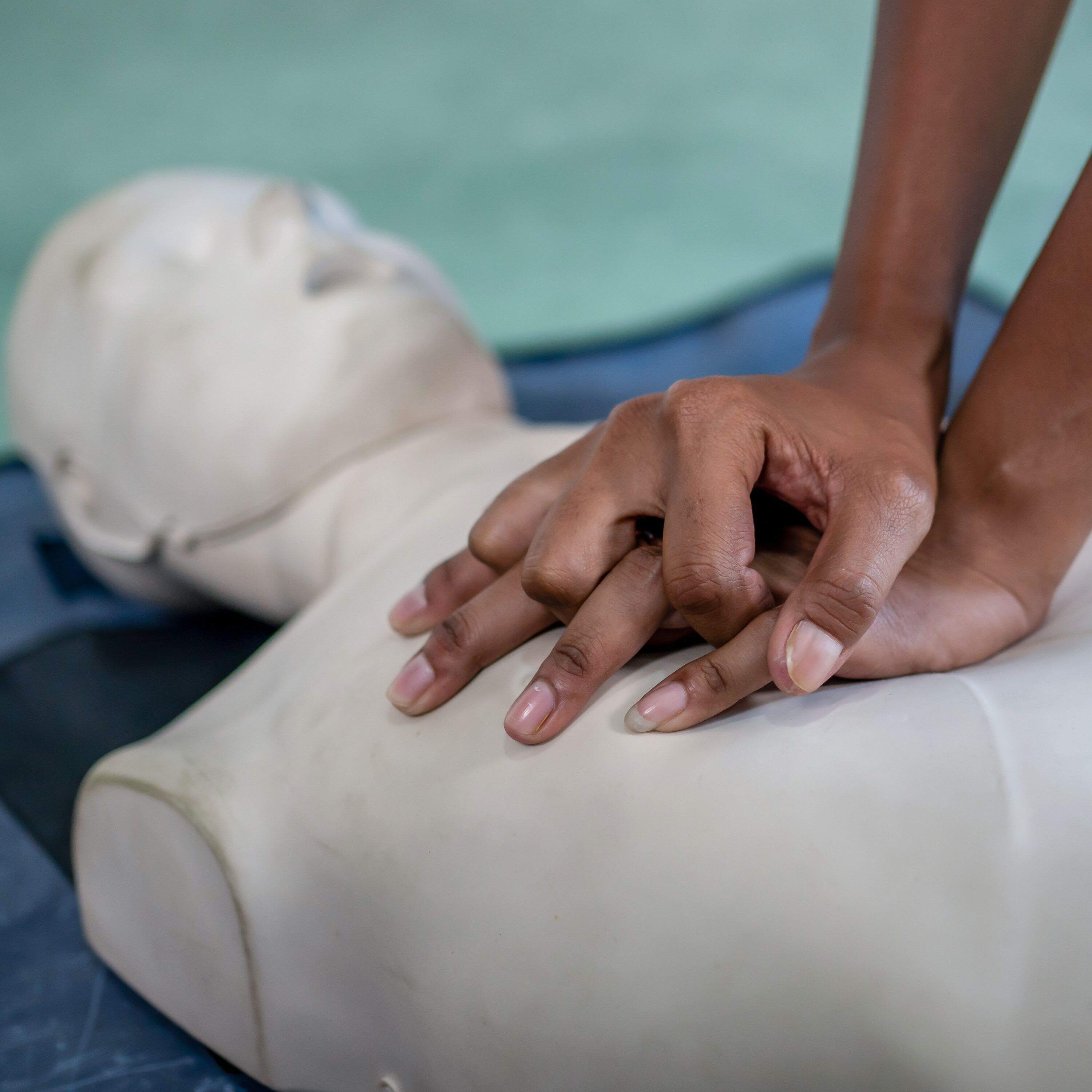
Got it. Okay. And so when you are starting to push like that, you cross your. You put your hand, one hand over the other and press with the heel of your hand. But you said in the center of the chest. Is that basically, like right between the person's nipples?
- [07:05]
Catherine Y. Brown
Well, let me say it's making. Okay, I'm gonna give you the PG version that you'll never forget. Right. I despise the nipple example. I think it's the worst reference ever known to man because I have four children. They are 30, 23, 22 and 15. And I breastfed my children. That's the worst example because my nipples might not live where your nipples live at anymore.
- [07:33]
Mariel Segarra
I appreciate that.
- [07:34]
Catherine Y. Brown
That is a yes, right? So, yeah, that no. So kneel at the person'. Put the heel of the hand in the center of the chest, keep our arms straight, elbows locked. You're pushing straight down at least 2 inches. So when you're kneeling at that person's side, you remember, you're bending at the waist. You're pulling the heel of your hand in the center of the chest. You interlock those fingers if you're able, your arms straight, elbows locked, push straight down at least 2 inches deep, as hard as you can. And we do it to 120 beats a minute. Two familiar songs. The cadence kind of helps you push. Stand alive, staying alive.
- [08:39]
Mariel Segarra
Yeah, I could totally picture that. So you mostly teach hands only cpr, meaning you don't teach people who aren't medical professionals generally to do rescue breaths. Why is that?
- [08:53]
Catherine Y. Brown
So research shows that hands only CPR is almost equally as effective as traditional cpr. That's going to be that CPR with the rescue breaths.
- [09:03]
Commercial Announcer
Why?
- [09:04]
Catherine Y. Brown
Because it was initiated and people started doing those chest compressions. I think people get that confused and they say, well, CPR doesn't have any breaths at all. And that's not true. It's just that, for example, consider me. I'm walking in grocery stores and gas stations and teaching people. I've got to take a complex topic, break it down into a simple step that they can remember.
- [09:31]
Mariel Segarra
Okay. And then if you are going to attempt the rescue breaths, you have to tilt back the person's head a little bit, right?
- [09:39]
Catherine Y. Brown
Yes. Place one hand on the person's forehead, pull the head back, two fingers under the chin. And when you get ready to give a rescue breath, you got the airway open, Right? Press your mouth over theirs, give a breath just until you see the chest rise. Next breath, and then you're going to go back to chest compression. 30 chest compressions followed by two breaths. So 30 and two. 30 and two.
- [10:04]
Mariel Segarra
What about if you're giving CPR to a child or to a baby? How is it different?
- [10:09]
Catherine Y. Brown
So in many instances, research shows that there was something respiratory in nature, sometimes that led to the child or the infant needing cpr. They also have a smaller lung capacity for that reason. Regular traditional cpr, cpr, chest compressions, and rescue breaths is recommended for children and infants.
- [10:40]
Mariel Segarra
Yeah, it can be harder to explain with a baby the positioning, like how you actually give CPR to a baby because your hands are so much bigger than their chest. In our class, they taught us to wrap our hands around around the baby and press with our thumbs in the center of the chest.
- [10:58]
Catherine Y. Brown
And many people refer to that as a two thumbs encircling hand technique. And you use your thumbs at the same time and you're pushing correct. And I say for people who want to learn on children and infants to take a traditional CPR class. There are classes happening all around the world.
- [11:20]
Commercial Announcer
Foreign.
- [11:22]
Mariel Segarra
We'Ll have more life kit after the break.
- [11:34]
Commercial Announcer
This message comes from Kachava. It feels good to connect to your simpler side, simplifying your wellness with Cachava's all in One Nutrition Shake. Feels good too. With 25 grams of protein, 6 grams of fiber, grains and more nutrients. No fillers, just the highest quality ingredients. Simplify your nutrition@cachava.com and use code NPR. New customers get $20 off an order of two bags or more now through January 31st. That's K A C H A V A.com code NPR.
- [12:08]
Mariel Segarra
So now when you tell someone, hey, you call 911, you can also tell them to look for an AED machine. Let's talk about the AED. What is it?
- [12:18]
Catherine Y. Brown
The AED is an automated external defibrillator which is a portable medical device. It has voice prompts and is designed to analyze that person's heart rhythm during a cardiac arrest. And if necessary, it will deliver a shock. You can find them in schools, public places, airports, sometimes shopping centers and casinos of all places. You get a better chance of finding an AED in a casino than you do in underserved communities. And we got to do something about that. There are disparities that exist between layperson or bystander CPR rates and AED use because there is a lack of resources in our communities of color, rural communities and also low income neighborhoods. But let's talk about the aed. So the most important step with the automated external defibrillator is just to turn it on. When you turn it on, it has voice prompts and you're going to see some pads inside of it. And it will say apply pads to patients bare check. Apply pads to patient's bare chest, plug in pad connector next to flashing light. So once you apply those pads to the victim's chest, the device will say analyzing heart rhythm.
- [13:55]
Mariel Segarra
Analyzing. It's going to start analyzing. So as soon as it starts analyzing, you want to say what clear.
- [14:02]
Catherine Y. Brown
You want to make sure that you don't touch the patient and you're going to tell everybody around to stand clear advised. Charging.
- [14:15]
Mariel Segarra
We want to make sure that we say clear again.
- [14:17]
Catherine Y. Brown
Stay clear of patient.
- [14:21]
Mariel Segarra
Deliver shock.
- [14:22]
Catherine Y. Brown
Now press the orange button.
- [14:25]
Mariel Segarra
Now you want to make sure you have a clear before you shock delivered and then get ready to start. And then we want to go right back in to our CPR chest compressions and it will give you a nice little metronome to follow.
- [14:41]
Catherine Y. Brown
Every two minutes the device will pause. It will analyze the heart rhythm. Now if for some reason device says no shock advised, I want you to go right back to doing chest compressions, get to CPR done and wait for help to get there. Do not stop until help arrives. That's so important.
- [15:07]
Mariel Segarra
If there's more than One person. Can you switch off?
- [15:10]
Catherine Y. Brown
Absolutely. After every five cycles of 30 and two, you trade off if a person is available.
- [15:18]
Mariel Segarra
So let's say you haven't taken a class or gotten a certification in cpr, but you know this much. Now you're in a situation no one else around you is, like, officially trained in cpr. Should you try it?
- [15:33]
Catherine Y. Brown
Absolutely. Absolutely. Even if you have not had formal training? Absolutely. You should try. Sometimes when I'm teaching and people say, I don't want to hurt the person, and I say, you can't kill a dead person. That you. You can't kill a dead person. Their heart has stopped. A person who in good faith is administers emergency care at the scene of an emergency is not liable in civil damages for an act performed during the emergency unless the act is willfully and wantingly negligent.
- [16:13]
Mariel Segarra
Okay, that's good to know. So who should take a CPR class like the one that Sylvie and I took?
- [16:19]
Catherine Y. Brown
Everyone. And you've heard that first from your CPR lady. Everyone should know cpr. You learn stop, drop, and roll. You learned all these different things. I believe that CPR should be just the standard. You're never too young. My. My son, when he was little, he's 15 now, I would put his teddy bear on the floor and he push on the teddy bear. Why? Because that's what he knew. Mommy doing, right? I have something called the AED game. Their parents don't like me, but it's really cool. This is how it goes. I tell them what the AED is, how to use it, and then every time the AED machine, if their parent doesn't notice it, then they have to give the child $20. The parents like $20. I'm like, inflation. Times are hard. So the key is what. What am I teaching them? I'm teaching them to look. For what? The aed to notice it, to pay attention to it. So I send, you know, my CPR heroes out there. Why? Because they remember it. And it's not about the money. It's just about finding fun ways to get the message. When we have sporting events, there are commercials that come up during sporting events. There should be CPR commercials showing at sporting events. Every household needs to have someone trained in cpr. If not, you're going to have people like me that will continue to knock on doors.
- [17:45]
Mariel Segarra
Katherine, you are the best. Thank you so much. This has been great.
- [17:50]
Catherine Y. Brown
Thank you so much.
- [17:52]
Mariel Segarra
All right, it's time for a recap. When you come upon an adult who appears unconscious and unresponsive if the situation is safe for you to approach, you're gonna tap them on the shoulders hard and say, hey, hey, are you okay? If they don't respond quickly, look to see if their chest is rising and falling with breath. If not, you want to call 911 and then start CPR. Now. If you're alone, put your phone on speaker and call 911 as you start CPR. But if there are other folks around, look at one person and say, hey. You call 911 and then find the AED machine. You want to make sure they hear you and understand the task. Okay, so CPR on an adult or a teenager. Basically, it comes down to push hard and fast in the center of their chest. You want to go about 2 inches deep. As Catherine mentioned, there are several songs you can use to pace yourself, and the classic one is Staying Alive. If you choose to do rescue breaths, the cadence is 30 chest compressions and then two breaths into the person's mouth. And you can use a barrier if there's one available, like in a first aid kit. If there's an AED available, turn it on. Put the pads on the person's chest and follow the prompts. If you're administering a shock, make sure no one is touching the victim, including you. And then after the shock, you go back to giving cpr. Until the person wakes up or help arrives, you're going to keep the pads on their chest while you're doing this. With children and infants, rescue breaths are always recommended. Also for infants, you're going to use something called the encircling thumbs technique. You can find a diagram of that online. These are the basics, but we would absolutely recommend that you take a training course like I did. Now I'm certified for two years. Practicing hands on made me feel more confident and empowered in case the situation ever comes up. Hey, before we go, I have a favor to ask. If you have a second, would you leave Life Kit a five star review? If Life Kit has ever helped you save a little money, make a healthier choice, or if we've just made you feel a little more seen, a five star review is a great way to show your support and thank you. This episode of Life Kit was produced by Sylvie Douglas. Our visuals editor is Beck Harlan and our digital editor is Malika Grebe. Meghan Keane is our senior supervising editor and Beth Donovan is our executive producer. Our production team also includes Andy Tegel, Mika Ellison, Claire Marie Schneider, and Margaret Serino. Engineering support comes from Valentino Rodriguez Sanchez. I'm Mariel Segarra thanks for listening.
- [20:27]
Commercial Announcer
This message comes from Capital One. With the Capital One Saver card, earn unlimited 3% cash back on dining and entertainment. Earn Capital One what's in your wallet? Terms apply. Details at capitalone. Com this message comes from Capital One. Capital One offers checking accounts with no fees or minimums. What's in your wallet? Terms apply. See capitalone.combank for details. Capital One NA Member FDIC.