← Live Wire with Luke Burbank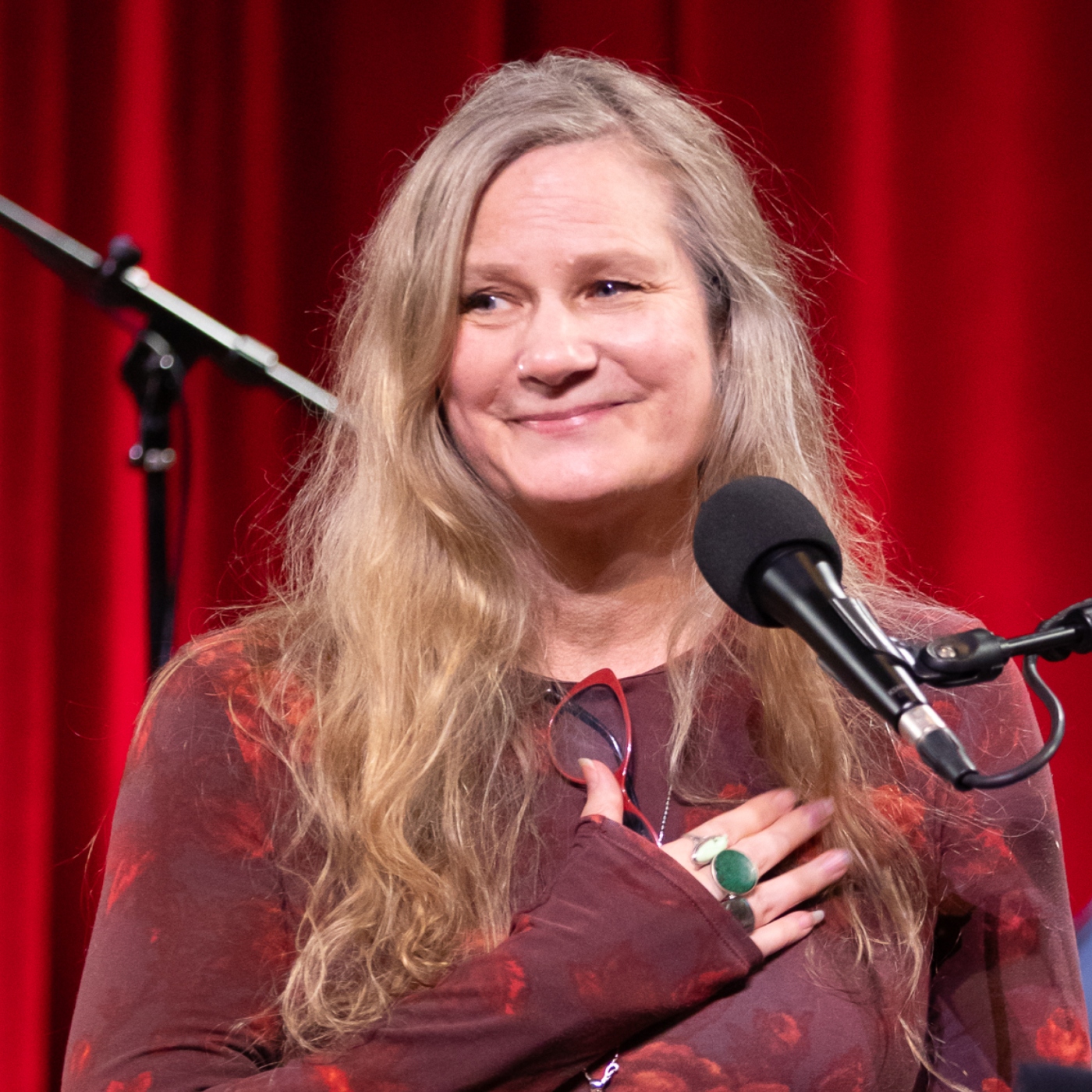
Live Wire with Luke Burbank
Lidia Yuknavitch, Felipe Torres Medina, and Pedro the Lion
00:52:05
This episode features author Lidia Yuknavitch, comedy writer Felipe Torres Medina, and music from Pedro the Lion.
Loading summary
Transcript189 lines
- [00:03]
Luke Burbank
Hey there. Welcome to Livewire. I'm your host, Luke Burbank. This week on the show, we are talking to best selling author and self described beloved misfit Lidia Yukonovich about her new book, Reading the Waves. The way she describes it is it's more of an exploration of memory and she'll kind of expand on what exactly that means. Coming up. Then we're gonna hear from Colbert TV writer Felipe Torres Medina about his new book. It's called America Let Me A Choose youe Immigration Story. It kind of peels back the layers of just how insanely complicated the US Immigration system is. And the whole thing is written in the style of a choose your own adventure kind of book which kind of adds a fun dimension to this otherwise unfun topic. And then finally, we're gonna talk to Seattle indie rocker Dave Bazan, AKA Pedro the Lion, and we're gonna hear some music off of his latest album. That's all coming up on LIVEWIRE this week. Don't go anywhere. Get started right after this. Livewire is brought to you by Progressive Insurance. You chose to hit play on this podcast today. Smart Choice. Make another smart choice with Auto Quote Explorer to compare rates from multiple car insurance companies all at once. Try it@progressive.com Progressive Casualty Insurance Company and affiliates not available in all states or situations. Prices vary based on how you buy from prx.
- [01:26]
Elena Passarello
It's Live Wire this week. Author Lydia Yuknovich.
- [01:37]
Lidia Yuknovich
I think it's more an exploration of memory and our relationship to memory and where you stand in relationship to the crap that's happened to you.
- [01:49]
Elena Passarello
Writer and humorist Felipe Torres Medina.
- [01:52]
Felipe Torres Medina
We all know that a lot of the things that they're doing are illogical and absurd and lack of logic and absurdity is to me the seed of humor.
- [02:01]
Elena Passarello
With music from Pedro the Lion and our fabulous house band, I'm your announcer, Elena Passarello. And now the host of Livewire, Lou Burbank.
- [02:17]
Luke Burbank
We've got an absolutely packed shot show for you this week. Of course, look, we live in the world that you all live in. We know that times are tough out there when it comes to the news, but we like to think on this show that if you look hard enough, you can find some bright spots in the news. Sometimes you've got to use a telescope. Yes, it might be the James Webb telescope. It might be in another galaxy where the good news is. But we search for it. We find you a couple of those stories and we present them at the top of the show in a little segment we call the best news we heard all week. All right, Elena, what is the best news that you heard all week?
- [02:58]
Elena Passarello
Okay. Luke Burbank. Have you ever read a romance novel before?
- [03:02]
Luke Burbank
Well, yeah, of a sort. You know, back in the day when I was in school and there was that kind of roundabout of books in the back of the classroom with some, like, Louis Lamour and Some Lonesome Dove and the like on there. And I got caught up in a few of those books. Bodice rippers.
- [03:17]
Elena Passarello
Oh, well, this story's for you.
- [03:19]
Luke Burbank
Oh, good. Okay.
- [03:21]
Elena Passarello
So from what I understand, the romance novel fan base is pretty devoted, and they turn out for their favorite authors. And one of their favorite authors is Abby Jimenez. She's the author of such steamy sounding novels as Just for the Summer.
- [03:38]
Luke Burbank
Ooh.
- [03:39]
Elena Passarello
And the Happy Ever After Playlist. Both of which sound like maybe best news. Maybe I should just recount the plots of those.
- [03:47]
Luke Burbank
That was how I was hired on Livewire. Just for the summer.
- [03:49]
Elena Passarello
Whoops.
- [03:50]
Luke Burbank
And I just never left.
- [03:51]
Elena Passarello
And now you're living the Happily Ever after playlist. So Abby Jimenez did an event recently in Toronto, and 400 people showed up. Most of them were women. They were really, really ready to hear one of their favorite authors talk about the romance novel game.
- [04:07]
Felipe Torres Medina
And they.
- [04:08]
Elena Passarello
And then all of a sudden, the fire alarm went off.
- [04:10]
Luke Burbank
Uh. Oh.
- [04:11]
Elena Passarello
And everyone was like, oh, no. Oh, no. Oh, no. And then a door opened in the back and like, six firemen came in. They were all hot. I saw the TikTok. They had the gear. They had, like, short sleeves and suspenders. And one of them had his helmet in his hand.
- [04:27]
Luke Burbank
They were, like, right out of central casting.
- [04:29]
Elena Passarello
Yes. I feel like some of them had, like, sexy soot, which doesn't make any sense. Cause, like, nothing was on fire.
- [04:33]
Luke Burbank
They had come from a different fire.
- [04:35]
Elena Passarello
Yeah. They were like, one of them was holding a kitten, you know, and then apparently the entire crowd went insane and started being like, are you single? And all this stuff. Firefighters took it in stride. There also was no fire. It was just literally a false alarm. To the point where people were like, is this some kind of paid promotion? Because it's something that apparently would have happened in an Abby Jimenez novel, but no, it was real. And apparently Toronto firefighters can get it.
- [05:04]
Luke Burbank
Yeah. Life imitating art.
- [05:06]
Elena Passarello
Yeah. Which for me, that just makes me smile when, like, random perfect things happen to the perfect people to receive them.
- [05:14]
Luke Burbank
You know what I mean? Speaking of people getting what they deserve. And I mean this in the best way, you know, there's almost nothing worse than moving right. Can we agree moving is a huge hassle. Actually, there is something worse than moving, and it is your friend asking you if you will help them move.
- [05:31]
Elena Passarello
Yes.
- [05:32]
Luke Burbank
Yeah. Like, hey, I've got a sales pitch for you, Elena. Could you spend, I don't know, the better part of 12 hours endangering your lower back, carrying heavy stuff up to my place for the reward of up to two slices of pizza?
- [05:48]
Elena Passarello
Why is the reward always pizza?
- [05:50]
Luke Burbank
It's not enough. It's not enough reward at our age.
- [05:53]
Elena Passarello
Why does anybody say yes to that? People in their 20s do.
- [05:56]
Luke Burbank
Just because I think that's one of those things you generally age out of.
- [05:59]
Elena Passarello
Yeah.
- [06:00]
Luke Burbank
Okay. So a woman named Michelle Tuplin had to move her bookstore in Chelsea, Michigan. It's called Serendipity Books, and it's been in this same spot since about 1989. And it's beloved in the Community Independent Bookstore. But she was going to move down the block and around the corner. And she was very daunted by the project of moving this whole bookstore. She's the owner and basically one employee of this thing. And so a couple weeks ago, she just put a note out on the Facebook page and just said, like, could somebody come help me with this? This is a lot. And she comes out of the bookstore on the day of the move, and there is not one, but two lines of people all the way down the block and around the corner to the new location to be a book brigade to hand a book. Yeah. Like a book starts out in the original Serendipity Books location and then goes past person to person all the way down to the new location.
- [07:05]
Elena Passarello
That's so beautiful, because then it's a community bookstore. And, like, a lot of the community has had their hands on the entire inventory.
- [07:13]
Luke Burbank
And you bring up a good point, Elaine, because this was in the article I read out of the town paper. This is a quote organized, type A volunteers were at each end of both lines to ensure the books stayed in order.
- [07:25]
Elena Passarello
I did worry about that. I did worry about that. About that.
- [07:29]
Luke Burbank
Shout out to my type A kings and queens. Just, like, being very organized about it. But check this out. The book brigade involved volunteers from ages 6 to 91.
- [07:42]
Elena Passarello
Yay.
- [07:44]
Luke Burbank
It took them two hours to get over 9,000 books.
- [07:48]
Elena Passarello
That's it.
- [07:49]
Luke Burbank
Yes.
- [07:50]
Felipe Torres Medina
Wow.
- [07:50]
Luke Burbank
9,000 books moved all the way down to the new location. This is very cool because it means that Serendipity Books will now be able to open in time for National Independent Bookstore Day, which is coming up.
- [08:00]
Elena Passarello
That's right.
- [08:01]
Luke Burbank
I mean, any story about people and books. And the books surviving these days, yeah, is a huge W. People in Michigan taking care of serendipity books. That is the best news that I heard this week. This is Livewire from prx. Our next guest is a bestselling author who transforms complex personal experiences into hauntingly beautiful sentences. Her memoir, the Chronology of Water, is coming soon in film form, directed by none other than Kristen Stewart. Her latest book, reading the Waves, is a quicksilver, expansive exploration of grief and hauntings, according to Vanity Fair. We are so glad to have her back on the program. Please welcome Lidia Yukonovic to Livewire. Lydia, welcome back to Livewire.
- [09:10]
Lidia Yuknovich
My complete pleasure. Also. I love you, Portland.
- [09:21]
Luke Burbank
Let's start kind of at the beginning of this book where you write that this is not a traditional memoir. I'm wondering, what is this book to you? What were you looking to do with this book?
- [09:33]
Lidia Yuknovich
I think it's more an exploration of memory and our relationship to memory and where you stand in relationship to the crap that's happened to you. And we often just stand in one place and kind of lock on to the story of what happened. And that's cool.
- [09:59]
Luke Burbank
That's one way to do it.
- [10:00]
Lidia Yuknovich
Don't let anybody take your story from you. However, if you hold onto it so long that the story kind of begins to be too heavy or something you can't carry anymore, it might be time to consider standing in a different position to the crap that happened to you. And I guess I mean the difficult stuff, the things that have wounded you or made things hard for you. And so I think the book is kind of a kind of spacewalk or mind walk or heart walk around looking at your own life to see can I stand in a different place? Can the story shift? And can I shift?
- [10:46]
Luke Burbank
You know, this book does deal with some pretty traumatic things, and I found the book incredibly readable. But I was also reading reviews of it, and one thing I saw coming up over and over again was people talking about your ability as a writer, sort of. I don't know if it lightens things, but it makes it possible for the reader to go on this journey with you over a lot of topics that are really intense. And I'm wondering when you're writing about something like do you feel pressure to write in a very clear way so that the book doesn't just get pulled down by the topic?
- [11:22]
Lidia Yuknovich
You know, about this kind of question. One mustn't kill the reader. This is very.
- [11:28]
Luke Burbank
Is that job number one as the writer?
- [11:30]
Elena Passarello
Keep the reader alive.
- [11:31]
Luke Burbank
Okay.
- [11:33]
Lidia Yuknovich
Resuscitate them if necessary. Well, you know, think about your own life, right. And the sad stories or the sorrowful stories or the heavy stories, you know, they can weigh you down till you're underground. Right. And so one thing that's beautiful about storytelling space, I think you'd agree, Alina, is it's different than real life. You can move around, you can make narrative dynamics, you can make sound, you can make smell, you can make a silence, you can make a pause, you can make up. But in real life, you just get dosed with the experience and it's overwhelming. But storytelling space lets you curate or choreograph so that we're going somewhere together. And yeah, it's sad or difficult, but we're holding hands.
- [12:30]
Elena Passarello
I totally relate to that. There's a power in that curation. There's a power. And putting your story through those paces on the page, if you're just somebody who's telling stories as a person, like, you're never going to write a book, but you're just talking to people. Do you think we have the same power to narrate our lives how we.
- [12:46]
Lidia Yuknovich
Want to or I would not know. I'm an introvert and I'm hiding in the bathroom while other people are telling really verbal stories that are wonderful. But I have noticed when they're telling the stories that I can participate in the listening. And I admire that. And then I go back and hide in the bathroom.
- [13:07]
Luke Burbank
This is a perfect time for us to take a break. Lydia will let you power down for about 60 seconds. This is Livewire Radio. We're talking to the writer Lydia Yukonovich about her latest book, Reading the Waves. We will take a short break and then we'll be right back with more LIVEWIRE in a moment. Special thanks to our sponsor, Up Up Books, a Portland bookshop specializing in diverse authors, local writers and independent presses. They're located across from Revolution hall in the Buckman neighborhood and they offer a space for book clubs, workshops and events. Check out their website and grab a book@upupbooks.com welcome back to LIVEWIRE Radio. Coming to you this week from the Alberta Roach Theater in Portland, Oregon. I'm Luke Burbank here with Elena Passarello. And we are also here with Lidia Yuknovich. Could you read a little bit from this book? You talk about an ex husband of yours named Devin who passed away, although I know you're not a fan of that term. I want to talk about that, too, in a bit. So I'll use the term that you probably prefer. He died in 2015 under some extreme and somewhat unclear circumstances. I was wondering if you could read a little bit from the book.
- [15:06]
Lidia Yuknovich
Sure. The word Devin means poet, skydiver. 1 People are sometimes too interested in what happened. The plod of plot and action. Sometimes the rest of the story, or perhaps the heart of the story, is carried by image, by repetition. Tiny intensities not captured fully from plot and action. A very intense drama played out in my relationship with Devin. You will not find it in these pages. The drama is not the story or the story of why and how relationships dissolve or crescendo. Is every story living inside all of us to differing degrees, rising and falling in waves? When I focus on a moment, on small intensities that may or may not interest anyone else, I'm reminding us how those tiny pieces of a life are sometimes carrying bigger meanings than the big, dull, thunderous calamities that befall us. If I track not just plot and action, but impressions, emotional intensities, associations, repetitions, images, can I transmogrify and reframe the story? What happened is Devin and I loved each other into the death of our marriage, which is not any kind of unique story. Oceans of women have fallen for dangerous men, for example, or angry men, or depressed men, or death driven men. Legions of marriages fail. I don't want to write about the plot of what happened to him. I want to find the heart of the story underneath that.
- [17:25]
Luke Burbank
That's Lidia Yukonovich reading here on Livewire. I guess you sort of, in that reading, answered sort of my next question, which is I was struck by the line people are too interested in what happened. Is that kind of going back to the conversation about memory? I mean, do you feel like the specifics of what happened are sometimes over prioritized and over indexed?
- [17:46]
Lidia Yuknovich
I think the dramatic action is overemphasized. When Virginia Woolf has written extensively about the periphery of your life and what's just to the side of the main action, or what's underneath it, or little moments that other people ignore but she thought were like, this is the whole deal. There's a moth dying on the windowsill. Literally is a story of hers.
- [18:16]
Luke Burbank
Was it Kafka?
- [18:19]
Elena Passarello
The moth was named Kafka.
- [18:20]
Luke Burbank
I would love to see those stories intersect.
- [18:23]
Lidia Yuknovich
What an unholy love child that would be. I'm sorry, my brain just went somewhere really weird. But you know, what if those tiny periphery flickers and moments and small pieces are where they're holding part of the story? What of the big dramatic thud action that we've been so trained to embrace as what happened to us is only carrying a small fraction of the story. It could be that in your heart the sound that happened is more important or the smell or something you put in your mouth and ate. But that doesn't get to be the center of the story because it wasn't the dramatic action of what happened. So I'm interested in that. And I don't. I'm not right. I'm not a wizard. I'm just interested in bringing those smaller things in the side and underneath and above into the heart of the story in case they're holding something, which for me, they're holding everything.
- [19:30]
Luke Burbank
Now, you are not the only person that I know who has lost loved ones, who does not really enjoy or appreciate the term passed away. What is it about? And it sounds like there's other folks here that feel the same way. What is it? What is it about that. What an odd support group we're forming this week. Like the world isn't bleak enough. No, but when I read that in the book, it was echoed in conversations I've had with other people who've suffered loss and do not appreciate that term. Can you kind of explain why it is that you don't really have use for that term?
- [20:11]
Lidia Yuknovich
I mean, again, I'm not right. But what pisses me off is how passive it is. Like something just floated off. When the lives we lead, when we're in relation to people we love, that's all there is. That's the heart of being human. And so I'm not trying to say that we should exalt death and give it over dramatic language. I'm saying we should bring death into the story of being human. And the beauty and the pain and the sorrow and the joy and the ecstasy of that. And so when someone dies, it's part of what it means to be alive. And why don't we glory in that and the passed away language also, I was raised Catholic and Devin's family was Baptist Christian. And so it just pisses me the hell off that this language is like, oh, fly away. You don't fly away. You're remembered in the bodies and hearts of people you were close to and that's still there as long as I'm alive. And hopefully I can pass that to someone else. And so that language again, you don't have to agree with me, but you know what I mean.
- [21:35]
Luke Burbank
Yeah, I do. We're having a very meaningful and deep conversation, as we often do with you, Lydia. I don't want to take it to Hollywood, but it.
- [21:50]
Lidia Yuknovich
But you're going to.
- [21:51]
Luke Burbank
But I feel professionally obligated to mention that your last book has. Well, actually was Chronology of Water. How many books ago was that?
- [21:58]
Lidia Yuknovich
2011, I think.
- [22:00]
Luke Burbank
Well, that really beloved memoir has been adapted into a film. I understand it's been filmed. I was looking at production stills of a person who's portraying you in the film, a young version of you. And I'm just curious. I know that you and your husband were in on the writing of the film. What is that like for you to see the story of your life portrayed in that way?
- [22:27]
Lidia Yuknovich
Well, let's back up for a second and talk about who's making the film. It's Kristen Stewart.
- [22:36]
Luke Burbank
Did I read that she said she was pausing her acting career until she could get this movie officially made? All this being a famous Hollywood person was getting in the way of her executing a movie about your life.
- [22:48]
Lidia Yuknovich
She did say that. I think a feature we share is that when someone tells us no, we get feisty and pissed off. And someone was telling her no, and that was her response. But what I want to say about her being the person making this piece of art, it matters because she has a singular and, you know, different than everybody else view of what films are, of what acting is, of what stories are, of what women are, of what gender is. And so she's not making a biopic. This is not that. She's very interested in being faithful to the experimental quality of the narrative. And so if I was telling you what to look for, I'm thinking art house movie, probably beyond Jarmusch, like collage, vaguely psychedelic, interested in memory.
- [24:00]
Luke Burbank
Okay.
- [24:01]
Lidia Yuknovich
Not interested in linear narrative. Interested in image sequencing and rearrangements. And that's fine by me.
- [24:11]
Luke Burbank
Yeah, that's gotta be maybe a relief from this otherwise kind of constraining notion of a biopic of a linear story of a. That's not maybe what I thought in that moment or how I wrote about that moment, but to have it be a totally different expression, that must be kind of liberating for you as the person whose life it is to some degree, based on.
- [24:33]
Lidia Yuknovich
Completely. But also I just have a fundamentally different view of the whole project, which is this kind of like in jazz musicians. I'm an artist. I made a piece of art. This other artist came along, had felt something about the piece of art I made, and now she's making a completely different piece of art. And she riffed off of my art. And whatever it is will be its own autonomous thing. And that's Beautiful to me. I don't need it to have anything to do with me. It's just a riffing, an artistic riffing.
- [25:10]
Luke Burbank
Well, we're very excited to see however it turns out. Lydia, thank you for coming on Livewire. That was Lydia Yukonovich right here on Livewire. Her latest memoir, Reading the Waves, is available right now. And it is really, really something else. Hey, special thanks this episode to David Hardman of Beaverton, Oregon. David is part of the Livewire member community and is generously supporting our show with a donation each month. And we are grateful for that support because it's how we're able to do Livewire. We could not do it without folks like David Hardman of Beaverton, Oregon. So, David, shout out to you. Thank you very much for helping us do this thing. I'm Luke Burbank here with Elena Passarello. Of course. Each week we like to ask the Livewire audience a question. And we were inspired by Felipe Torres Medina, who you're going to hear from in just a moment, whose book America Let Me in is about the insanely complicated U.S. immigration process. So because of that, Alana, what did we ask the Livewire audience?
- [26:31]
Elena Passarello
We asked our audience to tell us about something that's way more complicated than it should be.
- [26:36]
Luke Burbank
Okay. We actually recorded responses from a recent audience at a Livewire taping, and here's what they had to say. This is something Jonathan thinks is more complicated than it needs to be. Low key college physics.
- [26:50]
Lidia Yuknovich
Like in class.
- [26:52]
Luke Burbank
Why do I always have to assume.
- [26:54]
Lidia Yuknovich
That gravity equals zero or like we're.
- [26:56]
Luke Burbank
In a vacuum or something? Like the equation makes no sense. I don't want to sound anti science or anti math, but I really salute this as a non math person. I mean, we've just, we've taken it as a given that physics should be complicated and that we should be trying to learn it. And for some of us, it just might not be in the cards.
- [27:16]
Elena Passarello
What does it mean when someone starts a sentence with low key?
- [27:20]
Luke Burbank
It means high key, Elena. That's the whole thing. Well, I think it's sort of morphed into, like, low key. I just am not really that big on putting guacamole on my tacos. Right. But now I feel like when we say low key, we kind of mean it's a big deal. It's kind of like so like when.
- [27:35]
Elena Passarello
Someone says, like, no offense, but you're.
- [27:36]
Luke Burbank
A total jerk, it's just like that. In my reading of the lexicon, that.
- [27:41]
Elena Passarello
Makes it even better that it's a low key. Physics, Physics.
- [27:44]
Luke Burbank
Take low key. Physics is a little more complicated than it needs to be. All right, here's Brandon's response to the question. I think roundabouts are more complicated than they should be.
- [27:55]
Felipe Torres Medina
So all you have to do is turn into it and go in a circle and exit, and people just keep going.
- [28:02]
Luke Burbank
I don't know why I high key. Totally agree with this. There is a roundabout down the hill from my house, and so it means that I use this roundabout very frequently. And I'd say at least 60% of the time, there's somebody who is very confused by the process, by the yield signs, and who has right of way. They're not as simple as we were told they would be.
- [28:27]
Elena Passarello
If we don't learn it in driving school, which at least not when I learned how to drive in the South. I didn't see a roundabout, I think, until I moved out of Georgia. I don't think they're allowed down there.
- [28:38]
Luke Burbank
Let's do one more before we get out of here. This is from Amitai. Something that's extra complicated, that maybe doesn't need to be.
- [28:44]
Felipe Torres Medina
I'll go with printers.
- [28:46]
Luke Burbank
Well, printing should just be really easy, and it feels like it hasn't gotten any better since the 90s.
- [28:50]
Elena Passarello
That's a good answer.
- [28:51]
Luke Burbank
I think this was intentionally inserted by our executive producer, Laura Hadden, who is unbelievably qualified for her job, but spends a good hour each show trying to get the printer to work.
- [29:02]
Elena Passarello
Yeah, because we have to have a printer that can travel to the several places where we do a live show. And it does seem to be about 80% of her job description once we're on site.
- [29:11]
Luke Burbank
Okay, so where I'm talking to you from right now, Elena, I have a printer that, for whatever reason, it works. It's on the network. My computer can talk to it. I can never move because I have it. When I hit print, it prints. And I know if I were to move to another location, these things would never talk to each other again.
- [29:29]
Elena Passarello
Don't even move the computer. I say keep it all exactly where it is right now. Because you're in some kind of sweet spot.
- [29:35]
Luke Burbank
Exactly. All right, well, thank you so much to those brave Livewire audience members who weighed in on the topic. Appreciate you. All right, speaking of Felipe Torres Medina, he's actually our next guest. He moved to the US at the age of 21 and then spent the next 10 years of his life navigating the chaos and the confusion of the US Immigration system. And now he's spending this phase of his life trying to explain that craziness to those of us who have not had to go through it. And when he's not doing that, he writes for the Late show with Stephen Colbert. And he's earned five Emmy nominations. He's got a book out. It's titled Let Me a Choose youe Immigration Story. Here is Felipe, who joined us on stage at the Alberta Rose Theater in Portland, Oregon. Check it out. Hello, Felipe. Welcome to the show.
- [30:27]
Felipe Torres Medina
Thank you. Thank you for having me.
- [30:29]
Luke Burbank
Okay. I feel like I learned a lot about the immigration process in this book and also a lot about you. You grew up in Colombia, had a pretty good childhood, a good life going there, but then you wanted to come to the US for sitcoms.
- [30:43]
Felipe Torres Medina
Yeah, I love sitcoms. I love writing. I love television. And I was like, wait a minute, someone writes these.
- [30:52]
Luke Burbank
Did you have some favorites? Like, were there some sitcoms that really.
- [30:55]
Felipe Torres Medina
Spoke to you at the time? Definitely. 30 rock.
- [30:59]
Luke Burbank
Okay.
- [30:59]
Felipe Torres Medina
Which was on the air.
- [31:01]
Luke Burbank
Sure. I mean, your lived experience as a 20 year old in Columbia. Timothy Busfield and the crew. 30 something.
- [31:10]
Felipe Torres Medina
No, 30 rock. Oh, 30 rock.
- [31:13]
Luke Burbank
Wow. That makes a lot more sense.
- [31:15]
Felipe Torres Medina
I have no idea who Timothy Buzzfield is.
- [31:18]
Luke Burbank
I literally.
- [31:18]
Elena Passarello
30 Rock was on when you were in college. You do not know 30 something.
- [31:22]
Luke Burbank
When you said 30 Rock, I heard the moody 1990s long running emo kind of dramedy. 30 something. Which would be insane if that was the show.
- [31:35]
Felipe Torres Medina
Never heard of it. Must binge now.
- [31:37]
Elena Passarello
Yeah, it would be a hell of a mashup.
- [31:42]
Felipe Torres Medina
You gotta call it 30. 30 though.
- [31:44]
Luke Burbank
Yeah.
- [31:45]
Elena Passarello
30. 30.
- [31:45]
Luke Burbank
Okay. So I'm sorry, 30 Rock really spoke to you.
- [31:48]
Felipe Torres Medina
30 Rock and Arrested Development. I obviously grew up on the Simpsons on a very weird Simpsons diet because my, my mother didn't let me watch it until I was like 12. Because that boy Bart is rude to his parents.
- [32:02]
Elena Passarello
Right.
- [32:03]
Luke Burbank
So you. You decided to come to the US And I'm wondering what you expected. The process of navigating the immigration system, how you thought it would be, and then what you found it to actually be.
- [32:15]
Felipe Torres Medina
I have a friend who also writes for Colbert who came up with the term to describe the Trump presidency. But it's exactly what you thought, but even worse than you imagined. And that's kind of how the immigration system feels. It's very difficult. And I knew that because it's difficult even if you're trying to get a tourist visa. So I assumed that everything else would be hard. Perhaps didn't know how hard it would be.
- [32:41]
Luke Burbank
The book is a choose your own adventure, essentially did you grow up reading those kinds of books as a kid in Colombia? I did not have the attention span.
- [32:49]
Elena Passarello
You didn't.
- [32:50]
Luke Burbank
I would just like, be like, I don't know, back of the book. I would just, like, skip right to the end.
- [32:55]
Felipe Torres Medina
We had one or two in my school library. And I remember that people really wanted them. And once I finally got it, I remember reading it and I died pretty early. It was like a medieval one. And I was like, this sucks. What do you mean, I'm dead. I hate this. And I returned it. So, yes, I was familiar with the genre, but it wasn't like, oh my God, I love it.
- [33:21]
Luke Burbank
Did you start out with the plan to write this book in that format or were you working on a more traditional book and you thought, oh, no, this is a better way to do it?
- [33:28]
Felipe Torres Medina
It's a weird one because I very much wanted to tell a bunch of stories and to talk about a bunch of visas. So I think at one point I was like listing the kinds of visas and I had gotten something called an 01, which is an alien of extraordinary ability visa, which is a ridiculous name. And so when I started doing that and listing the kinds of visas and realizing that I wanted to tell a bunch of stories about immigrants, I was like, there must be a way to do this. And I landed on this, like, playful format. And then that just helped me create a book that put you in the shoes of the immigrants. And I think was very important because I was tired of explaining the immigration process to very well meaning liberal and progressive Americans.
- [34:19]
Elena Passarello
But it also seems like such a technical marvel to actually pull off not just to choose your own adventure, but. But a choose your own adventure about one of the most complicated systems I have ever encountered in my life. I mean, did you just have a serial killer wall with all of the.
- [34:37]
Felipe Torres Medina
It wasn't a wall, but I think I have like seven maps, like tree branch maps with all the stories in different formats until I found the one that worked for me to be able to track the stories. Also, obviously the choose your own adventure books are very popular here in America. But that was not my only inspiration. When I was in high school, I read this Latin American author named Julio Cortazar, who's. He has a book called Hopscotch. You can find it in translation here. And that book is like that. That book is a novel that's told that at the end of every chapter tells you go to this chapter. But also the writer is like, this is a game of hopscotch. So if you want to Read it start to end. You can do that or you can read it in this kind of style. So it was also a little bit of like. I'm inserting myself in the literary tradition of Latin America.
- [35:29]
Luke Burbank
We're talking to Felipe Torres Medina about his book America Let Me a Choose youe Immigration Story. Now, I'm reading this book, I'm finding it informative, I'm enjoying the humor, but it's all under this cloud of the intense seriousness of the topic of what is happening in this country. And you have a kind of a disclaimer in the book that, that just says like, yes, this is a very fraught topic. This is something that's very hard for a lot of people. I'm choosing to address it with humor. I'm wondering, but you probably wrote that a while ago before what we're now actually seeing. And I mean, it's impossible to even really describe accurately what's going on for people in this country who are either trying to become citizens or are citizens and are being disappeared. Does that kind of make it harder to approach it with humor or is humor still the only option for you?
- [36:18]
Felipe Torres Medina
For me, it's the way to stay sane. Right. Not to sound trite, but, you know, joy is a form of resistance. And you know, we all know that a lot of the things that they're doing are illogical and absurd and lack of logic and absurdity is to me the seed of humor. Right.
- [36:37]
Luke Burbank
Yeah.
- [36:38]
Felipe Torres Medina
So for me it's like, well, if I don't make a joke about this, I'm going to cry.
- [36:43]
Luke Burbank
Yeah. Yeah.
- [36:44]
Felipe Torres Medina
And so for me, it's the only way to address it. And it's also a way to, especially with this book, inform people about something that I say. In the book, everyone has an opinion on immigration. Everyone, every American has an opinion on immigration. But no one knows how the system actually works, including clearly the people doing the arrests and disappearances because they just take people like they took a person who has citizenship. So they don't really know the system. They're just trying to either fill a quota or whatever. So for me it was like, humor's a really, I think, fun way and non preachy way to address things that you don't know.
- [37:27]
Luke Burbank
Yeah, you. At the sort of beginning of the book, you allow the reader to select a difficulty level of their immigration process. Easy, medium, hard or very hard. What would be the things realistically that would lead a relatively easy process of immigrating or becoming a US citizen versus a very hard one? What are those situations?
- [37:48]
Felipe Torres Medina
Look like, well, I say this in the book, but if you pick the easy, it turns you to a page that says incorrect. There is no easy way to move to the United States. Start again. I think, obviously, medium and hard, which are the categories where most of the stories in the book live, are very much dependent on privilege, be it like racial or mostly economic privilege. Right. I was able to move here. I came on a student visa, and then I got my alien of extraordinary ability visa. Now I'm on a green card because I was born, you know, upper middle class in Colombia. So that obviously makes things easier for me, and I think that that's the biggest factor.
- [38:32]
Lidia Yuknovich
But.
- [38:32]
Felipe Torres Medina
But when you get to the very hard section and you get to the people who come here the very hard way, I try to make a disclaimer that this is a humor book, and I don't want to deal with the very hard stuff with jokes, because I don't want to make fun of these people.
- [38:47]
Luke Burbank
Sure.
- [38:48]
Felipe Torres Medina
I didn't want to disrespect the, I think, very courageous people who come here the very hard way. So what I use this section for is to maybe posit the question, why do you think people still want to move here despite all the difficulties, despite the high costs, both emotional and monetary?
- [39:11]
Luke Burbank
I won't belabor it, but there's just L1 visa, EB5 investor visa, opt. H1B, work visa, F1 student visa, 01 visa, 01A visa, EB1 visa, green card.
- [39:26]
Felipe Torres Medina
It's actually O1A. And it's very funny that I had to correct you on that. 01 and 01A and 01B.
- [39:35]
Luke Burbank
And that's like. I'm like 2/3 of the way through the list. The point is that these are just. There are so many different classifications and things that are confusing even to public radio hosts about this process. Towards the end of the book, Felipe, you have a chapter that is titled why even move to a sort of conclusion? And I'm wondering about your conclusion these days, because I feel as an American who can see how enriched we are by people who come here from other places. And knowing how close Canada is, I really wonder why people would still choose to want to come to this place with all of the barriers that are being thrown up.
- [40:14]
Felipe Torres Medina
You know, it certainly keeps changing by the day. But I do think the idea of America is why people come here, regardless of government and who's in power and all that kind of stuff, which is why I think we have to protect the idea. And so that's why people want to move here. And that is the motivation. And I think, as you said, immigrants make this country better because they believe in the idea, like, we are so America pilled, like, for real. That it, like, we like America so much more than Americans who did absolutely.
- [40:54]
Luke Burbank
Nothing to be here other than be born somewhere.
- [40:57]
Felipe Torres Medina
Exactly. So I think that that is kind of like the motivation is to defend this idea and protect it so that it continues to be a country that people want to move to. Because. Because. Thank you. Because also, like, I think Americans think America is the greatest country in the world. And I think that's a good thing. I don't think that's necessarily a bad thing. And so I think we should always have that sense of superiority. So if we continue to make America a country that people want to move here, that's a branding thing. Like, that's good branding. So many people, like every other country can be like, oh, well, we have free health care. It's like, yeah, how many people want to move to Finland? You know?
- [41:41]
Luke Burbank
Right. The book is America Let Me In A Choose youe Immigration Story. Felipe Torres Medina, thank you so much for coming on Live Wire. That was Felipe Torres Medina recorded live at the Alberta Rose Theater in Portland. We have to take a very quick break, but stick around because when we come back, indie rock artist and personal friend of mine, Pedro the Lion, will perform some music for us here on Livewire. Stick around. Welcome back to Livewire from prx. I'm Luke Burbank here with Elena Passarello. All right, here we go again, Lehner. It's the part of the show where we play station Location identification Examination. If you are new to the show, first of all, where have you been? Been here for 20 years doing this, and you may not know. This is where I quiz our esteemed announcer Elena about a place in the United States where Livewire is on the radio. She's trying to guess where that place is. All right. One of this city's nicknames is the City of Clustered Spires because of its skyline of historic downtown churches. City of Clustered Spires. So it certainly rules out Phoenix.
- [43:12]
Elena Passarello
Yes. Yeah, I'm trying. It's probably an older city.
- [43:14]
Luke Burbank
Probably older. Let me give you this other hint and see if this zeroes you in on it a little bit. This place has a baseball team. The baseball team's nickname is the Keys. This is a summer league team. They are named for Francis Scott Key, who, of course, composed the Star Spangled Banner and was a resident of this city.
- [43:36]
Elena Passarello
It's not St. Paul, Minnesota is it.
- [43:39]
Luke Burbank
Wow, that's a great guess.
- [43:40]
Elena Passarello
I know. F. Scott Fitzgerald. He was named after Francis Skuckian. I think he was from St. Paul. And it seems like that's a town that would have a lot of spires.
- [43:47]
Luke Burbank
You got to go. You got to keep going east. You're going to have to get into Maryland now. This is actually the second largest incorporated city in the state of Maryland.
- [43:55]
Elena Passarello
Is that Frederick, Maryland?
- [43:56]
Luke Burbank
It's Frederick, Maryland. Frederick, Maryland, where we are on the radio on W Y P F FM 88. One shout out to everybody tuning in from Frederick, Maryland. All right, before we get a little music from Pedro the Lion, how about a little preview of next week's episode of Livewire. We are going to be talking to our friend, the truly magnificent poet and writer Danez Smith. Danez is going to be talking about their latest collection of poetry. It's called Bluff. It's really incredible. Then we will say hello to the writer Rachel Kong. Rachel's most recent novel is Real Americans and was named one of the most anticipated books of last year by the New York Times. And it certainly paid off. Then we're gonna wrap things up with some music from singer songwriter Danelia Cotton, who put out this really incredible album. It's called Charlie's Pride, and it's a tribute to Charley Pride, one of the first really, really well known black country music stars. So it's gonna be quite the show next week, and we hope you can tune in. All right, in the meantime, our musical guest this week hails like me from Seattle, Washington, Alaina, and unlike me, is about to celebrate his 30th anniversary playing music with his bands. His latest release is Santa Cruz, and it covers Dave Bazan's teenage years and early adulthood, which is particularly notable to me because I was there for some of it. I grew up going to church youth group with Dave. We're gonna get into this. Pitchfork calls the album densely packed and deeply sincere. And I couldn't agree more. Pedro the lion joined us at Benaroya hall in our hometown of Seattle, Washington. Take a listen to this. I don't mean to keep, like, going over this territory every time we have you on the show, Dave, but I just have to go back to our early days of meeting because I came to this church youth group that you were in attendance at already, and you were the. The worship leader for the youth group and you would play the song into your arms by the Lemonheads, but you would make it about Jesus and you were putting out these DIY tapes that were legitimately Good. And I was just like, this guy is the freaking coolest, and you are. But I've been listening to this latest record of yours, which covers periods of that time, and it seems like you were feeling very differently inside. I was at that time when I was perceiving you as this guy who just had it totally made.
- [46:27]
E
Yeah. I'm sorry I didn't mention you on the record.
- [46:30]
Luke Burbank
No, no, that's okay. You know what? There's always the follow up. That's right.
- [46:36]
E
Yeah. What was happening was called masking, I've learned recently.
- [46:41]
Luke Burbank
Yeah. You know, what was sort of happening for you emotionally and mentally in your teenage years that you wanted to revisit with this record?
- [46:47]
E
I think, you know, since I was a kid, I. You know, we each have these bad bumps, bad bounces as children and adolescents and things, and depending on how we deal with them, if we shove them down for later or have somebody to talk to about them, it turns out kind of differently. And so I shoved all of it down, waiting, thinking, this won't be forever, but right now I have to suck it up. And that was, you know, 45 years in. I was like, oh, it's time. I got to do it.
- [47:19]
Luke Burbank
A lot of your music over the years has been you sort of publicly grappling with your relationship with God and sort of where you might be on that on any given year or week. And I know that's why a lot of people who grew up the way I did really sort of were drawn to your music because we also experienced that journey. I'm wondering what that's like for you to have that part of your life really public, and then to have a lot of people be like, oh, yeah, I know what he's talking about.
- [47:45]
E
I mean, it's a huge honor. Like, it's a really delicate thing to experience. And my experience was pretty lonely. And so even writing about it, I thought, no one's gonna connect with this. This is just my own trip. And then when you put out the song or the record and you have people come up and say, oh, man, I felt lonely, too, in my transition from beliefs to, you know, belief to belief. And so that's huge. Like I said, it's an honor. And I can't think of it as too big of a responsibility. You just have to be yourself, you know?
- [48:21]
Luke Burbank
Have you considered integrating the Lemonhead song into your arms, into the page of the lion set? I mean, it kind of slaps.
- [48:29]
E
Yeah, it does. Just don't tell Evan that I sang it to God.
- [48:36]
Luke Burbank
All Right. What song are we gonna hear?
- [48:38]
E
This is Spend Time from Santa Cruz.
- [48:40]
Luke Burbank
All right, this is Page of the lion on Livewire.
- [48:46]
F
Spend time with the energy Spend time with the energy Spend time with the enemy at college I started my own band and then I dropped out to play shows Found me a room where I live and rehearse I'm pretty excited to see how it goes Is what I would have said to the cousins I love at Christmas dinner When they asked me what I was up to if I had courage left Instead I told him I was teaching drum set I couldn't let it I couldn't let it I couldn't let myself let it in I couldn't let it I couldn't let it I couldn't let it I couldn't let myself Spend time with the energy Spend time with the energy to spend time with the enemy Then my mother, she pulled me aside looked me in the eye Said, why you saying that? You really do in the bed don't be ashamed of it I'm back in my room drumming the pole you can lift it up like a nail.
- [50:38]
Luke Burbank
When.
- [50:38]
F
It was my turn I couldn't let go or get out of my head or into the flow I couldn't let it I couldn't let it I couldn't let myself let it in I couldn't let it I couldn't let it I couldn't let it I couldn't let myself Spend time with the energy Spend time with the energy Spend time with the enemy.
- [51:24]
Luke Burbank
Thank you. That was Pedro the Lion right here on Livewire, performing the song Spend Time off of his new album, Santa Cruz. All right, that's gonna do it for this week's episode of Livewire. A huge thanks to our guests Lydia Yukonovich, Felipe Torres Medina, and Pedro the Lion.
- [51:48]
Elena Passarello
Lara Haddon is our executive producer, Heather D. Michel is our executive director, and our producer and editor is Melanie Sevchenko. Our technical director is Eben Hoffer. Hazik bin Ahmad Farid is our assistant editor, and our house sound is by Dee Neal Blake. Ashley park is our production fellow.
- [52:03]
Luke Burbank
Valentine Keck is our operations manager. Andrea Castro Martinez is our marketing associate, and Ezra Ravinestra runs our front of house. Our house band is Sam Pinkerton, Ethan Fox, Tucker, Eyal Alves, Mike Gamble, Pony Dahmer, and A. Walker Spring, who also composes our music. This episode was mixed by Eben Hoffer and Hazik bin Ahmad Farid.
- [52:24]
Elena Passarello
Additional funding provided by the City of Portland's Office of Arts and Culture. Livewire was created by Robin Tenenbob and Kate Sokoloff. And this week we would like to thank member David Hart Aardman of Beaverton, Oregon.
- [52:36]
Luke Burbank
For more information about our show or how you can listen to our podcast, head ON over to livewireradio.org I'm Luke Burbank. For Elena Passarello and the whole Livewire crew, thank you for listening and we'll see you next week. Dear Livewire, when we first met, I was really shy. I had no idea we'd spend so much time together or that you'd be one to fill my heart with joy and make me want to be a better person. Oh, I'm sorry. I didn't know you were here. I was busy reading a review from one of our many, many rapturously smitten listeners. Oh, wait. Actually, no. Sorry. This is from Elena. Anyway, the point is, it would be really helpful if you wanted to leave us a review. Review. Feel free to say really nice things about us and we'll even read them now and then on the show so you might hear your review of Livewire read on the program itself. Reviews help other people hear about the show, and then we can keep doing this for a long, long time because we love having this job. Thank you so much. If you've left a review and if you're about to leave a review, you can go ahead and do it right where you get the podcast.
- [53:57]
Elena Passarello
From PRX.